








Transcript: A sneak peek of the Obama Presidential Center
Transcript: A sneak peek of the Obama Presidential Center
The 21st Show
A sneak peek of the Obama Presidential Center
Read the full story at https://will.illinois.edu/21stshow/a-sneak-peek-of-the-obama-presidential-center.
Transcript
// This is a machine generated transcript. Please report any transcription errors to will-help@illinois.edu.

[00:00:00]
Brian Mackey: It's the 21st Show. I'm Brian Mackey. In February 2016, a little more than 10 years ago, in his final year as president of the United States, Barack Obama visited the place where his political career began. Speaking to members of the Illinois General Assembly in Springfield, where he'd served almost eight years as a state senator, he reflected on his time in Illinois government.

[00:00:30]
Barack Obama: This is why I've always believed so deeply in a better kind of politics. In part because of what I learned here in this legislature. Because what I learned traveling across the state, visiting some of your districts before I was running statewide, before I was a U.S. senator. Learning all the corners of this state, this most representative of states. A state of small towns and rich farmland and the world's greatest city. A microcosm of America where Democrats and Republicans and independents and good people of every ethnicity and every faith shared certain bedrock values.

[00:01:12]
Brian Mackey: A decade later, the place he called the world's greatest city is now home to his presidential library and museum. The Barack Obama Presidential Center is about more than his life, though. It's also about the struggles for freedom throughout American history. Officially, the center has its grand opening June 19th, but since early last month, the museum has been operating in a limited capacity. In fact, one of our colleagues at Illinois Public Media unexpectedly got a tour of it.

Reginald Hardwick is director of news and public affairs for IPM. He joins us now in studio in Urbana to talk about that experience. Reginald, welcome back to the 21st Show. Hello, Brian. And listeners, you can join us for the rest of the hour today, about 13 minutes left. 800-222-9455 is the number. 800-222-9455.

All right, Reginald, so I understand getting inside the museum was not, you know, in your plans when you stopped by the campus on the South Side of Chicago. So what brought you there in the first place?

[00:02:13]
Reginald Hardwick: Honestly, being a journalist and thinking ahead on our coverage, I went there a couple of weeks ago just to get some pictures of the outside. Also, I heard about this being constructed and just went to the South Side of Chicago. And then saw some folks going in, parked on the south side of the campus. It's a 19-acre campus. Saw some folks going into the home court and just decided to follow in and then kept going and going and going, and they said, come on in, and there's docents and everyone just welcoming you.

[00:02:44]
Brian Mackey: Wow. So, before we get to the part of going inside, talk a little bit about the grounds, right? So people may be familiar with the Lincoln Museum in Springfield. It's pretty standard, right? It's got a museum and a library, but the Obama Center is really, it's a campus, right? What's there?

[00:03:00]
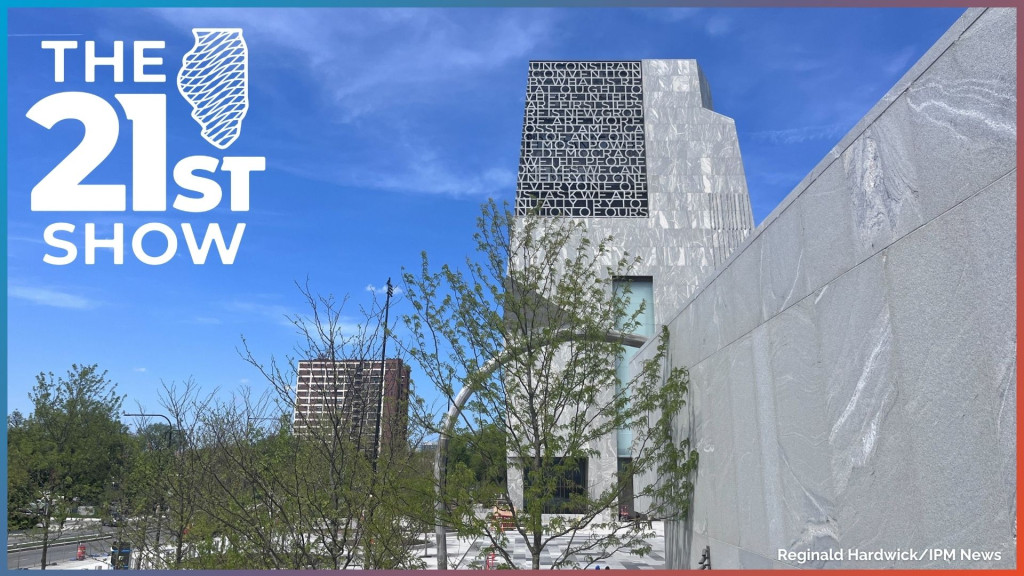
Reginald Hardwick: It is, it's a campus and, you know, you have the — what is most photographed, of course — is the [eight-story] gray granite building on the north side of the campus, and I think if people know where the University of Chicago is, it's close to there. And then immediately south of that is a — what they call the forum, and that's kind of a [two-story] building where there's an amphitheater and some other things like a media site. And that is for folks in the community, especially young people. They wanna come make music or come make a podcast.

There's also an amphitheater, like I said, for speeches and other things. South of that is a branch library, and that is named after, of course, the president, and that's for the community. It's a Chicago Public Library branch library. On top of that is a roof, and that is the [fruit and vegetable garden], named after Eleanor Roosevelt, and that is where they're growing all sorts of fruits and vegetables that will be shared with folks on the South Side.

Continuing south of that is a huge playground and also a green space adjacent to that where people can catch a concert, catch a movie out in the outdoors, or go out and grill or have a picnic. And then there's a huge big blue — and you see it because it looks like aqua, like a river — of all sorts of playground equipment, all ADA compliant. And I saw a note from a kid that said best playground ever.

And then south of that is the home court, which is the athletic center — 60,000-square-foot athletic center right across from Hyde Park Academy High School — and has an NBA regulation court inside, all sorts of programming rooms. And again, the idea being, you know, kids who are on the South Side of Chicago can come there and also practice sports and connect with each other, do their homework there. Just so much. It is, yes, it's sprawling. It's like being here really at the University of Illinois. It's just huge.

[00:05:14]
Brian Mackey: Yeah, and I guess not to be a negative Nelly, but it's worth remembering, maybe, one of the reasons there is so much sort of community-focused stuff there is that he did have to fight [their use] of the park in order to get the space in Jackson Park to make that happen. Some people were not very happy about the idea of this museum there.

But, all right, so you mentioned this main building, 8 stories. It's the tallest thing in the area. I've seen it going up over time as I visited there. Let's imagine we're standing in front of it. Describe for me what you see.

[00:05:42]
Reginald Hardwick: So it is a joke, you know, he wrote "The Audacity of Hope." It's the audacity of a building. It is a very gray, stark granite building, and then towards the top you see these letters that are 5 feet tall, and it is actually from a speech that he gave in Selma, Alabama, for the 50th anniversary of the march there. And —

[00:06:06]
Brian Mackey: Yeah, let me ask you to pause because we actually have some audio of the speech that Obama gave in Selma. The words, as you said, they make up a significant part of the facade of the presidential center. Let's listen to it.

[00:06:18]
Barack Obama: You are America. Unconstrained by habit and convention. Unencumbered by what is. Because you're ready to seize what ought to be. For everywhere in this country there are first steps to be taken. There's new ground to cover. There are more bridges to be crossed. America is not the project of any one person. Because the single most powerful word in our democracy is the word "we." We the people. We shall overcome. Yes, we can. That word is owned by no one. It belongs to everyone. Oh, what a glorious task we are given, to continually try to improve this great nation of ours.

[00:07:19]
Brian Mackey: Barack Obama there, again speaking in Selma, Alabama, and those words are part of the facade of the main building at his new presidential center in Chicago, which we're talking about with Reginald Hardwick, director of news and public affairs at our home station, Illinois Public Media. He had the chance to actually go inside the museum late last month.

I should say we asked members of our texting group how they are thinking about President Obama's legacy and what people are interested in at the [Obama Presidential Center]. You can join that group, by the way, by texting "talk" to 217-803-0730.

Terry in Batavia said, "I'm looking forward to visiting the center. Obama was and is an honorable person. He was an excellent president. We need more public servants like him who understand that their job is to serve the country, not be enriched by their office at the expense of their constituents."

We also heard from Brandy in Urbana, who said, "I think that with Illinois's mixed history for Black Americans — from our role in the union to our position as the sundown town capital of the nation — it's particularly meaningful that the first Black president began his political career here." She says, "I'm excited to tour the center, and I'm most excited to see the artwork compiled from President Obama's speeches." Thank you for that, Terry and Brandy.

We also got a voicemail.

[00:08:44]
Speaker 3: Good morning. This is Joe from Havana. I'm calling because I do plan on going to Barack Obama's museum, because I've taken my kids to several of the different presidential museums. However, I think Barack came way too early. Yes, he's a symbol of what the United States will become, because let's look at most schools — we have a lot of biracial kids of all different [backgrounds]. He also was a president that made us think about what our humanity could be. He could have done a whole lot more, but he wasn't given a chance to do that, and I hope this museum is a great beacon of hope for everybody in the United States — not just biracial kids, but African kids, Asian kids, European kids, all of us. We need to feel like we're part of this great nation. We are unfortunately leaving the repercussion of Barack coming way too early.

[00:09:49]
Brian Mackey: Thank you so much for that message, Joe. Again, we are talking a little bit about Obama's legacy through the lens of his new museum. We're gonna have more coverage of this later this summer. But for now, we're talking with Reginald Hardwick, my colleague and director of news and public affairs at Illinois Public Media, our home station.

So, Reginald, I mentioned you got to go inside. How do you actually end up getting inside a museum that hasn't had its grand opening yet?

[00:10:14]
Reginald Hardwick: Yes, it's been open for a soft opening, and they just welcomed us in. You come in from the John Lewis Plaza right in front. Went through a little metal detector and then I went over and paid my ticket, which is $26 because I'm an Illinois resident — $30 for everyone else — and then they direct you —

[00:10:33]
Brian Mackey: — on like a missed opportunity to charge $21 to Illinois residents there, but maybe I'll have to talk with Barack about that. So what — we only have a few minutes left — what are some of the highlights that jumped out to you?

[00:10:46]
Reginald Hardwick: You stroll over to the Harold Washington [exhibit] there, and then you go up a series of elevators, and it takes you to the 2nd through 6th floors, which is where all the exhibits are. And by the way, when you get off the elevator you're immediately greeted by a four-story video wall that has just every kind of media — you know, Barack's speeches, Michelle's speeches, different movements throughout the years.

The second floor, of course, deals with his beginnings — his mother being from Kansas, his dad being from Kenya, Michelle Obama's South Side Chicago roots — and also the different civil rights movements throughout America. It's a real measure of, you know, what has happened and what can happen.

You keep going through the different floors and you eventually get to the campaign. There is a replica of the Oval Office, and you can sit behind a resolute desk. Right outside there is where — I think Barack Obama told Stephen Colbert — would probably be the most popular part: all of Michelle Obama's — not all of them, but a lot of her outfits, including both inaugural dresses, and shoes. And there are like 800 "We Can" buttons, and all sorts of things from the campaign. And then of course there's — I mean, everywhere you look, you see "Yes We Can," "Yes We Can."

Another thing that stuck out to me: they really want people to, yes, remember the Obama years, but also, what are people doing now? What are they doing for democracy? And so there's a Democracy 101 exhibit. I think it's really powerful that kids can go through — they can hit an interactive exhibit that shows the voting age — in that 60 or 70% of people over 60 vote, but people under 40, that's about less than 40%, through the years.

Gosh, there's so much stuff, but you can leave a video message for the Obamas. You know, he was the president during the social media times, so there's constant video. And also a lot of ADA equipment — there's a lot of material in Braille, there's a lot of exhibits that people can touch if they have low eyesight. There are wellness rooms. It is almost like they've thought of everything of a modern museum.

[00:13:35]
Brian Mackey: Well, we will again have more in-depth coverage of this later. Reginald Hardwick, director of news and public affairs at Illinois Public Media, thanks for sharing your experience with us. I appreciate it.

And I gotta say, as of this morning, one of our producers checked, and the absolute earliest date for which you can get advance tickets is late August. That may have even changed in the time since she checked this morning, but the museum also offers free days for Illinois residents, but those are completely booked out, at least until they start opening up dates for December and beyond. So if you do want to visit, you may have to plan well in advance.

All right, that is it for us today. Coming up tomorrow on the program, we're going to take a deep dive into everything the Illinois General Assembly did and did not accomplish this spring. We are planning to have conversations with both the Democratic and Republican leaders of the Illinois General Assembly — House Speaker Chris Welch and Senate President Don Harmon on the Democratic side, and their Republican counterparts, House Minority Leader Tony [Maccombe] and Senate Minority Leader John Curran. That's coming up tomorrow here on the 21st Show. If you have questions for them, get in touch. talk@21stshow.org is our email address, and you can find that and every other way to contact us at our website, twentyfirstshow.org. We've also got our past programs there, and you can find links to subscribe to our podcasts, or just look us up on Apple, Spotify, YouTube, or wherever you listen.

The 21st Show is produced by Christine Hatfield and Jose Zepeda. Our digital producer is Kulsoom Khan. Technical direction and engineering comes from Steve Morck and Jason Croft. Reginald Hardwick, whom you heard from a moment ago, is our news director. Thank you to the band Public Access for our theme music. The 21st Show is a production of Illinois Public Media. I'm Brian Mackey. Thanks for listening.
Transcript Assistance
Illinois Public Media may use AI assistance for transcript generation and/or formatting. Transcripts that have not yet been reviewed for accuracy will be labeled.
To report a transcription error, or to request transcription of archival material, please contact will-help@illinois.edu.