








Transcript: What comes next in the Iran war?
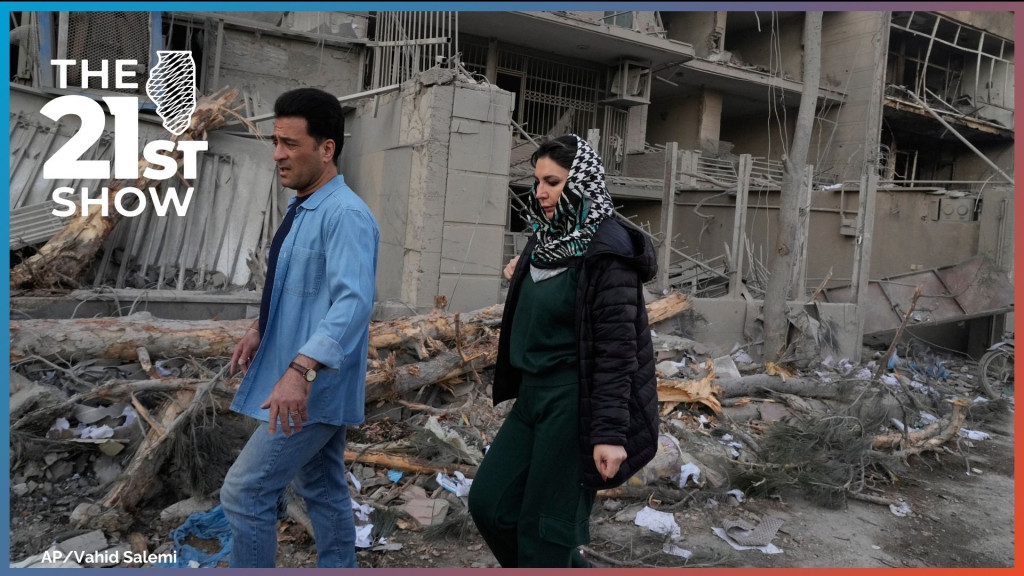
Transcript: What comes next in the Iran war?
The 21st Show
What comes next in the Iran war?
Read the full story at https://will.illinois.edu/21stshow/after-ceasefire-deal-in-iran-war-what-comes-next.
Transcript
// This is a machine generated transcript. Please report any transcription errors to will-help@illinois.edu.

[00:00:00]
Brian Mackey: Today on The 21st Show, America and Israel's war against Iran has been underway for more than a month. Yesterday, President Trump capped off a series of increasingly wild threats to target civilian infrastructure by warning a whole civilization will die. The worst-case escalation seems to have been averted for now, though events are changing by the hour. Today we'll take stock of where we've been, where we are, and where we might be going. We want to hear from you at 800-222-9455. How are you thinking about President Trump's threats to Iran and the possibility of an escalation of this war or what we can do to end it? 800-222-9455 throughout the hour. 800-222-9455. I'm Brian Mackey. That's today on The 21st Show, which is a production of Illinois Public Media. But first, news.

From Illinois Public Media, this is The 21st Show. I'm Brian Mackey. America and Israel's war against Iran has been underway for more than five weeks. Yesterday, President Trump capped off a series of escalating threats to target civilian infrastructure — bridges, power plants, that sort of thing — by posting, "A whole civilization will die tonight." The ceasefire that followed just before his own deadline may have averted the worst. Or it may not have. As we go to air at 11 a.m. Wednesday, Illinois daylight time, Iran is threatening to keep the Strait of Hormuz closed and refuse peace talks unless Lebanon is included in the deal, a condition rejected by both the U.S. and Israel. Events are moving by the hour. Today we take stock of where we've been, where we are, and where this might go. We want to hear from you. How are you thinking about this war? What we're doing, what we should do, or how to live with the uncertainty. Give us a call at 800-222-9455. That's 800-222-9455.

With us today are two guests who know Iran, not just from the outside. Elahe Javadi was born just after the Iranian Revolution and lived in Iran for more than two decades before coming to the United States. She's now an associate professor of information systems at Illinois State University in Normal. Elahe, welcome back to The 21st Show.

[00:02:33]
Elahe Javadi: Good morning, Brian. Thanks for having me. Good morning to your listeners too.

[00:02:39]
Brian Mackey: Also with us is Mateo Mohammad Farzaneh, professor and chair of both history and political science at Northeastern Illinois University. He was born in Iran. His family was displaced when Iraq invaded in 1980. He came to the U.S. in 1984. Mateo, welcome back to you as well.

Mateo Mohammad Farzaneh: Thanks for having me.

[00:03:05]
Brian Mackey: So I, I want to begin with sort of a temperature check. Elahe, I mentioned you were born in Iran just after the revolution. You have family there. What has it been like for you in the last month or so, and especially in the last day or so watching these events unfold?

[00:03:15]
Elahe Javadi: Thanks for asking, Brian. And I want to take a moment here to honor the fallen service members. As an information systems professor, the loss of Sergeant Cody specifically, who was an information systems student in Drake University from Des Moines, hit me very hard. I also want to honor the fallen compatriots, especially those who are being executed by the regime. I want to name Saleh Mohammadi, the 19-year-old national wrestling champion who was executed on the very eve of Nowruz, which is our New Year in Iran.

I want to say to you, I still don't know if my sister and my nephew and my brother-in-law is safe in my hometown. I don't know if my friends and extended family, uncles and aunts are safe. But I want to briefly mention to you that I still at this point, more than a month into the war, I still maintain that the greatest threat to Iranian life, liberty, and the pursuit of happiness is not this war or any foreign intervention — it's the regime itself. So with that, I'm going to stop here and let my colleague share his opinion.

[00:04:42]
Brian Mackey: Yeah, all right, thank you. Thank you for that. Mateo Mohammad Farzaneh, sort of same question to you. What has it been like for you in the past month and really the past couple of days when the rhetoric has really escalated from President Trump, watching what's been happening there?

[00:04:57]
Mateo Mohammad Farzaneh: Well, it's been quite hectic obviously because, similar to Dr. Javadi, [I] have family members in Iran, so it's been quite difficult since five weeks ago when the war started. And at the same time, yesterday there was a lot of speculation, a lot of nervousness that [was] quite tangible on social media, talking with friends and what have you. But as I stated before on this show and in other programs, I was not fully confident, but at the same time, I had a feeling that what Trump was saying was some sort of a bluff maybe or some sort of a leveraging [of] American forces in order to force Iran to come up with a solution because as the listeners might know, the United States had offered a 15-point plan to end the hostilities and Iran had rejected that and they came back with their own 10 points as a starting point to start negotiating [which is] going to start in Islamabad, Pakistan, on Friday. And the U.S. has accepted that. So I see that as a win for lack of a better term for Iran. And contrary to what Dr. Javadi is saying, I think the greatest enemy for the Iranian people, not necessarily Islamic Republic, is foreign intervention, including the current one that Iranians have experienced. So with that I'll let you ask the other questions.

[00:06:36]
Brian Mackey: Yeah, well, let's, let's talk then about, about the dangers that have been faced by the Iranian people. Elahe, over the course of five weeks there have been airstrikes on an elementary school that killed, I think 170 children, [and on a] university. I wonder how you're thinking about this war, you know, has been affected by the, by the toll on the ground.

[00:07:01]
Elahe Javadi: It is, it is saddening. It is heartbreaking, Brian, as a mother, as an educator. It's specifically hard for me to see the destruction and to see the loss of life. But anyone from Iran who has had a chance to connect to the internet for just a few minutes has written to me from family and friends close and far. They didn't say, "Oh, we wish for this war to end quickly," or "We wish for the U.S. and Israel to stop attacking the regime infrastructure." They said "We wish for this regime to fall quickly."

So that's the sentiment that I'm sharing with my friends and family, and I would say with about 90% of Iranians inside and in the diaspora. We still maintain that. Why? Because the regime is already on track to shatter its record of executions. Brian, I want your audience to understand that they're still on a daily basis executing protesters and dissidents. They are still doing the lash [visits] to hospitals and killing people on recovery beds and imprisoning nurses and doctors. They are still doing what they've been doing for the past 47 years. And for us, we see the destruction. It is, it is, there is no question about that, but we're hoping, we're really hoping that this regime will fall and we see the other side of it.

So while I do not condone Mr. President's Stone Age comments, but I want to share with you that [the] IRGC was already systematically driving us there. They have poisoned our air. We have [an] increased number of cancers because of the pollution. They have drained our rivers. They have engineered poverty and drought. And yet with the help of U.S. and Israel, we discovered that what they've been doing [is] creating the most advanced underground missile silos that you could ever imagine. So what has been happening to the Iranian [wealth], the oil money, the mineral and [ecological] resources? They have been spending that to create [a] war machine. And Brian, I want to share that with your listeners. This is me experiencing this in my K through 12. We would chant "[Death] to America." So for 47 years they have been planning this war. This is not a surprise, and you see them having a war infrastructure 500 [meters] under granite. And yet they have not created a single bomb shelter for the civilians.

So this is what we are facing. They didn't care about the nation. They didn't care about the people. They were just funding terrorism in Lebanon, in Palestine, in Iraq, in other places in the Middle East, and they did not care to create one single shelter for the civilians. So for me to have that feeling, to look at this destruction and still say, "Oh, I'm hoping this regime falls, and I hope the U.S. continues until this regime falls," this is not surprising and it shouldn't be surprising for anyone who has lived under the regime and who's tasted a little bit of their atrocity from close or from afar.

[00:11:09]
Brian Mackey: Let me reintroduce our conversation. If you're just joining us, this is The 21st Show. We are taking stock of where we are with America and Israel's war against Iran after more than a month of fighting and seemingly averting President Trump's threats to, as we just heard, bomb Iran back into the Stone Age, [threat to] the civilization as he posted on his social media account yesterday. But events are fast-moving and this ceasefire, such as it is, seems quite fragile and potentially already being violated or not even necessarily agreed to with [the] same understanding among the parties involved. So if you want to join us today, 800-222-9455 is the number.

I'm gonna share a few text messages we've gotten from listeners. Adrian in Carbondale said, "I was just thinking about this and how I should address it with my preteen daughter. I'm scared. I want to reassure her, but I don't know how because I don't know what to think. I think the country needs a total overhaul of leadership." In that case, she was talking about America, not Iran. We also heard from Ann in Urbana who said "Either our president is following very bad advice or he has lost his ability to discern reality. I believe it's time to consider removing him from office before he gets us into a nuclear war toward which I fear we are headed. This is very frightening," she says.

But then also Randy in Glassford did want to note that, you know, obviously he says Democrats are not going to be in favor of what the president says, but "Does it escape the memory of every journalist and fair-minded man and woman just how brutal and evil the Iranians are? I hope the president has a plan that wins in the end and Iran is somehow brought into a place that forces it to stop destroying the lives of so many people."

We are talking about this with Elahe Javadi and Mateo Mohammad Farzaneh. They're both professors at different Illinois institutions. Javadi is a professor of information systems at Illinois State. Farzaneh is a professor and chair of history and political science at Northeastern Illinois University. They're both originally from Iran and spent significant parts of their lives there. Professor Farzaneh, let let me ask you about what this war has actually done to the Iranian regime, Iranian government. Has it weakened it or something else?

[00:13:29]
Mateo Mohammad Farzaneh: Well, similar to what happened back in 2003 when George W. Bush attacked and invaded Iraq and essentially handed Iraq to the Islamic Republic and their operatives there, I think President Trump in this current situation has emboldened, strengthened the Islamic Republic. And if the Iranians didn't know that they could control the [Strait] of Hormuz or the Strait of Hormuz, which is a chokepoint between the Persian Gulf and the Sea of Oman, now they definitely know that. And part of the 10-point plan, [which] factors in the ceasefire, the current ceasefire, they are going to be charging a toll, and they're going to share that with the kingdom of Oman or the sheikhdom of Oman rather in the south of the Persian Gulf region.

So in so many words, Iran has been strengthened through this action. And that might be good news for some people, but at the same time for the Iranians inside, this might not be so good news if we consider the fact that now the Islamic Republic is going to be emboldened even that much more to stifle political dissent and have a chokehold on its own society and as it has for the past 47 years and [has] been violently interacting with the public if they so dare to object to the status quo. So it depends on whether or not we're talking internationally or domestically. I think Iran has been emboldened in both cases.

[00:15:23]
Brian Mackey: Elahe Javadi, we need to take a break in just a couple of minutes here. But, but briefly then, what do you make of this idea that, you know, the president, I mean, you may be committed to a sort of a new government in Iran, but maybe the president, President Trump does not share your level of commitment to that. And ultimately, the government that had been in power could be even more consolidated in power at the end of this.

[00:15:50]
Elahe Javadi: Yeah, I want to be brave. So the path we were on was 100% probability of going to a Stone Age. It was a clear darkness, murder, and execution for people, brain drain as an educator. I care about that. But I do not know what President Trump is thinking. But if there is 1% chance of getting to a lighter [side], I would take that chance, and I cannot make any prediction on the war outcomes. But I know that Iran was a factor in the Iraq war being a failure. It wasn't just happening in a vacuum. Iran was funding militia in Iraq. Iran had a hand in Iraq getting into some sort of chaos, so we cannot separate Iran from any of the chaos that is happening anywhere in the Middle East. We have to be clear about that.

And again I'm committed to that 1% even if that percentage is very low [or the] probability is very low. I'm going to take that over the guaranteed destruction that [the] IRGC has been imposing on my country. This is a yes, go ahead.

[00:17:12]
Brian Mackey: Yeah, so we, we need to take a break. We will continue this conversation when we come back. If you want to join us again, the number is 800-222-9455. How are you thinking about what's happening in our name? 800-222-9455. This is The 21st Show.

It's The 21st Show. I'm Brian Mackey. We are talking today about the war in Iran being waged by the United States and Israel and the consequences for that. There was, as you know, President Trump has been escalating his rhetoric in the past few days. Yesterday he posted on social media, if Iran did not open the Strait of Hormuz, quote, "A whole civilization will die tonight," and he had been threatening to target civilian infrastructure, bridges, power plants, water treatment, although I suppose I guess he could argue that that was also used by the Iranian military as well, although some international bodies might describe that as a war crime.

We're talking about this with Elahe Javadi, who was born just after the revolution, lived in Iran for more than two decades before coming to the U.S. She's now a professor of information systems at ISU in Normal. And Mateo Mohammad Farzaneh, who is professor and chair of history and political science at Northeastern Illinois University, he was also born in Iran. His family was displaced when Iraq invaded, came to the U.S. in 1984. 800-222-9455 to join us today. 800-222-9455.

Mateo Farzaneh, I want to ask you, what, what have we learned? What should we have known? What did we know maybe about Iran's ability to, you know, from, from a position of relative, you know, weakness, it, it, it doesn't have one of the, you know, it's not listed as having one of the greatest militaries in the world necessarily, but it has been able to exercise significant effects on the world economy through the Strait of Hormuz. Is this something that that people anticipated? Talk about how you've, how you've responded to how you're thinking about what we've learned in the past month.

[00:19:23]
Mateo Mohammad Farzaneh: Well, I think if the news that comes out of the White House and out of the administration is true, apparently there was advice against this unnecessary war which the president basically did not listen to. [As for] why we got in the debacle that we find ourselves in now after spending billions of dollars and killing over 2,000 Iranians inside Iran, these are civilians, by the way, and bombarding and destroying universities, hospitals, dialysis centers, schools for girls, killing collectively 167 or 145 depending on where you check the numbers of children in elementary school. I think we as Americans suffer from not knowing the globe generally, but in this case Iran.

Iran has fought a war for eight years between Iran and Iraq that was fought from 1980 [to] 1988. If people would take a moment to look that history up, the entire body of the Islamic Republic currently today and the way it operates not only domestically but regionally and globally stems from the fact of the lessons that they learned during that war. The IRGC or the Islamic Revolutionary Guard Corps, which everybody talks about, wasn't even a name that you would hear much till a few years ago actually. And after the 2003 American invasion and occupation of Iraq, that name was mentioned but barely. And for whatever reason, the media in the United States did not really take notice of the fact that this is a highly trained, highly violent inside Iran and highly successful group that has an international arm, the [Quds] Force, that was very, very active before its commander Qasem Soleimani was ordered to be assassinated in the first Trump administration.

So going back to your original question, I think it's lack of understanding the history of the Islamic Republic, history of Iran, and more importantly, history of Shiism, which is a sect that 90% of Iranians identify as. So all those things become incredibly important. I'm a historian, so I always say if you don't know the history you're gonna get yourself in a lot of trouble and that appears to be the case right now.

[00:22:02]
Brian Mackey: I want to share an email we got from a listener, Terry, who is snowbirding in Florida says "This war was conceived to meet the needs of Israel. Our president had no idea what he was getting into. Experts had contended for years that we should not make war on Iran or they would close the Strait of Hormuz. Now we are trying to negotiate the straits open when we already had them open before the war. Our president is barbarous in his comments to Iran. We are embarrassed before the humane world. We have lost our moral way and lost this war." Professor Farzaneh, what, what do you think of that?

[00:22:37]
Mateo Mohammad Farzaneh: I think we've discussed this on your show before, Brian. I don't think anybody can drag the United States into anything unless the United States wants to be dragged into it. Israel is a state that the United States recognized 10 minutes into its birth back in May of 1948 by the Truman administration. Israel has been on a list of the highest paid [donor] — from the United States, from the taxpayers ever since, we as Americans pay over 3 or $4 billion a year officially as taxpayers, and there's a lot of grants that the state of Israel receives as a state that we fully support for a variety of reasons. So I don't think it's so much [the] tail that's, you know, wagging the dog in this case, it's actually the dog essentially calling all the shots. So I have a different opinion than a lot of people when it comes to the idea of the effective Jewish lobby in the United States or the, uh, how the Jews might be influencing American politics. I think actually it's the other way around. And there's been some studies, but not very good studies done. There's a lot of room for studies to be done on this, and historical facts remain to be the same. We support Israel. Israel does not support us and cannot influence the United States foreign policy under any circumstances.

[00:24:15]
Brian Mackey: That's interesting. What do you make of this reporting we've seen that that Bibi Netanyahu, the leader of Israel, was in the Situation Room working on President Trump? I mean, I, I, I take your point that broadly the Israeli people and the American people, that that is a maybe set that to the side for [a] moment, but the individual personalities involved here. You know, we've seen plenty of reporting over the years that President Trump is, you know, perhaps one of these people who's like most influenced by whoever's in the room with him at the moment. And, and Netanyahu made a very strong case to pursue this war in [the Situation Room].

[00:24:46]
Mateo Mohammad Farzaneh: [This] is interesting, Brian. A lot of people, as much as I probably agree with them, really don't like the personality of Donald Trump for obvious reasons — the way he speaks and the way he handles himself, the racist ideas that he verbalizes out in the open, all of that is given. But at the same time too, I don't think Donald Trump is a person that anybody can convince to do anything unless he sees something in it for himself, number one. And then for his organization or for quote unquote his legacy. Bibi Netanyahu is a war criminal. He is wanted by the International Criminal Court. He has a warrant out for his arrest. He cannot go in certain places in Europe or fly over those countries, but at the same time too, he is still a client. That's the way I look at it, and I'll just leave it at that.

[00:25:42]
Brian Mackey: Interesting. Elahe Javadi, what do you think of this line of discussion we've been having here?

[00:25:49]
Elahe Javadi: Thank you for asking me and thanks for your listener who had the comments and I want to share briefly that do not also underestimate the power of the Islamic regime lobby in the U.S. As most of the Iranians in the diaspora protest the regime. We see some of the the Islamic Republic's talking points on many U.S. media. So I'm not a historian. I'm not a politician. I cannot comment on the relationship between the U.S. and Israel government and the role it had in initiating this war. What I can say that, um, some of your listeners, maybe their parents, remember the, the U.S. embassy hostage situation that took, that lasted more than 400 days.

This regime's opening act was terror, and you see that unfolding as its ending act as well. So Iranian lobby is strong. We as average Iranians in the diaspora, we feel that because we hear the talking points over and over again from some of the most respected networks and newsletters and papers in America. We also want the listeners to remember how this regime started and the fact that [if] this regime [has] anything to do with peace or if Americans [are] or will be safe from the terror that this regime is manufacturing and exporting, I think this is a selective presentation of the facts by some of the people who study history and politics.

[00:27:47]
Brian Mackey: All right, we need to have a little change in the lineup of our program now. So Elahe Javadi, I'm gonna ask you to stay with us, but Mateo Mohammad Farzaneh.

Mateo Mohammad Farzaneh: Oh, sure, sure. I know you, I know you needed to. Sure, you can follow up. Go ahead.

[00:27:58]
Mateo Mohammad Farzaneh: No, no, I, I need to respond to that. So, um, what Dr. Javadi is saying, and I have a quote from her, she says 90% of the diaspora supported this war against Iran and 90% of Iranians inside Iran supported it. I was just wondering where she gets those numbers because actually with the surveys that I've been taking it's the exact opposite. The great majority of people inside Iran do not support bombs being dropped on their heads. And the great majority of Iranians in diaspora, including the United States, don't support their mothers and grandmothers and their cousins to be bombed back to [the] Stone Age. So I don't know where she gets that.

And at the same time, I take offense to the fact that she thinks whoever talks about facts that are facts and remain to be facts that might also be the things that the Islamic Republic says tends to be untrue. That is not the situation here. We have facts. Facts don't change if they're told by two opposing sides. Listeners need to realize that we need to be fair about this. If the Islamic Republic says something that is true, then we need to point that out. And if something that is said by the Islamic Republic [is] untrue, then we need to point that out.

I think I mentioned here today and in previous shows with you, Brian and Dr. Javadi and Dr. Grossman that [the] Islamic Republic hasn't been the most wonderful regime for Iranians. That's a given. That's the reason I'm here and living in diaspora rather than in Iran. So people need to understand that, but at the same time too, we cannot throw the baby out with the bathwater, as the saying goes. If the facts that the Iranians are presenting, if it's coming out of the mouth of the Islamic Republic, if they remain to be facts and we can verify them, they remain facts. It's not about my emotions or Dr. Javadi's emotions or the [audience's] emotions. It's about facts. And I thought we should make that very, very clear.

[00:30:12]
Brian Mackey: Can I ask you as a subject matter expert in this, how do you decide what facts are, how do you verify, um, in this era? I mean, because frankly, the Islamic, neither the Islamic Republic nor the Trump administration have proven themselves to be trustworthy and honest brokers of information in the past.

[00:30:30]
Mateo Mohammad Farzaneh: Well, the kind of facts that I'm talking about is the facts that when the school in Minab, if you remember, was bombed or they had used a missile against it to kill those children, the diaspora on social media came out and said, first of all, they said "That's a lie. It's a movie." Then when the U.S. media and the Western media said "No, that's actually true," they said, "Oh, so the Islamic Republic must have bombed them." So that was the second [claim]. So when they saw that that was actually not the case and it was an American missile that had hit the school killing those children, then they said, "Oh, they were the children of the Revolutionary Guards people," and that became really hurtful as a human being, not as a supporter of the IRGC, but as a human being, as a parent. I take offense to that.

So at the same time, those things that are facts such as the Minab bombing were verified not only by the Iranians but also by the U.S. Department of War, better known as the Defense Department, that they had either made a mistake or they had used faulty intelligence photographs that were dated back to 2016 when the entire ground of the school was used as a base for the IRGC.

[00:31:53]
Brian Mackey: Hm interesting. All right, well, I know you need to run Mateo Mohammad Farzaneh, a professor and chair of history and political science at Northeastern Illinois University. Thank you so much for being with us today on the 21st [show].

Mateo Mohammad Farzaneh: Thanks for having me.

Brian Mackey: And Elahe Javadi, I want to give you a chance to respond there before we need to take another break and say goodbye to you as well.

[00:32:09]
Elahe Javadi: Absolutely, I'm going to be quick. I'm going to respect Dr. Farzaneh's facts by sharing here. These are selective facts. Dr. Farzaneh, when he talks about the Iraq war, he doesn't talk about [the] confounding impact of Iran. He doesn't talk about De-Ba'athification. When Dr. Farzaneh talks about the school, he doesn't talk about 216 students killed by the regime. He doesn't talk about the regime blinding the youth. Did you know that about a few hundred people have been targeted in their eyes and they have lost their eyes? He doesn't talk about [the] 10, about 10 daily executions. I'm not disputing his facts. I'm disputing the representation of selective facts, the facts that keep glorifying the regime, and I'm going to end with that.

[00:32:59]
Brian Mackey: All right. Elahe Javadi is a member of the Iranian diaspora, also lived there for two decades. Now she's a professor [of] information systems at Illinois State University. Thank you so much for being with us and sharing your perspective with us today here on The 21st Show. Coming up after the break, we are going to continue this conversation. We'll talk with Nicholas Grossman, who's a professor of political science at the University of Illinois. And on point for us, he has written a book called "Drones and Terror: Asymmetric Warfare and the Threat to Global Security." That is something we are seeing the fruits of in this very conflict in the Strait of Hormuz and the way that Iran is carrying out its end of this war.

I wanna share some more listener reaction before we go to break. David in Mount Morris said "In a sensible world, the 25th Amendment would have been evoked by now. It's unacceptable, inexcusable for any sitting president to be calling for the annihilation of a civilization. I mean, really, who in their right mind would defend such rhetoric, especially in a war of choice that nobody wanted, asked for, and from what I understand, unauthorized by Congress? We woke up on Easter morning of all days to a man posting expletives, threats of war crimes, and 'Praise Allah?' At what point are we as a nation going to say enough? Will it take a loose nuke for Congress to accidentally grow a spine and assert its authority? I'd say by this time it's too late. The founding fathers predicted a man like Trump would come around. They didn't predict that most of Congress would follow along with him. It's sad, really." Thanks, David, for the thoughtful message.

If you want to join us for the rest of the hour, 800-222-9455. That's 800-222-9455. We'll have more on this when we return. This is The 21st Show.

It's The 21st Show. I'm Brian Mackey. We are talking today about more than a month of America and Israel's war against Iran. The president's threats to bomb Iran back to the Stone Age. Yesterday he posted on social media, "A whole civilization will die tonight." Then there were reports of a ceasefire of a sort. Although apparently this is just a verbal agreement, it's not actually a document, and Israel didn't know about it and is not happy with it. And Iran and Israel and America seem to have different ideas of what its requirements are. So, events are changing as we're going to air in the 11 a.m. hour Wednesday morning. If you're hearing this on one of the rebroadcasts or podcasts, things may have changed by then. But if you want to join us, we'd love to hear from you at 800-222-9455.

Joining us for the rest of the hour today is Nicholas Grossman, political science professor at the University of Illinois Urbana-Champaign, and author of the book "Drones and Terror." Nick, welcome back to the show.

[00:35:59]
Nicholas Grossman: Hi, good to be with you.

[00:36:02]
Brian Mackey: So you, you've studied asymmetric warfare, you've written about drones. I mentioned your book. What what stands out to you about how Iran has waged its end of this war?

[00:36:20]
Nicholas Grossman: Well, a big part of it is it wasn't really asymmetric, or obviously there's a power differential. The United States and Israel are a lot stronger, have fancier weaponry than Iran, but Iran fought in a direct state style, meaning that when we usually think of asymmetric warfare, we think of ones that can't possibly compete that way, of insurgencies, terrorist groups, think in Iraq, Afghanistan, al-Qaeda or ISIS internationally, things like that.

What Iran was able to do was use a lot of cheap, pretty easy to produce drones, as well as a variety of missiles to constantly get fire out to hit the various Gulf states where the United States has bases and to be able to fire enough into the Strait of Hormuz that even under heavy American and Israeli bombardment that was focused on trying to destroy Iran's missile capacity and drone capacity. Iran was still able to do it on a daily basis enough that it scared other ships [into], scared ships and insurance companies against sailing, and that was able to block the strait and close down global energy markets, about 20% of the world's energy supply, and they might not have been able to do that if they didn't have drones in particular, this one they have called the [Shahed], which also Russia has been using a version of in Ukraine.

[00:37:39]
Brian Mackey: So what, what do you make of this idea that there is a ceasefire? Meanwhile, we're still seeing Israel attacking Lebanon. I'm seeing reports from, I think it's Bloomberg, that, uh, you know, water desalinization plants are still being hit in Kuwait and elsewhere. Um, how have you processed the last 24 hours?

[00:37:56]
Nicholas Grossman: So we don't really know. It's hard to say the possibility. So currently the United States is not firing, and Iran seems to have stopped at least some of its attacks against especially American-specific targets. So there is some degree of a ceasefire. It's worth noting that the way the U.S. got there was by essentially agreeing to negotiate on Iran's terms, that Trump had started the war making really grandiose claims of regime change and unconditional surrender. And then [relaxed] that somewhat to big demands about Iran's nuclear program and missile program and had sent 15-point terms that involved a lot of Iranian concessions and Iran had countered with a 10-point list and according to Pakistani mediators, the way that they got to this ceasefire sort of is that by the United States accepting a lot of Iran's terms, which were that negotiations would be about removing sanctions on Iran and acknowledging Iran's control of the Strait of Hormuz and withdrawing American military forces and none of the parts about nuclear or other concessions.

Now that said, it's possible that since the Israelis were not in on it, while Iran's terms that America at least agreed to talk about on that basis included an end to Israeli operations in Lebanon, they don't seem to be interested in that. And while the United States can probably get Israel to stop bombing Iran, it is unlikely the United States, as part of negotiations with Iran, can get Israel to stop fighting Hezbollah in Lebanon.

As for Iran, they're still firing. Part of that might be if we would take the most positive outlook on it, it would be that the order to stop firing hasn't really filtered down to all of the different parts of the Iranian Revolutionary Guard. So one of the smart things that they did, and this is a asymmetric technique, but what they did was fighting somebody that was a lot stronger than them. They cut off a lot of electronic communication, so they diffused command for their different units so that subunits could operate without having to get orders from the top, and they communicated by things like courier, a motorcycle courier, people taking physical notes from place to place, as opposed to any sort of electronic or cellular communication that the United States or Israel could possibly [intercept].

So it might be that the leadership has agreed to a ceasefire, but the people under them have not totally heard about it yet. That's possible. It also could [be] that Iran doesn't really think that this is something serious, that it's going to hold, that they don't trust that the U.S. won't renege, and so they're still trying to push their advantage. That one's also possible. And then there's the big problem that Iran is saying something very different about what the terms of this ceasefire is than the Trump administration is saying. For example, in the Farsi version, they said that the United States was agreeing to accept Iran's nuclear enrichment, to acknowledge that Iran has a right to enrich uranium. Meanwhile, Secretary of Defense Hegseth, President Trump have been saying things about how Iran will never be able to do that and never have a nuclear weapon. So there might be something that then emerges from discussions, but at the moment all we have is an agreement between the U.S. and Iran that is not formally written down, that is on Iran's terms to have negotiations over the next two weeks and at least take a break [from] fighting. But whether that holds or not is really uncertain.

[00:41:15]
Brian Mackey: What do you get the sense, uh, does Iran come out of this potentially stronger than when it went into it? I mean, obviously, there has been a weakening, there's been a lot of destruction from America's military. But in terms of, you know, the ultimate outcome for the government of that country and its ability to flex its will on international politics and the international economy.

[00:41:38]
Nicholas Grossman: Oh, without question that if this is where the war is ending, then Iran is clearly the winner and emerges unambiguously stronger. So Iran did take a lot of hits that they lost missile capacity and, you know, a lot they used and others that got destroyed and some factory capacity, some economic capacity, but all of that is stuff that can be rebuilt, and there were a number of Iranian leaders that the U.S. and Israel assassinated, but all of those people have been replaced. Other people move up the chain, and Iran, the regime has continued to operate. So while they've taken damage, it's just tactical damage, not anything broader in a strategic sense.

Whereas by gaining control of the Strait of Hormuz, and one of the provisions of these negotiations are that the U.S. acknowledging Iran's control of the strait and Iran charging fees, perhaps something in the range of $2 million per ship, which could generate upwards of $100 billion a year for Iran. That is the equivalent of their entire annual government budget. So Iran went from not having control of the Strait of Hormuz [while] the United States was both as the world's premier power, the guarantor of freedom of navigation, and has lost that, at least in the Persian Gulf. The United States since World War II has been the dominant navy in the Persian Gulf [since], without question, and has the U.S. 5th Fleet, the Navy's 5th Fleet is in Bahrain. I don't know how that's going to work with Iran in control of the only access point to and from it, but Iran has emerged as something of a world power as a result of this, that with control over this special waterway that they didn't have before, and with having taken a really big shot from the United States and Israel and remained standing, whereas the United States not only [started] with big goals and relaxed them repeatedly has then found itself in this weak position of facing economic damage and entering into talks by saying that they are going to make a lot of concessions to Iran as opposed to get concessions themselves, while the entire world saw that the United States was not able to force a weaker country like Iran to its knees or even to force Iran to restore the pre-war status quo of freedom of navigation in and out of the Persian Gulf.

[00:43:54]
Brian Mackey: All right, let's go to the phones 800-222-9455. Paul is calling from Urbana on line two. Paul, thanks for calling in.

[00:44:01]
Paul: Hi, there's a lot to discuss, but, uh, since you're the drone expert, I wanted to ask you about something I've never heard reported much since the time that it happened, which was, I believe it was in [2011], the Iranians spoofed a Lockheed Martin sophisticated drone that had been monitoring Iranian airspace and brought it down. It was slightly damaged because they didn't get the geolocation exactly right, but they were able to reverse engineer that a lot is made of the reverse engineering of the [Shahed], but, uh, you know, the main thing about that is it's made of plywood and [polystyrene] and polyurethane and so it's very cheap to make. So, um, what, what about that?

[00:44:48]
Nicholas Grossman: All right, the one you're talking about, uh, is thanks, um, the one you're talking about is known as a RQ-170 Sentinel, and it's a stealthy drone, so it looks like a flying wing, you know, sort of like the stealth bomber looks. And, um, as the listener said that Iran spoofed it, meaning they tricked it into landing in Iran without much damage. They sent it a fake GPS signal and they jammed its remote control. So they didn't actually hack it, but they tricked it into landing.

As, um, best we can tell, that at least as far as I know from the outside, Iran did some reverse engineering of that. They made their own version of something that at least from afar looks a lot like it. It's known as the Thunderbolt. It has a name in Farsi, but the English version is Thunderbolt. You can look that one up online that there are pictures of it and you'll see it look the same. I am not aware of that being used in battle, and in part because, uh, it is fancier, it's more expensive. That's the sort of thing that the U.S. was using for spying, not attack, and that if Iran, if it were to use it, would be using for spying, and the United States would be [much] more likely to shoot something like that down than Iran would be able to.

The [Shahed] drones that they use were originally a domestic design, and those are a lot cheaper. Those are the ones that they use to fly kamikaze missions, one-way attack missions. They carry explosives. They're basically slow, more maneuverable cruise missiles, and they fly low. They're hard to detect and they crash into things and that's how Iran has done a lot of its damage. But the advantage of those things is in volume. This is like the old line about how quantity has a quality all its own, whereas the RQ-170 Sentinel that the United States quote unquote lost over Iran, the one that they spoofed, and the possible reverse engineered version that they have themselves, the Thunderbolt, would not be the sort of thing that they use, and at least as far as I know they didn't use it against the U.S. or Israel in this fight here.

[00:46:39]
Brian Mackey: Just a few minutes left. I'm, I'm trying to decide where do you, where should we go? 25th Amendment is a[n issue] — we hear a lot of Democrats, including Governor Pritzker calling for removal of the president. I'm also, you know, this idea we talked so much in the past decade about Obama's red line in Syria. And how terrible it was that he didn't follow through on that. At least that's what you heard from conservatives and Republicans. And it seems like President Trump has had a dozen red lines in the past couple of weeks that, that have just blown past without, you know, much commentary at all from Congress. So, what do you make of the domestic side of what's happening here?

[00:47:14]
Nicholas Grossman: I can do both of those, I think, pretty quickly. One, the, the 25th Amendment talk, I think is, is misguided. I understand the [impulse] of wanting to do something to check the power of a president who is breaking the law and causing a lot of damage with an illegal war. But the 25th Amendment is basically impeachment with more steps and a higher threshold. It would need first half of the cabinet, and then since it's for incapacitation, as in like [he] just had a heart attack or the only time it's been invoked is when the president has gone under anesthesia and temporarily passed power to [the] vice president. As long as the president says, "I'm OK, I'm physically capable," and it doesn't matter if anybody else thinks he is or not, as long as he can say it, then it goes to Congress, it needs two-thirds of the House and two-thirds of the Senate.

Whereas impeachment does not need the cabinet, needs only [a majority] of the House plus two-thirds of the Senate, and impeachment is the remedy for a president that is violating the Constitution the way that Trump is, so if they can't get impeachment through Congress, there's no way they're getting the 25th Amendment through Congress. What was and then remind me the [second part]?

[00:48:18]
Brian Mackey: Just about the red lines in just about a minute with the —

[00:48:21]
Nicholas Grossman: [With] the red lines that I think that one was, you know, somewhat exaggerated, and Trump has had a bunch though he's also used more force than Obama [did]. The part that I find really remarkable when we look at past statements was a lot of the criticism from Republicans and some others [against] the Iran nuclear deal, against Obama's nuclear deal, one of the big criticisms for a long time was how it was a bad deal because it showered Iran with economic benefits and in particular there was a lot of criticism using the term "pallets of cash" that Obama had delivered pallets of cash to Iran, which was a total of a financial transfer of $1.7 billion. And that was because in the 1970s, Iran had contracted to buy fighter jets from the United States. They had sent the money. Then before the jets were delivered, there was the Islamic Revolution and the United States did not send the jets and also froze the funds. And so under the Iran nuclear deal, the JCPOA, the U.S. agreed to unfreeze those funds and also pay interest on them and return that to Iran.

And when you compare that 1.7 billion to now with Trump agreeing at least to negotiate on these terms to Iran getting $2 million for each ship that transits Hormuz for something in the range of $100 billion a year. It's really amazing to think that when you realize that we went from saying Iran, the United States having successfully restricted Iran's nuclear program is bad because Iran got one payment of $1.7 billion plus sanctions relief. And now all of a sudden, Iran having [a] continuing to have a nuclear program that the United States just failed to damage or failed to [significantly] damage or destroy or prevent Iran from continuing it, plus Iran getting an immense amount of revenue as a result of these new fees across the strait.

[00:50:16]
Brian Mackey: The dichotomy is striking. We're going to have to leave it there. Nicholas Grossman, political science professor at the University of Illinois, thanks for being with us. That's it for us today. The 21st Show is a production of Illinois Public Media.
Transcript Assistance
Illinois Public Media may use AI assistance for transcript generation and/or formatting. Transcripts that have not yet been reviewed for accuracy will be labeled.
To report a transcription error, or to request transcription of archival material, please contact will-help@illinois.edu.