







Transcript: A look into the nuances of Catholicism and American politics amid President Trump’s criticism of Pope Leo
Transcript: A look into the nuances of Catholicism and American politics amid President Trump’s criticism of Pope Leo
The 21st Show
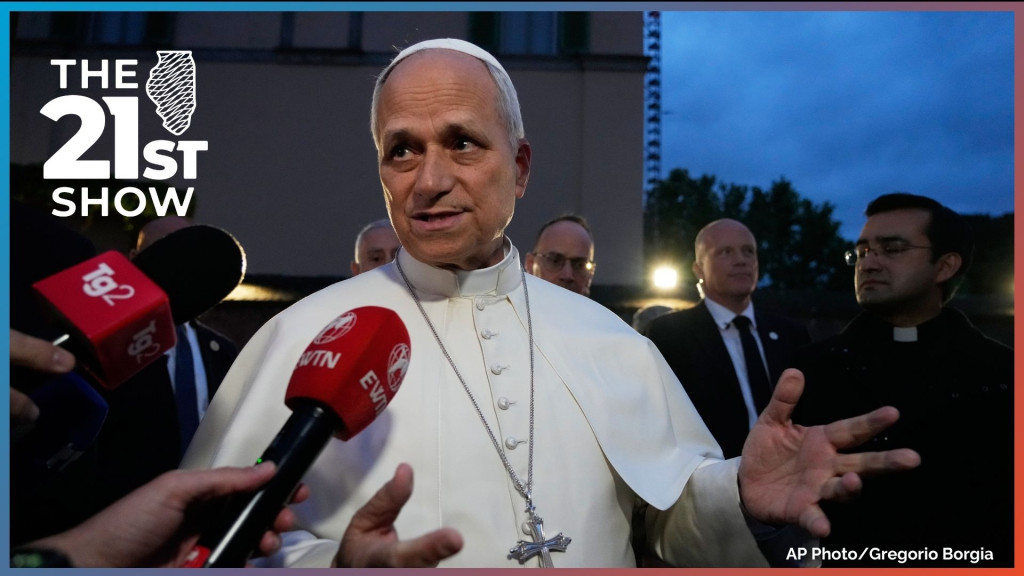
A look into the nuances of Catholicism and American politics amid President Trump’s criticism of Pope Leo
Read the full story at https://will.illinois.edu/21stshow/as-president-trump-feuds-with-pope-leo-where-do-catholics-stand-in-american-politics.
Transcript
// This is a machine generated transcript. Please report any transcription errors to will-help@illinois.edu.

[00:00:00]
Brian Mackey: This is The 21st Show. I'm Brian Mackey, back live now. And we're talking today about the intersection of American politics and the Catholic Church, specifically Catholic moral teaching, Catholic social thought, as it's sometimes called. You can join us today at 800-222-9455. That's 800-222-9455.

Joining me now are two people who've spent a lot of time thinking and writing about these matters. Heidi Schlumpf is senior correspondent at Commonweal magazine and the former executive editor of the National Catholic Reporter. She's also co-host of the Francis Effect podcast and a part-time member of the faculty at Loyola University Chicago. Heidi, welcome. Thank you for being with us.

[00:00:44]
Heidi Schlumpf: Thank you for having me, Brian.

[00:00:46]
Brian Mackey: Also with us today is Mary Hallan FioRito. She's the Cardinal Francis George Fellow at the Ethics and Public Policy Center. She's also a former vice chancellor in the Archdiocese of Chicago, the first woman in that role, and she worked primarily during the tenure of Cardinals Bernadine and George. Beyond that, she's also an attorney whose primary expertise is abortion law and policy. Mary, thank you for being here as well and welcome.

[00:01:09]
Mary Hallan FioRito: Thank you for the invitation, Brian. I'm happy to be here.

[00:01:12]
Brian Mackey: So, Heidi, I want to begin with you. As we heard from Cardinal Suic, it's nothing new for church leaders to speak out about issues of moral concern. What is unusual, I think, is the furious reaction we've seen from President Trump. I wonder what's been going through your mind as you've been following this over the past few months.

[00:01:29]
Heidi Schlumpf: Well, it certainly has been something for Catholic journalists and religion journalists to cover. It's been keeping me busy. What strikes me is why Trump personally and other members of the Trump administration continue down this path, even though it seems to be hurting them politically. So there was quite a bit of negative reaction to Trump's post on Truth Social, and in particular the AI-generated image that he used portraying himself as Jesus. There was just a poll that came out this morning in the Washington Post that said 87% of Americans and 90% of Catholics had a negative view of Trump for posting that image. So I'm not sure why he's picking a fight with Pope Leo, who conversely has pretty high positive approval ratings among Catholics and among Americans. It just doesn't seem to be a smart political strategy.

[00:02:28]
Brian Mackey: Mary, same question to you. What's been your general reaction? How have you been thinking about the president's attacks and Pope Leo's engagement with it, his responses to it?

[00:02:38]
Mary Hallan FioRito: Well, what first came to mind for me, Brian, was what Saint Thomas Aquinas taught about the impact that your personality has on who you are and how you act, and that's grace builds on nature. And I think what we have in the nature of President Trump is a very outspoken, bombastic New Yorker who doesn't, I think, wait between thoughts before he expresses them, and that particular characteristic of his can come in handy in certain situations, but it certainly has backfired when he attacked the Holy Father in the way that he did.

I don't know. I move in pretty conservative circles, and I don't know of one person, Catholic or non-Catholic, who was not simply appalled that President Trump would make these kind of side swipes at the Holy Father. And I'm happy to hear that our Secretary of State Marco Rubio will be meeting with him tomorrow and hopefully a better understanding between the two will be reached.

But, you know, it's also nothing new because if you think back to the time of the Iraq War — and I worked for Cardinal George at that time — Pope John Paul II, now Saint John Paul II, spoke very, very outspokenly against that war, and there were a lot of conversations, direct and indirect diplomatic interventions. I was sitting in the office with Cardinal George when Condoleezza Rice called him. But the difference was that President Bush and his administration really sought to gain understanding of why John Paul II was so opposed to this war. Unfortunately, they didn't listen. And in fact there was a terrific headline in the Los Angeles Times saying John Paul II warned us about Iraq. We should have listened to him.

So there's a lot of, you know, experience with the human condition that comes along with being the Holy Father, with being the Pope of the Catholic Church, and I think if we look back at the course of history, it would probably serve President Trump quite well to perhaps give more of a listening ear or at least try to understand.

[00:04:42]
Brian Mackey: I'm so glad you mentioned that. We need to take a break, but I myself was looking back on the Iraq War, and I found a CNN article in which — and I don't know if I'm saying this right — Cardinal [Pio Lagi] had met with a White House official, or had met actually with the president, President Bush himself, and came out of it saying that Bush did not try to present a religious case in support of military action. So you're right. The message from Rome is the same. It's the reaction in Washington that's quite different.

All right, we're going to take a break. We will continue this conversation and talk about some of the broader ways — or broader conflicts — that can exist within Catholics as they try to live their faith in American politics that doesn't always line up with Catholic teaching. My guests for this part of the program are Mary Hallan FioRito and Heidi Schlumpf. We're going to continue this conversation after a break. If you want to join us, the number is 800-222-9455. That's 800-222-9455. This is The 21st Show. We'll be right back.

It's The 21st Show. I'm Brian Mackey. We are talking today about the intersection of American politics and the Catholic faith. We asked members of our texting group about this. Sue in Champaign said, in part, Pope Leo has spoken true Christian teachings and has noticed when they are being horribly violated. It's a long list. We also heard from David in Mount Morris who said the same people who are saying that the Pope should stay out of politics are the same people who want the 10 Commandments posted in every public school. Sure, let's go with that. Either way, it's time to tax the church, David says. Thank you, David and Sue.

You can also join us today at 800-222-9455. What do you think about how the Pope's statements have been received in America? If you are Catholic, how have you adapted church teachings to your political and policy ideas? And what do you think about the way officials in the second Trump presidency have centered their own interpretations of Christianity? 800-222-9455.

We're talking about this for the rest of the program with Mary FioRito, the Cardinal Francis George Fellow at the Ethics and Public Policy Center. She's a former lay official in the Archdiocese of Chicago and also a lawyer. Heidi Schlum[pf] is senior correspondent at Commonweal magazine, former executive editor and other positions at the National Catholic Reporter, also part-time faculty at Loyola University Chicago.

We got several — I mentioned those texts from listeners. A few people responded to us: Jay in Elburn, Jim in Danville, Cheryl in Sullivan, Graham in Urbana. They all took issue with our phrasing of the message. I'll take responsibility for that. One of my questions was, how do you think about the Pope making statements about political issues? And they argued that what Pope Leo is saying is not political, but rather moral and humanistic. I don't know, Heidi, I think that, you know, moral issues are at the heart of our political disagreements in this country. So I wonder what you think of that.

[00:08:03]
Heidi Schlumpf: I agree, and I'm so glad that Mary brought up the issue about John Paul II also entering into the conversation about political and moral issues. These are related. Catholic social thought has "social" in the name because it talks about how we as a society organize ourselves and solve our problems, and at the heart — the foundational principle of Catholic social teaching — is the human dignity of all people. And I was pleased to hear Cardinal Suic talk about the importance of human dignity as part of this moral framework and how that needs to be spoken about in the public square, not just by Pope Leo, but — you know — everyday Catholics need to live that out in their own political involvement, and by our U.S. bishops, who just this past year spoke out again very strongly about the political issue of the mass deportations.

So I do think the two things are related. I wrote a column recently in Commonweal that has the headline "In Praise of a Political Church." Our church has not had a problem being political about the issue, for example, of abortion, and people who are having problems with it being political now, I suspect, are more concerned about the actual issues that we're talking about because they may be ones with which they disagree with the church.

[00:09:30]
Brian Mackey: Mary, can you address that? Pick up where Heidi was going with that. I mean, that is true, right? When — you know, for most of my life, I'm in my late 40s now — when I think of politics in the Catholic Church, the issue of abortion is always top of mind, although obviously there are many others of concern. But now that there is maybe a different frame of emphasis coming from Rome and coming from various bishops around the country, I wonder what you make of that.

[00:09:59]
Mary Hallan FioRito: Yeah, well, you know, I had the great privilege of serving Joseph Cardinal Bernardin as his pro-life director. I ran the pro-life activities office for the Archdiocese of Chicago, which is in fact where I met Heidi, when we were both young church workers. And Cardinal Bernardin, of course, was what they would call — I guess — the architect of the consistent ethic of life, which means that all human life is sacred. We respect life at all stages, at all points of vulnerability as well as strength.

And Cardinal Bernardin would sometimes be accused of trying to politicize what are moral issues, or trying to equate all sorts of different issues as if they were all the same and deserved the same kind of moral analysis. And he was very clear that there are some issues that at whatever time in history or humanity need to be given more attention and emphasis than others, but he never said that they were all equal. He talked about abortion as a priority for the church because, you know, none of your other rights really mean anything if you're not alive to enjoy any of them.

So it's difficult when you're looking at these moments in time politically that then also have moral implications. And when you look back to the common law or to the Magna Carta or even to statutory law here in Illin[ois] — in our country — at some level our laws reflect morality, right? I mean, "thou shalt not kill" is a commandment, but it also is a law in every state in this country. So there's a lot of overlap. But what the church tries to do, and lay Catholics ideally would try to do, is to say, OK, in this particular situation, using my knowledge, my prudential judgment, what is the right thing to do? Because in most cases you're not going to find a perfect politician, you're not even going to find a perfect law in many cases, but to try to minimize whatever damage can be done to the human person through a law and to maximize opportunities for human beings to thrive and to be protected, especially if they're in a particularly vulnerable situation.

[00:12:10]
Brian Mackey: This is The 21st Show. I'm Brian Mackey. You can join us today at 800-222-9455. And let's go now to the phones. We have Brian calling from Peoria on line one. Brian, always good to talk to a fellow Brian. What's on your mind? Can you hear me OK?

[00:12:28]
Caller Brian: I can hear you great. I was just wanted to comment that I'm good with the media and the Catholic Church sharing their political opinions, but I wonder if you feel that the media and Catholic leaders are being maybe a bit too partisan in their comments recently, you know, maybe they're being affected by the Trump derangement syndrome. And it's affecting really their objectivity. I don't remember so much bashing of Biden when he was the president. Thank you.

[00:12:59]
Brian Mackey: All right. Thank you for that call, Brian. I appreciate it. Heidi, I don't know if you want to speak to that first or —

[00:13:05]
Heidi Schlumpf: Well, you might have heard my chuckle there. U.S. bishops actually tried to deny communion to President Joe Biden for his positions on abortion. So it is true that religious leaders have spoken out on both sides of the aisle. But I think that your caller Brian makes a good point about the difference between being political — or interjecting with your moral teachings into the political conversation — versus being partisan, and it is important that church leaders not be partisan and not be perceived as partisan. Now, as everyday Catholics and voters, we eventually have to be partisan if we participate and vote, but church leaders definitely should not be partisan.

I don't see much evidence of Trump derangement syndrome. I see church leaders and lay Catholics speaking out about moral issues that they see as very urgent and very critical right now — like life and death issues of war and the mass deportations.

[00:14:13]
Brian Mackey: I'll just share another message from a listener. This is back to Sue from Champaign, who said, I remember our father Frady noting before Biden was elected that rendering unto Caesar what is Caesar's meant we were responsible to vote and to vote for truth, but he didn't specify a candidate. Mary, what do you think about that?

[00:14:33]
Mary Hallan FioRito: Yeah, and generally that would be the principle — that the church does not endorse political parties or candidates. But what we do do is to speak about issues and to speak about them clearly. You know, we as Catholics — I mean, we all believe that when we die we will stand before God for judgment, and he will ask us, what did you do for the least of my brothers and sisters? What did you do with the gifts I gave you, with the knowledge I gave you? So we're going to face what the church calls our particular judgment.

And so when we engage in an act that has moral implications — like voting, for example, or being involved in the creation of laws — we have to kind of keep that end game in mind, right? We have to make sure that what we're doing is not going to harm particular groups of people. It's going to try to, in fact, lead to human flourishing. That really is sort of the goal of the law — the overarching goal of the law is to create a world, to create a country in the United States where everyone can succeed, where people can live safely, where the poor and the vulnerable have a safety net and can be provided for.

And, you know, the church's vision is that we extend that to all members of the human family, whether it's unborn children, whether it's those with disabilities, whether it's the frail elderly who might not have medical care — everybody counts in the Catholic vision of the world. And again, because so much of our — as Heidi points out so well — by necessity it becomes partisan at some point because you have to vote, right? We live in a representative republic, in a democracy. But voting also is an act of not just the will but of the conscience. And so I think a good examination of conscience always really should precede any kind of political action that we happen to take.

[00:16:26]
Brian Mackey: Heidi, you've no doubt heard the phrase "cafeteria Catholics." I know some people find that offensive. I know most of the Catholics I know use that sort of endearingly, right? The idea is like you go down a cafeteria line — maybe I'll have some chicken, skip the broccoli, I'll take dessert. Do you get the sense that people really grapple with the way that Catholic social thought does not line up with the American political parties as they are now? Or are people resigned to it?

[00:16:53]
Heidi Schlumpf: Well, I think there's a lot of evidence that U.S. Catholics have in recent decades tended to identify more with their political identity than perhaps their religious identity, and we see that happening on both the left and the right. But as someone who teaches a course on Catholic social teaching, I sit with 35 students every semester who really do wrestle with how this intersects with the issues of the day, and I see everyday Catholics in my own parish — readers of our magazine and my own church leaders — who I think are really trying to, as Mary mentioned, use their informed conscience to think about what are the issues, how should I think about them, what does the church have to say to me, and then what are the hard decisions I'm going to have to make about which issues are going to take priority in what I'm doing and how we're going to solve those issues.

Everybody is a cafeteria Catholic in some ways. So this idea that it only applies to liberal or progressive Catholics — we've been seeing during the Trump years — has not been true, as we've seen conservative Catholics pick and choose as well. But we're all challenged to wrestle with that, and I see a lot of Catholics wrestling with it.

[00:18:19]
Brian Mackey: Mary, how about that? You mentioned you move in conservative circles. Do you see that wrestling? Or, as Heidi said, are people more identifying with their political party — the red shirt or the blue shirt — than they do with their faith?

[00:18:33]
Mary Hallan FioRito: Well, I think for at least a lot of people with whom I work and am friends, many of us were raised in Democratic households. I mean, both of my parents were immigrants to this country. My dad went on to become our Democratic precinct captain in our neighborhood because the Democratic Party was the party of the little guy, right? And then, after the Roe v. Wade decision and then the sort of gradual move from the Democratic Party welcoming pro-life Catholics and other pro-life people as equals — you know, there was Governor Casey of Pennsylvania, the nation's largest Democratic state by population, who even had a presidential bid — and Dan Lipinski here in Illinois, Congressman Dan Lipinski, who was actually a classmate of mine from high school and who very much voted with the Democratic Party 90% of the time except on the abortion issues. And what happened to him? He was primaried by his own party and removed from office.

So I think, you know, it breaks my heart that I have to consider myself politically homeless. I do think when we're talking about the cafeteria aspect that Heidi spoke of, it's important to distinguish issues that are non-negotiables from issues that are matters of prudential judgment. So, for example, abortion would obviously fall into a non-negotiable, right? We do not kill unborn children — full stop. Assisted suicide, another issue: we don't kill elderly people because they're sick and they're dying.

That is different from, for example, is this particular welfare program a prudent use of funds right now? Is this something that's going to help increase human flourishing? So there are moral absolutes and non-negotiables, and then there are things that people of goodwill can disagree upon. I mean, Heidi and I are very different people in that regard, but we can agree to disagree on particular issues that again are matters of prudential judgment. They're not what we would call preeminent priorities, or what John Paul II said in Evangelium Vitae about abortion — always has been wrong, always will be wrong, right? So you kind of have to think about, when we're talking about which church things you support and which you don't, what kind of issue you're talking about.

[00:20:52]
Brian Mackey: Mary Hallan FioRito is the Cardinal Francis George Fellow at the Ethics and Public Policy Center. Heidi Schlum[pf] is senior correspondent at Commonweal magazine and a member of the faculty at Loyola University Chicago. Thank you both so much for being with us and sharing your perspectives with us today here on The 21st Show.

[00:21:09]
Mary Hallan FioRito: Thank you, Brian. It's been a pleasure.

[00:21:11]
Heidi Schlumpf: Thank you, Brian and Mary.

[00:21:15]
Brian Mackey: That is it for us today. The 21st Show is a production of Illinois Public Media. I'm Brian Mackey. Thank you for listening. We'll talk with you again tomorrow.
Transcript Assistance
Illinois Public Media may use AI assistance for transcript generation and/or formatting. Transcripts that have not yet been reviewed for accuracy will be labeled.
To report a transcription error, or to request transcription of archival material, please contact will-help@illinois.edu.