








Transcript: Illinois author Shelby Van Pelt on the smash success of ‘Remarkably Bright Creatures’
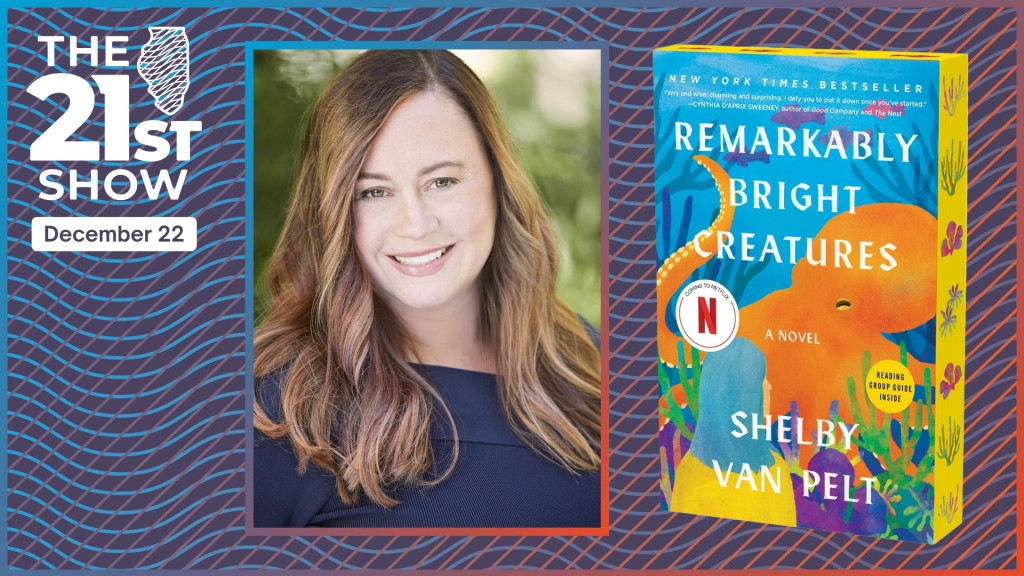
Transcript: Illinois author Shelby Van Pelt on the smash success of ‘Remarkably Bright Creatures’
The 21st Show
Illinois author Shelby Van Pelt on the smash success of ‘Remarkably Bright Creatures’
Read the full story at https://will.illinois.edu/21stshow/author-shelby-van-pelt-on-the-smash-success-of-remarkably-bright-creatures-encore.
Transcript
[00:00:00]
Brian Mackey: Today on the 21st show, novelist Shelby Van Pelt was born and raised in the Pacific Northwest, but she now makes her home in Illinois, in the suburbs of Chicago. Her debut novel, Remarkably Bright Creatures, is about an octopus who forms a bond with an aging woman still grieving her son's disappearance many years ago. The book has been a huge success, reportedly selling more than 2 million copies. It's also been made into a movie by Netflix. We'll talk with Van Pelt about her life and work. I'm Brian Mackey. That's all coming up today on the 21st show, which is a production of Illinois Public Media, airing on WILL in Urbana, WUIS in Springfield, WNIJ in Rockford DeKalb, WVIK in the Quad Cities, and WSIU in Carbondale. But first, news.

From Illinois Public Media, this is the 21st show. I'm Brian Mackey. And my guest today is the writer Shelby Van Pelt. She was born and raised in the Pacific Northwest and attended college at Claremont McKenna in California. But today, she and her family reside in Wheaton, Illinois. During the pandemic, Van Pelt and a writing partner made a pact to finish their books. The result, her debut novel, was Remarkably Bright Creatures. It came out in 2022 and it's been a remarkable success. To date, it's reportedly sold more than 2 million copies, and now it's also a movie on Netflix starring Sally Field and Lewis Pullman.

We originally spoke with Van Pelt back in 2025, shortly before the Champaign Public Library hosted an event with her. We're revisiting our conversation for the hour today. Because our program's on tape, we're not taking calls live, but you can always let us know what you think about the show. Send us an email. Our address is talk@21stshow.org. That's talk at 21stshow.org.

I know you've been asked this before. I'm going to just start by asking you to briefly describe the book. I was trying to summarize it myself and I thought, you know, I think this would be easier — we have the author with us. I'm going to ask her to do that.

[00:02:26]
Shelby Van Pelt: Are you asking me for an elevator pitch, Brian? I feel like you are.

[00:02:30]
Brian Mackey: I know you came from the world of business before this, so we can talk about that.

[00:02:34]
Shelby Van Pelt: Well, yeah, you know, I always say that Remarkably Bright Creatures is a book about an octopus that's not actually about an octopus. It is, of course, partially narrated by a giant Pacific octopus named Marcellus, who is, in some ways, a typical curmudgeon. From my sort of author perspective, he's like this kind of all-seeing, offstage narrator who adds some punch and some levity and is the keeper of certain secrets, really, in the story. But the story itself really is a story about humans. It's about human things that we all experience, like loneliness and grief and loss, and sort of how unexpected friendship can heal those things within us.

[00:03:25]
Brian Mackey: How did you come to put an octopus at the center of this story?

[00:03:29]
Shelby Van Pelt: Oh my gosh. Well, you know, I kind of wish I had a better story about this. I wish I was like a marine biologist, which I'm not. Do you know that I've never even been scuba diving? I can't even believe I am admitting that. But no, I came to become an octopus fan through YouTube, actually, which feels very modern, doesn't it?

[00:03:53]
Brian Mackey: It's just the way that most of us became octopus fans. Yes,

[00:03:56]
Shelby Van Pelt: well, there's just so much good content out there. And you know, this was 10-plus years ago when I first started developing this character and developing this book. I was trying to teach myself how to write fiction. I didn't have any formal writing training. I was sort of at a crossroads in my career. As you mentioned, I had this whole other kind of career and job before in business and finance that paid the bills but didn't really do much to satisfy me — satisfy my soul, so to speak. And at this crossroads, I thought, maybe I'll try writing some fiction. I had no idea what to write about. And luckily for me at that time, I happened to go down this YouTube rabbit hole watching these videos of octopuses — mostly in captivity, sort of behaving badly, but some in the wild, too, behaving badly in the wild. And I was just fascinated. Those two things came together: I'm trying to figure out how to write fiction, how to be creative, and here's a character that I would love to try to embody the voice of — embrace this and make an octopus into a curmudgeon.

[00:05:06]
Brian Mackey: As I've been reading Remarkably Bright Creatures, I'm sure you've heard something like this before, but I kind of imagine him in the voice of Sideshow Bob from The Simpsons, if you're familiar with that character. I wonder if you have your own voice in mind, and maybe you can talk about how you found the personality of Marcellus.

[00:05:22]
Shelby Van Pelt: Yeah, Sideshow Bob is a new one. I've never heard that, but I kind of like it. When I was first writing him, I kind of heard him as Stewie Griffin from Family Guy in my mind. But like a nicer version — not quite as salty as Stewie Griffin, but definitely that, you know, "Why am I here? I'm so much better than everybody else" type of attitude.

His voice really came quite naturally to me, which is strange because it's so different in some ways. But I guess I have a grumpy old man inside me somewhere that was just eager to come out when I was developing his voice. It was challenging, of course, to think about — even within the context of writing a non-human character, it's an octopus — it's not going to be realistic. But I did want it to feel realistic. I certainly wanted everything that he was doing in his physical world to be possible for an octopus. And within his internal monologue, I wanted the language that he would use to be reflective of the experiences that he would have had in captivity. So I was very deliberate with my language there.

[00:06:37]
Brian Mackey: Another of the characters in the book is named Tova, a woman — I believe in her 70s, if I remember correctly — not often the type of person who's given main character energy in stories today. How did she come into this book?

[00:06:50]
Shelby Van Pelt: Well, I don't know why that is. People of all generations should be given main character energy. I don't know why it is that we always like to read stories about people in their twenties.

Tova came into the story — she was sort of the first human character that was really introduced. After I had been writing basically this series of journal entries from this octopus's point of view, I thought, OK, I need to have a human in here somewhere, just to give him more material, basically.

I thought a lot about my grandmother when I was developing the character of Tova. My grandmother — my grandma Anna — she passed away in 2017, but she and I were very close when I was a kid. We lived next door to my grandparents, and I spent a lot of time at their house. She was this tiny little Swedish lady — super sweet, but also just super tough, super hardworking, never stood still, was always doing something to keep busy. Usually cleaning or some sort of chore. She would do things that I didn't necessarily think needed to be done — that did not objectively need to be done — because she always just had to have something to do. So I think I took that worldview and brought it into a character who would be at this aquarium doing the cleaning, doing really more than probably needed to be done, because she just needed to be in motion.

I was also spending a lot of time in aquariums at that point because I was trying to research how to write an octopus, and so I spent a lot of time just trying to observe octopuses in order to get that right. There's sort of this aesthetic that overtakes you when you spend a lot of time in aquariums, where all of the fish are just in constant motion but they're not really going anywhere — they're just kind of circling the tank. So I think I brought this "circling the tank" mentality into this Tova character — this character who was really my grandmother at her core — this person who is just sort of circling her tank, just staying in motion, just staying afloat, until change descends upon her. Which she knows is going to happen at some point, and she doesn't know what to do when that does happen — when she gets to a point in her life where she needs the help of someone else and she doesn't have anyone left. And she's starting to think about what that looks like, and is really sort of afraid of what that looks like in some ways. That's the challenge that she has to confront.

So I think that's how Tova and Marcellus were initially tied together — this idea of being kind of trapped, kind of static, kind of stuck in one place, circling their tanks, just staring down the reality of what's coming next.

[00:09:46]
Brian Mackey: Circling their tanks, circling the aquarium — which is circular shaped, if I remember correctly from the description. I see what you did there.

OK, let me take a moment to remind listeners this is the 21st show. We are speaking with author Shelby Van Pelt, originally from the Pacific Northwest, now residing in Wheaton, Illinois, in the Chicago suburbs. Her book, Remarkably Bright Creatures, has been a huge bestseller.

Let's come back to the book a little bit later. You mentioned your upbringing next door to your grandmother. You grew up in the Pacific Northwest. What was your childhood like there?

[00:10:20]
Shelby Van Pelt: Oh, you know, it's so funny. I feel like when you grow up somewhere, you think it's like the worst place in the world, right? You can't wait to get away. I didn't travel a lot when I was a kid. Pretty much Western Washington was what I knew, outside of movies and TV. And I could not wait to get away. I fled to Southern California for college — I fled to the sunshine.

SoCal is great, and I've lived all over in between. I've lived in the Midwest, the Northeast. I spent almost a decade living in the South, in Georgia and North Carolina. I had landed here in the Midwest — my husband's family is from the western suburbs of Chicago, so this was a very natural place for us to land once we had children. And I love it here.

But when I think about Western Washington and my attitude at 18 of just, you know — oh, this place is so small, it's so green, it's so kind of wet, I just can't wait to get away — and now when I go back and visit, I'm like, this is paradise. And it truly is. But you can't know something, I guess, until you know something else. I haven't lived full-time in Washington state since I was 18, but I go back to visit a lot, and it's just been really healing for me to put myself back in touch with my roots and realize that I was wrong at 18. This was not somewhere that you want to flee. This place is wonderful. It's beautiful.

The Pacific Northwest is almost difficult to describe to people who haven't spent time there. Everyone thinks, oh yes, Seattle is rainy, and that's true — it does rain a lot. But it doesn't actually rain as hard as it does out here. You take a good summer storm in the Midwest, it's going to rain way harder than anything you'll see in Seattle. But everything is that kind of damp, mossy — ferns everywhere, green and overgrown, so beautifully, but almost to the point of being a little bit claustrophobic sometimes.

[00:12:34]
Brian Mackey: I have family in Bellevue and Everett out there, and yeah, they sort of chide you for bringing an umbrella. They say you just need a coat — a raincoat.

[00:12:43]
Shelby Van Pelt: Yeah, no one wears an umbrella. It doesn't ever rain really hard enough to need one. You just put the hood up on your North Face coat and you're fine. It's funny — you walk through downtown Seattle or Portland or Bellevue or Everett, and you see people going to work and they're in a business suit with a rain jacket — like a North Face coat — over the top of it. It's very, very typical. But yeah, I really enjoyed writing that setting because it allowed me to sort of remember everything that I loved so much about growing up there. It was a wonderful place to grow up.

[00:13:15]
Brian Mackey: I was going to say — do you think part of what drew you to the story of, you know, an oceanic creature like the octopus, not something as familiar to those of us here in the landlocked Midwest?

[00:13:26]
Shelby Van Pelt: Well, it's funny — I don't think there ever was another place where this book could have been set. It was important to me that Marcellus, in his captive situation inside this small-town aquarium, be mere feet from home. I mean, his home literally is on the other side of the cement wall and across a little dock. It wouldn't have really worked if he'd been somewhere like the Shedd Aquarium, because an octopus can't live in Lake Michigan — probably, definitely not.

So yeah, I think it was just always set there. And you mentioned that I wrote a lot of this during the pandemic, and I did — I wrote probably the last 70% of it during the pandemic. Which was a time when I felt like I was missing home more than ever. I was not able to go back home and visit and see my family and see my hometown, and I feel like being able to just immerse myself in this world through this story that I was writing was really comforting.

[00:14:24]
Brian Mackey: Did you also feel that you were in captivity and maybe swimming in circles endlessly during the pandemic, as many of us did?

[00:14:32]
Shelby Van Pelt: It's funny — I remember a specific moment looking out my front window. We live on a street that is not a cul-de-sac; it's like a dead end, but it goes into a bike path that goes into a park. The result of that is that we had almost no car traffic, especially during COVID, but just tons and tons of foot traffic because everyone was out walking their dogs and going for walks. I would stand at the front window and just sort of watch this almost like parade of people go by — dogs that I had never seen before that lived in the neighborhood. And I remember having the distinct feeling that I felt like I was the one behind glass. And so yes, I think that is definitely a part of it.

[00:15:13]
Brian Mackey: So you mentioned you wrote most of it during the pandemic. When did you actually start writing this book?

[00:15:19]
Shelby Van Pelt: Oh, like an embarrassing number of years ago. I think it was like 2012 or 2013 — probably 2013, maybe. Like I said, I was kind of in this career crossroads. I was taking some time away — slash leaving for good — this other career that I had had, and really just trying to figure out what I wanted to be when I grew up. We had just moved to a new city; we had just moved to Atlanta. And I had the blessing of time, which — I look back and, you know, not everyone has that. It's a real privilege to be able to have time and explore something like writing, something that is sort of a passion pursuit. And yeah, so that was a while ago.

[00:16:05]
Brian Mackey: All right, we're going to take a break on the program. We'll have more with Shelby Van Pelt when we continue. She's the author of the bestselling novel Remarkably Bright Creatures, which has now become a movie on Netflix. We originally talked in 2025. With that in mind, no calls today, but there are still many ways to let us know what you thought about the show. One is by leaving us a voicemail, and you can do that anytime, day or night. [217-300-2121 is the number. That's 217-300-2121.] More with Shelby Van Pelt in a moment. This is the 21st show. Stay with us.

It's the 21st show. I'm Brian Mackey. Today we're listening to my 2025 conversation with a writer who makes her home in the 21st state. Shelby Van Pelt is the author of Remarkably Bright Creatures, a bestselling novel. Because this conversation's on tape, no calls today, but we do have email: talk@21stshow.org. Talk at 21stshow.org.

I'm curious about your path to writing. You said you went to Southern California — Claremont McKenna College. Were you a philosophy major?

[00:18:08]
Shelby Van Pelt: I did a major called Philosophy, Politics and Economics. Sometimes, yeah — it actually originated, I think, at Oxford University. That was the original program.

[00:18:19]
Brian Mackey: I've had the PPE reading list for Oxford University freshmen on my lifelong reading list. I'll get to it someday.

[00:18:28]
Shelby Van Pelt: Yeah, so my alma mater, Claremont McKenna College, sort of adapted it. I think they've probably had it for 20-plus years. It's a small kind of cohort program that you have to apply to, and there were, I think, 13 of us in this cohort together for three years doing all of these courses. But sometimes — that's a mouthful — so sometimes I do just say I studied philosophy. Philosophy was my favorite of those three things, and probably —

[00:18:58]
Brian Mackey: What did you envision you would do in life?

[00:19:02]
Shelby Van Pelt: You know, I don't know. When I graduated, I leaned more into the economics piece of it. And that wasn't something I ever really aspired to do — I never was like, oh, you know what I really want to do is a lot of Microsoft Excel. I can do it and it's fine; I'm not bad at it, and it certainly paid the bills — the student loan bills that you graduate with. It was what I needed to do at the time.

But I always liked writing. I think if I had said I'm going to have a writing career, I would have pictured myself probably in something more like journalism or nonfiction, because I was always good at writing, but I never thought of myself as being creative. It's actually something that I still kind of struggle with. I don't think of myself as being a particularly creative person. It's hard to think of myself as an artist — I guess maybe coming from this very practical educational background. But I'm certainly happy to have landed here.

[00:20:10]
Brian Mackey: Yeah. How many artists can say they can give you an Excel spreadsheet worked up with formulas and everything? So you worked as a financial consultant. What was that like?

[00:20:21]
Shelby Van Pelt: You know, it was fine. It was a fun thing to do in my twenties. I don't know how it is today, but it was a pretty intense job. It was the sort of thing where you're traveling a lot and you're working long hours, and you have sort of a cohort of other twenty-somethings and you're going out to happy hour. It sort of worked at that time. I try to picture myself being in that industry now and it's very hard to imagine.

And that was one of the reasons why I decided to get out of it. As I got into my later twenties and I got married and I started thinking, OK, what does the next decade of my life look like? It was hard to imagine being in a job where you're getting a call at 5 p.m. saying, oh, by the way, you're on the 10:30 flight out tonight because the client needs you to go do this and that. It's just not super enjoyable, and it's not really compatible with having a family. My husband also was working a job like that, so it was like, OK, we can't both do this, and I am super burned out. I'm ready to walk away from the frequent flyer miles and just do something else — I don't know what, but something else.

[00:21:39]
Brian Mackey: Diamond platinum status — not what it was cracked up to be when you were younger, maybe.

[00:21:45]
Shelby Van Pelt: No, you know, it's not.

[00:21:47]
Brian Mackey: So you mentioned it was family that drew you to Illinois. You ended up in Wheaton — Village of Churches. How long have you been in Illinois now?

[00:21:56]
Shelby Van Pelt: We moved up here in 2018. We had been living in Atlanta prior to that. Atlanta was the longest we had lived anywhere, really. We had bounced around quite a bit, and I loved Atlanta — Atlanta was so much fun. But the problem was we just didn't have any family there. We didn't really have any roots there. My husband's job was the thing that had brought us there, and when he decided to leave that job, there wasn't really anything keeping us there other than the restaurant scene, which we loved.

It seemed natural — our kids, I think, were like 1.5 and 3 at the time — and it was just time to move somewhere to be closer to family and in a place that was a little bit easier to raise kids. When we lived in Atlanta, we were right in Midtown, which was so much fun — so many great restaurants in walking distance — but it wasn't the sort of street that your kid could ride a bike down. It was a bit chaotic. So we ended up in the suburbs, which — man, I said I would never live in a suburb. I was like, never ever. And yet here I am. And you know what? It's not bad. It's actually really kind of easy.

[00:23:05]
Brian Mackey: Could be worse. Could be worse. All right, I wonder if you've lived here long enough to do kind of an Illinois lightning round.

[00:23:11]
Shelby Van Pelt: Oh gosh, I can try. All right, I can try.

[00:23:14]
Brian Mackey: Cubs or Sox? And you can't say Mariners or Braves or whoever you want.

[00:23:19]
Shelby Van Pelt: I do — I want to say Mariners. No, I know that Sox is the right answer for being like a Chicagoan. But I have to say, like if we had friends that were coming to town and I was going to take them to a baseball game, I would have to take them to a Cubs game. I just feel like it's a bit more iconic. I don't know.

[00:23:38]
Brian Mackey: South suburbs born and raised myself, but I can't argue with that, to be honest with you. O'Hare or Midway?

[00:23:45]
Shelby Van Pelt: Well, I am in and out of O'Hare more than I would like. You said lightning round, but I'm just going to —

[00:23:52]
Brian Mackey: That's fine. This is the point of this, yes.

[00:23:55]
Shelby Van Pelt: I was at a book festival up in Harbor Springs, Michigan, with a bunch of other authors last weekend, and it was absolutely lovely. But it's a very, very small airport that you fly in and out of up there — Pellston [Pelston] Airport. And so everyone was flying through Chicago to go where they were going. This entire plane was like full of authors. It was so funny. It was like, please let's not have this plane crash, because this would be like an event in the history of literature.

[00:24:23]
Brian Mackey: Literature died. Yes. Oh gosh.

[00:24:25]
Shelby Van Pelt: But anyway, we were all sitting around this tiny little airport surrounded by taxidermy in Pelston, Michigan, and everyone was like, oh well, we have this layover — are there any good restaurants at O'Hare? And I started going terminal by terminal listing all of the restaurants and telling them, this one's good, this one's not as good, oh if you're passing through here you should definitely go there. People just kind of gave me this look like, you spend way too much time in this airport. And I'm like, yeah, I really do. With all of the book travel, I'm there a lot. O'Hare definitely has the better restaurants, but any chance I get to go in and out of Midway, I will take it. It is so easy. It's a little bit farther from my house, the distance is not as good, but it's easier.

[00:25:10]
Brian Mackey: Good answer. How do you feel about people policing hot dog condiments?

[00:25:15]
Shelby Van Pelt: Oh, you're going to get me canceled. So I am a ketchup-on-hot-dog person. I'm sorry, I love it. I'm with you — which is to say, I don't feel good about it. Again, if someone came in from out of town and we were going to do the Chicago thing, I would say after our Cubs game we would go out to some bars, and then I'd say, OK, we're going to get a Chicago dog and we're going to have it the right way, with the onions and the mustard — and if you ask for ketchup, they're going to yell at you — and yeah, we'll do that. But when it comes to if I just were to eat a hot dog, I would absolutely put just ketchup on it. I'm happy, ketchup only.

[00:25:57]
Brian Mackey: Yeah. Ketchup and a dill pickle spear for me. Deep dish or tavern style?

[00:26:02]
Shelby Van Pelt: Oh, I think that tavern style is pretty underrated. I mean, a good deep dish is good, but it's a different food for me. Eating a deep dish is eating a pizza casserole. It reminds me more of having a lasagna or something. I have to really be in the mood for it — a cold day, maybe you're kind of cozy and you want something really hearty — then it's really hard to top a good deep dish. But if I just want a slice, I would say tavern style.

[00:26:32]
Brian Mackey: Can we talk about Eat, Drink, Run? I suspected you might — oh my gosh,

[00:26:36]
Shelby Van Pelt: talk about a throwback. Sure,

[00:26:38]
Brian Mackey: yeah. So you ran this blog for a long time. I saw it — I came to know of it because someone mentioned it on Reddit, I think the Chicago suburbs subreddit. They were talking about you and the fact that, you know, your success, and you're a neighbor to them — broadly speaking, not one of your actual neighbors. But they mentioned that they enjoyed reading your blog back then. How did that contribute to your development as a writer?

[00:27:03]
Shelby Van Pelt: Well, this was back in the days where this sort of thing was normal. I have to say the concept sounds insane these days, but this was back in the early teens — late [zeros], early teens — and it was when there were a lot of food blogs around and a lot of running blogs around. These people would make these blog posts of, here's what I ate today. And that's it — that's the whole post. Maybe there's a story around it, but we were all doing this, and for some reason people enjoyed reading it. And so I thought, well, I don't really want to do a food blog because I'm not that much of a foodie. I followed a lot of running blogs — I was really into running back then. I was a somewhat competitive marathoner. I was out doing 5Ks every weekend, doing track workouts, I was on running teams. So I followed a lot of people who were in that space, and I didn't want to do just that either. So I thought, I'll just combine my passions and make this a food and running — and also I would blog whatever beer I was liking. I used to drink a lot more beer than I do now.

But yeah, I would just — it was kind of a daily thing, and it still is so fascinating to me that I would basically sit down after dinner and write these posts about, well, here was my track workout, here were my splits, here's how it felt. And then, you know, I had this American pale ale and here's a picture of it, and it was really good, here's where I got it, here's how much it cost. I would just sit down and write that and then press publish, and it would go out on the internet. I think some of it is probably still out there — it's been a while since I've checked. But you know, there would be some life kind of stories interspersed in there.

In terms of the content, I think it's probably pretty banal by today's standards. But again, I was not the only one doing this. I feel like there was this era of this kind of — it went from LiveJournal into Blogger into this like daily diary type of blogs. I would say the thing that it really helped me with was it did establish a daily writing habit. And even though I can't imagine pressing publish on something every single day without editing it, it did sort of ingrain in me: you sit down and you put some words on a page — if not on a daily basis, on an almost daily basis. And that's a habit that I try to maintain to this day.

[00:29:32]
Brian Mackey: Yeah, well, that's amazing. And that's kind of what I was wondering — if there was going to be that connection. So how did you decide to go from your running splits and the beer you were drinking to starting to write fiction?

[00:29:45]
Shelby Van Pelt: Well, I had kids. And so the running splits kind of went away for a while. They haven't really been back — I don't know if they'll ever be back. The idea of going to a track and running quarter-mile repeats for fun just does not sound fun. And obviously I wasn't drinking beer like I used to. I can't — you know, you can get away with so much when you're in your 20s that just doesn't fly in your 40s.

[00:30:13]
Brian Mackey: People in your twenties listening — you have no idea. Enjoy it while you have no idea.

[00:30:18]
Shelby Van Pelt: Enjoy it while it lasts. So I've never thought of it this way, but I suppose — well, I guess the other piece of that is, once I had kids, the natural evolution would have been to make it a mommy blog, and that was a big thing at that time. My daughter was born in 2014. And there are a lot of mommy blogs out there. In fact, a lot of the running blogs and the food blogs that I had followed sort of morphed into mommy blogs as people started having kids. And I remember having a conscious thought of, I don't want to do that. I don't want to put my kids on the internet every day. I don't really want to write about this — this isn't necessarily what I want to write about. And so I'm just going to kind of wind it down. And I did — I kind of wound it down. But it was really at that same time that I started increasing my investment in writing fiction. So I guess I did sort of trade one for the other in a way. And writing fiction is better than writing about having small children. There we go.

[00:31:22]
Brian Mackey: I'll believe that, having been through that about 13 and 9 years ago respectively myself. But how did you get over that — I mean, you mentioned, I don't know if you use this phrase exactly, but that idea of impostor syndrome out there, right? Like, who am I to be writing fiction? Was that something you had to get over?

[00:31:39]
Shelby Van Pelt: Oh, it's something that I still have to get over. And comparing it to sort of the blog days — again, that's the fascinating thing when I think about it. I was just writing this stuff every day and just pressing publish, and there was no thought of, like, who am I to do this? Who cares if anyone reads it, right? You're just putting it out there. But then you start to write fiction and you start to try to publish, and you do start to think, am I good enough at this? Is someone going to read it?

I think at the very beginning, I wasn't thinking that much about it because I never thought it would actually get published. I was just doing it for my own personal growth or my own entertainment. And I feel like in some ways I battle it now a little bit more. When I sit down to write something, I know that people are going to read it. And I have to get over that hump of, is it good enough? Am I good enough? What did I do to deserve all of this? I've never met a writer who doesn't deal with it on some level — even my own writing idols, when I get to meet them and they say that they still deal with this, it makes me feel a little bit better. This is a very universal problem.

[00:32:58]
Brian Mackey: It is a weirdly self — I don't know, self-punishing isn't the right term — but like, self-doubting field, right?

[00:33:06]
Shelby Van Pelt: Well, when you think about any other area where you're making a product — and even into some other creative areas like perhaps filmmaking or TV — it's very collaborative. This product is sort of created by a bunch of people. But when you're writing fiction, you're literally just pulling things out of your brain and putting them on paper. And it's all on me as the writer — this is good or not. Of course, you have your editors that come in at some point, but in that first stage when you're just drafting, it does feel very much like it's just on my shoulders alone.

[00:33:43]
Brian Mackey: All right, we need to take another break on the program. We're listening back to my conversation with Shelby Van Pelt. She's a writer based in Wheaton, Illinois, the author of the bestselling novel Remarkably Bright Creatures, which has been adapted into a Netflix movie starring Sally Field and Lewis Pullman. I originally spoke with Van Pelt in 2025, a few days before an event that featured her at the Champaign Public Library. No calls today, but if you want to share your thoughts on future conversations or planning for the show, you can do that by joining our texting group. We often share people's thoughts from the group during our programs. You join by texting the word talk — T-A-L-K — to 217-803-0730. Again, text the word talk to 217-803-0730. More to come after the break. This is the 21st show. Stay with us.

It's the 21st show. I'm Brian Mackey. Today we're hearing from Illinois author Shelby Van Pelt. She's based in Wheaton in the Chicago suburbs, though she grew up in the Pacific Northwest. Her book is Remarkably Bright Creatures. It's been a mega bestseller, selling more than 2 million copies. And if that wasn't enough, Netflix has made a movie of it, starring Sally Field and Lewis Pullman. We originally spoke with Van Pelt back in 2025, shortly before she visited Champaign for an event at the public library there. That said, no calls today, but you can share your thoughts about the show anytime by emailing talk@21stshow.org.

I want to talk about the success of this book. I wonder what your expectation was when you — OK, you work on this for years, you make this pact — correct me if I'm wrong on any of these details — with your writing partner to finish your books, you start shopping it around to agents, it gets picked up, there are deals here, there are deals overseas, and then it becomes, slowly over time, this mega bestseller. What were your expectations going into it?

[00:36:16]
Shelby Van Pelt: Well, my expectations when I was drafting it were very low. Even as I got to the point where I thought, hey, I'm going to actually query this to agents, I'm going to put it out in the world — being the sort of person I am, I started looking at the numbers. And as anyone who has spent time in the querying trenches, as we call it — the numbers are bleak. Like, objectively bleak. The number of submissions that agents get versus how many of those they sign on — the minuscule number of them that they sign on as clients — and then even from there, can you get a publishing deal? There's another portion of those that never make it to that point. And even when you look at published books, like, most of them don't earn out their advances. It's just a tough industry.

So I feel like I went into it with characteristic low expectations. I always say I have one foot in Gen X and one foot in the millennial generation as a 1980 baby, and sometimes my cynical Gen X side really does take over and just say, OK, good luck with that, you know. So I definitely had that attitude when I was drafting it and getting ready to query it.

I think I benefited from a couple of things when I did finally query it in 2020. I was querying it right when My Octopus Teacher, the documentary on Netflix, had come out, and I didn't plan that. It was a lucky stroke that this documentary was wildly popular when it came out in the fall of 2020 — it went on to win an Academy Award the following spring. And that was when my manuscript was landing on agents' desks and eventually on editors' desks at publishing houses. It was sort of this fiction version of this other thing that had been proven to be popular, and I think it helped a lot. I think in publishing, anything that can sort of mitigate the risk from their perspective is a good thing. And octopuses were very much having a moment, and I think are still having that moment, which is really fun.

[00:38:32]
Brian Mackey: Yeah. If I could just read this line — it was a New York Times story about your success a couple of years ago, and it quotes Kristen Nelson, who I gather is your agent: "My assistant reached out to me and said this query came in today, and it's either brilliant or it's bananas because there's a talking octopus." So it really was this kind of lightning-in-a-bottle moment, like you say, because this film had come out. I'm sorry to interrupt you,

[00:38:57]
Shelby Van Pelt: but no, so I think, you know, at some point my expectations shifted, obviously, once I started getting traction. Kristen was actually the only agent that called me back — that responded. A lot of times when you're querying a manuscript, you're an unpublished author trying to become a published author, and you're just sending these query packages out into like the void. A lot of times the agents don't even write you back — it's just sort of assumed that if you don't hear back, it's a no. And I think I queried — I should look up the actual number — I think it was somewhere between six and 10 agents was like my first batch, and Kristen was among those. She was the only one that wrote me back, and she was like, can we get on a Zoom call this afternoon? And we did. I had to bribe my kids with some snacks and some juice to stay in the other room while I did this life-changing Zoom call.

And yeah, at that point it was kind of like, OK, wow, this is actually happening. My expectations obviously became vastly different from what they had been when I was just writing this ridiculous octopus story and assuming it would go nowhere.

I don't think anyone could have predicted what actually happened, though. The book has followed a little bit of an unusual path. It had great success right when it first came out — we hit the New York Times bestseller list that first week, which was fantastic. We came in at No. 15, which is, of course, the very last slot, but that doesn't matter. Whether you're second or last, you're still a New York Times bestseller. So that was a big cause for celebration.

And then it fell off the list, and we kind of did what you would expect a book to do — you get that big bump in the beginning from the pre-orders, from — I was a Read with Jenna book club pick, so you get a bump from that. But at some point over those weeks, it kind of just starts to taper off, and it did. But then it had like this resurgence, I think around November of that year, probably around holiday shopping. It was on a lot of best-of-the-year lists, a lot of holiday gift guide lists, and it started picking up. And since then, it just has kind of stayed up. It's very, very unusual. The highest sales numbers were a year-plus after publication. It has legs — it has eight of them.

I don't know that I can really explain it. I don't know that even my publishers can really explain it, and it's not for lack of trying. We have sat around and said, hey, is it BookTok? Is it Bookstagram? Is it booksellers and librarians hand-selling it? Is it book clubs? Is it friends recommending it to one another? And I think the answer is probably all of those things. But it has just been, you know, truly the wildest ride. And that's the part of it that I never truly could have expected — even at that point where I had the agent and I had the publishing deal and I knew that this was going to happen and it was going to probably do pretty well — I never would have expected to still be riding this wave three years later.

[00:42:18]
Brian Mackey: You know, it's one of these books where there's so many personal recommendations, right? I've seen you talk about that. I've seen other people referencing that. You know, I was looking online — even A Tale of Two Cities, one of the great works of literature, there are 38,000 one-star reviews on that. I wonder if you ever read or engage with the minority of people who, you know, maybe your work doesn't resonate with. Do you ever think about that, or do you just keep that out of your mind?

[00:42:44]
Shelby Van Pelt: You know, I mostly try to keep it out of my mind. I know a lot of authors who read their one-star reviews, and they're quite funny. I have done that occasionally, and they are usually pretty funny. But now that I'm in the process of trying to draft another book, I feel like I need to protect my headspace a little bit. So I don't intentionally delve into those.

For the most part, I know what they say, and that's fine — it doesn't have to be for everyone. The truly strange thing is sometimes I will come across some sort of review or comment about my book when I'm just scrolling on something unrelated, and someone posts on my Instagram feed about the book, and then you see people's comments — they're like mostly very positive, but then you get the occasional person who's like, yeah, man, I hated that book, didn't see what the hype was about, it's a talking octopus, who cares? It's like, all right, well, it's not for you. That's fine.

[00:43:42]
Brian Mackey: My favorite one — and maybe I shouldn't — it was so silly. They found it unbelievable that Tova would have brought her own cleaning supplies. Something about that — that was their big complaint about the book. Come on.

[00:43:54]
Shelby Van Pelt: Yeah, people have little — and it's so funny. That's why I choose to try to write in fictional towns most of the time, because as soon as you bring in these details, you start to invite people to —

[00:44:07]
Brian Mackey: [to lie — ] First Street doesn't go all the way to Maine.

[00:44:10]
Shelby Van Pelt: Did you know that there's actually a four-way stop there? It's not a stop sign.

[00:44:14]
Brian Mackey: Um, what — let's actually, we can get a phone call in here. Cindy is calling from Champaign. Cindy, thank you for calling in.

[00:44:22]
Cindy: So, I'm actually very much enjoying the program. I actually listened to the book — an audiobook — because a book club that I'm not a part of had recommended it, and I was kind of suspicious at first. I said, what's this going to be like? And actually I really enjoyed it. I listened to a lot of books because I sew a lot and I do it that way. But I called because I was very amused by your comments about Chicago pizza and your likes. So while you're here in Champaign, you really need to try Papa Del's, because it is an icon. Yeah, Papa Del's.

[00:44:56]
Brian Mackey: It's D-E-L — Papa Del's, yeah.

[00:44:59]
Shelby Van Pelt: Oh, Del's, like the Wisconsin Dells? Yeah,

[00:45:02]
Brian Mackey: one L. Yes, I'll email it to you.

[00:45:05]
Cindy: Yeah, anyway, I just was amused by that, and I thought you really have to try it while you're here in Champaign.

[00:45:12]
Shelby Van Pelt: OK, but I have to know — is it tavern style or is it deep dish? What is it?

[00:45:15]
Cindy: You can get either one, you know — you can get either one, and you can also get gluten-free, you can get vegan. It's just a pretty amazing place that's been here for 50 years, I think. Yeah, long time.

[00:45:31]
Brian Mackey: Cindy, thank you so much for the call. Appreciate that.

[00:45:34]
Cindy: OK.

[00:45:35]
Brian Mackey: What advice do you have for people who maybe, like I said earlier, have those pages in the drawer that they haven't touched, or that file on the computer that they haven't touched — maybe they're not satisfied with their consultant job? What advice do you have for people to actually get started with this?

[00:45:53]
Shelby Van Pelt: Well, I think there are two things that helped me a lot. The first one is realizing that I didn't necessarily have to write a novel. We touched on this talking about the old blog — the development of a writing habit, no matter what you're writing, is really helpful when you're trying to take on a longer project. But the other part of that, that I don't think we've really touched on, is that I've written a lot of short stories, I've written a lot of flash fiction, when I was sort of trying to teach myself how to write, to get back into writing. I wasn't always just focused on this novel. I did a lot of these one-off writing competitions where you sign up for a weekend-long assignment and they give you prompts. I find those even now to be so helpful for breaking through writer's block. There's something so satisfying about getting to the end. And when you're writing a novel, it can feel so very far away. But if you're sitting down to write a flash fiction piece — which is typically 1,000 words or less — you can get there in a weekend. And sometimes you need that to keep going.

So people who say they want to write a novel, I always say great, you should absolutely write a novel. But don't be afraid to also write some other stuff to keep you going, and you never know — that material that you're generating, I have taken a lot out of my short stories and my flash fiction pieces and dropped them into novels. There are characters, there are little bits and pieces in Remarkably Bright Creatures that came from some of those writing competitions. I try to think of it less as working on a novel and more of like you're working on just a body of material — your writing. And you gotta do whatever — if the novel is frustrating you, you put it aside, do something else. There's no shame in that.

And then the other thing that really helped me a lot was finding a writing community. I found that initially through signing up for a class — this was at Emory University, which we were living in Atlanta at the time. But they have them here at College of DuPage. I'm sure they have them all over the state — wherever there's a university, a community college, even a library — there's probably some sort of class that you can sign up for. Those classes are great for what you learn, but I think they are just as helpful for the community that you can potentially build out of them. That was how I found my longtime critique partners — out of that class and out of that community. It is so much more fun to do it when you're doing it with other people. It is fundamentally a pretty lonely job to be a writer, and it's a lot more fun if you have a group of people that you can text and joke around with and lean on. So I would say definitely don't be afraid of short-form writing, and find your writing community — those would be my two big pieces of advice.

[00:49:02]
Brian Mackey: Well, we are unfortunately out of time. Shelby Van Pelt, what a pleasure talking with you today. Thank you so much for making the time with us.

[00:49:09]
Shelby Van Pelt: Of course, thanks so much, Brian. This flew by. This was fantastic.

[00:49:13]
Brian Mackey: Glad to hear it. That was Shelby Van Pelt, author of Remarkably Bright Creatures, which is now out as a movie on Netflix. She lives in the Chicago suburbs, and we originally aired that conversation in 2025. That's it for us today. We'd love to hear what you think about what we've been talking about on the show. One way to do that is by leaving us a voicemail. You can call 217-300-2121 anytime, day or night. [217-300-2121.] The 21st show is produced by Christine Hatfield and Jose [Zaeda]. Our digital producer is Colson Kahn. Technical direction and engineering comes from Jason Croft and Steve Mork. Reginald Hardwick is our news director. The 21st show is a production of Illinois Public Media. I'm Brian Mackey. Thanks for listening. We'll talk with you again next time.
Transcript Assistance
Illinois Public Media may use AI assistance for transcript generation and/or formatting. Transcripts that have not yet been reviewed for accuracy will be labeled.
To report a transcription error, or to request transcription of archival material, please contact will-help@illinois.edu.