








Transcript: Biking 500 miles on the Grand Illinois Trail
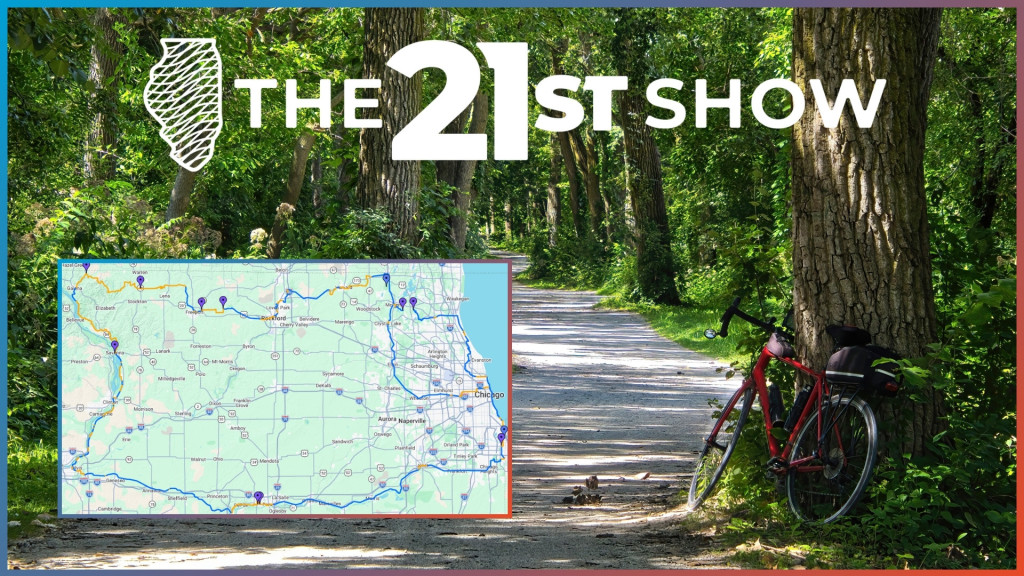
Transcript: Biking 500 miles on the Grand Illinois Trail
The 21st Show
Biking 500 miles on the Grand Illinois Trail
Read the full story at https://will.illinois.edu/21stshow/biking-500-miles-on-the-grand-illinois-trail.
Transcript
// This is a machine generated transcript. Please report any transcription errors to will-help@illinois.edu.

[00:00:00]
Brian Mackey: From Illinois Public Media, this is the 21st Show. I'm Brian Mackey. The Illinois Department of Transportation officially recognizes 169 bike trails across the state. Among the grandest of them all is, well, the Grand Illinois Trail. It's 500 miles. It's a loop comprised of several other trails that circumnavigate the northern part of our state, from Lake Michigan to the Mississippi River and back. It's a project that's been in the making for 30 years, and it's finally almost complete. But emphasis on almost. There are a few spots where the trails need to link up. Enter Open Lands, the Illinois-based conservation organization working to finally close the loop. Joining us now to talk more about this is Sarah Egan, director of conservation planning for Open Lands. Sarah, welcome to the 21st Show.

[00:00:58]
Sarah Egan: Hi, Brian, thanks for having me.

[00:01:00]
Brian Mackey: Listeners, you can join us today. 800-222-9455. We're just on this topic for the next 15 minutes or so, I should say. So don't wait. 800-222-9455. All right, Sarah, tell me a little more than I said there about the Grand Illinois Trail, right? Especially for listeners to whom this might be a new idea.

[00:01:20]
Sarah Egan: Yeah, absolutely. So the Grand Illinois Trail showcases a diversity of Illinois's landscape. As you suggested, it stretches all the way from the shoreline of Lake Michigan all the way to the Mississippi River, and most people just simply aren't aware that all of these trails that make up the Grand Illinois Trail can take you on a tour of so many of our incredibly diverse and globally significant natural landscapes.

[00:01:43]
Brian Mackey: So what are some of the highlights? It starts at Navy Pier, right?

[00:01:46]
Sarah Egan: Sure. Um, well, there really is no specific start to the trail. As you said, it's a loop system. But I'm happy to take you from Chicago's lakefront and sort of walk you through some of the, I think, most well-known and most iconic spaces. So I'll start in Chicago on the lakefront path. It connects south down the Burnham Greenway and it connects down to the Old Plank Road Trail, which Open Lands had a role in creating back in the '90s. And that Old Plank Road Trail runs along an old railroad right of way. And it has remnant prairie adjacent, so these landscapes adjacent to this path remain undisturbed.

[00:02:23]
Brian Mackey: I love it. Just a personal note — I grew up in that area and have logged many, many hundreds of miles on that trail in my younger days. So that's great.

[00:02:32]
Sarah Egan: Well, great. So a little context there — it took about 10 years to actually get that deal done. Open Lands was very persistent in the '90s, meeting with the railroad once the railroad was no longer active. It's a 22-mile segment and there are seven communities along that segment that we had to coordinate with. And as a land trust, we were able to purchase the land and essentially create the trail from there. So really just incredible. I think for me, approaching the end of the second decade of my career as an urban planner, to kind of understand what it takes in terms of persistence to get these grand visions in place — and I'm picking up the work from multiple individuals at IDNR and across the Open Lands organization that have worked on these efforts for decades. So I'm just really happy to be part of it. And it just helps me persist as we get closer and closer to completing the full vision.

[00:03:27]
Brian Mackey: So, OK, Joliet — and you start heading west from there, yeah?

[00:03:31]
Sarah Egan: Yeah. So from Joliet you'll hook up with the I&M Canal, and that connects six state parks, including the well-known Starved Rock State Park. There's a gap in between the I&M Canal and the Hennepin Canal that's currently being worked on through the Grand Illinois Trail Alliance. A lot of the alliance members across this expansive landscape are working to fill these gaps, and that gap between sort of Peru and Bureau, Illinois, is actively being worked on. So you'll then hook up with the Hennepin Canal Trail and that'll take us all the way to the Mississippi River. On the Mississippi, you'll get to enjoy the incredible bluffs of the Mississippi River and connect along a lot of state wildlife refuge areas, hooking up with the Mississippi Palisades State Park and Albany Mounds State Historic Site. And that takes you into the driftless region, which of course is in and around Galena via the Great River Trail. So as you head east from Galena, the trail winds through kind of small local roads that connect Apple River Canyon State Park and [Lake Leaquina] State Park. So some of this trail system is on-road segments that essentially connect those larger off-road greenway segments, and that's an example of one of those.

[00:04:45]
Brian Mackey: Yeah, let me stop you there and ask you about that. How much of this trail is — you know, that's sort of more protected — asphalt bike path or gravel or whatever it would be versus having to share the road with F-150s and semi trucks, potentially?

[00:05:02]
Sarah Egan: You know, Brian, I'll give you kind of the high level because I could certainly quantify that, and I think maybe some of that information might be on our website, which has a very clear map of the on-road and off-road segments. I'm gonna just take a stab and say that about a quarter of it is on-road segments and the rest is dedicated greenways.

[00:05:21]
Brian Mackey: OK. Is there, you know, thought that this would ever become entirely greenway, or is that just not how these things —

[00:05:30]
Sarah Egan: Well, what's great about that is we are actively working with [IDOT]. They just released their new active transportation plan — in fact, I should say their first active transportation plan. So really at the state level, having leadership for safe bike riding, both on-road and off-road, is really critical. So we're working directly with them. They're part of our alliance, and over the next couple of years we're gonna be working on some very specific safety upgrades that include a lot of dedicated lanes. So I think — you know, I'm a planner, so I'm optimistic — that ultimately there is a possibility that all of this at one point could be off-road dedicated bike lanes and paths.

[00:06:10]
Brian Mackey: So let's talk about the terrain. You mentioned the driftless, right? This is — for people — astute listeners will remember, I think we've talked about this on the show before, but that's the part of Illinois that was not scrubbed flat by glaciers. So we have this reputation as a prairie state, but not entirely. What is the terrain like across the miles and miles of this trail?

[00:06:30]
Sarah Egan: Yeah, well, interestingly, as the Prairie State, the majority of it is flat. But certainly as you get into that segment along the Mississippi River, you're increasingly climbing. And then certainly the most terrain happens in that driftless zone. But we also have an area that was heavily impacted by the glaciers in northern Illinois, kind of on the border between Illinois and Wisconsin, which is called the Hackmatack National Wildlife Refuge. And that area is a glacial area that has a lot of incredible moraines and kettle wetlands. So that has some terrain to it as well. I think just what's interesting is that difference in the east and west segments on the northern portion, where you get to kind of experience both the driftless and the area that's highly impacted by the glaciers.

[00:07:20]
Brian Mackey: Yeah, people who have never been to the driftless area — it's really remarkable. It does not feel like Illinois if you've spent most of your time driving on interstates in central Illinois. It really feels like Vermont or California or something like that.

Talk to me about — you mentioned some of these gaps and what's being done to try and close them. What has prevented — I think there's what, 10 gaps remaining?

[00:07:45]
Sarah Egan: There is. Yes, depends on how you define them, but yes, generally there's about 10 left. And your question was what's sort of preventing those gaps from being closed?

[00:07:54]
Brian Mackey: Yeah, or what's been the holdup? However you want to take that.

[00:07:59]
Sarah Egan: Well, you know, local leadership — visions like this don't happen without kind of a range of partnerships across both state, regional and county levels. A lot of these routes run through local roads, so there's so much coordination, and any kind of good coordination takes funding and it takes dedicated staff across these agencies. And so that's really where a nonprofit like us can kind of fill in. Where IDNR was really leading in the '90s and early 2000s on this effort, for various reasons that leadership has dropped off. And so that makes a space for us to come in and sort of re-engage what we're now calling the Grand Illinois Trail Alliance on closing these gaps.

So I would say coordination is one thing. I would also say that over the last 15 or so years, there just hasn't been a lot of leadership and dedicated staff time. So for us to come in as a nonprofit is a great opportunity. You know, we are conveners generally here at Open Lands, so to be able to bring all these entities together and coordinate is really, I think, an important way to close those gaps, as well as generating awareness. So we have a couple of events that we can briefly talk about happening this summer along the Grand Illinois Trail as well. The more and more we generate awareness, and the more and more individuals can work with their local leaders and their legislators to close the gaps with us.

[00:09:27]
Brian Mackey: If you're just joining us, this is the 21st Show. We're talking about the Grand Illinois Trail, a 500-mile bike path across northern Illinois from the Quad Cities to Chicago, and efforts to finally complete it after work first started in the mid-1990s, as we just heard. We're talking about this with Sarah Egan, director of conservation planning at Open Lands, a nonprofit conservation organization that's working to get this 500-mile loop completed. You can join us: 800-222-9455.

We've both said now this started back in the 1990s — that was a Democratic presidential administration, Republican leadership in Illinois, you know, bipartisanship. What sort of fell apart? You mentioned — I think the phrase you used was "for various reasons" — the state Department of Natural Resources. That phrase is doing a lot of work there. What happened?

[00:10:21]
Sarah Egan: Yeah, well, I was in elementary school at the time, Brian. But what I understand is, as Governor Edgar's administration ended, so did a lot of dedicated funding around the Grand Illinois Trail effort. Certainly even with that, staff at IDNR have remained pretty constant, but certainly their roles have shifted over time as well. And so as their responsibilities have grown, there really hasn't necessarily been sort of the next generation to fill that gap through that organization. But they remain part of our alliance and remain very engaged in getting this completed. Does that answer your question?

[00:11:05]
Brian Mackey: It does, and I can fill in. So I was in high school and college in the '90s, but I was covering state government during the Blagojevich administration, and I can tell you he — uh, let's just say the Department of Natural Resources was not a big priority for the Blagojevich administration. And that is when a lot of people point to and say state parks and things like that started deteriorating. But that's a conversation for another day.

So you mentioned some events coming up for people who are interested, you know, in maybe helping to see what they can do to make this trail complete. Tell me about that.

[00:11:38]
Sarah Egan: Yeah, so part of our raising awareness is four events that are going to be held this summer. The alliance has a steering committee, and the four events that they are hosting begin this Saturday, May 30th, in Crystal Lake. That's part of their Petalpalooza event, which is a fundraiser to benefit local residents by ensuring that regardless of insurance status or income, healthcare is accessible to everyone. So that's the first event this Saturday.

And then we'll host a ride from Freeport to [Lake Leaquina] State Park on June 6th, and IDNR is a host on that one as well as the city of Freeport. Galena is hosting their Ride the Driftless on June 13th, and then Ottawa, Illinois, is hosting a Ride the Grand Illinois Trail as a portion of their Lincoln-Douglas debate reenactment event on Aug. 22nd.

[00:12:30]
Brian Mackey: You know, that's another interesting thing about this trail. It's not just sort of nature, although that's obviously a big part of it, but there's a lot of history here, too, right? Can you talk about some of the historic paths that people will be riding across if they go on this trail?

[00:12:45]
Sarah Egan: Well, there are two that I know very well, having grown up around those, which is the Hennepin Canal Trail, which is a tow path — so mules used to walk adjacent to this canal, now being utilized as recreation. And similarly, the I&M Canal was also a waterway that connected the Illinois River to Chicago and has a tow path that mules also walked along, which is now the bike path.

So yeah, a lot of cultural areas. The I&M Canal was one of the first national heritage areas, and Open Lands was really critical in establishing that as a national heritage area. So you're right — it connects not just natural places, but it connects people to the land and it connects people to cultural assets as well. And I think I mentioned earlier the Albany Mounds State Historic Site, which is a really important historic site along the Mississippi River. So yeah, we're not just connecting people for recreational movement here, but certainly connecting a lot of our cultural assets as well.

[00:13:44]
Brian Mackey: So if people are interested in checking out the trail, what should they know if it was their first time doing a sort of distance bike ride?

[00:13:53]
Sarah Egan: Yeah, great question. I think the thing that I would share is that this is a very family-friendly, multi-use trail. So people are walking, they're hiking, they're biking, dogs are welcome. Also keep in mind that this is a collection of trails that are managed by a range of agencies, all of which sort of have their own rules to follow. So I think just being aware of that as you move along the trail system is really important.

In terms of general etiquette — of course, you know, bike path etiquette: keep right, pass left, announce when passing, yield appropriately, don't block the trail, ride at a safe speed, leave no trace — all those general rules. And again, keeping in mind that this is a system that uses a lot of on-road segments to connect those various greenways, so just being aware for safety and various conditions that you'll deal with along the trail is really important.

[00:14:46]
Brian Mackey: Yeah, no doubt. Certainly some of those parts are going to be more family-friendly than others. All right. Sarah Egan is director of conservation planning with Open Lands, an Illinois-based conservation organization working to complete the 500-mile loop known as the Grand Illinois Trail. Sarah, thanks so much for being with us and sharing your work with us today on the 21st Show.

[00:15:08]
Sarah Egan: Thank you for having me, Brian.

[00:15:12]
Brian Mackey: Coming up after the break, we are going to talk about the summer travel season with Mark Walters, a University of Illinois business professor who also runs a travel YouTube channel with more than a million subscribers. So he is an expert in these subjects.

I've mentioned previously we're aiming to put more 21st Show conversations on video, and this is going to be one of them. You can watch my chat with Mark Walters on YouTube. You can find our YouTube page by searching for the 21st Show.

You can let us know if you have advice for how we're doing on that — be kind, but be constructive. Feel free to get in touch with us about this or anything else. Our email address is talk@21stshow.org. While you're at our website, you can find links to our past conversations, including the one just today on the Grand Illinois Trail. We've also got links — often with our segments, as we do today — where you can find a map of the trail. Again, all that is at twentyfirstshow.org. All right, we're gonna be talking with Mark Walters after a break. This is the 21st Show. Stay with us.
Transcript Assistance
Illinois Public Media may use AI assistance for transcript generation and/or formatting. Transcripts that have not yet been reviewed for accuracy will be labeled.
To report a transcription error, or to request transcription of archival material, please contact will-help@illinois.edu.