








Transcript: Cardinal Blase Cupich reflects on Pope Leo’s first year in papacy, emphasizes peace and empathy
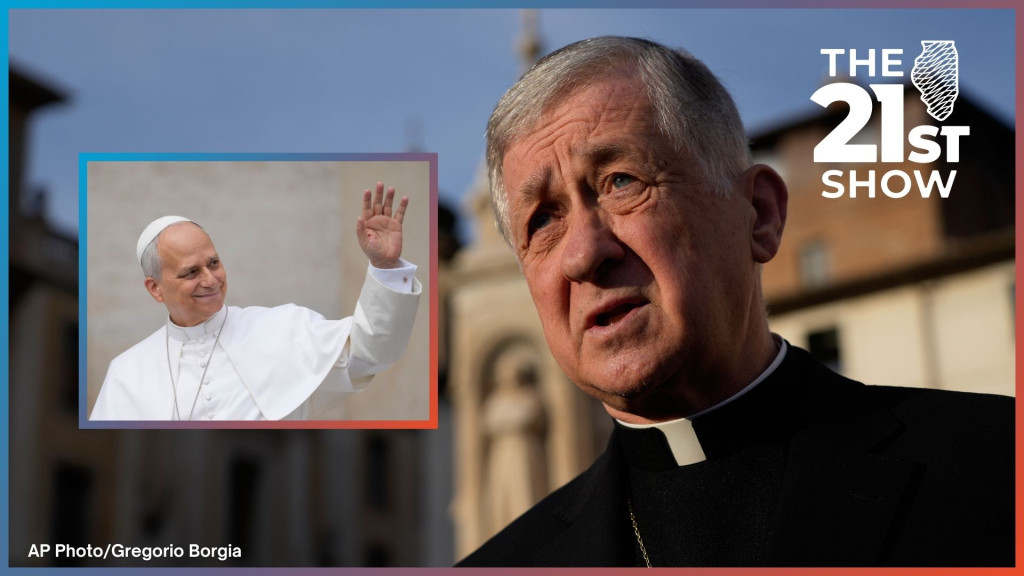
Transcript: Cardinal Blase Cupich reflects on Pope Leo’s first year in papacy, emphasizes peace and empathy
The 21st Show
Cardinal Blase Cupich reflects on Pope Leo’s first year in papacy, emphasizes peace and empathy
Read the full story at https://will.illinois.edu/21stshow/cardinal-blase-cupich-reflects-on-pope-leos-first-year-in-papacy-promotes-peace-and-defending-human-dignity.
Transcript
// This is a machine generated transcript. Please report any transcription errors to will-help@illinois.edu.

[00:00:00]
Brian Mackey: From Illinois Public Media, this is The 21st Show. I'm Brian Mackey. This Friday will mark one year since an Illinois man, Robert Francis Prevost, was elected bishop of Rome. Pope Leo the 14th, once known as Father Bob, has done what popes do: said mass in Rome, blessed babies in St. Peter's Square, met with world leaders, and preached a message of peace. That, however, has drawn multiple angry reactions from President Donald Trump. Back on April 12th, for example, he posted to his social media site, quote, "Pope Leo is weak on crime and terrible for foreign policy." The president went on to say, "Leo should get his act together as Pope, use common sense, stop catering to the radical left, and focus on being a great pope, not a politician. It's hurting him very badly, and more importantly, it's hurting the Catholic Church." End quote. Yesterday on Hugh Hewitt's radio show, Trump once again made similar false claims.

[00:01:12]
Donald Trump: The Pope would rather talk about the fact that it's OK for Iran to have a nuclear weapon, and I don't think that's very good. I think he's endangering a lot of Catholics and a lot of people, but I guess if it's up to the Pope, he thinks it's just fine for Iran to have a nuclear weapon. He's from Chicago. He's got a few things — he's from Chicago.

[00:01:31]
Brian Mackey: Let me ask you about — yesterday in Rome, reporters asked the Pope about this. He addressed the president's latest attacks. The first answer is in Italian. I'll read a translation by the Associated Press.I have spoken out from the very moment I was elected, and now we are approaching the anniversary. I have said peace be with you. The church's mission is to preach the gospel, to preach peace. If anyone wishes to criticize me for proclaiming the gospel, let them do so with the truth. For years, the church has spoken out against all nuclear weapons, so there's no doubt about that. And I simply hope to be heard for the sake of the value of God's words. The Pope addressed another reporter's questions, this time in English.

[00:02:23]
Pope Leo XIV: I always believe that it's much better to enter into dialogue than to look for arms and to support the arms industry, which gains billions and billions of [dollars] each year, instead of sitting down at the table, solving our problems and using money to solve humanitarian issues, hunger in the world, etc. Thank you very much.

[00:02:43]
Brian Mackey: I think it's worth noting that Leo's message is fairly typical, at least for modern popes, but how extraordinary it is to hear him speaking in unaccented English. We asked members of our texting group about all this. I don't know what to call it — this exchange of views between the Pope and the president. Lloyd in Danville said, "I'm an African American Catholic, which means that over the last 65 years I've questioned the church's position on many issues. However, when it comes to the current position by the Pope, I wholeheartedly agree. Politics and religion are strange bedfellows. If the religious positions are on the side of human rights, it's fair play." And Sonia in Decatur said, in part, "I believe the Pope's entitled to his opinion. He's a human being, but when he speaks to Trump, he should just save his oxygen." He — and I think she means Trump — "he's a person in his own world of power with the belief he is the most superior being on the earth." Thanks for those messages.

Today on the program, we're going to talk about the intersection of Catholicism and American politics. Later on, we'll hear from a journalist and a lawyer well versed in these matters. But first, Cardinal Blase Cupich is the Archbishop of Chicago. He's the senior leader of the Catholic Church in Illinois, where an estimated 3 million people are part of that faith tradition. That's roughly 1 in 4 of us. In order to accommodate Cardinal Cupich's schedule, I spoke with him yesterday afternoon. Because of that, no calls for the first part of our show today, but you will be able to join us later in the hour at 800-222-9455. Cardinal Cupich, welcome back to The 21st Show. Thank you for being with us.

[00:04:22]
Cardinal Blase Cupich: Thank you. It's great to be with you again.

[00:04:25]
Brian Mackey: We last spoke after the passing of Pope Francis, but before the selection of Pope Leo the 14th. Can you just speak to how well you knew Bob Prevost before his selection?

[00:04:38]
Cardinal Blase Cupich: Well, I knew of him because he was a provincial of the Augustinians here, and he also attended my installation as the archbishop in the fall of 2014. And then I knew of his work in Peru, but I got to know him more closely when he was a member of the [Dicastery] for Bishops, which I'm also a member of. And we worked together for some years, and then even more so when he became the head of that office as a prefect. So I would say, particularly in the last 10 years or so, we have gotten to know each other quite well.

[00:05:23]
Brian Mackey: Catholics have this idea of a vocation, right? A calling. How have you seen Father Bob, as he was once known, responding to his latest calling in the church?

[00:05:33]
Cardinal Blase Cupich: Well, I think that on the day of his ordination as a priest, he said yes to that call, and yes has been that answer every time that he has been chosen for a position of leadership — whether it's to go to Peru to head up a church there, to become a bishop as well, also the nomination to be the prefect for the [Dicastery], and then of course when he was elected Pope. So I think he knew that the rest of his life the answer would always be yes the day he was ordained.

[00:06:13]
Brian Mackey: What does it mean to you — to people in the diocese, I almost said parishioners — I guess broadly speaking, to have an American pope, to have a Chicago pope?

[00:06:25]
Cardinal Blase Cupich: Well, of course we're quite proud of the fact that he hails from Chicago and is known to us, that he also speaks in an idiom of English that is familiar to our ears, and that we take great pride in the fact that Chicagoans say we produced a pope. There's something good about this local church here that seemed to be the place where he was formed and where he became the person that he is through his parents and schooling. So I think that there is great pride in the fact that he hails from here.

[00:07:10]
Brian Mackey: Well, one of the reasons we're talking today is that the Pope has really become central to the American political conversation, for better and worse. And I wonder what has been your impression watching that unfold — in the past year, I guess, but specifically in the past few months.

[00:07:28]
Cardinal Blase Cupich: Well, I think it's important to keep in mind here that the Holy Father does not come at these issues from a political standpoint, but in terms of proclaiming the gospel. He's not a political rival of anyone, but rather is someone who brings to the discussion of global events the eyes of prophetic witness to the gospel. So I think that it's important to make sure that we properly understand how the Holy Father sees his role, and that he can't be reduced to just another leader who has a political agenda. That's not how he views the world, or how the church views the role of the papacy.

[00:08:23]
Brian Mackey: Yes, and one of your fellow cardinals — you were on 60 Minutes not long ago, and I think it was one of your fellow panelists on that program who made the comment, "He's not a pundit." And so I wonder if you can speak to how you and other leaders in the church decide how and when to speak out when political matters are of concern to people of faith.

[00:08:50]
Cardinal Blase Cupich: Well, I think that we want to make sure that issues that impact humanity don't lose sight of the important principle of human dignity — that is, I think, lost sometimes when we begin to think of issues in a very narrow sense of what national gains would be, what the ability of one country over another can dominate because of military force. But there are other principles involved that have to enter into the discussion. Maybe another way of putting it is: sometimes the language that people bring to the discussion of global affairs is very narrow, and we're trying to expand that language to include a moral framework that puts at the forefront human dignity.

[00:09:50]
Brian Mackey: Well, I wonder if you can speak more broadly about that moral framework — because there are many strains in American politics that run counter to Catholic teaching, whether it's on abortion or the death penalty or care for the dignity of immigrants or opposition to unjust wars. I don't necessarily want to get into a point-by-point discussion of American politics, but I wonder if you can talk more about the unifying idea — the moral idea — behind what unites those values, I should say.

[00:10:20]
Cardinal Blase Cupich: Well, then I would go back to what I just said about the principle of human dignity and respect for the rights of people that cuts across all of these issues that you just mentioned — with regard to immigration or the death penalty, the protection of the unborn, war and peace, the rights of poor people, that they would have a place at the table. So what it really comes down to is: how can each and every individual flourish in society, and allow them to live the life that God has given them to the fullest extent possible? Whenever that dignity is challenged or undermined, then we have to make sure that the society keeps that in mind, and that's when we raise our voice in protection of all of those people who are all created in the image and likeness of God.

[00:11:24]
Brian Mackey: Few, if any, American politicians embody the full range of Catholic social thought. And so I wonder how do you recommend people think about — when they are trying to decide how to live their values, how to live their Catholic faith in how they think about participating in civic life — holding that in mind when there are no perfect choices?

[00:11:47]
Cardinal Blase Cupich: Well, you know, one of the things the Holy Father said last year is that, in terms of being respectful for human life and dignity, you can't focus on just one or the other issue, cherry-picking them in a way that suits you. You have to be consistent in your approach to defending human dignity, whether it's the unborn or the person on death row — they all deserve that kind of respect. So I think sometimes when church leaders raise their voice, it makes people uncomfortable, but that discomfort comes from the fact that they've decided in some way to limit their understanding or their appreciation of the respect for human dignity to just one or two issues. And the Holy Father challenged that recently. He says you cannot consider yourself pro-life if you're only for the life of the unborn and don't say anything about the death penalty or migrants or the inhumane treatment of migrants. And I think that does make people feel uncomfortable because it challenges the very limited scope that they give to defending human dignity. Our job is to make sure that people understand that all of the aspects in which human life and dignity is threatened are part of the agenda of the church.

[00:13:18]
Brian Mackey: I wonder what it says to you when a simple moral precept like — the Gospel of John, if I remember correctly — "love one another," right, can come across as a personal or a political attack in our current environment here.

[00:13:34]
Cardinal Blase Cupich: Well, I think that the gospel — as Jesus said, the two great commandments: to love God with all your heart, soul, and mind and strength, and your neighbor as yourself — that's the foundation of the Christian gospel. And how that is lived out in people's lives is always a challenge. So I think that our job is not to make people comfortable, but to challenge them to understand the full breadth of what the gospel entails.

[00:14:12]
Brian Mackey: Earlier in our conversation, you mentioned Pope Leo the 14th speaking in "the idiom of English that is familiar to our ears" — I think that's the phrase you used. An American accent, perhaps even a Chicago accent. Sometimes I distinguish — although obviously he spent a lot of time speaking Spanish in South America, and he's multilingual. But talk about what that matters, right? It's such a different experience than any living person has known: to see the Pope on TV — they're used to that; to hearing the Pope's pronouncements often translated — they're used to that. But to hear it directly from the man himself, in Chicago English.

[00:14:53]
Cardinal Blase Cupich: Well, again, I think that ears do perk up a bit when someone addresses you in a familiar idiom. And I think that it's a lot more convenient for us to pay attention, rather than maybe dismiss someone because of an accented voice — or maybe even think that they came from a culture that doesn't understand Americans. That can't be said about Pope Leo. He's familiar with life here and the culture. And at times in the past, there were people who dismissed Pope Francis saying, well, he was from Latin America and doesn't understand us. That doesn't fly in the instance of Pope Leo.

[00:15:47]
Brian Mackey: Alright, let me take a moment to remind listeners: this is The 21st Show. We are talking today about the intersection of the Roman Catholic faith and American politics. My guest for the first part of the program is Cardinal Blase Cupich, Archbishop of Chicago. I spoke with him on Tuesday afternoon in order to accommodate his schedule. Because of that, we're not taking calls for him, but we will be taking calls later in the hour. If you want to join us, the number to do so is 800-222-9455. That's 800-222-9455. We'll continue after a short break.

This is The 21st Show. I'm Brian Mackey. We are talking today about the intersection of American politics and the Roman Catholic Church. Obviously, Pope Leo has been speaking out — as popes do — with the message of peace, denouncing war, and that has drawn a furious reaction on multiple occasions now from President Donald Trump, including yesterday when he was on the Hugh Hewitt radio program and basically falsely accused Pope Leo of favoring Iran having nuclear weapons. Obviously, the Pope has long spoken out against nuclear weapons. That is the official position of the Catholic Church. But beyond this back and forth, we're also talking about how Catholics live their political lives in America, given that Catholic teaching does not neatly line up with the political parties we have here.

A little later in the hour, we're going to hear from a journalist and a lawyer who are both well versed in these matters. But for now, let's get back to my interview with Cardinal Blase Cupich of Chicago, with whom I spoke on Tuesday afternoon. The president has speculated that Leo was chosen because of his, you know, Americanness. I know you were in the room where it happens — quite literally, to quote Hamilton. The proceedings are secret. Forgive me if this is an inappropriate question, but can you speak to the why of his selection?

[00:18:00]
Cardinal Blase Cupich: Well, I think the president really said that he was selected because he was the president at this time, and that he in some way was responsible for his election — unless I'm not reading that right.

[00:18:17]
Brian Mackey: Well, and I guess — maybe it is a difference of interpretation, or maybe it's my misunderstanding. I took it to mean the church wanted to send a message to Trump, and that's why they selected [him].

[00:18:28]
Cardinal Blase Cupich: OK, then I think that's probably a good interpretation, but I would just say this: it was not even mentioned. It wasn't even on the radar screen of anybody. What we did was we chose someone that we felt best could lead the church at this point. In our discussions prior to going into the conclave, we identified what are the qualities that are needed for an individual, and it's based on that discussion that we then were able to identify the proper candidates and then finally select one — namely, the present pope.

[00:19:06]
Brian Mackey: And I know it was a while ago now, although a short time in church history. So what is it about him that makes him uniquely qualified at this time?

[00:19:15]
Cardinal Blase Cupich: Well, look — just look at his track record. He's lived on a number of continents. He has traveled to 40 countries as the head of the Augustinians. He's fluent in a variety of languages. He has missionary and pastoral experience, but also administrative experience. So I think you see that he checks a lot of boxes for a world-class leader who is going to be able to appreciate the diversity in the church but also to create unity. So just look at his curriculum vitae and you can see what is so compelling about him.

[00:19:59]
Brian Mackey: One of the comments for which the Pope seems to have drawn the most angry reaction from the president has to do with the war in [Ukraine — can you speak to what the church teaches about war? This idea of a just war has come up quite a bit, and we hear American politicians citing the Bible for justification of their actions. Can you speak to those topics?

[00:20:25]
Cardinal Blase Cupich: Well, I gave a talk this past week at the Chicago Theological Union, and it's been published now in America magazine, in which I make the point that the starting point of trying to figure out if this is a just war is not the right starting point. What the real starting point — in the manner of the gospel — is, is: how do we promote peace? That should be the first impulse that we have as a Christian people. That is what Jesus talked about when he came to the disciples after the resurrection and said, "Peace be with you." So the Holy Father is saying to the world: forget about trying to back into the corner of whether or not a war is justified. That's a nonstarter. The real issue is what does the gospel demand of us in terms of promoting peace. So I think that's the real question.

[00:21:22]
Brian Mackey: Americans seem to be more divided than most of us can remember in our lifetimes, by our politics, for those of us who are engaged in politics. I wonder what is the church's message in terms of attempting to bridge some of those divides — regardless of which policies people end up preferring, is there a role for the church in trying to bring people back together?

[00:21:47]
Cardinal Blase Cupich: Yes, and I think it's by helping them to speak to one another, to talk about these issues, to have dialogue. That is something that is at the heart of the reason we're offering people a different language to talk about these issues, rather than the polarizing language that is very much framed around nationalism or nationalistic goals. How do we speak to one another from a very human level about what we value and what's important?

I think by getting people just to sit around the table and speak in dialogue — one of my cardinal predecessors years ago, who was the son of John Foster Dulles as Secretary of State, and that is Cardinal Avery Dulles, once said that dialogue is about giving people across the table from you permission to tell you why they think you're wrong. And I think that kind of dialogue and interchange is critical right now. People are not talking to each other; they're shouting at each other. And I think the church can be a means by which we give people the language to speak to each other and to listen closely to what each other has to say.

[00:23:11]
Brian Mackey: It almost sounds like — and I'm thinking back to my own Catholic education here — the idea of humility as something to bring into our interactions, into our civic lives, into our politics. Can you speak to that?

[00:23:26]
Cardinal Blase Cupich: Yeah, well, humility, of course, is necessary if you're going to listen to somebody. You have to suspend your own ego and what you want, to really be curious about what another person has to say. And I think that is a very important aspect, and I think you have your finger on the pulse of what's needed. There is a kind of humble openness — as I said, this business of giving permission to the person across the table from you to tell you why he or she thinks you're wrong.

[00:24:03]
Brian Mackey: I wonder if you have advice for Catholics navigating a media ecosystem — an information environment that rewards people seeking out the views they want, and sometimes their outrage — and it certainly simplifies and flattens some of the moral questions we face. What advice do you have for people in that regard?

[00:24:24]
Cardinal Blase Cupich: Yes, that is a real problem, because you're right — people gravitate towards news sources in which they feel reinforced in the opinions that they already have. And that's why I think maybe that's what the Holy Father is doing in speaking out: disrupting that, and giving people a chance to break out of that pattern of behavior and realize that you can be held hostage by a particular media source that's just going to continue to treat you as though you're subject to whatever they have to say. And if the Holy Father's words do challenge people to break out of that kind of enslavement, I think that he's doing a great service. But to listen to someone like the Holy Father and give serious consideration to the fact that maybe the opinions you have formed — and that are being reinforced by a particular media source — are really not correct: I think that's a great service.

[00:25:39]
Brian Mackey: The last thing I want to ask you about is just sort of parting thoughts as people are trying to navigate this very polarized time. There are conflicting messages from every corner of life. What advice do you have for people in terms of just trying to make sense of this very confusing world we're in?

[00:26:01]
Cardinal Blase Cupich: Well, I think I would just encourage people to first of all have a real sense of empathy for anyone who's suffering. We all suffer as human beings. We have our limitations, but to really have an openness to the fact that we're all very vulnerable human beings — we have the same limitations in life, and we should really care about each other.

I believe that this new moment in history with regard to the development of artificial intelligence has the opportunity to bring us together, in this sense: that we will see that there really are some threats to us with the development of this technology, especially if there are no guardrails going forward. There are going to potentially be a lot of people who are going to be disenfranchised from society. There's going to be disruption in the job market. Also, the security of our systems and finances could be upended if this artificial intelligence is not brought into some sort of control. So I think that we should all care about the fact that this technology could have a negative impact on society today, and we should all begin to think in a unified way about how the unity of the human family is going to be the most important thing going forward. So I think within a year or so we're going to see some developments in this technology that are going to frighten us and maybe bring us together.

[00:27:51]
Brian Mackey: Cardinal Cupich, thank you for being with us today.

[00:27:54]
Cardinal Blase Cupich: Thanks a lot. Good to be with you, Brian.
Transcript Assistance
Illinois Public Media may use AI assistance for transcript generation and/or formatting. Transcripts that have not yet been reviewed for accuracy will be labeled.
To report a transcription error, or to request transcription of archival material, please contact will-help@illinois.edu.