








Transcript: Illinois without Cook County?
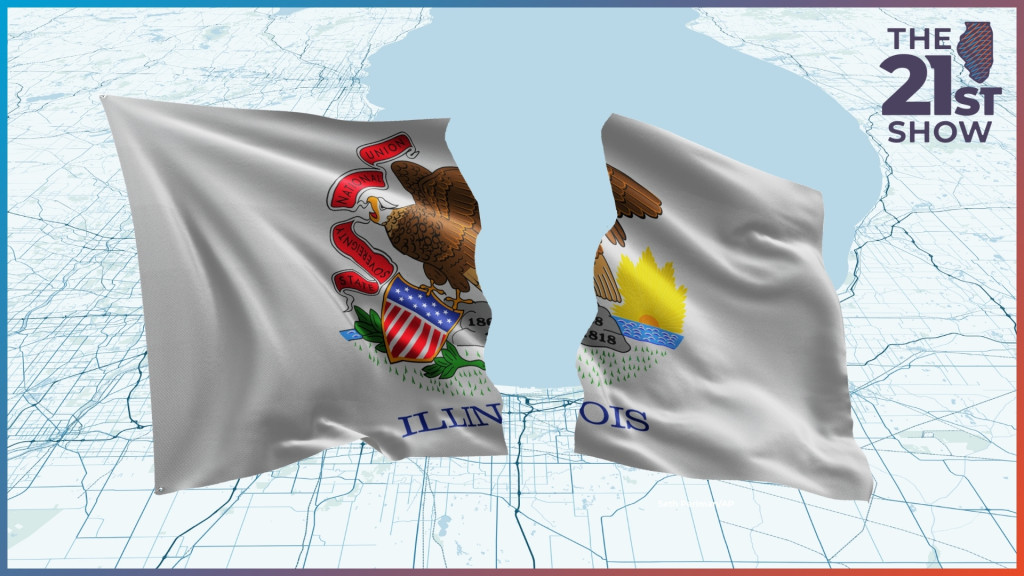
Transcript: Illinois without Cook County?
The 21st Show
Illinois without Cook County?
Read the full story at https://will.illinois.edu/21stshow/illinois-without-cook-county.
Transcript
// This is a machine generated transcript. Please report any transcription errors to will-help@illinois.edu.

[00:00:00]
Brian Mackey: From Illinois Public Media, this is the 21st show. I'm Brian Mackey. This fall, Illinois voters in at least another six counties are going to be asked whether they support the idea of partition. That is, Illinois becoming two states. There are multiple groups pursuing this idea. The one calling itself New Illinois, tagline, "Leave Illinois without moving." They want to slice off Cook County, which I guess would remain old Illinois. Then the other 101 counties, from Lake, Winnebago and Jo Daviess in the north to Alexander, Pulaski and Massac in the south, they would make up New Illinois.

We've talked with this group and others in the movement in the past, but this year they're getting national attention, and that's thanks in part to the work of reporter Connor Towne O'Neill. He's been filing stories for NPR as part of their broader America 250 coverage. That includes a feature on All Things Considered and a full half-hour episode of the Sunday Story podcast just this past weekend. O'Neill's experience at NPR also includes the podcast White Lies, season one of which was a Pulitzer Prize finalist. Connor Towne O'Neill joins us today in studio in Urbana. Connor, welcome to the 21st show. Thanks for being here.

[00:01:20]
Connor Towne O'Neill: Hey, Brian, good to be with you.

[00:01:22]
Brian Mackey: Before we get into it, I do want to mention we asked members of our texting group about that. You can join us by going to our website twentyfirstshow.org. We've got instructions there.

Brandy in Urbana says, "I'll vote against splitting Illinois off from Chicago. We don't generate enough tax revenue downstate to support ourselves. I'm also grateful for the progressive pull big cities provide. I'm a proud Illinoisan, and I do think Springfield is responsive to downstate needs. It seems like those who think otherwise wouldn't be happy either way on many issues."

On the other hand, Tom in Elburn says, "I think it's a great idea. The Democrats have control over the entirety of the state due to extreme gerrymandering. They do not represent the opinions and values of the rest of the state. They've ruined Illinois financially and continue to create deficits despite innumerable tax increases. I'm all for the division of Illinois into two states."

You can join the conversation today at 800-222-9455. We're on this topic for the first half of the show. What do you think of this? Do you think state government is or is not responsive to the concerns of people outside Cook County? And if you get the chance, if you're in one of these counties, will you vote for or against? 800-222-9455 is the number. 800-222-9455.

All right, Connor, let's start with some background. Talk a little bit more about what is motivating this push for partition.

[00:02:51]
Connor Towne O'Neill: Yeah, so I think it's incredible that the two text responses you got so far, I think, lay out a lot of the issue pretty succinctly. But basically, this group, or a number of groups within this movement, that want to create the 51st state — they see a whole host of grievances about the state. What they see as tyrannically high taxes, what they allege are unconstitutional gun laws, and they look at this, you know, democratic supermajority wielded by Democrats in the state legislature as serving urban needs, Chicago needs.

One of the things that people are most exercised about — the thing that gets mentioned time and again — is the gas tax, which Illinois has one of the highest gas taxes in the nation. People in the movement see that as this undue burden on rural people who maybe live 30 to 45 miles from where they work. One person said, you know, there's not a business within five miles of where I live, so I'm driving all the time and I pay this high gas tax. And then, to compound that, they say, you know, the state is using proceeds from that gas tax to subsidize the CTA in Chicago. And so they point to that as this emblematic issue — that the state is set up in such a way that it benefits people in the city and doesn't serve the interests of folks in the rural counties. So I think that gives a nice sort of nutshell of the issue.

Yeah, yeah, go ahead. The question then, of course, as I think Brandy got at when she texted in is, you know, does something like that, does that issue warrant creating a whole another state and grappling with the issues like funding a new state — that's to be determined. But that's the real tension in the issue right now, I think.

[00:04:39]
Brian Mackey: Yeah, we got another text message on this point. Steve in Mattoon says, "It's the stupidest idea that's ever come out of the southern half of the state." Which, ironically, I think one of the organizers says this is from the very north part of the state, but I digress. He says, "People just don't seem to realize how much of our money from the southern part of the state comes back to us. At least $1.80 — some of the counties on the river get $3 back."

And Connor, I know you looked into this. There is this impression of state spending that is way — how do we say — at variance with reality. You know, the Simon Institute at Southern Illinois University Carbondale — now, it was a decade ago, but they looked at these numbers, and, you know, you think of where the miles and miles of roads are, the universities, state parks, prisons — it's all downstate, mostly. And that means a lot of state infrastructure money, for example, goes there. How do people in this movement reckon with that?

[00:05:36]
Connor Towne O'Neill: That's right. That study from the Paul Simon Institute gets brought up time and again and really exercises people in the movement. Because you're right, as that study lays out, it's almost $3 in return in state services — like the ones you laid out: parks, universities, roads — for every $1 that they're taxed. They get almost up to $3 in the southern portion of the state in state services.

Now, leaders in the New Illinois movement push back on that, though, because they quibble with the numbers and how it works, and I don't think we need to get into that. But if you just take at face value what those numbers say, they push back and say, look, that's the state as it's construed now. If we have our own way — which really, I think, they mean if you give us our own state — we're going to totally change how the state runs, how the state is taxed, what kind of business regulations are here. They look at people leaving the state, businesses leaving the state, and they say, look, if we lower our taxes and we create a more business-friendly environment here, people are going to stay, businesses are going to stay, businesses might even relocate here — sort of the Florida playbook in some ways. And that's going to totally change how the state is taxed and what kind of return downstate gets. So it's a sort of — they want to render the Paul Simon study and those tax figures moot, because they say, look, that's how it's construed now, but we could change all of that and have a more business-friendly kind of state.

[00:07:05]
Brian Mackey: I think it's interesting that their dividing line is Cook County, right? Not Chicago, not what we think of as Chicagoland, which classically includes Lake, McHenry, Kane, DuPage and Will counties — the collar counties. And now I think you could even argue Kendall and Grundy; there's been so much exurban sprawl that they're part of the metroplex as well.

So — OK, you're an experienced radio and podcast producer, so you know numbers are bad on the radio, but I'm gonna try anyway here. Illinois has 12.7 million people. Cook County is 5.2 million. So New Illinois without Cook County would be 7.5 million. It would be a bigger state, actually, if you leave the collars in. And we'd — instead of being the sixth most populous state, we'd be 14th, which is like Arizona, Tennessee, in that range. If you actually keep the population center together — which I know no one is asking for, but Cook and the collars — they would still be, you know, 8 million people. Downstate would be 4.3 million, which is like Kentucky or Oregon level.

Talk about what they reckon with, where they put this dividing line. And the idea that — because something I've struggled with in this is that the suburban counties have trended blue as well. I'm not sure it would deliver the results they're thinking and expecting.

[00:08:27]
Connor Towne O'Neill: Yeah, it's a good question, and where that line gets drawn has changed over time. There's a downstate Rep. Brad Holbrook who represents Shelbyville. He's the person who introduces the legislation to try and get this to happen, because — just to back up — for this to actually happen, the Constitution does lay out a mechanism for starting a new state out of the territory in an existing state, and you need the state legislature's approval and then the U.S. Congress.

And so there is a rep who's, I think, on the executive committee of New Illinois — Rep. Holbrook — who's introduced legislation to try and get the mechanics of this actually going. And the first time he introduced the bill, it was just Chicago. They've now — the most recent time he introduced the bill again, in the most recent legislative session — now it's construed as the 101 counties not including Cook County. And I think part of that just has to do with the continuity of going county by county. The ballot referendums work county by county.

So the real proof of concept that they have for this as a movement comes from these ballot referendums that are working county by county. And — not to get into the whole, you know, bureaucratic stuff on the radio — but how counties would switch over and start a new state: leaders in the movement understand the logistics of that to be a little bit easier if you go county by county. So they say, all right, Chicago, we really want to leave Chicago, but maybe it's easier to leave a whole county than just a city.

[00:09:59]
Brian Mackey: Well, you mentioned these referendums — these are advisory. What kind of success or failure have they had so far?

[00:10:06]
Connor Towne O'Neill: It's been success across the board. Since 2020, the Illinois separation referendum — which is another group within this movement — they've put this advisory question on the ballot in 33 counties, and every single county has voted yes, often overwhelmingly so. I think it's an average of 70%, sometimes upward of 80%.

Now, a lot of these are rural counties. Moultrie County, pretty small county. But Iroquois County, pretty big, closer to Chicago. And Madison County, over by St. Louis — you know, something like 250,000 people live in that county. They voted yes.

And there are actually eight more counties that are going to have it on the ballot here in November. It's gone up since that story ran — I've been able to confirm two more county boards have approved the referenda appearing. So, eight more counties, perhaps up to 11. The deadline for getting the referendum on the ballot is in August. So if 11 happened, that puts the number up to 44. So by the end of the year, nearly half the counties in the state could have voted on this.

[00:11:15]
Brian Mackey: Iroquois County — maybe larger geographically — 26,000 people live there. One of the things I did not have time to do in my fun with numbers this morning is tally up all the counties that have voted for it. And I'm curious if the population adds up to — well, obviously it's not gonna add up to Cook County, because like almost half the people in the state are in Cook County. But it's a really small number.

You know, one of the other questions that came up, too, in text messages from people is the idea of sour grapes. And I wonder — is this really just a movement of partisans, Republicans dejected over the fact that a majority of Illinoisans vote for Democratic politicians?

[00:12:00]
Connor Towne O'Neill: I think that's definitely in there. You know, you mentioned some of these stories that I've been doing, running as part of the NPR package about the 250th anniversary of the Declaration of Independence. Leaders in the movement really talk about themselves in terms of the Declaration of Independence — take inspiration from the Declaration of Independence, allege that this is taxation without representation. [They] have actually officially and formally declared independence from Cook County and, like the Founding Fathers in their declaration, they have a list of grievances. So there are grievances — and they talk about them, capital-G Grievances — and so yeah, I think that sense of grievance is definitely a part of it here.

And I think part of that has to do with — talking with a lot of people in the movement — they feel this deep connection to this place. One of the people I talked to lives in a house that his great-grandfather built. Another lives on family land, homes that their fathers built. They feel this connection to the place, but then they look at how the state is run politically. They don't see their politics represented in it. They feel completely shut out from affecting the kinds of changes that they'd like to see in this place. And yet at the same time they feel this deep connection to the place, and I think that fuels a lot of that grievance.

[00:13:15]
Brian Mackey: I'm gonna share another couple of messages from listeners here. Julie in Bettendorf gets at some of those ideas of cultural differences and grievance — I guess she doesn't use that word. She says, "Separating Illinois is not a productive idea. I believe it stemmed from the vast differences between local culture in Chicago and that of downstate. But show me a state that doesn't have that between their big cities and the more suburban or rural areas. I think trying to separate them is selfish and naive. Separating the two won't magically create more resources or funds for one or the other. It's very much an us-versus-them, and a cop-out to working together and building community. We are the land of Lincoln. We belong together."

And we also heard from Terry in the Quad Cities, who says, "Downstate Illinois was primarily responsible for causing the graduated income tax to fail." And I'll just interject here: this was a constitutional amendment that the governor supported some years ago, although it failed to get the necessary supermajority to actually make it into the constitution. Terry continues, "It would have shifted more of the tax burden only to higher-income people. Where are they located? Chicago and the suburbs. So if tax was their problem, why did they not shift it northward?"

I don't know if you have a response to either of those, or how the movement has responded to those sorts of critiques.

[00:14:37]
Connor Towne O'Neill: Yeah, you know, I did speak to an expert on secession movements — Kenneth Owen, who's a professor at University of Illinois Springfield — and he talked a lot about how, often, traditionally, in other secession movements that he's looked at, the threat of secession can kind of be a way of renegotiating a social contract in the state. He pointed to an earlier movement in Illinois — Forgottonia — where western counties in western Illinois were feeling neglected by the state and created a secession movement they called Forgottonia. And that instigated a bunch of public works projects and roads projects specifically in the western part of the state in the late '70s that addressed some of those issues.

And so Dr. Owen thinks about this idea that, you know, if you're unhappy about specific things, you feel like you don't have any recourse, and so if you threaten secession, that can start a new kind of conversation and get things moving to some kind of compromise — or, as he puts it, a renegotiation of the social contract — to try and bridge some of these urban and rural differences.

Now, the issue, though, is that, you know — let me, let me actually —

[00:15:50]
Brian Mackey: I'm sorry, I'm gonna interrupt you — because we need to pause here, and we'll come back to that. [Forgottonia] got some very nice highways. Not super well-traveled, I will say, even to this day in western Illinois. But that's something we can continue after a break.

We're talking with Connor Towne O'Neill — writer, reporter, producer. You've heard his work producing the White Lies podcast for NPR, and he has been reporting on the New Illinois movement. You can join us at 800-222-9455. This is the 21st show. We'll be right back.

It's the 21st show. I'm Brian Mackey. We are talking about the idea of partitioning Illinois into two states, which there are a number of groups still pursuing. One, calling itself New Illinois, has been the subject of some recent reporting by Connor Towne O'Neill for NPR. His work has been on All Things Considered — a feature about this — and the most recent full half-hour episode of the Sunday Story podcast was about this. It's part of NPR's ongoing America 250 coverage.

And we asked our listeners about this. We've got a lot of text messages in very short order, mostly running against — a lot of sort of "What's the Matter with Kansas" type ideas, if you remember that book from 20 to 25 years ago.

Cheryl in Sullivan, Illinois says, "I think it is ridiculously silly. Chicago helps downstate Illinois both financially and culturally. I think most people who support the separation are critically uninformed."

And Randy in rural Peoria County says, "It reminds me of Brexit. So let us just keep inflicting unnecessary pain. Somebody has way too much time. I think if that happens, I am moving. Wow, that is a bad idea."

You can join us at 800-222-9455. We're on this topic for about just another seven minutes or so. And we're talking about it with Connor Towne O'Neill, who's been reporting on this for NPR.

Connor, before the break — I'm sorry I had to interrupt you. We can pick up where we left off there, or, you know, move on to some meta questions that I'm hoping to talk with you about here.

[00:18:08]
Connor Towne O'Neill: Well, yeah, I think — I was pointing to this earlier movement in the '70s, Forgottonia, in western Illinois. And that gets pointed to as a sort of proof of concept for this idea that, yes, people threaten secession as a way of getting attention. It's such a provocative term, secession, right? Someone mentioned the Land of Lincoln — the associations, the connotations we have with the Civil War — it really sparks something, it gets attention. Once you get that attention, people who study secession movements say, oh well, that becomes the way of starting a conversation that brings things back together, that might keep the state as one.

The issue now, though, is that this is coming at a moment of such fierce political polarization in the country. And I think the polarization in Illinois — this urban-rural divide — really gets at something that is a major issue in the country. And so I suppose the question is, does that old dynamic — where you threaten it but only to sort of get the ball rolling on a conversation and come back together — can that happen now? I think that's a question on everyone's mind.

[00:19:14]
Brian Mackey: All right, let's get meta in the time we have remaining here, because I've got to admit I'm conflicted about covering this every time it comes up. We've done two full hours on this in the past couple, three years now, I guess.

On the one hand, it's happening, right? This is a deep sentiment. And I will say the Democrats have not done themselves favors with the extreme gerrymandering, right? Illinois is — if you look at statewide election returns, it's basically a 55-45 state in the Trump era. Although, you know, set aside the fact that we, as recently as a decade ago, had half our statewide electeds as Republicans. But Illinois is a 55-45 state. The Democrats have gerrymandered it to be much bigger margins for themselves than that in the General Assembly.

On the other hand, you know, the people saying these things, putting real questions on real ballots — these are advisory, they're not binding — but still, it's a fantasy. It would need the consent of Illinois government, which is never gonna go for this. And so sometimes I wonder: Is coverage playing into an unrealistic fantasy? And I wonder how you reckon with that.

[00:20:16]
Connor Towne O'Neill: Yeah, it's a good question, and I've received a lot of response from some of these stories. My editor at NPR has been forwarding me listener responses, and there is that meta question of the role of covering this if it is such a long shot.

And, you know, I tend to work by the motto from the journalist Scott Carrier, who talks about how he tries to move toward the scary thing mostly by listening. And just to clarify: the scary thing, in this case, I mean the fierce political polarization in this country right now, and the divide, and often what sparks into political violence in this country — that is the scary thing for me. And so I'm trying to move closer to that thing mostly by listening.

And so when you hear about New Illinois and when you see these returns on the ballot referenda, you think something's happening here. Now, does it have the popular support of the state legislature for it to actually go at the moment? No. This bill that was introduced in the last legislative session didn't make it out of committee — actually, didn't even make it into committee. It didn't make it out of the rules committee, which is the first stop. So, yes, it's a long shot in that way.

And yet it is happening, and there is serious support behind it in some places in the state. Obviously, as we're hearing from listeners and as I've been talking to people, that is by no means across the board — not all of downstate supports this. No. And yet there is a big minority — that minority of people in the country who support this. And because they're in that bind where they really want this to happen and it really seems like a long shot of happening, that is putting a lot of tension on the movement, and people are trying to figure out now what to do about that. They feel like their only recourse is to start a new state, and that thing — because of the requirements of the Constitution — just isn't gonna happen. So what then?

[00:22:16]
Brian Mackey: What then, exactly? And that's where I worry. And we shared in our pre-show communications — we don't have to get into it — but there was this really fascinating study from this group called the Agora Institute. It's out of Johns Hopkins. They do like focus groups on steroids, where they spend weeks and months with individuals around the country, just really getting to know them and their views. And they did this thing — "Faith, Freedom, Family, Place" — an ethnographic study of conservative Americans' relationships to democracy. And the big takeaway — people can read this, we'll put a link to it on our website, twentyfirstshow.org — but the big takeaway for me is that there are a group of conservative people in this country who really feel alienated, even as they have a trifecta in federal government right now. Really feel alienated.

And I wonder, you know, movements like this sort of play into that thinking. There is a fantasy way out of this that is not working with your fellow Illinoisans to try and compromise or gain power back by persuading people — right? Just sort of taking your chips and going home. And, again, I don't know if that's something that people in this movement are really reckoning with, or how they're approaching it.

[00:23:25]
Connor Towne O'Neill: Yeah, it's an interesting question, and some people have talked to me about it as a kind of pressure-release valve — that being a part of this movement is a way of channeling some of those grievances, some of this feeling of being shut out from state politics, being alienated from power in those ways. And that working to get these on the ballot referendum, talking to neighbors, going door to door, doing this grassroots movement, assembling signatures on petitions — that's a way of channeling that frustration into the political process.

Now, people might disagree about how productive that specific process of our politics is, but they're engaged, and they're getting out there, and they're attempting to follow what the Constitution lays out, what state laws lay out, how county boards work. I mean, in some ways this is an education in civics. Getting spun up on this story is learning a whole lot about county procedures, state procedures, federal procedures, the Constitution, the Declaration of Independence.

So it's a really engaged political process. But because there is this alienation involved, too, some people feel like, well, if it doesn't work, what are we gonna do then? And one person I talked to is ready to grab his gun. They just feel totally stymied, and that if we're not gonna get the votes in the legislature, then our only recourse is something more violent.

[00:24:46]
Brian Mackey: And down that path, suffering lies. Connor Towne O'Neill — writer, reporter and producer — he's been covering the New Illinois movement for NPR. Thanks so much for being with us today on the 21st show.

Connor Towne O'Neill: Thanks.
Transcript Assistance
Illinois Public Media may use AI assistance for transcript generation and/or formatting. Transcripts that have not yet been reviewed for accuracy will be labeled.
To report a transcription error, or to request transcription of archival material, please contact will-help@illinois.edu.