Transcript: Two friends channel grief into advocating for peace in Holy Land
Transcript: Two friends channel grief into advocating for peace in Holy Land
The 21st Show
Two friends channel grief into advocating for peace in Holy Land
Read the full story at https://will.illinois.edu/21stshow/palestinian-and-israeli-friends-channel-grief-into-advocating-for-peace-in-holy-land.
Transcript
// This is a machine generated transcript. Please report any transcription errors to will-help@illinois.edu.

[00:00:00]
Brian Mackey: Today on The 21st Show, in the long wars over Israel, countless thousands have been killed. That includes family members of Maoz Inon, an Israeli, and Aziz Abu Sarah, a Palestinian. And yet together they're holding on to hope. They've written a new book. It's called The Future Is Peace. I'm Brian Mackey. We'll talk with Inon and Sarah for the hour today on The 21st Show, which is a production of Illinois Public Media, airing on WILL in Urbana, WUIS in Springfield, WNIJ in Rockford-DeKalb, WVIK in the Quad Cities and WSIU in Carbondale. But first, news.

From Illinois Public Media, this is The 21st Show. I'm Brian Mackey. More than 2.5 years ago, on October 7th, 2023, Hamas launched an attack on Israel. Some 1,200 Israelis were killed that day. Hundreds more were taken to Gaza. In Israel's response, more than 70,000 Palestinians have been killed. And even six months after a ceasefire agreement, the war goes on. It's the latest chapter in a conflict that has lasted for decades, part of what my guests today call a hurricane of violence and vengeance.

In their new book, The Future Is Peace, they write: "The scars of our generational trauma are deep. We are so divided by fear and anger, by extremism and tribalism, that we can no longer see each other's humanity or feel empathy for one another's suffering. We live the histories handed down to us, but if Israelis and Palestinians are to build a shared future, then we must, for the sake of both of our people, the only way forward is to tear down the walls of ignorance and hatred that divide us."

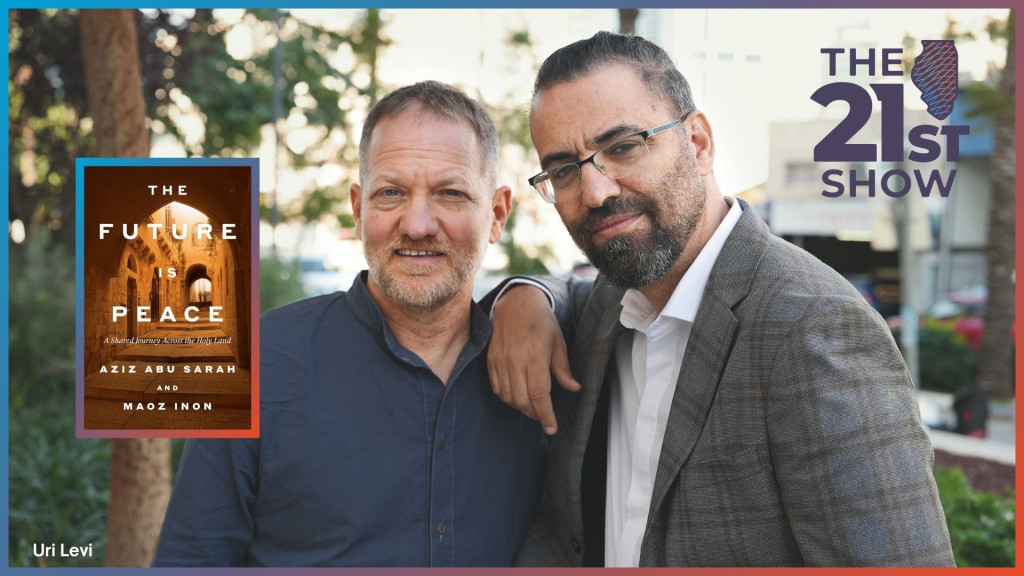
That is from the introduction of the book. Again, it's called The Future Is Peace: A Shared Journey Across the Holy Land. It was written by Aziz Abu Sarah, a Palestinian, and Maoz Inon, an Israeli. They connected after Maoz's parents were killed on October 7th. Aziz also knows the pain and grief of this long war. Decades ago, the brother with whom he shared a bedroom died after almost a year of captivity and torture by the Israeli government. Together, Aziz and Maoz built a friendship and channeled their grief into their work toward a lasting peace. They're with us for the hour today.

Aziz Abu Sarah and Maoz Inon, my condolences for your losses. Welcome to The 21st Show.

[00:02:53]
Aziz Abu Sarah: Thank you, Brian. It's a real honor to be with you at The 21st Show, and to everyone in Illinois, we just say hi and how honored we are to speak to you today.

[00:03:04]
Maoz Inon: Yeah, same here, and Brian, I love when you read the book. I'm like, we should have had you read the Audible. People are stuck with my voice now.

[00:03:14]
Brian Mackey: The words are beautiful. Let me invite our listeners to join us throughout the hour today at 800-222-9455. What does peace in this area look like to you? How have the wars of the past few years changed how you think about the prospects for peace? Or maybe you just have a question for our guests about their journey and their friendship. Again, you can call us throughout the hour at 800-222-9455.

Aziz, I want to begin with you. Tell me about your dual narrative approach to history and tourism.

[00:03:52]
Aziz Abu Sarah: Absolutely. So I grew up only knowing one narrative, and I think most of us — Israelis and Palestinians — only grew up knowing our story. If you listen to media, if you — the people with you in school or schools are very much either Israeli Jews or Palestinian Arabs, and so I knew only one of those narratives. And when I started doing my peace work, I quickly realized that one thing I want to do is to change that reality and expose both locals and travelers who come to the Holy Land to both narratives.

And I ended up partnering with a Jewish friend, Scott Cooper, who lives in Illinois, to start a company called Mejdi Tours. Mejdi is an Arabic word that means honor and respect, and we thought, what if we put two tour guides, one Israeli and one Palestinian, to co-lead a tour together. And in the beginning, everyone told us this was the dumbest idea you could imagine. But being a Jew and [a] Palestinian, we're known for being stubborn, so we still did it. And it ended up being incredible where the travelers and the locals can go through the land hearing different perspectives on history, archaeology, culture, religion, and meet different narratives also. It's not only the tour guides. And through it realize that things are a lot more — there's a lot more diversity, a lot more opinions than we actually know, and mostly to discover the humanity of each other and realize that there is hope, that hope is not dead, as people do, and that through these trips people can create hope.

And we modeled the book The Future Is Peace exactly around this idea. [It's] Maoz and I being an Israeli and a Palestinian co-lead[ing] the readers in this journey where we meet many people and we hear so many stories, and we bring not just two narratives, but many narratives through the journey.

[00:05:50]
Brian Mackey: Maoz, can you pick up on something [that] Aziz mentioned a moment ago, which is that growing up, he didn't know the Israeli narratives of the history of the area. What was your experience of knowing Palestinian stories?

[00:06:03]
Maoz Inon: So from the other side, it was exactly the same. And also it's important for everyone to know that between the Jordan River and the Mediterranean Sea, there are 14 million people. Half of them are Palestinians and half of them Jewish Israelis, and we live within total segregation. It took me 30 years — only after traveling twice around the world — to realize that I know about indigenous people, native people around the globe from Australia to New Zealand to Asia to South America, but I know nothing about the Palestinian people. I didn't have — not only that I didn't have any Palestinian friends, I didn't know the differences between [Eid] and Ramadan. I didn't know where Jesus was born, where he was buried, and never heard about the [Nakba].

So when I was 30, I realized that for 30 years I lived within walls, physical walls like the wall that was shadowing my parents' house a quarter of a mile from the Gaza Strip, to mental walls. And together, my wife and I choose to use tourism as a tool to open gates, to build bridges above those walls, because when there is ignorance there is fear. And when there is fear there is hate, and when there is hate we live the reality, the devastating reality we are all living within. But there is an alternative, and the alternative is acknowledgement. The alternative is to recognize. The alternative is to learn about those that are supposed to be on the other side. But when we start dialoguing exactly like Aziz and I are modeling, we suddenly realize that we are on the same side, that we are on the same side of justice, peace and equality. And this is exactly what we are manifesting in The Future Is Peace.

[00:07:53]
Brian Mackey: Why do you think that is, that there's no cross-education? And Maoz, I'll start with you or stay with you.

[00:08:01]
Maoz Inon: It's difficult to understand exactly why, and again it's the fear and the feeling of victimhood. I can speak as a Jewish Israeli that we live within victimhood. It's going back to the biblical time, to the Spanish Inquisition, to the Holocaust, and to all the wars that Israel is being fought in the 78 years of existence. And this fear is leading to a naive thought that walls will defend, that bombs will bring quiet and that [a] wall will bring security, but that's a false belief because that's the only way to bring destruction and to bring more violence and bloodshed. And we are trapped. We are trapped within this cycle, but there is an alternative path and there is an alternative future, and this is exactly the hard work Aziz and I and many others, many other Israelis and Palestinians — we are taking it upon ourselves to create a different reality, to pave a new narrative, a shared narrative between Palestinians and Israelis.

[00:09:14]
Aziz Abu Sarah: I'll add to that, I think — look, people are socialized when you talk about the Israeli society. For example, you're going to have to go to the army when you are 18. You're fighting against Palestinians, and so the idea of you being in the same classroom and learning and making friends with the quote unquote enemy is going to break down this whole system of we're going to have to fight each other. And if you're on the Palestinian side, you grow up saying we're under occupation, we need liberation, and so again the idea of being together, how is that going to work?

And then I would add that there's a fear of empathy. Because the moment you empathize, you are going — the concept is you might then feel whatever they've done to us is OK. So if I'm a Palestinian empathizing with an Israeli, does that justify the occupation? Does that justify what Israel is doing to us in Gaza? Does that justify all these wars? And if you're an Israeli empathizing with Palestinians, does that justify October 7th? There's this fear that, oh, if we empathize with each other, what will happen? And as Maoz said, this is a false narrative. Empathy makes you stronger, not weaker. It makes us realize that this is not a war between Israelis and Palestinians, but this is a conflict between those of us who believe in equality, in justice and in peace, and those who do not yet.

[00:10:43]
Brian Mackey: Does the Holocaust justify the Nakba? I've heard you talk about that as well, as sort of the trickiness of thinking about these things.

[00:10:52]
Aziz Abu Sarah: Yeah, I mean, I grew up — most Palestinians have not learned a thing about the Holocaust, and they either know nothing, which is the vast majority, or if they sometimes learn a little bit, they say, but it wasn't our fault, so why should we even learn about it? This is not us who did it, it's the Germans. And we pay the price for it because this is part of the reason of massive migration to Palestine and eventually the establishment of Israel.

But for me growing up, I knew nothing about the Holocaust and I didn't know I even should learn about the Holocaust. It was not on my radar until my Hebrew teacher when I was 18 told me about it, and she said, look, unless you understand the history, as Maoz said, the trauma that Jewish people have and the narrative they grew up with, even if you show up to a dialogue, it's going to be missing. And so I decided to go to the Holocaust Museum in Jerusalem, and it was very hard. I wanted to turn around maybe a dozen times. As I arrived there, there were soldiers everywhere. I wanted to turn around. I thought everyone was looking at me. I thought nobody wanted me to be there, but as I walked through the museum, very quickly as you see the stories and you see the pictures of people suffering, this whole concept of us versus them starts falling apart and you start empathizing, you start feeling, and it doesn't matter who's Jewish and who's Arab and who's — this whole thing falls apart.

And I think it changed a lot in how I approach dialogue, and I remember writing an article for Haaretz about it and about my feeling and how I was so moved and I wanted to understand and connect. And in response, I started getting all these messages from Israelis saying you took a step to learn about our history, about our pain, we want to take a step to learn about yours. What do you suggest we do to learn about the Nakba? And this is what's missing today. If we can reach that level where we both can learn about each other, it would make a huge, huge difference.

[00:13:00]
Maoz Inon: Yeah, and Brian, if I can add it, it goes the same to the Israelis, and we learned nothing about the Nakba, the Palestinian catastrophe of ['48]. We completely ignore that in our education system and in our book, in our culture, it just completely not existed. So that's when in 2005 we opened a guest house in Nazareth, the largest Palestinian city within Israel. It took us a while to learn, to be educated, to know about the Palestinian Nakba, and then we learned that during the Nakba 700 villages were displaced, 700,000 people displaced. And acknowledging that — and it doesn't mean we can bring justice into the past, but we can start building a shared future based on acknowledging the other side narrative.

[00:13:59]
Aziz Abu Sarah: It's Brian [Bilston's] poem, and it's a poem by one of the greatest in my opinion, Patrick O[wen] [Paddy O?], an Irish poet who says: "When I was a child I learned to count to 5: 1, 2, 3, 4, 5. But these days I've been counting lives, so I count one life, one life, one life, one life, one life, because each time is the first time that that life has been taken. Legitimate target has 16 letters and one long abominable space between two dehumanizing words."

And I love it because it talks about how being a peacemaker in some ways, we have to unlearn a lot of things and we have to learn many new things.

[00:14:41]
Brian Mackey: We need to take a break in a couple of minutes here. We're on a fixed clock on our program, but before we do, just tell me a little bit about the sort of the path of your journey that you decided to take across this land.

[00:14:55]
Maoz Inon: Yeah, so The Future Is Peace is a journey that we are inviting you and all the readers to join us. And it's an eight-day journey. Each day is a chapter and each chapter is taking place in a different location. And as we go from one day to the other, we are sharing stories from the land, stories from the Greek mythology, from the biblical time, history about the 100 years of conflict, our personal life and families, and we're also investigating about the potentials of the future. And we are meeting also many people, a friend of ours, [an] activist.

So in the first day we are meeting Beit [Bat-Hen] Eggev, a friend of my parents that was also born and raised in the same kibbutz that I did, and she lost on October 7th her daughter and son-in-law and two grandchildren. And soon after we are speaking to Aziz's friend Abdel Rahim in Gaza that lost 50 members of his family, and they are both sharing their pain, their trauma, their suffering, but also encouraging us to continue on our journey, on our journey to peace.

And as the journey continues, we are transforming despair into hope. We are transforming revenge into reconciliation and trauma into healing. And we learned a lot about the Israel[-]Palestine in the Middle East, but we're also sharing many stories from Aziz's knowledge regarding conflict zone[s] around the world, because Aziz's been working in something like 60 different conflict areas around the world. And what we are proving [is] that all conflicts in the history end[s]. It doesn't matter if they last day[s], weeks, months, years, decades or centuries, they all end in the end, and they end in the same condition we were able [to reach in] an agreement and terms we were able to achieve before the latest escalation of bloodshed and destruction.

And for us, peace is definitely going to happen, and that's what this [is] to prove. And the only question we should ask ourselves is when and how many lives will be lost. And we believe that we all have the agency to end the Israeli[-]Palestinian conflict sooner than later and with as many life[,] as little life that will be lost. Again, it's too late for what [?] Tayer, as his brother, too late for my parents, but it's not too late for 14 million people.

[00:17:18]
Brian Mackey: All right, we will continue this conversation. The book is called The Future Is Peace. More to come after a short break. Stay with us.

[BREAK]

It's The 21st Show. I'm Brian Mackey. We are talking for the hour today with Aziz Abu Sarah, a Palestinian peace activist, and Maoz Inon, an Israeli peace activist. They are the co-authors of a new book called The Future Is Peace: A Shared Journey Across the Holy Land. They talked before the break about the idea of a dual narrative approach to history and tourism. This is something Aziz came up with, leading tours where an Israeli and a Palestinian would both talk about their sometimes very different perspectives on the history of that land.

If you want to join us today, 800-222-9455 is the number. That's 800-222-9455.

Maoz, I want to come back to you, and in keeping with this idea of the dual narrative, can we talk about October 7th, 2023? I know you've told this story many times. I can only imagine it's still painful, but can you take us through your family's experience of that day?

[00:18:40]
Maoz Inon: Yes, Brian, it's very painful, but I thank you for asking this because it's part of my healing. And it's just a great way to memorize [memorialize] my beloved parents, [Bilha and Yoav].

October 7th, Saturday morning, I woke up in Binyamina. It's a small town between Tel Aviv and Haifa where I've been living for the last 20 years, and I saw a message from my dad in the family group that there is a war, that they can hear the shooting, the shouting, the bombs and the sirens, so they locked the house and they are in the safe room. So immediately I called my dad and asked him, "Daddy, what's going on?" And he shared exactly what he wrote in the message, and I just told him, "Please Dad, take care of yourself." I could hear my mom in the background. I asked my dad to send my love to mom too, and I told him that I will call him soon.

And then I watched the social media and I could see Hamas trucks in the nearby communities. I could see the wall that was only a quarter of a mile from my parents' house falling, and I could see Hamas intrude into the Israeli communities, and that's my community. My parents lived in the nearest Israeli community to the Gaza border. So 5 minutes after speaking to my father, I called him again, but this time there was no answer. So I called my mom and there is no answer. I woke up my sisters, my young brother who is based in London. We tried to reach them, neighbors and community members, but no one picked [up] the phone for the entire morning and afternoon. No one is picking up the phone, so we grouped together at my sister's house and we [were] expecting the terrible news.

And at 4 in the afternoon, one of the neighbors picked [up] the phone and we told him, "Just tell us what's going on. We don't need a delegation. We don't need you to be sensitive. Tell us where are our parents?" And he shared with us that my parents' house is burned to ashes and that there are two bodies inside.

[00:20:55]
Brian Mackey: I'm so sorry to hear that, as I was to read it in the book. Aziz, can you talk about — pick it up from there. What was your experience? How did you process what was happening that day and ultimately [what] led up to your decision to reach out to Maoz?

[00:21:10]
Aziz Abu Sarah: Right, so on October 7th, I got up to the news of Hamas [' ] attack and very quickly I knew within a few hours that some people I knew personally have been affected by it. A good friend of mine, Vivian Silver, was killed — at the moment we thought she was taken hostage. Other friends of mine, including people I work with, they had friends and family who've been taken hostage or killed. And then I found out that Maoz — Maoz's parents, I think just about a day or two later, that Maoz's parents have also been killed.

And I, you know, it wasn't hard for me to reach out. I've done it already before. When somebody is hurt in those dark times, I believe it's important to reach out because that's what my teacher did to me when I was in Hebrew class. And so I reach[ed] out to Maoz and to others. The only question I had honestly was, is this the right time to reach out, or should I wait maybe a couple of days and maybe a couple of weeks, maybe a couple of months? But I decided it's still the right thing to do. And what I didn't expect is Maoz to respond that quickly, and immediately he responded with a broken heart.

We started talking and within days he told me that he's not only crying for his parents, but he's also crying for every child that is being killed in Gaza. And to me that was just such a powerful connection between us because we both were embodying the same way of thinking [is that] even in our own suffering, you know, I knew Gaza is going to be under severe attack right on October 7th. I knew people I know will be killed, and that's what happened. And for [Maoz] also to step out of his own pain immediately and talk about Gaza and talk about the pain there and the people who are suffering there was not something common at the time. Very few people did it in Israel.

[00:23:16]
Brian Mackey: Before we move on with the journey, Aziz, can I also ask you just so our listeners understand your own background and your own grief, to tell me about your brother.

[00:23:26]
Aziz Abu Sarah: Yeah, I grew up in East Jerusalem right around the time of the first Palestinian uprising [intifada], and I've experienced the occupation in its full manifestation in the sense of having settlers attack our homes, having the army raid our schools, was shot at when I was 7 or 8 years old, had to carry an onion with me to school to avoid the suffocating from tear gas — onion is supposed to help in that.

And then in this particular day, it was Ramadan. I was 9 years old. Tayer was 18. We got up early morning to do the pre-dawn, pre-morning food, and then a group of soldiers broke in[to] our house, came in and they took my older brother Tayer for interrogation on suspicion that he threw rocks. He refused to confess to the charges, so he was tortured. He was in prison for just over 10 months, and by the time he was released, he was — you know, the injuries caused a lot of internal, the torture caused a lot of internal injuries and he was not treated while in prison, so by the time he was released, he was pretty much on [his] deathbed. And soon after he ended up dying as a result of that.

[00:24:54]
Brian Mackey: I'm sorry for both of your losses again. What is it? How did you turn that experience into not a desire for vengeance, but ultimately a desire for peace?

[00:25:08]
Maoz Inon: So a day before Aziz reached out to me offering his condolences, we were sitting, my siblings and I, the 5 of us, and it was my young brother who asked us to take a family decision to choose, to choose to reject revenge. And he explained to us that by avenging the death of our parents, not only that we are not going to bring them back to life, we're only going to escalate the cycle of violence, bloodshed and trauma that we both, Palestinian [and] Israelis, been trapped within for a century.

And it took us maybe 2 or 3 minutes to accept my young brother [']s advice, and this is the message we've been sending with everyone coming to [offer] condolence[s], offering their condolences privately or in all the interviews we've been giving ever since. And for us it was, it was natural. Because this is the legacy our parents raised and educated us upon: that all human[s] are equal, all should live in dignity and equality and be acknowledged and respected. So for us it's something that was very natural.

And in the shared work Aziz and I have been doing and many other[s] in the peace movement, we are modeling this shared future, the importance of dialogue, and we're trying to model that yes, we can choose. We can choose forgiveness, we can choose reconciliation and reject [av]engeance and revenge. And also realizing that the hole that was created within us, our body and soul by losing our loved one[s] won't be filled by revenge. Revenge will only make this hole bigger and bigger till it will be big enough to be our grave. So there is an alternative for revenge. There is an alternative for bloodshed, and this is what we are offering in The Future Is Peace in our shared journey, and this is what we are offering the world.

[00:27:21]
Brian Mackey: Let me remind listeners, this is The 21st Show. We are talking today about the new book, The Future Is Peace: A Shared Journey Across the Holy Land. That journey was taken by my guests today who are Maoz Inon and Aziz Abu Sarah, respectively an Israeli and Palestinian peace activist[s]. If you want to join us today, the number is 800-222-9455. That's 800-222-9455. What does peace in this area look like to you? And how do you think the wars of the past few years have changed how you think about the prospect of peace? Or if you just have questions for our guests about their journey, you can join us 800-222-9455.

So, you know that we are an Illinois program. There's actually an Illinois person who makes — is a character in your book. Aziz, I want to ask you about [Dr. Thaer Ahmad], the doctor who is in Gaza. What do you remember about his experience?

[00:28:22]
Aziz Abu Sarah: Well, I met [him] before we started writing the book and we were both in a conference together. We were the only Palestinians invited to this conference, and he shared his experience with me. He shared being in Gaza, coming to a hospital there, and he's been in many disaster zones around the world, and he said, "I've never been to a place more dire than in Gaza." And he came with the understanding or the thought like in other conflicts that in the hospital we will be safe. And he said his doctors who were with him in the hospital told him, "No, you're not safe, not in this hospital, not in any other hospital. Almost every medical facility has been bombed."

And what [was] to me incredible [was] he was sharing so many heartbreaking stories from children dying, from families bringing their own kids who were already dead on arrival and still begging and saying, "It only happened 5 minutes ago. Can you revive this child?" to the story of Hind Rajab which has become [a] very well-known story, a child who was killed with hundreds of bullets waiting for the Red Cross [/] Red Crescent to come and save her.

But to me what stood out because I knew many of these stories [was] stories of dignity through this time, and he was saying how the patients and the doctors who had nothing, had no food, starving, would bring the little they have to share with him and the other doctors who come from abroad, and that they wanted to show generosity even when they did not have enough food for themselves. And when he told me that, I just couldn't stop crying because to have people who hold [on to] their humanity in such dark times is extremely hard, extremely hard to be suffering, starving, and yet say, "I want to share the very little I have with you."

[00:30:28]
Brian Mackey: We actually spoke with Dr. Ahmad on the program back in 2024. Let's just listen to a brief clip of what he said to us at the time.

[00:30:37]
Dr. Thaer Ahmad: We saw thousands of kids in the hospital who had lost one or more limbs, and there was no rehabilitation services. There are no prosthetics. There are no, there were barely any crutches, pediatric crutches to give them so they can move around. They're just sort of dragging themselves on the floor to get [from] place to place. Women who were pregnant have no real prenatal care and have to have that anxiety every single day about wondering if they were going to be able to deliver their baby safely, and then if they delivered their baby safely, would they be able to have access to formula because that was totally cut off at that time. And you know I can go on and on, but I just would encourage viewers to think about or our listeners to think about everyday life, what you do when you get up in the morning, you take a shower, you drive to work, you maybe fill up gas in your car, you go to the grocery store, all of that, all of that came under attack in Gaza in a literal sense.

[00:31:37]
Brian Mackey: Maoz, in keeping with this idea of dual narratives, can you talk about to the best that you can what sort of the everyday Israeli person understands about what has been happening in the past few years?

[00:31:49]
Maoz Inon: Yeah, so the everyday Israeli is basically ignorant, and ignorant to what's happening in Gaza. [T]he mainstream media from news channels to newspaper to social media is just not showing those stories, devastating stories coming from Gaza. And we live within our, so that we are totally ignorant. We see completely different — Israelis see completely different reality on the ground and on the screens.

And at the same time, we are fueling our own trauma. We keep sharing stories from October 7th. [While] there was still Israeli hostages in Gaza till September 2025, that was [not] only the headline, that was the only news that you could see and hear in all Israeli media. So the typical Israeli is totally ignoran[t] to the [w]hole stories that are coming and are in Gaza and not just in Gaza but also in the West Bank and in Lebanon and in Iran. This is the reality.

And at the same time there are more and more people, and maybe I was the first one, the first Israeli to call for an end of the war, for a dialogue, for negotiation. And so now there are more and more people. So there are many Israeli activists that were protesting, protesting in the main streets with photos, photos of children that were killed in Gaza. There is a documentary that was nominated to the Oscar[s], [F]or [S]how [Thei]r [Name or For Sho'ah or Foxtrot Charlie?], that is showing those people. My young daughter is there in the movie and me and my siblings were also protesting with many others, but still we are still a minority. And this is why we need your support. This is exactly why we are here. We need international intervention. If the US will only send weapons and tools of destruction to the region, it doesn't matter if it's to Israel or to US allies. We're going to keep hearing those stories and the broken reality will just [get] worse and worse. And this is why it was important for us to publish The Future Is Peace here in the US, to speak to US media. We've been to the Capitol Hill a few times to policymakers, and the US must change its policy.

[00:34:43]
Brian Mackey: All right, we're going to take another break again. The book is The Future Is Peace. My guests are Maoz Inon and Aziz Abu Sarah, the authors. We'll continue. This is The 21st Show. Stay with us.

[BREAK]

It's The 21st Show. I'm Brian Mackey. My guests for the hour today are peace advocates, Aziz Abu Sarah and Maoz Inon. In the midst of war, they traveled across Israel and Palestine together and then wrote a book about their experience. It's called The Future Is Peace. And that title, it's not just a wish or a hope. What comes across in the book is that it's a deeply held conviction. Here's another excerpt:

"Peace builders have been marginalized both at home and abroad for far too long. We are not invited to sit at negotiation tables or included in international summits with those making decisions on behalf of our peoples. We are used to being dismissed as dreamers and mocked as being naive. Yet we are realists. We know that bombs will not bring quiet, walls will not protect us, and war will not bring security to either side. What is truly naive is imagining that fear and multi-generational trauma will lead to security, or that any strategy to end the horror of this conflict can succeed without dreamers and visionaries at the vanguard."

If you want to join us today, the number is 800-222-9455. That's 800-222-9455. And in fact, let's go now to the phones. We have Curtis calling from Rock Island. Curtis, thank you for calling in. Go ahead.

[00:36:30]
Curtis: Hi, thanks for having me. I wanted to ask a question, so you talk about like reconciling the narratives of like grief and like what both sides are losing in this conflict, and I first [would like to say] to the authors I'd like to say like thank you for sharing your story and it's very hard to hear that. I'm sorry for your loss. But like it does seem that like the nature of this conflict is kind of to me at least, like Israel is the primary aggressor in the situation, and I wanna know how you reconcile like the personal loss and like coming together with the nature of that conflict. And like how does that shape your discussions?

[00:37:13]
Brian Mackey: Curtis, thank you for the call.

[00:37:17]
Aziz Abu Sarah: I would like to answer that. I think in our journey we don't ignore the reality. We talk about the imbalance of power. We talk about the occupation, we talk about the killing. We talk about settlers and [what's] happening in the West Bank. It's not new to what's happening before October 7th and after. So we don't ignore any of these things. What we do say is that us coming together is much stronger than each of us working alone, and we see it on the ground. We have more Israelis today come to the West Bank to protect and stand with Palestinians in areas where settlers are attacking them. It's not enough yet, but this is how it starts. We need more and more. We need thousands of people to show up.

And it's the same when we go to Capitol Hill. Yes, we talk about our story and our narratives. We talk about the corruption in the Palestinian Authority, but we also talk about — [as you] just mentioned — sending weapons to Israel is not going to solve this issue. Saying "oh, we support Israel regardless of what" is not going to solve this issue. We talk to Europeans [and] say you need to put your pressure, and we use history. We say you've done it in Northern Ireland, you've done it in Colombia, you've done it in Europe as well, all over Europe after World War II. Then why is the international community not doing anything?

We don't believe that you can solve the Israeli[-]Palestinian conflict by only talking, by us talking to each other, Israelis and Palestinians. It can only be solved when people around the world and governments around the world step up and take the responsibility. We don't live in an isolated place. It's a very global world. It's a very interconnected world, and we need everyone here to push their congressmen, [congress]women, to push their senators, their local politicians, their local media to push to change this reality with us.

[00:39:15]
Brian Mackey: It does seem to be changing, the attitude in America towards the sort of reflexive support for Israel that has been such a domInont feature of our politics for a long time. Maoz, I wonder if you can speak to that, to what, from your perspective, how this shift appears to you and how you understand it.

[00:39:35]
Maoz Inon: Yes, when the first time Aziz and I were in [the] Capitol Hill and we were advocating to stop sending weapons to Israel, everyone told us don't even mention that because you will be kicked out of the rooms of the congres[s] members. And now — and just two days before, I think it's like 40 senators voted in favor of stopping sending weapons to Israel. So we definitely see that not only the discourse change[d], but also policymakers changing their mind and policy, and this is exactly what we need to continue.

And it's not enough to stop sending weapons. We need to invest in reconciliation, in shared life initiatives. Sorry, exactly what the US completely stopped. There was US aid. There was [a] fInoncial support for the civil society within Palestine and Israel to invest in programs like the Parents Circle [–] Family Forum, a group of 800 families, Palestinian [and] Israelis that lost their loved ones, and now are creating reconciliation program[s] in schools, in universities, in communities. And this was supported by the US administration, but this support stopped completely. So we should act in one aspect to stop sending weapons and sanctions against those who act within violence, and in the other end we must incent[ivize] those who choose and act to promote reconciliation, to promote equality and to promote peace.

[00:41:14]
Brian Mackey: Maoz, [you've] pointed in the book and in this conversation and elsewhere to places like Vietnam, and — or I should say Aziz actually [went] to Vietnam and Rwanda and Northern Ireland — make the case that peace, I don't know if inevitable is the right term, but is the ultimate outcome in it —

[00:41:34]
Aziz Abu Sarah: — it is inevitable. So I've been to all these places and I've worked in all these places. And what's incredible, you take a place like Rwanda. And I learned in Rwanda what people there told me. Everyone has [a] potentiality to be a killer and everyone has [a] potentiality to be a peacemaker, and that it was dehumanization that led to the mass killing and to the genocide there. But also I learned that peacemakers, the ones who eventually, not peacemakers, the ones who eventually sign a peace treaty and a peace agreement, are usually not us, not us the peacemakers. It's going to be leaders who in most cases have blood on their hands. But when they [are] pushed, when they [are] challenged, when there's pressure from outside and inside, they come together, and it doesn't mean they love each other. It doesn't mean they'll even want to shake each other's hand. I mean, Northern Ireland, Gerry Adams and David Trimble didn't shake hands when they met in the White House for the Good Friday Agreement. They did not like each other, they did not [?] each other, but they still understood that they can't continue this path [any]way.

And so from every conflict I've been to, every war zone I've been to, eventually an agreement was reached and usually it was not so different than what they could have achieved. In Northern Ireland, you could have reached the same agreement in the 1960s that ended up being achieved in the Good Friday Agreement, just with thousands of lives lost and so much destruction, economy destroyed. All of that, but it took international intervention. It took the US to say we will put our power behind this. It took the EU saying we're going to invest political power and money into this agreement, and that's what happened in each one of those.

[00:43:22]
Brian Mackey: Maoz, how do you think about what's happened in the last few months, right? The US and Israel expanding the war in the region to Iran and elsewhere. How are you processing this?

[00:43:34]
Maoz Inon: I process it that we are [?] past and present being hijacked by extremists, those who thrive over polarization, division, hate and ignorance, and they are lacking any political imagination. They can imagine that the future will be even more devastating than the present, and this is something I cannot accept. I and we cannot accept. So this is why our work as peacemakers, as leaders within the civil society is so crucial at the moment, because when there are no leaders, we should be those leaders that create a different reality, that prove that it's possible that if Aziz and I that we were supposed to be enemies. We weren't supposed to sit in the NPR studio and look into each other in the eye and go and have lunch soon. We were supposed to be on the other side of the battlefield.

And if we lost family members, [we] lost so many loved ones, [we] paid so much within this century-long conflict, if we can overcome, if we can partner, if we can forge a brotherhood so everyone can. And this is exactly why we [wrote] The Future Is Peace, to show first that we are not alone. There's many others like us and to show that peace is a choice. We must choose that we want peace, and after choosing that we need to build a roadmap with concrete milestones that can be achieved and to follow and implement this roadmap.

[00:45:16]
Aziz Abu Sarah: And to give an example, Maoz and I started, we are co-leading an organization called [Interact International] and in our work we're not just talking here but we're also implementing stuff on the ground. We [started] Beit Fawzia Azar in Nazareth, which already is a meeting point for people in that region of 1.5 million people, more or less half and half or more Palestinians than Jews. We are working on a multi-narrative museum in Nazareth that we are working on now that will provide the different narratives we talked about earlier and be online as well at a website called narratives.org. We are doing support for Palestinian women's scholarships and leadership program because without women at the helm of this, we will lose — women [in] any agreement that does not have women at the table is more likely to fail. This is science, not my opinion. We have tons of examples from the past, so we're investing in supporting Palestinian women going to college because in the last few years, Palestinian economy has collapsed and the first to suffer from that are usually women. We are building coalitions among peacemakers and peace organizations together.

So this is what the two of us focus on and it's very important. We're not only speaking about peace. Peace is an action. You don't only talk about it, you do it. Hope is an action. You don't just feel it, you actually go and do stuff and that's how you feel hopeful. Otherwise, it doesn't matter what you listen to, you're going to always eventually feel despair. But the moment you start acting, you realize, yes, things can change.

[00:46:57]
Brian Mackey: What are the most important actions? [We have] just about a minute and a half left in our time together. What are the most important actions people can do to avoid despair, as you're saying?

[00:47:06]
Maoz Inon: The most important action and [what's] most needed now is to amplify the voices of the peacemaker[s], to amplify our voices exactly, Brian, like you are doing now and like NPR is doing, to share with the world that there is hope, that there are Israelis and Palestinians that are working together that are building a shared future rooted in peace and justice. So amplify our voices, share our social media, invite us to your communities, to your universities, to your city halls, to your — to politicians, to meet your politicians, policymakers, we are here to partner and our ask is we are reaching out to you, partner with us. We are committed to the cause. We are committed to peace. We are committed to equality and we are looking for partners.

[00:48:03]
Brian Mackey: Maoz Inon is an Israeli peace activist. Aziz Abu Sarah is a Palestinian peace activist. Together, they wrote the book, The Future Is Peace: A Shared Journey Across the Holy Land. Thank you so much for sharing your story and your work with us today.

[00:48:18]
Aziz Abu Sarah: Thank you, thank you, Brian, for having us.

[00:48:20]
Maoz Inon: Thank you very much.

[00:48:49]
Brian Mackey: That is it for us today. Coming up tomorrow on The 21st Show, the city of Cairo at the southern tip of Illinois has been coping with a housing crisis that's been going on for decades. Outside developers promised the city that 3D printed homes could change that, but the homes never materialized. We'll talk about what happened with an investigative reporter who's been following the story. And there's been a lot of tornado activity across the state lately. Most people head for shelters or their basements to stay safe, but our sister program, Weather [Realness], spoke to some individuals who run towards the storms. It's all coming up tomorrow on The 21st Show.

You can find our podcasts wherever you listen, Apple, Spotify, YouTube, just search for The 21st Show or Illinois Public Media. The 21st Show is a production of Illinois Public Media. I'm Brian Mackey. Thanks for listening. We'll talk to you again tomorrow.
Transcript Assistance
Illinois Public Media may use AI assistance for transcript generation and/or formatting. Transcripts that have not yet been reviewed for accuracy will be labeled.
To report a transcription error, or to request transcription of archival material, please contact will-help@illinois.edu.