Transcript: Raphael & Whitney on their music, their partnership, and revisiting their roots
Transcript: Raphael & Whitney on their music, their partnership, and revisiting their roots
The 21st Show
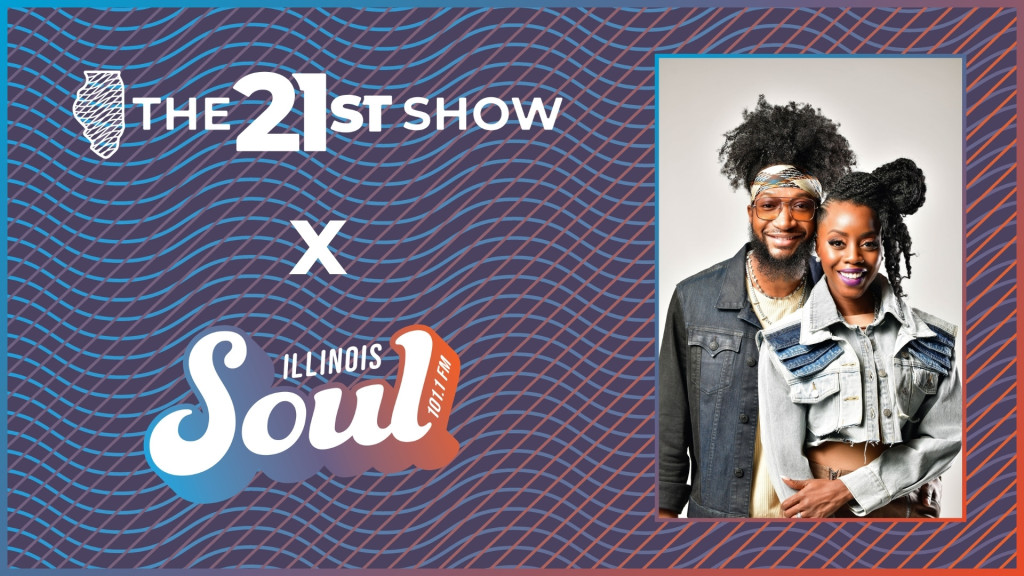
Raphael & Whitney on their music, their partnership, and revisiting their roots
Read the full story at https://will.illinois.edu/21stshow/raphael-whitney-on-their-music-their-partnership-and-revisiting-their-roots.
Transcript
// This is a machine generated transcript. Please report any transcription errors to will-help@illinois.edu.

[00:00:00]
Brian Mackey: It's the 21st show. I'm Brian Mackey, and you're listening to Rafael and Whitney. They're a husband and wife duo known for their soul and R&B vocals and music. Whitney has roots in [Champaign], and they met when Rafael came down to attend the University of Illinois. The duo will be performing at this year's Juneteenth celebration at the [Krannert] Center for the Performing Arts in Urbana. That's today at 5:30. The concert's free and is being produced by our sister station Illinois Soul. Kimberly Schofield, who until recently was a colleague at Illinois Public Media, spoke to them for the show Dialogue ahead of tonight's concert. Because the program's on tape today, no calls, but our email's always open. Talk at twentyfirstshow.org.

[00:01:13]
Kimberly Schofield: Rafael and Whitney, thank you for joining me. I want to kick off the interview by first asking some background on the two of you. How did you all meet?

[00:01:24]
Rafael: How do we meet? Well, first of all, thank you for having us, Kimberly. Uh, we are excited to be here and we met over 24 years ago,

[00:01:35]
Whitney: in a — in a gospel group, an inspirational gospel group in Champaign, Illinois. Yeah,

[00:01:41]
Rafael: so I attended the University of Illinois and Whitney is from Champaign and I joined a gospel group that she was already a member of and we became friends. We became singing buddies, we became pals, we became

[00:01:56]
Whitney: yeah, in the group we were — um, we would, we would arrange some of the vocals together, helping in the studio sessions when we were recording the albums together. We were just building a friendship through — actually a friendship and a partnership through music because, um, him joining the group, it was like I felt like I found a male version of myself and we were like we, we realized we like some of the same artists and music and style and just even our work ethic with training and developing and coaching. I don't think that was not — I don't think that wasn't anything we expected or, um, realized that that would be something we would do kind of for the rest of our lives, but we bonded over it and we, um, built our friendship through it. And so it wasn't just him being a new guy and me being a singer — we were arranging and coaching together, and then

[00:02:50]
Rafael: we were also the closest in age in the group as well.

[00:02:53]
Whitney: Yeah, we were the youngest in the group so there were moments when we would travel with the group, we would sit next to each other on the — on the bus and like share headphones and listen to music together and just build. And then when he would make, you know, music, um, he would make music, he would invite me over to, uh, his, his apartment — um, where was that you guys were on, I can't remember where that was — and his roommates, but he would be making music and he would always let me hear what he was making. Like, I'd be one of the first people to hear the first. She

[00:03:20]
Rafael: was

[00:03:20]
Whitney: my

[00:03:23]
Rafael: exclusive fan club, fan base, audience support team. Right,

[00:03:29]
Whitney: yeah, and it would be like till 3 a.m. sometimes just like recording music, listening to music and oh I have this and I've learned this and oh and listen to this, and it was just through music we spent hours together. And then when he would be preparing to perform at the university, I would work with the background singers, um, making sure that they knew the parts and he would work with the band, and it was just something that happened so naturally with us, um, and we weren't even dating

[00:03:59]
Rafael: — that part we were literally strictly friends, just platonic friendship, good uh chemistry, good energy with each other, but it was not romantic

[00:04:09]
Whitney: yet. Yeah, we just liked being around each other and just developed this, um, safety and comfort and, um, just appreciation and respect for each other, loving — yeah, just through music.

[00:04:21]
Kimberly Schofield: Wow. How did you two then get this music business industry started together?

[00:04:29]
Rafael: So we met in [2002] — we met in 2002, and then in 2007, 2006 is when I was about to graduate and I told Whitney that she was my soulmate. Now this story has many interpretations, um, and back then I called [her] a soulmate and right now I realize that I realized she was my partner. She was the woman that I was supposed to be with. Um, but I told her that and we began to look into being romantically involved. Now the thing is Whitney had already expressed that she was romantically interested in me subtly. Right,

[00:05:15]
Whitney: it wasn't clearly — I wasn't as direct because I was like, [shoot,] this — we've been friends for a long time. I'm not really — I'm not really sure how I should say that I like him more than — I wanna be more than friends now. So it was more like, you know, I really love you and our friendship and I really appreciate we are and we're, you know, I don't really know what to say but I'm trying to say what I wanna say and he's like, yeah, I appreciate you too, you know, and it was more like little sister like

[00:05:46]
Rafael: it was trying to

[00:05:46]
Whitney: profess. Yeah, it was a more friend zone and I was like, yeah, I probably wasn't really sure about that. I wasn't direct enough, but um, but when he did express that he felt like I was the one for him when he, uh, graduate — he was, it was a graduation night actually. Him and his family were out celebrating and I was like, you know what, I know you guys have had champagne and y'all been toasting. I want you to tell me this when you're totally sober the next day, don't play with my emotions. So he definitely called me the next day and reiterated how he felt and we made the decision to become boyfriend and girlfriend or just take it to the next level so

[00:06:25]
Rafael: that intentionally to

[00:06:26]
Whitney: intentionally

[00:06:27]
Rafael: see what — what romance looks like between the two of

[00:06:29]
Whitney: us. Yeah, but then three months into that he said I'm gonna go to New York because I just need to pursue my career. I don't want it. I don't want there to be any ifs, ands or buts or what, you know,

[00:06:41]
Rafael: regrets, ifs.

[00:06:42]
Whitney: And I was like, wow, OK. So immediately we're pushed into long distance.

[00:06:48]
Rafael: But it was one of the greatest decisions. I drove across country, I fit everything I could into my car at the time and I made it by the grace of God because my car shouldn't have made it that long. Um, and I began this journey of sleeping on the floor, attending open mics, um, auditioning for off-Broadway plays while working, while trying to find other jobs, like it was just literally me trusting God and doing everything I could to see what could happen. And so I began to get kind of connected with the music scene out there as it relates to open mics and off-Broadway situations and I met producers and artists and so there was an artist, a producer that was working on a project and he had me come in as a part of like the vocal production team. And he was looking for a female singer and I'm like, well, my girlfriend, she sings very good — she sings very well, but she's in Illinois. And so he was like, well, let's fly her out.

[00:07:45]
Whitney: Yay. Yeah, I did like an audition over the phone, like I sang over the phone and what was beautiful for me was I — I was actually trying to finish college at [Columbia], um, and doing, uh, pursuing fashion design, but there were some really weird like situations that were happening where I couldn't get in contact with my counselors to like solidify my schedule. And I was like this is very weird. I'm like this is, this is a, I mean — why is this happening? So I just prayed. I'm like, God, are you preventing me from finishing my last two years? Like, am I supposed to be doing something else because I don't know why this is, why, why there's so much like hindrance and restrictions. So, um, I prayed. I was like, well, if I'm supposed to be in New York pursuing music or being out there because I only wanna be where you want me to be. Like I know my family wants me to finish and get my, you know, my — my bachelor's, but I wanna be in your will. Like that's really important to me. And so I'm like I don't have a car — like my boyfriend had a car to drive across. I don't even have a job. I don't have a car. So if I'm supposed to be there, then you have to find a — you have to figure out — you have to find a way for me to get there. And so when I sang over the phone after I prayed that and the man was like, OK, yeah we'll fly you out, I was like, whoa. Now that was really fast. I was like, that was really fast. So I took that as an answer [to my] prayer and I packed up the apartment I was

[00:09:13]
Brian Mackey: staying in. All right, we need to take another break. When we come back, more with hometown performers Rafael and Whitney. This is the 21st show. Stay with us.

[00:09:28]
Speaker 4: [Music break]

[00:10:07]
Brian Mackey: It's the 21st show. I'm Brian Mackey. Let's get back to the conclusion of our conversation with Rafael and Whitney, a husband and wife duo with ties to Illinois who are performing tonight at Stage 5 at the [Krannert] Center for the Performing Arts in Urbana. It's part of Illinois Public Media's Juneteenth celebration. My former Morning Edition host colleague Kimberly Schofield spoke with him ahead of this performance.

[00:10:32]
Kimberly Schofield: What was it like? And I know that you went to school here, but you — hi — you were from here. So for either or both of you, what was it like as far as musical or — I know faith is very important to you. What were those influences like being in this central Illinois or Champaign-Urbana area?

[00:10:50]
Whitney: Well, my grandfather was, um, a huge influence in the community. Reverend W.B. Keaton, he was a pastor here at Pilgrim Missionary Baptist Church. Um, he came from Arkansas with my grandparent, with my — with my grandmother, and, um, he pastored that church but he also had a radio station, his own radio — I mean a radio show. He also did a lot in the community for, um, incarcerated, um, people. He, he, you know, handed out turkeys, you know, he was that kind — helped out in the community in a huge way, um, but I grew up singing in his church and my mother was my choir director. And so I was — my mom would say I, I started singing before I could talk really. Um, music was one of the things that would keep me calm. She said she could clean up around the house if — if she played music. She could get so much done 'cause I would just be listening. I would never go to sleep. Like she could never lullaby me to sleep with music. She was like, your eyes were always wide open. You were internalizing and listening and taking in. She was like, you — I could never sing you to sleep. It was like you wanted to sing with me. Like you would never go to sleep with music. Um, but yeah, my grandfather was my — my pastor, my mom was my choir director, and similar to my —

[00:12:05]
Rafael: for me, I grew up on the South Side of Chicago. My grandmother was the pastor of the church that I attended. My mom was my choir director. And, um, I began — she said I could sing before I could talk as well, so we literally have footage — we found footage of us singing a similar ad lib at a similar age at different times, like it's pretty incredible. Um, and so when I went to U of I, I joined the University of Illinois Black Chorus under the direction of [Ollie] Watts Davis and that was a continuation of, you know, music and faith being combined and being able to sing in a communal community of other vocalists who believe in a similar thing. Um, and that's also where I cultivated more leadership capabilities as well as, um, my solo capacity.

[00:12:54]
Whitney: And that — even, even in that, my mom was a member of Black [Chorus], so even, uh, my mom was a teen mom, so I would go to the rehearsals with her. So I — I knew [Ollie] when I was like a kid, just like 7, 8, 9, 10 [years] old, just sitting in rehearsals, um, going to the [Mother's] Day concerts and being in their rehearsals for that. And so we — and then we went to church with [Ollie] and her husband and her children and I went to high school with her — her children and, you know, so we built a relationship with them and the Black [Chorus]. Even though I never was an official member like I pretty much knew everyone that was in the Black [Chorus] because because they

[00:13:33]
Kimberly Schofield: knew.

[00:13:35]
Whitney: Yeah, yeah, they knew me since I was a kid, so, um, being a part of that was, um, was special too, and — and having that connection with my husband of him being a part of it and me being an honorary member, um, yeah, the — the history is — is pretty deep.

[00:13:50]
Rafael: And that's why it's really cool that we are able to come back and perform at Stage 5 in [Krannert] because I used to go there for rehearsals, I used to perform in — in the — in the great hall, you know what I mean? So it's really, really a full circle moment for us.

[00:14:03]
Kimberly Schofield: It's beautiful. We're very excited. And also our grandmother's amazing. My grandmother influenced my performance stuff too, and it's just hearing about families is the best. Um, for both of you, do you have any influences, any — are there any artists who have influenced your sound today?

[00:14:22]
Rafael: I would say yes. I think that I have embraced artists like Luther Vandross and Donny Hathaway and Marvin Gaye. I love the richness and texture of their voices and their capacity and capability to express a song very genuinely and authentically and it reached people in a very simple way.

[00:14:45]
Whitney: Yeah, I would say Aretha Franklin, um, Whitney Houston and Brandy, to just name a few. Uh, there's, there's an ease that Aretha Franklin sings with that I've been learning to, um, embrace and then there's a power and strength and confidence from Whitney Houston that I've been cultivating over the years, and then there's an airiness, a new R&B feel that Brandy has that I've, I've used in performing. So a combination of those three singers — I feel kinda actually like — it's like I'm, I'm just not realizing this. I think those three is who I sound like in — in different moments.

[00:15:30]
Rafael: I mean, there's — there — you got other things too, but yes, I agree.

[00:15:34]
Whitney: I feel like those are like three strong pillars of where I kind of pull from when I'm singing, whether it's a ballad, whether it's an R&B song, whether it's a gospel inspirational. Those — those three sounds and feels and emotions are is what inspires me.

[00:15:54]
Speaker 4: [Music break]

[00:17:38]
Kimberly Schofield: What does it mean to come back to your hometown for a Juneteenth performance — hometown relative, hometown for Whitney, but where you kind of collaborated your relationship together?

[00:17:50]
Whitney: I feel like it's gonna be like a big reunion, family reunion.

[00:17:53]
Rafael: Yeah, it means a lot. It's actually — we got engaged, um, at Champaign[-Urbana] — [Champaign-]Urbana. So you know, our — our romantic journey, our life journey,

[00:18:04]
Whitney: friendship journey, friendship

[00:18:05]
Rafael: journey is very connected to Champaign-Urbana.

[00:18:07]
Whitney: It's the foundation of where we started.

[00:18:10]
Rafael: It is and it means a lot because we are in the season of introducing ourselves as Rafael and Whitney. For many years we've been known as Rye and Whitney. And, um, we've decided to change our name to Rafael and Whitney because Rye represented an era for me. It represented an era where music was the forefront and it actually was an acronym — and it's an acronym and it stands for rhythm, alternative, instrumental and inspirational. And I used it because every time I would introduce myself as Rafael prior to becoming Rye, people will automatically say, hey, [Raphael] Saadiq, like [Raphael] Saadiq, and I'm like, OK, he's amazing but that's not who I am. And then my last name — it starts with an S — and so I'm like there's another thing for people to compare me to this other artist that's already established and that was a little, you know, it just kind of made me feel like I needed to do something else. But now, as I've grown artistically and as a man, I realized the beauty of the name that my mother gave me which is Rafael, and it means God has healed. And I believe that that's what I do to music. I believe that that's what I aim to do as a person with whoever I come into contact with and it fully represents who I am, not just musically but as a person. So I feel really excited to be able to introduce ourselves as Rafael and Whitney on this stage for the first time for our family and friends who have known us, who have celebrated us and supported us along the way. It means a lot.

[00:19:40]
Kimberly Schofield: Yeah. It's going to be such a good time. It's going to be a good time. What can the crowd expect from the performance aside from this beautiful introduction now as Rafael and Whitney?

[00:19:52]
Whitney: They gonna — they can expect. Man, uh, an emotional journey. Um, of — yeah, an emotional life journey, um, of exciting moments of — um, I think they're gonna — it's gonna make them think and feel. Think and feel about where they are, where they wanna go. Um,

[00:20:20]
Rafael: I think also what — what — what they should expect is what I'm gonna expect. I'm expecting people to be engaged. We do a lot of audience inclusion in our show. So I want — as much as I know people may be coming to be entertained, I want them to be involved. I want them to feel comfortable to stand up if they're feeling something, to dance, to, you know, communicate back and forth with us, um, not just to stoically watch and applaud when the song is over. And so we've created a show that allows us to tell our story, to engage with them, and to really just celebrate love and life.

[00:21:01]
Kimberly Schofield: That's beautiful. I love that. I have a very random question for you all, and you might not, but whenever I hear it — do either of you know Courtney Agnew, who was also a backup singer for Alicia Keys? This was like 2010.

[00:21:15]
Whitney: Yes, I, I, I, I brought her on to sing

[00:21:20]
Kimberly Schofield: — I was in an a cappella group when she was in the Girls Next Door and I remember her leaving to go do it, so that's funny that

[00:21:26]
Whitney: yeah, yeah, we brought her out to New York. She actually lived with us. We let her live with us so that she can, um, be local, um, and brought her in. Yeah, I brought her in to do that. She actually

[00:21:37]
Rafael: sang for both of us when we got engaged at the Champaign-Urbana [event] as well, so

[00:21:42]
Kimberly Schofield: sweet. I didn't know her well, but I remember this happening vividly.

[00:22:55]
Brian Mackey: Thanks again to Rafael and Whitney and to Kimberly Schofield. That's all the time we have for our show today. Before we go, I wanna suggest joining our texting group. We love sharing your comments and questions on the show. You can do that by sending the word talk — T-A-L-K — to 217-803-0730. Again, just text the word talk to 217-803-0730. We appreciate hearing from you about our programs and your suggestions for future guests or topics. You can email us — talk at twentyfirstshow.org is the address — and you can find that and every other way to contact us, voicemail, social media. It's all at our website, twentyfirstshow.org. That's twentyfirstshow.org. We've got our past programs there, and you can find links to subscribe to our podcast or just look us up on Apple, YouTube, or wherever you listen. The 21st show is produced by Christine Hatfield and Jose Zapeda. Our digital producer is Kulsoom Khan. Technical direction and engineering comes from Jason Croft and Steve Morck. Reginald Hardwick is our news director. The 21st show is a production of Illinois Public Media. I'm Brian Mackey. Thanks for listening. We'll talk with you again on Monday.

[00:24:45]
Speaker 4: [Audio ends]
Transcript Assistance
Illinois Public Media may use AI assistance for transcript generation and/or formatting. Transcripts that have not yet been reviewed for accuracy will be labeled.
To report a transcription error, or to request transcription of archival material, please contact will-help@illinois.edu.