Transcript: Route 66 in Illinois: New film explores highway from coast-to-coast
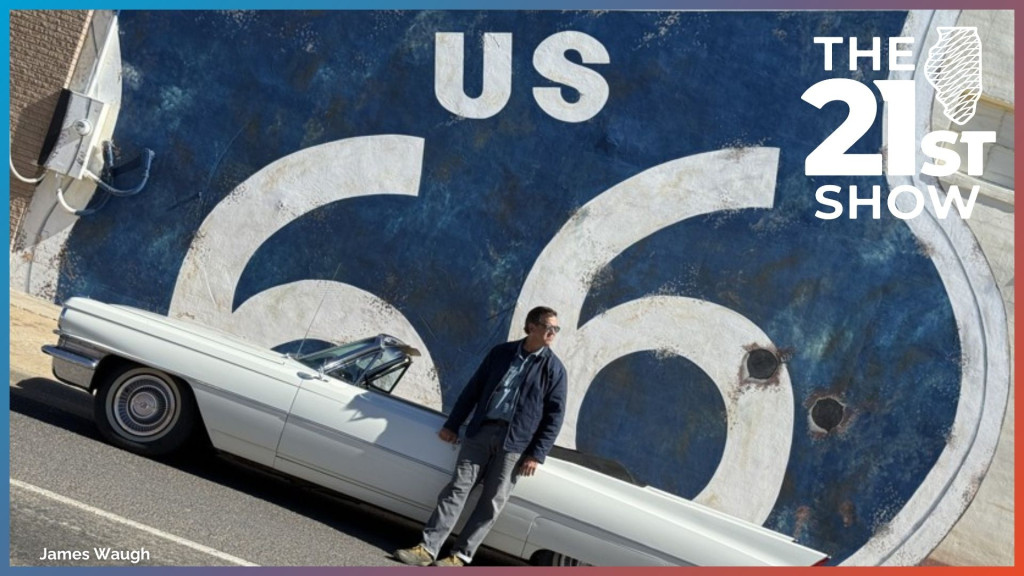
Transcript: Route 66 in Illinois: New film explores highway from coast-to-coast
The 21st Show
Route 66 in Illinois: New film explores highway from coast-to-coast
Read the full story at https://will.illinois.edu/21stshow/route-66-in-illinois-new-documentary-explores-highway-from-coast-to-coast.
Transcript
// This is a machine generated transcript. Please report any transcription errors to will-help@illinois.edu.

[00:00:00]
Brian Mackey: It's the 21st show. I'm Brian Mackey, and all this week we are talking about Route 66, particularly the 300 miles or so of it that span the 21st state. Obviously, Route 66 goes well beyond our borders for another 2,100 miles, though, as this — through, I should say, as the song has it, Saint Louis, Joplin, Missouri, Amarillo and Gallup, New Mexico, Flagstaff, Arizona, don't forget Winona, Kingsman, Barstow, and San Bernardino.

The entirety of the [Mother Road] is the subject of a new documentary from First and Main Films. It's called Route 66, the Main Street of America. Let's listen to part of the trailer.

[00:00:58]
Speaker 1: We sold everything we owned and we moved to [Tucumcari], New Mexico. And I don't look back

[00:01:03]
Speaker 2: on my first journey down Route 66,

[00:01:06]
Speaker 1: I made films about the people who carried the mother

[00:01:09]
Speaker 2: road

[00:01:09]
Speaker 1: through its darkest years.

[00:01:11]
Speaker 2: Now, as the road turns

[00:01:12]
Speaker 1: 100, I'm

[00:01:14]
Speaker 2: heading back to discover what's still out there

[00:01:17]
Speaker 3: and who will carry

[00:01:18]
Speaker 2: it forward.

[00:01:21]
Speaker 4: Most of the people are absolutely out of this world just like me.

[00:01:29]
Speaker 5: Travel, go meet other people, see what life is like through their eyes, and boy, it'll open your

[00:01:34]
Speaker 3: heart. My grandpa was the Jackie Robinson of Route 66. He's the one that started this first black service station on Highway 66.

[00:01:45]
Speaker 6: We reside within what we call the [Four Sacred Mountains].

[00:01:48]
Speaker 7: This is a holy place for us. This is our home. It gets

[00:01:51]
Speaker 8: to the very nature of us as humans to look up and wonder. Every day we see people from around the

[00:01:56]
Speaker 9: world, every country on the planet. This road represents the American dream.

[00:02:02]
Brian Mackey: All right. There are screenings moving west along Route 66 through November. Although the ones in Illinois have already happened, additional screenings will be announced later and there's a PBS series in the works for next year. Joining me now to talk more about the film is its writer and director, John [Pagett]. John, welcome to the 21st show.

[00:02:23]
John Pagett: Thank you. Thanks for having me on. And

[00:02:24]
Brian Mackey: listeners, you can join us again, 800-222-9455 is the number. 800-222-9455. All right, John, what drew you to Route 66 in the first place?

[00:02:39]
John Pagett: Well, what drew me to it — I think it was in the early '90s when I first made my first films on Route 66, 30 years ago. And that was a time in America where it just seemed like the country was losing its sense of place. The country was becoming more and more homogenized. The same freeways, franchises, big box stores showing up everywhere, and Route 66 felt like the opposite of that. It was eccentric and local and, you know, strange roadside architecture and idiosyncratic characters, towns and villages with their own identity, and all of that really grabbed me at that time.

It was also kind of the underdog story of these places and their fight to survive against all of those forces — the freeways and the franchises — their struggle to stay alive.

[00:03:46]
Brian Mackey: I don't wanna get too psychoanalytical. You're originally, I understand, from Washington state, where a lot of the highway driving is like forest tunnel kind of thing. I wonder if there's something about the wide open spaces that appeal to you, or how you think about making that journey, that transition.

[00:04:03]
John Pagett: Well, yeah, the scenic drives of the Southwest were truly amazing and something new. But also the small town squares, the courthouse squares with the beautiful county courthouses, which especially in Illinois, Route 66 kind of winds you through that deep history that you're exposed to by just following the twists and turns of Route 66.

[00:04:33]
Brian Mackey: Yeah,

[00:04:33]
John Pagett: absolutely intriguing as well.

[00:04:35]
Brian Mackey: And every courthouse has its story where, you know, Lincoln blew his nose in their courthouse or something like that. So tell me a little more about your original documentary, Route 66: An American Odyssey. How did that come about?

[00:04:50]
John Pagett: Yeah, it started with — I had to do a drive across the country, and I just thought, at that time I was just pretty much fresh out of college, trying to be a filmmaker, trying to make documentaries, and I thought, well, here's an idea, I gotta make this drive across the country. Why don't I make a film about it? One thing led to another as I researched what route to take and how I would do it, and I landed on Route 66. I kind of discovered it, and thought, well, I'll do a film about that.

Again, that was in the '90s. It was still gone from most maps. That was kind of before this modern day revival that we have today at Route 66. This was the first wave. I was kind of in on that first wave of the Route 66 renaissance when it was first being marked historic and starting to make its way back onto maps, and they were starting to put up signs again to help people follow it. And I met a lot of the people who survived the '60s, '70s, and '80s, trying to keep their town alive or their business alive after they had been bypassed. So that was really an amazing experience to meet all those people and tell their story.

[00:06:12]
Brian Mackey: You know, it's interesting — Route 66 is decommissioned. Illinois has other federal routes that run through it, right? 24, 36, which is actually continuous with the interstate in parts, but US 30. There's something though about Route 66 and its decommissioning that still — it stays in the public imagination. So I wonder — I guess this is a long way of getting into the question — what changes have you seen along Route 66 since your original documentary and then revisiting it this time around?

[00:06:50]
John Pagett: Well, the changes are both good and bad. I think one change I've noticed is that at that time, it was Walmarts that were moving into the small towns, and that would end up killing a lot of the economy of the small town main streets and the commercial corridors of these small downtowns. But at least the towns that were smaller than 10,000 weren't affected by that. Now, dollar stores have moved in to any town with 500 people, it seems, and continued kind of that negative force,

[00:07:33]
Brian Mackey: Yeah,

[00:07:33]
John Pagett: desiccating these towns.

[00:07:36]
Brian Mackey: I have this rule of thumb that you can kind of guess the population of a town by the fact — does it have, in central Illinois at least, a Walmart, a Dollar General, or a Casey's, right? Like, what is the biggest place in town? Yeah,

[00:07:49]
John Pagett: right. On the good side, what I discovered was that there is a next generation of entrepreneurs who've seen opportunity and adventure in the prospect of moving to Tucumcari, as the trailer said, and giving up corporate life and moving to a Route 66 town and taking over a motel property or a curio store or an old gas station or cafe — people finding fulfillment in that. Or even in some cases, young people who are third-generation owner-operators of very unique businesses, burger stands and whatnot, and are totally committed to keeping alive a family tradition or a local tradition, a local institution.

That's encouraging to see because it points to the fact that Route 66 has a future beyond just the people that have a lived memory or experience of it. And I think it has a future because there's value in a sense of place and heritage, and traditions. Even young people are seeing that and recognizing that.

[00:09:07]
Brian Mackey: All right, let me take a moment to reintroduce our conversation. This is the 21st show. We're speaking with John Pagett, co-founder and creative director of First and Main Films, and the director of Route 66, the Main Street of America, a new documentary that explores all 2,400-plus miles of Route 66 from Chicago, Illinois, to Santa Monica, California. You can join us at 800-222-9455. That's 800-222-9455.

Well, you mentioned this — I think Route 66 is steeped in nostalgia, right? Neon lights, cars with fins and no shoulder seatbelts, right? I mean, you think of the Disney movie Cars and how it comes across there. There is this critique of nostalgia in American life, right? Maybe it leads people to imagining there's some halcyon past we can get back to when America was great, to borrow a phrase. Obviously that overlooks a lot — racism, on the important end of things. Everything smelled like cigarette smoke all the time. How do you think about the place of nostalgia in our culture?

[00:10:18]
John Pagett: Well, I think it's easy to write that off as just nostalgia, but another way to think of it is that it's memory, and memory is powerful and important in our history and feeling like you're part of a story, an American story. And Angel [Delgadillo] is the barber in Seligman, Arizona, who is credited with launching the historic Route 66 movement. He's the one that first stood up and petitioned the state of Arizona to mark the highway historic after his town was bypassed and almost turned into a ghost town.

And this is how he told me that he got the idea. After they were bypassed, the town nearly dried up and blew away, but he said every once in a while people would stop into his barbershop and say this must be the road, this must be the highway that my mother and father took when they were leaving Oklahoma and traveling to California, and they were looking to reconnect with that history. And I just think that's powerful — that's how this whole historic Route 66 movement began, is people looking to reconnect. And that wasn't nostalgia for the good old days. That was remembering some really difficult times, tragic reality.

[00:11:50]
Brian Mackey: Grapes of Wrath stuff, yeah, absolutely,

[00:11:52]
John Pagett: right, yeah, and the road encompasses all of that, and I don't think it would be as famous and iconic today if it was just one-dimensional like neon and poodle skirts and Elvis. It really — it's the Grapes of Wrath. It was the road of the Great Migration. It was the road of really gut-wrenching reality, and that's part of the story too, and I think that's what makes it iconic around the world.

[00:12:26]
Brian Mackey: So I thought maybe we could pick like a character or sort of set piece from the film. Tell me about the guy who buys an entire town. What is the story there?

[00:12:38]
John Pagett: That's — I think you're referring to Amboy, California. So there's a string of towns in the Mojave Desert that grew up around the railroad. Actually, they were first railroad towns because back then the trains had to stop every 20 miles or so for water. So there were a lot of towns throughout the Mojave Desert that sprung up, and then Route 66 paralleled the railroad, so then they became Route 66 towns. When that happened, they became boom towns. So Amboy, California, by the 1950s, I think, was population 700. It had a school, it had a church, it had a whole thriving town and numerous gas stations and cafes.

The day the freeway opened and bypassed Amboy, it was dead. I mean, it was gone. And it took a while, but eventually today it's population 0. The school and the church are still there as if somebody just, you know, boarded it up and walked away. And the owner of the town put the town up for sale on eBay. The bidding never met the reserve price, but an entrepreneur in San Bernardino bought it with the aim and the vision to restore it and bring it back to life. Then he suddenly passed away, and so everything was in jeopardy. No one knew what was going to happen. Most people who were interested in buying it were just going to raze it. But his son has taken over now and is determined to continue bringing back the town of Amboy, and he's trying to get it revived. They've relit the neon sign, they have the gas station open, it pumps gas now, and they're trying to get the cafe and the motel cottages open next. So it was a great story to include in the film, because this is a young guy who is trying to revive a Route 66 town. This is cool.

[00:14:46]
Brian Mackey: So we talked a lot about nostalgia, but your film makes the point of looking to the future, right? And the future of Route 66. So tell me — where do you see this road? Will we still be talking about it 10 years probably, but 50 years, 100 years from now, with our flying cars?

[00:15:04]
John Pagett: Well, the way I'd answer it is that not only can it survive, but it must. It must survive because it exists today as our most powerful reminder of the importance of traditions and sense of place, local businesses, unique characters, our heritage. It's so important that it survives. So whether or not it can — it's definitely in jeopardy and we're losing more and more of the landmarks and pavement every year. But I really hope Americans rediscover Route 66, take a trip, and then get active in preserving it and think about moving to [Tucumcari] and buying a motel. I mean, hey, you watch this film and you might be inspired to do just that, so be careful.

[00:16:09]
Brian Mackey: Yeah. I'm not sure that's a selling point, but there are other virtues. It's called Route 66, the Main Street of America. If you feel like taking a trip on Route 66, you can catch it at screenings all along the route heading west from now through November. And then as I mentioned earlier, there will be additional screenings after that and a PBS series is in the works. The director is John Pagett with First and Main Films. Thanks so much for sharing your work with us today here on the 21st show, and congratulations on the movie.

[00:16:40]
John Pagett: Thanks. I wanted to mention that you can find all the screening dates at [mainsteetamerica.com]. [**Human review required**: Please verify the correct URL for the film's screening schedule website.]

[00:16:47]
Brian Mackey: Absolutely, and if people didn't catch that, we will put a link to it at our website twentyfirstshow.org. John, thanks again. Thank you. More to come here on the 21st show. Stay with us.

[00:17:05]
Speaker 10: You get a car. I want a ticket to anywhere, maybe we may — we can get somewhere. Any place is better. Starting from zero, got nothing to lose. I got nothing to prove.
Transcript Assistance
Illinois Public Media may use AI assistance for transcript generation and/or formatting. Transcripts that have not yet been reviewed for accuracy will be labeled.
To report a transcription error, or to request transcription of archival material, please contact will-help@illinois.edu.