Transcript: The Illinois schools that discipline Black students the most
Transcript: The Illinois schools that discipline Black students the most
The 21st Show
The Illinois schools that discipline Black students the most
Read the full story at https://will.illinois.edu/21stshow/the-illinois-schools-that-discipline-black-students-the-most.
Transcript
// This is a machine generated transcript. Please report any transcription errors to will-help@illinois.edu.

[00:00:00]
Brian Mackey: From Illinois Public Media, this is the 21st Show. I'm Brian Mackey. There's been ongoing debate as to how schools, teachers, and administrators should approach student discipline. Gone are the days that teachers used to be able to hit students, what was known as corporal punishment. But even so, many teachers today would tell you that today's students are rowdier, more disruptive, and overall just not following the rules. And that's led to other forms of discipline, suspensions, in particular, whether that be in school or out of school.

But across the country, who is getting disciplined is disproportionate to who is actually a student. So, according to data from the U.S. Department of Education, preschool boys who are Black accounted for 9% of enrollment, but 30% of out-of-school suspensions. Again, that's preschoolers.

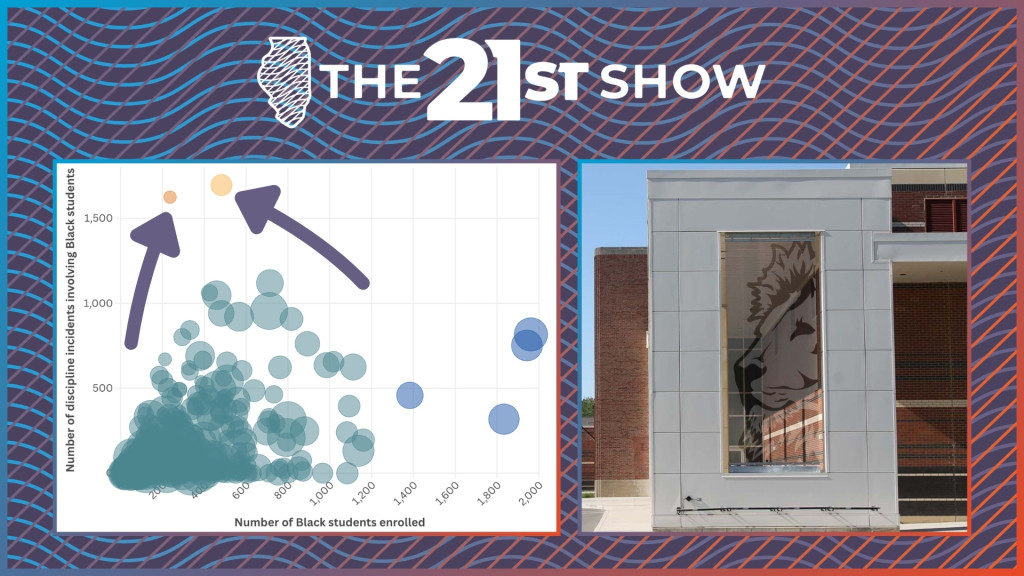
And this brings us to Illinois, where two schools in particular discipline Black students at much higher rates than any others in the state. Kennedy Middle School in Rockford, and [Lanphier] High School in Springfield. Both gave out more suspensions and other forms of discipline to Black students than their peers back in the [2024-2025] school year. And that's despite the fact that Black students did not make up the majority of the student population at either school.

This is the result — I should say — of an investigation done by two Illinois Public Radio newsrooms. We're joined now by the two education reporters who looked into this to talk more about what they found. Emily Hayes is with Illinois Public Media. Peter [Medlin] is with Northern Public Radio. Both are partner stations, WILL and WNIJ. Emily, Peter, welcome back to the 21st Show.

[00:01:51]
Emily Hayes: Thanks for having us.

[00:01:51]
Peter Medlin: Thanks for having us. Yeah.

[00:01:54]
Brian Mackey: And, listeners, we want to hear from you. We are taking calls for the first part of the show today. 800-222-9455 is the number. 800-222-9455. What is your experience with how schools handle discipline? What do you think is driving these disparities? And how should schools deal with disruptive students? Again, 800-222-9455. 800-222-9455.

All right, Emily, I'm going to start with you. Tell me about [Lanphier] High in Springfield.

[00:02:30]
Emily Hayes: One thing that I just wanted to say is that actually I think Black students were the majority at that school, but looking at statewide data as a whole, Black students are disciplined more total across the state than white students, despite so many more white students across the state. But yeah, at [Lanphier], [Lanphier] and Kennedy were those two outliers. One thing that is interesting about [Lanphier] High School and the Springfield school district is that it is under a 50-year consent decree, which started with desegregation and a lawsuit from a parent, saying that there wasn't racial equity in the schools, and that has continued because the school district has never managed to do one part of the consent decree, which is hire as many minority teachers proportionate to the number of minority students.

[00:03:24]
Brian Mackey: So we'll come back to that. So you mentioned that Black students are the majority at [Lanphier]. Tell me about the student population.

[00:03:31]
Emily Hayes: So, slightly more Black students than white students. It is a higher degree of low-income students than the state as a whole. I think that is true for Kennedy and Rockford as well. So, you know, everyone knows that these are more common approaches and maybe needed more in low-income schools. Some people would say that there's rowdier behavior, but what we found is that these two schools resort to suspensions way more than other schools in the state.

[00:04:08]
Brian Mackey: So, yeah, tell me — put some numbers on that. Quantify that for me.

[00:04:14]
Emily Hayes: So, you know, Peter can tell you more about Rockford, but —

[00:04:22]
Brian Mackey: Let's stick with [Lanphier].

[00:04:23]
Emily Hayes: Sorry, sorry. [Lanphier]. So, in both cases they are suspending Black students more often than there are Black students in the school. So even though it's a sort of small population of 482, there's almost four times that number of suspensions of Black students.

[00:04:44]
Brian Mackey: All right, Peter, let me bring you into the conversation. Tell me about Kennedy Middle School. Just the overall.

[00:04:50]
Peter Medlin: Yeah, so Kennedy Middle School — like I mentioned, this is a middle school in Rockford, and this is a really low-income school, even compared to the district as a whole, which is a pretty low-income district. This is like a school where over 90% of the students are low income. It's also one of the schools in the district with the highest Black student population, so about 62% of Kennedy students [are] Black. But also, again, as we're referring to disproportionate discipline, they receive over 80% of the in-school suspensions. It adds up to basically seven disciplinary actions per Black student.

Actually, Emily put together this metric — that is literally a Black student discipline rate — and not only did Kennedy have the highest rate in the state, it was actually basically twice as high as the second school on that list, which of course was [Lanphier]. So again, this is 236 Black students total at the school and over 1,600 discipline incidents, which for our data set includes in-school suspensions, out-of-school suspensions, and expulsions.

[00:05:53]
Brian Mackey: Do you understand what sort of incidents or allegations are prompting these kinds of outcomes?

[00:06:05]
Peter Medlin: So at Kennedy, we do know there's basically two big categories that make this up. One of them is called "violence without physical injury." And so, again, it's a little bit vague. We know there is "violence with injury," which I think we can maybe explain a little bit better. But the vast majority are either "violence without physical injury" or they get lumped into the category that is just called "other things." So like, we don't really know — we don't have good data on there. Again, we've got some anecdotes from students about, you know, they might be interpreted as talking back to a teacher or maybe they're late for class a couple of times and eventually that builds up to earning them an in-school suspension. But again, they often get categorized in these categories that are a little bit vague — sometimes "violence without physical injury," but also "other categories" or "other things" is inherently vague.

[00:07:00]
Brian Mackey: Yeah, I hear what you're saying. Like, "violence with physical injury" — that seems pretty intuitive, right? People get into a fight or you punch someone, they get hurt. But "violence without physical [injury]" — is that like words or —

[00:07:11]
Peter Medlin: We don't really know. Yeah, teachers have a lot of discretion about what that is.

[00:07:17]
Brian Mackey: Emily, what about at [Lanphier]? Same question. Like, what do we understand — or don't understand — about what is actually prompting this disproportionate discipline?

[00:07:28]
Emily Hayes: It's the exact same situation, where it's not tobacco — there are so few incidents on tobacco, alcohol, violence with physical injury that there's no data reported. There are just a few drug offenses, a few "violence without injury," like 100, but then 2,000 in this "other" category. So similar to Rockford, where, you know, it's clear it's not these incidents that people might imagine when they hear suspensions — like, oh, there was violence or something. This is not violence.

And, you know, looking into what could be causing this, I talked to an expert. One of the interesting things is that suspension rates didn't start until desegregation. Black schools were not suspending Black students, but when Black students started entering white schools, the white schools responded with something that they were using — some suspensions — but then started treating the same Black student behavior as worse, and we've kind of stuck with that pattern all this time.

[00:08:34]
Brian Mackey: Interesting. All right, let me take a moment to remind listeners this is the 21st Show. If you're just joining us, we're speaking with Emily Hayes, education reporter at our home station, Illinois Public Media, and Peter Medlin, education reporter at WNIJ Northern Public Radio, based in DeKalb. They also cover Rockford and many other communities in northern Illinois. If you want to join us today, 800-222-9455. We're talking about their reporting, looking at how Black students are disproportionately disciplined in schools, specifically through the lens of two cases where the data showed it was the most extreme. That's Kennedy Middle School in Rockford and [Lanphier] High School in Springfield. Again, if you want to join us, 800-222-9455. 800-222-9455.

We asked members of our texting group what they thought about this and got a variety of responses. Frannie in Hinkley says, "For 20 years, I worked in an elementary school with an enrollment that was roughly a third Black, a third white, and a third Hispanic. I thought the Hispanic kids and their parents were the most respectful. I don't remember the Black kids being that much more disruptive than the white kids." She says behavior issues in the classroom are frustrating and bothersome. "Classroom management needs more attention in getting that degree in education. In my experience, the teachers who treated their students respectfully had the fewest discipline problems," she says. Thanks for that message. We'll share some more messages as we go on. But again, if you want to join us, 800-222-9455.

All right, Peter, you shared some tape. And this is a student — I should say the mom of a student, Victoria Batson — talking about how frequent in-school suspensions have affected her daughter.

[00:10:22]
Victoria Batson: My daughter's whole attitude changed. She used to be happy-go-lucky all the time, and when she went to that school, it's creating her to be upset, angry a lot.

[00:10:33]
Brian Mackey: So say more about that situation.

[00:10:35]
Peter Medlin: Yeah, so Victoria — she just finished 7th grade at Kennedy. And [she] says that she's, again, like a lot of Black students at the school, had a lot of in-school suspensions. She says, again, when we're talking about what category — OK, like, what is she doing to earn this — she's like, yeah, sometimes she's being interpreted as talking back to a teacher or sometimes being late to class or things like that. And really, the story that she told us is that having all of these discipline incidents and being in-school suspended all the time has just made her enjoy school a lot less. Like her mom kind of alluded to, she was someone who really loved going to school, was really interested in learning before, but has had such a negative experience at her middle school. And, you know, she just finished 7th grade, she's got a year left, and she's at the point where she's like, well, I don't think I'll be able to move schools. I would if I could, but now I kind of just have to wait it out until, you know, I get to high school and hopefully things improve. But again, it's unfortunately another story of these kinds of discipline incidents really dampening a student's love for school and love for learning.

[00:11:44]
Brian Mackey: So you mentioned this is an in-school suspension. What happens during an in-school suspension, for people who may not be familiar with that?

[00:11:51]
Peter Medlin: Right, so for people that don't know — obviously, out-of-school suspension means, you know, for one or two days or however long it is, students are out of school. In school, you basically go to an in-school suspension room, and depending on the school and depending on the district, they might have a teacher's aide in there. Some of them actually have specific in-school suspension monitors. So the idea is that they would go in there and, you know, work on homework, work on classwork — even though, again, by nature of them being in-school suspended, they are literally not in their classroom during that. So the idea is that they would work on classwork. Sometimes they receive help from those in-school suspension monitors, or if there's a teacher's aide in there. Sometimes, you know, the folks in Rockford say that they try to have someone in there to provide some kind of reflection work — like, OK, here's how you ended up here, here's how we can improve the [situation regarding] discipline.

Victoria, though, is telling us that that doesn't really happen, at least in her experience. She felt like they kind of just get tossed in there and [are told], you know, do your work, get on your Chromebook. She was also like, it's cold, the room's uncomfortable, the food's bad — all that type of stuff, too. But that's generally what an in-school suspension is. And, you know, at some schools, you might be in-school suspended for the full day or for multiple days, or if there's an incident related to a certain class or certain teacher, you might get in-school suspended for multiple smaller chunks of multiple days.

[00:13:21]
Brian Mackey: All right, let's go to the phones at 800-222-9455. We have Maurice calling from DeKalb on line one. Maurice, thanks for calling in.

[00:13:31]
Maurice: Yeah, thank you for letting me join the conversation. I serve as an elementary school principal at a pretty diverse building, and I will say in my years of experience, one of the things that I've noticed is that oftentimes with Black students, that negative behavior is perceived as innate or part of their actual character, whereas with white students, that behavior is perceived as coming from an outside factor. So for example, maybe they're going through something, parents are splitting — something like that. And I think there has to be room for, again, that conversation on being trauma-informed, understanding that trauma is negatively impacting communities of color in our country, certainly in the DeKalb and Rockford area, throughout the state of Illinois, as well as students from low-income [backgrounds], right? So that trauma shows up, and how can we be responsive to that? Consequences are necessary, but suspension can't be our only answer.

[00:14:35]
Brian Mackey: That's interesting, Maurice. So it sounds like what I'm hearing from you is a teacher might say to a white student, "Hey, what's going on? Are you OK?" and say to the Black student, "Go to the principal's office right away," right? How do you work through that as a school administrator?

[00:14:49]
Maurice: Yeah, so I think one of the things that we try to do for sure is build out those skills for our teachers, build out some of that opportunity as well to be reflective. We regularly look at that data to be able to say, "Hey, notice who is getting in trouble in your classroom. Is there something we can change on the front end that is going to help to reduce some of these behaviors?" So I think reviewing that data together, being reflective, and then building those skills as well to be able to handle some of those things inside of the classroom in a more culturally responsive way are things that we try to do in the school system.

[00:15:32]
Brian Mackey: Maurice, thank you so much for calling in to share your experience. Really appreciate that. If you want to join us today, 800-222-9455 is the number. We're on this topic for about another 20 minutes. We'll have some more text messages to share as well when we return. We're talking today about disproportionate discipline for Black students, as opposed to their white peers, particularly through the lens of two schools that our guests studied in some detail. Kennedy Middle School in Rockford and [Lanphier] High School in Springfield. We're talking with Emily Hayes and Peter Medlin, two education reporters here in Illinois. Again, if you want to join us, 800-222-9455. This is the 21st Show. We'll be right back.

It's the 21st Show. I'm Brian Mackey. We are talking today about student discipline, particularly how Black students are disciplined with things like in-school or out-of-school suspensions at much higher rates than would be expected based on their share of the population. And we're talking with Peter Medlin of WNIJ Northern Public Radio and Emily Hayes of WILL Illinois Public Media, who spent some time looking into this, particularly through the lens of two outlier schools — Kennedy Middle School in Rockford and [Lanphier] High School in Springfield. 800-222-9455 if you want to join us today. 800-222-9455.

And let me, Peter, come back to you, because one of the things Maurice said that struck me was: it's one thing if this is an individual teacher maybe handling — you know, approaching students differently, as he said. And I should say, if people are just joining us, we had a caller who said he was an elementary school principal just before the break. And, you know, maybe some teachers would give the benefit of the doubt — you might say to white students — and assume that there was something going on in their lives causing disruptive behavior, whereas Black students maybe don't get that benefit of the doubt. That's an individual choice. It seems like what you and Emily have been reporting on are more systemic policies to just use the sort of disciplinary measures much more rapidly or broadly, or however you want to say. Can you speak to that?

[00:18:05]
Peter Medlin: Yeah, definitely. I mean, yeah, they're at the top of the state when it comes to — and again, our metrics that we were using for school discipline — we're looking at expulsions as well as in-school suspensions and out-of-school suspensions. And at Rockford, one of the arguments that they made to me was that how things are now is a great improvement from how they were, because they used to give out way more out-of-school suspensions and they've kind of shifted towards more in-school suspensions. And so, again, the idea is that in-school suspensions aren't — we actually found some research that suggests that's not necessarily the case — that the academic impact of in-school suspensions may be more severe than originally assumed, and that even just getting one or two of those can really impact you academically. But also, the case is that they are still giving out a lot of in-school and out-of-school [suspensions].

Particularly, when we're talking about Kennedy Middle School, this is a really small middle school. So even though, when you're looking at the top schools for discipline, there might be some schools that have a lot more out-of-school suspensions — those schools are also like two or three times larger than Kennedy. But yeah, this is all the way across [the district]. And again, it's not even something that — Kennedy obviously is an outlier, but it's also something that the district as a whole relies on, specifically when we're talking about in-school suspensions, right? Like, if you look at the top schools — top middle schools, rather — in the state for the school discipline metrics, five of the six are Rockford middle schools. So this is really a direction that the district has gone and tried to utilize, again, with the idea being that they're trying to reduce out-of-school [suspensions] by shifting to in-school, but again, that's not as clean as maybe they'd hoped.

[00:19:57]
Brian Mackey: I want to share another message we got from a listener. [They] did not give their name. This is a text message. [They] say, "I've worked in Decatur public schools and currently [in] Champaign Unit 4. Both districts approach discipline differently, but [are] very similar in size. I'm in my 20th year teaching. I'm a music teacher, so I'm considered the fun space in elementary and middle school. Generally, kids want to stay."

"Behavior," [they] say, "is an indicator of something else going on. Some children come in a little feral. We don't require kindergarten or pre-K in the state of Illinois. Some children learn how to behave in a school setting. But also, kids act up in school because it's the safest place to make a mistake." This person says, "Some of the behaviors I experienced in a classroom — fighting, hitting, running, chair throwing, fighting — they feel unreal when you're experiencing it." This person says, "In my experience, the poor delivery of discipline comes from inexperienced administrators who do not culturally know or understand the families in their school. Sometimes it's from an admin who doesn't know how to discipline, so they suspend instead. Knowing the community makes a difference as well. Those who fail are often outsiders failing to make connections."

This person continues, "There are great admins out there — the ones who recognize children need a safe space before they can learn. I work with one in Garden Hills who's now in Brookfield. She created a calm baseline and space to help students understand the why of their reactions and behavior. If we do not teach children how to manage emotions, we won't have adults who can either."

And with that, let's go back to the phones. We have Marvin calling from Springfield on line one. Marvin, thank you for calling in. Hey, how are you doing today?

[00:21:43]
Marvin: I'm doing well. So I understand you actually work with some of the kids we might be talking about today.

Yeah, I have the opportunity to work with some of those kids that have gone to [Lanphier], and because of the excessive suspensions and disciplinary actions, they were sent to alternative schools. So I've had the opportunity to do some therapy with those kids. And what I recognize is a lot of the pressure is being placed on the school and the system to inform the teachers, and [there are those] expecting the system to change, when in essence I think there also needs to be resources dedicated on the back end, because after those kids got suspended and [entered] alternative schools, there's still not a lot of support to help them learn behavioral management and all the skills necessary to not only function in school but function in life.

[00:22:26]
Brian Mackey: Marvin, thanks so much for sharing those thoughts. I really appreciate it. Emily, I wonder if you can respond to what Marvin said, or anything else, or just what you heard from [Lanphier] as well.

[00:22:38]
Emily Hayes: Yeah, I think it's interesting because the principal of [Lanphier] — I talked to her and she's like, "You know, all the kids know I love them, whether they've been suspended or not." And she had a background in restorative justice, which is — the idea is you talk out and fix the problem instead of just punishing kids — and that the district has been shifting more to that. And she was saying, you know, hopefully we'll see better data this year. She's seeing better data so far.

But, you know, everything that the callers have said is so similar to what the expert I talked to said. And, you know, there's a lot of debate around school resource officers — having police officers in schools. Most schools I cover in depth have them. And they do result in more interactions between students and law enforcement, like arrests or [students] getting into the legal system. Versus if you have more school psychologists and school counselors — the expert said that is an indicator that the school will have lower suspension rates, because they're supporting students that way. So, you know, what the caller said about having more support for the students is definitely true, according to the expert I talked to.

[00:24:13]
Brian Mackey: I want to share another couple of messages we got in. One person just said — Anthony in Chicago — "correlation doesn't equal causation." And somebody else expanded on that a little bit, I think in an email. John from Urbana says, "Maybe you should consider that Black students are disciplined at a disproportionate rate because Black students are disproportionately disruptive in the classroom. When a 14- and 16-year-old were out late last week allegedly killing and critically wounding two of their peers" — and I'll just say as an aside, he's referring to a shooting that took place in Urbana last week — John continues, "there appears to have been a lack of supervision in the homes. Teachers and school administrators can't solve all of society's problems. Some problems must be solved in the home."

And Peter, I wonder if that's something you heard through your reporting on this, that sort of sentiment.

[00:25:08]
Peter Medlin: You know, not necessarily. And we're talking to a lot of families involved, and we definitely didn't hear that from school administrators. School administrators didn't say anything like, "Oh well, Black students are receiving more discipline because they're having more action that merits it." That's not something that we heard from the school district or administrators or parents at all.

[00:25:29]
Emily Hayes: But I did hear — I talked to a student at [Lanphier] and his grandfather, and his grandfather had that approach. He's like, "Yeah, and you know what, if these are just students who are —" And the grandfather was Black, by the way. He was like, "Yeah, I think that students need to be disciplined more." He's a bus driver, and he was like, "You would be so shocked by what the middle schoolers are saying."

And, you know, it's definitely — and if you look on Facebook about news, like there was a — you know — an assistant principal who allegedly assaulted a student and like punched [him] in school, and a lot of the Facebook comments were very empathetic towards the assistant principal, saying like, "Oh, you know, everything that he's been through. Oh, he was injured by a student in the past," that sort of thing. So it's definitely an attitude that a lot of people have, and I think could be part of, you know, when you see the "oh, they need consequences" or "they need punishment," then the response is punishment. But there are other ways to do this.

And another school that I focused on had — it was the opposite end of the data. This is a Chicago high school with 2,000 students, almost all Black, and they have very, very few suspensions. It's about 50% poverty rate, so it's not as high as [Lanphier] or the Rockford school, but their approach is they solve problems before they get started. The principals, the assistant principals, the teachers are all so there for the students, and the students say they feel like they're treated like humans more than at other schools.

[00:27:34]
Brian Mackey: Yeah. Well, OK, so let's get into the solutions part of this conversation then. So this is Kenwood in Chicago. You shared some audio with us. This is a student, Rihanna Crane, talking about comparing the experience at Kenwood to her previous school.

[00:27:50]
Rihanna Crane: Instead of just throwing the bad people away, we fix it — like, we [find out] what's going on, we talk about what's going on, and we resolve it.

[00:27:58]
Brian Mackey: So tell me more about what's going on at Kenwood that's different from places that are, you know, handing out suspensions like candy.

[00:28:06]
Emily Hayes: Yeah, so I think Rihanna Crane is such a good person to talk about this because she was at a different school, I think last year. And then this school year she was at Kenwood. At the previous school, she had gotten into this fight. She did really well academically, but her friends were this conflict-prone group, and her mom warned her to stay away from them. But she was like, "They're my friends, you know." And so they kept getting into conflicts with upperclassmen, and then the upperclassmen responded by targeting her specifically. She would go to the office and try to talk to the counselors and administrators and say, "They're targeting me. They keep antagonizing me. Can you do something about it?" And they were like, "OK, we need to talk about this later. We don't have time right now. We'll talk about this later." And they kept pushing it off, and eventually she goes into the office and says, "There is not going to be a later — this is going to happen right now." And they were like, "No, no, no, we'll talk about it later." And before that later happened, the upperclassmen jumped her, and she said they stomped her head and she was physically injured. But the administration responded by suspending everybody involved in the fight, and she says she was suspended for two to three days. And her mom talked with me a little bit about this as well.

So that's one example of how a school can respond — from her perspective, she just wasn't listened to. But then she came to Kenwood and she saw how quickly administrators listen. Because they had heard she had been in this fight, they had a plan for her as soon as she got started — [looking at] how are we going to make sure this doesn't happen.

And then another student at Kenwood — the exact same situation was starting with him at Kenwood. He's a young man named Theo Andrew, and he was like, "There was an upperclassman who was disrespecting me in front of everyone, and I really didn't want to have that." But he also — Kenwood has tons of opportunities. He was in chorus, he's in all of these extracurriculars, and he didn't want to lose any of that. So he went to the principal's office and, you know, told Principal Calloway — that's her name — and he was like, "This is what's gonna happen. I really need you to help me, or like, something's gonna go down." And the principal's like, "OK, sit in my office and I'm going to go find this upperclassman and we'll talk it out." And she went — she spent four periods trying to find this upperclassman. She was that committed to solving this problem.

And I talked to a bunch of students at Kenwood and they all said that the administrators — you can talk to anybody. You have a problem coming up, the administrators will counsel you through it and solve it. And so they all said, like, "We don't have that many class clowns, because we're also invested in our opportunities" — and nobody really gives the class clowns the time of day. And they also, you know, don't get to the point where anybody needs to be suspended. I mean, there are a few cases, but because people are just so — the problems are solved so early.

[00:31:28]
Brian Mackey: Yeah, deep — Brian, can I jump in really quick on that?

[00:31:31]
Peter Medlin: Sure, go ahead. In just a couple of minutes, I should say, before we need to wrap up, but go ahead. Yeah.

[00:31:35]
Peter Medlin: Yes, yeah. But it's like — when we're talking about solutions again — the idea that, like, people aren't advocating — even the students that we talked to at Kennedy in Rockford — [they're] not saying, "Oh, this is unfair and therefore there should be no discipline that happens at all," right? Like, they were saying that not only are in-school suspensions unfairly given to them, but they also get given to students who have actually misbehaved, but it doesn't deter those students. It's like, they just go back to the in-school suspension and then go back and do it again and again and again. And that's something that the data and the research actually backs up — that these exclusionary discipline procedures don't really deter students from the misbehavior. Which again, if you're doing discipline, it's not just to be a punishment — the idea is that it's so that they don't do it again. But that's not really the results that we see.

[00:32:28]
Brian Mackey: And briefly, can you talk about Bros for Change, Sis for Change, Peter?

[00:32:32]
Peter Medlin: Yeah, so this is one of the ways that Rockford is hoping to try to change things, and the way they're doing it is this mentorship program that is really led by Black teachers and Black leaders in the district, trying to build relationships with students, trying to help those students build relationships with their school — kind of like what Emily was referring to about all the opportunities, like getting involved in sports, getting involved with chorus or a club or something like that, connecting with teachers. Because again, the reality is that a school like Kennedy — over 60% of the students are Black, but less than 7% of teachers are. And so, in some of these ways that behavior of Black students can be misinterpreted, or interpreted as misbehavior — trying to bridge those cultural gaps a little bit to have some understanding — that's the idea. It's a pretty new program. They're trying to expand it out, so we'll see how it goes.

[00:33:24]
Brian Mackey: Peter Medlin with Northern Public Radio and Emily Hayes with Illinois Public Media, thanks for sharing your reporting with us. Thank you. And we will have links to their coverage if you want to go deeper on these stories at our website, twentyfirstshow.org. We'll also have links to some other stories — this is an ongoing issue, people have been reporting on this for years. We'll have that all again at our website, twentyfirstshow.org.

Coming up after the break, we're going to be talking about technology at the World Cup that started in Illinois. This is the 21st Show.

---

**Flags for Human Review:**

- **[00:00:00]** — The high school name is spelled and pronounced inconsistently throughout the transcript (rendered variously as "Lanfair," "Lafeer," "Lamer," "Lampier," "Lamphier," "Landfe," "landfi," "land fear," and "Landfair"). Based on context and available public records, this appears to refer to Lanphier High School in Springfield, Illinois. All instances have been rendered as [Lanphier] pending human verification.
- **[00:00:00]** — Brian Mackey refers to "the 2024, 202025 school year," which appears to be a transcript error for "the 2024-2025 school year." This has been rendered as [2024-2025] pending human verification.
- **[00:00:00]** — Peter Medlin's last name is spelled inconsistently in the original transcript ("Medle," "Medlen," "Medlin"). Rendered consistently as [Medlin] throughout pending human verification.
- **[00:08:34]** — Brian Mackey's station identification refers to Peter Medlin's affiliation: the original transcript states "WNIJ Northern Public Radio based in DeKalb" and that they "Cover Rockford." Human review recommended to confirm the station's primary base location and coverage area as stated on air.
- **[00:21:43]** — The transcript attributes Marvin's opening line ("I'm doing well. So I understand you actually work with some of the kids we might be talking about today.") to spk_5, the same speaker label as Marvin. Based on context, this line appears to be Brian Mackey's response and question to Marvin, not Marvin speaking. However, since the speaker label in the original assigns it to spk_5/Marvin, this has been flagged for human review rather than corrected.
- **[00:27:50]** — Rihanna Crane's audio includes the phrase "we fix it like we f —" which appears to be a false start or unclear word before "what's going on." Rendered as [find out] pending human verification.
- **[00:31:28]** — The transcript contains a confusing speaker exchange. Brian Mackey appears to say "Yeah, deep, deep, deep Brian, can I jump in really quick on that?" which may be a crosstalk moment where Peter Medlin interjects mid-sentence. The subsequent attribution of "Sure, go ahead. In just a couple of minutes I should say before we need to wrap up, but go ahead. Yeah." to Peter Medlin (spk_2) seems inconsistent with context, as that response sounds more like Brian Mackey. Human review of this passage is recommended.
- **[00:32:28]** — The program referenced as "Bros for Change, Sis for Change" could not be independently verified. Spelling and name retained as spoken pending human verification.
- **[00:19:57]** — The text message read by Brian Mackey includes "currentlychampaign" (no space), suggesting a transcription artifact. Rendered as "currently [in] Champaign" for readability pending human verification.
- **[00:00:00] (closing)** — Brian Mackey refers to "the 2first show" in the closing line, which appears to be a transcript error for "the 21st Show." Rendered as "the 21st Show" for consistency with all other references in the transcript, pending human verification.
Transcript Assistance
Illinois Public Media may use AI assistance for transcript generation and/or formatting. Transcripts that have not yet been reviewed for accuracy will be labeled.
To report a transcription error, or to request transcription of archival material, please contact will-help@illinois.edu.