








Transcript: The true story of the Billy Goat Curse, and other tales of baseball magic
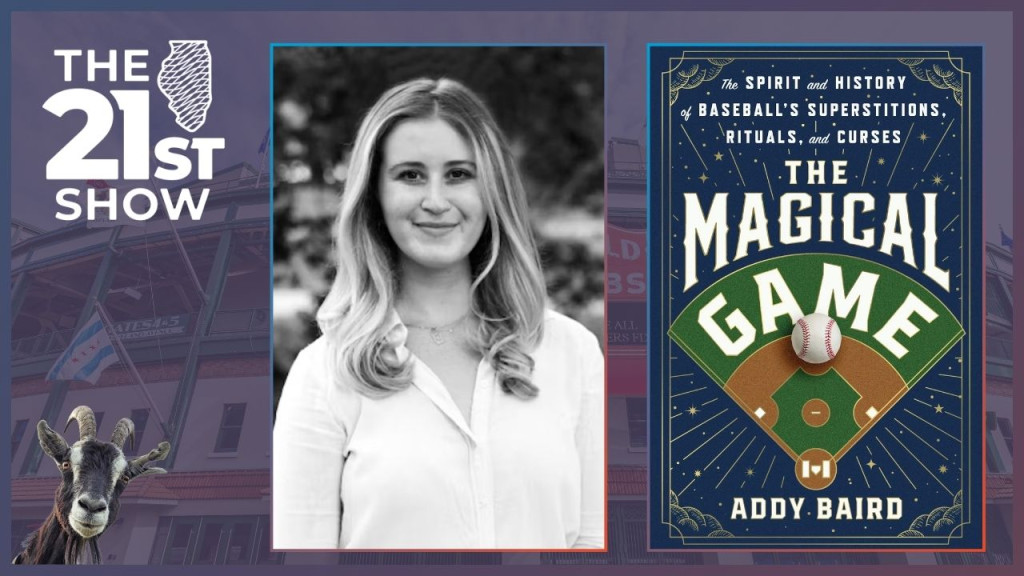
Transcript: The true story of the Billy Goat Curse, and other tales of baseball magic
The 21st Show
The true story of the Billy Goat Curse, and other tales of baseball magic
Read the full story at https://will.illinois.edu/21stshow/the-true-story-of-the-billy-goat-curse-and-other-tales-of-baseball-magic.
Transcript
// This is a machine generated transcript. Please report any transcription errors to will-help@illinois.edu.

[00:00:00]
Brian Mackey: It's the 21st show. I'm Brian Mackey. In 1945, so the story goes, the owner of Chicago's Billy Goat Tavern tried to get his pet goat into a baseball game at Wrigley Field. It was the 1945 World Series, and William [Sianis] was hoping to bring the Chicago Cubs some good luck and his tavern some publicity. As one version of the story has it, after some back and forth that went all the way up to the Cubs owner, the club let [Sianis] in. But not his goat. In a fit of anger, he declared, "The Cubs ain't going to win no more." The team went on to lose that World Series, and it would be 71 years before they appeared in another and then won it for the first time in more than a century. It came to be called the curse of the Billy Goat.

Now, it's worth noting, [Sianis's] family and the Cubs' official historian both dispute that account. Still, the incident and its aftermath have become part of the lore and mythology of baseball, a sport full of superstitions and rituals. To journalist [Addie] [Barrett], it's those stories that give the sport a feeling of magic. [Addie] makes her living as a political reporter. She currently writes for the Salt Lake Tribune in Utah and in the past has reported for Politico, BuzzFeed News, and other outlets. And last month saw publication of her new book, "The Magical Game: The Spirit and History of Baseball's Superstitions, Rituals, and Curses." [Addie's] with us for the rest of the hour. [Addie], welcome to the 21st show. Thanks for being here.

[00:01:29]
[Addie Barrett]: Hi, hi, it's great to be here.

[00:01:31]
Brian Mackey: All right, listeners, in order to make schedules meet, we spoke with [Addie] Wednesday afternoon. Because of that, no calls for this part of the show, but you can let us know what you think anytime. Our email address is talk@[twentyfirstshow.org]. All right, you write quite a bit about the curse of the Billy Goat in your book. You've done the research. What's your understanding of what actually happened that day?

[00:01:52]
[Addie Barrett]: This is a really good question. This was one of my main questions when I embarked on the project of this book. And as you mentioned, I talked to both the descendants of William [Sianis] and the Cubs' official historian. And the Cubs' official historian, I think, tells the version of this story that is truest to the facts. And I say "truest to the facts" because I talk in the book about how there's truth to mythology. It's something that we — there's something that we want to believe in, sort of the version of the story that's become famous.

But the Cubs' official historian talks about how, when William [Sianis] came to the game on this fated day, he actually got the goat inside. And so that's kind of where these stories kind of fundamentally break down. And there's actually photographs of this. There's photographs of [Sianis] walking this goat on the field. And it was him walking it on the field. And, by the way, it had been a rainy day and the goat had gotten wet. And by the time he's walking the goat on the field, it had started to dry up, but you can imagine how a goat that was once wet that hasn't been washed starts to dry and it's stinky, and that also —

[00:03:16]
Brian Mackey: "Fragrant" is the word that comes to mind, yes.

[00:03:18]
[Addie Barrett]: It's fragrant, and that contributes to this curse because the National League president was actually sitting right in the area where [Sianis] is parading this smelly goat on the field, and they were so embarrassed about this — they being kind of management at large and the stadium — and the Cubs are so embarrassed by this in front of the head of the National League in which they play, and it's then that they actually kick the goat out. And so there's — they had threatened to arrest him for trespassing, by the way. So there's this kind of initial tension in the story that we wash over in the way that we kind of tell the lore now. But that is my understanding from, you know, the team's historian, the photographs that we have, the newspaper articles at the time, of what really happened on this fateful day.

And the other thing to note is that there was no talk of a curse at this time. It was not actually — you know, [Sianis] apparently sent this telegram, it's real, saying the Cubs will never win on my watch, essentially. But he doesn't say like, "I curse you." There's no immediate, like, "They're cursed by this bar owner." That comes later as sort of banter in the newspapers with his friend who's a columnist. But it's a telling story about how we like to form the myths and form the stories of our curses, that's challenged a bit by the history of it.

[00:04:51]
Brian Mackey: "Truthiness," as Colbert once put it. Yeah, talk more about what actually did cause this lore or myth to sort of take hold.

[00:05:01]
[Addie Barrett]: Yeah. So [Sianis] has a friend who's a columnist at the paper. And when the Cubs actually started to have some hope, about two decades later — it's 15, 20 years later — the Cubs really have some hope to play well and maybe go to the World Series. And [David Condon] writes in the paper about this kind of feud between this bar owner and the team owner, and kind of tells this story that they've been cursed. And the Cubs playing so well has actually made the two of them make up, and there's hope and there's faith, and then the Cubs collapse. So the question is, like, well, is it [Sianis's] fault? It becomes this banter in the newspaper. And [Condon] is [Sianis's] friend. He comes into the bar — there are so many journalists who like to drink in this bar of his — and I think that is very key for this story, that it's a reporter's bar.

[00:06:01]
Brian Mackey: Yeah, I think, you know, the simpler explanation, as a born and raised South Sider and White Sox fan, is that the Cubs just stink. So what can you do? The White Sox, though, had —

[00:06:12]
[Addie Barrett]: Go ahead. [Sianis] actually says the same thing. He gets asked after the Cubs collapse if he has cursed the Cubs, and he says, "The Cubs curse themselves."

[00:06:23]
Brian Mackey: A lot of that going around these days. Of course, the White Sox have their own curse of the Black Sox that took 90 years to break. And it's not even unique to American baseball. You write about a team in Japan that spent decades dealing with its own curse after throwing a statue of Colonel Sanders from Kentucky Fried Chicken into a river. Talk about how the idea of a curse can bring about failure.

[00:06:47]
[Addie Barrett]: Yeah, well, this is something that I talked about with the Cubs' official historian — this feeling that, you know, he said, "If you believe you're cursed, you're cursed." And I think that's it. I think in the book, I look at a whole series of curses. As you mentioned, there's a team in Japan that throws a statue from KFC into the river, and it becomes this kind of piece of lore similar to the lore that surrounds the Cubs of the Billy Goat. And the team's official historian said, you know, if you believe that something is going to go wrong, something will go wrong. And what could be more cursed than that feeling of foreboding that kind of haunts you? And the longer it goes on with the Cubs — it's 108 years — when you're 99 years into this bad luck, into this very entrenched story, you start to believe it.

[00:07:41]
Brian Mackey: All right, we're going to take a break on the program. We'll continue with [Addie Barrett]. Her book is "The Magical Game: The Spirit and History of Baseball's Superstitions, Rituals, and Curses." She's also a political reporter now at the Salt Lake Tribune. We're on tape today, so no calls, but our voicemail line is 217-300-2121. [217-[unclear]-2121.] We'll have more after a short break. This is the 21st show. Stay with us.

[00:08:16]
Speaker 2: [Music: "Hey, hey! No doubt about it, they're going to pitch today, they're going to field today. No doubt about it, they got the muscle — the Chicago [Cubs]."]

[00:09:00]
Brian Mackey: It's the 21st show. I'm Brian Mackey. We're talking about the myths, legends, and superstitions of baseball. [Addie Barrett] is the author of a book about all of that. It's called "The Magical Game: The Spirit and History of Baseball's Superstitions, Rituals, and Curses." We heard a firsthand account of this from our texting group. You can join, by the way, by sending the word "talk" to 217-803-0730. Franny in Hinckley, Illinois, says there's probably a million moms in Illinois with similar stories. When my son's high school baseball team was on a winning streak, he would not let me wash his baseball socks. He didn't want me washing the good luck out of them.

Again, we taped this conversation with [Addie] on Wednesday, so no calls, but let us know what you thought. Talk at [twentyfirstshow.org]. All right, [Addie], your day job: political journalist. You mentioned in the acknowledgements that when you told your agent you had a book idea, "I'm sure she thought, hoped even, that it was going to be a politics book," you write. So what inspired you as a self-described converted baseball fan to write a book about baseball?

[00:10:06]
[Addie Barrett]: Well, first of all, I love that you read the acknowledgements. I feel like there are such little special treasures and gems from authors that get skipped over, so I appreciate the acknowledgements shout-out. There are a lot of really special people in there. But yes, my agent is one of them, and it's interesting.

I don't know. I think maybe if you're listening to this and you're a writer, you might understand this feeling. Ever since I was a kid, I wanted to write a book. I read under my blanket at night with a flashlight, genuinely. But I was working as a political reporter at BuzzFeed News and I was covering Congress. I covered two impeachments in two years. I covered a pandemic. I covered mass shootings, and I was really burnt out. They restructured the newsroom and I left, and that feeling of being a kid who just wanted to write and read books more than anything was really bubbling up in me. I started calling my friends who were authors and asking for their advice about how to approach a book.

I was thinking about writing a politics book because it was just what I knew best and have always written about. And a friend of mine said, "You have to write about something you really like." And the truth is, politics is important, but I don't like it. And I thought, what do I really like? And the answer was baseball and its magic.

And I am a converted baseball fan. I fell in love at a really special game when I was in college, which is a long story that you can read about in the book. But I also started to discover that even in baseball, there was this magical culture, and I've always been interested in that. I've been interested in astrology and magic ever since I was a kid. So it all kind of came together in this moment that felt very magical for me, so to speak, to get to write this book about essentially my passion project, my kind of hyper fixation. I was able to use my work as a reporter and my ability to approach a longer reporting project for the book, but I got to turn that kind of approach on something that I've never, until now, written about. So it was really special.

[00:12:21]
Brian Mackey: What is it that makes baseball more magical than, say, basketball or professional ultimate frisbee or any of the many other sports out there?

[00:12:32]
[Addie Barrett]: That was basically my No. 1 reporting question, and I think there are several answers. The first is there's a lot of research that shows that in sports where there's less scoring, there's a higher luck factor. So basketball, of our four major North American sports, has the lowest luck factor, and in a series of seven games between two teams, 80% of the time the team that is the better team by record is going to emerge.

That is not true in baseball. There is such a luck factor. To get that same 80%-best-team-advances figure out of baseball, baseball teams — I'm not joking — would have to play series of 80 games, because there's so much luck and so much variability in baseball. It's not just about skill because it's lower scoring, so that is part of it.

The other thing is that baseball has a really strange structure compared to our other four major North American sports, in that the defense and the offense are imbalanced, and the defense has the ball. And this creates a huge disadvantage for players on the offense. And as anyone who has paid any attention to baseball in their life can attest, baseball is a game predicated on failure. We see amazing players fail seven in 10 times.

And that also breeds a magical culture. We know from the history of research about superstition and magical thinking and magical practice that people engage in magic when the outcome is uncertain, and it's a way of maintaining at least a feeling of control over an uncontrollable situation. And I think baseball — every single one of those little pieces comes together for this puzzle that I think just really appeals to the magical thinking and the pattern recognition that we are really primed to do as human beings. It's that whole cocktail of things that results in this really magical game.

[00:14:52]
Brian Mackey: I love that you talked about the role of luck there. And you think about it — like you said, premised on failure — this is a sport where someone who's batting .300, right, they're getting a base hit 30% of their at-bats, and that's considered elite, All-Star level. You're still failing 70% of the time at your job. What other job would let you do that? I don't think your employers would allow that sort of failure. So one of the ways that baseball players like to — I mentioned the mom not washing her son's socks, right, and those are the superstitions — players have many of them. They always warm up at the same time, they drink the same brand of coffee, same shirt, same socks. What is it about baseball that lends itself to these superstitions beyond the role of luck?

[00:15:44]
[Addie Barrett]: Yeah. So I think you're getting at this other aspect of it, which is that baseball is a daily game. We know from the studies of superstition and the psychology of superstition that we are more likely to develop superstition about things that are happening over and over again. So the fact that there's a baseball game almost every single day from April to November is part of what creates this sense for players and for fans that you're repeating the superstition because the thing itself is frequently repeated.

And this goes on down through a baseball game. Players who have at-bat superstitions — not only are they playing baseball basically every day, they're seeing maybe up to 10 pitches in an at-bat, and in that case, maybe dozens of pitches over the course of a game. That creates, again, this feeling that there's some value in repeating the superstition because you're frequently finding yourself in a situation where maybe it's helpful.

And there is this real body of research that says, at least for athletes, it can be helpful, and that it gives a player a sense of confidence to perform a ritual. It gives a player a feeling that they are prepared and protected in what they're about to embark on, and that has a measurable, real effect on performance. Whether you think that's supernatural magic in action, I think is where people really get lost, but the real psychological benefit is there and documented.

[00:17:24]
Brian Mackey: Well, even the most skeptical among us can say the placebo effect can be real in certain instances. Yeah. So baseball has arguably been losing some of its magic, right — and what's made it unique for almost as long as it's existed. Talk about that undercurrent in baseball history.

[00:17:44]
[Addie Barrett]: The description of it as an undercurrent in baseball history is perfect. And I will be totally honest with your listeners: when I pitched this book, I pitched a chapter about the magic being dead. This was right before Major League Baseball was about to implement a pitch clock, and I was really against a pitch clock. I proposed a chapter in this book about how it was destroying what makes baseball magical, because for me, a lot of what makes baseball magical is the way that a baseball game exists outside of time. There's no clock, and I felt like the pitch clock would imperil that magic.

And I started doing my research about this question of baseball dying. And I encountered something really interesting, which was that people have been saying that baseball is dying for like 150 years. And it's still here. One of the earliest examples that we have is from the 1860s of a player talking about how baseball players don't play ball like they used to, quote unquote, and that other forces controlled the game — and he was referring to the influence of gambling on the sport and that it had killed the magic of when he was young and people played for the joy of it. And it was so funny because it's basically this cycle that I encountered every decade or so of someone saying baseball is dead, baseball is actually back, baseball is dying, the magic is dead — even if the business of baseball is healthy. And I thought, well, surely I can't argue that baseball is dying and that the magic is dead if people have been saying that for so long and it keeps surviving and I'm out here writing a book about the very magic of it.

And then I watched the pitch clock get implemented, and I was really surprised. I was living in Washington, D.C., at the time and I lived not far from [Nationals] Stadium, and I loved going to games, but I wouldn't really go on weeknights because I would end up getting home at like 11:30 and it was too late and I had to work the next morning. And the season that they implemented the pitch clock, all of a sudden games were significantly shorter, and without really thinking about it, I started going to weeknight games more often. And I was like, isn't this funny — that my complaint was that the pitch clock would make for less baseball and thus less magic, and it's actually brought more baseball into my life. And it really challenged my thinking about the impact on the game. I have complaints about baseball — that's also part of the tradition for people who love baseball, is to complain about baseball, it really is — but I really changed my mind on this.

Part of it was seeing it implemented and the way that it brought more fans, it brought younger fans, it actually meant more time for me at the game. And when I was looking back through baseball history, I noticed something too, which was that the early descriptions of the game are of the game having vim to it and having an alacrity to it, and that you couldn't get out of your seat for fear of missing something, which doesn't really sound like the baseball we know. I was talking to a friend about the pitch clock and he was like, "I feel like I can't go get a beer or I'll miss half an inning." And I realized that the pitch clock was actually bringing us — if our goal is to keep baseball kind of pure and classic — that the pitch clock actually started to sound a bit more like the early descriptions of the game that I had encountered over the course of my research. And that really challenged my assumptions for me as well.

So I think this is part of what makes baseball so special, is that the history is so rich. It's just interesting to encounter yourself in it. I felt like I was this very modern baseball fan, and I started to complain about the pitch clock and look back through the history, and I saw myself.

[00:21:59]
Brian Mackey: Well, we're coming to the end of our time together, and I want to end by asking you — we're now what, 20 years into the Moneyball era, give or take? Maybe even 25. Anyone can go on their phone, look up a player's stats throughout their whole career. What is it that keeps us attached to these rituals, these stories, these superstitions?

[00:22:19]
[Addie Barrett]: Well, we talked about luck a little bit earlier. I was talking to some [sabermetricians] — people who are experts in baseball statistics — while I was writing this book, and one of them pointed out to me that you could do the stats perfectly and you will never actually know the outcome of the game. You can never actually accurately predict how a game is going to go.

I was watching the Mets last night, which I still do despite it all — and Cubs fans will understand — and they ended up playing this bizarre game. They lost 16 to 12. They were at one point up like 9 to 4, and it was so random. And I had the thought, how could we analytically ever predict this game?

And I think that's what keeps us coming back, and it's what keeps the magic alive — that there's this element of luck and randomness, and it feels like there's this thread of fate running through the game. The Mets announcers said last night — when the Mets were up — Gary Cohen said, "Only fate could take this win from the Mets." And I thought, it will. And I think that's what keeps it alive, is that we can never really know, and in that way it's this sort of mystery that we encounter every single day, every single summer.

[00:23:43]
Brian Mackey: [Addie Barrett], the book is "The Magical Game: The Spirit and History of Baseball's Superstitions, Rituals, and Curses." It's available now from St. Martin's Press. [Addie], thanks so much for sharing your work with us today on the 21st show.

[00:23:57]
[Addie Barrett]: Thank you.

[00:23:59]
Brian Mackey: That is it for us today and this week. The 21st show is a production of Illinois Public Media. I'm Brian Mackey. Thanks for listening. We'll talk with you again on Monday.
Transcript Assistance
Illinois Public Media may use AI assistance for transcript generation and/or formatting. Transcripts that have not yet been reviewed for accuracy will be labeled.
To report a transcription error, or to request transcription of archival material, please contact will-help@illinois.edu.