








Transcript: Three decades chasing the Amish, Mennonites and the last Shakers
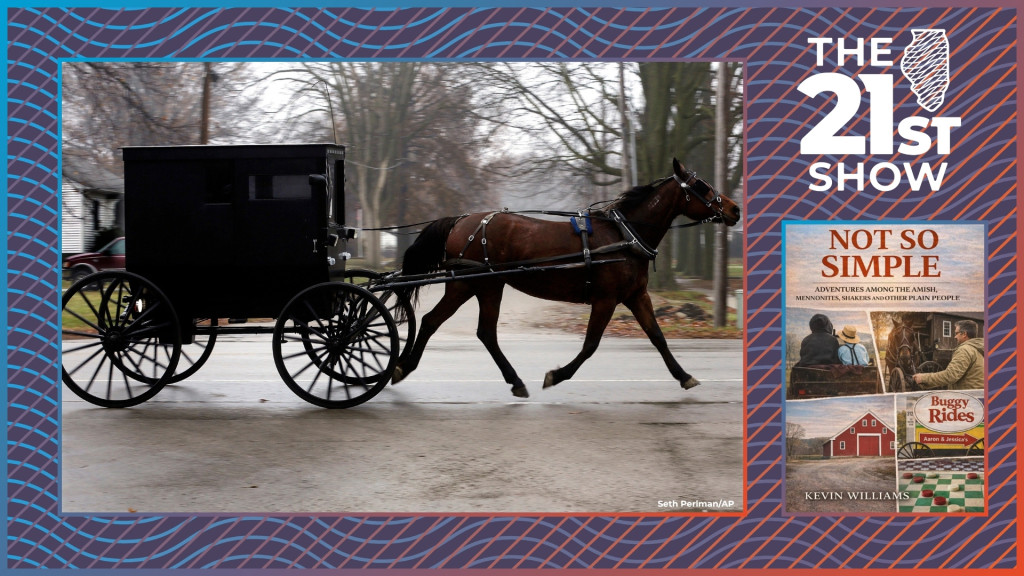
Transcript: Three decades chasing the Amish, Mennonites and the last Shakers
The 21st Show
Three decades chasing the Amish, Mennonites and the last Shakers
Read the full story at https://will.illinois.edu/21stshow/three-decades-chasing-the-amish-mennonites-and-the-last-shakers.
Transcript
// This is a machine generated transcript. Please report any transcription errors to will-help@illinois.edu.

[00:00:00]
Brian Mackey: It's the 21st Show. I'm Brian Mackey. Kevin Williams was a college student when he started driving around Michigan and Indiana, knocking on the doors of Amish women with a pitch: Write a weekly newspaper column about your life, tack on a recipe, and he would get it into print. He heard no most of the day. Then in Adams County, Indiana, one woman said yes.

That column, the Amish Cook, is still running these days, written by an Illinois woman named Gloria Yoder, and it set Kevin Williams on a path of more than three decades reporting on the Amish and other people dedicated to what you might call simple living. His new memoir is "Not So Simple: My Adventures Among the Amish, Mennonites, Shakers, and Other Plain People." Kevin joins us now. Kevin, thanks for being here. Welcome to the 21st Show. And Kevin, are you unmuted there? Modern technology — if you can give Kevin a second —

[00:01:13]
Kevin Williams: we're gonna be, yeah, there you go. Welcome for me.

[00:01:17]
Brian Mackey: Thanks for being here. You know, we'll get through the tech. 800-222-9455 if you want to join us today. 800-222-9455. There's some irony in having a little technical challenge when we were talking about the Amish. All right, let me ask you: What first drew you to Amish communities?

[00:01:38]
Kevin Williams: I mean, I think the simplicity. What draws a lot of people to the Amish is their simplicity, this way of life that seems less complicated. That's what it seems like at the surface, but once you really get into the communities, it's a lot more complicated than it looks from the outside.

[00:01:56]
Brian Mackey: Yeah, well, let's dig into that. So you say the word Amish — people have different impressions, maybe based on their experience, right? For some people it's horse-drawn buggies. For others it may be popcorn or expensive oak furniture. What are the most important definitions that you've learned of what it means to be Amish?

[00:02:16]
Kevin Williams: Being Amish is more than just the religion — it's a way of life, and it's maintaining the outside world at sort of an arm's length. The Amish are very careful about what they let into their lives. It varies greatly from community to community, and that's what makes understanding them kind of difficult sometimes, because the Amish in Arthur, Illinois, are very different from the ones that you find, say, in Flat Rock near Robinson. The interpretation of their theology is very different from community to community. It can make it confusing to an outsider.

[00:02:50]
Brian Mackey: Yeah, talk about how some of those differences manifest, right? I think we've all had the experience of seeing a group of Amish people drive up in a van and talking on a cell phone and that sort of thing, and you think to yourself, well, that's not what I thought it was supposed to be about. So talk about that range of difference.

[00:03:07]
Kevin Williams: Well, you have very conservative Amish, and you have some that live in the western part of Illinois near [Piketon] that are much more conservative than the ones in — the largest community in Illinois is Arthur. That's a very interesting community, very entrepreneurial. I would say it leans towards the progressive side, but not nearly as progressive as, say, the Amish near Robinson. And some of them actually have electricity in their houses. They're much more accepting of photography, so you have a wide range just in Illinois.

[00:03:41]
Brian Mackey: And talk about where this idea of keeping modernity or modern life at arm's length comes from. Can you talk about the theological roots of that?

[00:03:54]
Kevin Williams: It's about being separate. The Amish, you know, are a Protestant breakaway group that goes back centuries, and the whole underpinning of Amish religion and culture is separation, and they've continued that to this day. Now, the Mennonites embrace a similar doctrine, but not quite as — although it varies greatly among the Mennonites too, because you have some Mennonites that are horse and buggy, that live very much like the Amish, and then some that are much more progressive. But the general underpinnings of their religion are just separation from the rest of the world. That's very, very important to them.

[00:04:35]
Brian Mackey: You have the word "plain" in the subtitle of your book, and I was curious about that. I did a little research on it. Talk about where that comes from and what it means in this context.

[00:04:46]
Kevin Williams: "Plain" — that's a term that Amish and Mennonites will use to describe themselves. I use it, I capitalize it. They consider themselves Plain people, and that refers to their dress, the clothing. You're not gonna find an Amish person, for the most part, with, like, a University of Illinois sweatshirt or something. It's plain clothing, solid colors, and it's also about not wanting to stand out in a group. The group generally dresses the same — no one person is supposed to stand out. And that can be difficult with capitalism, because the Amish are also a very entrepreneurial, capitalist group. So you have some Amish that are much more prosperous than others, but they're not supposed to show it, and that can be difficult too.

[00:05:35]
Brian Mackey: All right, let me remind listeners, this is the 21st Show. We're talking with Kevin Williams, who has spent decades writing about and studying the Amish and other Plain communities in America. He's the editor of the Amish Cook newspaper column, which at its peak was in 150 different newspapers around America — now it's in 40. We're gonna talk about that, and it sort of traces some of the changes we see in media over the past few decades.

If you want to join us today, 800-222-9455 is the number. I should say we're talking with Kevin because he's written about these experiences in a book. It's "Not So Simple: My Adventures Among the Amish, Mennonites, Shakers, and Other [Plain] People." Again, if you want to join us, 800-222-9455 is the number. This is the 21st Show. We'll be back in a moment.

It's the 21st Show. I'm Brian Mackey, and my guest for the rest of the program today is Kevin Williams, editor of the Amish Cook, a nationally syndicated newspaper column he created and which is now on its third writer, Gloria Yoder of Illinois. He has been writing about and studying — trying to learn about — the Amish and other Plain people for three decades, and he's written about those experiences in a new book. It's called "Not So Simple: My Adventures Among the Amish, Mennonites, Shakers, and Other Plain People" — that's with a capital P.

If you want to join us today, 800-222-9455 is the number. That's 800-222-9455. And we actually have a caller on the line already. Craig is calling from [Frankfort] on line one. Craig, thanks for calling in.

[00:07:52]
Craig: Well, thank you for this interesting topic. I would just like to ask the guest about outsiders coming into the Amish community. I don't mean, you know, visitors or people like me, but if somebody wants to be Amish, wants to become part of the community, are they welcoming? What's — I guess I was wondering kind of what the process would be, if they do allow outsiders. And if they don't, how do they keep their community going? Because I imagine they're rather small communities, so intermarriage among families must have its limits. So I was kind of just wondering how they're able to grow their community if they allow outside people to come in who want to be part of it. Thank you.

[00:08:37]
Brian Mackey: Good question, Craig. Thanks for that. Kevin, over to you.

[00:08:40]
Kevin Williams: I love that question. I could spend the rest of the show on that, but I won't. Outsiders joining the Amish are very rare, but it does happen, and I've met several successful converts. They often don't — people who try to join don't get tripped up by the technology. Because most people, that's why a lot of outsiders want to join — no internet, no TV. It's overload on our end, so that's the appeal. What trips outsiders up is the language, because the Amish do speak German at home. That's their first language. And, you know, I've got young daughters and they can pick things up like a sponge, but when you're an adult, it's a lot harder. And if you don't speak the language, you're never going to be a part of the community. It really is exclusionary.

And then you have to have the spiritual motivation. You can't just be doing it for an off-the-grid lifestyle — you can do that without religion. You have to feel the spiritual aspects of it. So those are the key components of joining. But I mean, I met a public school teacher who was in his 40s who just decided he had had enough, and he joined the Amish about 20 years ago and is still there and is well accepted, so it happens.

As far as genetic diversity — the Amish don't evangelize. They don't ask people to come in. Intermarriage has caused some birth [defect] issues in the Amish. The Amish are generally aware of these, and you do have Amish people that move around from community to community, but that is a problem in the church.

[00:10:18]
Brian Mackey: You mentioned outsiders coming in trying to — what you say convert, I guess — or being tripped up by the religious dimensions. What would you say defines this way of believing from other Protestant denominations?

[00:10:36]
Kevin Williams: It's just this authentic — very authentic — belief in, I mean, I'm not saying you don't see this in other Protestant religions, you do, but there's this authentic belief in the afterlife, in heaven. I met an Amish man in Montana once who told me that he was so excited about death that he can't stand it — is what he told me. I'm just like, oh my gosh, I want to stick around as long as I can, and he's wanting to get out of here — not because he's unhappy, but because he believes so much in what awaits. So you have to have that. And a lot of other religions have that too. The Amish express it through simplicity and separation, but that's the key component — you have to have that spiritual fire. Like if you're going to join the church, Amish people who grew up in it have that instilled in them.

[00:11:29]
Brian Mackey: I was reading one of the recent Amish Cook columns, and it described someone holding a baby that they knew was not long for this world — I use that phrasing advisedly. And you really got the sense that they believed it and were almost — I think most of us would view that as a horrible tragedy, a baby that was on the path to dying, but they wrote about it in such a way as, like, how excited they were for this child.

[00:11:59]
Kevin Williams: That's a good example. They just have a much different view of death than most non-Amish. I mean, I've been to Amish funerals where the casket is elevated a little bit, so if you've got a really small child walking by it, they couldn't see inside. I've seen many Amish parents lift their children up so they can directly look in the casket and make contact before they pass by. It's just instilling in their kids that death isn't the end — it's a beginning.

[00:12:31]
Brian Mackey: Let's go back to the phones. We have Tim calling from Champaign. Tim, thank you for calling in.

[00:12:36]
Tim: Hey, how you doing this morning?

[00:12:37]
Brian Mackey: I'm doing well, thank you. So I understand you used to go to Yoder's — or your mom used to go to Yoder's restaurant.

[00:12:46]
Tim: Well, I took her to Yoder's a couple times when she was still alive. I think she was rather inquisitive, noticing things. She would lean over to me and she says, "They're wearing Nike shoes" — you know, the servers — "is that allowed?" And the other quick question: Are the Amish the innovators of the clothesline? I see a lot of unique ones out there.

[00:13:15]
Brian Mackey: OK, interesting questions. Kevin, I'll start with the Nikes.

[00:13:23]
Kevin Williams: Yeah, there's no prohibition against that type of clothing. I would be surprised to see a lot of Amish wearing Nikes just because they're expensive — they're generally more frugal. But Crocs are really popular among the Amish. You've got to get shoes somewhere, so that really doesn't surprise me a whole lot.

As far as clothesline innovations — yeah, you see that a lot. I've seen Amish people repurpose bicycle wheels and hang them horizontally, and you pin little socks on them. They're great for socks and underwear. Bicycle wheels they've repurposed into, like, a round laundry line. I've also seen laundry lines on pulleys that go, you know, 50 feet into the sky to better catch the wind for drying. So yeah, there's a lot of innovation among the Amish and the clothesline. I don't think they invented the clothesline, but they certainly have made some modifications to it.

[00:14:20]
Brian Mackey: So how did the Amish Cook come about as a column? Tell me about that day — I mentioned, you know, the days driving around trying to find someone.

[00:14:30]
Kevin Williams: Yeah, and I go into that in the book pretty in-depth. It really was — it was before that, when I was a young journalist, because I was really always in this for the journalism. I consider myself a journalist first more than an Amish expert. But this was a time when newspapers were still in their heyday, and I just thought — I was interested in the Amish, I'd done some writing about the Amish — and I just thought, wouldn't it be neat to have a syndicated column where an Amish person could share their life each week and maybe a recipe? That's what being young does to you. You have these ideas that you have no idea whether they can be done or not, and yeah, it could be done, but it was not easy. Even newspapers in their heyday didn't pay a lot, but it really caught on.

Quincy, Illinois, was the first newspaper in the country to carry the column, and they still carry it to this day, long after many have dropped it — just because newspapers are, you know, dropping like flies. But it was a fusing of my interest in journalism and the Amish, just a convergence that was very unique and probably wouldn't have happened today. But back then, when newspapers were doing well, it happened.

[00:15:46]
Brian Mackey: So I mentioned Gloria Yoder — Elizabeth Koblenz [spelling unverified], I don't know if I'm pronouncing that correctly, please correct me — was the original writer. What do they get out of it? What do you understand they're getting out of this?

[00:15:58]
Kevin Williams: I can tell you what Gloria's view on this is — it's missionary. It's a way for her to spread her way of life and religion, and she views this as missionary work. Now, she's part of a sect that's more evangelical than other Amish. Elizabeth, I think, did it — she was kind of a pioneer in that sense — just because she liked to write. She enjoyed writing, and there weren't many outlets at that time for Amish authors. There still aren't a whole lot, but there's more today than there used to be. So I think with the first one, you had an Amish woman who just genuinely liked to write. And then Gloria, I think, views it with a much more evangelical lens. Her columns do touch people — Gloria will definitely inspire spirituality among her readers.

[00:16:55]
Brian Mackey: It was one of hers, I believe, where I mentioned the holding the baby. You know, there are those who might cast a skeptical eye on some of this, right? Cynics can frame most journalism as exploiting its subjects. I've certainly — I think anyone who does journalism long enough will face that issue in their work, especially when it's people who have opted out of mass media culture to some extent. How have you thought about that over the years?

[00:17:21]
Kevin Williams: I've thought about that a lot — and cultural appropriation, you know, I'm not Amish. Should I be doing this? I get that. But the Amish Cook columnists always wanted to do it, and it was always something they wanted — like Gloria enjoys writing and enjoys spreading the word. So if she ever decides she wants to hang it up, that's completely up to her. I try to — you know, I don't edit her work much. I leave it alone, even if there are grammatical turns of phrase that might be a little different just because of the language translation.

So, as a journalist, I cover a lot of different communities now because I write for a number of news organizations. I always try to be sensitive to the fact that I'm telling other people's stories. As a journalist, that's what you're doing — you're telling other people's stories — and you try to do it with sensitivity and respect. That's really all you can do.

[00:18:27]
Brian Mackey: Yeah, I should say for readers who may not be familiar, you've had bylines in The New York Times and other big news outlets as well.

Let me ask about — as I was reading about this and thinking about the Amish Cook and what has happened — I mentioned this was once in 150 newspapers, now it's 40. There are just not newspapers in as many places as there used to be. TikTok has filled that void for a lot of people in terms of where they consume media. Do you think the fascination with Amish culture persists? Do you see that ever moving into where media is going with short-form vertical videos?

[00:19:12]
Kevin Williams: There's a woman who left the Amish — her name's Lavina Zuck. She left the Amish, but she's really popular on TikTok because she wears her Amish clothing still and has this sort of accent and the cooking style — cooking videos, you know, Amish-style. And then there's Ben and Rose — they actually are Amish musicians who are very popular on YouTube. So you're seeing Amish starting to dip their toe into social media. Now you're also getting a backlash from some of the more conservative Amish over this, so the Amish are going to have to work it out among themselves over the years ahead as to how far down that road they want to go.

[00:19:53]
Brian Mackey: Well, the Amish have been holding on to their way of life — and I should say we're coming to the end of our time together — for, in some cases, 200 years now. I wonder what that past tells us about what you think these communities might be like in another 50 or 100 or even 200 years.

[00:20:07]
Kevin Williams: Oh gosh, 50 years I can maybe envision — you go further than that, it's really hard. They're gonna try to stay simple and insulated, arm's length. But even things like AI are encroaching into Amish communities, where some Amish are accepting that — they're saying, well, it's a perfectly viable way to get information. Some Amish communities are tiptoeing towards cars, at least for some people in their communities, so they can be driven around. So I think 50 years from now you will have the Amish living steps behind the rest of us, but those steps will look very different compared to where we are at that time. And I think the plain dress will continue to mark them as wanting to stay separate. I think the minute that goes away, that identity goes away. And the horse and buggy.

[00:21:02]
Brian Mackey: Kevin Williams is the author of "Not So Simple: My Adventures Among the Amish, Mennonites, Shakers, and Other Plain People." He's the editor of the Amish Cook newspaper column. You can follow his work at Amish365.com, and you can find links to get the book from there, or just Amazon or wherever you get your books. Kevin, thanks so much for being with us today on the 21st Show.

Kevin Williams: Interesting. Thanks for having me.

Brian Mackey: That is all the time we have for our program today. Coming up tomorrow, we'll be speaking with Connor O'Neill. He is a producer on the NPR podcast "White Lies" and also a reporter. He has been documenting a group in Illinois seeking to partition the state in two and have a new Illinois. We're gonna talk about his work there and where that movement continues, putting questions on the ballots around the state. We're also gonna speak with author [Eddie Baird] on her new book on baseball superstitions, rituals and curses. It's called "The Magical Game." It's all coming up tomorrow here on the 21st Show, which is a production of Illinois Public Media. I'm Brian Mackey. Thanks for listening.
Transcript Assistance
Illinois Public Media may use AI assistance for transcript generation and/or formatting. Transcripts that have not yet been reviewed for accuracy will be labeled.
To report a transcription error, or to request transcription of archival material, please contact will-help@illinois.edu.