







Transcript: Meet Democratic candidate for Lieutenant Governor Christian Mitchell
Transcript: Meet Democratic candidate for Lieutenant Governor Christian Mitchell
The 21st Show
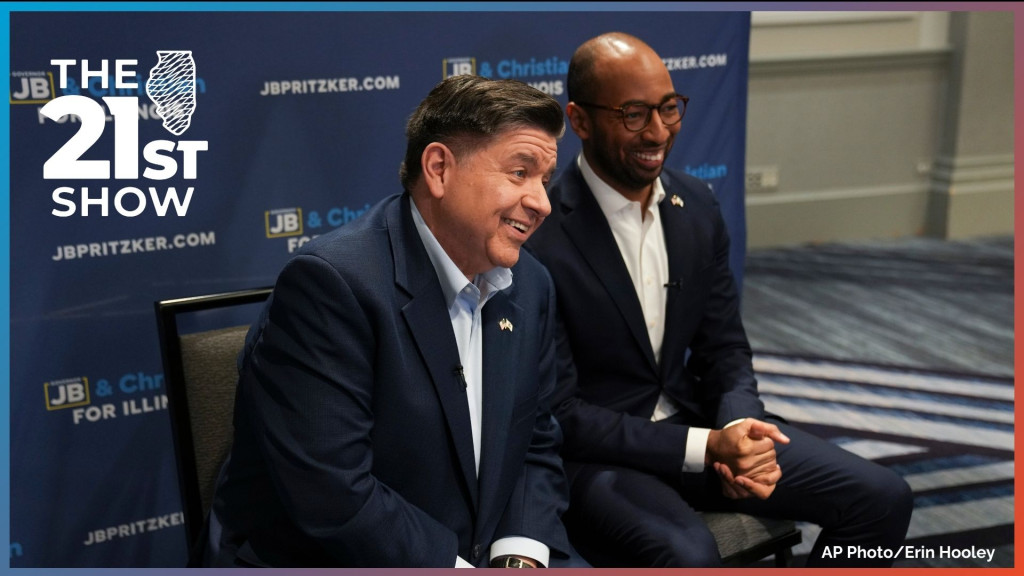
Meet Democratic candidate for Lieutenant Governor Christian Mitchell
Read the full story at https://will.illinois.edu/21stshow/who-is-the-democratic-candidate-for-lieutenant-governor-christian-mitchell.
Transcript
// This is a machine generated transcript. Please report any transcription errors to will-help@illinois.edu.

[00:00:00]
Brian Mackey: From Illinois Public Media, this is the 21st Show. I'm Brian Mackey. Governor JB Pritzker was unopposed in the Democratic primary this year as he seeks a third term for office, but the incumbent lieutenant governor, Juliana Stratton, chose to run for Senate, and of course she ultimately earned the party's nomination. That meant Pritzker had to pick a new running mate, and his choice is our first guest today. Christian Mitchell served three terms in the Illinois House of Representatives and then spent four years in the Pritzker administration as a deputy governor — essentially a senior aide — focusing on the environment, infrastructure and public safety.

A little biography: Mitchell was born and raised in Chicago. He earned his undergraduate degree in public policy from the University of Chicago. He went on from there to work as a community organizer and also worked for several Democratic politicians. In November 2012, he was elected to the Illinois House, becoming the youngest member of the 98th General Assembly. He was reelected in the years that followed, including 2018, but at the end of that year, Governor-elect Pritzker at the time announced Mitchell would serve as deputy governor. During his time in that role, he earned a law degree from Loyola. He also served for a time as executive director of the Democratic Party of Illinois, and in 2023, he joined the Illinois Air National Guard. For the past few years, he served as vice president of civic engagement at the University of Chicago. And now, Mitchell is running for lieutenant governor in this year's elections in Illinois. Christian Mitchell, welcome to the 21st Show.

[00:01:43]
Christian Mitchell: Brian, thanks so much for having me, and thank you, everybody, for listening.

[00:01:47]
Brian Mackey: And a quick note: I should say we've also invited Republican candidate Darren Bailey's running mate, Aaron Del Mar, to join us on the program. His campaign has been in touch. We are working on coordinating availability. That said, we're with Christian Mitchell live for the first half of our show today. If you have questions or comments for the candidate for lieutenant governor on the Democratic ticket, you can join us at 800-222-9455. 800-222-9455. All right, first question: What brought you into politics?

[00:02:21]
Christian Mitchell: Well, I grew up, as you said, in the western suburbs of Chicago. I was raised by one of my heroes — my mother, single mom — worked at Rush University Hospital in Chicago for nearly 40 years as a NICU nurse, so taking care of the most vulnerable children at their most difficult time, and then my grandfather, who was a union steelworker and a sergeant in the U.S. Army. And we had a normal middle-class life, Brian, until I was about nine years old, and then, like I think many middle-class families, we got hit by a series of healthcare crises that really changed our situation. My grandmother got Alzheimer's. My grandfather was in congestive heart failure, and my mother actually would have her own fight with breast cancer. And so I remember watching my mom struggle to figure out how, as she said, to rob Peter to pay Paul to make her paycheck stretch as far as it could to try to cover some of those expenses. And so that really showed me the vulnerability that families have and how we're all, in some ways, you know, one paycheck from being in a more difficult situation. And that is really what got me thinking a lot about public service.

And so I went to the University of Chicago, met one of my mentors there, Will Burns, who was a state representative before me, who really helped me decide that this was something I wanted to do, worked on a couple of campaigns, as you said in your intro, and then in 2012, a seat came open and I was fortunate to run for it and win, and that was the beginning of my time in politics.

[00:03:44]
Brian Mackey: Are you the type of person who's always wanted to go into politics from a young age?

[00:03:48]
Christian Mitchell: No, I wouldn't say always. Actually, I wanted to — I loved the movie "Jerry Maguire." I wanted to be a sports agent. I really, really liked sports, grew up watching a lot of boxing, basketball, football — "Show me the money," [Kwan]. And so that's what I wanted to do, and I figured that I'd be able to make good money and buy my mom a new house and pay off all those old bills and my college debt. And it really was meeting Will, meeting one of my mentors besides Will in college — a guy named John Easton, who was a professor who had been a community organizer — and basically their challenge to me was, "You're at this great institution. You've made it. What about all the families that you grew up with, talked about in your time in Maywood, that saw similar difficulties? What are they gonna do, and how can you be helpful in making a better world for people who grew up in the same circumstances you did?" And that really changed my trajectory, and working for Will is what got me on this path.

[00:04:42]
Brian Mackey: To be blunt about it: So now you're running for lieutenant governor. This is regarded by some as one of the worst jobs in Illinois politics. Why do you want it?

[00:04:54]
Christian Mitchell: Well, a couple of things. I think the first is the most important thing in being lieutenant governor is having a really good partnership with the governor, and I think that I've been fortunate to see JB in action for, you know, nearly a decade now, working on his first campaign, being deputy governor. And this is someone who gets big things done, who's already raised the minimum wage and capped the cost of insulin and, you know, helped pass the $45 billion Rebuild Illinois infrastructure bill that is rebuilding roads and bridges across the state, which was a project of mine as deputy governor. And so I'm getting to work with the best governor in the country to keep getting big things done. I think that's the number one thing.

I think the second is we have a level of trust and respect for each other that means that I'll be, I think, very highly involved in a lot of big initiatives, making sure that we continue to advance the cause of the people of Illinois. And so I think that for me, when I think about the statutory duties of the office — everything from a Rural Affairs Council, which means that we're touching our farmers and other folks who make the Illinois agriculture sector so great, to the Main Streets program that the office has, that is gonna be helping to think about the future of, you know, yes, places like Chicago, but also places like Belleville and Alton and other towns and municipalities in Illinois — I'm really excited about that work. But I'm also excited about being part of making sure that the governor's agenda about lowering the cost of housing, lowering the cost of energy, raising wages and the [standard] of living, I should say, for the people of Illinois — I think I'll be heavily involved in that, and that really excites me.

[00:06:24]
Brian Mackey: We had a couple of questions from listeners. We invite them to submit questions ahead of time by text message. On this point, right, the idea of — well, John in Rockford points out, he cites John Nance Garner, Franklin Delano Roosevelt's first vice president, famously described the office as not worth a bucket of warm — let's say spit for the radio. One of your predecessors —

[00:06:48]
Christian Mitchell: [I know] the quote, Brian, but it's pretty good.

[00:06:50]
Brian Mackey: One of your, you know, could-be predecessors as lieutenant governor, Dave O'Neill, resigned the position citing boredom. What would you hope to accomplish beyond, you know, the Rural Affairs Council and the rivers coordinating chairmanship or whatever that other title is?

[00:07:06]
Christian Mitchell: Well, I mean, you mentioned that the listener who called in was from Rockford, which has a great mayor in Tom McNamara and is one of the fastest-growing municipal regions in the entire country that has done some really interesting stuff on housing, has lowered crime, has done some real great economic development work in partnership with the governor's office. I've been to meet with the mayor several times on capital projects we got in Rebuild Illinois that are making a big difference in Rockford. So it really is continuing to do that kind of work.

What is the future of the state of Illinois? What's the 2050 plan? What are the things we need to do right now to invest in our community colleges, our colleges, our technical education, our K-12 education to make sure that Illinoisans are ready for the jobs of now and the jobs of the future? What's it going to take, you know, with everything we're seeing coming out of Washington, with the higher input costs for our farmers right now and the tariffs that are making it harder for them to sell their soybeans to market? What are we going to do to continue to open up new markets and push back on all of these new Trump taxes that your listeners may have seen? There's now going to be an eight-cent tax on the mail to pay for the higher cost of fuel because of the war of choice that the president started in the Middle East. So what are we going to do to bring down those costs for Illinois families, to make sure we're protecting our farmers and investing in our small towns and villages and then our big municipalities? Those sorts of things are the things that really excite me, and I think this office gives me a chance to do the thing I love the most: go around the state of Illinois, talk to people where they are, hear about the things that they want to see done to make their lives a little bit easier, and then work with them to get those things done.

[00:08:40]
Brian Mackey: All right, let me remind listeners: This is the 21st Show. We're speaking with Christian Mitchell, former state representative, former deputy governor to JB Pritzker, who is now Governor Pritzker's running mate, running for lieutenant governor in the November elections. You can join us at 800-222-9455. 800-222-9455. All right, let's — you mentioned some policy issues there. Let's talk about some of those. You were an advocate for changes to education funding during your time as a lawmaker that led to what's known as evidence-based funding. Do you think those reforms have lived up to their promise?

[00:09:16]
Christian Mitchell: I think there's always more to do, but absolutely. Education funding reform, evidence-based funding, has been a good thing. You know, the governor's put billions of new dollars — I think it's more than $2.5 billion in new funding in education — and because of the way the formula was structured, it is going to the schools that need it the most to do the things that they most need. And I wanna give a special shout-out here to my former colleague, Deputy Governor Andy Manar, who led on this, and I was fortunate to go around the state and do town halls with him because of the connection between not just our urban centers but also some of our more outflung rural hamlets that were suffering similar challenges with education.

We obviously need to continue to do more to fund public education. The governor's proposed a $200 million fee on social media companies who have had really outsized negative impacts on our children, asking for them to help foot the cost of putting more money into K-12 education. There's always more to do, Brian, no question, but it is unassailable that this has been a very good thing for the people of Illinois.

[00:10:16]
Brian Mackey: You mentioned $200 million on a proposed social media fee. There's still — the teachers union says we're still billions of dollars short. The goal was to reach 90% of funding needs for each school by next year. It's estimated we're billions of dollars short of that. How else can we bridge that gap?

[00:10:34]
Christian Mitchell: Well, I think we have to consider our context. So, you know, evidence-based funding was passed, I want to say, back in 2017. In 2017, you know, we had a Republican governor, Bruce Rauner, who had driven us into $16 billion of unpaid bills. We had a massive structural budget deficit that we're still clawing our way out of. We had eight credit rating downgrades. We've now had 10 credit rating upgrades. We are now — all of the state's short-term debt is gone, and we continue to improve our fiscal situation. But that hole that the Republicans dug us into has lasting reverberations and consequences. And now President Trump is talking about withholding something like $8 billion in funding from the people of Illinois. So that is our context.

So we have to continue finding ways to fund education at the level it deserves to be funded at. I don't think myself or the governor would disagree with anything the teachers unions are saying so much as we have to find a way to find the revenue but also to continue to grow the economy so we have more taxpayers so that we continue to get more tax revenue. We look forward to working with anybody who has a good idea about how to do that.

[00:11:36]
Brian Mackey: As deputy governor, you were a key negotiator over what became the Climate and Equitable Jobs Act, which made a lot of changes to power and energy, including a phase-out of fossil fuels by 2045. Last year, a report from a number of state agencies warned Illinois could face energy shortfalls going into the 2030s. Energy demands from data centers have already driven up costs here. What would you do to deal with those issues?

[00:12:04]
Christian Mitchell: So I want to point out a couple of things. I mean, again, this is another place where a lot of changes in federal policy have had difficult impacts on the people of Illinois. There were a lot of new wind and solar projects, other projects that were in the queue to come online that have since been canceled by the Trump administration. That is energy that was ready to go that could help make sure that we had more resource capacity in the state of Illinois, and that has had a negative impact and will have a negative impact over time on prices. So that's one thing that I think has certainly hit us pretty hard.

I think the second is we've got to continue investing in new resources that are gonna help to drive down costs, ensure reliability. The governor has said that we want to lead the nation. We already have a significant amount of our power — about 54% — that comes from nuclear energy. We would like to have more power that comes from nuclear energy, get new reactors online. We've got a plant that has a reactor license that we could bring online, I think, in the relatively short term that can supply clean and reliable power 24 hours a day and help lower costs for consumers. We also need to continue — and we just passed something on battery storage as well as additional clean energy resources — that, again, will help bring new resources online. So that stuff is all going to be helpful.

I wanna [assure] folks that part of what was baked into the CEJA is that the Illinois Commerce Commission and others can look and say, "Hey, listen, there's a resource that's gonna go offline and we're not ready for it to do so." We can override and have a circuit breaker to make sure that that plant can stay online. So I think CEJA was well designed. We continue to see challenges at the federal level, but we are very, very, I think, focused on bringing new clean, affordable energy sources online to provide reliable power for the people of Illinois.

[00:13:43]
Brian Mackey: What do you think should be state policy toward data centers? I know the governor has celebrated their location here in the past. We've also seen local opposition in places like Champaign and Springfield to putting data centers in those counties. What should the state's policy be toward that?

[00:13:59]
Christian Mitchell: I think the governor called in his budget address for pausing the state data center tax credit, in part because there's real concern about the impact that data centers are having on prices for everyday consumers. There's been a lot of discussion about how those data centers can bring their own energy and their own power, and I think you've seen some of our utilities start to take steps towards asking them to do so. You've got, you know, multi-billion-dollar tech corporations that are looking to build these data centers for the effectuation of their business. Since they've got that kind of capital, they need to put some of that capital up in order to make sure that the people of Illinois and the people of the Midwest and the nation are not overly burdened by new price increases driven by the fact that some of these data centers themselves demand as much energy as entire small towns. And so I think that asking the folks who are gonna benefit the most to help solve the problem is the right way to go, so that we continue to move our economy forward but not do so in a way that means that the small business owner or the everyday household is paying more for their energy because, you know, Meta or some other big tech company wants to build a new data center.

[00:15:05]
Brian Mackey: We need to take a break in about a minute here, but would you be open to reconsidering the climate goals set by the Climate and Equitable Jobs Act?

[00:15:16]
Christian Mitchell: Again, I think the thing that I mentioned before, Brian, I think is a really relevant point, which is if the concern is if there is a plant or something that is going offline that would cause reliability issues, built into that bill right now is the ability to say, "Hold on, let's keep that plant online until such time as we are ready for it to go away." And so I think that that sort of circuit breaker is the appropriate approach, and I think we also need to give the new energy storage work time to come online.

[00:15:41]
Brian Mackey: All right, we are talking here on the 21st Show with Christian Mitchell, who is the Democratic nominee for lieutenant governor, running with Governor JB Pritzker, who, of course, is seeking a third term in the elections this November. If you want to join us, 800-222-9455. We've also gotten some questions by text message. We're gonna get to some more listener questions after a break. You're listening to the 21st Show. Stay with us.

It's the 21st Show. I'm Brian Mackey. We are live today with Christian Mitchell, who is Governor JB Pritzker's running mate in the elections this November — former state representative, former deputy governor. He has a law degree. He's also in the Illinois Air National Guard. You can join us at 800-222-9455. That's 800-222-9455. And let's go now to the phones. We have Rolf calling from Woodridge. Rolf, thanks for calling in.

[00:17:09]
Rolf: Thank you very much, Brian. Mr. Mitchell, I have a question regarding the DNR, I believe. And recently, my wife and I took a trip around the state, and we wanted to go to some historic sites and various other places — state parks and whatnot. I have an enjoyment of history and archaeology. I went to Cahokia. The Cahokia Visitor Center has been closed now for renovation for four years, which is — I keep inquiring about when it's going to open, and the latest is there's no date that they've set. [I] went down to Fort Massac down at the one of the oldest forts in the state, and I was very shocked to see the building all boarded up with plywood that is so old that it's peeling off of the buildings. It just seems to me as if the state is not open for tourism like they're advertising. Maybe this is as much an awareness thing, but it just seems like we do not do as good of a job as some neighboring states in encouraging tourism other than in Chicago, of course. Can you comment on that?

[00:18:26]
Brian Mackey: Rolf, thanks so much for the call. Appreciate it. Christian Mitchell?

[00:18:29]
Christian Mitchell: Yeah, Rolf, thank you so much for your question. Actually, I was just in Southern Illinois a couple of weeks ago and got over to Rend Lake to see some of the progress on renovations over there. And my understanding is that's expected to reopen here sometime either this year or potentially early next year.

Short answer is: Let me look into it. Obviously, we care deeply about tourism across the state and have an agency that focuses on doing that work across the state, so I will ask questions about Cahokia, etc. I can say under Director Phelps Finnie, we've put a real focus on this. I am not — I try very much as somebody who is getting back into politics, not spent a bunch of time in the past, but I do want to remind folks because we had a 736-day budget impasse — this, by the way, in 2015, 2016, 2017 under Bruce Rauner — you had a bunch of projects that shut down for a significant time where now we are still catching up on getting new supplies for them, which, again, has been strangled a bit by some of the tariffs you've seen from President Trump. So there's a lot of construction work going on. A lot of it is catching us up on a backlog. Again, not an excuse. Want to make sure we continue to move the ball forward, but some of it is legacy from that [paralyzation] of state government for a few years and making sure that we can get back up to speed. So I'm happy to look into it, and your concern is heard. Rolf, thanks for calling.

[00:19:44]
Brian Mackey: I would actually go back even farther than that. The Blagojevich administration is really when the sort of defunding or disinvestment, at least in the Department of Natural Resources, began. But let's get to another listener question. This is John in Chicago, who is very engaged — actually sent us a little transcript of a committee hearing, May 25, 2017. He says during a committee hearing on a bill pushed by then-Mayor Rahm Emanuel to impose stiffer penalties on people convicted of illegally possessing guns, you asked then-Chicago Police Department Superintendent Eddie Johnson what impact the bill would have on reducing shootings in Chicago. He assured you it would reduce shootings by 50% in one to three years. You voted for the bill, and shootings did not decline at that rate until the penalty enhancement provisions sunsetted. And then John asks: Has your thinking on public safety evolved since then?

[00:20:38]
Christian Mitchell: Thanks for the question. I remember this hearing very well, and my stance on public safety has always been we need to make sure that we have treatment and rehabilitation, especially for nonviolent offenders, simply because locking people away for small amounts of possession of marijuana, etc., does not work, is not helpful, is not useful. Often takes people away from jobs that can keep them out of trouble.

When you pick up a weapon and you discharge that weapon in the community, I have significantly less tolerance for that, because now you have done something that can not only potentially hurt the target of your aggression but also can go through a window and hit somebody else — has happened several times in my district when I was a state representative. So in that sense, I continue — and I think that the governor's in this place as well — to say we have no tolerance for violent crime. It's a scourge on our community. It makes it harder to attract tourists and to make sure that people feel safe in their homes. So in that sense, I remain somebody who believes that violent crime is something that we have to do all we can to stamp out, to make sure that we're doing not just the criminal justice side of it but also things like community violence intervention. We have seen drops in the past few years in violent crime in Chicago. That's good, and in part it's the real focus on community violence intervention and some of the investments that the city has made, but also we made in new equipment and training for police. By the way, Governor Pritzker has presided over an unprecedented number of new cadet classes, and as deputy governor for public safety, I helped to get the funding for those cadet classes for the Illinois State Police. So we remain laser-focused on driving down violent crime in the state of Illinois and making sure for nonviolent offenders they have the resources they need to not reoffend.

[00:22:24]
Brian Mackey: Another listener question we got — this was a text message from somebody who identifies themselves as S in Mattoon, and this is related to the state's policy of — Chicago Transit last year had a fiscal cliff that they were facing, and money was redirected to them from the road fund. Republican lawmakers raised frustration over what they saw as a lack of funding for downstate transit. S in Mattoon says, "Don't forget the southern half of the state. We need roads, too. Why are you taking motor fuel tax money generated in southern counties and shipping it to Chicago? Without those home-generated dollars, we can't rebuild or maintain rural roads — roads that all products in Illinois use to feed the world." So what would you say to S, who feels they're being, I guess, neglected by state government?

[00:23:09]
Christian Mitchell: Well, I wanna say to [S], first of all, I love the way he ended that question because, you know, Southern Illinois is a breadbasket not just for Illinois but also for the nation, so thank you, [S], and everybody in Southern Illinois for what you do.

The other thing I would say, though, is that when I was deputy governor, I presided over the Rebuild Illinois Capital Program — $45 billion in new capital construction — and for the money that went to roads, I wanna say more than 60% of it went to roads and bridges south of Interstate 80, and we actually, by the way, got some flak for that because, you know, those are [silly] areas that vote for Democrats. But the bottom line is that's where the needs were, that's where the roads were, that's where the work needed to be done. So we will continue to put more money into downstate roads and bridges. There actually was significant money in that new RTA bill for downstate transit, rebuilding and investing in those systems. But most importantly, we will always make sure that we have the resources we need to fund the rebuild of those roads because it's how we get goods to and from market. It's how we continue to grow our economy. So I'm very, very grateful for the question. I would say I think that the facts on the numbers are a little bit different than [S] has stated. There is significant money going to downstate roads and bridges, and there should be.

[00:24:19]
Brian Mackey: I know you have to leave us in just a few minutes, so I do like to sort of go a little bigger picture in some of these conversations. We are in an era where trust in institutions in our society — in the government, in law, in media, in higher education — it seems to be eroding, and the same thing is going for social cohesion, right? What steps should we be taking? What steps will you take if elected to help rebuild trust and unity in our society?

[00:24:49]
Christian Mitchell: Thank you for asking that question, Brian. It's a really good one. It's one I think about a lot, and I want to give you two answers.

The first is my view is that you show up for people. A couple weeks ago, I was in Crawford County and apparently was the first [statewide] candidate to be down at the Crawford County Democrats in something like 20 years. And I was happy to do it, but also a little bit heartbroken to hear that. My view is that your time is the most valuable thing you have in life. Your time is your life, and you demonstrate how much you care about people by showing up for them. So my pledge to your listeners and to the people of Illinois is I'm gonna show up everywhere I can because, ultimately, I want to make sure that you find me accessible, that you can see me and touch me and see that I am real.

Second thing I would say is you mentioned a couple of times I'm fortunate to serve in the Illinois National Guard. I'm a captain and judge advocate, and I serve at the wing in Peoria, Illinois. And every single time I go down for drill, I am with people who I'm quite sure have very different political beliefs than me. Some may be the same, others very different, many of whom I'm sure are not voting for me. But we manage to work together to get some of the most complicated aircraft in the world up and down and get people back safe, make sure that the soldiers and airmen have what they need to go off and protect our country or help with a disaster in our state and come back home safe. And it's a reminder that we can do big things together, even when we don't necessarily agree, because we work with each other, we see each other's humanity, we recognize that there is so much more that pulls us together than pulls us apart. And my commitment is to continue building those sorts of relationships and reminding people that we're all in this together, and the big challenges of this century — from dealing with war and peace to making sure we have an economy that includes everyone to making sure we protect the rights of every Illinoisan — is going to require our collective enterprise and our belief in each other. And, you know, my faith teaches me, and my experience teaches me, that we can do this when we're willing to believe in each other.

[00:26:49]
Brian Mackey: Christian Mitchell is the Democratic nominee for lieutenant governor of Illinois. Thank you for your time.

[00:26:55]
Christian Mitchell: Thank you. [Glad] to come back.
Transcript Assistance
Illinois Public Media may use AI assistance for transcript generation and/or formatting. Transcripts that have not yet been reviewed for accuracy will be labeled.
To report a transcription error, or to request transcription of archival material, please contact will-help@illinois.edu.