



Transcript: Why are digital books causing a financial headache for Illinois libraries?
Transcript: Why are digital books causing a financial headache for Illinois libraries?
The 21st Show
Why are digital books causing a financial headache for Illinois libraries?
Read the full story at https://will.illinois.edu/21stshow/why-are-digital-books-causing-a-financial-headache-for-illinois-libraries.
Transcript
// This is a machine generated transcript. Please report any transcription errors to will-help@illinois.edu.

[00:00:00]
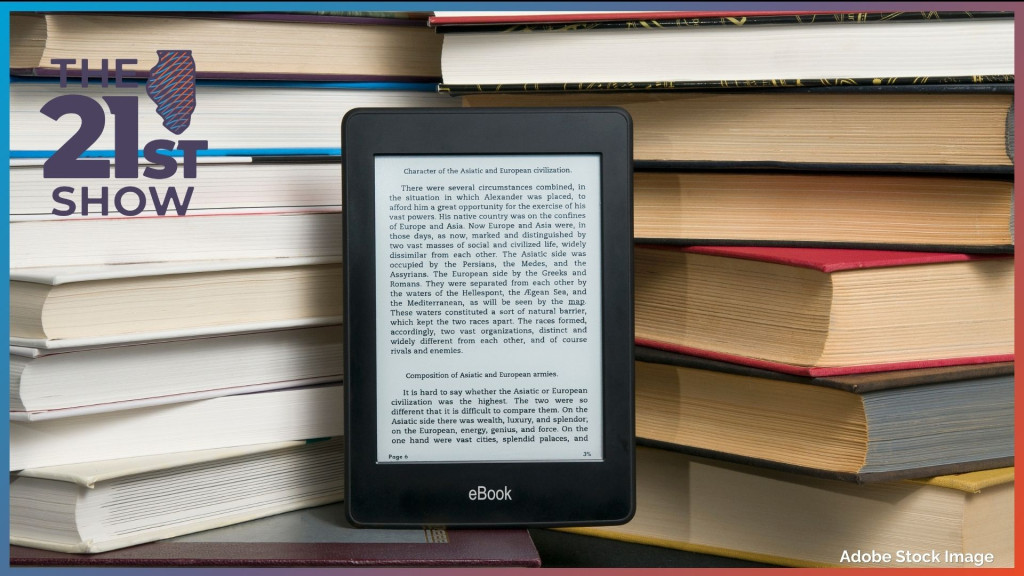
Brian Mackey: It's The 21st Show. I'm Brian Mackey. Like so many other aspects of modern life, books have been moving into the digital age. When Pew Research polled American adults last year, it found about 1 in 3 of us had read an e-book in the past 12 months, and 1 in 4 of us had listened to an audiobook. Many people appreciate that they can freely access these digital books through apps connected to their local libraries. Apps like Hoopla and Libby and Overdrive.

But for the libraries themselves, this can be a financial headache. The digital books libraries have to buy often cost far more than a physical book, and more than the versions of e-books we can buy as everyday consumers. And the library copies are often temporary, set to expire after a certain amount of time, or maybe after a few dozen people have checked them out, or maybe both. After that, if the library wants to keep the book available, they have to pay again.

Illinois libraries are hoping to change this with legislation that aims to ban those licensing rules. Last month, the proposal was approved 99 to [0, with 1] voting present in the Illinois House of Representatives, but it seems to have stalled in the Illinois Senate. It missed a key deadline for advancing earlier this month. Nevertheless, the issue remains.

So joining me to talk about this is Cassandra Thompson, who's associate director for the Illinois Heartland Library System. It connects more than 500 libraries across downstate. She also directs the [SHR] program, SHARE, a catalog consortium of libraries in central and southern Illinois. Cassandra, welcome to The 21st Show.

[00:01:56]
Cassandra Thompson: Hi, thank you so much for having us today.

[00:01:58]
Brian Mackey: We also have two library directors with us. Kyla Waltermire is executive director of the Mississippi Valley Library District, which serves Collinsville and Fairmont City near St. Louis. Kyla, welcome to you as well.

[00:02:13]
Kyla Waltermire: Thank you.

[00:02:15]
Brian Mackey: And Samantha Ralston is director of the Crab Orchard Public Library. It's based in Marion in southern Illinois. Samantha, thanks for being here as well. Thank you. Listeners, you can join us today at 800-222-9455. How do you read books? Are you an e-book user? Has technology made reading more accessible to you? And what has been your experience if you've used your local library for getting e-books or audiobooks? Let us know, 800-222-9455. 800-222-9455.

All right, Cassandra Thompson, talk about the way we read books in general and how it's shifted over the past decade, especially with regard to e-books and audiobooks.

[00:03:00]
Cassandra Thompson: Sure. Well, according to Overdrive, last year, Americans checked out almost 7 million e-books and digital audiobooks. So for working parents, rural students, seniors, disadvantaged communities, people with disabilities, digital lending is often the only way that they would have access to library materials. And so of that, about 20% of the total items circulated in Illinois are circulated digitally, but more and more library collection budgets are being consumed by these high prices like you had mentioned. Some libraries are spending almost half of their collection money to only 20% of that circulation.

I know every library is different and I think Kyla's going to have some great statistics on what she's seen at Mississippi Valley and of course [Samantha will share what she's seen] at Crab Orchard, but it is a challenge. And so as usage continues to rise, we're definitely seeing a very high rise in audiobook usage. And that I think is specific to change to technology. You know, audiobooks used to be on CDs and so you'd pop them in your car CD player. Well, we don't have that anymore. Now there are smartphones on digital files, so we're definitely seeing a huge increase. In April, users checked out 11,000 audiobooks in our Cloud Library program, and that's for our SHARE consortium. In comparison, in 2019, it was closer to 8,000, so we're definitely seeing a big increase there.

However, in Cloud Library for e-books, it's actually gone down, and one of the reasons that we suspect is because we have such long wait times — 6 months or more for some of the hot titles. And so we don't have the titles they want and they say, well, the library doesn't have it, I'm going to go elsewhere. And so I think that's directly related to these challenges with the high prices and these licensing restrictions.

And so we are all working so hard to remind [patrons] how relevant [libraries] are and we're more than just books, but when they have an experience like that, it's really challenging. In a 2023 research study, I think you had mentioned, over half of millennials and Gen Z visited the library in the last year. So even though some people may think, well, I can look it up on the internet, people are still going to libraries. But about half of those surveyed also say that they prefer digital content. So when we can't fairly purchase the items that they want and need, we start to lose relevance, and that's a huge problem for our communities.

[00:05:29]
Brian Mackey: Yeah. All right, well, Kyla, let me come to you. Talk about Mississippi Valley. What are you seeing in terms of e-books, audiobooks?

[00:05:38]
Kyla Waltermire: Yeah, so like Cassandra said, there has been a steady rise in the demand for [e-audiobooks], more so than e-books — that stayed relatively steady — but at my library in 2025, it was the first time in our history that the use of e-resources outpaced the use of physical items. So this is definitely — I know that's not the norm at most libraries, but it's definitely a factor in how we continue to allocate our resources. And with the costs of e-books and audiobooks and the lending restrictions that are placed on them, it's increasingly challenging for us to meet that demand.

I've been doing e-book selection for different libraries for over 15 years. Back in 2018, 2019, if I bought five items a month that cost around $200, and now it costs about $300 for me to buy five items. Our wait list, our recommendations from patrons, is an increasing list — we have hundreds if not thousands in a backlog that we just can't get to because the cost is so prohibitive.

[00:06:52]
Brian Mackey: I just want to make sure I heard you correctly. You said that e-resources — so that would be audiobooks, e-books, I don't know if it also includes if you do like a streaming video platform or something like that — more, you know, versions of those were, quote unquote, "checked out" than physical books at your library.

Kyla Waltermire: Exactly.

Brian Mackey: Wow. Samantha Ralston, what about you? What's the similar story at Crab Orchard?

[00:07:17]
Samantha Ralston: Uh, yes. Over 55% of my circulation last year is e-content, and that's not even including the streaming services. That's just counting audiobooks and e-books, not including like television or other stuff that our platform offers. So just e-books and audiobooks was over 55%.

[00:07:39]
Brian Mackey: Wow. All right, let me share some messages from listeners here. And I'll just remind people this is The 21st Show — we're talking about libraries and e-books, and specifically what libraries have to go through to get e-books and audiobooks so they can lend them out. As we've been hearing, sometimes they will pay several times more than a consumer would for a copy that expires after maybe a few dozen people have read it or listened to it. We're talking about what that means for libraries and readers.

We asked members of our texting group about this — which, by the way, you can join by texting the word "talk" to 217-803-0730. We heard from Christopher in Brimfield, who said, "I read most of my books digitally. It should be cheaper than printing books. I don't understand why libraries would get charged more for digital copies." And on the subject of digital books more generally, Jesse in Mattoon said, "If I don't read a physical book, I listen to audiobooks. I do house calls, so audiobooks are a great way for me to keep up with the authors I enjoy. On occasion, I have had to explain to a customer that I'm fine — a character in a book I was listening to died unexpectedly before I hit their driveway, and the tears are from a book I was listening to."

We are talking about all this with Cassandra Thompson, associate director for the Illinois Heartland Library System, which is a backbone for downstate libraries; Samantha Ralston, director of the Crab Orchard Public Library in Marion; and Kyla Waltermire, executive director of the Mississippi Valley Library District, which serves Collinsville and Fairmont City. We're going to take a break. We'll continue this conversation for the rest of the program today. If you want to join us, if you have a question or comment about your own relationship with your library and e-books in particular, 800-222-9455 is the number. 800-222-9455. This is The 21st Show. We'll be right back.

It's The 21st Show. I'm Brian Mackey. We're talking about the high costs that libraries pay to give their patrons access to e-books and audiobooks, as well as legislation in the Illinois General Assembly that would change how publishers sell licenses to libraries for those books.

A couple more texts from listeners. Aaron in Murfreesboro told us, "I think it feels greedy for publishers to be able to charge higher prices for electronic books, since they don't charge higher prices for physical books. It just doesn't make sense to me." On the other hand, Lex in [Champaign] said, "Libraries have to pay more for digital works because each book they lease from a publisher gets many reads, not just one as an individual does. Let's not forget the authors — they need a royalty per read just as they would get from a purchased [hardcover] copy. Libraries decide how to structure their book purchases, hardcovers and leases, digital copies, and I don't think we need laws regarding that. Let libraries who know their patrons figure it out. Remember the authors," Lex said.

Thanks for that, and we'll get into that perspective a little more in a moment here. My guests are Cassandra Thompson, associate director for the Illinois Heartland Library System; Kyla Waltermire, executive director of the Mississippi Valley Library District, which serves Collinsville and Fairmont City; and Samantha Ralston, director of the Crab Orchard Public Library in Marion. If you want to join us, 800-222-9455. That's 800-222-9455.

Samantha, I'm going to come back to you. Talk a little bit more than I have so far about how it actually works to buy a license for an e-book and how that's different from, you know, a physical book.

[00:11:35]
Samantha Ralston: Well, from my perspective, we use a platform that allows for instant download, so we pay per checkout. That's the way my library chooses to do it. So for example, last year our most checked out audiobook on our platform was "The Housemaid" by [Freida] McFadden, and it cost $2.89 per time that it was checked out. And for the past 11 months it was checked out 13 times, so almost $40 to check out that book. And that's just the way we've chosen to do it — just like our second most checked out audiobook was "The Hobbit," [checked out] 11 times at [$2].89, some of them up to $3.99 per checkout. And it's the same for e-books and streaming services that our platform provides.

[00:12:36]
Brian Mackey: Kyla, let me ask you — do you get the sense that patrons know about these challenges? Because I think people maybe have this idea — my kids do this — they walk into the library, they're going to get 10 books, right? Because they don't know what they feel like reading that particular night. And so they just load up their basket or bag or whatever and walk out with 10 physical books. Are people doing that with e-books? And are they aware of the consequences of, like, "Oh, I'll download these 10 books and pick which one to read," sort of thing?

[00:13:06]
Kyla Waltermire: I don't know how aware most people are about those types of backend issues that libraries are facing, but there are certainly some instances where it comes up. Cassandra mentioned that Illinois Heartland Library System oversees an e-book consortium that my library is a part of, and we do have to put limitations in place on the number of holds you can place, the number of checkouts you can have, just because there's such a high demand that we're trying to meet as many people's needs as possible.

To go back real quick to the different kinds of lending models and things — Samantha mentioned one lending model, which is the cost-per-circ model — but the type of model that's set up through Cloud Library, Overdrive, platforms like that, is different. So within those platforms, when we license a title, oftentimes there is a restriction on that license where we can get it for either one or two years or 26 or 52 checkouts, after which it disappears from the platform. And if we want to hang on to that title, we would have to repurchase it. A lot of these licenses also have restrictions in place that only one person can borrow it at a time. And so it's being treated a lot like a physical book, and people still have to wait to receive that title rather than have immediate access to it.

So when people do run into those types of things where they've put something on hold and then it's disappeared and they don't know what happened — they thought they did something, but it wasn't them. It was because the license expired. Or they've been waiting for months, maybe even over a year at times, to try and get a title because we just can't afford to buy as many copies as we need in order to meet the demand under the terms of the licenses that are available to us. So in those cases I would say people are a little more aware, but by and large I think most people just hop on, look for what's available, and borrow it.

[00:15:14]
Brian Mackey: I guess a little piece of me can almost understand the one-at-a-time thing if you're, you know, the publisher trying to make money and replicate the physical experience. But do you have any similar limits like you can only check a physical book out, you know, two dozen times and then you have to throw it in a wood chipper or anything like that?

[00:15:32]
Kyla Waltermire: No, not at all. And in fact many times we're able to extend the life cycle of a book because we're able to do repairs from use in-house so that we can extend the lifespan, and oftentimes books we have in our collection do surpass 26 or even 52 checkouts before they would need to be replaced.

I also want to mention that when it comes to publishers, these same publishers do work with libraries very positively in other aspects. For the print books that we receive, we often are able to get them at a discounted rate from what most people pay. So it's just this very strange dichotomy that we have a discount on the print and then an upcharge on the medium that is becoming more in demand as time goes on.

[00:16:28]
Brian Mackey: All right, let's go to the phones at 800-222-9455. We have Deb calling from [Alton]. Deb, I understand you're an e-book reader.

[00:16:37]
Deb: Yes, I am. And the reason that I've chosen e-books is because I read while I walk on the treadmill. My husband made me a book rack, and it's difficult to turn the page of a physical book. It's easy on an e-book while you're walking.

[00:16:53]
Brian Mackey: That's right. That does make it a lot easier. Also —

[00:16:55]
Deb: If I want to read at night in bed, I don't have to have a light on that might disturb my husband.

[00:17:00]
Brian Mackey: Do you use the library for your e-books?

[00:17:03]
Deb: Yes, I do.

[00:17:04]
Brian Mackey: Yeah, and were you aware of some of these cost issues that libraries are facing?

[00:17:08]
Deb: Not at all. In fact, I think I'll go by and talk to my library today because, no, I had no idea that it was so expensive.

[00:17:16]
Brian Mackey: All right, well, thanks for the call. Appreciate you sharing your perspective. Cassandra, I'm going to come to you if you want to respond to anything you heard there, and then we can move to talking about this legislation in the General Assembly.

[00:17:26]
Cassandra Thompson: Yeah, I just wanted to give you a specific example with some actual data. The new Women's Murder Club book by James Patterson was released earlier this month, "26 Beauties." In our Cloud Library program, it already has a wait time of 6 months, and we've already bought 7 copies at $75 each. It costs the consumer $11.99 on Amazon. It would cost us $3,500 more to get enough copies for everyone. And then we also have to decide if we need to buy it again in two years.

If the library was charged the same amount as the consumer, we would almost have enough copies. Maybe patrons would see a three-week wait, but in this situation, taxpayers really are in a lose-lose scenario with significantly higher hold times of 6 months or more, limited access to older titles, and tax dollars that don't go as far as the same money in their pocket. And so this isn't a funding or a budget problem. This is a pricing model that's the problem.

[00:18:23]
Brian Mackey: Well, let's talk briefly. What would this legislation change that is being considered in the General Assembly?

[00:18:31]
Cassandra Thompson: So this is a bipartisan, common-sense consumer protection bill [that] ensures fair pricing and fair terms so that books can be purchased instead of expiring after a year or two, and libraries are going to be charged the same as what a consumer would be charged. And so in order to meet our community's needs — there was one comment that, well, why don't they negotiate for better terms? It's always been kind of, we know you need these audiobooks so you can take these terms or you can leave it. And if we leave it, of course we're disappointing our communities, like the caller who just said she likes to get those e-books from the library or the audiobooks so she can do her exercise, or [for those who are] commuting to work. With this bill and Illinois libraries working together, we do have a bit more leverage to ask for these fair contract terms.

[00:19:23]
Brian Mackey: All right, we did reach out to the — excuse me — the Association of American Publishers to ask their perspective on this. We heard back: "House Bill 5236 strips authors of their rights. It limits their ability to make a living and dictates what authors and creators can and cannot do with their own work. When a new movie is released, the government does not force it to be immediately made available for free on a public streaming platform without just compensation for its creators. But that is what this bill would do to authors and the entire ecosystem involved in turning ideas into the stories that readers love. The bill's profound disregard of author rights will grant the government an alarming power to decide which books are accessible to Illinois readers and jeopardizes library access to digital books."

Cassandra, what do you think of that?

[00:20:13]
Cassandra Thompson: Well, some publishing associations are in opposition to this bill, but some authors are not, and the Authors Alliance actually supports this bill. In a recent statement, they actually called it pro-reader, pro-author, and pro-library. One Illinois author actually mentioned that their royalties are based on total item sales — it has nothing to do with the final price of their item. We want authors and publishers to succeed, and Illinois libraries will continue to allocate millions of dollars towards e-resources. Obviously our patrons want them, they're using them, but at the same time we have to be good stewards of taxpayer money.

This bill would actually benefit midlist, debut or backlist authors as well as local and scholarly authors, because when libraries are forced to disproportionately spend [on] relicensing a small number of [high-demand] titles, those authors are actually missing out. In a report that was actually published in 2020, 1 in 3 consumers bought a book that they were first exposed to at the library. So the library is supporting publishers and they're supporting authors, including [for] e-resources. We're just asking for common sense and fair contract terms.

[00:21:25]
Brian Mackey: Kyla, libraries have been up against a lot in the past few years, right? There has been this big national conversation, if you will, around book challenges, book bans, threats to funding cuts and services in some places. Can you just talk about what this legislation in your view would do to help libraries in the bigger scheme?

[00:21:45]
Kyla Waltermire: Well, what Cassandra was just saying is part of it, which is that it would give us better terms on which to use local tax funds, which means that with the same amount of tax money that we have right now we would be able to purchase significantly more items and be able to better serve the needs of our community.

The thing that I want to particularly highlight is that this is a broadly bipartisan effort, which is really unheard of today. As you said, there are ideological differences at all levels of government at the moment, but on the granular level we are seeing library boards who have different ideologies come together to support this bill, to reach out to legislators in support of it and ask for their support. We saw in the House that it passed 99 to 0. Hopefully now in the Senate — again, I don't know what's going to happen next — but there's definitely a broad interest in this type of effort to help cross over those ideological differences, because it just makes sense. It just makes sense that we want our money to be spent in the best possible way, and the best way to do that is to try to get better terms for us to be able to do that.

[00:23:10]
Brian Mackey: Kyla Waltermire is executive director of the Mississippi Valley Library District serving Collinsville and Fairmont City. We've also been hearing from Cassandra Thompson, associate director for the Illinois Heartland Library System, kind of a backbone for downstate libraries, and Samantha Ralston, director of the Crab Orchard Public Library in Marion, Illinois. Thank you all for being with us and sharing your perspectives with us today here on The 21st Show.

[00:23:37]
Cassandra Thompson: Thank you. Thank you.

[00:23:39]
Kyla Waltermire: Thank you.

[00:23:55]
Brian Mackey: Once again, if you want to look up the legislation, House Bill 5236 — as I mentioned, and we've heard several times in the conversation, it did pass 99 to 0 in the Illinois House, but so far seems to have stalled out in the state Senate, missed a key deadline there. But you never know — the legislature is in session through the end of the month. We shall see.

That is it for us today. Coming up tomorrow on the program, after the United States Supreme Court weakened part of the federal Voting Rights Act, a Republican, a former politician, is mounting a legal challenge to the Illinois Voting Rights Act, I should say. We're going to hear from the plaintiff. We'll talk with experts about the future of voting rights here in the 21st State.

I want to mention our website, 21stshow.org. You can find all the ways to contact us there. We've got our email address, our voicemail line. You can also find links to subscribe to our podcast. Again, it's at 21stshow.org. You can also find us on Apple, Spotify and YouTube. Just search for The 21st Show. The 21st Show is a production of Illinois Public Media. I'm Brian Mackey. Thank you for listening. We'll talk to you again tomorrow.
Transcript Assistance
Illinois Public Media may use AI assistance for transcript generation and/or formatting. Transcripts that have not yet been reviewed for accuracy will be labeled.
To report a transcription error, or to request transcription of archival material, please contact will-help@illinois.edu.