Transcript: Book takes deep look into evolution of women through lens of the female body
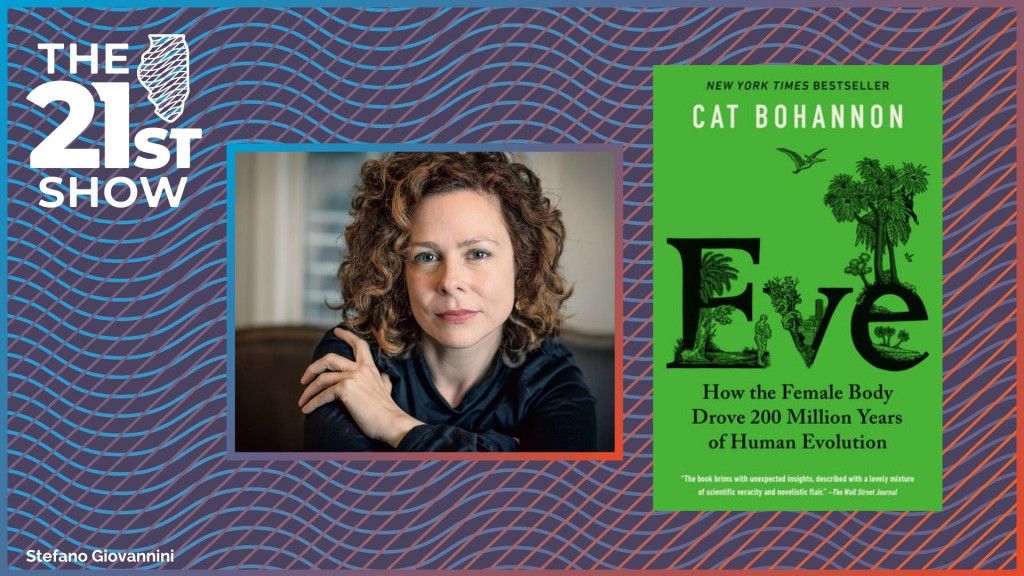
Transcript: Book takes deep look into evolution of women through lens of the female body
The 21st Show
Book takes deep look into evolution of women through lens of the female body
Read the full story at https://will.illinois.edu/am/author-takes-deep-dive-into-the-evolution-of-the-female-body.
Transcript
[00:00:00]
Brian Mackey: Today on The 21st Show, scientific research has long been dominated by what's known as the male norm. From studies involving lab rats to pharmaceutical trials, much of our current understanding is based on biological males. That is part of what inspired Kat Bohannon to write a history of human evolution that puts women at the forefront of our development. The result is the New York Times bestselling "Eve: How the Female Body Drove 200 Million Years of Human Evolution." I'm Brian Mackey. We'll talk with Kat Bohannon for the hour today on The 21st Show, which is a production of Illinois Public Media, airing on WILL in Urbana, WUIS in Springfield, WNIJ in Rockford DeKalb, WVIK in the Quad Cities, and WSIU in Carbondale. But first, news.

From Illinois Public Media, this is The 21st Show. I'm Brian Mackey. Years ago, when Kat Bohannon was a PhD candidate in New York City, she went to see the movie "Prometheus." This is a prequel to the classic sci-fi horror movie "Alien." There's a scene where one of our heroes has been impregnated with a bloodthirsty alien. The woman is played by [Noomi Rapace], clutching her abdomen and screaming in pain. She stumbles into sick bay and tries to get help from one of the robot medical pods.

[00:01:37]
Speaker 1: Emergency procedures initiated. Please verbally state the nature of your injury.

[00:01:42]
Speaker 2: I need

[00:01:43]
Speaker 3: cesarean —

[00:01:44]
Speaker 1: Error. This med pod is calibrated for male patients only and does [not support] the procedure you have requested. Please seek medical assistance elsewhere.

[00:01:55]
Speaker 3: Surgery. Abdominal penetrating injuries. [Foreign] body. [Ish.]

[00:02:06]
Speaker 1: Surgical procedure to begin.

[00:02:10]
Brian Mackey: All right, we'll spare you the grisly details from the rest of that scene. The key line there is: this med pod is calibrated for male patients only. The reason we listen to that, and the reason Kat Bohannon recounts the experience of seeing that in her book "Eve," is that it points out an ongoing problem in real life. Much of modern medicine, biological research, and even our understanding of evolution has been shaped by what's known as the male norm or male bias. Bohannon's book aims to be a corrective to that — a history of how humans came to be that puts women at the center of the story. It's a lineage of not just one Eve in the biblical Garden of Eden, but a series of them over hundreds of millions of years, and it seeks to answer questions like: Why do we have wombs rather than lay eggs? Why do our eyes face forward? Why do we walk on two legs and talk and go through menopause, one of the few mammal species in which females live past reproductive age?

The book is called "Eve: How the Female Body Drove 200 Million Years of Human Evolution." It's a New York Times bestseller and was a finalist for several prizes when it first came out back in 2023, which incidentally is around the time Bohannon earned her PhD in narrative and cognition from Columbia University. "Eve" is now available in paperback. There's also a young adult adaptation. I first spoke with Kat Bohannon in June 2025. Because of that, we're not taking calls live on the show today, but you can always let us know what you thought. Our email address is talk@[21stshow.org]. Kat, welcome to The 21st Show.

[00:03:49]
Kat Bohannon: Hi, thanks for having me.

[00:03:51]
Brian Mackey: So let's start with talking about the male norm. Tell me more about the male bias.

[00:03:57]
Kat Bohannon: Yeah, so it's one of these weird moments where it wasn't about sexism. I'm not saying there isn't sexism, people. Yeah, it's real, turns out. No, in this case, actually, it was kind of good science run amok. Essentially what happened is, well, in mammals, right, you know, we study rats, we study monkeys, we study a lot of nonhuman species to understand biology well before we might do anything like a clinical trial for any medication you might take. OK. So, in basic science, we're doing that. But the thing is, in mammals, every tissue you've got has sex hormone receptors, just about. And we kind of only barely understand what they do. So, if you've got an [e]stra cycle — you and I might call that a menstrual cycle — well, you've got this cascade of hormones in the female that goes up and down. Depends on the species, [and] how it influences you, but we've all got it. So, the kind of unspoken agreement was, well, the best way to control for your confounds — and you want to do that if you're a scientist. You want to understand what you're seeing in your data. You want to eliminate the kind of messiness of your numbers. Well, the best way to control for [estrus] is to just not study the one that has it. And so for a long time, in many different fields of biology, we were only studying males, which of course, turned out to be a bit of a problem.

[00:05:16]
Brian Mackey: Yeah, so I mean, like you say, there are good reasons for this — confounding factors, I think, is a term that scientists use. But it's not impossible to separate those things out, right?

[00:05:26]
Kat Bohannon: It is not impossible. I mean, the first thing you have to think about is, like, do I want half the human patient population to be kind of treated like a confound? It's like, well, is that the best? Is that where we should really go with medicine? Probably not, right? But, you know, effectively, from basic science on up, we call this the, uh, women's health research pipeline, right? You begin with your basic science and way later you end up in human [trials]. Well, at every stage of the process, if you're not studying females, and if you're not studying females properly when you do, well, you end up with an obvious problem where half your patient population is poorly understood.

[00:06:06]
Brian Mackey: So what are some of the consequences of this male norm in real life?

[00:06:11]
Kat Bohannon: Well, you know, as I've been half joking but actually also totally serious for the last couple of minutes, you can imagine what the results might be. You know, it's very true for a number of reasons that female patients tend to be, well, diagnosed later. Because, again, bodies are poorly understood, poorly modeled. Many of our symptoms turn out to be a bit different. Famously for heart attacks, we're now learning, thanks to good public education, that that presents a little differently in a female patient. But it's also true that if you don't even understand how sex hormones are influencing something like the brain in your postpartum state after you've had a baby, well, then you're not really going to have a good idea of how to treat postpartum depression, right? Which is a very common condition because sex hormones do influence the brain. They influence almost every organ in your body. So, that's the thing.

But the real and obvious consequences are things like drugs getting approved without having been properly tested in female bodies. Opioid drugs are a really famous one — that female patients tend to need a different profile when we take these common prescription painkillers. We tend to need a bit more of them. And the side effects leave our body at different rates. And so you end up with patients coming back into the clinic saying, "Hey, this thing didn't work the way you said it did." And then that clinician needs to make a decision: Did I do something wrong? Did the patient lie to me about their symptoms, or did the patient not tell me enough? But neither the patient nor the doctor is saying, "Did basic science give us enough to make this decision? Am I receiving proper medical guidance for how this drug's going to work in a female body?" And we're only just starting to catch up on fixing that problem.

[00:08:03]
Brian Mackey: And, like you say, this is not entirely — I mean, I'm not going to say there's not sexism and women's concerns are sometimes dismissed — but this is just not something that even really might occur to a physician.

[00:08:15]
Kat Bohannon: Absolutely true. You know, I think education is coming along. We're starting to have this be a better part of medical training, and we're starting to have this be a better part of basic biology research training from undergrad to grad and on up. But it's slow going, you know, because this is a kind of sea change in biology where we're saying, actually, what if sex differences do matter? Actually, maybe we don't always know where they do and they don't. Let's go back and make sure we get it right this time, you know. And that requires a kind of change across the board from basic science all the way to medicine. But it's true, like a lot of times we want to blame the clinician and say, "You're sexist, you're not taking me seriously." Sometimes that does happen. We've done the studies — female pain is taken less seriously. But not enough people are saying, yeah, but maybe part of that reason is because treatments often don't work as well in female patients, depending on what kind of drug you're working with, what kind of condition you're working with. And so when they come back and say, "Hey, this didn't work," that clinician then has to make a decision: Is it that I did something wrong? Is it the patient saying something wrong? Or are both of us being poorly armed with guidance because the science didn't get us there? That third thing is the thing I think is really fixable.

[00:09:29]
Brian Mackey: Let me take a moment to reintroduce the program. This is The 21st Show. Our guest today, Kat Bohannon, a PhD scientist and author of the book "Eve: How the Female Body Drove 200 Million Years of Human Evolution." It's out this year in paperback, as well as a young adult adaptation. We first broadcast this conversation back in June, so we're not taking calls today, but you can always let us know what you thought. Our voicemail line is [217-300-2121]. That's 217-300-2121.

All right, Kat, you structure the book around a series of Eves. The first of whom is known as Morgy — your and my great-great-great-great-great-great-great-great-great-great-great grandmother. Who was Morgy?

[00:10:18]
Kat Bohannon: Well, she was more like our great-great-great-great-great grand rat. OK. So she's like an early mammal, because the reason I wanted to do an evolution story to kick off this topic with this book was like, well, look, there's a reason we study rats in the lab and it's not because we hate rats. I mean, it might be that you hate rats, you know — it depends where you live in Chicago, if you do, right. You might have a biased relationship with rats. But the main reason we study something like a rodent in a lab is because it's a mammal, right? And there's this idea of the conservation of traits. Like, there might probably be something in their bodies that's still evolutionarily conserved, still true of the human body now, because we're all mammals, right? So I was like, all right, well let's just get back to the root of this problem. What can we find out about where these bodies come from, these female human bodies?

Morgy is so great. She's about the size of a human thumb. She's kind of everywhere — like if she still existed, she'd be digging through your garbage. She was a really successful little mammal. And what's cool about her is she's one of the first to, well, breastfeed — well, she doesn't have breasts, but she makes milk, right? But she's still laying eggs. She's still laying eggs like most reasonable animals still do, but she is giving her babies milk. And it's this really cool evolutionary upgrade, basically, that kind of changes the game for mammals.

[00:11:38]
Brian Mackey: Talk about that. Why is breast milk so important? What is game-changing about it?

[00:11:43]
Kat Bohannon: Well, one of the first things that's game-changing about it is that it's where you get your water when you're a newborn. Most people don't know this. Breast milk — human breast milk — is about 90% water. The other 10% is the stuff you think of that makes it milk. The rest of it is just mom giving you water through her body, right? And what's cool about that is it means a number of things. So, picture a little burrowing, mouse-like creature living literally under the feet of dinosaurs. They don't have to leave the nest to get something to drink, right? So when a newborn cries — a human newborn cries for food — we think she's hungry. Nah, nah, nah. She's thirsty, she needs water, right? Everything else is a later add-on. So, just that safety thing is a big thing. But the really big thing is immunological. You're controlling for infection. Think of the body as the world's best water filter in this case, right? That your mother's immune system is already fighting off a lot of the infectious baddies that might make you vulnerable when you're a newborn. So if you can get your water for a while anyway out of mom's chest wall, well, that helps you — actually, that helps you not die of infection within the first few hours of your existence.

[00:12:53]
Brian Mackey: You mentioned that Morgy is still laying eggs. Why don't we lay eggs? It seems, you know, pretty good protection — you got that hard shell and everything. It makes it a little harder to eat maybe. What's up with that?

[00:13:06]
Kat Bohannon: I so wish we still laid eggs. Look, I've given birth twice and I would so sit on a clutch. It would be clutch to sit on a clutch, OK? It would be awesome to lay eggs. Really not super down with how we're doing it. Many of your listeners have probably done this and you're like, "Actually, yeah, I could have been fine. Like, I would have totally just sat with my feathers anyway." Um —

[00:13:28]
Brian Mackey: I was in the room when it happened. I feel like I could have helped with the sitting, too.

[00:13:32]
Kat Bohannon: Yeah, you know, I was in the room when it happened in my family, and I was doing a little more there, a little more with my role. Yeah. Oh my goodness.

So, yeah, no, we don't know. The short answer is we don't know why we stopped laying eggs. I maintain it's a bad idea. But I will say that the central reason we don't lay eggs is accident. A lot of evolution is accident. Some people think we got a cold, actually. There seems to be something about implantation that's tied to some viral genetic material, it turns out. So like, maybe ancient creatures got a cold and then suddenly they had to give birth and they're like, "What the hell? I just thought I had a flu."

But the main thing that happened is that an asteroid hit the planet, right? So this is the famous thing that takes out the dinosaurs. And it just so happens that more of [marsupials'] ancestors died off than the ancestors that became us — internally gestating, uh, placentals, the [eutherians]. So that's why we only have one vagina instead of multiple. Most marsupials — you know, like your kangaroos — they have a multi-vag complex, which again, would be great. [I] would love to have an extra vagina. Could think of many uses for that. But we only got the one and we give birth to larger babies. And so that's how we do it.

[00:14:53]
Brian Mackey: You've described the human body as a flaming garbage pile making babies, and you're sort of alluding at some of those. What are some of the other sorts of issues you might identify?

[00:15:04]
Kat Bohannon: Well, let's put it this way. I think it's safe to say that something sucks and also say that that thing that sucks is also cool and amazing, right? The way that we make babies and give birth sucks. It's quantifiable suckage, turns out, right? That actually our pregnancies and our births and our postpartum recoveries are longer and harder and more prone to complications than they are for almost any other primate, which is the kind of animal we are — except for a squirrel monkey; we feel real bad for her. But otherwise, yeah, it pretty much sucks for us. It sucks more for us than most other mammals. Like, don't look up what hyenas have to do on the internet. But, uh, otherwise, yeah, it sucks for us.

And there's a number of reasons for that. One of which is that we have a narrow pelvic opening, which is a consequence of walking upright, right? So when we rotated our pelvis to go from a four-legged thing to more of a two-legged thing, it narrowed that pelvic — it's called a pelvic inlet. It should be called an outlet. It's where babies come out between those two hip bones, right? And, uh, you know, meanwhile, our heads kept getting bigger. Our babies kept getting proportionally bigger compared to the size of the mother's pelvis. And so that's your obstetric dilemma, basically. We have a watermelon-sized thing coming out of a lemon-sized hole, right? So if you've met fruit, it's a problem.

So there's that. But it's also that our placentas are really invasive. The placenta is what attaches to that uterine wall. It's what your umbilical cord connects to if you're a fetus, right? And ours are very, very deeply penetrating. It goes all the way into the mother's — sorry, all the way into the mother's circulatory system, [into] our blood vessels. And that has effects on everything.

[00:16:47]
Brian Mackey: We need to take a break. I'm sorry to interrupt you. We're on a fixed clock on our program. Let me remind listeners, this is The 21st Show. We're listening back to an interview I taped with Kat Bohannon in June 2025. Her book is called "Eve: How the Female Body Drove 200 Million Years of Human Evolution." Because our program is on tape today, no live calls, but you can always let us know what you thought. Our email address is talk@[21stshow.org]. More to come after a short break.

This is The 21st Show. I'm Brian Mackey. Let's get back to my interview with Kat Bohannon about her book "Eve: How the Female Body Drove 200 Million Years of Human Evolution." This interview was first broadcast in June 2025. Because of that, no calls today, but you can always let us know what you thought by emailing talk@[21stshow.org].

All right, Kat, I'm sorry I had to interrupt you. We're on a fixed clock on our program. But we were talking about the placenta and the sort of — it really creates a sort of [conflict between] mother and child.

[00:18:14]
Kat Bohannon: Yeah. So, it's, again, it's amazing how female bodies are able to make babies the way we do, but we don't actually give it quite enough credit for how ridiculously hard it is. And one of the central reasons it's hard, right, is that actually the mother and child are, from a biologist's point of view, effectively competing for resources. Right? If you picture the uterus as a kind of environment, right, and all the resources are coming from whatever that mother is able to acquire, well, that baby is also long evolved [to] get as many resources — as many nutrients, as much water, as much protein, as much everything it can get — including portions of the mother's immune system, some of her actual immune cells, through that placenta, through that wall of the uterus, into its body, to do crazy things like build an extra skeleton in your stomach, right? So, OK.

So, to do that, it means it's evolved to kind of take as much as possible. But meanwhile, the maternal body has longer evolved to not die. Not dying is great. So you have that kind of metabolic competition. You have that energy resource competition, right? And it turns out the best predictor for when you give birth is not like when your fetus becomes a certain size. It's when you reach a certain metabolic threshold beyond which either the fetus is going to start to suffer, or your body is going to kind of give out. Basically, you give birth at the moment at which, really, if we kept going with this thing, one or both of you are going to die. Pretty much that. Pretty much that's what triggers labor for the most part. So, congratulations on not dying. Your kid's beautiful. Love both of them, you know. And that's actually a better story for how it works.

[00:19:57]
Brian Mackey: I think we have our pull quote for the web post of this — "not dying is great," Kat Bohannon. Um, all right, so —

[00:20:04]
Kat Bohannon: [Let's go from there.]

[00:20:07]
Brian Mackey: What are the other areas you look at? There's perception. What did you learn as a professional naked person?

[00:20:14]
Kat Bohannon: OK, so I can give you this story. So I'm in college and one of the good ways for me to make money, with the kind of body I have and the kind of personality I have, was I was an art model. You know, those naked people that stand up on the dais and, you know, take off their clothes and everyone sketches them. It's like every teenage girl's nightmare — like everybody literally judging your body while you're naked in a room and everyone else is in their clothes. I did that, but like, for money.

So I did that and what was really cool and weird is during the breaks — because this was like the late '90s, right? So everybody would go out and have a smoke in the middle of their art class, which sounds super pretentious, but it also was true, and also don't smoke, OK. So then I got to put on a robe and kind of walk around the easels and see how people were drawing me. And there was always this one thing that was true. The guys — OK? — the guys, and it was a variety of straight guys and not straight guys, OK? They were all drawing my boobs too big. And I mean, not just like, I'm fairly well endowed, but I mean like cartoony kind of knockers — like, full-on massive tatas, right? But what was interesting is, over the course of the semester, because it's like an art school, right? So they do this for months in their drawing class. My boobs would kind of shrink on the canvas. They would consistently get smaller as the guys learned to draw what their eyes actually saw and not what their brains thought their eyes saw.

So I thought that was a pretty good way in the book to kind of think about: Do males experience a different sensory reality than me? Like, do my boobs literally look bigger to them even if they're queer? Like, how is that? Why is that so consistently so? So I use that as a kind of frame to kind of dig in there and look at how our perceptive organs evolved.

[00:21:59]
Brian Mackey: And it's true in terms of hearing. Talk more about some of the other ways in which, indeed, our perceptive organs are different.

[00:22:07]
Kat Bohannon: Yeah. So, we all have roughly the same kinds of ears. For example, you guys in radio know a lot about audition and hearing and all that good stuff. But what's interesting is it's almost like a high-def stereo — like it's tuned a little bit differently. So the average female ear — again, we're talking about averages here, people. Intersex is real, gender identity stuff is real. We're just talking about your basic statistical humps, right? If you've fallen under that average female curve, OK — so, if you've got those female-typical ears, your ears are tuned a little bit more to those higher pitches, which actually correspond to the pitches of a baby's cries, right? Those higher pitches. Sounds we hear them better, and we hear them for longer in our lives.

Meanwhile, male-typical ears actually start kind of crapping out starting at age 25. So, at age 25 or so — and it's not like you need a hearing aid at 30, guys — but at age 25 or so, you start losing those upper ranges of your hearing, slowly but surely. And so by the time most guys arrive at middle age, y'all aren't hearing very well. In fact, you're especially not hearing female voices very well, which are a little bit higher pitched. So I found that both satisfying and frustrating. Like, actually the guys in the room aren't hearing me well. Like, that doesn't say why they don't care that they don't hear me well, but it does say that, oh, it's like actually an aging problem. It's like an ear problem.

[00:23:38]
Brian Mackey: Not just selective hearing, as they say. Yeah. Um, one of the other areas I thought was interesting about perception is men's armpit stink in the relationship to sexual orientation.

[00:23:53]
Kat Bohannon: So, OK, so, look y'all, there is a whole subset of science that has to do with, like, wiping college-aged dudes' armpits on T-shirts — like having them wear them for a day, then having them take that T-shirt off, put it in like a plastic bag, send it to a lab, and then making women smell them. There's like a huge subset of science which is basically that, which I love, on many levels. Not my thing, but, you know, I don't judge.

But what's interesting about that is we're trying to figure out if there is such a thing as a scent-based kind of social preference. Whether it has to do [with] your sexuality, or who you like to hang out with, or like your social judgments. Like, if you smell this one dude's smelly armpit T-shirt thing, will it make you more or less attracted to [them]? Does it depend if you're a person who ovulates, on whether or not you're ovulating or on birth control? Does it make you think whoever you're talking to is more or less authoritative? It's like a huge subset of science that has to do with armpits.

And the science is kind of unclear. Like, it does seem to be true that, in one study, you know, self-identified gay cis men — well, they didn't ask if they were cis. This is a study from a long time ago, but for the most part, assuming, right? — like, they smell the armpits of other men more [positively], than, you know, straight dudes do. So like there's a whole lot of science around this. And it's unclear, it's unclear if humans have [pheromones] the way the other mammals do. Now, pheromones are like this specific chemical that your body might make to smell sexier. And if we do have pheromones, it's mostly produced around the genitals, but especially around the armpits. But actually, science is really divided as to whether or not we do.

[00:25:41]
Brian Mackey: All right, let me reintroduce our program. If you're just tuning in, this is The 21st Show. We're listening back to an interview I recorded in 2025 with Kat Bohannon. Her book is "Eve: How the Female Body Drove 200 Million Years of Human Evolution." You tell the story of an Army captain at Ranger School in Georgia, one of the toughest crucibles for the American military. What does that tell us about male and female bodies and what we think of as strength and weakness?

[00:26:12]
Kat Bohannon: Yeah, so that was a really interesting moment in military history. So, there were a couple of women who were finally allowed — and I highlight one of them in the chapter — to compete for the Army Ranger school. Now, this is like qualifying for the Navy SEALs. This is like, you know, in the Army, this is like you're going to be a forward combat military officer person. And you go through this barrage of both physical and psychological tests to do it. You have to like climb a mountain with very little food. You have to like wade through snake-infested waters. It's like the bro-iest bro thing you can imagine. It's like "American Ninja Warrior," but like with less spandex and more things biting you, right? So, you know, it's great. We think of it as this very male thing. So no one really thought that women could do it, right?

We think of the female body as less strong. And one of the things I examined in that chapter about how our musculoskeletal system evolved, and where sex differences are and aren't real, right? Is that a lot of what we think of as strength is about what male bodies can do, but that isn't necessarily like what's cool about human bodies, right? Because like a chimp is way stronger than you. Like, so much. Like, I don't care how much you lift, bro. Like, a chimp can just take you the hell out. But they're not going to be able to do it for long. Like, they'll rip your face off. There's no safe place to be around a chimp, OK? But then they have to go like eat a mango under the tree real fast because they don't have any endurance. That's not a thing that chimps have. The human body, though, is really an endurance story. We're able to do hard stuff for like a long time, and female bodies are a little bit better at that.

[00:27:57]
Brian Mackey: Why? How did that evolve?

[00:28:02]
Kat Bohannon: So, science is still out. There's a lot of stuff we're trying to figure out for that evolutionary path. One of the ways it evolved is we got kind of, well, fat — like the whole species. I don't mean just like, you know, some of us. We have way more subcutaneous adipose tissue than most other primates — most other, you know, a lot of other mammals. Like, when we're born, we're as fat as a baby seal. Man, like we are chubby, which is part of where you get those cute little rolls, right? You know, and then the baby gets born. So, that's part of it. Like, we're good at holding on to energy and then selectively using it when we run out of — like when your muscle runs out of local sugar, right? Which is a thing. Then you have to do what people call your second wind. Like, if you've ever run a marathon, you know what it is to hit your second wind, right? And it's actually a metabolic shift in your muscular tissue.

Female muscle cells are a little bit better at utilizing what we call mixed substrates. That means they're good at switching from local sugar to fat and from fat to protein — whatever they need to use to keep going, right? For some reason, those cells are a little bit better if they happen to have two X chromosomes. It's also like a muscular repair thing. So, if you get an athlete on a soccer field or something, the basic idea is a female athlete might need to tap out, might need to hit recovery a little quicker, but then they're back in the game faster. And so that's like an immunological thing — that's a thing where, like, a lot of using your muscles is actually about kind of breaking it down and then repairing it. And if you have a certain kind of immune profile, you're going to repair that tissue a little faster. And again, that's something that female bodies are slightly better at for reasons that are still a bit mysterious.

[00:29:47]
Brian Mackey: I also learned from your book that humans are one of the only mammals to go through menopause. Most of our sister creatures are childbearing until death. What's behind that?

[00:29:59]
Kat Bohannon: Yeah, it's super weird. So the first thing to know for your listeners is that menopause isn't exactly just about your ovaries shutting down. Your menopause is actually about continuing to live a full third of your potential lifespan after that. So congratulations, ladies — if you've gone through menopause, the only real thing to know is you're not dead. That's what menopause is. Congratulations on not being dead, right? So it's really about like outliving that reproductive lifespan.

And we used to think it was all about — and there's the thing called the grandmother hypothesis — well, human babies are really needy. They're really, they can't even hold up their stupid heads for a while, OK? Again, love my kids, but let's admit they're a little bit dumb for a long time, right? So, they need a lot of attention, they need a lot of care. So maybe if grandma doesn't have her own needy baby to take care of, she can help her daughters take care of those needy grandbabies. And so there's an evolutionary advantage for something like that.

The only problem is, the one other creature that we've studied really well that we know [has] menopause — and this is [the] orca, the killer whale — took a while to learn this because we can't live in oceans and that's where they live, but once we had enough boats and we studied it, they don't really spend more time taking care of grandbabies. What they do do is when the pod runs out of local food, they guide everybody to rarer sources of good food. And they're also really good at training that third generation at specialized hunting techniques. In other words, they're not like nature's version of free daycare. They're nature's version of, well, wisdom. Like, older members of social societies are valuable for what they know, because they've lived long enough to remember crap that the younger people don't remember because they didn't live through it, right?

Which I think is a better argument for human menopause. So, maybe we have it because we all evolved to live longer. We live way longer than a chimp does, man. A 60-year-old human is doing way better than a 60-year-old chimp, right? But the ovaries, well, they're still running the old monkey plan. They didn't get the message.

[00:32:02]
Brian Mackey: What do we — I think this is another area where we get into this issue of the male norm, right? Are we behind in our understanding of menopause? And, like, maybe it isn't even right to say [it's] a medical condition. I don't know how you think about that.

[00:32:17]
Kat Bohannon: So, I think that we are catching up and there's a lot of extremely exciting — well, exciting for someone like me, but also anybody who's got a female body and would like menopause to suck less. It's exciting that actually menopause science is really going ahead by leaps and bounds. Part of that is that we're talking about it more regularly, not just in scientific spaces, but like public spaces, like, you know, radio. We're just talking openly about this thing that used to be kind of taboo or kind of gross or kind of, well, "the women will deal with that," you know. So that's good and that's actually pushing the science forward. But are we behind? Oh yeah, absolutely we're behind. Filling in a knowledge gap, you know, is a generational effort. I think my daughter is going to benefit from what we're learning about menopause right now.

[00:33:01]
Brian Mackey: All right, let me reintroduce our conversation again. If you're just joining us, my guest is Kat Bohannon. Her book is called "Eve: How the Female Body Drove 200 Million Years of Human Evolution." It's out now in paperback and in a version adapted for young adults. Kat, we need to take a break in another minute or so, but briefly, what goes into adapting a version of a book for young adults?

[00:33:25]
Kat Bohannon: Uh, it basically involves having a really talented person do it for you and then you approve the changes. That's what that is in the shortest version possible, and I'm so grateful that they did a great job.

[00:33:39]
Brian Mackey: Yeah, no, that's interesting. I guess, why is it important to you to reach younger readers, right? I mean, you describe this book as a manual for the female body in some ways.

[00:33:50]
Kat Bohannon: I mean, I think that teenage folk equally deserve to understand their bodies and know where the hell they came from in deep evolutionary time. It shouldn't be like, "Oh, you're only allowed to know this once you're 18." I think we should get to know this as soon as we're capable.

[00:34:07]
Brian Mackey: All right, we are going to take another break. We'll have more from our conversation with Kat Bohannon, recorded back in June 2025. She's a PhD and the author of the book "Eve: How the Female Body Drove 200 Million Years of Human Evolution." Before the break, will you consider joining our texting group? You can do so by sending the word "talk" to 217-803-0730. Talk to 217-803-0730.

This is The 21st Show. I'm Brian Mackey. Let's get back to my conversation with Kat Bohannon, author of the book "Eve: How the Female Body Drove 200 Million Years of Human Evolution." We first broadcast this back in June 2025, so no calls today, but let us know what you thought. Our email address is talk@[21stshow.org].

All right, Kat, let's talk about some of the implications of your work. I think some people could hear the subtitle of your book alone, not read it, and think, "Aha, just the proof J.K. Rowling has been looking for." And in case there's anybody who doesn't know —

[00:35:44]
Kat Bohannon: Sure.

[00:35:45]
Brian Mackey: — and I guess maybe I don't — do we need to explain for those who don't know: J.K. Rowling, beloved Harry Potter author, has turned into a trans skeptic or anti-trans activist, depending on your perspective. You, though, are careful to separate biology and gender. Talk about that.

[00:36:02]
Kat Bohannon: Well, look, I think the brain is an organ. I know, controversial position, right? You know, but actually that kind of, uh, weirdly moist and slightly greasy football of tissue in your head is one of your organs, which therefore means that what you experience in your brain is just as legitimate and real and made of your bodily experiences as, well, anything else your organs do. So, that's a really elaborate way of saying there is no reason at all biologically to assume that the experience of having gender dysphoria, or the experience of simply identifying as a gender that isn't a thing that makes sense to people who are used to there only being two, is somehow illegitimate and somehow not real or somehow not biologically based, right? There's just no argument for that.

So, as far as, uh, Joanna in her many castles in Scotland or elsewhere, we're not sure why she's quite as obsessed as she is, but I've never met her personally. I will say that I think there's a big difference between, you know, what your liver is doing with sex — which is having to do with your sex chromosomes, and is also influenced in development by like what sex hormones are doing in response to your sex hormone receptors; it's actually pretty complicated, you know — versus what your brain is doing with this complex cultural phenomenon we call a gender identity, that is both based in your body and also based in how your body interacts with your culture. It's like, assume it's complicated, because a lot of what your brain does is complicated. But I see them as very separate things.

[00:37:41]
Brian Mackey: Yeah. And yet, people are looking in our current political environment to — I don't know if you'd say conflate them, or to root this discussion in one side or the other. Like, I don't know if you have — if you speak publicly about, you know, the arguments over people who are born male, transition to female, and then compete in elite athletic competitions. Since that does seem to suck up a lot of political oxygen, you know, relative to the number of people that actually directly affects. But go ahead, yeah.

[00:38:10]
Kat Bohannon: You know, I think that metaphor you're using — "suck up the oxygen," "suck the air out of the room" — I think actually that's a, we use it a lot in media, but actually it's a really apt metaphor. Because basically it's hard then to talk about other things. It's hard then to think about other things. I think it's really telling that certain people who don't really want us to be kind of pissed off about how much money billionaires have are the ones who really want us thinking a lot about whether or not less than 1% of all athletes might compete in, you know, a gendered competition having been a person who transitioned. Like, you know, for example, also we way overplay male athlete strength. It is not the case that trans female athletes win every competition, whether in the locals or in the Olympics. Like, that's not a thing. It is not a thing that like suddenly all of those athletes are the ones who are winning all the medals — far, far, far from it.

So I think we have made a mountain out of a molehill, and I think the reason we're doing it is it drums up a certain base who don't understand what's up, and it feels like the heebie-jeebies or something — it just gets under their skin for some reason, and then that's what we talk about. Instead of saying, "Oh, here's a really small minority of people who suffer, and nobody deserves to suffer, and it's not that hard to accommodate them. And by the way, can we talk about the billionaires, though? Because like it's really hard to get housing," and [so on], right?

[00:39:43]
Brian Mackey: Yeah, well, speaking of how much money billionaires have — what would it be like to be pregnant on Mars?

[00:39:50]
Kat Bohannon: Oh my goodness, it would be terrible. But let's assume that you have a place to breathe, because on Mars, not so much with the oxygen. So there's that. And let's assume you're living underground, because radiation — not really shielded, right?

So, being pregnant on Mars would be sort of terrible on every [level], because our bodies evolved to live on Earth, not on Mars. But what's really interesting in thinking through the problem is that we begin to quickly realize how much we neglect female bodies here on Earth. It's like, one of the problems with being pregnant on Mars is you can't have any life-saving medication because it all expires en route and is messed up by the space radiation getting there. Oh, you know who else sucks a lot [at] giving birth? People in remote rural locations on Earth who can't actually have the kind of oxytocin that saves them from hemorrhage. Maybe we could lean into developing shelf-stable [oxytocin] so that nobody has to bleed out giving birth. That'd be pretty awesome. And the list goes on from there.

[00:40:51]
Brian Mackey: Well, and the reason I mentioned this — for our listeners who are probably not going to know — is that you have co-authored, co-produced, co-starred in — I don't know how you say that — a show called "Moms on Mars." It looks super interesting, super entertaining. Talk about that. How did that come about?

[00:41:08]
Kat Bohannon: Oh man. So I noticed that a bunch of, well, again, billionaires — what is it with these guys that they have so much free time. They're like, "You know what we're going to do? Whether we're Bezos or whether we're Musk, we're going to go to space, y'all. We're going to go to space and we're going to colonize Mars and it's going to be awesome sauce." And there's a lot of excitement in our current Mars-based space race, but there's a lot of stupidity, too. Nobody's surprised there.

But what nobody talks about when they say, "I want to build a self-sustaining settlement on Mars," is that — oh — you're talking about making babies on Mars, because we don't have an artificial womb yet. So what you're really saying — and this is maybe on brand for someone like Musk — you want to send a bunch of female astronauts to Mars, knock them up, have them gestate, give birth, lactate, be postpartum, and somehow not die, but on Mars this time. Ah. OK, cool.

So I called up Kelly Wiener Smith. She co-authored this wonderful book, "City on Mars," you know, which was nominated for a number of the same prizes as "Eve," which was super fun. And we co-wrote this kind of science comedy show that really walks through all of the ways in which having babies on Mars is challenging. And then I got funding from Lelo, the [fancy] sex toy company, as you do, to commission a bunch of artists to help create wearables that might help these poor ladies survive the process. Like a giant jumpsuit that will magnetize you and attach you to a giant underground centrifuge to spin you all night long to mimic Earth gravity. Because it turns out your uterus might not even be able to get knocked up on Mars, because the uterine lining doesn't develop right in low G — or at least that's what we've discovered by launching pregnant rats into space. So, as you do. So, a number of different pieces, and we just walk the audience through it. It's really, really funny. We just did a couple of shows in the U.K. It premiered at MIT last September.

[00:43:11]
Brian Mackey: It sounds really fun. Um, yeah, on a more serious note, I wonder what you make of the current degradation of scientific research — you know, steep cuts to government funding, that sort of thing.

[00:43:25]
Kat Bohannon: [Waves hand at burning room.] Um, yeah —

[00:43:28]
Brian Mackey: This is fine.

[00:43:30]
Kat Bohannon: It's so not fine. But it's fine, but it's not fine. Yeah, so, what's happening right now to American science is, in a word, horrific. I don't know what else to call that. RFK is not remotely qualified to be the head of the [HHS], but, you know, nobody's surprised at that. But what's been happening at the NIH is what should never happen at a scientific institution — it's become a matter of poorly advised politics who's getting grants and who isn't. People who don't even understand what they're reading are deciding if that research should go on. And for quite a long time, words like "woman" was a search term for whether or not your grant should be canceled. And I would really, really like for biomedical science to continue to study the female body. That would be awesome. So, maybe let's fix this.

But I don't think in a few minutes on our radio show we're going to be able to sum up all of the ways that it's a flaming garbage pile in Bethesda right now. I will say that people are working really, really hard to control the damage, right? Getting Musk out of there is a good thing, but DOGE has not been eliminated. We obviously need to get DOGE the hell out of biomedical science in this country. They're not doing good things. They're not saving money. They're just wrecking our future for having good health. So maybe let's not do that anymore. It doesn't matter which side of the political divide you're on — you want people who are controlling science to actually know anything about science. So, let's do that.

It's also true that I think it shouldn't be a political test of loyalty whether or not you're simply trying to understand what menopause does, you know. I don't think it should be the case that trying to care for female bodies means you are or are not on the right side of political loyalty. And last I checked, in a true democracy, loyalty shouldn't be the test in the first place. So that's the shortest way I have of saying that.

[00:45:35]
Brian Mackey: Yeah, and just a few minutes left. I guess what scares me most is the idea that it's so divorced from consequences, right? If people have to wait in lines to get into national parks this summer, I think, "Well, I guess that's what people voted for." But if, you know, if I get cancer in 10, 15, 20, 30 years, and maybe a treatment that would have been more advanced at that time is not available — how many people are really going to connect that to the consequences of what's happening now?

[00:46:05]
Kat Bohannon: Look, Americans can be absolutely brilliant and we can also be a bit stupid. You know, that all of that is true. That's probably a true statement of any given country, all right? I'm setting up softballs here. But I think what we do have to remember is that, unlike what happens on television, where, you know, you can come up with a medical diagnosis in like five minutes of screen time, or you can come up with a cure for a disease in like a week or two of imagined time — this is actually a generational project, right?

Like, in other words, the young scientists coming up now, finishing their PhDs now, starting their postdocs, starting their labs, deciding what they want to research — many of them in the U.S. are actively choosing not to pursue the biology of sex differences because it's not getting funded and they're scared of destroying their own careers, right? Many are choosing not to pursue women's health research because they're seeing how vulnerable that kind of line of research is to the political winds. And it's absolutely the case that if you care about your own old age, if you care about your kids, you care about your grandkids, you need to understand that science needs to be left to do what it needs to do, right? To advance knowledge. It can't be subject to these kinds of political whims, right? Because I don't know that your grandkids are really going to connect it to this moment, but this moment really matters.

[00:47:31]
Brian Mackey: Well, Kat Bohannon, you've had great success with this book — New York Times bestseller. You were on "The Daily Show" — of course, "The 21st Show." Yeah, well, so of course "The 21st Show" — now we have to mention that. So what will you do next?

[00:47:47]
Kat Bohannon: Ooh, I'm writing my next book. It was just contracted by Knopf and it's going to be about the health of female folk across the lifespan, from nursery to nursing home. Now that we are finally — ignore what's happening at the NIH, but otherwise — leaning into studying the biology of sex differences, it's really changing the story of what it means to be healthy if you've got ovaries, at every age of your life. So I'm going to get out there and talk to all the labs and try to make it sensible to people who don't have a PhD, because it's exciting out there and there's cool stuff that we get to know about our bodies.

[00:48:20]
Brian Mackey: Well, Dr. Kat Bohannon, thank you so much for being with us today on The 21st Show. It was a real pleasure.

Kat Bohannon: Thanks for having me.

Brian Mackey: Once again, the book is called "Eve: How the Female Body Drove 200 Million Years of Human Evolution." That's all the time we have for our show today. The 21st Show is a production of Illinois Public Media. I'm Brian Mackey. Thanks for listening. We'll talk with you again tomorrow.
Transcript Assistance
Illinois Public Media may use AI assistance for transcript generation and/or formatting. Transcripts that have not yet been reviewed for accuracy will be labeled.
To report a transcription error, or to request transcription of archival material, please contact will-help@illinois.edu.