Transcript: Illinois doctor recounts life on Mars — in a yearlong NASA simulation
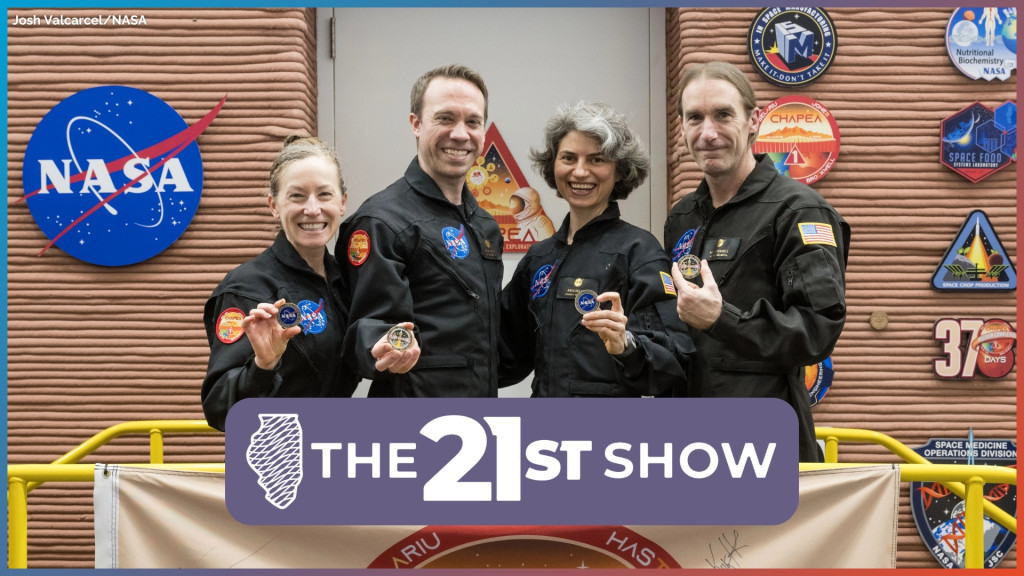
Transcript: Illinois doctor recounts life on Mars — in a yearlong NASA simulation
The 21st Show
Illinois doctor recounts life on Mars — in a yearlong NASA simulation
Read the full story at https://will.illinois.edu/am/doctor-recounts-life-mars-yearlong-nasa-simulation.
Transcript
// This is a machine generated transcript. Please report any transcription errors to will-help@illinois.edu.

[00:00:00]
Brian Mackey: It's The 21st show. I'm Brian Mackey. We've been talking today about Illinois's role in NASA's recent Artemis II mission. That, of course, is part of a long road that aims to eventually lead us to Mars. NASA has already spent a lot of time thinking about how something like that would work. A few years ago, four crew members spent a full year in isolation here on Earth on a simulated Mars mission. It was called the Crew Health and Performance Exploration Analog, abbreviated as NASA does, C-H-A-P-E-A, or CHAPEA. One of the people who signed up for CHAPEA was an emergency room doctor from Springfield called Nathan Jones. In late 2024, a few months after he emerged from isolation, we had a chance to talk to him about that experience. We'll be revisiting that conversation for the rest of the hour today.

Because this part of the show is on tape, we cannot take your calls live, but you can share your thoughts. Our email address is talk@21stshow.org. I should also say this is a shorter version of the conversation than the one that originally aired, and you can find the full version at our website. Again, 21stshow.org.

So, you were the CHAPEA medical officer, and I think the NASA website also listed you as an expert communicator. What was your role on this mission?

[00:01:27]
Nathan Jones: Yeah, so I was the crew medical officer, and they selected me for that because I am a physician and I do have experience in many different fields. I've got experience as a flight physician, flying with OSF Life Flight in Peoria years ago, and then international medical missions — we traveled down to Central America every year and spend time taking care of a population of indigenous people down there. And then also spend time working with EMS and tactical SWAT teams here in the area as well. On top of that, working as an emergency medicine physician in Springfield and local areas.

[00:02:12]
Brian Mackey: So how did you make use of your medical training on this mission?

[00:02:16]
Nathan Jones: You know, that's really an interesting question. Thankfully, NASA selects people to be astronauts and analog astronauts who are actually very healthy. And so most of the medicine involved with NASA's trips is actually preventative care and those sorts of things. Medical issues do pop up, and I would have been the first sort of line of defense if any emergencies happened, and then whenever any medical issue pops up, again, sort of the first person to step in and do something until the team at mission control — the actual physicians back in Houston — can take over and make their recommendations. And that's basically the way it operates in space.

But if you're a physician on a mission to space, you're not really probably doing much medicine in the end. You're actually probably working just as one of the regular crew members in the day-to-day tasks. And again, that's because they send such healthy people to space in general for these longer missions, except for, you know, for instance, potentially some of the private missions that have been ongoing the last couple of years. But generally very healthy people, and thankfully they haven't really had many significant medical issues. And so most of the things that you would do would just be the work as a regular crew member. And so I think the most important part of it is just taking those skills as you learned to become a physician and that you learn in your other work and being able to apply them to other daily tasks as an astronaut.

[00:03:56]
Brian Mackey: If someone's on a multi-year mission to Mars, they're months away from returning to Earth, they need an appendectomy — a decision needs to be made in space. What were your protocols if someone had sort of an acute severe medical issue in this simulation?

[00:04:16]
Nathan Jones: Yeah, and so ours would have been slightly different than a true mission in space. The further we get away, the more difficult it will be, as you mentioned, to actually find a solution, and NASA does have protocols for those sorts of things. As far as our mission goes, because we were actually Earth-based and at Johnson Space Center in Houston, Texas, we would have probably pulled the crew member out. They would have had to decide if, hey, is there a way that we can do this to where the crew member doesn't really feel the effects of being pulled out of the mission? Would it violate the parameters of the mission to be able to pull them out, perform some sort of procedure and then put them back in?

Now, if it was an appendectomy, I assume that they probably would have been done with the mission most likely. But if, for instance, you sprained an ankle and needed an X-ray, something like that, they would have found a way most likely to have obtained some imaging and then made a decision before deciding to pull someone out of the mission. So it probably depended just based on more of the specifics of the injury in that case.

Now, if you're in space on the International Space Station, for instance, an appendectomy isn't going to be possible. You're probably, honestly, a couple of days out from being able to get something done, so you're probably looking at taking some sort of antibiotic and then trying to find the quickest, safest way to get you back into the United States and a hospital there. Now, as we get to the moon and further away, you're days away from anything like that. And so they've done some recent surgery studies to see, you know, is there something we can do using like a virtual robot operated by a surgeon on Earth — that sort of thing. And those are some technologies we're still looking into.

[00:06:03]
Brian Mackey: What was a typical day like for you and your crewmates?

[00:06:06]
Nathan Jones: So it actually tried to mirror what would be occurring currently on the International Space Station, as that is probably our best model for what we would continue to implement in future missions. And so a very rigid designated time to wake up in the morning — usually you're looking at like 6 in the morning. And then you've got probably a little bit of time to get up, wake up, get some things ready, chat with your crew members. If you drink coffee, maybe you're getting something like that. And then you get breakfast, and then you have a little bit of time designated for the crew to get together and talk about the day's tasks and preplan. And then you get to work doing the tasks of the day. Mostly you're looking at science operations, maintenance, those sorts of things, and then potentially something for lunch — usually it's going to be separate from the other crew members — followed by the regular other activities like science and maintenance throughout the afternoon. And then dinner would usually be together as a crew, and maybe a couple more hours of activities that were scheduled, followed by an hour or two in the evening where you would kind of get to self-select what you were going to do. Then by 10 p.m., I think you were going to be looking at lights out every day.

And inside those days, you'd also have a few other activities like public outreach. You might have some time — I can't remember what they call them — but basically they were educational blocks where they let you select a kind of educational track to kind of stimulate your mind and continue to learn.

[00:07:41]
Brian Mackey: Interesting. So I also understand that communication — and this makes sense in space — it takes a long time for messages to travel between Mars and Earth. We've seen that with some of the probes we've sent there. What was that like? I understand that they tried to incorporate that into the simulation. So how much contact did you have with the outside world, and what was it like?

[00:08:02]
Nathan Jones: Absolutely. So that was probably one of the bigger parts of the mission. NASA wants to see just how it affects crew morale to have that isolation of time limitation and bandwidth limitations whenever you're communicating with Mission Control and others back on Earth. And so we were able to mostly just communicate with Mission Control through sort of a specific messaging application that NASA developed specifically for their program. And it was time-delayed, which changed throughout the mission. And then we also had —

[00:08:41]
Brian Mackey: When you say messaging app, is it like you're typing, or it's voice recordings — how was that?

[00:08:47]
Nathan Jones: Yeah, both. So if you think of like an app that you would use on your phone, you could add to it maybe a picture or maybe a short video, but mostly you're talking about typing a message. And I think that was probably something they'd selected based on feedback from — NASA's actually done many similar short-term missions in the past and participated in those, whether it's [HI-SEAS] in Hawaii, NEEMO, which is underwater, and then there's the NEK with Russia, and then HERA is actually a mission that NASA does at Johnson Space Center that are usually 45-day-long missions. And so they've kind of taken those missions and applied what they've learned to them and developed this sort of app.

[00:09:32]
Brian Mackey: All right. Most of us have expectations going into new experiences. I wonder what your expectations were going into this mission, and then how you might have had those expectations confounded in some ways by what it was actually like.

[00:09:47]
Nathan Jones: Yeah, I think that for the most part, it felt like it was what I was expecting it to be. But maybe one of the things that caught me off guard — and we live in this culture, I see a lot of times people are kind of racing towards retirement and that sort of thing — one of the things that really surprised me is just how much of my identity is being a physician, in particular being an emergency medicine physician. And I think maybe it's just kind of this weird sort of situation where you're going into it and you're like, man, I really don't feel like I'm an astronaut — well, you know, you're not going to true space — but I also don't really feel like I'm even what we call an analog astronaut. And then partway through the mission, I start feeling like I wasn't really even an emergency medicine physician anymore, just because it's been so long. And so it was a really interesting sort of identity playing around in my mind at that time. And coming back — and we're really still being on Earth, but coming back to my regular life and everything and settling back into it — it was just a sort of interesting thing mentally. And I really do feel like I'm an emergency physician again, but it was interesting realizing like, man, I really do feel like I would be lost stepping away from that.

[00:11:10]
Brian Mackey: And one imagines going to another planet would change your perspective on life. I wonder how participating in this simulation here on Earth might have changed your perspective on life.

[00:11:25]
Nathan Jones: Oh, absolutely, and there's so many things I could talk about for that. I think one that stuck out to me in particular is if you think about how Earth and Mars both rotate around the sun but at different speeds — at one point they're going to be on, you know, Earth's on one side, sun's in the middle, Mars is on the other side. And I remember just after we had had sort of a conjunction event where they were all aligned like that and communications were established with Earth, and thinking — we had sort of a window set up that they had created with a virtual Mars on the outside of it to look like you had a window to true outside. And it was a really neat thing, but at one moment I remember looking up and seeing the sun out of that window and realizing that if I was actually on Mars — and keep in mind we had been sort of trained to think mentally that we were actually there — and so to me, looking out that window and seeing the sun and realizing right next to it, way on the other side of that, would be home, would be Earth, would be everything I knew. You know, that was just sort of a wild mental thing for me.

[00:12:39]
Brian Mackey: Yeah, what a leap. Would you recommend this experience if other people were ever interested in going to Mars, either as a sort of an analog mission as you did, or perhaps strapping themselves to a rocket and committing to a couple of years, as you said, miles and miles away?

[00:13:00]
Nathan Jones: Yeah, absolutely. I think if I had the opportunity to do it again, I absolutely would. I would say yes, but qualify it with: for the right people. I think NASA spent a lot of time trying to figure out who they should send on a mission like this. And in fact, I think this mission is partly for them to try and get more information as far as who those people should be, because I think it will take a certain skill set to be able to deal with the isolation and other challenges of a mission like that. But I think it was worth it — great experience.

[00:13:35]
Brian Mackey: Would you do it if NASA comes to you five years from now, 10 years from now and says, you know what, you actually fit the profile to a T — will you be on one of our first Mars missions? Would you go?

[00:13:46]
Nathan Jones: You know, if I was in a situation where it's isolated in a bubble, I would absolutely love to go. The difficult part there is I've already spent so much time working with NASA and away from my family and all my loved ones, and so I think I'd really have to have a discussion with them before I could commit to something like that.

[00:14:08]
Brian Mackey: Dr. Nathan Jones, an emergency room physician at Springfield Memorial Hospital. He was also one of the first four crew members to take part in a NASA Mars simulation known as [CHAPEA] at the Johnson Space Center. Thank you so much for being with us.

[00:14:23]
Nathan Jones: Yeah, you're welcome. Thank you for having me.

[00:14:25]
Brian Mackey: We originally spoke with Jones in late 2024. I should mention again, you just heard an abbreviated version of that conversation. The whole thing as it originally aired is online at [21stshow.org]. While you're there, you can also find our voicemail number, our email address, and every other way to contact us. Again, [21stshow.org].

That's it for us today and this week. The 21st show is produced by Christine Hatfield and Jose Zepeda. Our conversation with Nathan Jones was originally produced by Anna Casey. Our digital producer is Kulsoom Khan. Technical direction and engineering comes from Jason Croft and Steve Morck. Reginald Hardwick is our news director. The 21st show is a production of Illinois Public Media. I'm Brian Mackey. Thanks for listening. We'll talk with you again on Monday.
Transcript Assistance
Illinois Public Media may use AI assistance for transcript generation and/or formatting. Transcripts that have not yet been reviewed for accuracy will be labeled.
To report a transcription error, or to request transcription of archival material, please contact will-help@illinois.edu.