Transcript: From the prairie to the moon, these Illinoisans are connected to the NASA Artemis program
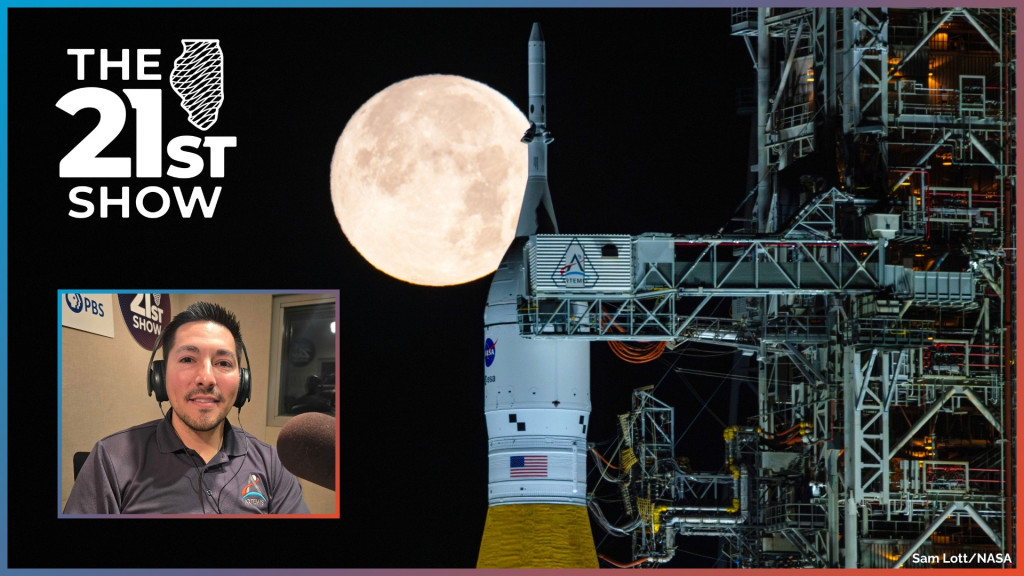
Transcript: From the prairie to the moon, these Illinoisans are connected to the NASA Artemis program
The 21st Show
From the prairie to the moon, these Illinoisans are connected to the NASA Artemis program
Read the full story at https://will.illinois.edu/am/from-the-prairie-to-the-moon-these-illinoisans-are-connected-to-the-nasa-artemis-program.
Transcript
// This is a machine generated transcript. Please report any transcription errors to will-help@illinois.edu.

[00:00:00]
Brian Mackey: From Illinois Public Media, this is The 21st Show. I'm Brian Mackey.

[00:00:05]
Speaker 1: 10, 9, 8, 7 RS-25 engines lit. 4, 3, 2, 1, booster ignition. And liftoff. The crew of Artemis 2 now bound for the moon. Humanity's next great voyage begins.

[00:00:26]
Brian Mackey: That was the countdown, as he just said, to the launch of Artemis 2, the recent mission to the moon and back. This was humankind's first lunar flyby in more than 5 decades, the first crewed one at least. The last one goes back to the Apollo program in the 1970s. Four people were on Artemis 2, but their achievement was the culmination of work by thousands upon thousands of others, scientists, engineers, technicians, and some of those people are based right here in the 21st state.

A little later, we'll hear from an executive at a company based in Downers Grove that supplies a key component NASA has been using for decades. But first, Joseph Fernando Gonzalez is a clinical associate professor in the Department of Aerospace Engineering at the University of Illinois Urbana-Champaign. He helped develop the technology that made the Artemis 2 mission a success. Joseph joins me from our studios in Urbana. Welcome to The 21st Show.

[00:01:20]
Joseph Fernando Gonzalez: Brian, thank you for having me. Pleasure

[00:01:22]
Brian Mackey: to be here. You too can join us today at 800-222-9455. That's 800-222-9455. Did you watch any of the Artemis 2 mission? What do you think of NASA returning to the moon? And do you think humankind will ever set foot on Mars? Maybe should we? 800-222-9455 is the number. 800-222-9455.

All right, Joseph Fernando Gonzalez, tell me a little about yourself. What is your space origin story?

[00:01:55]
Joseph Fernando Gonzalez: Brian, thank you for having me this morning. Pleasure to be here and listening to that clip, I still get chills. It's amazing, um, the, the accomplishment that we had as a program, as a society to be able to accomplish a mission like that.

My origin story started all the way back in the South Side of Chicago. I went to [Saedo] Steam Magnet Academy in the South Side and it was really a 4th grade project that I worked with a few of my friends on building a water bottle rocket. And it was that project that really stemmed my curiosity in rockets and space, and from then I got hooked. I saw this object that we were able to launch into the air several, like maybe 30 ft in the air. And from there I got hooked and I started following more of the NASA shuttle launches growing up. There was a lot of them in the late '80s and the '90s and and from there it just snowballed.

And one of the other pivotal moments that really set me down this path was in high school. I went to [Brother Ice] High School in the South Side of Chicago. And Brother Hayes, my physics teacher, he sent us, you know, we went on a trip to Kennedy Space Center. And and that was eye opening and from that moment I've made the decision, this is what I want to work on.

[00:03:21]
Brian Mackey: Oh, you one up me. I was gonna ask if you got to hang out at the Museum of Science and Industry. They have the space center there, but, uh, you went straight to

[00:03:28]
Joseph Fernando Gonzalez: Florida. Went straight to Florida. Absolutely.

[00:03:32]
Brian Mackey: So, uh, was it common for people to be into space in the, you know, the people you grew up with, your friends, family?

[00:03:38]
Joseph Fernando Gonzalez: Not, not, not quite. I, I felt like an outsider in a sense. Yeah, my, my two goals in life were to be a professional baseball player, and once that fell. Once that my mom always asked me to have a backup plan. So my backup plan was something even more difficult and to be an astronaut was my backup plan. I wasn't with much company in that arena, definitely on the baseball side, so many kids grew up wanting to be professional baseball players, but not many that I have met that have wanted to be astronauts in the circles that I grew up in.

[00:04:11]
Brian Mackey: Yeah, was that weird at all? I mean, were you, you know, people make fun of that, or you keep it to yourself, or how did that play out?

[00:04:18]
Joseph Fernando Gonzalez: No, people were pretty open about it, you know, they'd look at me with shocked eyes, but I, I didn't really get made fun of about it. I think people thought it was pretty cool. I had a pretty unique upbringing in terms of having a diverse group of friends. I played in the band. I wrestled. I, you know, did baseball, so I had and I hung out with theater kids too, so I had a super diverse group of friends and and you know it was pretty fun to have that experience and they were all, you know, pretty supportive of that in general.

But it wasn't until I came to college where I really started, you know, sharing that with more people. In fact, I'm, I'm sitting here in the studios at the University of Illinois and one of the questions that really helped me decide where I was to go in my career journey starting with my undergraduate degree was asking a professor during a college visit day, I want to be an astronaut. What major should I attempt? And they pointed me to aerospace engineering and the rest is history.

[00:05:17]
Brian Mackey: Yeah, well, that was going to be what I asked you about. So aerospace engineering, that is not an easy engineering in general at the University of Illinois. I mean, it's a nationally renowned program. It's not easy to get into. What was that like for you?

[00:05:31]
Joseph Fernando Gonzalez: It was a big change. My, my, you know, the first in my family to go to college and, you know, my parents didn't really know what engineering was, and but they really valued — my mom really valued education, so it was, she was going to send me to the university and, um, you know, my parents both did, and, and, but they didn't know how difficult it was and I didn't have anyone to talk to, um, about that. But I, you know, the great thing about the University of Illinois is there are so many different clubs and groups that you can get involved with here to find your community and, you know, be together on this journey and learn from others and I was able to find that community through a few different student organizations here at the university to help navigate that.

[00:06:16]
Brian Mackey: So talk about your educational journey. So you, you're navigating it. You ended up going on and staying at the [U of I] through your entire education, right? A lot of people try to go into industry right away. Talk about your path from, from education to, to the, to actually working in the field. Yeah,

[00:06:32]
Joseph Fernando Gonzalez: my, my path was a little bit unique. I did decide to stay at the University of Illinois, you know, contrary to a lot of people, you know, from my undergraduate to my graduate studies, a lot of people encouraged me to try another university. But yeah, I did evaluate the University of Texas at Austin as well as the University of Illinois where my two top schools and, you know, the my advisor here, Professor John [Lambrose], was a big reason why I decided to stay, you know, such a big advocate, um, almost like another father figure as I see him, and you know that's a, that's a key thing in terms of having that relationship and also the research capabilities here are unparalleled at the university, so I decided to stay.

And and pursue my doctorate's degree. After a doctorate's degree, people typically go into academia to teach and they were certainly trying to convince me to do so, but I considered myself the wild child. I wanted to go to industry and get experience working on a space program and doing things that I've dreamed of doing, you know, since I was a kid.

[00:07:34]
Brian Mackey: So, uh, before, let me remind listeners, this is The 21st Show. We're speaking with Joseph Fernando Gonzalez, who is an associate professor in the Department of Aerospace Engineering at the [U of I] Urbana-Champaign. And he helped develop some of the technology that made the Artemis [2] mission a success. If you want to join us, 800-222-9455. We'll get to some callers a little later in the program.

So let's talk about Artemis. Uh, for people who may not, you know, have the full scope of the program in their minds, can you just briefly outline what are the goals of Artemis? What, what are they trying to accomplish?

[00:08:10]
Joseph Fernando Gonzalez: So the Artemis program is the next major chapter in human space exploration. Our goal is not simply to return humans to the moon, but in this case, as a part of the Artemis program, it is to develop and establish a long-term sustainable presence that will help us prepare for future missions to Mars and beyond. A lot of people ask, why not go straight to Mars? Well, getting to the moon is only 4 days away, 3 to 4 days, and Mars, on the other hand, you're looking anywhere between 6 to 10 months away. So it's, it's a lot further and you run a lot more risk from a program standpoint if you were to go directly to Mars without first trying out the architecture, your systems, developing the infrastructure to establish a sustainable presence on Mars. We're practicing that on the moon.

[00:09:05]
Brian Mackey: So how did you get involved in the Artemis program?

[00:09:08]
Joseph Fernando Gonzalez: When I after I finished my doctorate's degree, I, uh, I joined the Boeing Company in Huntsville, Alabama, and I joined as a principal investigator for a battery research and development, and I worked on space programs. I worked on defense programs, commercial programs within that year, led a team of about 8 people leading destructive battery testing to inform design decisions for different programs.

I eventually, you know, one of the things I stress to the students now that I teach is make sure that you carry yourself well, have high quality work and you network with people and develop a brand so that people understand the quality of work that you bring. And what had happened within a year of being at the Boeing Company, I got tapped on the shoulder to take on this project that was in support of the Artemis program developing ground support equipment to test the propulsion systems as a part of the core stage rocket on the Space Launch System. So I, uh, you know, accepted that role and that was my first step into the program and I held several roles and projects throughout to support both Artemis 1 [and] 2, and even the 3rd and the 4th rockets that are currently still being developed. I've, I've worked on all of them and have been inside each of those departments and inside the rocket and and understand it very well. So that was my entry into the Artemis program when when I first started.

[00:10:36]
Brian Mackey: I, I have an uncle who, uh, like a generation or two ago was literally a rocket scientist also at Boeing. He was based on the West Coast. I don't know if you, if you [consider] yourself a rocket scientist properly, but, um, you mentioned destructive battery testing before we get to our, uh, I just have to ask about that. I'm envisioning sledgehammers and blowtorches. What, what is the work of a principal investigator at a company like Boeing look like, you know, day in, day out.

[00:11:00]
Joseph Fernando Gonzalez: You are leading a team on a vision and a, you know, on a vision and also goals of executing certain tests and it was developing a lab from the ground up. You mentioned sledgehammer. You know, one of the funny things that I showed in staff meetings when we had to include a safety moment is a person doing destructive battery testing. They had a broom. They had a pole with a nail taped to the end of it, and he was poking it with flip flops on, no safety goggles or anything like that. And this is what's not what not to do.

But when it comes to, you know, doing research, especially at a renowned company like Boeing and and others that exist, you know there's a there's a quality and a standard to the work that you do and and that's what we did, we developed the capability to be able to test batteries and be able to inform, you know, battery pack designs on spacecraft, launch vehicles, on commercial airplanes. So it was, you know, pretty exciting, very dynamic. The research environment is always very dynamic. It changes month to month, week to week, day to day, but uh that that was a very good entry into the program, a lot of creativity that you're allowed to make, especially in in a research area.

[00:12:18]
Brian Mackey: So tell me a little more about the, you know, what sort of work you were specifically doing on the Artemis missions when you moved over to that project.

[00:12:25]
Joseph Fernando Gonzalez: Yeah, when I went to that project, I started off as a fluids test engineer and a mechanical test engineer. We had to develop and build over 2 gas pneumatic system panels that would test our propulsion systems on the core stage rocket. We also had a lot of flex hoses and tubes and fittings and and flanges that had to be developed and cleaned and [essentially shipped] to the factory to support the [effort]. That was a 2-year project and very exciting, a lot of hands-on experience that I gained and and I worked with technicians that have worked on space programs for over 25 years so I learned so much from them in that project working for the Artemis as my first role.

I then transitioned into a different role after that project was concluded. I started as a materials and processes engineer working on both the core stage rocket. If you were to, you know, if you saw the Artemis 2 launch, you saw all of that orange color on the outside of the rocket. Pretty much everything in orange all the way down to the engines is is what we call the core stage rocket, and that's what that was a primary role that I played in and that was a part of that team. So we were responsible for all the materials that go onto the rocket, understanding everything that that not only from a design standpoint but also production, installing these, you know, these installing the hardware, putting the materials and the coatings on.

And, um, I eventually transitioned from there to a production role as well to support production. I traveled to [Stennis] Space Center to support the Green Run Test Campaign, which was a full-scale 8-minute hot fire of the core stage rocket. And then supported launch operations for Kennedy Space Center. So had a lot, had a lot of traveling to do from Huntsville, Alabama to the [Michoud] Assembly [Facility] to [Stennis] Space Center to the Kennedy Space Center.

[00:14:21]
Brian Mackey: I'm trying to get a sense like visually, are you one of those people like with a hard hat and a white lab coat, you know, magnifying glass, looking at things as they're being sprayed on, or is it more of an office job? What is it like day to day?

[00:14:32]
Joseph Fernando Gonzalez: It was a combination of both. There's, as engineers, oftentimes if, if you're on the design side, it's typically an office job. You're working with people from different locations and you know, in, in key meetings throughout. When you are on the production side, which I also, you know, I supported as well for a few years, you're very much wearing steel-toed boots and a hard hat, especially when it comes to certain operations. So you're out there looking at hardware and working with technicians that are physically putting the rocket together.

So it was a — I had the fortune, the fortunate experience of getting to do it all, all the way from the desk job to production, wearing the hard hats, getting out there, um, working with our technicians. Um, I also transitioned — my last gig before I came back here to the University of Illinois — for the last 5 years of the program, I was on the systems engineering team leading 6 different teams within the systems engineering umbrella. And I also served on the chief engineering board for our program, so I — every day was very dynamic, not only managing people, managing the execution of the work, but getting to still get involved with the production, going out to see the rocket, be, be a part of it and also see the different issues that were coming up day to day that we had to resolve, right? That's a part of engineering is solving difficult problems and there's no, you know, build a rocket instruction manual. You do your best to design and then you test and you continue to fix it to put the best product you can to send astronauts up to space.

[00:16:11]
Brian Mackey: Yeah, no shortage of complexity, I'm sure. All right, we're gonna be speaking more with Joseph Fernando Gonzalez, a professor at the [U of I] Urbana-Champaign, aerospace engineer. We're talking about Illinoisans who contributed to Artemis and we'll continue after a moment. This is The 21st Show.

It's The 21st Show. I'm Brian Mackey. For the first part of our program today, we're talking with some of the Illinoisans who have ties to NASA's Artemis program and specifically the Artemis 2 mission that just happened last month. It was NASA's first lunar flyby, the first crewed human flyby, uh, since the Apollo missions in the 1970s. And it's part of NASA's program to return to the moon. That is scheduled to be Artemis 4, which currently has an estimated launch date of 2028.

We're talking about this with Joseph Fernando Gonzalez, clinical associate professor at the University of Illinois Urbana-Champaign in the Department of Aerospace Engineering. Uh, he worked on Artemis 2's Space Launch System. I also want to bring in someone from a Downers Grove-based company that's been helping NASA since the Apollo days. Chemring Energetic Devices makes NASA's standard initiator. We'll talk a little bit more about exactly what that is, but it's basically a starter for mechanical operations. It was recently named the coolest thing made in Illinois by the Illinois Manufacturers Association, a trade group. Joining me now to talk more about this is Morri Leland, vice president of strategy and business development for [Chemring]. Morri, welcome to The 21st Show.

[00:17:53]
Morri Leland: Thank you, Brian. It's great to be part of this show.

[00:17:56]
Brian Mackey: So tell me a little bit more about the history of Chemring.

[00:18:01]
Morri Leland: Well, it's a great company. I uh I represent a few hundred people based in in Downers Grove, which if you're not familiar with that, it's on the western side of Chicago out in the suburbs. The company has actually been around for a little more than 50 years, but 50 years ago this year we started in the energetics and energetic device business, which maybe we can explain more about, but we're headquartered there and we pull people from the entire region up there.

[00:18:27]
Brian Mackey: Yeah, what is an energetic device?

[00:18:31]
Morri Leland: So it's a great question. You know, if we think about it simply, energetics is, is just think of it in its basic form. Think of like gunpowder. That is one form of stored energy. So energetics that we do take some of that powder, albeit in a much more sophisticated chemistry, and we put that stored energy into a small device and then at the appropriate time that stored energy is turned into something mechanical, so it's about the energetics but it's really about the devices. And by device you means in the space context, if you want something mechanical to happen, so if you want the solid rocket boosters to detach, a stage to separate, or if you want an umbilical to detach or parachutes to deploy, all those things require mechanical action and most of them start with a small amount of stored energy in a compact device that translates and makes those things actuate.

[00:19:37]
Brian Mackey: And I suppose one way to do this could be through like a a hydraulic valve or something, but you could probably get a lot more force per square inch, uh, you know, for the weight and everything else that goes into it with just a little bit of gunpowder or some sort of other chemical compound. Yeah, and that's the idea behind the standard initiator, I gather.

[00:19:55]
Morri Leland: That is the idea behind it, and it's about size, weight, and power — effectively how much energy do you need to actuate a device? Yeah, it may be a thruster, just it may be something that needs an expanding gas volume or it may need something that needs just pressure or flame, but that's the, that's the basis of what the NASA Standard Initiator is — the NSI as it's called. It's a device that it's changed through the years, but it actually goes back to Apollo [and] space shuttle days where NASA needed a standardized type of device that's quite sophisticated actually and extremely reliable under difficult conditions to drive a variety of different things, so they created this small — you know, it's, it's 1.5 inches long and maybe 1 inch around — and it contains some stored energy. And when it [is] applied with a very specific electrical input, it operates. It functions to drive those other devices, so the NSI serves as a basis for multiple functions in the Artemis mission and in many other spacecraft and missiles actually.

[00:21:12]
Brian Mackey: Yeah, Joseph Gonzalez, let me bring you back in. Is is the initiator, you know, something you encountered in your work on Artemis or in aerospace engineering more generally?

[00:21:20]
Joseph Fernando Gonzalez: Absolutely. As a as a systems engineer, you know, this is pretty neat to see that this device came from somewhere in Illinois, having grown up in Chicago myself. As engineers, when we send out requirements out there, supply chain takes care of it and then we end up getting a part into the production. We had pyrotechnic engineers that I worked with in terms of closing their verification at the end of [building] a rocket to NASA and ensuring that all of ours and requirements from a pyrotechnics standpoint [were] valid. So I, I got to hold one of these devices, to work with some of the engineers that [were] on the program, and to know that [it] stem[med from] Downers Grove, the suburbs of Chicago.

[00:22:10]
Brian Mackey: Yeah, so, so, uh, Morri, let me ask you, if somebody is watching the Artemis 2 launch, right, and they, you know, they, they see the, the, the, the Space Launch System going up, they see the boosters separating, what, what sorts of things would they have seen that were actually initiated by the standard initiator from, from your company, from Chemring?

[00:22:30]
Morri Leland: Oh, that's a great question. You know, what is it actually, what materializes out of it? You know, it's actually from the start of the mission to the end. So from the time the, the rocket — most the boosters are ignited, let's say. You know, it sounds simple, but you light the torch at the bottom, and that's a one-time operation that has to work. It has to be reliable without fail, so we call that extreme reliability. So when you light the, light the boosters, it starts at the very beginning with a pyrotechnic device, a small initiator that lights something larger that ultimately lights the boosters.

Interesting thing when you're watching it go up, you know, 2 [minutes and] 53 seconds after launch when the solid rocket boosters burn out, it shows them falling away from the rocket. Well, they, they do fall away, but it's actually, you know, those boosters are connected to the main body by something we call a thruster, and it looks like — for those of you who can remember — like pistons on a car, on your, your tires, a shock absorber. Well, there's 3 of these things that look like really big shock absorbers that connect a solid rocket booster to the main body and after the boosters burn out, those pistons actually extend to kind of push the boosters away. Those are our devices made right there in Downers Grove that are connecting and then pushing away the boosters.

And then so on. And there's other devices along the way, but at the terminal end when you see the parachutes deploy, you know, you see the top of the Orion capsule open up, there's drogue chutes and there's a parachute. And when it when it touches down in the ocean, those parachutes are detached. All of those are mechanical functions that are initiated by our devices. So it is from start to finish. There's applications for this throughout the mission profile.

[00:24:26]
Brian Mackey: So, uh, Joseph Gonzalez, I want to come back to you. You mentioned when we were talking earlier about hoses and gaskets, and, and anyone who is, you know, familiar with the history of, of manned space flight will know the phrase O-ring and the significance of that specifically to the Challenger mission. And I wonder how you take that upon yourself and, and your teammates as you are working with, you know, things that are so critical, and there's going to be so much attention to how they operate and so little margin for error. Talk, talk about how you, how you deal with that.

[00:25:01]
Joseph Fernando Gonzalez: You deal with that by first creating a culture of safety and first-time quality within your team. There's there's there's a lot of incidents that have happened throughout the history of space exploration and and you mentioned one of them, and the Challenger. Columbia was another and and there's a series of other missions after that. And one of the key things that, you know, I did leading my teams out in the Artemis program as well as what I educate my students on is really the attention to detail and having a good understanding of your requirements and the risk. Sometimes the conditions are not going to be ideal. You have to understand the risk if you were to proceed in making a decision.

And that's another thing that with my experience on the chief engineering board, there were a lot of things that we had to resolve and some of them we couldn't resolve 100%, but there's conversations that happen at all levels, all the way up and through NASA, to talk about the risks of those and ensure that everyone is aligned before we send astronauts on this rocket to ensure the most reliability to have a successful, successful mission. So it really starts with the culture in terms of the teams that you lead and develop and and the work that they put out.

[00:26:20]
Brian Mackey: Alright, let's go to the phones at 800-222-9455. We have Gil calling from Freeport on line one. Gil, thank you for waiting. Thanks for calling in. What's on your mind?

[00:26:32]
Gil: Oh, how you doing, sir? How you doing? OK, I'm gonna make this quick. Um, everybody's talking about the hardware and the technology and the Artemis 2. Great, love it. But here's our problem. I'm gonna make this fast. Humanity hate one another. We have smart engineers in the United States, and don't let me mention China because they make robots that serve you coffee and dance. My point is, we have smart people on planet Earth, but if they take away the hatred and come together as a unit, they can build a spaceship to get to Mars. And that's all I have to say.

[00:27:08]
Brian Mackey: All right, Gil, thanks for the call. I appreciate it. Uh, let's also hear from Paul calling from Urbana. Paul, thank you for calling in.

[00:27:17]
Paul: Well, it's interesting that I had a similar impulse as the previous caller, and I was going to point out the ISS, the International Space Station, as a joint project. Uh, the previous caller just mentioned the Chinese robots. They have a jumping robot that they're planning on putting on the moon, and they — maybe because they're communists, they have a 5-year plan — to have a, have an astronaut there by 2030. But, um, and I think it should be a joint project. Maybe, maybe Trump can bring that up at his meeting with Xi Jinping.

But uh yeah, I'm, I'm uh since you brought up the O-rings, I wasn't going to go off on this, but the space shuttle was upsized because it was partially a military project, and it doesn't make sense to send your, your supplies along with your, your personnel. They should have been separate as they do now, but [an] author named Jack Mann [,] "Arming the Heavens," has a short essay about the military antecedents to the space shuttle, so it's it's, it's a broad subject and I, I'm an enthusiast, but I have the misgivings when, when all of the nationalism that undermines our humanity, as a previous caller mentioned — that it [brings] no joy unalloyed. I can be enthusiastic about the space program, but I have these misgivings, so that's a lot to chew on, and I'll just — not much of a question either. So thank you.

[00:28:47]
Brian Mackey: No, it's good, it's good. It's interesting because I was looking at the the Wikipedia page for list of missions to the moon. And uh Canada has no entries until Artemis 2 on in terms of the milestone section. And because there was a Canadian on board this uh flight. So a little bit of international cooperation there, at least.

Joseph, can, can you speak to that? Uh, was, was there, uh, you know, the, the international or nationalist dimension of, of this work? Is that something that you and your colleagues are thinking about?

[00:29:17]
Joseph Fernando Gonzalez: It's an important topic and I, and Gil, really good point in terms of if we're working, if we're able to work together as a humanity we will be able to accomplish more, no doubt about that, right? You know, even here within the university, getting students to work together collaboratively — like that's the that's the culture we're trying to bring and ensure that people respect each other's perspectives and and continue to come up with the best solution to solve a problem.

But you know, when we look at the Artemis program, the Artemis Accord has many different countries around the world that have agreed and have signed on to the Artemis Accords, and this is truly an international collaboration. When you look at the Space Launch System itself, a lot of the suppliers are here in the United States, but a lot of parts come from around the world in order to build those parts. And then the European Space Agency is also a big proponent as well since they developed a service module for the crew capsule for Orion. So the rocket itself does have an international aspect to it with the collaboration with the European Space Agency.

[00:30:24]
Brian Mackey: We're, we're coming to the end of our time together. Morri, uh, I wanted to ask you, when, when I was a kid, I think when Joseph was a kid, we're probably not all that different in age, you know, the space shuttle program was the latest and greatest thing. Um, and, and maybe this says more about me and the nerd I was, but I remember a lot of excitement about space then that I don't necessarily quite see as much in the world today, at least, you know, setting aside until the recent Artemis mission, you know, especially among children. Morri, can you talk about the prospects for Artemis and other space work happening now to, uh, you know, reignite that interest, if I can say it that way?

[00:30:58]
Morri Leland: No, it's a, it's a great question and a, and a good topic. I could probably talk about this longer than you have time for, but I'm, I'm in kind of a unique position. My career actually started after I graduated from college. My first job was at NASA down in Johnson Space Center. And I supported the space shuttle program with some of the legends of space. I mean, these were folks [whose] names you read about in history books, and the excitement about the program then was palpable. I mean everyone understood it and talked about it.

Today we had a flash of that with Artemis this year, but it has been quite a long time and with media the way it is and so many things, it's hard to capture the attention of the public at large with the same kind of intensity we had back during the shuttle days, but I'm not a skeptic. The material's there and the excitement is there. There's an opportunity for us in the next [12 to] 5 years to do things that are just almost unimaginable, and there's lots of contributing reasons why we're at that precipice now, but Artemis is a big trigger event for the future. If you look back to Apollo and space shuttle and how things seem to not slow down, but there, there wasn't much exciting progress for a couple of decades, we're triggering that phase again now and the pieces are there. We are competing against a lot of other things going on in the world. I love the passion of your two callers. Gil was, uh, Gil got right up front with it. I'm, I'm upbeat about it. I think there's a lot there. I think there's a lot for your audience to be excited about. The people of Illinois have real-world examples of how they contribute to something like this. So I'm, I'm definitely on the positive side of this one, [Brian].

[00:32:56]
Brian Mackey: Jose[ph], yeah, just about 30 seconds and I'm gonna have to hold you to it. Go ahead.

[00:32:59]
Joseph Fernando Gonzalez: Yep, and, and I have students that are gonna be moving on to space programs that are supporting the Artemis [program] as a whole, whether it be with Blue Origin, SpaceX, some going to NASA, so that's exciting. And then when I look at Artemis 1 to 2, the engagement, the interest with Artemis 2 was more significant than Artemis 1. So that was super positive to see. It's not to the level that I would like it to be, but it was a step in the right direction.

[00:33:27]
Brian Mackey: And there is more to come. Joseph Fernando Gonzalez is a Department of Aerospace Engineering associate professor at the [U of I] Urbana-Champaign. Morri Leland, vice president of strategy and business [development] at [Chemring] Energetic Devices in Downers Grove. Thank you both for being with us. Congratulations on the success of the Artemis missions so far. We'll have more on The 21st Show after a short break. Stay with us.
Transcript Assistance
Illinois Public Media may use AI assistance for transcript generation and/or formatting. Transcripts that have not yet been reviewed for accuracy will be labeled.
To report a transcription error, or to request transcription of archival material, please contact will-help@illinois.edu.