








Transcript: Where does Illinois stand in U.S.-Canada trade war?
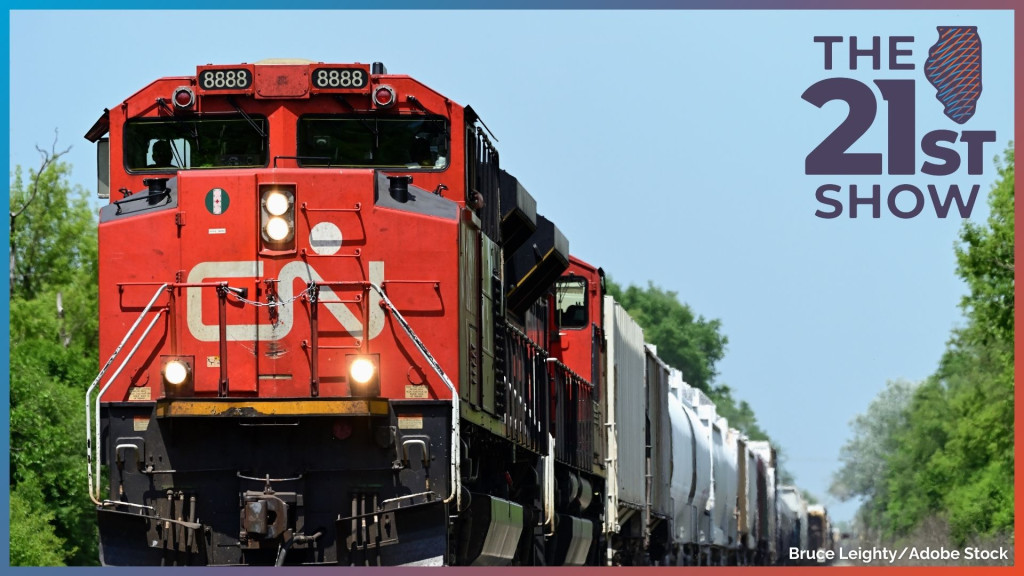
Transcript: Where does Illinois stand in U.S.-Canada trade war?
The 21st Show
Where does Illinois stand in U.S.-Canada trade war?
Read the full story at https://will.illinois.edu/am/illinois-in-the-trade-war.
Transcript
// This is a machine generated transcript. Please report any transcription errors to will-help@illinois.edu.

[00:00:00]
Brian Mackey: From Illinois Public Media, this is the 21st show. I'm Brian Mackey. You don't have to look far to see Illinois's deep economic ties to Canada. At this very moment, you might be waiting at a railroad crossing as a Canadian National train is pulling tons of goods across our state. Or maybe you roll up the windows when you drive past one of the petrochemical plants refining Canadian crude oil and gasoline. Every year, so far, there have been tens of billions of dollars — that's billions with a B — worth of goods and services going back and forth between Canada and Illinois.

And it's not just economic ties that bind Illinois, America, and Canada. We've been military allies for decades. Did you know more than 40,000 Canadians were deployed to Afghanistan during the global war on terrorism? And yet, President Donald Trump has consistently alienated Canada since returning to office last year, talking about making the sovereign country a [51st] state and launching a trade war that has us imposing 50% tariffs on each other's goods.

So what does this mean for Illinois, which counts Canada as its No. 1 international trading partner? Joining me now to talk about this is Dr. Barbara Ribbons, director of the Carson and Iris Varner International Business Institute at Illinois State University. Barbara, welcome back to the 21st show.

[00:01:27]
Barbara Ribbons: Thank you. It's great to be here.

[00:01:29]
Brian Mackey: Mark Denzler is president and CEO of the Illinois Manufacturers Association. Mark, welcome back to you as well.

[00:01:37]
Mark Denzler: Hey, good morning, Brian. Thank you so much for having me.

[00:01:40]
Brian Mackey: And to offer some insight on how our neighbors have reacted to this, we have Stuart Trew with the Canadian Centre for Policy Alternatives. He's a senior researcher there and director of its trade and investment research project. He's joining us today from Ottawa. Stuart, welcome to the show.

[00:01:57]
Stuart Trew: Hi, Brian, it's great to be here.

[00:02:00]
Brian Mackey: And listeners, we're live today, at least for this part of the program, spending most of our show on this. You can join the conversation at 800-222-9455. What do you think the new tariffs will mean for you? And what is our relationship with Canada tell you about America's place in the world? The number again, 800-222-9455. That's 800-222-9455.

All right, Barbara Ribbons, last time you and I talked was just after so-called Liberation Day last year, when the Trump administration announced sweeping tariffs on dozens of countries. Broadly speaking, how's it gone since then? What's happened since then?

[00:02:44]
Barbara Ribbons: Well, a lot of tariffs have been collected and that money goes into the national treasury. The costs have been passed on to consumers. We've seen that happen, and I think anybody listening can think of one or more items that they bought recently that has gotten more expensive than two years ago, let's just say. So there's a lot that has changed in that year for consumers, but I think it's more complicated actually to think about how things are shifting for companies, because this has created a lot of uncertainty. It's not just the tariffs themselves, it's the threats of tariffs and the — is it gonna last? Is it gonna go up? There's just so much uncertainty and that's certainly wreaking a lot of havoc with business planning.

[00:03:45]
Brian Mackey: Yeah, and Barbara, I'm sorry, I'm gonna interrupt you for a moment. Your sound is not the best, so I think our producers are gonna work on that with you. Maybe we'll switch over to phone.

Stuart Trew, let me come to you. Even before this latest — what would you say — battle in the trade war, what effect has this past year and a half had on Canada and Canadian politics in particular?

[00:04:08]
Stuart Trew: It's been quite a year, Brian. You know, things have gone up and down a number of times. As I'm sure you're aware, there's been the possibility — if you remember, last October — of a deal, and then that kind of fell by the wayside. We still don't know exactly what made it fall apart. I think maybe it was the ads that one of our premiers here in Ontario, Doug Ford, was running in the United States that included Reagan's views on free trade. In any case, you know, it's had a profound effect.

I think as Barbara was saying, the trade war's biggest effect is uncertainty, you know. People aren't investing, companies aren't investing, and this is true actually on both sides of the border, right? If you see where the money is and isn't going, there's not a lot of new investment in manufacturing in the states or in Canada. People are holding back, right, and waiting to see what happens.

You've seen a number of businesses in Canada go under in the past year. We've seen major furniture employers in Quebec, for example, have decided they simply cannot continue with the tariffs in the states and other pressures from imports of furniture products from overseas. Just this week we had a paperboard manufacturer in Quebec put 400 workers aside — kind of lay them off indefinitely — because of the latest round of Section [232] tariffs. So a lot of uncertainty. Canadians are kind of coming together. Maybe we'll talk about this in a little bit. There is a sense of camaraderie and we can stick through this, but definitely it's not a great situation.

[00:05:49]
Brian Mackey: Yeah, I do want to come back to that. But Mark Denzler, president of the Illinois Manufacturers Association, let me come to you. What has this meant for your field, manufacturing?

[00:05:59]
Mark Denzler: Well, Canada is a major ally, as you noted, Brian, in the introduction, both from an economic standpoint and from a geopolitical standpoint. When you look at Illinois, we export about $80 billion worth of goods every single year, and a quarter of those go to our friends in the North, go to Canada. We've seen an increase in trade since 2019 of about 25%. And so that means manufacturing jobs, and when you look at those exports from Illinois to Canada, the vast majority are manufactured products and agricultural products — two sectors that are pillars of the Illinois economy — and it's really important to have that stability and that certainty.

Moving forward, manufacturers are not planning next year, they're planning five and 10 years out. So getting certainty — we encourage the United States, we encourage Canada to sit back down and work out a reasonable arrangement, because fair trade between these two countries is critically important to both of our economies.

[00:07:06]
Brian Mackey: What do you — I understand that industrial output, Mark, has gone up since the start of this year. To what do you attribute that?

[00:07:14]
Mark Denzler: So we have seen both during the Biden administration and the Trump administration some requirements about — kind of buy America or having certain American components in. But you look at just the auto sector, for example, we're home in Illinois to several auto manufacturers. It really is a North American supply chain when it comes to autos, and you'll have component parts that will cross the borders three, four, five, and even six times. If you impose tariffs on that, that's going to increase the price of an automobile.

And so again, keeping this relationship — this important relationship — when 25% of our exports from the state of Illinois moving north to Canada, we have to make sure that we have markets. As I like to say, 95% of the world's consumers live outside the United States, and so for manufacturers, whether you're large global iconic companies or you're small suppliers that sell to some of these larger companies, we have to be able to move products around the world.

[00:08:11]
Brian Mackey: All right, Barbara Ribbons, thanks for sticking with us through a little sound challenge there. I think we've got you back on the line. So we heard Mark say 25% of Illinois manufacturing exports — I think was the figure, correct? Someone can correct me on that if I'm wrong — go to Canada. Let's talk about — tell me more about Illinois's sort of economic relationship with Canada.

[00:08:34]
Barbara Ribbons: Well, a lot of it is just the normal doing business and the fact we're in proximity, but we also process a lot of Canadian products as inputs to manufacturing that happens in the state. So there's a variety of ways we interact with Canada. We also have to think about their services, and while the tariffs are on products, the relationships getting strained hurt services as well. So we have a very complex relationship between the state of Illinois and Canada, and I think one of the challenges is the whole relationship between the US and Canada gets considered in an oversimplified way too often, because Canada does so many things that we use and we sell to them a lot as well. Not one way.

[00:09:36]
Brian Mackey: What was your reaction when these latest tariffs were announced — 50%?

[00:09:41]
Barbara Ribbons: I was kind of stunned because I felt like it didn't work when we tried it. It didn't work well a year ago, didn't have good outcomes for consumers or for companies, just creating a lot of extra uncertainty. So why are we circling back to something that didn't work? And I think a lot of it is not the tariffs themselves, but the threat behind it. It's a lot of rhetoric, not necessarily a well thought through tariff program — which is really what it [should be]. Tariffs have a role, but a well thought through tariff program has had a lot of planning, a lot of background, and a lot of involvement by the organizations who will benefit, so they understand and are poised to take advantage of it. These threats that come out of thin air surprise the manufacturers and the businesses involved just as much as they surprise the consumers.

[00:10:47]
Brian Mackey: Yeah, a little personal anecdote. I purchased a very small product from an outdoor goods company that happened to be based in Vancouver. It has been stuck at a FedEx depot in Tennessee for like two weeks now. I may never get it. But this is not about me.

This is the 21st show. We're talking today about the trade war — the United States with Canada. The U.S. has put tariffs on billions of dollars of Canadian goods and retaliatory tariffs from Canada go into effect next week. We asked members of our listener texting group about this — which you can join, by the way. You send the word "talk" to 217-803-0730.

Nancy in Urbana said it's embarrassing to have a president who treats a long and valued friend with such disrespect. These retaliatory tariffs hurt everyone. There aren't enough words to describe how stupid renaming Lake Ontario is. We haven't even talked about that. Joe in Charleston also said tariffs make our imports more expensive and domestic goods cost more anyway, so we all become poorer. We're personally getting poorer only because of the president's decisions, including starting a real war. And the government's becoming poorer too — $40 trillion in debt. I think we're poorer and weaker and our reputation and credibility as a nation is ruined. And Vicky in Centralia simply said, I am cheering Canada on. We are very bad neighbors.

We're talking about this with Mark Denzler of the Illinois Manufacturers Association, Barbara Ribbons at Illinois State University, and Stuart Trew with the Canadian Centre for Policy Alternatives. If you want to join us, 800-222-9455.

Stuart, let's talk a little more about how we got here. President Trump announced these tariffs in July — they were going to take effect mid-August. At the last second, they were postponed because the president said the U.S. and Canada had a deal, but then those talks fell apart and the tariffs went into effect. What do you understand to be happening in the past month or so?

[00:12:46]
Stuart Trew: Well, it's a really interesting question. I see us as being in a bit of a fog-of-war situation here — the fog of the trade war, right? It's very hard to know exactly what's happening and why certain things failed.

Let me just say though that when I saw, in July, the Trump administration propose these 50% Section [232] tariffs on a number of Canadian goods — now those goods that are targeted, let's just be clear, they were targeted, I think on purpose, because they're mainly from provinces — British Columbia, Ontario, Manitoba, and Quebec. These are the holdout provinces, the provinces where the pressure was expected to work on them and kind of produce maybe an outcome where they would be favorable to a deal.

But I think what has happened since then is that for whatever reason, with the talks breaking down over the past two weeks, their spine has kind of stiffened, right? I just want to say I thought the [Section 232] tariffs were a ploy to get a deal, to kind of come to some arrangement that would actually get us over this hump and past the trade fights and maybe toward the review of the USMCA — the trinational agreement with Mexico. All that blew up though, because I think people got wind of the deal on the table, realized it was not going to be feasible for our auto sector, our manufacturing sector. It was a pretty bad deal all around that got out to the public, and now the public is essentially set on this idea that we should not accept that deal at any price — that the U.S. has asked too much and they're not offering enough, right?

So what has happened — for whatever reason the trade deal talks broke down recently — what's happened now is you've got a kind of stiffened resolve, a stiffened spine from the premiers, from the public. We've got across-the-board political support here now from different parties for ratcheting things up if we have to even further, right? To the point where we're maybe taxing energy exports to the United States. So you have a situation that I think is not conducive to coming to a deal anytime soon, which is very concerning from the perspective of cross-border business — but that's where we're at.

[00:15:14]
Brian Mackey: I'm just trying to wrap my head around the fact that when you talk about the Canadian people having stiffened their spine against the enemy — and we're not talking about, you know, insert name of country here, right? Russia, China, Iran — countries that we've had adversarial relationships with in the past. We're talking about the United States.

And we're doing so with Stuart Trew with the Canadian Centre for Policy Alternatives, Dr. Barbara Ribbons at Illinois State University, Mark Denzler with the Illinois Manufacturers Association. We need to take a break on the program, but when we continue — or I should say we will continue this conversation. If you want to join us, we'd love to hear from you. 800-222-9455 is the number. That's 800-222-9455. We're going to talk more about the Canadian tariffs, the trade war, and specifically how that's playing out here in Illinois. This is the 21st show. Please stay with us.

It's the 21st show. I'm Brian Mackey. We're talking about the United States trade war with Canada and what it means for people and businesses here in the 21st state.

Another text message. This is from David in Mount Morris: I work on a small mom-and-pop shop that builds food equipment. Since Trump's Liberation Day, my company has laid off 40% of the floor workers, 20% of the office staff. I want to say half our products go to Canada. We went without a raise last year, only got a 3% raise this year. So yeah, I'd say we're really reaping in the prosperity that Trump promised. Then he adds: Yes, that was sarcasm. Thanks for the note, David.

Tana in rural Menard County said: I expect the price of food, gas, and other goods will rise for me as they will for everyone else. There are things I buy that say they are grown in Canada — in the middle of winter — various car and appliance parts, along with plenty of other things that come from Canada. But that's nothing compared to what's being done to one of the best friends this country has ever had. I've always felt it was such an honorable thing the way the United States and Canada respected each other and worked together to solve mutual problems.

My guests are Stuart Trew with the Canadian Centre for Policy Alternatives, Dr. Barbara Ribbons at Illinois State University, and Mark Denzler of the Illinois Manufacturers Association. If you want to join us, 800-222-9455. That's 800-222-9455.

Mark, I want to share another message from a listener. This is from Sarah in Rockford, who says: I'm a small business that makes the bulk of sales during festival season, May through September. I'm switching from import products to what I can source or make locally. It's hard because some of my top sellers I can no longer carry due to high costs, or the manufacturer just not making them anymore. It means more time sourcing and making, less time selling, coupled with a poor overall feeling about the economy — people are just not buying at any price or value point. It's not limited to Canada. It really hurts when you're trying to survive, let alone grow. Thanks for the message, Sarah.

Mark, we talked about manufacturing. What's changed for business more broadly because of these tariffs?

[00:18:45]
Mark Denzler: Yeah, and when you talk about tariffs, Brian, they're obviously very complicated. Tariffs can be an effective tool when you use a scalpel approach — certainly if you have countries that are stealing intellectual property, or they are cheating on trade agreements, or dumping steel. That's where tariffs are most effective, to go after the bad actors, so to speak. But these broad-based sweeping tariffs, as Barbara said, create a lot of uncertainty and instability for planning. They disrupt supply chains.

I was with my Canadian friends a little over two months ago in Calgary and Alberta visiting the oil sands, and we talked about how much of that Canadian crude comes down and is refined in the refineries in Illinois. It's used to produce jet fuel and auto fuel and diesel fuel, and those kinds of things increase costs. But when you unilaterally — talking about the company in Rockford — add significant costs or disrupt supply chains, it just makes it so hard for these manufacturers to compete. American manufacturers can compete with anyone in the world if we have a level playing field. So again, that's why tariffs can be important if used selectively against bad actors who are cheating or gaming the system.

[00:20:03]
Brian Mackey: You know, Mark, if we give the president his due — he's touted tariffs as one part of a path toward American economic self-sufficiency. As you well know, manufacturing has been moving to other countries for decades now. How viable is it for those pieces of the supply chain to move back stateside? Is there a timeline you can imagine on that?

[00:20:25]
Mark Denzler: Well, the president's been good for manufacturing when it comes to tax policy — for example, HR 1 and immediate expensing have been very good in adding rocket fuel to the manufacturing sector. Certainly we saw during the pandemic one facility shut down and interrupted complete supply chains around the world. Starting with President Biden and President Trump requiring a certain percentage of American-produced content — it's important and we're seeing that reshoring, we're seeing manufacturing coming back here.

But there are certain supply chains — as I mentioned earlier, the auto supply chain is really a North American auto supply chain. If we significantly increase costs, whether it's on Mexico or Canada, you're going to increase the price of a vehicle. It's going to be more difficult for that family to buy their new vehicle. We've seen it with agricultural inputs, some of the impact with losing some markets, and then the impact on large agricultural manufacturers and their supply chains.

So again, we live in a very complex world, and Canada has been a long-time friend and ally. In the view of many manufacturers, if you're going to use tariffs, use them selectively to go after the bad actors, as opposed to these broad-based tariffs that in some cases can do more harm than good.

[00:21:45]
Brian Mackey: Barbara, I want to ask you about a report from the news site [Semafor] last week that the Trump administration was looking at outright banning some imports from Canada. How tenable would that sort of policy be?

[00:21:59]
Barbara Ribbons: Well, I think it's gonna be really rough, because the rest of the world is all working together, and if we start building barriers to cut ourselves out of any supply chains and cut off suppliers, we're always putting ourselves at more risk. Sure, we're a big country — we have a lot of different things going on — but that doesn't mean we can do everything here, and it doesn't mean that everything is most efficient here. And I think that's the piece of this that gets lost in some of the rhetoric: if the rest of the world is doing a global supply chain and we're isolating ourselves, we're always going to lose — with quality, with price. It's just not healthy, and it cuts off our ability to be resilient to shocks like COVID. So isolation is just not a good idea in any way, shape, or form.

And certainly we also have to go back and think about the fact that trade negotiations are a particular kind of negotiation that's focused on long-term relationships — at least it has been historically and it is globally. So if we start dealing with our next door neighbor with a transaction-only-based mentality, I think — as Nancy said — we're destroying a relationship, and for trying to get some small win in one particular area, that's really foolhardy. So the whole idea of how we negotiate has to get refocused back on building strong, healthy relationships. Doesn't mean they always win, doesn't mean we always win, but the relationship is more important than the specific details of one particular transaction or one particular setting.

[00:24:02]
Brian Mackey: Well, I'm glad you mentioned relationships, because Stuart Trew with the Canadian Centre for Policy Alternatives — I want to play a clip. Prime Minister Mark Carney was speaking at the World Economic Forum in Switzerland this past January. Let's listen to some of what he had to say.

[00:24:18]
Mark Carney: We are a stable and reliable partner in a world that is anything but — a partner that builds and values relationships for the long-term. And we have something else. We have a recognition of what's happening and a determination to act accordingly. We understand that this rupture calls for more than adaptation. It calls for honesty about the world as it is. We are taking the sign out of the window. We know the old order is not coming back. We shouldn't mourn it. Nostalgia is not a strategy. But we believe that from the fracture we can build something bigger, better, stronger, more just. This is the task of the middle powers — the countries that have the most to lose from a world of fortresses and the most to gain from genuine cooperation. The powerful have their power. We have something too — the capacity to stop pretending, to name reality, to build our strength at home, and to act together. That is Canada's path. We choose it openly and confidently, and it is a path wide open to any country willing to take it with us.

[00:25:37]
Brian Mackey: A path wide open to any country willing to take it with Canada. Stuart, what does it look like for Canada to join together with other middle powers — as the prime minister had it — to fight back?

[00:25:50]
Stuart Trew: Well, Brian, before I answer that, I just want to say these comments coming in from listeners are really heartening, and I wanted to express my gratitude — and that of Canadians as well. We feel exactly the same way, that this has nothing to do with our personal relationships, long-term cultural [ties] and so on. There's just the deepest respect for American working people and we understand what they're going through, and we would hope that we could work together to figure out our common problems. So just to say that — it's been great to listen to some of those comments.

On the prime minister's speech from Davos earlier this year, I'm a bit skeptical about how much or exactly what he meant when he said he's going to build a middle power alliance to do something or other, right? I think the idea was that there are these geopolitical forces and poles kind of emerging — whether it's China or whether it involves Russia — or the United States, as countries that are perhaps pulling back from what was apparently or supposed to be this great cooperative model of global economic exchange before the rupture, as he calls it.

I'm not sure how much the prime minister in Canada honestly has done to create a new world. In fact, he sometimes speaks out of both sides of his mouth. He was in New York shortly after that speech saying he wants to create a fortress with the Americans — with the Trump administration — he's talking about fortress North America. There's lots we can do together in terms of military cooperation and foreign policy cooperation and so on, and that would maybe be a way to ease trade between the countries. So he'll say that, and then he'll go and talk to the Europeans about selling more military hardware to the Europeans. Meanwhile, Canada's still ignoring much of Africa in its foreign policy, and it's actually doing a lot of what the U.S. is doing recently, which is tying its international aid and other relations to what's in the best interest of Canadian companies. So there's actually quite a bit of alignment in some ways between what our government in Canada is doing and what the Trump administration's been doing — to privilege certain companies and kind of limit, as I was saying, the kinds of international cooperation that's possible.

So basically, I don't know, Brian. I don't know exactly yet what our prime minister means when he says that.

[00:28:24]
Brian Mackey: How do you rate, Stuart — you know, we hear some of this: OK, the first Trump administration was one thing, we can write that off as an anomaly. The second Trump administration means the American people want this. We can't count on any sort of future deal lasting more than the length of however long the current administration goes. Are we going back? Is there any going back to sort of regular world order, so to speak?

[00:28:52]
Stuart Trew: Another good question. I really don't know. I don't think we're going back to the World Trade Organization and continuing to push these very corporate-friendly trade rules at the international level. I think the reason why Trump's trade agenda has been attractive is because it claims to address the real concerns and insecurities that a lot of workers had with how things were going prior to 2016. I think that feeling is still there, and I think it exists in a lot of countries, including in Canada, right — that things weren't quite working exactly as they'd hoped.

I don't think the Trump administration has any lessons for anyone on how to address it, as we've been talking about today. I think a lot of it is counterproductive — it's blowing back on U.S. workers as well. But I do think we need to come up with a new way of operating internationally. I think it involves much more flexibility and understanding about the development needs of all countries, the need to create good jobs, and the pace with which they can do that. So I don't think it's the Trump version, but I also don't think we're going back to the old version, which was very focused on what's in the best interests of the profits of multinational companies.

[00:30:11]
Brian Mackey: Mark Denzler with the Illinois Manufacturers Association, how do your members plan and think about the path ahead at a time like this?

[00:30:22]
Mark Denzler: That's a great question, Brian, and one that I talk to our members about literally every day. I had a member reach out yesterday that's building a new factory in the United States. They're sourcing some equipment that'll be hit by a potentially new tariff, and that equipment is being used to produce goods in the United States and employ people in the United States — and they're facing a significant price tag that they didn't envision when they started this project a couple of years ago. I've seen that play out over and over again, where companies are getting hit with higher prices.

Again, companies want certainty and predictability. They want that stability, whether they're located in Illinois or elsewhere across the United States, because they're planning five and 10 years and 20 years out. They're not planning for next year or six months out. They deal with shocks when they come to the system, but they want that long-term predictability and that stability. And I think most of our members, when I talk to them, would much rather that the United States focus on China, or focus on Russia and the aggression in Ukraine, or North Korea — some of those adversaries around the world — and really target those countries and companies that are acting against the norm or violating trade agreements or dumping. When I talk to our members, they're much more focused on that than they are on dealing with Canadian companies.

[00:31:53]
Brian Mackey: Barbara Ribbons, probably the last question to you — broadly speaking, how do businesses plan for the future at a time of such uncertainty?

[00:32:04]
Barbara Ribbons: It's very hard. I think Mark's example of the equipment is a great one, because consumers — the voters — tend to see the consumer component of this. They don't always, unless their job gives them privy to it, understand the whole supply chain and the complexity of international relationships that ripple through that whole supply chain. And so it's very complicated when our voters are seeing the consumer component of it, and who they put in then doesn't always act in the way they wanted, nor in the way manufacturers wanted.

So just staying flexible, I think, is really an important thing. We hate when people lay off and reduce their forces. On the other hand, being lean definitely provides flexibility and opportunities to shift and move. And I think being global is very important — having facilities in different places that you can move production around as needed. You can move people around sometimes as needed, or other resources. Get your resources from multiple places so you have the ability to adapt. So staying flexible is the best course.

[00:33:30]
Brian Mackey: Dr. Barbara Ribbons is at Illinois State University. We've also been speaking with Mark Denzler of the Illinois Manufacturers Association and Stuart Trew with the Canadian Centre for Policy Alternatives, who joined us today from Ottawa. Thank you all so much for being with us today on the 21st show. Really appreciate your time.

Another break — afterwards, we'll be talking with the central Illinois-born-and-raised musician Pokey LaFarge. This is the 21st show. Stay with us.

---

**Flagged for Human Review:**

- **[00:00:00] "5first state"** — Transcript reads "5first state," likely a speech-to-text error for "51st state." Rendered as [51st] per inference rules.
- **[00:04:08] "Section 338 tariffs"** — Rendered as [Section 232] based on context (Section 232 governs national security tariffs; Section 338 does not appear to be a recognized tariff statute). Please verify the correct statutory reference.
- **[00:05:49] "Section 338 tariffs"** — Same flag as above; rendered as [Section 232] for consistency.
- **[00:12:46] "Section 338 tariffs"** — Same flag as above; rendered as [Section 232] for consistency.
- **[00:21:45] "Semaor"** — Transcript reads "Semaor," likely a speech-to-text error for the news site "Semafor." Rendered as [Semafor].
- **[00:25:50] "Reagan and Reagan, Reagan's views"** — Apparent speech-to-text repetition artifact. Rendered as "Reagan's views on free trade" for clarity. Please verify.
- **[00:25:50] "cultural and so on"** — Original transcript reads "cultural and so on" with unclear preceding phrase; rendered as "long-term cultural [ties] and so on" for readability. Please verify.
- **[00:25:50] "poll kind of emerging"** — Transcript reads "poll kind of emerging"; rendered as "poles kind of emerging" based on context. Please verify.
- **[00:08:34] spk_4 speaker label** — A fourth speaker voice (spk_4) appears at this timestamp, separate from Barbara Ribbons' earlier spk_1 label. Both have been attributed to Barbara Ribbons based on context and Brian Mackey's introduction. Please verify this is the same speaker.
- **[00:09:41] "the terrorists themselves"** — Transcript reads "the terrorists themselves" in context clearly referring to "the tariffs themselves." Rendered as "the tariffs themselves" without brackets, as the correction is unambiguous in context, but flagged here for awareness.
- **[00:09:41] "what it tariffs have a role"** — Apparent speech-to-text fragment. Rendered as "[should be]. Tariffs have a role" for readability. Please verify intended phrasing.
Transcript Assistance
Illinois Public Media may use AI assistance for transcript generation and/or formatting. Transcripts that have not yet been reviewed for accuracy will be labeled.
To report a transcription error, or to request transcription of archival material, please contact will-help@illinois.edu.