Transcript: Lost in war, found in time: How America accounts for unknown war dead
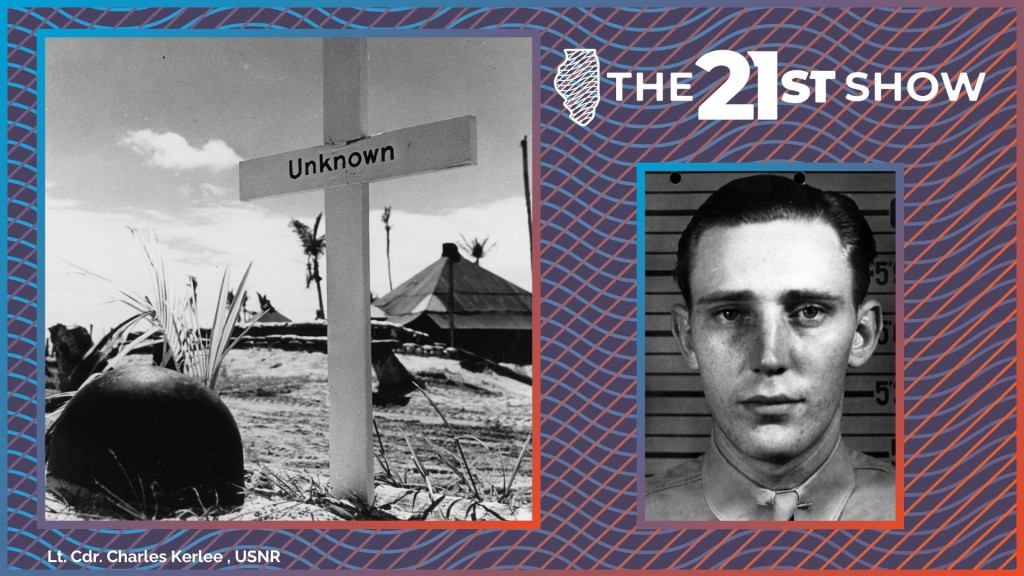
Transcript: Lost in war, found in time: How America accounts for unknown war dead
The 21st Show
Lost in war, found in time: How America accounts for unknown war dead
Read the full story at https://will.illinois.edu/am/lost-in-war-found-in-time-hpw-america-accounts-for-unknown-war-dead.
Transcript
// This is a machine generated transcript. Please report any transcription errors to will-help@illinois.edu.

[00:00:00]
Brian Mackey: Today on the 21st show, it's Memorial Day. We'll talk about searching for tens of thousands of American military personnel who are still missing from World War II all the way up to the Gulf War, and we'll hear the stories of a few Illinoisans who've finally been accounted for in the past few years. Plus, we'll talk about the symbolism and mythology of soldiers thought lost in Vietnam with Thomas Hawley. He's the author of "The Remains of War: Bodies, Politics, and the Search for American Soldiers Unaccounted for in Southeast Asia." I'm Brian Mackey. That's all coming up today on the 21st show, which is a production of Illinois Public Media, airing on WILL in Urbana, WUIS in Springfield, WNIJ in Rockford DeKalb, WVIK in the Quad Cities, and WSIU in Carbondale.

But first, news.

From Illinois Public Media, this is the 21st show. I'm Brian Mackey. Today is Memorial Day, when we remember the men and women of the armed forces who gave their lives in the service of our country. It was Edmund B. Whitman, superintendent of national cemeteries after the Civil War, who said, "That nation which respects and honors its dead shall ever be respected and honored itself." We've practiced that for decades, sometimes even while we are still at war, as evidenced in this 1945 Memorial Day newsreel, which of course was in the final days of World War II.

[00:01:50]
Speaker 1: At Anzio, Italy, scene of one of our bloodiest landings, a group of rangers pays a visit to the fields where they fought. Captured by the Germans and freed by the Russians in Poland, they're on their way home. First, they visit the cemetery where many of their [bodies] lay buried for a last silent farewell. Signal Corps cameras show that they have remembered: Memorial Day will be every day for them, for you can't forget the man who died at your side. Let us remember the best Memorial Day tribute we can pay. Work harder for final victory.

[00:02:25]
Brian Mackey: Among the many men and women we remember today are prisoners of war and those who are remembered but missing in action. One estimate is that around 81,000 Americans are still missing from World War II, the Korean War, the Vietnam War, the Cold War, even the Gulf War. The work to find these soldiers, sailors, airmen, and Marines is still ongoing decades later, and every year dozens, if not hundreds, of families are getting answers.

That's the focus of an agency in the Department of Defense. It's called the Defense POW MIA Accounting Agency, or DPAA, and it works around the world to search for the missing. The motto of a predecessor group, the Joint POW MIA Accounting Command, was "Until They Are Home." [C Elliott Moore], a forensic anthropologist for the agency, talked to the Associated Press in 2004 about what motivated his work.

[00:03:18]
Speaker 2: It gives me a lot of personal satisfaction in what I'm doing, and recovering the remains of those who paid the ultimate sacrifice, to provide answers [to] the questions of the families of their loved ones, so they will know what really happened.

[00:03:37]
Brian Mackey: On this Memorial Day, we're going to talk about those searches and tell some of the stories of Illinoisans who just in the past few years have finally been accounted for. We start today with Emily Tarbet Hust, a forensic anthropologist at the Defense POW MIA Accounting Agency. We originally aired this show back in 2025. With that in mind, no calls today, but we'd love to hear what you thought of our program. Send an email to talk@21stshow.org. That's talk@21stshow.org.

So there are so many of these stories we could be talking about. Your work has been focused on the Battle of Tarawa on the Pacific Front in World War II, and one of the men involved in that fight was a Chicago-born Marine sergeant named Robert F. Van Heck. He was 25 years old, November 1943. He lands on the Tarawa atoll called the Gilbert Islands. Pick up the story from there. What happens next?

[00:04:37]
Emily Tarbet Hust: So, for Sergeant Van Heck — I guess it's important to kind of back up a little bit and explain that the U.S. was trying to gain a more offensive position in the central Pacific, and so they had set their sights on Tarawa, more specifically on the airstrip that was located on the largest island. The Japanese had spent the entire past year building up their defensive capabilities on that island, and so it took months of planning. On Nov. 20, 1943, about 18,000 Marines began the invasion on [Betio], and that's what started the Battle of Tarawa.

So for Sergeant Van Heck, he was assigned to the 2nd Amphibious Tractor Battalion of the 2nd Marine Division. During that battle, he was assigned to what's called an LVT — a landing vehicle [tracked]. It's an amphibious vehicle, almost like a duck boat kind of, and he was assigned to LVT 13. It's always really neat to see what the historians are able to pull out of the historical records — they can kind of get a little personality to come through what we know about what happened. The driver of the LVT that Sergeant Van [Heck] was assigned to actually thought the number 13 was remarkably unlucky, and so he renumbered it 13.5 and would only address it by the name Wabbit Twax. You just kind of see some of their personality come through, you know, remembering that these are 20- to 25-year-old young men.

So they were able to successfully land their LVT on one of the beaches alongside numerous other LVTs, but shortly after they landed, two explosions rocked the front and the back, ending up killing both the driver and Sergeant Van Heck. And although we were able to figure out from historical records where the driver was buried, there was never any record of where Van Heck had ended up buried, which is a problem kind of across Tarawa in general. Things happened really fast, a lot of cemeteries ended up being kind of hastily created, so historical records are not always the best or the most complete for the island of [Betio].

[00:06:39]
Brian Mackey: So it's a situation where so many Marines are dying in quick succession that their peers are just trying to get them buried, and maybe they don't have the best records. Is that what you're saying happened?

[00:06:52]
Emily Tarbet Hust: Yeah, so we have some historical records, but they weren't expecting such a high casualty rate, and then the battle went on for so long — it was about 76 hours — and then within a day of them securing the island, the Marines were reassigned and sent back to Hawaii to prepare for their next mission. And so they left really quickly afterwards, only leaving behind a small group of Navy [personnel] to build it up into a functional military base.

[00:07:22]
Brian Mackey: So what happens in the decades between then and Van Heck's eventual identification 80 years later?

[00:07:32]
Emily Tarbet Hust: Sure. So initially the Navy — they were building up the island into a functional military base, and they replaced a lot of the simple burial markers the Marines had initially used with white crosses and memorials. But when they did that, they ended up changing the layout of the cemeteries — something we call cemetery beautification. They put the crosses in neat rows, they evenly spaced them apart. They didn't actually disinter any remains when they did that, and so the burial markers now no longer match where people are buried.

[00:08:04]
Brian Mackey: Oh, wow. So it looks like a, you know, a classic military cemetery — people have seen, you know, film if not in real life — but that doesn't necessarily line up with what's happening beneath the surface.

[00:08:17]
Emily Tarbet Hust: No, it doesn't. So that meant that a lot of cemeteries were either lost or took a while to find. After the war was over, the 604th Graves Registration Company arrived in Tarawa to recover and identify fallen service members, but they really struggled due to those beautification efforts. They were able to get some chaplains who were on the island and oversaw the burials to come and help locate things. With that, they were able to recover about 500 sets of remains, which left probably about 350 sets of remains still on the island.

[00:08:52]
Brian Mackey: So this group is working in the 1940s, shortly after the war — this is very much a present effort at the time, but they're limited in what they can get done.

[00:09:01]
Emily Tarbet Hust: Yeah, exactly. They did as much as they could at the time on site and were able to identify about 300 of those 500 individuals. Then what they couldn't identify was sent to an identification laboratory located in Hawaii at the time. They were able to identify about another 100, and then the remaining 100 of those 500 were given an unknown designator and buried in the National Memorial Cemetery of the Pacific — which we affectionately call the Punchbowl Cemetery here in Hawaii, because it is located in a volcano crater, and so it kind of looks like a punchbowl.

[00:09:37]
Brian Mackey: And this is — maybe this seems obvious, but it's maybe worth repeating — this is before DNA, I guess before we even understood what DNA was really, right? And certainly before any sort of DNA analysis. So were there other efforts over the years, or did these remains basically stay where they were for decades?

[00:09:58]
Emily Tarbet Hust: Yeah, they've basically been in the Punchbowl Cemetery since 1949, up until 2016 when the [DPAA] began the effort to disinter all of the Tarawa remains.

[00:10:10]
Brian Mackey: So what does that work look like — actually physically doing it? I mean, are there machines that come in? I've got to imagine there are aspects of this that are probably rather unpleasant in the moment, meaningful as it may be.

[00:10:27]
Emily Tarbet Hust: Yes, we work really closely with the runners of the National Memorial Cemetery, and they'll come out — we do these about every other week right now, working on other conflicts, Korean War primarily — and so they'll bring out their equipment. They have machinery, and guys who've got it down to an art at this point. They know exactly how they're going to approach it, they know how deep the caskets are. And then we'll have an archaeologist on site in case anything happens with the caskets, which are 80 years old at this point — if there's any damage to them. Sometimes when we lift them up, the bottom might fall out or something. So we have archaeologists on site watching the whole process, and then they'll get brought into the lab and processed here by our project teams.

[00:11:15]
Brian Mackey: So talk about what that is like. Van Heck was ultimately identified after 80 years. How does that actually come about?

[00:11:24]
Emily Tarbet Hust: Sure. So when we get a case in, the first thing is it has to be inventoried. Because these have gone through so many different identification efforts at this point, we have to assess and make sure what we're dealing with is one individual. Burials are really close together, things were recovered — not by anthropologists, not by archaeologists — and were initially buried and then disinterred and then buried again. And so we have to assess and make sure what we're dealing with is something that we can conclusively determine is one individual.

With that, we'll use anthropology, we'll use DNA analysis, and we're also able to use isotope analysis for that. With that information, we're able to go forward and figure out what we have to do from there to continue figuring out exactly who that individual is.

[00:12:13]
Brian Mackey: Can you say more about what you mean when you say "we'll use anthropology"? I think people can imagine DNA analysis — we've all seen CSI. What does it mean to use anthropology to do this work?

[00:12:24]
Emily Tarbet Hust: So we're able to use the articular surfaces — where your joints fit together — we're able to take the skeletal remains and make sure that those are consistent with one another. That can deal with size, the type of surface. There's a lot of uniqueness in [skeletal] body variation that we're able to look at, and then we're able to look across the body. So symmetrically, you know, do both of these arms look like they could be from the same individual? And then some of it's just aging markers. You know, if we're doing an age analysis and the skull appears to be an extremely young individual and the postcranial elements appear to be a very old individual, it's a pretty clear sign that we're dealing with something that got swapped at some point.

[00:13:08]
Brian Mackey: Interesting. So would this kind of effort have been possible if you went back, I don't know, 10, 20, 50 years ago?

[00:13:16]
Emily Tarbet Hust: Some of it. The anthropology is very similar to what they were trying to do at the identification laboratory in Hawaii in 1949. A lot of our anthropology — obviously we improve our methods over time, we have more reference samples now, we have more precise methodology — but a lot of the anthropology is very similar. What's changed a lot is our DNA analysis and our ability to make those comparisons and more positively identify individuals.

[00:13:43]
Brian Mackey: So I know today that service members have DNA records for identification purposes when they enter the service. I've got to imagine that was not the case in the lead-up and the mobilization in World War II, or even Korea. What are you matching to?

[00:14:01]
Emily Tarbet Hust: So we have a database of family reference samples. We work really closely with the Armed Forces DNA Identification Laboratory, known as [AFDIL]. They help us collect reference samples from family members. So for Van Heck, it was a maternal niece who donated DNA and was able to contribute to the comparison. Sometimes it's siblings, distant relatives. It really varies quite a bit, but it's all about families.

[00:14:30]
Brian Mackey: It's interesting, because you would imagine that a lot of these young men in particular were not married — they were so young, they certainly might not have had children in many cases. So that I imagine complicates things. All right, so you get through the process, you've done the analysis, you have a match. What happens next?

[00:14:48]
Emily Tarbet Hust: So we write up reports. We have a medical examiner on site who helps us — she kind of compiles all the information that we've gotten from our dental team, from our DNA, from the [anthropology] team. She's able to compile all of that into a medical examiner report, and then the death certificate gets finalized. We go through a copyediting process, and the identification gets made. Then we notify the service casualty officers, who contact the family, and it goes on from there.

[00:15:16]
Brian Mackey: Do you, as a person doing this work, ever get to connect with the families when they find out about their loved ones? Do they have questions for you, or are you separate from that process?

[00:15:26]
Emily Tarbet Hust: It really depends on the family. Sometimes they'll come in for tours or they'll come in for the remains releases. Hawaii is a bit of a trek for a lot of people, so it isn't a terribly common process, and it's not something that I've gotten the chance to be extremely involved in — but it does happen. Family members will come in, especially from the Korean War and Vietnam War, where we're dealing with slightly more closely related individuals typically.

[00:15:55]
Brian Mackey: Yeah, that makes sense. One imagines that the World War II generation — there's not that many siblings left.

[00:16:01]
Emily Tarbet Hust: For this identification, yeah.

[00:16:03]
Brian Mackey: All right, we have to take a break. When we return, we'll listen to more of my 2025 conversation with Emily Tarbet Hust of the Defense POW MIA Accounting Agency. And we'll share more stories of those we're remembering on this Memorial Day. This is the 21st show. Stay with us.

This is the 21st show. I'm Brian Mackey, and today is Memorial Day. We are talking about the ongoing work to identify the soldiers, sailors, airmen, and Marines who died fighting for our country in World War II and other wars. As former President Franklin Roosevelt put it in a 1942 fireside chat, the people who served are soldiers, but they're also something more.

[00:18:08]
Speaker 4: Our soldiers and sailors are members of well-disciplined units. But they're still and forever individuals — free individuals. They're farmers and workers, businessmen, professional men, artists, clerks. They are the United States of America. That is why they fight.

[00:18:38]
Brian Mackey: We could be talking about U.S. Army Private First Class Robert L. Bryant from Bloomington, Illinois, who died at age 23 during World War II and was accounted for in 2024. Or U.S. Army Air Forces 2nd Lt. Jay [Batala] from Chicago, killed at 24 during World War II and accounted for in 2025. But we decided to focus on one particular story today — that of Chicago-born Marine Corps Sgt. Robert F. Van Heck.

Identifying the missing is the jurisdiction of the Defense POW MIA Accounting Agency. We talked about this back in 2025 with forensic anthropologist Emily Tarbet Hust. Our program's on tape today, so no calls, but you can let us know what you thought. Our email address is talk@21stshow.org.

All right, Emily, we are talking about one story out of many here, but how does this fit into the bigger picture of the work you do?

[00:19:39]
Emily Tarbet Hust: It's a good example of just how many people go into a single identification. We have to work with our historians to figure out who a case might be, what is our list of possible candidates. We have to work with our archaeologists, who are the ones who go out and recover the remains, [and] our anthropologists, who kind of figure out what path our case is going to go forward — and there are just so many different people who have to be involved with different specialties. All of those coming together for one identification, I think, really shows the commitment of our agency to just never give up on a case. We disinterred Sergeant [Van Heck] in 2016 after 80 years, and it took four or five years for us to have a path forward, but we were still able to do it. And every identification means something.

[00:20:31]
Brian Mackey: What made you want to get into this type of work?

[00:20:35]
Emily Tarbet Hust: It's funny — when I was 12, a librarian gave me a book by accident called "Death Acre," thinking it was a mystery book. It was actually a book by Dr. Bill Bass, who is a forensic anthropologist who started one of the first body donation facilities in Tennessee. That kind of kickstarted me forward. Then I found my way to [DPAA] because my grandfather was in the Korean War. I had done some historian internship work with someone who writes books on the Korean War, and so those two paths — interest in the military and interest in my grandfather's history, and interest in forensic anthropology — kind of collided and ended up with me here.

[00:21:21]
Brian Mackey: What does it feel like to get an answer to a question that has been, you know, an unsolved mystery for decades?

[00:21:30]
Emily Tarbet Hust: It's incredibly rewarding. I think that's the biggest part about this job. I've been with the [DPAA] for about 6½ years now, and in those 6½ years, I don't think any day has ever felt the same. Everything's a little bit different, every challenge is a little bit new, and every approach has to be shaped to match those challenges. It's just one of those things where every day is its own kind of reward when you understand how much your work matters to people. It's really a dream to be able to participate in this.

[00:22:03]
Brian Mackey: Do you feel a connection with these men and their families?

[00:22:09]
Emily Tarbet Hust: Yeah, sometimes. It's amazing how much you can learn just between the historical context and looking at someone's remains. You get to know them — you can see that they broke their arm when they were a kid and it healed really well, and you can see if they had their nose broken. You get to kind of know them in a way that I don't think you get to just by reading the historical records. But then obviously the historical records give you context into who they were and who they served with, and, you know, the humor that they might have had. So you really get to know them when you're working on a case for years at a time trying to figure out that answer. Getting to watch them go home is always a really big, moving [moment].

[00:22:55]
Brian Mackey: I would imagine there's also some visibility into the horror of war, the trauma of war, as well.

[00:23:01]
Emily Tarbet Hust: Yeah. I think the hardest thing is always to see how young they all were.

[00:23:06]
Brian Mackey: Yeah. How does it feel for you when they're reunited with families? In Van Heck's case, he had a funeral in Hillside, Illinois, this past January.

[00:23:15]
Emily Tarbet Hust: It's wild how much impact these identifications make after so many years. It's always really, really cool to see the articles that come out of this — the funerals and the quotes of the family members that are able to go and pay their respects and how much that closure means to them. We always share the articles around the lab whenever a funeral happens and it makes the news. We always make sure to put it out in a lab-wide email so we can all see the impact that our work is doing.

[00:23:49]
Brian Mackey: So this program's airing on Memorial Day. I wonder, given your work, what does this day represent to you?

[00:23:57]
Emily Tarbet Hust: It's interesting, because it's almost like every day is a type of Memorial Day. Every day we're working right there alongside the individuals who gave up their lives. We're looking through their historical records, we're analyzing them, we're getting to know them. But Memorial Day is still a really great chance for us to step back and put it all into the big picture. It's really easy, when we're doing it every day, day in and day out, to kind of just focus on our little piece. Memorial Day really helps us take a step back and remember what we really do and who it's for. We have the honor of giving these men back their name, giving them a final resting place where their families can pay their respects and helping bring closure to their story and to their families. That work is really important and it really matters, and we'll keep doing it until they all come home.

[00:24:44]
Brian Mackey: Emily Tarbet Hust is a forensic anthropologist at the Defense POW MIA Accounting Agency based in Hawaii. Emily, thank you so much for sharing some of your work with us today on the 21st show.

[00:24:56]
Emily Tarbet Hust: Thanks for having me. This is great.

[00:24:58]
Brian Mackey: Again, we originally spoke with Emily in May 2025. Robert F. Van Heck's funeral was held in January of that year.

This is the 21st show. I'm Brian Mackey. On this Memorial Day, we've been talking about the ongoing search to account for all the U.S. military personnel who've gone missing in war and how we're still getting answers to some of those stories decades later. In a field full of uncertainty, the Vietnam War has posed many of its own questions. CBS News' Bruce Morton reflected on that in a news report the day the Vietnam War Memorial in Washington was dedicated back in 1982. You'll also hear words from a man he described simply as a soldier who had come back.

[00:26:08]
Speaker 5: All these people on these walls, my friend. As far as I'm concerned, I wish they could have did something a long time ago. We didn't need no parades or that. All we needed was a little bit of respect.

[00:26:20]
Speaker 6: Respect was all around today. The patriots of an earlier American war talked of risking their lives, their fortunes, and their sacred honor. The lives that were lost remain lost, of course — young men denied their chance at fortune. But maybe today the Americans who went to war, and those who didn't — maybe they all regained some honor.

[00:26:40]
Brian Mackey: Less than 2% of missing U.S. service members fought in the Vietnam War, but the body of the missing soldier from that conflict has nevertheless taken on extra significance. Author Thomas M. Hawley writes about this in his book "The Remains of War: Bodies, Politics, and the Search for American Soldiers Unaccounted for in Southeast Asia." The book's history goes back more than 30 years to an article in the Honolulu Advertiser in March 1995. [Hawley] is a professor in political science at Eastern Washington University in Cheney, Washington. We originally spoke with him in May 2025. Because of that, no calls today, but we do appreciate hearing your thoughts on our program. Email is the best way to contact us, and the address is talk@21stshow.org.

All right, let's begin with a simple question. Who is Michael [Blassie]?

[00:27:36]
Thomas M. Hawley: Michael [Blassie] was the soldier whose remains were interred in the Tomb of the Unknown Soldier at Arlington National Cemetery — he was the one for the Vietnam War, and there are ones for other wars as well. There was speculation, however, even at the time that his identity could be discovered. So after a period of time, his remains were exhumed from the Tomb of the Unknown Soldier and, through DNA and other forensic testing, they were able to determine his identity. He was buried appropriately in Missouri, where he's from, and to this day the Tomb of the Unknown for the Vietnam War remains empty.

[00:28:17]
Brian Mackey: Remains empty, and there's still work to prevent it from having to be filled again, I guess. But what does it say to you that it was 26 years — I think, if I have that right — between when he was killed and when he was finally identified?

[00:28:32]
Thomas M. Hawley: Yeah, that's a good question, in part because some identifying information of his was recovered at the time his body was recovered, and it included things like an ID card and stuff like that. But a lot of that stuff got misplaced or lost or whatever. So there was a lot of speculation, even from the beginning, that his identity could be revealed.

The flip side of that, though, does concern the hallowed nature of tombs of unknown soldiers — and especially, of course, at Arlington National Cemetery, that's kind of the place where we go to pay respects to our deceased members of the armed forces. That really kept people from wanting to tamper with the tomb. It just felt sacrilegious to take a body out of an unknown tomb and try to identify it. That's an understandable impulse. Part of the significance of tombs of unknown soldiers is what they symbolize, and their anonymity is precisely the point, because they stand in for the fallen who, across that particular war, represent the nation in a particularly symbolic way. It's a very solemn place to visit, as anybody who has been there before has observed — with the changing of the guard and so on and so forth.

So I think it just seemed so sacrilegious at the time that there was a real reluctance, despite, again, pretty good sense that his identity could be revealed. And finally, the impulse to do so overwhelmed the sacrilegious nature of the tombs of the unknown.

[00:30:14]
Brian Mackey: Can you talk in a general way about the sort of military impulse to leave no one behind?

[00:30:22]
Thomas M. Hawley: Yeah, that's a really good question and a really important one as well. I think, at least initially and probably obviously, it's out of respect for the sacrifice that a member of the military makes when they are killed on the battlefield, and to leave someone behind is almost inherently disrespectful. It's also a code of honor. I mean, you hear it all the time, and it's true — "leave no one behind." That's kind of an animating principle of military comradeship, and it's a reflection of the bond as well, I think, that soldiers have with one another.

[00:31:11]
Brian Mackey: There's a moment — I think I recently read in the memoir of a soldier who was campaigning with U.S. Grant, he was one of his aides — he talked about before a battle seeing some of the Union soldiers sewing up their uniforms, and he thought, what a strange time to be making repairs. But no, it turns out they were sewing slips of paper with their names into the back of their uniform jackets so they could be identified. Because this is a fate — sometimes people come to accept death — but it seems somehow worse than death for some people in the military to feel like they won't be accounted for, right?

[00:31:48]
Thomas M. Hawley: I think that's a really perceptive point. It's one thing to make the ultimate sacrifice for your country. It's another thing not to be repatriated, because that does feel a little bit like an abandonment, and it feels, I think, potentially disrespectful. That story from the Civil War — I'm familiar with that as well, and I find it very striking and really representative of what you just mentioned: that maybe the fear of never being identified again actually is greater than the fear of death, especially in the Civil War. I think virtually everybody knew they were going to die. And so to take steps like that, I think it's really quite remarkable.

I think you could make the argument — I don't know if this is 100% true, but I wouldn't be surprised — that that's kind of the beginning of the advent of the dog tag, as a means of at least trying to have some identifying information on a soldier should he be killed in action.

[00:32:52]
Brian Mackey: What does it mean? Talk about the ways that the U.S. commemorates its war dead and some of the meanings those have had over time.

[00:33:01]
Thomas M. Hawley: Yeah, I think the United States is in a unique position in a lot of ways, and part of that is because of a long string of victorious military adventures throughout the 19th and 20th centuries. So memorializing American soldiers throughout the decades has been more triumphalist and celebratory than virtually any other thing. There's a whole host of symbolic codes and other ways of memorializing members of the military that are kind of baked into the way that we think about wars and the war dead in the United States and U.S. history.

That's why the Vietnam War is such a departure and therefore so much more difficult to memorialize — because the triumphalist narrative doesn't work, obviously, and the defeat obviously doesn't work either. Then the legacy of the Vietnam War, having been as complicated as it has been and still is, also makes it much more difficult to memorialize that war.

The Vietnam Veterans Memorial is a good example of a departure from a lot of — probably all of — the memorials on the Washington Mall. Its design is really quite striking, and it was reflective, I think, of some of the difficulties that Americans now face and have faced when it comes to thinking back and memorializing the Vietnam War.

[00:34:36]
Brian Mackey: Yeah, all right, we are going to take another break on the program. When we return, we'll have more with Thomas Hawley, author of "The Remains of War: Bodies, Politics, and the Search for American Soldiers Unaccounted for in Southeast Asia." This is the 21st show. Stay with us.

This is the 21st show. I'm Brian Mackey, and this is Pat Boone.

[00:35:07]
Speaker 8: In November 1969, through North Vietnam skies, rescue pilots searched the jungle. Captain Richard Hall was down, his Thunderchief was lost. No parachute was seen [mid—]

[00:35:31]
Brian Mackey: Today is Memorial Day, and we've been reflecting on the many thousands of American military personnel who remain missing decades after their conflicts ended and the ways we are still learning what became of some of them. We've been talking for this part of the show with Thomas M. Hawley, who wrote about how the Vietnam War — which the song you just heard talked about — has taken on special significance in these searches. His book is called "The Remains of War."

Professor Hawley, I mentioned at the start that Vietnam's count of missing is a pretty small share of the overall number of missing U.S. service personnel. But there is a major emphasis on this. As we heard with those songs, and we can talk a little more about other versions of pop culture — this was such an important part of the era. Why is that?

[00:36:19]
Thomas M. Hawley: Yeah, that's a really good question too. In my view, it is yet again tied back to defeat in Vietnam. The missing in action were, as you point out, a smaller number than any previous American war, but of much, much greater significance. Part of that does have to do with improvements in the ability to recover and identify the remains of military personnel. So that kind of gets the ball rolling, so to speak — it's like, well, we can do this and so therefore we should do it, which makes complete sense.

But another part of it was some amount of ambiguity about what had happened to those whose remains had not been recovered. There was some concern as to whether or not they were being held against their will in Southeast Asia. There happens not to be any evidence for that, but it was nevertheless top of mind for a lot of people. We've obviously seen many movies that have popularized that theme. So part of the emphasis on the Vietnam War remains was because of these suspicions that perhaps they've been held against their will in Southeast Asia. That took a smaller number of people but then blew it up into a much, much larger circumstance, and arguably a much larger problem, than was the case for, say, those missing from World War II.

[00:37:45]
Brian Mackey: I think people who are maybe younger today — who didn't live through the 1980s — may not really appreciate the extent to which this was in the air at the time, right? Those black flags, the wristbands people had. Rambo is one film example. Even something like that 1980s TV show "Airwolf" — I was reminded that one of the pilot's motivations in that — the helicopter pilot is finding his brother who he was convinced was still a POW in Vietnam. Can you just talk about how and why that was so ubiquitous at that time?

[00:38:21]
Thomas M. Hawley: Yeah, that's a good question. I think it really does have a lot to do with the very difficult legacy of the Vietnam War. The defeat in Southeast Asia was just such a shock to the system. Part of what I talk about in the book concerns the tangibility of the remains that are recovered from Southeast Asia and then identified — that provides quite a bit of closure, and not just for families. For the nation, there's like one more incremental step away from the war itself and something that might do something to pacify the very contentious legacy of the war.

I think especially in the '70s and '80s, when a lot of the POWs came home and then a lot of the other veterans had been home or were coming home, that was a very contentious time as well. I think it's fair to say that the living veterans who returned to the United States felt, in many cases, as abandoned as their unidentified counterparts in Southeast Asia. And so those two things really converge in the 1980s especially. Then, you know, you throw the Vietnam Veterans Memorial into the mix, which opens in 1982, and that of course was very contentious as well. So it just kept on being the case that the Vietnam War was just all around, all the time. And then, as you point out, people who grew up in the 1980s might not necessarily remember that.

[00:39:56]
Brian Mackey: Maybe we can actually pause to talk about the Vietnam Memorial. I know that could be an entire other book, and it absolutely has been. But why it was so different, why it was such a departure — and, frankly, how it has influenced other memorials. Every memorial that has come since then is now so much more personal and less about the collective.

[00:40:18]
Thomas M. Hawley: Yeah, that's a really good point, and I'm going to start with that. The degree to which it's personal is so striking, and one of the things that makes it that way is that the black granite is very highly polished. You can see the reflection of your face or your body when you're standing there looking at the names. And so there's a connection there that's really, really [powerful] when you're there.

There are a couple of other things that are unique and I think extremely both important and powerful about it. One of them is that instead of being listed alphabetically, the names are listed chronologically, starting in 1957 and going all the way around to 1975. You start your visit at the apex of the memorial and then go around to the right — so at the beginning, 1957, you go all the way around and back down the other side of the V, and you end in 1975. It is an incredible sensation to walk down into that — the wall at that point, at the apex, is like 12 feet tall — and so you feel very much immersed in this highly emotionally charged environment.

Then, a couple of other things. One, it was designed by an Asian American woman who was an undergraduate in a funerary arts class in college. When people found out about her identity, there was a lot of controversy about that. And I guess the other thing — a lot of it's been really controversial — but the other part of it is that it's not triumphalist. It's not a statue. A lot of people were unhappy that it was black. So because it's so outside the norm of how wars are typically memorialized, and especially for Americans as we were just talking about, yeah, it got a lot of people's hackles up. But after it opened, it almost immediately became the most visited memorial on the Washington Mall, and it's still, of course, enormously important today.

There's actually now a museum that houses artifacts that have been left behind by veterans who've come to see the name of a fellow soldier. That's a really powerful dimension of it too. So happily, that controversy died down and has now been replaced with a great deal of admiration for that memorial.

[00:42:35]
Brian Mackey: And as you said, it's really influenced every major memorial I can think of that's come after — be it 9/11 or Oklahoma City. It really does individualize the victims of those.

[00:42:49]
Thomas M. Hawley: That's another really good point, too, as far as putting those individual names up there is concerned. As you pointed out, it makes it more individualized, it makes it more personal. And one of the other very cool things that people can do is that they can put a piece of paper up there with a pencil and make a rubbing of the name, and it comes off on that piece of paper. You see a lot of people doing that. And yeah, you're right — the way that memorial has influenced others is quite striking as well.

[00:43:18]
Brian Mackey: Let's talk — you talk about how the Vietnam War has almost become a matter of victimhood for the United States. And there's maybe even some amount of trying to get back at Vietnam for how the war ended. I wonder how you've seen that play out in the past 50 years.

[00:43:37]
Thomas M. Hawley: Yeah, that was an especially prominent theme in the immediate aftermath of the fall of Saigon in 1975, and of course had gotten started before that. But yeah, it was tough, not just because of having lost, but having lost to Asians, to be perfectly frank about it. That was a major issue. So the racial dimension of the controversy over the missing was really quite prominent, and that did not help.

When you make the reference to sort of a payback slash revenge kind of attitude, that was very much in the air at the time too. As I say, it didn't help at all, because all it did was make it almost impossible for the Americans to get into Vietnam to look around for their missing. Vietnam wasn't having it. Had the vitriol been greatly reduced, I think this whole process would have been a lot smoother. But because of that vitriol, there was a lot of suspicion — suspicion that the Vietnamese were deliberately holding back remains, which they were, and also suspicion that the United States government wasn't doing enough to attempt to recover the missing, also true. That just, as I say, really poisoned the well, and it took a long time for the search to take on the look that it has now.

It's such a much more cooperative [effort] now, and the whole attitude around it is different. It's not about, "you have something of ours, we're going to come get it back." It's much more about the honor and the sacrifice, and the significance and symbolism of bringing home the remains of the missing and then positively identifying them.

[00:45:28]
Brian Mackey: You know, I grew up — my grandfather fought in World War II, actually both of my grandfathers did, but I only had the privilege of knowing one of them. And so that was very top of mind for me. Younger generations, that is ancient history — they will not know those people. And before we know it, that is going to happen with Korea and Vietnam as well. And I wonder if you sense already that the changes that take place in the way we think about the past are already sort of swallowing up those things that were so real and so present in our culture for so long.

[00:46:03]
Thomas M. Hawley: Yeah, that's an interesting point. I think you're right. Just to use my students as an example — they're the Gen Z types, typically 18 to 22 years old. You mention the Vietnam War and you literally could be mentioning something that was 3,500 years ago. And I think you're right to point out that a lot of that memory has been overtaken, largely by time, I suppose, but perhaps as well it's a component of the loss in Vietnam.

We almost every day in the United States [observe] a Memorial Day for the World War II generation — not so much, of course, for the Vietnam War generation. And you know, I've often reflected on this too. I'm not quite sure how to fully answer your question or explain this, but I wonder too — because Vietnam was a war of choice — if maybe the sort of not-such-great taste in the mouth that that left might also have an effect insofar as remembering this particular conflict is either more difficult or less palatable or both.

[00:47:18]
Brian Mackey: And I had in my notes here to ask you about when maybe the process of relitigating the end of the Vietnam War ends. But I don't know — maybe it already has. What do you think of that?

[00:47:29]
Thomas M. Hawley: Yeah, either it has or it hasn't. I think perhaps more the latter than the former. But the legacy of the Vietnam War, I think, will be with us for a long, long time. The hope, of course, is that some lessons were learned, and I suppose reasonable people can disagree as to whether that's the case or not.

Yeah, it's going to be around for a while. It still offers a lot of really important lessons — maybe that's what I'm getting at. Wars of choice are just intrinsically risky things. And after the public comes to see that the justification that was provided really doesn't hold any water — we've seen this more than once — that typically doesn't do great things either. It increases suspicion, so on and so forth. Unfortunate as that is, I do think that's one of the important legacies of the war and will more than likely continue to be.

[00:48:29]
Brian Mackey: Thomas M. Hawley is a professor in political science at Eastern Washington University. His book is called "The Remains of War: Bodies, Politics and the Search for American Soldiers Unaccounted for in Southeast Asia." Professor Hawley, thank you so much for being with us on this Memorial Day. I really appreciate your time.

[00:48:49]
Thomas M. Hawley: And thank you so much. It was a real pleasure.

[00:49:51]
Brian Mackey: That is all we have time for today. The 21st show is a production of Illinois Public Media. I'm Brian Mackey. Thank you for listening. I hope your Memorial Day is meaningful. We will talk with you again tomorrow.
Transcript Assistance
Illinois Public Media may use AI assistance for transcript generation and/or formatting. Transcripts that have not yet been reviewed for accuracy will be labeled.
To report a transcription error, or to request transcription of archival material, please contact will-help@illinois.edu.