Transcript: What do we owe Illinoisans who were unjustly convicted of crimes?
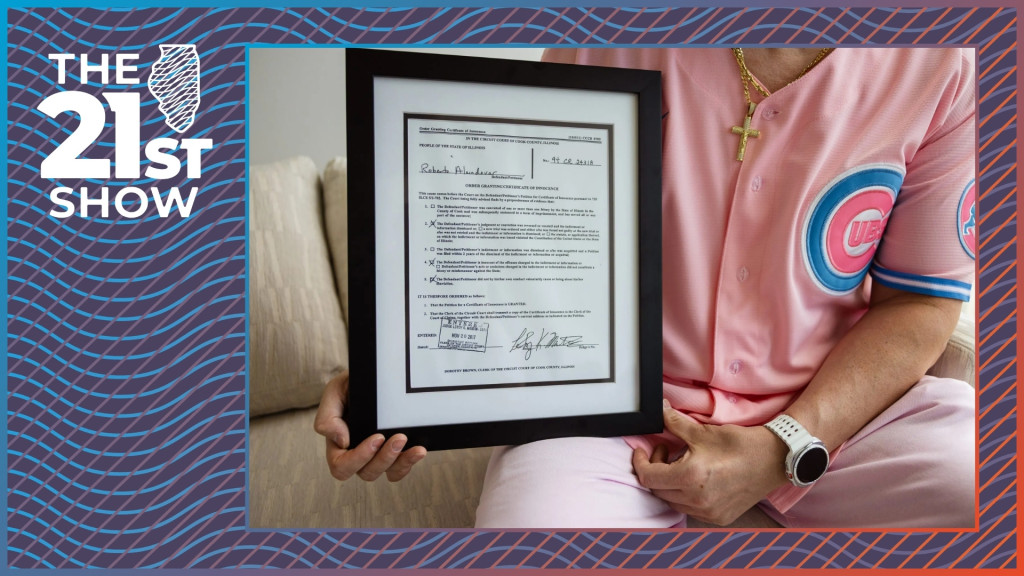
Transcript: What do we owe Illinoisans who were unjustly convicted of crimes?
The 21st Show
What do we owe Illinoisans who were unjustly convicted of crimes?
Read the full story at https://will.illinois.edu/am/what-do-we-owe-illinoisans-who-were-unjustly-convicted-of-crimes.
Transcript
// This is a machine generated transcript. Please report any transcription errors to will-help@illinois.edu.

[00:00:00]
Brian Mackey: It's the 21st Show. I'm Brian Mackey. In Illinois, when someone's convicted of a crime they didn't commit and later cleared, the state has a way of making it official. It's a court order called a certificate of innocence. It allows people to seek monetary compensation from the state government. It can also help a person wipe the case from their records, so it doesn't follow them into job interviews or applications for housing, that sort of thing.

Lately, however, that system has been moving in two directions at once. A state appeals court has ruled some exonerated people should get these certificates automatically, and lawmakers in Springfield just voted to substantially raise the money that comes with them. But at the same time, the Cook County State's Attorney has been fighting many of these petitions in court.
Hinkel has been reporting on all this for the nonprofit newsroom Injustice Watch. He joins us now. Dan, welcome to the 21st Show.

[00:01:01]
Dan Hinkel: Thanks for having me on. I appreciate it.

[00:01:03]
Brian Mackey: And listeners, you can join us today, 800-222-9455. What do you think Illinois owes someone who lost years of their life to a wrongful conviction? And maybe if you've watched a case like this play out, what stuck with you? 800-222-9455. 800-222-9455.

All right, Dan, let's start with the basics. Beyond what I said in the introduction there, what exactly is a certificate of innocence?

[00:01:30]
Dan Hinkel: Well, it's a court order that a judge can give to a person — once they are exonerated, once they've been freed — that person can go back into court and seek a certificate of innocence, which comes with the right to expunge your case from the public record and some state compensation. Those are the sort of practical impacts of it, but it obviously — we can talk about also the kind of emotional baggage that such a thing carries.

[00:01:54]
Brian Mackey: What are the sort of guidelines for getting one of these, right? Because one could imagine, OK, there are people who maybe there was misconduct, but it seems like maybe they probably still did commit the crime — but, you know, maybe the evidence was mishandled or something, they get out — versus somebody who is like, you know, the police just straight up lied about this person, and they did 30 years for nothing.

[00:02:13]
Dan Hinkel: Well, there's basically two ways to get one under Illinois state law. One way is called the automatic provision, which essentially if you meet certain specific bars — certain criteria — you can get one automatically. The other way to do it is to go in front of a judge and essentially make your case, right? Like sometimes this can lead to there being little miniature trials in front of judges where the standard is, if you can prove by a preponderance of evidence that you're most likely innocent and hit a few other sort of criteria, then you are entitled to one.

[00:02:47]
Brian Mackey: So what are some of the practical effects that a certificate can change in a person's day-to-day life?

[00:02:53]
Dan Hinkel: Well, I've spoken with a lot of exonerated people about this, and about how important it is to them, because I set out to figure out exactly why this was such a big deal, because ultimately it's a piece of paper, so what does it mean?

It comes with expungement — the right to get your case out of the criminal records. So let's say you've been in prison for 20 years and you're trying to get a job at Home Depot or wherever, and the hiring manager does a background check and they see you've got a murder case on your record, right? Pretty [slim] odds you're getting that job. So the expungement takes care of that to some extent.

And then also if you simply need the thing to show it to someone to explain why you have this — why they might be seeing these records of your case. I spoke with a number of people who said they would want them for encounters with police at traffic stops, right? Because if a cop sees something about your record, you want to be able to show it and say, yeah, well, I have this thing, it's called the certificate of innocence, right?

It also comes with that state compensation, and along with that, a lot of these do come into play in federal court cases, which is sort of the reason they're controversial here in Chicago, because those federal lawsuits have cost the city of Chicago quite a lot of money in these cases.

[00:04:17]
Brian Mackey: OK, so that's the sort of practical effect. You also mentioned — you used the word moral, maybe — but one of your more recent stories had Roberto Almodovar, right? He talked about keeping his framed certificate and said it takes the place of an apology. What did he mean by that?

[00:04:38]
Dan Hinkel: Well, yeah, I think that for Roberto specifically, his thinking was, I'm not getting an apology, right? This is as close as it's getting. And I've talked to a lot of people who are seeking these, and I think the thing that struck me most about the interviews — the thing I don't think I was ready for going into them — was how much emotional weight one of these certificates has for someone who did 10, 20, 30 years, sometimes 40 years, in prison.

I think a lot of it has to do with wanting to be done with the case — with wanting a definite end, you know. A lot of these guys really wish that at some point they could get like a definite end to their involvement with the justice system, and just say, OK, it's over, I'm done, you can't get me anymore.

The second really big thing for a lot of these people — that a lot of them expressed in very emotional terms — was that they want someone to just admit they were wrong, right? Like they just want prosecutors to come into court and say, OK, we messed up, you didn't do it. And you know, that may not reach the level of apology, as Roberto says, but for these folks to get that for themselves and for their families, I think a lot of them hope that that can kind of heal the wound of having been taken away, very frequently in the prime of their lives.

[00:06:01]
Brian Mackey: So you mentioned that one of the ways to get these certificates is like a trial. Walk us through that process. How does it actually unfold before a judge?

[00:06:11]
Dan Hinkel: Well, you file a petition for one of these things, and I've looked at a lot of cases in Cook County where it's pretty simple, where, you know, particularly during the Kim Foxx administration, the prosecutors didn't intervene, the judge took a look at the facts and said, OK, yeah — and it wasn't a controversy, it never made news, it just kind of happened.

And then in other cases where it's more contested, this can lead to a sort of miniature recounting of all of the facts at the trial, where the person essentially has to prove again that they didn't do it — or more likely than not, which obviously is a lower standard than the standard in a criminal trial.

[00:06:54]
Brian Mackey: So you mentioned when Kim Foxx — famously a progressive prosecutor — was in charge of the state's attorney's office up there, the office stayed out of it. What has that changed under Eileen O'Neill Burke?

[00:07:09]
Dan Hinkel: Well, if I could give a little context for it — Kim Foxx, generally in the history of Cook County state's attorneys, was a little bit more willing to acknowledge the shortcomings of the office and the abuses that they had been part of. And Cook County is the nation's leader in wrongful convictions, and so she was more so than her predecessors — or apparently her successor — apt to acknowledge those things. So her approach to certificates of innocence was sort of of a piece.

Now, that said, there were ways in which her efforts didn't always live up to the hype, but it was definitely a different approach than was taken by others who held the office.

Eileen O'Neill Burke seems to be a little bit more like the people who came before Foxx. She seems a little bit less likely to acknowledge wrongdoing by police or prosecutors. The Conviction Integrity Unit, which was pretty active in some years under Foxx, has stopped exonerating people. And specific to certificates of innocence, Kim Foxx pretty much kept her prosecutors on the sidelines — I think she only intervened in 1 out of every 4 of these during her second term, and obviously intervention is important because if there's nobody intervening, then it's just up to the judge with no opposing side of the argument, right? Under Eileen O'Neill Burke, she has so far intervened in, I believe, 4 out of 5 of these, so it's a much more aggressive approach to trying to block people from getting them.

[00:08:47]
Brian Mackey: What do you understand about why? What reason does Burke's office have for opposing these petitions?

[00:08:54]
Dan Hinkel: Well, I think I would know more if they would talk to me a little bit more extensively about it. I have been trying to speak with Eileen O'Neill Burke in person since even before she took office, and I've had no luck with that. The office is pretty limited in what kind of information they have given.

That said, Eileen O'Neill Burke did give an interview to the Chicago Tribune shortly after she took office in which she said that she felt that certificates of innocence were more for people who had what she called concrete, irrefutable evidence of their innocence, such as DNA. Anybody who follows the criminal justice system knows that DNA is fairly uncommon in criminal cases, and so if that's the bar you're setting, you're not going to be agreeing to a lot of these.

It should be said that a big part of the political controversy around these is that people do file them alongside their federal lawsuits against the Chicago Police Department, and obviously those cost the city of Chicago an enormous amount of money — the Chicago Police Department is pretty well known to be a fairly troubled institution. Her prosecutors have gone into court and suggested, or said pretty much outright, that they think people who aren't actually innocent are trying to get these so that they can get an upper hand in their federal litigation. Now, lawyers who work in this area say there's some doubt as to how much one of these certificates really helps, but that's kind of at the root of the political controversy around these.

[00:10:38]
Brian Mackey: You've reported that prosecutors have defended the work of former Chicago police detectives, and maybe we should remind listeners who may have forgotten — or weren't aware — of some of this history: How notorious the work of certain detectives was back in the day in Chicago.

[00:10:54]
Dan Hinkel: Yeah, I mean, the problem of wrongful convictions in Chicago — it's broad and it's deep, like they happen in a lot of different ways and people bring all kinds of cases into court. In Chicago, there are certain names associated with the Chicago Police Department who are pretty well established to have been responsible for some fairly egregious misconduct.

Obviously, probably chief among them would be the late Commander Jon Burge, who was responsible for the torture of at least dozens of Black men, some of whom falsely confessed. Following that, there was a gentleman by the name of Reynaldo Guevara, who has been responsible for putting together a lot of cases that fell apart. There's a cop by the name of Brian Forberg — a former cop — who, again, has been accused by many, many people of basically coercing witnesses into giving the version of events that police were looking for.

Obviously on a broader basis, the Chicago Police Department has problems that extend beyond wrongful convictions. It's just, you know, generally a history of coercion and abuse. The Chicago Police Department is under a federal consent decree, and that's for a reason.

[00:12:16]
Brian Mackey: Let's talk about this appellate court ruling. In late May, a state appeals court says some people should get these certificates automatically. Talk me through that.

[00:12:27]
Dan Hinkel: You know, it's an interesting thing — and sorry, it gets a little technical here, and I want to say I'm not a lawyer, but this is my understanding of the situation.

There's basically two ways to get a certificate of innocence. You meet a certain set of criteria and you get it automatically under state law, and then failing that, you can go into court and try to prove by a preponderance of evidence — show that it's more likely than not — that you're innocent.

This court ruling pertains specifically to the question of whether people are entitled to automatic certificates of innocence, and it came in the case of a gentleman by the name of Frank Drew, who was convicted of a murder in Evanston in 1998, did 24 years in prison, got out and was exonerated. He had always alleged that he was abused into giving the confession, and then several witnesses recanted. He went into court to seek his certificate of innocence on the automatic basis, saying he met all of the criteria. Prosecutors opposed that, the judge denied him, and it went to the First District Appellate Court in Chicago. They ruled that the provision of the law that he was trying to get his certificate under specifically says the judge doesn't actually have discretion to deny — either Frank Drew or people who are in his situation.

The situation being: they had an evidentiary hearing under the Post-Conviction Act on a claim of actual innocence based on newly discovered evidence, they won a new trial, they weren't retried, and then the state dismissed the charges. So basically the ruling is that if you can meet those criteria, the judge doesn't even really have much of a role to play — they have to grant it.

The prosecution's argument — the Cook County prosecutors under Eileen O'Neill Burke — their argument was that at the time of the dismissal of the charges in criminal court, there needs to be an affirmative finding of innocence. They need to say, basically, you're innocent, and so that would unlock the certificate of innocence. Frank Drew's lawyers said, well, that's not really a thing judges do, so it can't really be one of the criteria — and the appeals court agreed with them.

[00:14:51]
Brian Mackey: So just a couple of minutes left. The last thing I do want to talk about is this legislation the General Assembly approved toward the end of its session. It used to be — and I think I misspoke earlier on the program where I said $200,000 was the limit. That was the case a decade ago. I guess it's indexed to inflation, so now you can get closer to $300,000, but depending on how many years you spent — you know, that's diminishing because there is a cap. Talk about what this change in the law — or change in legislation, if the governor signs it — what it would do.

[00:15:20]
Dan Hinkel: Yeah, so to lay the groundwork from the past a little bit — you would get a certain amount by year, it averaged out to around $15,000 per year in Illinois, which compared to other states is not a lot. There are states giving, you know, six figures per year.

And it was capped at 14 years. So an example of how that might be understood to be unfair would be — there's a guy by the name of Jimmy Soto who had a case in Chicago and did 42 years, right? And so his compensation would be capped at the same as someone who did 14. There was also an argument from advocates around this that 14 years is just not enough, and that $300,000 is not enough for the amount of time that some people have done in the state that has more wrongful convictions than any other.

So what this bill would do — if the governor signs it — is raise the per-year compensation to $50,000 per calendar year incarcerated, and $25,000 per year for, I think, parole and other forms of —

[00:16:36]
Brian Mackey: — probation, that sort of thing, yeah. And no cap, right?

[00:16:39]
Dan Hinkel: There would be no cap, and so obviously you can do the math — for a person who did 30 or 40 years, it's going to be quite different than it was when it was capped at $300,000.

[00:16:48]
Brian Mackey: Yeah, quite a lot. All right, Dan Hinkel is a reporter at the nonprofit newsroom Injustice Watch. Thanks for sharing your reporting with us. I appreciate it.

[00:16:56]
Dan Hinkel: I really appreciate it.

[00:16:59]
Brian Mackey: More to come after a short break. We are going to be talking about something completely different with two sailors who are competing in something called the Warrior Games for the United States Navy — they're both from central Illinois originally. That's coming up after a short break. This is the 21st Show. Stay with us.
Transcript Assistance
Illinois Public Media may use AI assistance for transcript generation and/or formatting. Transcripts that have not yet been reviewed for accuracy will be labeled.
To report a transcription error, or to request transcription of archival material, please contact will-help@illinois.edu.