Transcript: Direct from Champaign: A Hamilton star and a Student Virtuoso talk about raising the bar
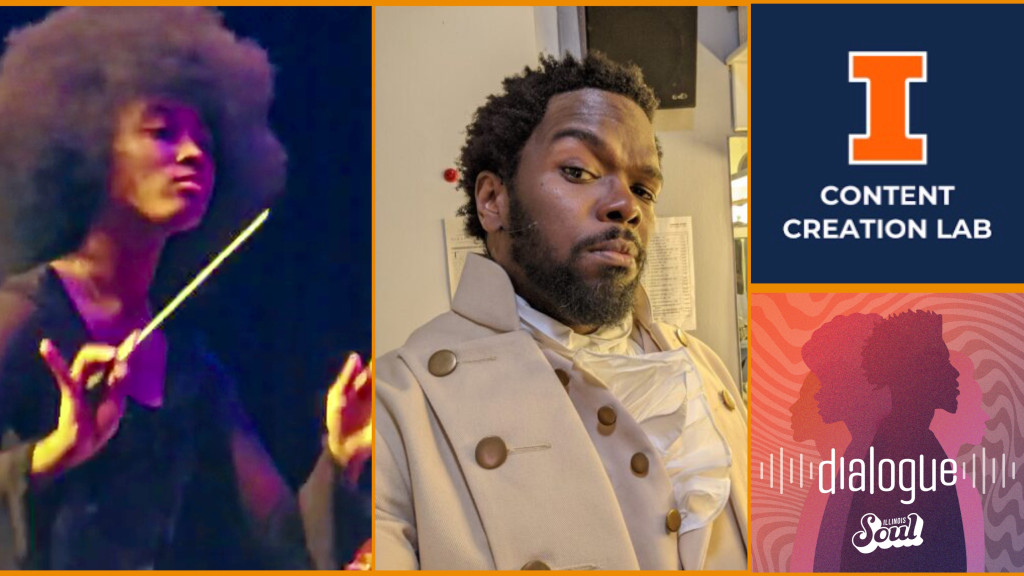
Transcript: Direct from Champaign: A Hamilton star and a Student Virtuoso talk about raising the bar
Dialogue
Direct from Champaign: A Hamilton star and a Student Virtuoso talk about raising the bar
Read the full story at https://will.illinois.edu/dialogue/direct-from-champaign-a-hamilton-star-and-a-student-virtuoso-talk-about-raising-the-bar.
Transcript
// This is a machine generated transcript. Please report any transcription errors to will-help@illinois.edu.

[00:00:00]
Curtis Beasley: Hello, I'm University of Illinois journalism student and Danville native Curtis Beasley, and welcome to Dialogue. Let's introduce you to the teens. Uh, what's your first name and your hometown?

[00:00:17]
Zach: Uh, I'm Zach and I'm from Carbondale, Illinois.

[00:00:20]
Felipe: I'm Felipe and I'm from Champaign, Illinois.

[00:00:23]
Anaya: I'm Anaya and I'm from Champaign, Illinois, and

[00:00:26]
Melissa: Melissa from [Elmwood/Elmhurst/Elmaton].

[00:00:28]
Curtis Beasley: Awesome. So we asked our panel about the topics they wanted to talk about. Everybody, um, if you could tell me what about the arts is interesting to you, is that what we're talking about?

[00:00:38]
Zach: I like, I like making music a lot, necessarily an instrument, but more digital for sure. Making beats and doing

[00:00:45]
Felipe: stuff like that. I like listening to music and I like painting. I

[00:00:50]
Anaya: like making music, especially with other people, and I'm not very good at it, but I enjoy drawing sometimes.

[00:00:56]
Melissa: Yeah, I feel the same.

[00:00:58]
Curtis Beasley: Have any of you heard of the Broadway show Hamilton? Yeah, is there anything specific that you know about it or that you could tell me a little bit more? Um,

[00:01:07]
Zach: I used to watch all the time. I know a lot of the songs word for word.

[00:01:12]
Felipe: Me too. My sister even went to watch it on Broadway.

[00:01:16]
Anaya: I think my brother's more obsessed with it than I am, but the only song I know word for word is "Satisfied."

[00:01:22]
Curtis Beasley: Let's meet someone who is on Broadway and we'll discuss after we see the video. OK.

[00:01:28]
Jonathan Butler Dulessis: Hi, my name is Jonathan Butler Dulessis. I'm an actor. I'm in the Broadway cast of Hamilton. I went to Head Start, Dr. Howard, Franklin Middle School, Central High School, Parkland College, and the University of Illinois. So I am [Champaign] all day. And the way the arts changed my life is they gave me the friends and the connections that I have carried my entire life. I spent so much time with people that actually care about me doing the things that I love that we still hang out to this day. So it helps you make the friends that you'll keep for a lifetime.

I mean, Hamilton is one of the most iconic musicals of all time, so it's always been a dream of mine to perform in Hamilton. I auditioned like 6 separate times and didn't get it. But eventually, I [wore] them down and I got to join the cast maybe about 4 years ago and it's helped me give back to [Champaign]. I only get to come back and give back to the community that raised me because the arts took such good care of me and it also allows me to leave something behind because what you remember about a society are its warriors, its kings, and its artists. So art is so important because when a society is no longer here, that's one of the only things that we have left to remember it by. So I feel very glad to be a part of the art that this country and this world will leave behind.

[00:02:55]
Zach: Uh, if I got that right, did he say he went to Dr. Howard, Franklin and Central? That's exactly — that's nice. I went to Dr. Howard, I went to Franklin, now at Central. So that was

[00:03:06]
Curtis Beasley: really crazy. With that personal connection and after watching the video, I mean, what do you feel like you learned from Jonathan and his determination? What inspired you about it?

[00:03:13]
Zach: I don't know. It just seems like sometimes if you're from like — I want to say that Champaign is necessarily super small, but it's not like a city — and it seems like it's hard for people to be successful if they're from not a city.

[00:03:25]
Curtis Beasley: Yeah. So does his story kind of give you a little bit more inspiration or determination?

[00:03:31]
Zach: Yeah, I know that it's possible to not necessarily get out of here, but just like, go farther, see more things, just go farther in life than I thought.

[00:03:43]
Felipe: I mean, yeah, even though he went to Central, I just think it's really interesting that you can have someone who grows up here and go through all the same stuff that we go through, actually end up going and being somebody who a lot of people can look up to and being someone that a lot of people just know, and that just being like a big person, being really successful. Just, like, I think it's really interesting that that's possible when — you know, it's like it's weird to see it. It's weird to see someone from the same place you grew up in, especially if it's not like, like you said, like a giant city, end up doing something that can be really important, like you said.

[00:04:18]
Curtis Beasley: Certainly.

[00:04:20]
Anaya: That's crazy. I wouldn't have thought that someone from Champaign — I guess living here you don't think that, you know, life is going to take you where it can, but it's cool to see someone who does that. And like, especially like when he was talking about the connections that he makes, it showed me how important it is to make those connections, to keep taking the opportunities that you have. Like, that really inspires me.

[00:04:48]
Melissa: I'm just glad he studied before in Central High School like me and I just, I don't know, I'm just excited.

[00:04:57]
Curtis Beasley: Yeah, um, I mean, do you feel like as someone who plays the piano and is interested in the arts, does that make you feel like you could do something big with the arts as well, knowing that someone from Champaign Central?

[00:05:10]
Melissa: Maybe, but I'm not like super professional in piano. I'm just like, you know, it's not my favorite hobby,

[00:05:19]
Curtis Beasley: so I got you, no problem. This show is about amplifying the voices of teens from across our region and recently at Centennial High School, this happened. That conductor is Anaya, a senior at Centennial High School. Let's give her a warm welcome.

[00:06:01]
Zach: Hey Anaya, nice to meet you.

[00:06:03]
Melissa: What's your favorite piece of music and why?

[00:06:06]
Anaya: Um, it was probably the piece of music that we played on that night. It was called Minotaur. Um, I think it was my favorite because it really challenged me, but it also gave me a chance to shine because that was like — I think my last solo that I'll ever play at that school. It was really special to me, especially seeing how I could improve and try and make myself better.

[00:06:33]
Melissa: Wonderful. Um, why do you like classical music?

[00:06:38]
Anaya: Oh, why do I like classical music? That's a good one. I don't know, it's always had something special. Like, knowing that classical music is music that has lasted for generations, it's lasted for such a long time — knowing that [I] can make music like that and have it spread and be [heard by] other people, that's awesome to me. And then knowing that I can play that classical music and make music with other people — that's, I think that's the best part of being a musician.

[00:07:09]
Melissa: I feel you. Um, so were you nervous [for] yours or [the] audience?

[00:07:20]
Anaya: Oh my gosh, yes. Every concert I try and calm myself down, but I'm gonna be — I'm always a little bit nervous. But it always turns out to be good in the end. I'm always enjoying myself, smiling throughout the concert even when I, you know, feel like I'm making little mistakes here and then those make me smile because it's something I enjoy. I enjoy it so much that those mistakes don't matter. It's just more that I get to improve on and that's what makes me happy.

[00:07:55]
Melissa: And really interesting question for me: do your arms get tired?

[00:08:03]
Anaya: Oh yeah. Not on that night too much, but if we do repetitions and like rehearsals and stuff, yes, my arms get tired and I have to shake them out and do like a whole routine where I stretch all of my like fingers and stuff like that. But um, I think the song that has been the most tiring is Pomp and Circumstance that we play for graduations because we have to keep doing that over and over again so everyone's off the stage. So yeah, my arms get tired, my fingers get tired, I have to try and take a break sometimes. But yeah, it's definitely tiring but that's why I have all these muscles that you guys see on me today, so.

[00:08:41]
Melissa: Nice. And I think the last question, can you tell us about your teachers? Is good. Yes,

[00:08:49]
Anaya: all of my orchestra teachers that I've had. Um, starting from elementary school, um, my first teacher was Mr. [Viceli], who I had in 5th grade. He was like my very first teacher, encouraged everyone to learn their violin, um, and then he lasted up to, uh, middle school. And I was actually gonna quit playing the violin after I was done with middle school, but then [Miss (unclear)] came in and encouraged me to keep going and I ended up loving it so much more in high school because I got to challenge myself, play with other people who were even more passionate about the instruments and orchestra. And eventually when we had [Sampson] who gave me the opportunity to go up there and perform that day — so the opportunities that they've all given me, the encouragement, it's so special because now this is something I'm gonna continue doing after I'm done with high school. So the teachers have had a huge impact on my life as well as my family and friends and everyone who supported me, so.

[00:09:53]
Felipe: I got a question on that too. So you said that you're gonna want to do it after high school. Are you looking primarily after high school to do more playing, more conducting, or you still want to do both?

[00:10:04]
Anaya: Um, I think primarily because that conducting I wanted to try it out. I'm not sure I'm ready to take it to that level yet, especially since music isn't going to be my main focus after high school. Um, but it's definitely a hobby I want to keep doing because I don't wanna stop, so I mainly just wanna play my instrument and make music with other people.

[00:10:28]
Zach: I heard you like classical music a lot. Is there any other kinds of music that you like to listen to or play? Oh,

[00:10:34]
Anaya: yeah, so definitely a lot of classical music that you know I play with the violin, sometimes like, uh, pop music that we get to play in the orchestra, but in terms of music that I listen to, um, I mainly listen to a lot of alternative, like gospel or Christian songs. And I'm into all kinds of music. I love old school, I love some new music that's out there. I'm willing to

[00:11:11]
Felipe: [unclear] the [unclear] if you're practicing playing [an] instrument or playing a song you just sit down [and] you can play the song. How do you, being a conductor, are you going to [unclear]

[00:11:25]
Anaya: that they play in the in front of my [unclear] tips on how [to] conduct [that could] have a similar to that['s the] [orchestra] is to um, mainly just a bunch of sitting in front of the mirror making sure I don't look funny when I'm conducting and

[00:11:43]
Felipe: how big of a role do you think a conductor plays? Like especially when I see orchestras, you see a lot of people looking down at their sheet music and flipping the page. So I'm just wondering how big of a role you think it plays having a good conductor.

[00:11:56]
Anaya: That's a great question. Um, I think the conductor is the one who brings everyone together because of course you have your sheet music in front of you and then you have to listen to the people around you to make sure you're all together, but having someone who's right in front of you telling you what page you're on — they're basically like, they're the one that connects the whole orchestra. And then the emotion that you can see from them is the emotion that gets put out into the orchestra, so I think that that's really important.

[00:12:26]
Felipe: I'm interested — you said a conductor can even tell you what page you're on, so what all does a conductor do?

[00:12:31]
Anaya: Oh, a conductor basically keeps the time, controls the dynamics — which is basically how loud or soft you get — and then, um, just making sure everyone has the like right, like emotion, like I said. Um, they don't really tell you what page — yeah, they um, just keeping the counts and looking up at them, that's basically it. And telling you which part of the orchestra is going, giving you your cues so you know when to come in, so stuff like that.

[00:13:03]
Curtis Beasley: No, thanks. All right, um, Anaya, if I understand correctly, you brought one of the 6 instruments that you play with you today. Could you please share some music with us? Yes,

[00:13:12]
Anaya: of course.

[00:14:24]
Zach: That's

[00:14:28]
Curtis Beasley: all right. I mean, would you like to start with some questions, feedback?

[00:14:33]
Felipe: I, I really liked it. I'm just thinking you said that you still think you have a long ways to improve, but I didn't — at least I couldn't hear if you messed up or anything. So what do you think that you could improve on?

[00:14:44]
Anaya: Oh, everything, um. Um, one of the things that my mom always says is you're your biggest critic, so even though like to everyone else it sounds, uh, good, I guess, um, I always have stuff I could pick on. Like, I could fix my tone, I could fix my like — there's everything, there's always something to improve on. But like, knowing that actually encourages me rather than, like, you know, discourages me.

[00:15:11]
Felipe: And what would you give yourself out of [10] for this[?]

[00:15:20]
Zach: I'd give it like [11], 11.5. It was

[00:15:23]
Felipe: good, right? I thought it was really good too.

[00:15:26]
Curtis Beasley: Yeah, I'd like to ask too — and if you guys don't know we can have Anaya tell us — do you guys know what song that was?

[00:15:33]
Felipe: Yeah, so that — I think that was called um "Lift Every Voice and Sing," like that. That's what I think, you know, off the top of my head.

[00:15:43]
Curtis Beasley: Well, um, do you all have any more questions for Anaya? Anything you'd like to say?

[00:15:51]
Melissa: I don't know, um, it was very beautiful. It's like, I don't know, musical language. Wonderful. I think I don't have any

[00:16:02]
Zach: questions. Is your family very musical?

[00:16:05]
Anaya: Oh yes, that's the only reason why I started. My whole family is musical whether it be um playing an instrument or singing — um, both, like everyone, everyone sings — uh, but yeah, my whole family is musical and that's also why I'm encouraged. Like, everyone is encouraging me and since everyone can hear certain stuff as like musicians, they know when I need to fix stuff and give me like little tips and stuff, give me ways to be more confident, so.

[00:16:38]
Felipe: Yeah. Do you think that that adds extra pressure sometimes?

[00:16:41]
Anaya: Um, you know, sometimes it does, especially if you have someone who knows what mistakes you make sitting right next to you and like, you know, paying attention to what you're doing. But other times it makes me feel more [comfortable] — if you're in a place where you don't know everyone, you know there are people out there who still support you.

[00:17:03]
Felipe: And then how long have you been playing the violin

[00:17:05]
Anaya: for[? Since] grade [unclear] — that's 8 years.

[00:17:12]
Felipe: [What other] instruments [do you play?]

[00:17:16]
Anaya: So I started playing the saxophone when I was a sophomore — I mean, a freshman — in high school. That's because my grandpa actually plays the saxophone. He goes around and plays the saxophone all around town, out of town. That's why I wanted to learn to play. So I played that in the marching band, uh, specifically the alto saxophone, and then I learned how to play the soprano too, um, and then this year I just started learning how to play the cello, the viola, and the bass, so yeah.

[00:17:49]
Felipe: And which one of those are you most excited to learn? Like, which one's your favorite?

[00:17:52]
Anaya: Oh, besides the violin, because this will always be in my heart, um, probably — I'm really liking the bass so far because that one was the hardest to learn out of all of them. Um, but I also like the comfort that cello gives me and how deep and rich its tone is, so yeah.

[00:18:14]
Curtis Beasley: All right. Anaya, who's a student conductor and a player of multiple instruments at [Champaign] Centennial High School, we see you and we thank you for joining us today. Thank you

[00:18:24]
Felipe: so very much.

[00:18:25]
Zach: That was really awesome.

[00:18:26]
Anaya: Thank you. Thank you for having me. Of course.

[00:18:34]
Curtis Beasley: Coming up on this teen edition of Dialogue, from climate to storytelling to fashion to canines, our teens react to hot takes on what different careers can do for you. This is Dialogue, an exchange about culture straight from the soul.
Transcript Assistance
Illinois Public Media may use AI assistance for transcript generation and/or formatting. Transcripts that have not yet been reviewed for accuracy will be labeled.
To report a transcription error, or to request transcription of archival material, please contact will-help@illinois.edu.