








Transcript: Students perform at Krannert and efforts to preserve Black churches and a one-room schoolhouse
Transcript: Students perform at Krannert and efforts to preserve Black churches and a one-room schoolhouse
Dialogue
Students perform at Krannert and efforts to preserve Black churches and a one-room schoolhouse
Read the full story at https://will.illinois.edu/dialogue/students-perform-at-krannert-and-efforts-to-preserve-black-churches-and-a-one-room-schoolhouse.
Transcript
Kimberly Schofield  00:03
From Illinois. Soul, this is Dialogue. I'm Kimberly Schofield. I host Morning Edition on WILL AM, 580, Illinois Classical FM 90.9 and Illinois Soul FM 101.1.

Reginald Hardwick  00:15
I'm Reginald Hardwick, news and public affairs director at Illinois public media dialog is an exchange about culture straight from the soul.

Kimberly Schofield  00:28
Homelessness is a growing problem in Champaign County, a group of organizations focused on the issue is launching a new strategic plan, IPM student, newsroom's Annisyn Krebs-Carr has more.

Annisyn Krebs-Carr  00:40
The Champaign County continuum of service providers to the homeless consists of local government entities, businesses, nonprofits and other service providers. They're using local data to see how homelessness affects the community and identify gaps in resources. Damita Parsley is Vice Chair for the group and one of the speakers at Monday's kickoff event.

Damita Parsley  01:03
It's very important to have a strategic plan. Homelessness is critical. It's serious. It's growing. It's increasing. There has to be a plan.

Annisyn Krebs-Carr    01:15
The event included guest speakers and a brainstorming session. Local officials say the goal is functional, zero homelessness, meaning homelessness is rare, brief and one time, I'm Annisyn Krebs-Carr IPM news.

Reginald Hardwick  01:30
For the past 20 years, the Krannert Art Museum has partnered with Rantoul Township High School to give students an opportunity for artistic expression. Speak Cafe is a monthly open mic event that is free and open to the public, and every month during the school year, rentoul students attend and even participate. Art teacher Andrea Cox says most of her students had never been to a museum prior to visiting Krannert for the art speak program.

Andrea Cox  01:58
It's always magical because, you know, we're their teachers, so we can tell them all the time that their artwork is beautiful, that they have stories to tell, but when there's somebody in the community coming up and pausing and really engaging with their art, that's a moment that every teacher prays that their kids can have.

Reginald Hardwick  02:12
The next speak Cafe will be held on April 2. For centuries, black churches in the US have been sanctuaries for not just prayer, but activism, economic uplift and cultural expression. Preserving this rich legacy is the focus of the preserving black churches program, which awards millions of dollars in funding for capital projects, program development and organizational planning.

Kimberly Schofield  02:41
Preserving Black churches, which is sponsored by the National Trust for Historic Preservation, recently announced this year's grantees and New Jerusalem Baptist Church in Tulsa, Oklahoma is one of them. Sean Jarrett is the pastor there and recently spoke with NPR Ayesha Roscoe.

SEAN JARRETT: Thank you, Ayesha, for having me on today.

RASCOE: So let's start with the history of your church. It's affectionately called New J.

JARRETT: Yep.

RASCOE: Am I right that it was founded in the aftermath of the Tulsa race massacre?

JARRETT: That's correct. Our church was founded by a pastor and those founding women and men that came together to reimagine what a Black church could be after such a horrific massacre that destroyed what is known as Greenwood or Black Wall Street, and that was the center of commerce, but also the center of our faith and traditions. And as urban renewal came in, which became urban removal for African American families, many families - mostly of African Americans - were pushed to north Tulsa. And so in 1957, our church was organized by a founding pastor and a founding group of community members.

RASCOE: And so this is a community that was torn apart by the massacre but then also by the urban renewal that had been through all of these changes, both the policies and the racial terrorism that happened to them.

JARRETT: Exactly. If you ever come to Tulsa and go to Greenwood, right now, there is a highway that runs through what was once a thriving, bustling community. It literally cuts the community off from the rest of the city.

RASCOE: How would the money from the Preserving Black Churches program help New J, and how much were you awarded?

JARRETT: We were awarded $200,000 to create a endowment fund for the preservation of our building. Our building where we currently worship in is 70 years old. And so this $200,000 from the Preserving Black Churches grant will be matching dollars for $200,000 that we plan to raise. It will help us not have to make the hard decisions that many Black churches have to make - do we help someone respond to a community crisis or need, or do we maintain the building? And oftentimes, Black churches throughout America, we've had to make the decision that, yes, we do for our community while our buildings lie in ruin. And so we don't have to make that tough decision now.

RASCOE: Talk to me about the state of Black churches today and the need for this program.
JARRETT: You know, we hear conversations every day about the rising cost in America, right? I think sometimes people think that churches have some kind of magic ATM machine that we go to and withdraw money. And the truth is that we do not. It is becoming increasingly difficult to do ministry in a society where the rich are getting richer and the poor are getting poorer in some ways.

RASCOE: We live in a time now where there is a lot of pushback on this idea of diversity, equity and inclusion, this idea that you should even have groups, have movements focused on, say, uplifting Black people. And there may be Christians listening saying, well, what does being Black have to do with being Christian? God doesn't see color.

JARRETT: Listen, African Americans experienced discrimination and were forced out of white churches, so that - for them to be their full selves, to have the dignity that they deserved, the Black church became necessary for the thriving and survival of African American people in our country. But to be unapologetically Black as a church, it's not to exclude races. Black and brown but also white and poor people are welcome to come to our congregations.

RASCOE: There are a lot of younger people turning away from church in general, saying it does not meet their needs of today, and they're looking to more spiritualism or other things that are not the traditional Black church. Is that a concern to you?

JARRETT: It is a concern. This idea of, I'm spiritual but not religious, I think doesn't just have to do with, like, this whole dechurch (ph) movement. But I also think it is trying to figure out, what do I do with Christianity because it has been co-opted by Christian nationalism? I pastor in a city that is the buckle of the Bible Belt, where we have megachurch pastors who showed up on January 6, marching with flags and crosses, and it has been documented.

And I think there is a generation that's trying to decide, I love Jesus, but I don't want that Jesus. And I think the Black church has a opportunity to re-present Jesus in such a way that Jesus is on the side of what James Cone says of Black people and those who have been pushed against the walls.

RASCOE: What role do you think that Black churches have in American life moving forward then?

JARRETT: Speak truth to power, to be prophetic, that we have always been at our best when we have been socially conscious, spiritually attuned, really joining those together. They have never been separate in our faith traditions.

But, secondly, I would say, the Black church is still primarily the largest owner of Black land in America. If you lose Black churches, not only do you lose our prophetic witness, but we also lose Black ownership and Black institutions that have ensured that our young people go to school, our young people have access to basic resources and needs. And so what we own, we must continue to make sure we own it and continue to control it because we own it.

RASCOE: That's Pastor Sean Jarrett of New Jerusalem Baptist Church in Tulsa, Oklahoma. Pastor, thank you so very much.

JARRETT: Thank you for having me.

Reginald Hardwick  06:56
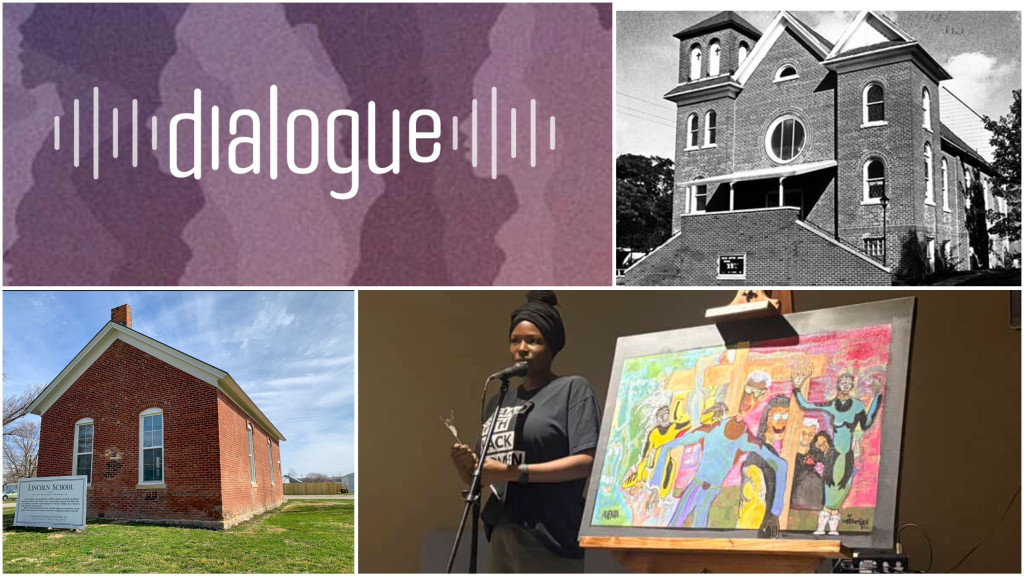
You're listening to Dialogue from Illinois Soul, a small, single story building sits in a corner of a city park in Canton, Missouri. It might not look like much, but for three quarters of a century, this building served as a school, but only for certain children, those who are blocked from attending other schools because of the color of their skin. Rich Egger has the story.

Rich Egger  07:20
The red brick building is called Lincoln School.

Phyllis Dean  07:23
This school was built in 1880 and it was the one room school that was used for all African Americans in this Lewis County area.

Rich Egger  07:32
Phyllis Dean is Project Director of Lincoln school. It's now a museum that shows what conditions at the school were like through the years. Lincoln school was built in the part of Canton where many of the town's black residents lived and went to church. This was before the community along the Mississippi River built a levee. So it's a part of town that flooded, swamping buildings, including the school, as

Phyllis Dean  08:00
you can see right now it has a wooden floor in it, but when they first did it and they had the wooden floor, it flooded so many times that they put a cement floor down.

Rich Egger   08:10
Phyllis, her husband, their sons and other family members restored the building in 2019 when they started the project, the ceiling was gone. The walls had deteriorated, and the building was about ready for the wrecking ball. Now, as a museum, it reflects various eras in the school's history. For example, there are pillows on the floor because they did not have desks when the school opened. But there are also desks in the room to demonstrate a later period and long benches reflect times when they did not have enough desks for all the children. There are books in one section of the room, though, Phyllis says the students did not have books for much of the school's history, and the books they did sometimes have were worn and tattered. Phyllis believes it's important to preserve history, and she says this chapter of canton's past is not well known.

Phyllis Dean   09:07
It's kind of been pushed aside because it's a painful subject for so many people. But when you don't tell the truth and the history of something, it has a tendency to come back and repeat itself. So I want people to know the truth.

Rich Egger   09:23
Phyllis says Lincoln school taught children through eighth grade. High school students were bused down to Hannibal, which is about 50 miles from Canton to attend Douglas School, which was for black students. The Reverend Carolyn Blair has not visited the Lincoln school museum, but she heard about such school houses from her parents. That's the kind of school they went to. It was a challenging learning environment, according to her parents, but they recognized the value of an education. So when they raised a family in New York City, they stressed the. Importance of education with their nine children, and Carolyn says all nine of them have high school diplomas and college degrees, including masters and doctoral degrees. Carolyn is now pastor of Zion United Church of Christ in Burlington, Iowa. She says people continue to be blocked from being all they can be. They're oppressed based on their skin color, where they're from, their gender or their sexual orientation.

Phyllis Dean     10:29
It never stopped happening. That blockage of preventing people from moving forward has even with Brown versus Board of Education all the way through. It has never, ever stopped.

Rich Egger  10:41
Brown versus Board of Education was the 1954 US Supreme Court ruling that was supposed to end segregation in schools. But some communities dragged their feet, and not just in the Deep South. For example, in Indianapolis, the schools remained segregated until 1971 when a federal court ordered them to integrate. And in Rockford and far northern Illinois, a federal magistrate ordered the school district to desegregate. In 1993 nearly 40 years after the Supreme Court ruling, the magistrate said the Rockford district had raised discrimination to an art form. Lincoln school is open for visits by appointment. Phyllis Dean hopes visitors come away with an idea of what it was once like for black children trying to get an education. She says it was especially challenging in rural areas. She praises the resilience of the Black people of those times.

Phyllis Dean  11:47
It was the work that each generation did to get us to the places where we are, and it was because of people like them that I am able to come out here and do the things that I do, and continue to share the information.

Rich Egger  12:00
Lincoln school was named a landmark school by the Country School Association of America, and a plaque on the front of the building says Lincoln colored school was named to the National Register of Historic Places in 1983 the marker says the school is a testament to rural education, Rich Egger reporting.

Reginald Hardwick  12:24
The late Hugh Masekela was dubbed the father of South African jazz. Now a new nightclub named for him is bringing his groove back to the city and showcasing today's South African talent. Kate Bartlett has the story.

12:41
(SOUNDBITE OF GLASSES CLINKING)

KATE BARTLETT, BYLINE: The drinks are flowing. The club is buzzing.

UNIDENTIFIED ANNOUNCER: So ladies and gentlemen, please get it together for refinement, for the brilliance, for legacy, Mdu and Mimi Mtshali at Hugh's.

(APPLAUSE)

BARTLETT: And the music is just getting started...

MIMI MTSHALI: (Singing) Yeah, tonight, come see...

BARTLETT: ...At Johannesburg's newest music venue Hugh's, named after the world-famous trumpeter South Africans simply called Bra - or brother - Hugh. The club was set up in collaboration with the Hugh Masekela Heritage Foundation, and on opening night, Masekela's 84-year-old sister, Barbara, paid homage to her brother, who died in 2018.

(APPLAUSE)

BARBARA MASEKELA: There is no place for people to go in Johannesburg and just to enjoy music and to chill. And this place looks like it's going to be the place. And it's a wonderful thing. I just wish Hugh were here to see it.

MIMI MTSHALI: (Singing) [inaudible].

BARTLETT: The club overlooks Johannesburg, colloquially Joburg, with the famous Nelson Mandela Bridge all lit up in rainbow colors. It's a place to see and be seen, and the red velvet New-York-style booths contain well-heeled jazz enthusiasts in eclectic evening wear, ranging from sequins to shweshwe, which is a vibrant, traditional South African fabric. Local radio personality Nonn Botha is among them and glad to see an intergenerational crowd at the club.

NONN BOTHA: It's so beautiful to see that Bra Hugh's spirit lives on in so many other young people.

BARTLETT: The group playing tonight is led by singer Mimi Mtshali and pianist Mdu Mtshali, who are partners in both senses of the word, having met 26 years ago at church music camp.

MDU MTSHALI: We met through music, And yeah, just, that's when we hit it off (laughter). It was love at first sight.

BARTLETT: Mdu explains what Bra Hugh meant to him.
MDU MTSHALI: What a legendary musician that, you know, Hugh Masekela was. He was bigger than life for me, yeah. He would preach to us and say, you must sound like instead of like an African, you know, you must be African enough. Be proud of who you are.

(SOUNDBITE OF SONG, "BRING HIM BACK HOME (NELSON MANDELA)")

BARTLETT: For South Africans, Masekela was more than a musician. He was a tireless voice against white minority rule.

(SOUNDBITE OF SONG, "BRING HIM BACK HOME (NELSON MANDELA)")

HUGH MASEKELA: (Singing) Bring back Nelson Mandela. Bring him back home to Soweto.

BARTLETT: As the apartheid regime grew increasingly brutal, Masekela went into exile in New York, where he was befriended by American jazz greats like Dizzy Gillespie and Harry Belafonte.

(SOUNDBITE OF HUGH MASEKELA'S "GRAZING IN THE GRASS")

BARTLETT: His instrumental hit "Grazing In The Grass" reached No. 1 on the Billboard Hot 100 in 1968. While in the U.S., he was also briefly married to fellow South African activist and musician Miriam Makeba. Masekela only returned home in the '90s after Mandela was released and South Africa transitioned to democracy.

(SOUNDBITE OF HUGH MASEKELA'S "GRAZING IN THE GRASS")

BARTLETT: While many of the patrons at Hugh's are too young to remember apartheid, like 36-year-old accountant Aluta Madikizela...

ALUTA MADIKIZELA: There's just songs that just draw you to, like, certain memories of your childhood and when your parents were joyful, and it's Hugh. It's Hugh's music.

BARTLETT: They say the music is in their blood.
Kate Bartlett, NPR News, Johannesburg.

(SOUNDBITE OF HUGH MASEKELA'S "GRAZING IN THE GRASS")

Kimberly Schofield  16:18
That's it for this week's Dialogue. If you have a story idea for us, send us a voicemail at 217-244-1989, again, 217-244-1989, Lamont Holden created our theme song. Dialog and Illinois soul are part of Illinois public media, a service of the University of Illinois. Urbana Champaign, I'm Kimberly Schofield

Reginald Hardwick  16:39
and I'm Reginald Hardwick, we'll talk with you again next week.
Transcript Assistance
Illinois Public Media may use AI assistance for transcript generation and/or formatting. Transcripts that have not yet been reviewed for accuracy will be labeled.
To report a transcription error, or to request transcription of archival material, please contact will-help@illinois.edu.