Transcript: Do self-driving cars have a future in Illinois?
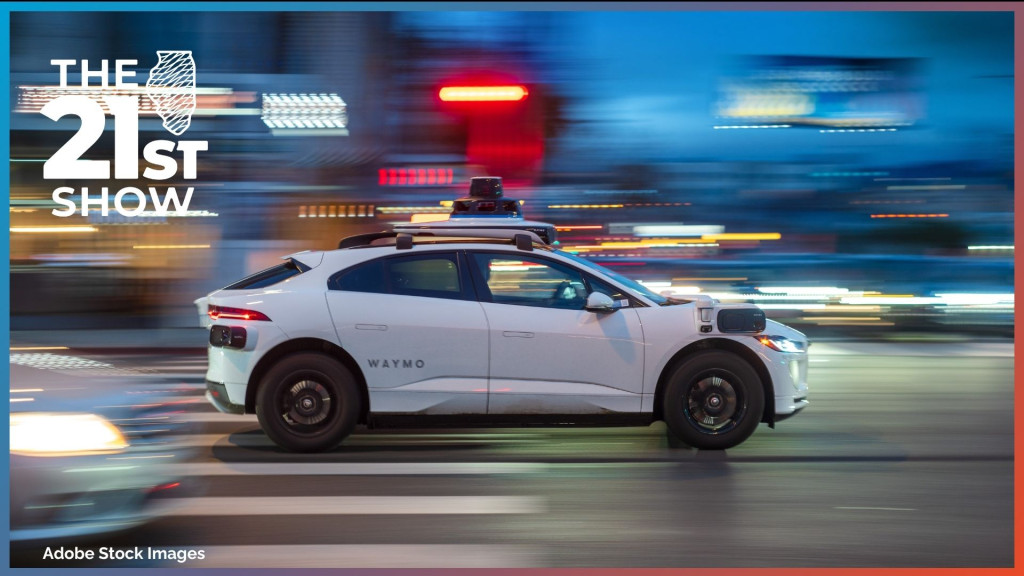
Transcript: Do self-driving cars have a future in Illinois?
The 21st Show
Do self-driving cars have a future in Illinois?
Read the full story at https://will.illinois.edu/news/do-self-driving-cars-have-a-future-in-illinois.
Transcript
// This is a machine generated transcript. Please report any transcription errors to will-help@illinois.edu.

[00:00:00]
Brian Mackey: Today on the 21st Show, self-driving cars were once a vision of the future. Now the company Waymo is hoping to put its autonomous rideshares on the streets of Illinois. We'll talk about what's happening, how they work, and why some people have concerns with the technology. We're also taking your calls throughout the hour today at 800-222-9455. Would you use a robot taxi if it was available in Illinois? Or maybe you've been in one? What was your experience like? And what would these vehicles change about the way we use our roads? You can join us live at 800-222-9455. I'm Brian Mackey, and that's all coming up today on the 21st Show, which is a production of Illinois Public Media. But first, the news from NPR.

[00:01:00]
Brian Mackey: From Illinois Public Media, this is the 21st Show. I'm Brian Mackey. Cars have come a long way over the past few decades, from the rise of electric vehicles to the addition of safety features like rearview cameras and blind spot monitors. But for even longer than that, self-driving cars have been a part of automakers' vision of the future. Take this short film General Motors produced in the 1950s, which imagined what driving would be like in the futuristic year of 1976.

[00:01:40]
Taped audio: Well done, Firebird. You're now under automatic control. Hands off steering. Ah, this is the life. Safe, cool, comfortable. Mind if I smoke a cigar? Oh, not with this wonderful air conditioning. Hey, do you want some ice cream or a cool drink? Orange juice, please. Oh, me too. I'm going to go for the ice cream.

[00:02:05]
Brian Mackey: All right, well, suffice to say some parts of that film have aged better than others. But in recent years, autonomous vehicles, as they are sometimes called, have actually been making their way out into the real world. Last month, Waymo, owned by the same company that owns Google, announced it would be bringing its self-driving cars to Chicago, but only for testing purposes. That's because the autonomous rideshares Waymo hopes to run aren't actually legal in Illinois, at least not yet. There are ongoing debates over whether and how to make them legal. There are considerations around safety and what they mean for the people who share the roads with cars. There are also economic factors at play.

So today for the hour, we're going to talk about the state of self-driving cars in Illinois. Later, we'll hear from an expert on the technology about how the vehicles we have now work, and we'll also talk with people on different sides of the robo-taxi legalization debate. I should say at the beginning, we reached out to Waymo as we were preparing this conversation, asking for a statement. They did not reply to our inquiry.

That said, we do want to hear from you at 800-222-9455. Would you use robo-taxis if they were available in Illinois? Maybe you've been in one. What was your experience like? And what would robo-taxis change about the way we use our roads? Again, you can call us throughout the hour today, 800-222-9455. That's 800-222-9455. We're going to start today with some context on what's happening with Waymo in Chicago. With me is someone who has been reporting on this, Violet Miller at the Chicago Sun-Times. Violet, welcome back to the show.

[00:03:51]
Violet Miller: Yeah, thank you so much for having me again.

[00:03:53]
Brian Mackey: All right, these are autonomous vehicles, I guess we're calling them. Human drivers though are being used in these tests in Chicago. Tell me what's happening there.

[00:04:03]
Violet Miller: Yeah, so they're laying the early groundwork in Waymo's terms. They're just kind of mapping out the city and not even the entire city. It's just a segment of the city from South Loop to Wrigleyville east of the Kennedy and Dan Ryan expressways, so folks can kind of get a picture of where these would be. But they kind of popped up overnight, you know, showed up in a parking garage. There were photos going out on Reddit. Our photographer Tyler and I hunted them down by matching the font of the photos in the background of the parking garages, matching them to ones we found on the street and eventually tracked them down and that's when, you know, Waymo kind of broke out that, you know, they're doing this testing.

So like you said, you know, it's not legal for now for them to be using the self-driving vehicle. So all of these pilots are with human drivers. But you know there are more pushes to, you know, make this something that the state could see. One of the big ones that was pushed at the time was from [Kam Buckner] because he was even quoted in Waymo's press release announcing that they were even, you know, kind of running this early sort of stages of prep work to get these cars out there. You know, he's promoting this kind of slow approach. And you know, that's with reason. A lot of people have been kind of concerned about the way that these have operated in other cities. Earlier this month in Texas, there was a Waymo that blocked an ambulance following a response to a mass shooting. You know, Reuters earlier this month also reported that the National Transportation Safety Board is investigating whether these vehicles were illegally passing stopped school buses. They've also, you know, hit cyclists or been accused of hitting cyclists. There's a San Francisco woman who is suing the company after she was both doored by a passenger stepping out of a Waymo into a bike lane and then hit by another one of the vehicles also pulling over in the bike lane.

So a number of concerns going into this, which is why [Buckner's] kind of trying to, you know, show his approach is this slower pilot program that sets up a pilot for three years, but even with this approach, you know, a lot of, specifically like cycling advocates, you know, have expressed concerns still that even in a pilot, even in a smaller test, there comes risk.

[00:06:34]
Brian Mackey: Yeah, I gotta say a self-driving car blocking an ambulance responding to a mass shooting. If that isn't a comment on America in 2025, I don't know what it is. Just to be clear, I can't hail one of these for a ride, right? That would be really illegal right now.

[00:06:51]
Violet Miller: Yeah, absolutely not. That infrastructure isn't even like, I mean, I haven't checked the Waymo app, but you know, from everything that the company has told us this is not something that you can hail right now in the city of Chicago. Again, they're just doing early mapping.

[00:07:06]
Brian Mackey: So yeah, what is the purpose then of having these vehicles here if they're not actually in use?

[00:07:11]
Violet Miller: Yeah, so I mean, you know, they got to learn the streets to be able to autonomously drive, you know, these vehicles, you know, by learning from driver data or the way that human drivers respond to things in the roadway, you know, theoretically they're learning to drive, you know, more like a human. However, you know, again, these kind of issues that have been expressed like, you know, for example, blocking an ambulance or something like that. You know, some of these behaviors just really aren't seeming to be picked up and so, you know, that remains to be seen if that will be something that they are able to fix, but in the meantime they're doing this kind of mapping just so that these vehicles are a little bit better.

And similarly with autonomous, you know, vehicles, obviously the delivery robots we've been seeing around the city as well, those were actually trained on data from Pokemon Go players. You know, the photos that they took everywhere, the way they, you know, went about the terrain and the world about them, that information was actually used to train those robots. There was an agreement between those companies and so it's a similar deal here with these autonomous vehicles. They're having human drivers take them around the city to try and map them in a way that isn't so, you know, rigid and just pulled from, you know, a computer essentially.

[00:08:30]
Brian Mackey: You saw that viral clip of one of these delivery robots sort of crashing through the glass of a bus shelter, or at least

[00:08:35]
Violet Miller: the one happened later, later yesterday. So yes, there have just now been two autonomous delivery vehicle robots that have crashed through bus shelters in the city.

[00:08:48]
Brian Mackey: And that glass is not like fragile, right? These are not like, you know, window decorations you make at Michael's.

[00:08:55]
Violet Miller: No, they say that they go a maximum of 5 mph. So I'm curious to see how the crash reconstruction goes with these.

[00:09:02]
Brian Mackey: Yeah, yeah, the torque maybe must be incredible. So, all right, you mentioned some of the places where they've been problems. Where can you actually ride a Waymo right now?

[00:09:12]
Violet Miller: So they're in a couple of different cities. You know, California actually has had autonomous vehicles since 2018, and so they've been one of the, you know, kind of earliest states to invest in this. But, you know, I think there's a number of cities. I want to say San Bruno is one of them. There's also a number of cities in Arizona and they're kind of expanding because Chicago isn't the only city getting these tests either. I believe some cities in Tennessee were also, you know, getting these sort of mapping early stages programs set out and about the company, you know, is talking about expanding into more cities as they make agreements with governments and get laws passed in other states and kind of set the legal framework so it's not so much, you know, guesswork essentially on new states.

[00:10:08]
Brian Mackey: All right, last question, what are you going to be watching for as this continues to develop?

[00:10:13]
Violet Miller: I'm going to be watching for the injuries, unfortunately, you know, the concerns are very valid with this, especially, I mean, the NTSB investigation about whether or not they're passing stopped school buses. Again, cyclists concerned with this, just the way we've seen this play out in California. So I think I'm just going to be, you know, waiting to see. You know, if Illinois lawmakers, you know, of course we haven't even gotten to, you know, them being legal yet, but if we get to that point, I will be curious to see how this actually plays out and what the toll will be.

[00:10:49]
Brian Mackey: All right. Watch your step out there. Violet Miller with the Chicago Sun-Times. Thanks for sharing your reporting with us.

[00:10:56]
Violet Miller: Thanks for having me.

[00:10:58]
Brian Mackey: If you're just tuning in, this is the 21st show. We're talking today about self-driving cars after Waymo, [owned by the parent company of Google, Alphabet], deployed its rideshare vehicles into Chicago for testing with human drivers. Waymo's been lobbying in Springfield to make robo-taxis legal in Illinois. Again, we'll talk about the debate about that later in the program.

I do want to mention we heard from people in our texting group about this. You can join that by sending the word 'talk' to 217-803-0730. That's talk T-A-L-K to 217-803-0730. Lloyd in Danville says, yes, I'd use a robotic taxi. For starters, test routes and signage would be a good start in test cities, 40,000 to 60,000 population. He also asked for tax incentives to reduce traffic and emissions, says that would definitely help. And he says test vehicles versus human operated cars would be the accident and safety issues. But he does note that humans violate state vehicle codes every day, so accidents with non-computerized vehicles would be an issue.

On the other hand, Adrian in Carbondale said, I don't understand why we will do everything except just have fast, affordable public transportation, especially trains. I am not interested in self-driving cars.

For the next part of the conversation today, we're going to shed some light, or aim to anyway, on what this technology is and how it works. Sayan Mitra has been studying it. He's a professor in electrical and computer engineering at the University of Illinois Urbana-Champaign. He's also an expert on autonomous vehicles. Professor Mitra, welcome to the 21st show.

[00:12:38]
Sayan Mitra: Brian, good morning. Thanks for having me.

[00:12:41]
Brian Mackey: So I'd like to ask you, you know, how do these autonomous vehicles work, Waymos in particular, but I'm going to say, as I sometimes do, explain it to me like I'm a smart 13-year-old.

[00:12:51]
Sayan Mitra: Sure, think of these cars as a robot on wheels. It does three things: look, decide, and act. The sensors, the cameras and the lidar and the radar, together with the maps that they are constructing right now, build a real-time 3D replica of what is going on around the car. Then based on that map that has been created, the onboard software decides the routes, the speed, the path that the vehicle is supposed to follow, and then finally, the acting part, the actuators turn the steering, engage the brakes, and move the car along. And all of these three things are running every 10 milliseconds. So roughly 100 times a second, it is looking, deciding, and acting. So at the end of the day this is a giant piece of software designed and tested by computer scientists and engineers. It's the next generation in the evolution of the same technology that powered your phone and online banking systems now being applied to one of the hardest problems that we have tried to solve.

[00:14:05]
Brian Mackey: How does it work in terms of like, you know, you mentioned my phone. Sometimes I try to open an app on my phone and the screen freezes for a few seconds. How does the software in cars handle that sort of thing? And, you know, what happens if there is some sort of glitch in the programming?

[00:14:22]
Sayan Mitra: That's where reliability and safety comes into the picture. So these pieces of software that are doing the sensing and the decision making have to be tested extremely carefully to the point that they're 99.99% reliable and can accommodate all kinds of scenarios that may come up in the real world.

[00:14:44]
Brian Mackey: So talk to me about how different the technology is among different brands, right? Waymo versus Tesla, for example.

[00:14:51]
Sayan Mitra: Yeah, so different manufacturers are following different approaches to solving this very hard problem. So we have seen the Waymo approach which is using lots of different kinds of sensors on board. The Tesla approach is a little bit different. They are using fewer sensors, mainly relying on the cameras, but then heavily relying on the learning capabilities of the onboard software and using a large amount of data that they can get from all the millions of Tesla cars that are already driving around different parts of the country. Then there's also the approach of redesigning completely new kinds of vehicles without even steering wheels. So that's something that one of the companies following that is Zoox, for example. So ultimately, what stands out or what turns out to be a good solution is likely to be a hybrid of these different approaches, and we are still in the very early days of arriving at any such conclusion.

[00:15:56]
Brian Mackey: All right, we need to take a break on the program. So, let me once again remind listeners, this is the 21st Show. We're spending the hour today talking about autonomous vehicles, the status of that in Illinois. Not currently legal to have the kind of self-driving taxis that have become pretty common in some cities in California and elsewhere in the southwest and western part of America, but Waymo did start showing up in Chicago. They have people driving these cars around as a preliminary, I guess, to trying to roll them out here if it ever becomes legal. You better believe they are also working in Springfield to try and pass legislation to get these things legalized here.

What do you think about that? 800-222-9455 is the number we want to hear from you. We're going to take some calls after the break. Again, would you use a robot taxi if it was available? Maybe you've ridden in one. What was your experience like? And what do you think they're going to change about how we use our roads? 800-222-9455. For this part of the program, we're speaking with Sayan Mitra, a professor in electrical and computer engineering at the University of Illinois. We're going to hear people for and against this technology later in the hour, at least the legality of how it's been structured in some places. And that is all coming up after a break. You're listening to the 21st Show.

It's the 21st Show. I'm Brian Mackey. If you're just joining us, we are talking for the hour about Waymo and the future of robo-taxis in Illinois. Currently, they are not legal here in the 21st state, but Waymo, which is owned by the same company that owns Google, has been lobbying the state legislature to change that. We're talking though for this part of the program about how these vehicles actually work. And my guest is Sayan Mitra, who is a professor in the Grainger College of Engineering at the University of Illinois in ECE, Electrical and Computer Engineering. If you want to join us, 800-222-9455 is the number. And in fact, let's go now to the phones. We've got Craig calling from Frankfort. Craig, thanks for calling in.

[00:18:26]
Craig: Thank you. I really appreciate this topic. I have not ridden in a Waymo yet, but I have been down in Phoenix about three or four times in the last year or so, and they're ubiquitous there. And to me, and obviously, you have to check and make sure that, you know, all the safety aspects of it, but to me they seem safer than, I mean, I'm more comfortable when I'm driving down there next to a Waymo than I am next to some of the other knuckleheads that are, you know, actually driving cars around me. So I feel like those cars, you know, could increase safety. I guess the only thing I'm concerned about is, you know, if you're a taxi driver or even an Uber driver, is it going to put you out of business or how will it adapt, you know, maybe it'll be something where you'll have to provide more personalized service if you're a taxi than, you know, these Waymos and also now Waymo in Phoenix, certainly, it's quite a bit more expensive than getting an Uber or even I think a taxi. So I don't know like how long it'll take to bring the cost down.

[00:19:28]
Brian Mackey: Yeah, no, that's an interesting point. Thanks so much for the call, Craig. Appreciate it. Yeah, and one of our producers looked this up, [Obie], which is a, I guess a rideshare price comparison company, found that Waymo rides are an average of almost 13% more expensive than an Uber and 27% more expensive than a Lyft. But Mitra, I want to come back to this idea that our caller brought up about autonomous vehicles versus human drivers, right? And I think the term he used, the technical term was knucklehead human drivers. Talk about that. What do we know about safety records of these computer and sensor driven vehicles versus vehicles driven with eyes and hands?

[00:20:12]
Sayan Mitra: Well, the peer-reviewed data is genuinely impressive. [A 2025] study covering about 56 million miles of driving showed 85% fewer serious injuries and 96% fewer intersection crashes compared to human drivers. But there is a caveat to this data. This data comes from driving in Phoenix and San Francisco, L.A. and Austin, cities with [favorable] weather. So the vehicles have not yet been tested in environments with snow, heavy rain, and ice. So that is where this experiment in Chicago is going to be very important for the maturation of this technology.

[00:21:03]
Brian Mackey: Yeah, what do we know? Do we have any data or evidence about how these vehicles do when, I mean, you mentioned lidar, radar, cameras, you know, you throw a bunch of snow in front of any of those devices and it can cause some real problems for the sensors, yeah.

[00:21:19]
Sayan Mitra: Yeah, absolutely. So that is the main challenge that vehicles are going to face. [Snow] and ice, even road salt can degrade the sensors. I'm sure the Waymo technology team is going to figure out solutions to this problem, but that's the journey we have to walk and see how the vehicles actually fare. There are also these elevated tracks in Chicago, the L tracks, which can interfere with the GPS and snow and ice can fall from those tracks onto the vehicles and sensors. So there are lots of challenges. One of the previous guests brought up this issue of cycling. Chicago has a very dense cycle culture. So Phoenix was partly chosen because it has a more forgiving environment for driving, and Chicago is going to be quite different. And if Waymo succeeds here, it will demonstrate that this technology is ready for truly national scale deployment.

[00:22:23]
Brian Mackey: We had another person who called in, couldn't stay on the line, but Christine in Rockford says, she wonders if anyone has seen the way humans drive. Says they can be pretty reckless. So she was in a self-driving car. It was a little weird being in the back with no drivers, but got used to it. She heard they were thinking of adding a mannequin to the front, so people don't get spooked. But she did have a question. She says she wonders what self-driving cars will do to car insurance premiums, argues if they're safer, that should mean fewer accidents and perhaps less use of insurance. I don't know if that's outside of your area of expertise or if you have any thoughts about that.

[00:23:04]
Sayan Mitra: It is a little outside, so the interesting thing here is these self-driving cars of different kinds will have to occupy the public roads with other cars. So whether that actually increases the accidents for other cars or not, that is the main thing to figure out. And so far the data seems promising, so it is possible, I'm speculating here, that the insurance premiums for everyone goes down because the roads are generally safer with sufficient penetration of autonomous cars that are safe.

[00:23:44]
Brian Mackey: As an engineer, how do you think about the fact that, you know, people are injured and killed by other human drivers all the time, right? We often say someone was hit by a car, but I've heard arguments that we should say they were hit by a driver, right? Because it's often inattention or [they're] looking at their phone or something like that. And yet, you know, a handful of cases when they are by these autonomous vehicles, get so much national attention, whether it's, you know, running over a neighborhood cat or some of the things Violet mentioned, you know, passing school buses. How do you think about the psychology of injury caused by other people versus injury caused by machines?

[00:24:24]
Sayan Mitra: So this brings us to this idea of testing and reliability, right? And we have gotten really good at engineering systems that are safe, and this is not just about cars. When a commercial aircraft takes off, the software controlling that flight system has been independently reviewed against specific safety objectives, right? No one can deploy code that flies without testing and proving to an independent authority that it meets those safety standards, and we have had this system in aviation at least for 40 years. So what level of safety standards we are going to enforce for these autonomous cars remains to be seen. So right now it is about reporting on this crash data, which is a great start, but it need not be just about, you know, crashes. It could be about also being transparent about what kind of code is running. The current regime is essentially self-certification, which is the standard for human drivers. But as we move towards autonomous cars going even faster on highways, maybe we will require that there's an independent review of the code that is driving the cars.

[00:25:43]
Brian Mackey: One other question that came up as we were thinking about this is, OK, it's one thing to figure out, you know, these sensors are looking for a bicycle, right? They presumably have countless hours of training. I've certainly done, you know, those [CAPTCHA]s. I feel like I'm probably training a generation of autonomous cars by identifying a motorcycle or stairs or bridges and these things. But then you add in the human element of other drivers, right? And we bring in not just errors, but emotion to our driving. How do self-driving cars accommodate that, right? Being brake checked or some of the other things that human drivers do, tailgating.

[00:26:22]
Sayan Mitra: Yeah, there's a robust research on understanding multi-agent systems, as they call it. So cars, autonomous or otherwise, interacting with each other, sometimes with explicit signals with, you know, indicator lights and so forth, but there's also often sort of subtle behaviors that drivers would perform to signal what they're intending to do and how do autonomous cars interpret those kinds of signals to make the right decision.

[00:26:54]
Brian Mackey: And that's right. Like sometimes I'll point if I'm going to merge, I'll wave or I'll point my hand. I mean, can an autonomous car detect that?

[00:27:02]
Sayan Mitra: Yeah, yeah, it could. You can sort of nudge your way into a merge point if no one is giving [you] way, and these ways of driving can also differ from one location to another location. So you can imagine that cars in Boston drive differently from cars in Chicago or in Champaign, for example, right? So the self-driving car software will also have to evolve to get tuned with the culture of driving in a particular place.

[00:27:32]
Brian Mackey: Fascinating. So, if you had to, you know, your best guess, your best speculation about a timeline for this technology, what do you see as the way forward?

[00:27:42]
Sayan Mitra: My favorite quote about this is, you know, the future is already here, but it is not uniformly distributed. So you can get into self-driving cars today in Phoenix, in San Francisco, maybe in a few years in Chicago. But there will be a long time before it penetrates all parts of the country because there are always corner cases where these cars are not going to be good enough, be it because of weather, off-road conditions, and so forth.

[00:28:15]
Brian Mackey: Fascinating. All right. Sayan Mitra is a professor in the Grainger College of Engineering at the University of Illinois. Thanks so much for joining us today on the 21st Show.

[00:28:24]
Sayan Mitra: Thank you so much for having me, Brian.

[00:28:27]
Brian Mackey: If you're just tuning in, we're talking for the hour about Waymo in particular, which has deployed some of its self-driving cars to Chicago to be supposedly operated by humans, not available as taxis yet, because that is not legal here in Illinois, although the company has been lobbying to change that in the state legislature. As we've just been discussing, plenty of people outside Illinois have experience with these vehicles. Our news director, Reginald Hardwick, shared a video from a woman he knows named Jane McGarry. She was a news anchor in Dallas, Texas for years, grew up actually in Anna, Illinois, and she tried out one of the Waymo vehicles for herself and documented the experience.

[00:29:07]
Jane McGarry: Gonna be too heavy to carry the turkey home walking, so I'm calling a Waymo. I've called Waymo and I'm waiting. Here I am. Don't drive away. Can't seem to get in the car. How do I get in? Anybody know? I had to hit a button on the app. My daughter-in-law talked me into this or my future daughter-in-law. Hey, I've got all my groceries loaded. Now I've got to get in. I'm getting very scared. I'm never doing this again. What if it takes off and I can't get it to stop? Nobody in the driver's seat and we're turning in traffic. I talk about trying new experiences as we get older. Here I am. Yay! That was nothing.

[00:30:00]
Brian Mackey: All right, I guess that's a positive experience, but these vehicles are getting some blowback. We heard from Roberto in Rockford in our texting group who said, I will be actively opposing robo-taxi companies from moving in. We don't need electric vehicles clogging up our streets and causing damage or unnecessary delays, given recent stories about the Waymo cars not properly following roadway safety laws and even actively blocking emergency vehicles. I believe the company also recently admitted to outsourcing their driving to people in other countries who likely have not received adequate training, Roberto says.

We can talk more about the safety in a moment here. I will say there is reporting on this from last month. Waymo does have remote assistance centers for its fleet which provides support and advice for the robo-taxis, but the assistance workers reportedly do not directly control, steer or drive the vehicle. I should also say, I'll say again, we did reach out to Waymo. They did not respond to us. You can join the conversation though at 800-222-9455.

For the rest of the program, we're going to dive into some of the arguments about what regulation on these vehicles ought to look like in Illinois. Joining me now is Corey Marshall, senior director of state and local government relations for a group called Chamber of Progress, which advocates for technology from a progressive perspective. Corey is based in Chicago. Welcome to the 21st Show.

[00:31:24]
Corey Marshall: Hi Brian, thank you so much for having me on today.

[00:31:26]
Brian Mackey: Appreciate you being here. And Josh Witkowski is also with us, a lobbyist in Springfield who works with ABATE of Illinois, that's short for A Brotherhood Aimed Toward Education. It's a group that advocates for motorcyclists across the 21st state. Just as a sort of testament to their lobbying success, ABATE is among the reasons that Illinois is one of just three states where motorcyclists do not have to wear helmets. Josh, welcome to the show.

Josh Witkowski: Thank you for having me.

Brian Mackey: So just to lay a foundation here, Corey, what do you see as the problems that self-driving cars can solve broadly speaking?

[00:32:01]
Corey Marshall: You know, Brian, I want to just note that Waymo is already operating in a number of cities across the United States. And just to flag that, as I talk to legislators all across the country and here in the great state of Illinois, I'd like to remind people that on December 17, 1903 in Kitty Hawk, [North] Carolina, the Wright brothers lifted the first airplane successfully into the air, sparking a race towards innovation. But that moment also sparked fear in a lot of our fellow Americans, and now we ride airplanes without thinking about it oftentimes.

You ask the question, what do Waymos help solve or autonomous vehicles? You know, as we think about safety, 94% of crashes are caused by human error. Waymo's AVs don't text, they don't drink, and they don't fall asleep at the wheel. So it solves a safety issue that currently is an encumbrance for law enforcement here in the state of Illinois and folks who've been in accidents and families who've lost their loved ones to tragic accidents. So this could help.

[00:33:10]
Brian Mackey: Josh Witkowski, sort of as a baseline. What do you think of self-driving cars as the technology stands today?

[00:33:17]
Josh Witkowski: Well, I think the comparison to Kitty Hawk is somewhat apt. If self-driving cars were even half as regulated as [the] FAA is, we would be in a much better spot. There is great potential in this technology to save lives on roadways, but it has to be done in a manner that prioritizes safety over shareholders, and that's the issue that we're seeing.

[00:33:42]
Brian Mackey: You know, Josh, in preparing for this conversation today, I went back into my archives as a statehouse reporter, which I used to do before this job. I was reminded that your group's political arm actually withdrew an endorsement of Governor Bruce Rauner, right? The Harley riding former governor over self-driving cars. Is that, do I have that right?

[00:33:59]
Josh Witkowski: You have that absolutely correct. In the motorcycle community, you stand on your word. Former governor Rauner said that he would not enact the executive order that he ended up doing. Once he did it, that was a violation of [his] word, plus this is a technology that is lethal to motorcyclists, so yes, we withdrew the endorsement.

[00:34:20]
Brian Mackey: All right, we're going to continue this conversation after a short break. If you want to join us, 800-222-9455 is the number we are talking about the potential legalization of self-driving vehicles and self-driving taxis in particular here in Illinois. Waymo, the company that's owned by Alphabet, which also owns Google, of course, has deployed them in Chicago just for testing purposes so far. Again, if you want to join us 800-222-9455. This is the 21st Show.

It's the 21st Show. I'm Brian Mackey. We're talking about self-driving cars today for the hour, particularly in the context of Waymo initiating a limited rollout of its vehicles in Chicago. Robo-taxis are not legal in Illinois, at least not yet. But Waymo has been pushing for lawmakers to change that. We're talking about all this in this part of the program with Corey Marshall, with the Chamber of Progress, a progressive technology advocacy group, and Josh Witkowski with the motorcycling group ABATE Illinois.

We're going to talk more about the economic side of this in a moment. I want to read another text from Sarah in Bloomington who works for Amtrak. She says she could see Amtrak taking up the technology and explains when buses are canceled between Bloomington-Normal and Peoria, but the passenger purchased a guaranteed connection to use both a train and a bus, say from Chicago to Bloomington-Normal to Peoria, it's Amtrak's policy to find a way to get the passenger to their final ticketed destination even in cases where the bus was canceled. This puts Amtrak in the position of purchasing rides using taxis, Uber or Lyft between Bloomington-Normal and Peoria. But many of those services [decline] to provide transportation one way for that length. She goes on to say, if the self-driving technology is cost comparable and willing to take those trips, she could see it being viable. You can join us today at 800-222-9455. That's 800-222-9455.

All right, Corey, I'm going to come back to you. You heard me talk with Professor Mitra about the human element in all this. I'm reminded of a conversation we had a few years ago about how everyone seems to be a lot worse at driving now since the pandemic. And in fact, we did hear that concern from some of our listeners. Jesse in Mattoon said, I'm highly skeptical about robo-taxis and would probably not use the service. I can't imagine how disorienting it would be to get in the back of an empty car and it just takes off. It's a cool concept, but too many intoxicated drivers to trust a vehicle that follows a program instead of instinct, Jesse says. We also heard from Terry in Batavia who said cars driven by humans are unsafe enough. Please, no robo-taxis.

So from your perspective, Corey, what makes self-driving cars a solution to those concerns about human drivers?

[00:37:24]
Corey Marshall: Because, you know, Brian, as you know, 94% of crashes are caused by human error. I just made the point earlier that AVs don't text, they don't drink, and they don't fall asleep at the wheel. And because of this, the real-world data supporting AVs shows that 57% fewer police reported crashes [are] a result of having AVs on the road. 85% fewer injury crashes happen because of AVs and up to 90% fewer serious [or] fatal crashes take place because of AVs. Traffic fatalities remain a real issue, and this tool will absolutely reduce those risks.

[00:38:08]
Brian Mackey: All right, we have a caller who has ridden in a robo-taxi in San Francisco. Kay is calling from Pomona, Illinois. Kay, thanks for calling in. Tell me about your experience.

[00:38:21]
Kay: Well, we've had several experiences. We visited our children in California, in San Francisco, and ridden in Waymos often. They're very prompt getting to you and they make, they insist that you fasten your seatbelts before they'll take off. It's a little weird at first not having anybody up there, but they're really good drivers and perfect.

[00:38:50]
Brian Mackey: I was going to ask, did you have to be convinced? Tell me about that weird feeling you got the first time you hopped in one of these.

[00:38:56]
Kay: Well, just maybe the first time, but then they're so handy and they're everywhere and they get there quick and, yeah, it was great. It was funny. It was wonderful.

[00:39:07]
Brian Mackey: All right, Kay, thanks so much for the call. We also have Doug calling from Springfield who's been to Phoenix where they also have Waymo. Doug, thanks for calling in.

[00:39:18]
Doug: You're welcome sir. I actually had a wonderful experience. We were watching [them]. I've never seen the actual vehicle and so I was asking my nephew about it and he told me all about it and so as kind of a gift he ordered me one and we went to a street fair. And we partied and then we had a Waymo pick us up, didn't have to worry about DUI and it was fascinating to watch the Waymos navigate through the crowds as the festival was ending.

[00:39:54]
Brian Mackey: Fascinating. All right, thanks so much, Doug. Appreciate the call. Josh, let me come back to you. So, we were talking a few moments ago, I don't know if you want to respond to anything the caller said, but, you know, about how these vehicles are equipped to deal with the people they share the road with, right? Bicyclists and motorcycle riders. What do we know about the experience of motorcyclists around these autonomous vehicles?

[00:40:19]
Josh Witkowski: So when it comes to autonomous vehicles, not only are we talking Waymo, we're talking Tesla and their full [self-driving] software, their robo-taxis. We know that four motorcyclists were run over from behind at highway speed and killed by Teslas in full [self-driving] mode. These are active NTSB investigations. We know that a Waymo in Austin, Texas, initiated an emergency stop, causing a motorcyclist to collide [with] it from behind, knocking that motorcyclist into another lane where they were run over by a large truck and killed. These are the things that we know.

We also know that Waymo uses lidar and radar sensors but has started cutting back on the number of sensors they use. There's an issue with radar. One, it doesn't work well in snow and precipitation. And two, if a smaller vehicle is near a larger vehicle like a big box truck, it fails to see the smaller vehicle, whether that be a motorcyclist, whether that be a bicyclist. You get lost in what's called the wash of the radar. So now you have to hope that the cameras are clear and the cameras pick you up, but there's not any independent testing to show us that secondary systems are working. The only thing you have is the study that Waymo continually promotes and that you actually have heard here a couple times talking about 85% reduction. If you read that study, Waymo even says in it, learn how we choose what data to include. It is a cherry-picked study. It does not match publicly available records from California or from NHTSA.

[00:42:06]
Brian Mackey: Josh, I do want to, I want to ask you to respond to this idea of human drivers are also pretty dangerous for each other, for motorcyclists. You know, Illinois had 1,176 people died in fatal crashes last year. You know, Tesla doesn't have a huge market share, so presumably, full self-driving mode would have been a very small fraction of that. What do you make of the arguments that yes, these vehicles have mishaps, they have caused death, but maybe they're actually better than human drivers in the aggregate?

[00:42:40]
Josh Witkowski: So as you said, Tesla has a small market share. There's fewer of them on the road, yet a significant number have had fatal incidents already. So when their market share gets bigger, does this mean we're going to see them account for more fatalities? That's part of the issue there. Do we believe this technology has the potential to be safer? Yes, if it is properly developed, and that's the issue right now. It is not being properly developed. You talked earlier about the issue of the school buses. It's not a question of if they did. They were caught. Waymo was caught 20 times passing school buses in Austin, Texas. The state of Texas could do nothing to pull them off the roadway. City of Austin could do nothing to pull them off the roadway. They said, Hey, we fixed it. We've put out a software patch. Then they got caught four more times doing it after their supposed fix. Now under other transportation regulations, they would have been pulled off the road. They would have been forced to show that they are safe before being allowed back onto the roadways, but they're not subject to those regulations because of special legislation they passed in Texas very similar to what they're trying to do here in Illinois, and that's a problem for us.

[00:43:57]
Brian Mackey: One of the other things we heard from listeners about on this is the economics in both ways, right? We had an email from John who said, I recently moved to Lawrenceville, a rural community in southern Illinois from the Chicago area, and John said, I find Uber and Lyft do not have a presence in this area. I can't afford a car. I rely on rides [and] mass transit for necessary travel. A Waymo presence would be welcome to help solve some of the transportation issues I'm experiencing, he said. But on the other hand, Cheryl in Sullivan texted and said robo-taxis are taking jobs away from people. JD in Springfield, bring back the taxis with real human drivers. And Julie in Bettendorf, Iowa said, I support employing citizens, not machines.

Corey, what do you say to people concerned about the human job displacement from autonomous taxis?

[00:44:50]
Corey Marshall: Thank you. Thank you, Brian. And I just want to say, while I appreciate my co-panelist's perspective today, I think the conversation is no longer if AVs are deployed or Waymos are deployed. It's how to deploy them safely and responsibly. I grew up, born and raised in Illinois, grew up in Peoria and live in Chicago with my family. And I'd like to [note], I took my son on a Waymo trip with my wife on a trip to Arizona when he was just eight months old. I trust the technology, and we know that [it's] going to [offer] mobility services for seniors, people living with disabilities, and communities that are underserved by traditional transit from the northern part of the state to downstate where I grew up and went to college and grad school. AVs also are going to unlock hundreds of thousands of jobs across engineering, fleet operations, maintenance, and [it's] also to create new categories of work, not just displacement. I think about AV technicians, remote operators, safety analysts. So I think we can be thinking about and positioning Illinois to be a leader, a Midwest hub for mobility innovation. And I'd finally like to say that history is going to remember some of us as opponents of [innovation] or individuals who stood in the way of progress or those of us who look to the future for the next generation.

[00:46:03]
Brian Mackey: So, Corey, what kind of legislation, what kind of regulation are you looking for? Big picture and we just have a few minutes left.

[00:46:11]
Corey Marshall: I think, you know, the opportunity here [is] Illinois. I think Illinois should establish clear statewide rules, not city by city regulations, not regulations in Carbondale or Eureka or Chicago or [Peoria], all places that I've lived. I think that lawmakers should focus on safety standards and reporting requirements, insurance and liability clarity. What they should not do, Brian, is create overly restrictive rules like requiring a human driver at all times. That's going to place Illinois behind other states that are moving in the direction of innovation and broad bans or delays disguised as studies or policies that make [a] deployment just unworkable at all.

[00:46:52]
Brian Mackey: Josh, what about you? What are you looking for from state lawmakers here?

[00:46:58]
Josh Witkowski: Well, oddly enough, many of the same things that Corey has mentioned, we would like to see statewide legislation. We also would like to see statewide oversight where if the vehicle, I mean you or I, if we cause numerous collisions, if we violate enough traffic laws, our ability to drive is suspended. The same premise should apply for a robot. You and I have to prove that we are safe to operate on Illinois roadways. Same thing should apply to a robot. I don't think that's too far to ask for, and there should be a review. There should be public disclosure. If you're going to use Illinois roadways as a test, which, you know, the doctor said earlier, they're in the early testing stage. Well, this field test isn't just a field test, it's our lives at risk with the field test. There needs to be public disclosure if you're putting the public at risk. And unfortunately, these are things that Waymo has been fighting against in Illinois.

[00:47:56]
Brian Mackey: Josh Witkowski is with the motorcycling group ABATE of Illinois. Corey Marshall is a senior director of state and local government relations with the Chamber of Progress. Josh and Corey, thanks for being with us and sharing your perspectives with us today on the 21st Show.

Corey Marshall: Thank you.

Josh Witkowski: Thank you.

[00:48:45]
Brian Mackey: That is all the time we have for our program today. Coming up tomorrow, we're planning to bring you a conversation with Governor Pritzker's running mate in this November's elections. Christian Mitchell served three terms in the Illinois House of Representatives and then four years as a deputy governor. Now he hopes to become Illinois's next Lieutenant Governor. He'll join us live. If you have questions, give us a call 800-222-9455. That's 800-222-9455 if you have questions for Governor JB Pritzker's lieutenant governor running mate, Christian Mitchell. That's coming up tomorrow.

I should also say we did reach out to the Republican campaign, the Republican nominee Darren Bailey, and trying to get both him and his lieutenant governor [nominee] Aaron Del Mar on the program. We hope to book them soon. Also coming up tomorrow, customer service is increasingly the domain of AI chatbots. Speaking of robots, as we've been doing today, they're supposed to streamline things, but they have created a lot of frustration for people. You may have experienced this. They're also vulnerable to security issues. We'll talk with someone who studies this technology and a researcher who discovered a public database of millions of customer interactions with an AI chatbot [from] the company Sears. It's all coming up tomorrow on the 21st Show. If you have questions about that, you should send us an email, talk at 21stshow.org. That's talk at 21stshow.org.

The 21st Show is a production of Illinois Public Media. I'm Brian Mackey. Thanks for listening. We'll talk to you again tomorrow.
Transcript Assistance
Illinois Public Media may use AI assistance for transcript generation and/or formatting. Transcripts that have not yet been reviewed for accuracy will be labeled.
To report a transcription error, or to request transcription of archival material, please contact will-help@illinois.edu.