








Transcript: Should Illinois pursue reparations for descendants of slavery? Take the survey
Transcript: Should Illinois pursue reparations for descendants of slavery? Take the survey
The 21st Show
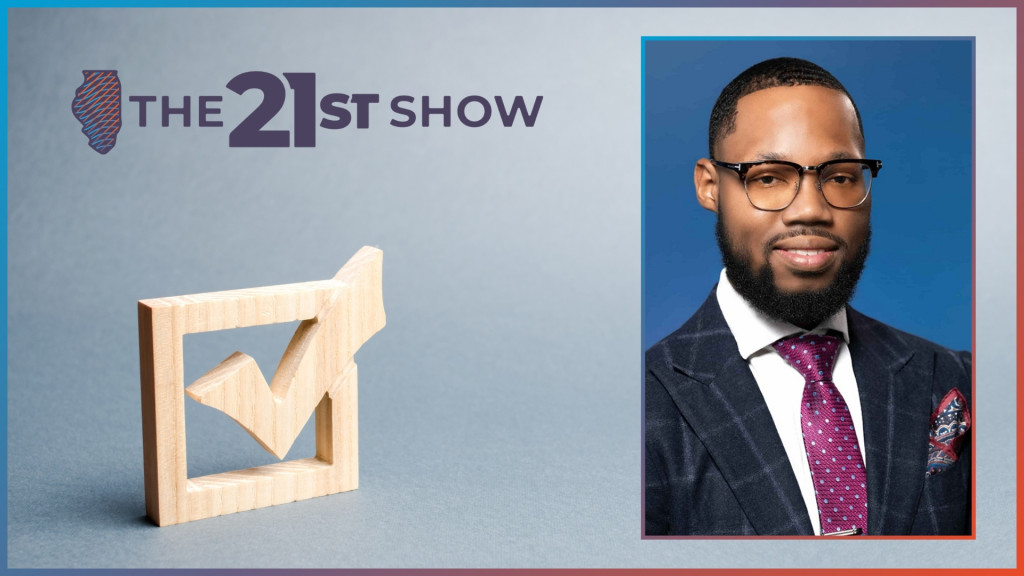
Should Illinois pursue reparations for descendants of slavery? Take the survey
Read the full story at https://will.illinois.edu/news/should-illinois-pursue-reparations-for-descendants-of-slavery-take-the-survey.
Transcript
// This is a machine generated transcript. Please report any transcription errors to will-help@illinois.edu.

[00:00:00]
Brian Mackey: From Illinois Public Media, this is The 21st Show. I'm Brian Mackey. Tomorrow is Juneteenth, the federal holiday that commemorates June 19, 1865. That's when U.S. government soldiers informed enslaved people in Texas that they were no longer in bondage. From the Civil War through the present, Americans have debated whether and how to compensate people who were enslaved and their descendants.

Here in the 21st state, the city of Evanston made history as the first in America to implement a publicly funded reparations program for Black Americans. That was in 2022. Today there's a statewide commission looking at this issue. Part of that work involves a statewide survey seeking the views of all Illinoisans on the question of reparations.

Our Illinois Public Media sister program Dialogue recently spoke about this with Marvin Slaughter Jr., the chairman of the State of Illinois African Descent Citizens Reparations Commission. They talked not only about the survey, but also a new report detailing the history of racism and injustice toward Black Illinoisans. Because our program today is on tape, no calls, but you can let us know what you thought. Our email address is talk@21stshow.org.

[00:01:28]
Speaker 1: Chairman Slaughter, a little bit of background in case people aren't familiar. Tell me about the commission, who was on it and what is it hoping to accomplish?

[00:01:37]
Marvin Slaughter Jr.: Yeah, so the commission — the commission's work started in 2022 after an aggressive strategy by the Illinois Legislative Black Caucus Foundation to end systemic discrimination, post the murder of George Floyd. This commission has currently 13 members, a majority of which are verified descendants of U.S. chattel slavery. We have a few legislators as well, including Representative Sonia Harper, and basically the work of the commission is to educate the public and to engage the public around the issue of reparations — what are reparations, for whom would reparations go to, as well as what potential policy recommendations will we make to both the state legislature and to the governor regarding how to repair harms that the commission has found the state to be complicit in.

[00:02:54]
Speaker 1: When I say the word reparations in the context of relating to Black Americans, what comes to mind for you?

[00:03:02]
Marvin Slaughter Jr.: Yes, so when I initially hear the term reparations, I always think back first to America's original sin, which was U.S. chattel slavery. The funny part about having this conversation in the state of Illinois is that most individuals have been socialized and taught that this state was a free state. Unfortunately, that is untrue, and we have discovered that and have published in our harm report — which was released this Black History Month of this year on our website — that the state did indeed have chattel slavery. That individuals were enslaved in the state of Illinois, that slave labor was utilized in the salt mines in Gallatin County and in other places, and that that labor contributed significantly to the Illinois economy. So when I think of reparations, I think of back pay or pay to individuals who are descendants of those folks, who are descendants of the individuals who have built this country that never received payment to begin with.

[00:04:14]
Speaker 1: Well, let's talk about the survey. Is it online and what are some of the questions that it asks and what are you looking for?

[00:04:22]
Marvin Slaughter Jr.: Yes, of course. So the survey is online at our website, ADCRC.illinois.gov. And we ask the general public to rank some of the policy prescriptions that we have developed to be able to repair individuals who are Black Illinoisans that are also descendants of U.S. chattel slavery. And we ask questions like, how do you feel about Illinois creating a state reparations program? What are your feelings on cash payments? Furthermore, we ask for individuals to rank policy ideas to address the harms that were caused by slavery in the state of Illinois, the harms that were caused by racial violence and terror against enslaved people and their descendants in the state of Illinois, the harms that were caused by unfair voting laws and the loss of political rights, the harms that were caused by stolen labor and hindered opportunity, the harms that were related to policing and an unjust legal system, addressing those housing-related harms that were experienced by descendants of enslaved individuals, addressing education-related harms, and addressing harms that affected the Black family. We also have a few additional ones regarding health, specifically around physical health-related harms, environmental health-related harms, mental health-related harms, and finally an opportunity for individuals to share about any additional ideas for repair.

[00:06:10]
Speaker 1: I imagine people who hear the word reparations imagine a check. I was on the survey last night and I did look through some of the questions and there are questions about whether reparations should show up as mental health care or debt forgiveness or land and property trust. Why should those types of relief be considered and why are they on the survey?

[00:06:31]
Marvin Slaughter Jr.: Yes, I mean, when we think about reparations, we have to think about and ground any policy that we propose in the harm. And Black Americans who were enslaved and their descendants were harmed in so many different ways. In our report, we talked through about 10 different harm areas, but we could have gone on for another 100. There's a very long history of harm to the enslaved and to their descendants specifically that America does not necessarily like to confront. So kudos to both the Illinois Legislative Black Caucus and to Governor JB Pritzker for allowing the state of Illinois to both acknowledge its complicity in the harms, how it has explicitly created harm against this very specific group of individuals, and looking to repair those folks. We talk about more than just a check — we talk about housing programs and we talk about life insurance policies because traditionally these are areas where large amounts of discrimination have been found. And while most individuals when they hear the word reparations immediately think of a check, we are of the mind that we would like a holistic approach to repair, which is both monetary and programmatic.

[00:08:13]
Speaker 1: Do you have to be an Illinois resident or Illinois native or descendant of an Illinois resident to take part in this survey?

[00:08:22]
Marvin Slaughter Jr.: We are still figuring out the final touches and the details on eligibility, but what is very explicit and is written in our bill language is that this program will be for those who are American descendants of slavery. So you will have to trace your lineage back to an individual who was an enslaved ancestor here in the United States of America.

[00:08:49]
Speaker 1: Are the answers confidential and how can you assure that?

[00:08:55]
Marvin Slaughter Jr.: Yes, the answers are confidential. We have gone through a painstaking process to ensure that all responses are de-identified, that we don't ask for any information that would allow for the re-identification of an individual. I think the most discreet information that we request is zip code. We don't ask for name, we don't ask for email addresses. We ask if you are currently a resident of Illinois, if you've ever lived in Illinois, and what your zip code is. And those are the pieces of information that we'll utilize to be able to kind of break into categories and cross-tab these survey results.

[00:09:42]
Brian Mackey: If you're just joining us, this is The 21st Show. I'm Brian Mackey. We're listening to a conversation with Marvin Slaughter Jr., the chairman of the State of Illinois African Descent Citizens Reparations Commission, conducted by our sister show Dialogue. The conversation centers on a statewide survey that you yourself can take about the debate over reparations at a statewide level. Because our program's on tape, no live calls. Our voicemail line, however, is always open. The number for that is [217-300-2121]. [🔍 Editor's note: Two different numbers were given in the audio — "217-321-21" and "217-300-2121" — please verify the correct number.]

[00:10:19]
Speaker 1: We talked a little bit about it earlier. Illinois brags that it is the land of Lincoln and a free northern state, but we know there were Black codes, there was the 1908 race riot where a mob of 5,000 white people attacked and killed Black people in Springfield. There were other documented incidents in Illinois history. How do those and other incidents figure into the reparations discussion specific to Illinois?

[00:10:46]
Marvin Slaughter Jr.: Yes, those are literally the harms that we discuss in our harm report. I've talked kind of ad nauseam about the Springfield race riot of 1908 and how the grandfather of Sonia Massey was an individual who was lynched in the race riot of 1908, and how Sonia Massey and her grandfather both passed at the same hospital, and drawing a line between what happened in 1908 and the types of harms that are still occurring here in [2025], 2025, 2026. And how you have this kind of unbroken line of hundreds of years of harm, and that example makes this real — that you have an individual who was killed in [1908] by a group of white people. [🔍 Editor's note: Speaker says "2008" but based on context appears to mean "1908"; please verify.] There are certain historical accounts that say that that white mob was also aided and embedded by individuals who were law enforcement. And then in [2024], this individual's descendant was killed by law enforcement. [🔍 Editor's note: Speaker says "2026" but Sonia Massey was killed in 2024; please verify.] This talks a little bit about and it highlights and illuminates the types of harms that we're discussing, and why it's so necessary that we repair those harms.

[00:12:17]
Speaker 1: And for people who may not remember, Sonia Massey had called for police because she suspected a prowler outside her Springfield home and within a half hour of Sangamon County Sheriff's deputy Sean Grayson showing up, he shot and killed her inside her home, and he was sentenced and found guilty of murder in that case. How long will this survey be up and how will the contents be tabulated and what will be done with that information after?

[00:12:49]
Marvin Slaughter Jr.: Yes, indeed. So this survey will be up until midnight of September 6th of 2026. We will conduct our survey analysis after the close of the survey, and ultimately the responses that we receive — both the positive and the negative and even the indifferent — will be utilized to help us determine what our final agenda and recommendation list will look like to the legislature and to Governor JB Pritzker.

[00:13:22]
Speaker 1: And in this era when the Trump administration is going after states and government agencies that simply mention race, or they're going after diversity, equity and inclusion programs, are you under any pressure to shelve this commission or does it make you more determined to go forward?

[00:13:41]
Marvin Slaughter Jr.: Yes, I mean, I think that we have some of the brightest minds — brightest legal minds — working on this issue. We are explicit about not being a race-based commission, so not every individual who is Black or African American is going to be eligible for reparations through this program. This is going to be a lineage-based endeavor. So for individuals who are explicitly descendants of those who experienced U.S. chattel slavery, they will be eligible. So this might actually allow us to get around some of the equal protection clause arguments that we see being made against programs like the Evanston housing reparations program, or [Buncombe][🔍 Editor's note: Speaker says "Bacomb"; this may refer to Buncombe County, N.C., which has a reparations program — please verify.], Asheville reparations work, because we have our harm report and we're going to be tying our recommendations explicitly to individuals who have A) experienced those harms or B) are descendants of those who have been deprived of life, liberty and the pursuit of happiness due to those harms. I think that we will not run afoul of those anti-DEI, anti-race-based efforts.

[00:15:10]
Speaker 1: How can the survey be a teaching moment for young people who may not be familiar with reparations, or for non-Black people who may have a myriad of opinions about the idea of reparations for the descendants of enslaved people?

[00:15:25]
Marvin Slaughter Jr.: Yeah, I mean, I'm not necessarily sure that the survey is going to be the thing that is the educational piece for individuals because we would like for folks who take the survey to take a look at the executive summary of our harm report. That is where the information that is going to be necessary to be abreast of is going to inform the responses for the survey — that's where that information is going to be found. So I encourage young people, I encourage individuals who are allies, I encourage individuals who are opponents, to do something radical and to read the report. These are official findings of the government commission. We have officially found that slavery did indeed exist in this quote-unquote free state. We have also detailed a multitude of other harms.

[00:16:21]
Brian Mackey: All right, we need to take a short break. This is The 21st Show. Stay with us.

It's The 21st Show. I'm Brian Mackey. Let's get back to Marvin Slaughter Jr., chairman of the State of Illinois African Descent Citizens Reparations Commission. He spoke with our colleagues on the IPM show Dialogue about a statewide survey seeking the views of all Illinoisans on the issue of reparations. No calls for our show today, but we'd still like to hear your thoughts. Our email address is talk@21stshow.org.

[00:17:04]
Speaker 1: How long has reparations been on your mind and what did you do to learn more about it? And are there any materials other than this report that perhaps you'd recommend people read?

[00:17:17]
Marvin Slaughter Jr.: Yes, yes indeed. So during my graduate studies, I had an opportunity to research and co-author with Dr. William Darity Jr., also known as Sandy Darity. And during that, I had an opportunity to learn more about all of the atrocities and the land that was stolen and dig into the archives and read diaries of individuals who were enslavers, white mobs that had stolen property from Black individuals for doing things as simple as trying to exercise their right to vote. And this is what kind of served to inspire me to dig deeper into the issue of reparations.

I actually came to this work as a skeptic — as an individual who, you know, believed we live in a post-racial society and there's no need for reparations — but then looking at and understanding the idea of human capital investment theory and understanding that when you deprive one generation of the ability to accrue capital, you deprive future generations of the ability to inherit that accrued capital, and that goes on for generations. And if you have at strategic points in history stopped these populations from being able to accrue capital, they had nothing to be able to give to the next generation, which means every generation was starting over.

So every time we talk about things like Black Wall Street — and Black Wall Street wasn't the only Black mecca, there were approximately 110 different instances of that same type of destruction — you can look at Ocoee, Florida, you can look at East St. Louis or Springfield. There are so many different examples of that type of destruction and the despair that followed. And they have real and lasting economic consequences, and those economic consequences bear out in things like the literacy rate, the education rate, the marriage rate, the ability for individuals to be homeowners or business owners. And it's an unfair advantage that happens for any person who did not have that explicit harm inflicted upon them, including those who may have immigrated to this country who would like to say that because they're an immigrant or a descendant of immigrants, they have nothing to do with U.S. chattel slavery.

And to those individuals, I would like to encourage them to think about why they immigrated to this country and who were the individuals that created a country that they thought beneficial enough to immigrate to in the first place. Because those exact individuals who created the circumstances that looked good enough for you to want to come here are the individuals who couldn't benefit from those circumstances themselves.

[00:20:31]
Speaker 1: Are you concerned that we're kind of in a regressive period? You know, we had the first Black president from Illinois, Barack Obama, in 2008, and 10 years after him leaving office, we seem to be a very different country right now. Does that concern you?

[00:20:54]
Marvin Slaughter Jr.: There are always going to be concerns politically about where we are as a country, regardless of whether or not we had the first African American president. I mean, I stress the term African American because, as great as President Barack Obama was, he was not a descendant of U.S. chattel slavery. And therein lies the rub, because when you look at the vast amount of individuals who are placed into high-ranking federal positions, they are not descendants of U.S. chattel slavery. They do not have that lineage. And this is part of the argument for reparations — that we see individuals who we do share phenotypic relationships with, but they don't necessarily have the lived experience of an individual whose ancestors were enslaved in these United States of America. These individuals don't necessarily have the blood equity that a person who descends from those enslaved might have. So we are advocating on behalf of this very specific group of individuals who has a very specific justice claim against the United States government and also against the state government of Illinois.

I would just like to reiterate — we really encourage everybody to fill out the survey. We want both opponents and proponents. If you are an individual who feels like you need more information, feel free to check out our webpage and read the executive summary or the full harm report. And then if you need any additional information, please go to our website and look at our meetings tab. Come to one of our meetings. Over the next two meetings, I will be going through the survey in real time and describing the policies, where those ideas came from, how they are directly tied to the harms that were experienced by these individuals, and how we might potentially move these ideas forward into legislation.

[00:23:20]
Speaker 1: Any upcoming meetings in Champaign-Urbana?

[00:23:23]
Marvin Slaughter Jr.: We currently do not have any upcoming meetings in Champaign-Urbana, but what we do have is three forums throughout the state of Illinois. We have a Springfield, an East St. Louis and a Chicago forum for all of our monthly meetings, and they can be accessed online if you go to our website at ADCRC.illinois.gov under the meetings tab. If you click on any of the upcoming meetings, you will be able to see the virtual Webex universal link and be able to see the location for each of the in-person sites.

[00:23:55]
Brian Mackey: And that was Marvin Slaughter Jr., chairman of the State of Illinois African Descent Citizens Reparations Commission, speaking with our sister program, Dialogue. You can find a link to that survey and the harm report on our website, 21stshow.org.
Transcript Assistance
Illinois Public Media may use AI assistance for transcript generation and/or formatting. Transcripts that have not yet been reviewed for accuracy will be labeled.
To report a transcription error, or to request transcription of archival material, please contact will-help@illinois.edu.