








Transcript: Abby Cadabby’s puppeteer is married to a guy from Normal, Illinois. Here’s how they got to Sesame Street.
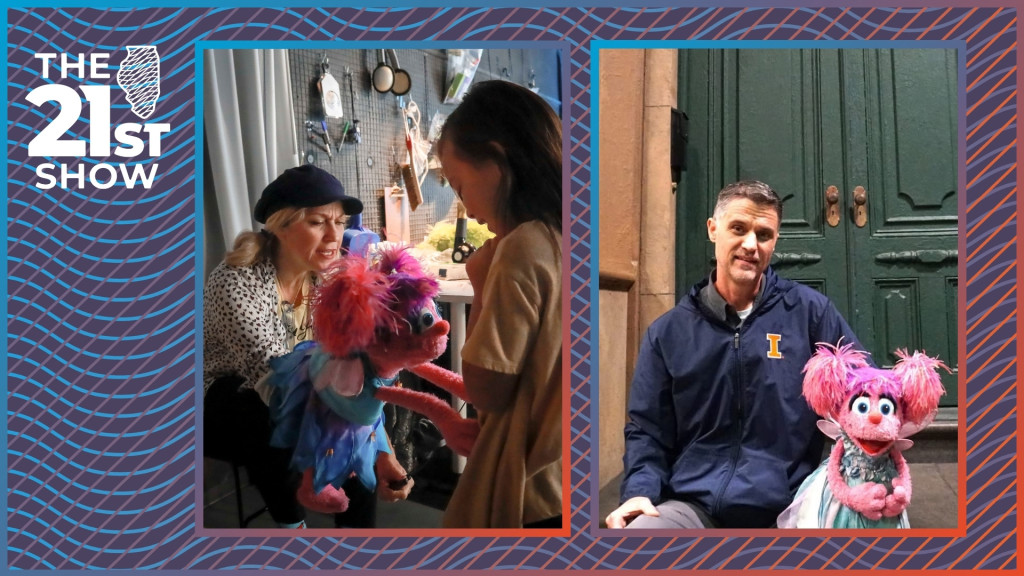
Transcript: Abby Cadabby’s puppeteer is married to a guy from Normal, Illinois. Here’s how they got to Sesame Street.
The 21st Show
Abby Cadabby’s puppeteer is married to a guy from Normal, Illinois. Here’s how they got to Sesame Street.
Read the full story at https://will.illinois.edu/tags/abby-cadabbys-puppeteer-is-married-to-a-guy-from-normal-illinois-heres-how-they-got-to-sesame-street.
Transcript
// This is a machine generated transcript. Please report any transcription errors to will-help@illinois.edu.

# Transcript: Illinois Public Media - The 21st Show

[00:00:00]
**Brian Mackey:** Today on The 21st Show from central Illinois to Sesame Street, we'll talk with Paul Rudolph and Leslie Carrara-Rudolph. Paul is a composer and music editor for both children's music and grown-up films. Leslie's a puppeteer best known for giving life to the Sesame Street character Abby Cadabby.

[00:00:18]
**Abby Cadabby:** Let's look together way up high for things that are pink.

[00:00:26]
**Brian Mackey:** Paul is originally from Illinois. He and Leslie are married. They met working on the show, Muppets Tonight. I'm Brian Mackey. We'll talk with them throughout the hour today on The 21st Show, which is a production of Illinois Public Media airing on WILL in Urbana, WUIS in Springfield, WNIJ in Rockford-DeKalb, WVIK in the Quad Cities, and WSIU in Carbondale. But first, news. From Illinois Public Media, this is The 21st Show.

I'm Brian Mackey. It's been more than five decades since Sesame Street first asked us to come and play, and the show is still going strong. Today, we're talking with two of the many people who helped make it happen. Paul Rudolph is a composer and vocal music director for Sesame Street. He grew up in Normal, Illinois, went to the University of Illinois first for music education, later coming back for composition and a master's degree, and he's been making music for the show since 2008. Leslie Carrara-Rudolph is a puppeteer best known as the hands and voice of Abby Cadabby, a role she's held since 2006, and one that recently earned her a Children's and Family Emmy Award. They're married. They work together. They're both in our studios in Urbana. Leslie and Paul, welcome. Thanks for being here.

[00:01:57]
**Leslie Carrara-Rudolph:** Brian, thanks for having us. [We loved] that intro too. We're smiling and laughing kind of about the intro.

[00:02:04]
**Paul Rudolph:** Yeah, I already have a fun fact about that intro.

[00:02:06]
**Brian Mackey:** OK, well, we'll come back to that in a moment. Uh, listeners, you can join us as ever. I want to invite you to join us at 800-222-9455. That's 800-222-9455. All right, let's start with a fun fact.

[00:02:21]
**Leslie Carrara-Rudolph:** Oh, OK. So when Abby goes, zippity zap, that magic word, first of all, her wand is named Wanda, but that magic word I got to make up myself. They came to me and they go, What do you want it to be? What do you want? It's not [abracadabra, peanut butter sandwiches] because that's for Mumford and all that stuff in the cow. So, um, zippity zap is actually a character that was on Muppets Tonight, where Paul and I met 30 years ago. It's the 30 year anniversary of Muppets Tonight. So I've been with the Muppets 30 years. And Zippity Zap was our favorite character and it kind of like we had our picture together and that's where we first met. So, zippity zap is a nod to that in our true love. You know, when you do something with your wand and magic, you do it with love and you do it from the heart.

[00:03:11]
**Brian Mackey:** So so much to unpack there. We're gonna get to [all of that].

[00:03:17]
**Leslie Carrara-Rudolph:** This is why—

[00:03:19]
**Paul Rudolph:** Brian, I can never follow my bride with questions and answers because she just performs it. No, OK, my fun fact is on that same show, this is a short fun fact, but on Muppets Tonight when Little Richard was on, I actually got to sit down at the drum set and kind of test the sound, like go through a sound check with him. And so I got to drum with Little Richard for about 30 seconds and it was pretty amazing. Well, as any rock and roller, you know, you're losing your hearing after playing countless shows for decades and Yeah, I think he towards the end he used to play with two drummers, like loud, loud, loud, and so I'm just, I'm, you know, people are doing work on the set and I'm kind of just tapping, kind of playing quietly. He's playing the piano and he's like, come on, Paul, come on, and like he wanted me to play louder and louder. So that was a treat. That was a real treat.

[00:04:05]
**Brian Mackey:** [That sounds] fun. All right, so let's let's start with Sesame Street since that's where both of you spend a lot of your time these days. Paul, and I'll start with you. What does your job actually involve day to day?

[00:04:17]
**Paul Rudolph:** I wear three hats. OK, so my biggest job when we're in season and we're filming content for the show and we're at the set of Sesame Street, I'm the vocal music director for that. And I'm also a music editor because I'm actually in my office recording our cast vocals singing songs in a little stand up booth in my office. So I'm running Pro Tools with my right hand and I'm directing them with my left hand. So the two hats for that are vocal music director and then uh audio editor or recordist. So then my third hat is as a composer and there's a dozen or so composers we use. We all have our little specialties, our little niche. Um, if you need Broadway, we've got a guy named Eli [Bolin] that just, he lives and breathes Sondheim. He can write that in his sleep. I cannot. I would have to research chord progressions for Sondheim to write that. So my niche is found found object percussion. Um, I wrote a fun song about an assembly line on Sesame Street where all the cast members had to work on teamwork to build a little craft. Um, so that's my third hat. So, well, what's the fourth, well, a vocal arranger, that's kind of part of my vocal music direction. I work harmonies for that. So when we do like the Macy's parade. When we do the Macy's parade, I have, you know, upwards of almost 20 voices to basically arrange the cast vocals, and we always have a guest singing on that, and I have to kind of put our vocals around that guest. If that guest is an alto or a tenor, I'm kind of working with harmonies around that. So yeah, that's a vocal—

[00:05:52]
**Leslie Carrara-Rudolph:** [Arranger.]

[00:05:55]
**Paul Rudolph:** The ranges, character ranges are super important for the show, which I learned from Dave Conner, my predecessor. He gave me this beautiful range chart that shows the vocal ranges and so that's part of my job is finding the best keys for them and when they're singing working on harmonies you can't—

[00:06:12]
**Brian Mackey:** You can't write Cookie Monster like a [soprano in the—]

[00:06:19]
**Leslie Carrara-Rudolph:** [Laughs] Cookie Monster is wearing an ultra tight Speedo and that affects his voice. But I mean we're like this and there'll be sometimes just because when Elmo and I sing together we sound like Pebbles and Bam Bam we always say um so there's times where we'll as performers we'll put a little extra like a little extra grit or something so we're not too much, you know, rubbing up against each other, but then if we go any lower, [you'll hear, and] all of a sudden we're playing Oscar's mother and that's a different voice and a character and it sounds nothing like Abby.

[00:06:59]
**Paul Rudolph:** So, so anyway, those are my hats.

[00:07:01]
**Brian Mackey:** Yeah, well, OK, so we, let's, let's get into the characters. So we have a clip here of, uh, this is from a song called 5 [Fairy] Ducks. Abby and Friends count down the number of ducks. We're gonna pick it up near the end [that took] a long time.

[00:07:19]
**Abby Cadabby:** One fairy duck went out beyond the [castle and barnyards. Then] none. [No] fairy ducks [swam out beyond the castles and far aways, that] fairy godmother [said, it's] time for a snack. [Hey, fairy] ducks, where'd you go? [It's] lovely this time of year.

[00:08:12]
**Brian Mackey:** I love the emotional journey that Abby goes on.

[00:08:15]
**Paul Rudolph:** I know [right?] I'm telling you, Abby's range is just off the charts.

[00:08:18]
**Leslie Carrara-Rudolph:** Dramatic or what[?] [Laughs] Way to chew the scenery.

[00:08:24]
**Paul Rudolph:** [Laughs] Oh my gosh, that takes me back.

[00:08:25]
**Brian Mackey:** So for people without maybe, uh, young children in their lives, tell us a little about Abby Cadabby. Where does she come from? What's her story?

[00:08:33]
**Leslie Carrara-Rudolph:** Oh my gosh, she's so funny. I always say like she's like um Gracie Allen meets Daffy Duck with a little bit of Barney Fife. Like she's kind of like, she's so quirky. And when I say Gracie Allen, which is like your listeners probably don't even know that, but she has her own like Gracie Allen used to see the world differently and because Abby's from the World of monsters and fairies and storybook world and trolls and like—

[00:09:01]
**Abby Cadabby:** You know, my dad is part gnome and so that's why we bake him fennel cookies because fennel's really good for gas and my dad's gassy.

[00:09:09]
**Leslie Carrara-Rudolph:** Like she has this like she'll take you like, wait, what did you just say? But she [sees] the world [there] with no boundaries and she's the ultimate, like she accepts everybody where they are with wonder and joy. And when she first came out because she was a fairy in training, she actually got criticized when she first came out like, oh, it's a girl who makes mistakes. And I'm like, no, she is resilient. [If] she makes [a mistake, she says]—

[00:09:40]
**Abby Cadabby:** [I made] another pumpkin. That's OK. I can do this.

[00:09:44]
**Leslie Carrara-Rudolph:** You know, she looks [at] a mistake as an opportunity to go forward, to see something another way, and you know, she does not give up and she is a fearless friend, so she doesn't give up on other people's dreams or her own [and] because she's a wish fairy. Um, uh, Tony Geiss, who created this character with Judy Freudberg, they wanted to create a funny female character that was kind of like they called her like a tiny immigrant that she had a nondescript [origin, she] was coming from. So it wasn't from any particular [reason—] region, excuse me. But she was on the street and she was able to say, I'm not like anybody here and I need to find a way to be myself and also [to] learn from everybody. So she had a non-specific culture. So it was really cool and they were like, oh, they made her a stupid girl. And I'm like, no, she's resilient, she's smart, she's funny. So, um, and luckily for me, the writers really got behind my quirkiness. You know, they'd call me up and they'd say, what would Abby dress as for Halloween? I'm like, Oh, a weaning bed. And they're like, What? I go, it's a bed of puppies that moms come to because she loves puppies and she'd [be in] the middle of it. And they go, How about a beverage? And I go, Oh, a cup of cocoa. So she's very, um, She believes that the most powerful magic comes from the heart, which is a quote from Tony Geiss, the creator. And so ultimately she just gets people to listen to their heart and starts from there.

[00:11:23]
**Brian Mackey:** Yeah, there was a really interesting New York Times story, um, from 2006, right? "A Girly Girl Joins the Sesame Boys," right? I'm gonna read just briefly here. It says, in the past, the show [being] Sesame Street has bent over backward to counteract stereotypes with the tomboyish Zoe or the highly opinionated [Rosita]. But political correctness hampers creativity, Ms. [Neyland] said. Abby Cadabby owns her point of view, but she's also comfortable with the fact she likes wearing a dress and as [we] tried to model strong female models, we neglected that piece of being a girl. How much do you get to participate in the development of Abby, you know, over the years?

[00:12:02]
**Leslie Carrara-Rudolph:** Over the years. Well, first of all, like if you look at fairies, like their culture is to wear those dresses and she was like from a design point of view, You know, she's very whimsical and approachable. Her, you know, the specific, you know, the blue dress blending in with the sky so she can't be seen. And her wings are dragonfly wings. They're not butterfly wings. Dragonfly in fairy folklore is dragonflies can go between two worlds. So you can interpret worlds whatever you want, the spiritual world, the different worlds [—] like she's like the bridge between those things. Um, yeah, Abby has like a necklace now that's a dragonfly, that's a light. So I think what happens to me is, as someone who loves to build on characters, I go the extra mile as a writer and a comedian and a performer to endow everything [with] meaning. So they're very open to that. I'll say, you know, Abby wouldn't say that because she wouldn't ask that question because she accepts everybody, so she wouldn't question something like that. Um, also, she's been on for 20 years, right? She's been through divorce. And I remember when the producers called me and they're like, OK, just so you know, we're going to do a special outreach [for] kids going through divorce and Abby's parents are getting divorced. And I [remember] going like, oh wow, that's going to be hard on her. That's going to be a lot. And they were really sensitive to that. And we talked about like you know kids saying, it's not my fault. This is an adult problem, but Abby's an empath because it's her job to help people with their dreams. So she took [on] that responsibility. So they were really wonderful the way they wrote that. My most favorite song is with Roscoe Orman. [Roscoe] plays Gordon and [it's] "I've Got Big Feelings." It's beautiful and that I think was written by [Bill Sherman and] Kat [Sherrell], another group of composers. So they listen to that and sometimes we've been on for so long, new people come in and try to say something about our characters and all the puppeteers do this, you know, because they embody the heart and soul of it. And we'll have to educate our writers in that form and say, that's not really something for me. That's maybe something for Grover or Cookie Monster or Rosita and we'll stay true to our voice. So they are really good about listening to that.

[00:14:40]
**Brian Mackey:** Yeah, Paul, can you talk about, and I should say we need to take a break in a couple of minutes here, but can you talk about, I mean, this is a show, I think you are probably just at the age that maybe you were a little too old when it first came out, so I don't [—] You were OK. So, so how do you adapt? I mean, you were a professional, you were in the working world for a while before coming to Sesame Street. How do you adapt yourself to something that's so established yet make your own mark?

[00:15:06]
**Paul Rudolph:** Well, it helped that I started on Muppets Tonight because I learned a lot about character voices. So that's where I really learned like where character [voice] ranges hit. And as a music director, I think teaching music to anyone of any age [is] kind of internalized for me because I started teaching when I was even in high school, just teaching, you know, drummers. But when I look at music on a page, my job is to teach the cast member and maybe the cast member doesn't even read music. But I can at least teach the nuts and bolts which are pitch and rhythm and so that's kind of where I begin every song journey with them is like just thinking about the notes and the rhythms, and then the cast are so unbelievably experienced at their own voices that I don't have to contribute too much to what they're doing character voice wise. I just have to make sure, like we talked about before, that the song is in a good key for them. So as a music director, it's kind of like I can go from a clarinet to Elmo to Abby and think about music in a similar way. Um, so I think my background just in education and being a band director for three years and private instructor for seven years, I think everything like translates to getting somebody, a cast member comfortable with headphones on [in] a studio learning a new song.

[00:16:23]
**Leslie Carrara-Rudolph:** [And] not just cast members and guests.

[00:16:25]
**Brian Mackey:** And guests. Well, OK, on that note, so we need to take a break. Let's hear one of those guests. We're talking with Paul Rudolph and Leslie Carrara-Rudolph. They both work on Sesame Street. Paul does music for the show including with guests, here is the artist Sia singing from several years ago.

[00:16:58]
**Sia:** I sing songs [—] sad songs and slow songs and jazzy songs and funky songs [that] get up and dance like a monkey. [Songs that] make you happy. [Songs that] will make you proud.

[00:17:20]
**Brian Mackey:** You're listening to The 21st Show. I'm Brian Mackey. We'll be right back after a break.

[00:17:25]
**Sia:** I want to sing [about clapping] songs and funny songs.

[00:17:47]
**Brian Mackey:** It's The 21st Show. I'm Brian Mackey. We are talking today with Sesame Street composer and music director, Paul Rudolph. He grew up in Normal, Illinois, went to school right here at the University of Illinois. We're also speaking with his wife, who's puppeteer and comedian Leslie Carrara-Rudolph. She's the voice and hands behind Abby Cadabby, just won an Emmy for that work. You can join us today, 800-222-9455, 800-222-9455. What do you remember about watching Sesame Street as a kid? Uh, what do you think it still has to offer children today? You can join us 800-222-9455. I should say that piece of music we were listening to there is [from a found] object instruments [ensemble] from an outfit called [Clank]. We're gonna come to that in a little bit. Uh, but Paul, let's talk about your background in Illinois. What brought you to the University of Illinois?

[00:18:39]
**Paul Rudolph:** The Marching Illini, full stop. Um, yes, and when I was growing up in Normal, of course, we had Illinois State University in our backyard and of course, like any, you know, hometown kid, I wanted to get out of town to go to university. [But] when I first saw the Marching Illini, which would have been like, I don't know, my sophomore year in high school when my Normal Community High School came over here for the band competition, it was the first time I saw a big giant stadium and the Marching Illini. And that was it. I'm just like, OK, I love this. I love marching. I love drum line. I love all this stuff, so I wanted to go there. That's literally what drew me there. And of course I knew that it was a great music ed school, and I think my parents were happy enough about that too, that I wasn't, you know, I was an hour away, but, uh, you know, out of the house, [and] out of Illinois State University. But no offense to ISU and the Redbirds, but [U of] I, come on. Yeah, who's got the best band in the land, honestly.

[00:19:35]
**Brian Mackey:** Um, so, and I'll just say I one of my most cherished possessions as a high school senior, uh, drum line, uh, member was a t-shirt from the [Marching Illini] with a pink flamingo on it from Illinois Drum Line—

[00:19:49]
**Paul Rudolph:** [The Pink Panthers?]

[00:19:50]
**Brian Mackey:** Yeah, definitely, um, how do you get from music education, uh, to composition because that's not a path that most music educators take.

[00:20:01]
**Paul Rudolph:** Yeah, I've dabbled in composition since I was in high school, and I think even just ad libbing things with my friends in the percussion world in the band room at Normal Community High School, that's kind of where my interest started. And then when I was an undergrad, I had that always in the back of my head. I always had a little 4 track cassette recorder or something where I was just dabbling in my own kind of song world. And I think once I was a band director, I was doing a lot of percussion arranging, um, and writing for like percussion ensemble. Then I would do some original songs for percussion ensemble, and then I was kind of intrigued by film scoring and TV music and so I would create stuff on a 4 track and send it to my good friend in California, and she actually worked for [a] film scoring [agent who] had, uh, say 6 or 8 film composers under his wing. And I would send her demo tapes and just silly stuff whatever I was doing on a 4 track, and she's like, you know, this is pretty good. You should come out here and just work with a composer that's under the wing of this agent and just get out here and do these things. And I was like, well, I haven't really honed my own craft as far as like what does my composition want to sound like. I knew my percussion world, but aside from that, I wanted to do more. So that's why I came back to school. I [went — I] didn't finish my master's, but I worked on my master's here to really hone that skill and say, what is my composing art going to be? Is it going to be arranging and sounding like someone else or, you know, making my own mark? And that was one of my instructors in grad school even mentioned that he said very specifically, What does the music sound like? Yeah, that's OK. But more importantly, if you can tell who it's written by, that was such a simple thing to say. Like if you listen to a composition, can you tell who wrote it, you know, going way back, can you tell that's Beethoven? Can you tell it's Mozart or Bartok or whatever? So going back to school really helped me kind of focus on how I wanted to compose.

[00:22:06]
**Brian Mackey:** That's interesting. I mean, [U of] I does have a great composition program. We used to joke about the [Fifth] Floor[s, I] don't know if you [—] you know, people rolling dice and you know, counting cats and things like [that.]

[00:22:16]
**Paul Rudolph:** Yeah, for me it was Scott Wyatt. Scott Wyatt, I studied with him in the experimental music and I heard a piece by one of his students. She took a single cymbal crash [and] put it on tape and then cut up that tape. This is analog. She [physically] cut the tape backwards, forwards, all this stuff, and the entire composition did not sound like a cymbal crash, but she used one cymbal crash, and I'm like, that's intriguing. OK, where can I go with that or can I study with that guy? And I did. And I also studied with Zack Browning, who was a theater professor and a composition professor, and he had a really fun minimalist way of composing. And I played on a lot of his pieces as an undergrad. And so I knew going back to school, I'm like, I want to study with Zack because he just had this really interesting take on rhythm and then I was like, OK, and I want to get into studio stuff and experimental stuff. So between those two, between Scott Wyatt and Zack Browning, [and] Salvador Martirano, I studied with him as well. Um and he goes back to like the late 60s with crazy, you know, John Cage kind of stuff. And so, those three really opened my eyes and ears to my own, you know, style, I guess you'd say.

[00:23:26]
**Brian Mackey:** Yeah. All right, well, we've got two guests with us today, Paul Rudolph and Leslie Carrara-Rudolph. So we're gonna have sort of parallel, some aspects of our conversation will be a little bit in parallel. So Leslie, I'm gonna go back to you now and ask you about your sort of origin story with what you do today. Um, because you studied child development. How do you end up doing puppeteering?

[00:23:46]
**Leslie Carrara-Rudolph:** Oh, that's actually a super easy jump for me. I mean, um, I think first of all, um, I grew up in an intergenerational family. My grandparents [lived] with us, so there was a lot of storytelling going [on]. Um, my dad's Italian. Um, [his] dream was to be an animator for Disney, and he was, you know, doing a bunch of odd jobs and manual labor, and he got in a pretty bad accident and had to redefine himself. He had three kids, one on the way, that was me, and he decided to move from Tacoma, Washington down to California to go to CalArts [because] he wanted to pursue the dream of being an animator for Disney. Um, and with that, he ended up, you know, exploring all the different things, art. [He'd] bring art home to us and he'd go into art education and he realized that his calling was to be a teacher and it was great. So when growing up, my dad would take me to school with him, um, summer school when I was old enough and [—] Um, we always had my mom [who] made all my clothes, you know, I had older siblings, so our house was always filled with stuff. So our house was basically, and I was always in the backyard. They're always like, I'd get in through the dog door eventually once they locked it, but, um, but they were always putting me in afterschool programs because I was a surprise kid, right? So, and I had all this energy. And so I was in the park and recreation department and then I became a [junior] camp leader, and then I became a camp leader and but I had all these creative skills that I could entertain kids through storytelling, through drawing, through putting a sock on my hand and making it talk. And so for me, when I saw Sesame Street for the first time, I was like, oh my gosh, that's exactly what it looks like inside my head, my very first puppet. I say my grandpa, we were in the backyard and my grandpa says, come here, this snapdragon wants to talk to you. And I'm like, What? So he pinched the corners of a little snapdragon flower and it's like, How you doing there? And I was like, Whoa my gosh, everything talks. That flower's talking to me. So I just saw the world with wonder. And as I became doing outreach, you know, doing lots of stuff with the park and recreation department, I also ran into kids that [—] [W]e had my brother, you know, I'm going to get a little deep. My brother rode a motorcycle to heaven when I was 10.5 years old, and that changed the landscape of my family. And luckily for me, I kind of became an escape artist, you know, I was able to express myself and things I couldn't control in my own home. I could control on an art pad or with a character or with a puppet. And it also gave me the ability to see in other children if [there] was more to their story, and I could get them to talk to me [and] we'd share through art and through puppets and I thought, you know, I really feel like [I've] been raised and given the skill set to reach kids in this way. So when I went to San Francisco State [—] And I'll also say that I have a learning challenge. I'm not dyslexic. They thought I was maybe ADHD [and] since then, I've actually had my brain mapped to find out whether or not those things are true, and they weren't. I had a lot of other things happening, which happens with childhood trauma, and it affected the way I approached learning. So Sesame Street was great for me because there was a lot of visual learning and I have a perception processing disorder. So I could learn things visually, but words would crash in my head and I [—] I had trouble reading. My mom actually helped me graduate San Francisco State because if there was a multiple choice question, um, I couldn't answer it. But if there was an essay question, I could tell you what I know[, you know,] so it was all those things. So I knew that I [wanted to] find a major and I ended up designing it. So the child development was child psychology. The therapeutic recreation was dealing with kids at risk, foster homes, hospitalized children. Back then, crack was a big issue, AIDS, all those different things that happened and theater arts, and that was storytelling. So I designed my major at San Francisco State and that's, and I just wanted to be the ultimate entertainer for kids. So for me, I just kept [—] and I put myself, you know, my parents helped me, but I did after school programs, birthday parties, window painting, you name it. And so when Sesame Street, and I loved fairies and in the backyard, so puppetry is just one of the tools that I use to reach kids and Sesame Street was just like my mom even says that I wanted to move there. [And] my sister goes, she [literally] packed her bags like, I don't belong here, you know, and so that's kind of a broad thing. It's actually what I'm going to be talking about today to the theater arts department and the education department. I'm really excited that those two departments are coming together because there's so many options of ways that you can use your powers for good when you're a performer because the arts are like the bees. You know if the bees die, we die. If arts die, humanity dies.

[00:29:27]
**Brian Mackey:** What do you think it is about a puppet, that a child talking to a child with a puppet sort of intermediating?

[00:29:33]
**Leslie Carrara-Rudolph:** It's not just children, it's adults as well.

[00:29:37]
**Brian Mackey:** What is it about that? What is your theory of that?

[00:29:40]
**Leslie Carrara-Rudolph:** Well, it's so funny because I've been asked to talk about that question in a few sentences, so I'm going to try to do it. I think what happens is, like, you know the feeling you get when you see a puppy or a dog [—] [T]here's something that happens with your mind and your heart, where your brain and your heart work together in unison to create a feeling of love and joy. And I always say, never underestimate the power of joy. So it's almost like a permission slip. [T]here's like a change in the energy. When you laugh, scientifically, when you laugh, it makes your saliva thicker. [W]e did some research. My creative partner in my company, Humor with a Heart, we've broken all this down. Um, and when your saliva is thicker, by the way, you have a better immune system. Just a little thing you didn't think you'd hear today. Yeah, fun fact. But I think [there's] something [that] happens where when someone sees a puppet, it's like seeing a [puppy]. There's something that happens. It's a permission slip to be a child, to find your innocence and that part of your soul that so desperately needs a hug.

[00:30:54]
**Brian Mackey:** All right, let me remind listeners, this is The 21st Show. Uh, we are getting a hug today from Leslie Carrara-Rudolph, who is a puppeteer and performer. You probably know her as Abby Cadabby from Sesame Street. Uh, and also Paul Rudolph, uh, who happens to be her spouse. He's a composer, music director, vocal arranger at Sesame Street. He's originally from Normal, Illinois and is an alum of the University of Illinois, uh, Marching Illini as well as the music education program here and studied composition here. Uh, if you want to join us, 800-222-9455, 800-222-9455. So you both, you mentioned this at the beginning of the program, you meet on Muppets [T]onight. I understand, uh that, uh, Leslie, you [were] Spamela Hamderson, which is a very nineties, uh, [Pamela Anderson/Baywatch reference.] Awesome. Can you uh briefly share your sort of meet cute story?

[00:31:52]
**Paul Rudolph:** Oh, Leslie can say that. Well, I mean, [the] artist formerly [known as Prince] kind of brought us together, but there [was so] much fun on the set of that because this is still kind of analog days and there was a piano, yes, an acoustic piano on set, and we would roll it around between stages and I had a fake book and we would just, I just discovered that she had a very similar taste in music to me, which is kind of old standards and singing and I loved her voice and so we would just during breaks, we'd just sit at the piano and we'd just go through standards and sing. Um, but the artist formerly known as Prince was on and there was this amazing [part — puppet thing we do — underwater] puppets. [She played the] angels, and we were watching that and Leslie kind of thinks that might have been a spark, but you tell [part] two if you want. I don't know. This could go on for [a while. What] time is it[?]

[00:32:39]
**Brian Mackey:** We got 2 minutes until a break.

**Leslie Carrara-Rudolph:** Oh gosh, I'm so sorry. Well, you don't want to know that story.

**Paul Rudolph:** [Laughs]

**Leslie Carrara-Rudolph:** Well, I mean, I just think that again, like those angels, we were super exhausted that night. We had like 4 hours sleep and we were filming this and we were sitting [there]. And I'm watching these angels and he went and got me some tea and I was just like, oh wow, this guy's really nice.

[00:33:04]
**Paul Rudolph:** So tea brought us [together.]

[00:33:06]
**Leslie Carrara-Rudolph:** [Laughs] [A]nd he invited me on a hike that I didn't know was a date. I don't know. There's lots of things.

**Paul Rudolph:** [Honestly,] just the magic of the set. There's something and Prince, I mean, come on, that was a day, 2 days we will never forget working with him. It was just amazing.

[00:33:21]
**Leslie Carrara-Rudolph:** I think we both found our true selves on that set. Paul was, you know, getting to do what he really loved to do, and he was working with a composer [—] [I]t was Richard Gibbs, and it was my very first Muppet job. I had an HBO [Workspace] show and they were looking for female comedians who can sing in character, and I had no idea what I was doing. I was terrible. But it was [my] first show, but we were both really doing what we love to do in an environment that we didn't realize that we felt at home. And I think we both just were at our best selves and—

[00:33:55]
**Paul Rudolph:** [That's] good. That's good 2 minutes.

**Brian Mackey:** Yeah, that is, that's great 2 minutes and perfect timing. All right, we're gonna take another break and we will come back more with Paul Rudolph and Leslie Carrara-Rudolph, both of Sesame Street and many other projects. This is The 21st Show. Oh, and I should say we're gonna listen to another piece. This is Paul on a vibraphone, I believe, [Echoism.] We'll be right back.

[00:35:08]
**[OK Go performs:]** But it don't get much dumber. It don't get much dumber than [—]

[00:35:40]
**Brian Mackey:** It's The 21st Show. I'm Brian Mackey, and this is the band OK Go. Uh, they did, uh, I think it was a Super Bowl commercial some years ago. Uh, it involved a Chevy, of course, uh, driving through a desert landscape, and there were all these attachments, I guess acting as mallets on the car [—] [b]eating on instruments and chimes and oil drums and all kinds of things, uh, an amazing thing. And Paul, I understand you were involved with that [as an instrumentalist]. So let me reintroduce our guest. We're talking with Paul Rudolph, who's a composer, percussionist, uh, also works on Sesame Street as vocal music director, uh, and we're also speaking with his spouse, Leslie Carrara-Rudolph, a puppeteer, uh, best known as the hands and voice of Abby Cadabby. She's an Emmy Award winning, uh, performer on Sesame Street and elsewhere. [Y]ou can join us 800-222-9455. So, OK, go there, that was an epic video. So many of theirs are epic, but that was, talk about that experience.

[00:36:35]
**Paul Rudolph:** Their commitment to every video they've ever done is something that I think every music video creator sets the bar to because they just go all in. Um, and the idea, the original idea for the car driving was to drive in a complete straight line and perform the entire song. They couldn't even find enough space to actually physically do that, but that was how committed they were. They were like, nope, we want to drive in one shot. We want the entire song to be one shot in a straight line. So they had to stop and turn around and go back and do [do] laps basically. But yeah, so [—] [o]ne of the producers actually just was researching online and did a Google search for found object instruments and found my website and that's how they contacted me. [I] make instruments out of mostly metal things, uh, propane tanks that I cut tongues into to make different pitches, saw blades, motorcycle gears, um, and but I use very specific what I call activators or mallets to hit those things and make sounds [because] it's not just as simple as a pair of drumsticks on something. And so they contacted me to come up with ideas for sounds that would mimic a song that they had done acoustically but with all percussion and including pianos in the desert and guitars in the desert, but the biggest thing I think I offered them was how to quote unquote activate those instruments from a car using different types of mallets, garden hoses, um, wooden sticks, things that I could help them think about how a metal or a wooden stick wouldn't break when the car is driving 35 miles an hour and hits something. And so a lot of my contribution was for mallets and activators. I did provide some instruments, but once we got into the weeds about that, I was like, well, the way they did the song [—] [T]hey needed [—] I think they got 300 [pianos,] 300 guitars from Gibson, but they used like 150 guitars to do the guitar solo. And they found they bought every used piano in Southern California they could find, so they had 65 acoustic pianos out in the desert.

[00:38:41]
**Brian Mackey:** I'm trying to imagine the budget for this.

[00:38:43]
**Paul Rudolph:** I mean their budgets are off the charts. So when I said, look, I can [—] [W]e can do, [propane] tanks, but you're going to have to buy like 100 [propane] tanks and [an] empty [propane] tank was like 30 bucks, so [y]ou know, some of the things put them out of their budget for my percussion contribution[,] but then a friend of mine, actually our friend Liz Hara, was studying [taiko] drumming, [taiko] drumming, and discovered that some of the people that [do] Japanese [drumming —] [Y]eah, the Japanese style, and if you wrap packing tape around a tire, a spare tire, you get a pretty decent sounding drum. So I thanked Liz and I'm like, I'm going to mention that to Damian of OK Go and they actually did use that because that was a cheap way to find used tires as opposed to brand new [propane] tanks. Um, but yeah, it was fascinating and like I said, their dedication was incredible, and Damian actually took a driving course, you know, a rally style driving course to learn how to do what he did driving and keep it at a steady speed. The math behind that song and all the songs they do is incredible, incredible.

[00:39:42]
**Brian Mackey:** [That's] amazing. Uh, Leslie Carrara-Rudolph, I want to come back to you now and let's listen to another clip. Um, this is a character of yours called Lolly Lardpop. I hope I'm pronouncing that correctly.

**Leslie Carrara-Rudolph:** [Lollipop.]

**Brian Mackey:** All right, let's, uh, I think it's pretty self-explanatory. Let's listen to that.

[00:39:59]
**Lolly Lollipop:** Hey [Russel], what kind of a bird works at a construction site? A crane. You think I'm nuts, don't you? What kind of [socks] do bears wear? They don't wear socks because they have bare feet.

[00:40:25]
**Brian Mackey:** Unfortunately, the radio just doesn't do the justice of the timing and the facial expressions of [Lolly]. Tell me about Lolly Lollipop.

[00:40:35]
**Leslie Carrara-Rudolph:** Oh my God. [First] of all, kudos to where you're finding these clips because that was something I did for the Dystonia Foundation for their zoo day, their online zoo day. [Dystonia] is a very rare disease that [—] [I]t's one of the [—] [O]ne of the organizations Humor with a Heart partners with, you know, where we take really heartbreaking and challenging situations and find a creative way to approach it with love and joy. OK, so the best description of Lolly, my friend said if Lamb Chop and Madame [had] a baby, it'd be Lolly, and she's way more [Madame] than Lamb Chop, and it's like I got [Shari Lewis and Wayland Flowers,] you know, and first of all, thanks for bringing [Lolly] into this because I'm 26 years of me being 5 this year. I'm way before [—] [T]hat [—] [W]hatever that fairy character, I don't know, I've blocked her name out. Um, anyway, um, and I will be speaking [—] Um, I founded Humor with Heart. Lolly is, um, she is a sock with, um, visually I'll describe her, she has orange hair that's twisted straight up over her head, so [s]he looks like an exclamation point when she opens her mouth. Um, she has 4 teeth. All of them have cavities because she's a candy addict and [fully,] and she has a candy necklace, a candy crown. [She's] small, so she says, I [—] [Y]ou know, I pretty much wear Chihuahua outfits. Um [—] And such, uh, her hit song actually Paul and I worked together. He [wrote] a song called [Milano] and Lolly did a whole song where she [—] [S]he has a beaver character that has a comb over named Mr. Darcy that plays [glockenspiel] bells, and she has Milano cookies that ride Vespas and sing backup for her, and she plays the accordion [—] [As usual.] So she's kind of like [—] [My] Lolly is like Mary Poppins meets Monty Python, and what I love about her is that [—] I was born in an underwear drawer and um well I actually I was born under a gay bar in Silver Lake, California and like she [has] no boundaries. She's 4 to 84, 94, 104, um, but when I bring Lolly into schools[,] [s]he's so simple that kids actually go home and they make a puppet. They make a friend [,you know,] if I bring Abby into a school, kids play with her completely different. They look at Abby as this fairy, as this character. [It's a] fully beautiful Muppet. And but when you bring a sock or a [—] [F]ound object puppetry into school, kids, it's like me seeing the [snapdragon] for the first time. They look at it and say, Wait, I can do that and wait, that's just her hand in a sock. So Lolly is incredibly flawed. She's—

[00:43:48]
**Paul Rudolph:** [Got] range too though.

**Leslie Carrara-Rudolph:** Range. Yeah, she's [—] I've done [five] 90 minute cabaret shows with her. I wrote a whole musical that got, um, [it's called] Wake Up You Weird, which is Lolly being bullied at a play date from one of her twisted dolls. Um[—] Yeah, I'm writing a screenplay, um, that I hope to [get made. It's] about, um, a senior citizen, a drag queen, and a sock puppet [who] save a mobile [home] park from destruction.

[00:44:24]
**Brian Mackey:** [Laughs] Can you, and I know you've done, you mentioned Lolly has range. You have range because you've done movies. Uh, you were in, um, Forgetting Sarah Marshall and the great, uh, Dracula puppet musical. You were also on an episode of The Celebrity Apprentice, um, coaching Arsenio Hall and Lisa Lampanelli while, uh, [t]he host of the show was watching from a [balcony.]

**Leslie Carrara-Rudolph:** Penn Jillette.

**Brian Mackey:** Yeah, Penn Jillette, and he, uh, you know, of course listeners may know the host of that program has gone on to other work. What was that experience like?

[00:44:54]
**Leslie Carrara-Rudolph:** OK, well, first let me do a bunch of disclaimers and let me talk about my range. What you didn't mention, which I wish you would, is I was on Muppets Mayhem, which is [—] [I]f you don't have Disney Plus, it's the origin story [of] the [Mayhem] band, and I play Penny Waxman. And that is one of the biggest puppets I've ever had on. I had a backpack puppet. It was like I wore a backpack with a metal pole up my back and she's huge, like you can fit 30 Abby's in her belly. So that's [one thing.] Forgetting Sarah Marshall, I'm going to end with that. So The Apprentice, we never saw [that entity]. Um, it was Brian Henson. We had a group called Puppet Up, um, and it was basically puppets and improv and we were at the Aspen Comedy Festival, and then [that] led to the Edinburgh [Fringe] Festival, and that led to the Australian Comedy Festival and now, you know, it's very popular and it's [—] [Doing] what we do on Sesame Street and stuff, but you see everything. You see us with our hands up in the air [—] [The] way we film Sesame Street, and it's an improv show and it's really entertaining. So that was one of the tasks that was set for that show. And um I did it because my friend who's another female [—] [T]here's [—] [I]t's a little more balanced [now] but there was not a lot of female puppeteers. There are a ton of female puppeteers throughout the world but not necessarily that [were doing] profile [work,] yeah, so anyway [—] So she talked me into doing it and they said, come on, let's just do it and let's focus on the task. So we focused on the task. So there's that. And then the Forgetting Sarah Marshall, I never saw the movie. I was just asked to do that part and my mom and dad, I go, Mom, I'm in this movie. And my mom and dad went and saw it and my mom's like, there's a lot of porn in that movie. I go, what? What are you talking about, Mom? I was mortified. Then Paul and I went and saw the movie and I was like, Oh my God, my parents, they saw this movie.

[00:47:04]
**Paul Rudolph:** But the stuff that ended up on the DVD, the [extras,] is the whole show that the quote unquote show that the character [performs —]

**Leslie Carrara-Rudolph:** Yes, and I actually [—] [Yeah,] there was actually a scene that got deleted. I don't even know if it [made it to] the extra part of the DVD that I did with Jason Segel, which was the breakup scene and I had the [—] [T]he whole opening breakup scene was done between Jason Segel and [—] [A]nd my Dracula character, but that was cut. But so anyway, yeah, so sometimes [—] [So] that's my disclaimer [—] [W]e didn't know these things were happening and it's like, but you know what I always say integrity is not a sometimes food. [And] authenticity is not a sometimes food. So I'm really specific. There's jobs that I've deliberately not taken. Um, uh, and I'm sure I could be further along in my career if I had, but I just can't, you know, I'm just dedicated to my work with kids and families.

[00:48:02]
**Brian Mackey:** Yeah. What a fun conversation. Paul Rudolph and Leslie Carrara-Rudolph, thank you so much for taking the time to be with us during your visit to Central Illinois. Yeah. All right, uh, Paul Rudolph is a composer and music director and vocal arranger at Sesame Street. Leslie Carrara-Rudolph is a puppeteer and performer at Sesame Street. You know her as Abby Cadabby. She does other work. You can find both of them online. We'll have links to their websites at our [website] when I actually get the show posted after we're done talking today. Uh, we're gonna go out with another piece of music. Uh, this one [is] called, I'm looking for [it] here, [Sing a] Song, I believe. Uh, and this is Paul's work. I think this might have even been his audition tape for Sesame Street. Uh, we're gonna end with that. And with that, I will say The 21st Show is a production of Illinois Public Media. I'm Brian Mackey. Thanks for listening. We'll talk with you again on Monday.
Transcript Assistance
Illinois Public Media may use AI assistance for transcript generation and/or formatting. Transcripts that have not yet been reviewed for accuracy will be labeled.
To report a transcription error, or to request transcription of archival material, please contact will-help@illinois.edu.