








Transcript: Northwestern Medicine using cutting-edge AI technology that could be game changer for certain surgeries
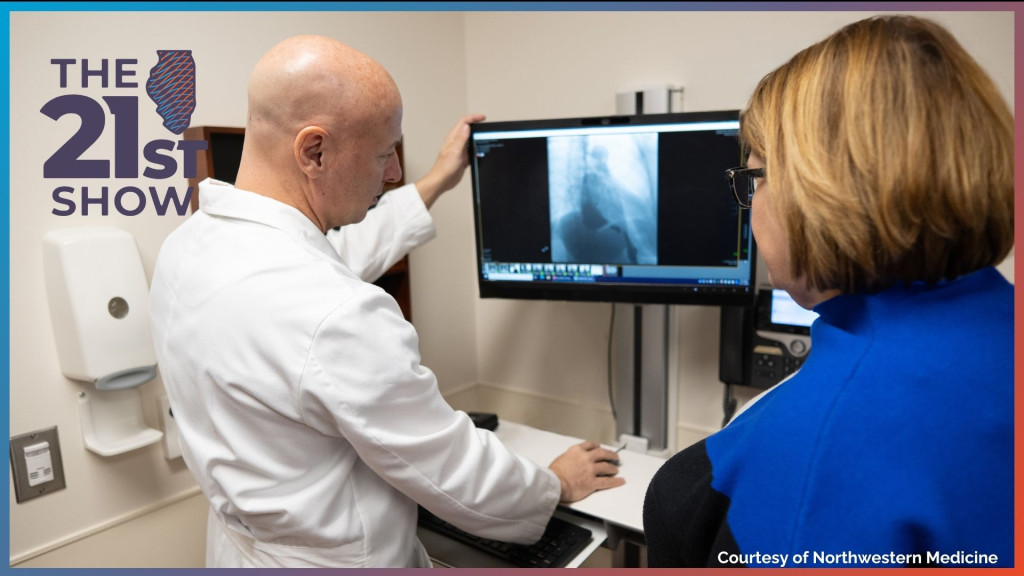
Transcript: Northwestern Medicine using cutting-edge AI technology that could be game changer for certain surgeries
The 21st Show
Northwestern Medicine using cutting-edge AI technology that could be game changer for certain surgeries
Read the full story at https://will.illinois.edu/tags/ai-medicine.
Transcript
// This is a machine generated transcript. Please report any transcription errors to will-help@illinois.edu.

[00:00:00]
Brian Mackey: From Illinois Public Media, this is The 21st Show. I'm Brian Mackey. Current estimates put the world population at nearly 8.3 billion people. And while there are many commonalities among us, each of us is also unique. Especially if we're unlucky enough to get into a complex medical situation. How will we respond to specific treatments? Just because something worked for you does not mean it would work for me.

So, what if doctors were able to test their treatment plans on you? On a version of you, before actually trying it on your body. Northwestern Medicine is developing something just like that with the help of artificial intelligence. They create what they're calling a digital twin, where they can simulate diseases and test how to best proceed with treatment. Another step forward in what's known as personalized medicine.

Joining us now to talk more about this are two doctors that are working to make this happen. Mozziyar Etemadi is an anesthesiologist and strategic director of AI research at Northwestern Medicine's Digestive Health Institute. Doctor Etemadi, welcome to The 21st Show.

[00:01:12]
Dr. Mozziyar Etemadi: Thanks so much for having

[00:01:13]
Brian Mackey: me. Also with us is John Pandolfino, chief of gastroenterology and hepatology and director of Northwestern Medicine's Digestive Health Institute. Doctor Pandolfino, welcome to you as well.

[00:01:25]
Dr. John Pandolfino: Also, thank you for having me.

[00:01:27]
Brian Mackey: Listeners, you can join us today at 800-222-9455. If you have questions about digital twins or the use of AI in medicine generally, let us know. 800-222-9455 is the number. 800-222-9455.

All right, Doctor Etemadi, before we get too far into the weeds, sometimes I like to say, explain this to me like I'm a smart 13-year-old. So, how would you explain this to a smart 13-year-old, how this digital twin process works?

[00:01:59]
Dr. Mozziyar Etemadi: It's a great question, and I think easier now to explain than ever, now that folks are so familiar with things like ChatGPT or other LLMs. So, when you're having a discussion or conversation with an LLM, essentially what it's doing is predicting the next word in its response based on the conversation so far, and I think we're all kind of very familiar with how that works. What we've been doing for quite some time is trying to adapt the underlying technology, not to predict the next word in a chat conversation, but to predict the next clinically relevant event. So for example, folks will get multiple medications prescribed, they will take those medications, those are all events. They'll get vitals like blood pressure, etc. So, if we can adapt the LLM technology to the clinical world, then we can predict next events with the, you know, facility that we already are accustomed to predicting next words.

[00:02:55]
Brian Mackey: Doctor Pandolfino, talk about how you're applying this to your work in particular.

[00:03:02]
Dr. John Pandolfino: Yeah, so we've had the fortunate ability to work with our School of Engineering at the McCormick, where we've been able to take some machine learning approaches using essentially the laws of physics and applying very high-level computation. So multiple computations, multiple simulations over and over to create a simulation or a digital twin of a person's esophagus. Essentially the tube that delivers food from your mouth into your stomach. And by creating this virtual twin, which is essentially a mathematical model created by this machine learning approach, we're able to test whether or not a food bolus will go effortlessly into your stomach from your mouth. And what we can also do is see how surgical procedures will affect that particular problem. So say for instance, you're having a problem moving the food — if we cut the esophagus, if we tighten up the sphincter or loosen up the sphincter, how does that affect how food moves down the esophagus? And using this mathematical model that essentially lives on a server, we can predict maybe the outcome of that particular surgical procedure, and also whether or not you might develop a complication. So, it gives us a little bit of a predictive ability before you actually have the procedure to see how you'll do.

[00:04:23]
Brian Mackey: I'm trying to imagine how this actually feels in practice. Are you running, you know, a million simulations, thousands of simulations, or are you actually like playing this like a surgical video game? What does it look like?

[00:04:35]
Dr. John Pandolfino: So it essentially starts with getting the standard test that someone would typically get if they have a problem in the esophagus. So an endoscopy, a scope where we have a camera, we look at the anatomy of the esophagus, how it moves, then we would do some physiologic testing with something called a FLIP procedure where we actually see how the esophagus, the walls and the muscles respond to something sitting in the esophagus. We then take that information, apply it to this mathematical model as the inputs, and then that spits out the result. So, theoretically, it would occur with the ingestion of this data as an input, then into the model and it spits out the output, and then we can actually say, OK, this is the right approach for you, or maybe we would modify that approach.

[00:05:25]
Brian Mackey: Doctor Etemadi, talk a little bit more about the development of this AI model. I gather you're not just, you know, sort of taking the diagnostic information you have and pasting it into a [cloud] window, the way people would ask for help writing a birthday card or something like that.

[00:05:44]
Dr. Mozziyar Etemadi: You know, great question and great framing actually, because we've all become so accustomed to just pasting things into [Claude] or ChatGPT — not singling any of these out — Gemini. The underlying technology is the key, and we've been doing this since before anybody knew about [Claude] or ChatGPT. So these are very powerful prediction engines that predict the next event, whatever that is. So again, [Claude], etc. — these are words that they're predicting, but there's nobody saying that you have to use words in the English language. You can use a menu of clinical events. So for example, you could have a GI patient and the words in the prompt so far are, you know, the entire video of the colonoscopy or the upper GI study, all of the blood tests so far, all of the doctor's notes so far. So this fills up a long prompt essentially to these custom models and then you're asking this tool, what's the next thing that's gonna happen to this patient? Is it gonna be cancer? Is it gonna be an X-ray that you can then look at and evaluate?

So, I think this is a unique and kind of bespoke approach in two ways. One is we're not limiting ourselves to kind of back and forth in English prose, we were really embracing the richness of clinical diagnostics. And two is because it's so focused on this one problem, it doesn't require massive resources and gigantic compute budgets and, you know, nuclear power plants looking at Three Mile Island to get this done. Basically we can do this in a very efficient and accurate way that helps us help our patients every day.

[00:07:18]
Brian Mackey: Do you have any of the same issues with, you know, hallucinations and things we think of as concerns with large language models?

[00:07:25]
Dr. Mozziyar Etemadi: Great question. So part of why large language models have hallucinations is that they're basically — they have the whole internet crammed in there, so it's not sure: am I supposed to respond to this, you know, as I would on a Reddit post or on a Wikipedia article or a proprietary data source that, you know, we don't know exactly what that is. That's why hallucinations happen and there's a lot of interesting research going into this. For us, it's clean. So we have — for example, if we build a system for Northwestern Medicine, it knows its patients very well, and it doesn't hallucinate because it knows exactly what it's doing. Now, I can't ask our model for GI procedures, for example, to give me a recipe for brownies, but I don't think anybody is expecting that when they show up at the doctor's office.

[00:08:13]
Brian Mackey: Well, it's not gonna suggest amputating a finger if somebody — if you're doing, you know, GI work.

[00:08:18]
Dr. Mozziyar Etemadi: No, and again, I think that's the beauty of this is the hallucinations are a result of confusion and broadness in the data. If you focus down your data and you have it in a patient-specific manner the way that we already do, we won't suggest an amputation because that's never happened before for a GI procedure, right? So I think it's a little bit of a catch-22, like the reason the existing systems hallucinate is because the existing systems are designed in a way that they're supposed to be general purpose. We're completely flipping that on its head.

[00:08:53]
Brian Mackey: Doctor Pandolfino, so I'm wondering when you actually are doing surgery, you reviewed this information generated by these computer models. Can you talk about what you found, what that experience is like actually doing the surgery, how it's helped you in a real-world case maybe?

[00:09:09]
Dr. John Pandolfino: Well, I think one of the great examples of this is a trial that we just have started from the NIH called [PreMedia]. This was actually a trial that came out of observations from our simulation model. We were noticing that there were certain patients who would get a specific type of procedure called a POEM — per oral esophageal myotomy — for a rare disease called [achalasia] that would develop a specific complication. And what we did was we went back and after we identified that this complication was occurring, we actually asked the model, why is this occurring? What are the features of the patient, their esophagus, and then the type of procedure we chose that led to this particular process or this complication. Now that we've done this, we've actually come up with this particular randomized control trial, so multi-center trial, 16 centers, where we're actually gonna test whether or not we can tailor the actual procedure to show that it actually improves outcomes and reduces some of these complications.

[00:10:16]
Brian Mackey: So a different technique or something like that in these cases and you'll do a randomized, yeah, OK, yeah,

[00:10:21]
Dr. John Pandolfino: a modification of a technique that was already there and showing that they're actually equivalent — we can actually reduce the size of the cut, maybe the depth of the cut and actually potentially reduce some of the side effects or complications that could occur.

[00:10:37]
Brian Mackey: Are there any risk factors in using a digital twin as you're thinking about developing this?

[00:10:43]
Dr. John Pandolfino: Well, I think we're still at the process now where there's always gonna be a human in the loop at this present time. There's also gonna be the opportunity for us to look at the data, say, does this make sense? Is this gonna put this particular patient in any jeopardy? And the ultimate decision will always be with the provider. So, I think, you know, the risks are very low. It gives us insight into what we may do, but it is always in line with the human in the loop.

[00:11:15]
Brian Mackey: All right. Let me remind listeners, this is The 21st Show. If you're just joining us, we're talking about digital twins, which is a technology being developed at Northwestern University. As the name suggests, it creates a digital version of you using health data that can be used to test treatment plans before they are administered to a patient.

We're talking about this with John Pandolfino, chief of gastroenterology and hepatology and director of the Northwestern Medicine Digestive Health Institute. And Mozziyar Etemadi, an anesthesiologist and strategic director of AI research at Northwestern Medicine's Digestive Health Institute.

Doctor Etemadi, what are some of the — so we've been talking about a very specific, you know, sort of surgery in this case for a rare condition. What are some of the other applications for digital twins that you all are thinking about or actually using?

[00:12:10]
Dr. Mozziyar Etemadi: Great question. So what I love about the approach we've taken is it starts off very granular, so we're predicting every micro event that happens to the patient, but it doesn't have to stay there. So you can imagine this working on multiple levels. So for a patient themselves, you can get very granular — you know, if you're in the hospital, you can get a future of what's gonna happen in the next hour. If you're out of the hospital and kind of doing doctor's visits, you can get your predictions over the next weeks to months. So that's kind of one level. But then nothing says you can't run aggregates. So for example, let's say you're at the hospital level and you wanna know is this floor gonna fill up? I'll run the future predictor on everyone in the floor and that gives you your answer essentially. You can zoom out a little bit more, do this at the hospital level, health system level, and then, you know, we'd love to collaborate with larger health systems, governments, etc. to do this at a kind of population level. You can get major trends in that case, you know, are there new and emerging diseases? Are there things that are getting better, getting worse, shortages, etc. That's what we're most excited about. It's one system that can really plug into multiple different, very active needed problems.

[00:13:22]
Brian Mackey: And do we as individuals already have access to, you know, data that can be used for a digital twin? What does that consist of?

[00:13:31]
Dr. Mozziyar Etemadi: That's a great point. So the underlying technology to create a digital twin — again, is this underlying large language model technology which is very open source, very accessible — because what we're doing is so purpose specific, it does not require a lot of resources. So I would love to get to a point where a patient can actually download and aggregate their own data from all of the different hospitals and doctors that they visit and then, you know, on their mobile phone potentially, train their own digital twin and it's private to themselves. This is not science fiction — I think right now the level of data and compute required is maybe a little bit larger than a phone, so we're talking like a gaming PC or something like that, but in the next year or two, I think things are going to converge to where this is entirely possible, you know, in the palm of your hand.

[00:14:25]
Brian Mackey: You say it's not science fiction, but I gotta be honest with you. Having been a patient trying to use the electronic health records of my provider, I can tell you where one stumbling block might be in terms of making this data accessible and, you know, easily obtainable. I mean, is that a challenge you all have run into in, you know, prosecuting this — [unclear] — yeah,

[00:14:48]
Dr. Mozziyar Etemadi: Absolutely. I mean that's the challenge. So I'm glad you highlight this because it's not about machine learning, training, GPUs, Nvidia — all this stuff — that is not, like, that stuff is, for this problem, basically solved. What you're describing is the problem. It is that in the U.S. traditionally our health, our electronic health records are barely electronic. If you look at the world's or the U.S.'s leading electronic medical record provider, Epic — the source code is 30-plus years old at this point. You look at Cerner, No. 2, it's 25 years old at this point. So this is the challenge. I think things are modernizing, not obviously as fast as all of us would like, but things are definitely headed in the right direction. When we can get health records to the level of, you know, even Gmail or something like that, Hotmail from the '90s, I think this problem is solved. That part is also sounds like science fiction, but I do think we're getting there too. There's a lot of initiatives happening where, again, I think, you know, we're years — years if not less — away from this.

[00:15:48]
Brian Mackey: We shall see. All right, we're gonna continue this conversation. We're speaking with Mozziyar Etemadi, who is strategic director of AI research at the Digestive Health Institute at Northwestern Medicine, and Doctor John Pandolfino, chief of gastroenterology and hepatology and director of the Digestive Health Institute at Northwestern. We'll talk a little bit more about digital twins when we return. If you want to join us, if you have questions about this advance in medical technology, the number is 800-222-9455. More to come. This is The 21st Show.

It's The 21st Show. I'm Brian Mackey. We are talking about digital twins in medicine — a technology being developed at Northwestern University that creates a digital version of you using your health data, and it can be used to test treatment before administering it to a patient. We're talking about this with [Mazia Amati — check spelling], a doctor, anesthesiologist, and strategic director of AI research at the Digestive Health Institute, part of Northwestern Medicine. And Doctor John Pandolfino, chief of gastroenterology and hepatology and director of the Digestive Health Institute at Northwestern. If you wanna join us, 800-222-9455. That's 800-222-9455.

Doctor Pandolfino, we've been talking about surgical treatment. Is there a role for this digital twin technology — or talk maybe more about the possibilities for preventative healthcare, right? That's a big focus in medicine these days.

[00:17:36]
Dr. John Pandolfino: Yeah, I certainly think there's definite opportunities in terms of prevention. I mean, we can identify specific processes that could potentially continue to get worse, where someone may develop worsening function of their esophagus or their GI tract, and I think that's been something that's been really important. One of the luxuries we've had, at least in the Griffin Esophageal Center, is that the Griffin Catalyst Fund has supported us to work on this particular approach where we can actually identify things early enough that we could potentially prevent things from progressing. So I think prevention is certainly something we're very interested in. We're not just interested in the future, but also the present and working with the patient using these particular technologies.

[00:18:26]
Brian Mackey: You did your training, what, in the '90s? Can you just talk about the development of technology in your field in particular and, you know, if your, you know, resident self could imagine some of the things you're doing today?

[00:18:38]
Dr. John Pandolfino: Yeah, I think it wouldn't even be imaginable to think about what was going on today back then. You know, we were doing fiber optic endoscopy. No one was collecting data. We were left at a very poor advantage in terms of doing anything like this. And really, the fact that we work with a very large medical system, Northwestern Medicine, that has 11 hospitals and all of this data — you know, we really were very lucky that we had access to this — because thinking back 20 to 25 years ago, you know, there's no way that we thought we would be able to predict whether or not someone had a disease from images just from an endoscopy. That you would typically need an endoscopy and multiple tests and X-rays. We could look at an endoscopy now, some videos, and give people a diagnosis with 90% probability of accuracy. So, really exciting, and can't really even think to imagine that we would see this coming to fruition in the future.

[00:19:45]
Brian Mackey: Doctor Etemadi, you know, people — there's all kinds of things people can do in medicine to learn more about their health profile, right? Genetic testing, that sort of thing. A lot of people would rather not know, right? Like there's that philosophical question, if you could learn when you were going to die, would you wanna know or would you rather never know? And I wonder how you think about that and as you are, you know, able to develop greater predictive models that can look at someone's potential health outcomes, you know, how — what is the ethical way to use that data and how are you thinking about that?

[00:20:22]
Dr. Mozziyar Etemadi: 100%, great question. So, in everything we've done over the last 15 years, we've always involved patients and patient advocacy groups in every bit of it, and I think that's the short answer is, you know, I can't decide that as an AI designer, we need to collaboratively come up with this decision. I will say in our kind of early forays at deploying these tools, it's not a dichotomy between we're gonna predict when you die or not. It's that we predict actually — the things we predict with the highest accuracy are very early markers of disease that actually when you intervene, make it impossible to predict when something bad is gonna happen because it's so far out in the future. So I think of it like a little like a flashlight cone, you know, we're stuck kind of early on in the flashlight and as long as you focus on those things, then kind of the bigger, scarier, longer term things, you know, they don't even enter the picture.

[00:21:20]
Brian Mackey: What about patient privacy? How are you dealing with that?

[00:21:24]
Dr. Mozziyar Etemadi: So this is one of the few areas which I think the government has done a great job over the last, you know, several decades. Patient privacy laws in the U.S. and abroad are very strict and very serious, and I think that's again why I think doing this type of development that we're doing, which is bespoke to the patient, bespoke to the hospital, to the doctor in a way that anyone else can do it too — it's not a proprietary thing, right? It doesn't require massive resources, massive numbers of GPUs. It means that it can be decentralized, which means that it can be totally private. So what could be more private than running it on your own personal device where it's encrypted and nobody has access to it, I think. Fortunately, we're in this kind of overlap where doing things kind of small and proprietary — or small and accurate and not general purpose — lends itself to privacy. So it's really a win-win situation, and I honestly wouldn't want it any other way for myself or my patients, my family, etc.

[00:22:26]
Brian Mackey: So your title is strategic director of AI research, if I have that right. So, what other areas are you looking at in terms of integrating, you know, this hot new thing that everyone's been talking about for a few years now — AI — into medicine at Northwestern?

[00:22:40]
Dr. Mozziyar Etemadi: It's a great question. So we used to think of this as different modalities. So you have your X-ray stuff, your mammogram stuff, your — Doctor [Pandolfino] was mentioning, you know, GI video stuff, endoscopy videos. I think what's super exciting is that these separate kind of parallel universes are — it's all just bits on the computer now. So how different really to a computer is an X-ray from a video, from a CAT scan, from a doctor's note, from an EKG? It's not that different actually. It's more different to the human than it is to the computer. So what's super exciting to me is we're starting to discover these subtle connections between these different modalities that we never imagined possible. Classic example I always go off of — and this is from a startup or a research lab outside of Northwestern, so I have no skin in the game — they're able to predict from an EKG, so this is stickers you put on your chest and you get a waveform, they're able to predict blood test results in some cases as accurately as actually drawing your blood, right? This is exactly, I think, the future here — is personalized medicine that's private on device where you're getting insights into the future using the data you already have or tests that you would normally get that you would never imagine they would give you these types of results.

[00:24:03]
Brian Mackey: Doctor Mozziyar Etemadi, Doctor John Pandolfino, thank you so much for sharing some of your work with us today on The 21st Show.

[00:24:10]
Dr. Mozziyar Etemadi: Thank you so much. Thank you.
Transcript Assistance
Illinois Public Media may use AI assistance for transcript generation and/or formatting. Transcripts that have not yet been reviewed for accuracy will be labeled.
To report a transcription error, or to request transcription of archival material, please contact will-help@illinois.edu.