








Transcript: Cory Haala on the populism that powered Midwest Democrats
Transcript: Cory Haala on the populism that powered Midwest Democrats
The 21st Show
Cory Haala on the populism that powered Midwest Democrats
Read the full story at https://will.illinois.edu/tags/book-examines-the-populist-movement-of-the-80s.
Transcript
// This is a machine generated transcript. Please report any transcription errors to will-help@illinois.edu.

[00:00:00]
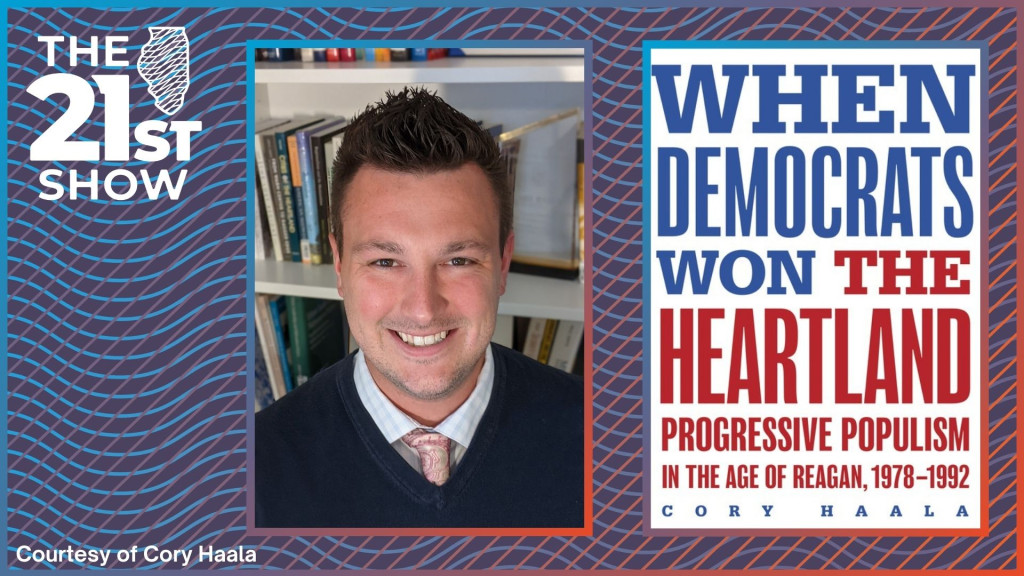
Brian Mackey: Today on the 21st show, imagine a time in America when conservatism was on the rise and nationally, Democrats were fighting over how best to respond. This happened in the 1980s, and while the Dems argued, they were racking up a series of electoral defeats. And yet, here in the Midwest, progressives made a populist case that resonated with voters in Middle America, urban and rural, Black and white. All this is the subject of a new book by historian Corey Haala. It's called "When Democrats Won the Heartland, Progressive Populism in the Age of Reagan." I'm Brian Mackey. We'll talk with Haala about that history and its relevance for what's happening today here on the 21st show, which is a production of Illinois Public Media. But first, news.

From Illinois Public Media, this is the 21st show. I'm Brian Mackey. And today on the program, we're going back to the 1980s, a time of bright colors and spandex, synth pop music and hair metal bands, and a series of humiliating electoral defeats among Democrats.

[00:01:26]
Speaker 1: CBS News. This is Charles Osgood at CBS News election night headquarters in New York. The polls have just closed in California and bango, the state of California has gone, as has every other state that has cast its votes so far for Ronald Reagan. Mr. Reagan now has 4[74] electoral votes according to our count, Walter Mondale has only the three from the District of Columbia.

[00:01:47]
Speaker 2: The president said he feels sorry for Walter Mondale. In his words, I'm quite sure there isn't anything I can say to make him feel better.

[00:01:55]
Speaker 3: This guy made McGovern look like William the Conqueror. You know, I don't remember the final count but I know when I went to bed Reagan had 598 electoral votes. Mondale had 3. You think about it, that's only 3 more than I had. I didn't even run, you know — I mean, this guy spent $40 million and I almost tied him. So, uh,

[00:02:17]
Brian Mackey: Stand-up comedian Dennis Miller following excerpts of a report from CBS Radio News. Rest in peace, CBS Radio. That scale of defeat following the Democratic Party crackup in the 1980 presidential primary led to a lot of soul searching. What should the Democrats stand for? How should they respond to the disruptions of the era, which included high inflation, job loss from deindustrialization, and a debt crisis on family farms. One line of thinking urged Democrats to moderate on business issues, make peace with corporate America, do what you can to help the workers land on their feet. But another line of thinking saw the answer in populist traditions, grassroots activists coming together to seek a more fair distribution of wealth and power. And that second idea, progressive populism, took root in the Midwest, and it allowed Democrats here to find political success, even as the party struggled nationally.

All this is the subject of a new book by the historian Corey Haala. It's called "When Democrats Won the Heartland, Progressive Populism in the Age of Reagan." It's out recently from the University of Illinois Press, and you know, it's a serious book cause even the subhead has a subhead, 1978 to 1992. Corey Haala earned his bachelor's degree from Northwestern, his master's and Ph.D. at Marquette. Today, he's an assistant professor of history at the University of Wisconsin, Stevens Point, where he's also museum studies coordinator. Corey Halla, welcome to the 21st show.

[00:03:47]
Corey Halla: Thanks, Brian. Thanks so much for having me.

[00:03:49]
Brian Mackey: Listeners, you can join us today. 800-222-9455 is the number. That's 800-222-9455. All right, let's begin by setting up the era more than I did in the introduction there, right? Nationally, this is a time when it seems conservatives are ascendant. Lay it out for us.

[00:04:12]
Corey Haala: Well, it is an era of conservative ascendancy and it's one that particularly we tend to jump right in with Ronald Reagan winning in 1980 and then, you know, as Dennis Miller reminds us, romping in 1984, but you know, look to the state level and you see that kind of conservative wave happening even earlier, especially in the Upper Midwest, the five states that I cover in this book — Iowa, Minnesota, North Dakota, South Dakota, and Wisconsin. Democrats hold across those five states in 1977, 9 out of the 10 U.S. Senate seats in that region. They hold 16 out of the 26 seats in the House of Representatives, they hold 4 of the governorships, a majority of state legis[latures]. Within just a year, a number of those governorships have flipped, a number of those House seats are gone, and when the dust settles after Ronald Reagan's election in 1980, Democrats are down to just two of those U.S. Senate seats out of 10. They've lost all 4 of those governorships, they've lost a number of House seats. It's just an absolute disaster for the Democratic Party, not only in 1980 but 1978 as well.

And looking down at the state level, we see a number of the different issues that animate voters — from the kind of the anti-tax revolts of the late 1970s, some of the anti-abortion, anti-feminist, anti-LGBTQ politics. But some of the frustration with the Democratic Party and just kind of business as usual, an institutional drift within more liberal and Democratic circles. And it really is something the party reaps at the polls and something that, you know, grassroots activists and party officials alike are trying to figure out by 1981: how do we rebuild from just this catastrophic defeat.

[00:06:07]
Brian Mackey: And to say more about what was behind that. I mean, you know, because on the one hand, you think, OK, we just came out of the Watergate era. That was a low ebb for Republicans nationally. Jimmy Carter is able to capitalize on that. What changed in the '70s for Democrats?

[00:06:23]
Corey Haala: You know, an economic climate that really shifts not only against Democrats, but shifts against kind of Main Street America, working class Americans, whether they are more blue-collar labor, whether they are in factories and farms, as Americans pivot as well to work in more of the kind of service and the tech industries. We see this hollowing out of the economy of the Midwest in particular, the struggles that we associate with the Rust Belt. With the industrial heartland of the Great Lakes region is something that's absolutely felt in cities in — I'm sorry, in eastern Wisconsin, like Milwaukee, Racine, Kenosha, things that are felt all the way up on the Iron Range of Minnesota, but that echo as well in rural America in particular, as farmers are encouraged throughout the 1970s to chase kind of bigger and bigger farms, bigger payouts. The Secretary of Agriculture under Richard Nixon, Earl Butz, who encouraged farmers to plant sort of fence row — and really underpinning all this was that they should get bigger or get out. All of that, you know, for agriculture is continuing to lift it through what some historians have called the go-go '70s. But that all kind of comes crashing down in one way or another by the late 1970s.

And you see this rebellion against some of those policies of Jimmy Carter, somebody who comes to the presidency in 1976, promising to be a different kind of Democrat, a breath of fresh air for the United States, but somebody who does kind of lean into what we talk about as neoliberal economic policy — deregulating airfare for one, but deregulating railroads for another — and leading to the kind of the massive outmigration of capital from the, especially the rural heartland. And then making the decision to embargo grain sales to the Soviet Union following their invasion of Afghanistan late 1979. Something that really does lead to kind of this just catastrophic collapse in the Midwest of the Main Street kind of economy, not just in family farming, but implement dealerships, small banks, and to say nothing of the blue-collar workers who are hurting at the same time.

And so it is those policies that even as Democrats bring in those Watergate babies in 1974, even as Jimmy Carter is elected in 1976, we don't see material changes in the actual economic positions, the economic fortunes of working class Midwesterners. At the same time as government is absolutely being tagged kind of in the Ronald Reagan way that, you know, "I'm from the government and I'm here to help," that government is not the solution to our problem, government is the problem. At the same time as many of the kind of social programs and the mandates of the 1960s are still in place. You see this kind of perfect storm for a rebellion against the, you know, the quote-unquote big government kind of stylings. Well, what good has it done us if family farms are saddled with debt? What good has it done us if capital and business are continuing to leave our communities? It really does translate into revolts across the board in 1978 and 1980.

[00:09:27]
Brian Mackey: You mentioned neoliberal policies, and this is a term that is still thrown around now as an epithet in some circles in politics, especially on the left. Can you talk about what the Steelman case is? What were the people espousing those policies trying to achieve?

[00:09:46]
Corey Haala: They're trying to achieve a — not necessarily restructuring of the American economy, but certainly trying to create a system in which growth can be the name of the game. Trying to pivot to some of the high-tech kinds of programs, some of what we talk about as some of the suburban liberalism that historians have studied out in places like Boston, approaching public-private partnerships while enforcing at the same time kind of austerity along social welfare programs and trying to turn toward policies that generally benefit multinational corporations, that benefit larger industry, with the idea that this is going to create jobs, this is going to create growth. If we're merely restructuring things in such a way that — we don't want to completely undo labor rights, we don't want to completely sell out, sell American workers, but we do need — some of this logic goes — to pivot toward a little bit of free trade, to deregulate just a little bit, perhaps as a treat for these businesses, in exchange for creating some of the jobs, creating some of the conditions necessary for Main Street to grow once again.

[00:10:56]
Brian Mackey: So then contrast that with this idea of populism at the time. And populism — we can talk about the sort of different definitions people have of that: right wing, left wing, historic, modern. But I guess, yeah, let's set that up. Maybe we should dive into that first, maybe. What do people mean when they talk about populists?

[00:11:15]
Corey Haala: Absolutely. So the kind of core — in one of the early moments in the book — and [the source] does use profanity, so I'll do my best to avoid an [FCC] fine here, for you, for me, for anyone. But this is the agriculture commissioner of Texas, a guy named Jim Hightower, colorful, kind of populist, outspoken Democrat who talks not only in a very appealing, very kind of confrontational, loud style, but really importantly has the policies and has the kind of approach to restructuring government that really does characterize populism in the American tradition. And he's talking about watermelon growers in Texas who are struggling in the early 1980s. But he contrasts liberalism and populism, and he says, you know, with these struggling watermelon growers, if we'd have been liberals, we'd have retrained them to do something else. But as populists, he says, we changed the market structure that was — he uses a more colorful word — we changed the market structure that was screwing them over. And he says that's the difference, right? That neoliberalism tends to accept and tends to lean into, or steer into the skid, of where the economy is taking average Americans — you know, perhaps puts its thumb on the scale to ensure growth but believes that a rising tide is better than none at all. Whereas populism is saying no, no, no, this structure and this system is rigged against average, you know, small producers, it's structured against small consumers, and it's the responsibility of government to actually rebalance things out for the benefit of working and average people.

[00:12:50]
Brian Mackey: So how does this idea begin to take root among Democratic politicians in the Midwest at this time, right? Because it had sort of had its moment a century earlier — or not quite a century earlier, but, you know, decades and decades earlier. How does it take root again?

[00:13:06]
Corey Haala: Well, it begins at the grassroots. And one of the — you know, we'll get into, I'm sure, some of the conversations that happened with senators, particularly senators like Tom Harkin of Iowa, Paul Simon of Illinois, Paul Wellstone of Minnesota, Russ Feingold of Wisconsin. But a really core idea here — to both understanding the populist movement of the 1880s and 1890s, and understanding the kind of resurgence of populism in the 1980s — is that it has to happen first with the people. Right? It has to happen first at the grassroots. And one of the really interesting things that I discovered early on in some of my research for this book was finding grassroots groups — you know, small little kind of magazines or small little advocacy groups that existed in North Dakota, in Saint Paul, Minnesota — that were talking about the economic challenges that they faced in the 1980s: issues that — challenges in, struggles facing folks trying to preserve our environment, struggles for folks who are trying to be small, 160-to-200-acre small family farmers and trying to make ends meet. And saying that, you know, how has it gotten so that you can't be a small family farmer? How have things changed so that you cannot support your family on, you know, a one-income household? It used to be that this was possible and something's changed. They feel the ground moving underneath their feet, and all of a sudden we start to see this resurgence of looking at — well, once upon a time there was a way in which things were structured in the Midwest differently. The government would intervene on behalf of working-class people.

This takes the form in North Dakota of a film — not a documentary — called "Northern Lights" in 1977, which looks at the history of a radical, progressive populist kind of caucus of the Republican Party called the Nonpartisan League in the 1910s in North Dakota. We see that film distributed, screened in North Dakota, but in places like rural Minnesota and rural Iowa, where activists are watching this and learning from this and saying, well, hey, what if we were to go out and organize people talking about, you know, the Great Depression, talking about the ways in which in the 1890s, average farmers got together and tried to regulate railroads, tried to get government to be more responsive on their behalf. And that really takes the form of this kind of awakening where folks begin to talk about the regional traditions, the just the kind of slightly different ways in which Midwesterners historically have done politics.

And that rediscovery includes the Nonpartisan League in North Dakota, where the Democratic Party is still to this day known as the Democratic-NPL Party, a merger that happens in the 1950s. That plays on Minnesota as well. There was a third party from 1918 to 1944 called the Farmer-Labor Party, and Minnesota since 1944 has had the Democratic Farmer-Labor Party, the DFL. Activists are beginning to explore, to rediscover and to talk about those kinds of parties and those kinds of politics in the late 1970s and early 1980s, and begin to grab not only their style, but their politics and say, hey, we need moratoria on farm foreclosures. Hey, we need to rein in the excesses of big business. We need to support unions and support working-class people. And politicians really do begin to take notice and to earnestly engage with the kinds of grassroots organizers, the grassroots groups, and the policies that they're espousing.

[00:16:45]
Brian Mackey: Yeah. All right. We need to take a break on the program. We are talking today with Corey Halla, who is the author of the new book "When Democrats Won the Heartland, Progressive Populism in the Age of Reagan." You might hear some overtones that echo today for debates Democrats are having about how best to come out of the political wilderness in which they find themselves. We're going to continue this conversation after a break. If you want to join us, the number is 800-222-9455. We'll also have some text messages to share. This is the 21st show. Stay with us.

It's the 21st show. I'm Brian Mackey, and we're talking today with Corey Haala. He's a historian of the Midwest. His new book is "When Democrats Won the Heartland, Progressive Populism in the Age of Reagan." He's also on the faculty at the University of Wisconsin, Stevens Point.

We asked members of our texting group about this — specifically, how you think progressive populism would be received today and how well, if you remember that era, how well Midwest Democrats handled the Reagan era. And, you know, what key factors are holding back Democrats today. We heard from Aaron in Springfield, who says progressive populism is the key for a healthy modern Democratic Party. The embrace of [MAGA] shows people are desperate for a political ideology that takes them seriously and supports them against entrenched power. The Dems need to stop focusing on the vanishingly small cohort of convertible neocons and activate the underrepresented masses that would respond to an honest, pragmatic, progressive economic and social policy. Thanks for that message, Aaron. Appreciate it.

You can join the conversation at 800-222-9455. 800-222-9455. So, Corey Haala, let's talk a little more about this approach that Midwest Democrats are taking and how that contrasts with what's happening at the national level, because this is where you start to feel the echoes of debates that we've been hearing for the past 10 years or more in politics today.

[00:19:10]
Corey Haala: It absolutely is a struggle between some of the maybe more known or talked-about groups — the Democratic Leadership Council in particular, the — to throw around the word again — neoliberal, or kind of moderate free-market-oriented wing of the Democratic Party. But one of the things that gets covered up in the process is the very vibrant way in which Midwestern liberals, as I call them in the book, but progressive populists, really did try to — not just at the local and state level, but at the national level — try to chart a new way forward.

And this is something that really does begin in Iowa, in Illinois, and other places. In February of 1983, two congressmen at the time — Tom Harkin from Iowa and Lane Evans from Rock Island — announced that they're forming what they call the Congressional Populist Caucus. And they talk about that they are going after imbalances in economic power, and they promise that they're going to serve the interests of the common people. They really do push in Congress this idea that they're going to fight for, you know, anti-plant closure laws, that they're going to fight for — they're going to oppose banking deregulation, they're going to oppose natural gas deregulation, and really express a lot of concerns about economic ownership and the economic future of the United States. And they talk about and they define this as progressive populism and really pit themselves in contrast to the emerging neoliberal, the emerging moderate consensus within the Democratic Party that is very much under the leadership of Chuck [Manatt], the DNC chair, under the leadership of [the] Congressional Campaign Committee Chairman Tony Coelho of California, and early on in Rahm Emanuel's career as well, that is really seeking to strip mine kind of corporate cash for all that they can, as that means of rebuilding the party. The Congressional Populist Caucus and a number of these progressive populists really do stand opposed to that and believe that people power is the way forward.

[00:21:18]
Brian Mackey: You know, one of the interesting elements you identify about the populism in the Midwest is that there is cross-racial solidarity as well as urban-rural solidarity. How did they pull that off?

[00:21:31]
Corey Haala: Well, in fits and starts. It's one that, you know, we ought to be clear-eyed about — that there are certainly racial fault lines that still exist within this movement, but it is one that by talking about and by really inviting folks, not only into conversation, but really kind of encouraging Midwestern small producers, encouraging Midwestern farmers, Midwestern laborers to confront and to share stories with one another, they really do attempt to reach across these racial divides nationally and these racial divides at the state and local level.

One such example in the book is what's called Farm Labor Solidarity Day. This is November of 1983, and it involves, in Minnesota and in Iowa, this just very — as the name suggests — farm-labor solidarity where they invite farmers into more kind of urban spaces. Farmers who are struggling to get a fair price for the commodities that they're producing — in particular the corn, the wheat, and the hogs that they're producing. Farmers come to union halls in Waterloo, Iowa, and in Duluth and Virginia, Minnesota, and give away some of their food. They donate it to food pantries, they send all the workers — members of a UAW local in Waterloo — home with a free pound of pork sausage. But they encourage these workers to listen to speakers in common and to talk to one another in the hall and to build these kinds of solidarities based not necessarily on identity — on race perhaps — but on class. Right? The ways in which, hey, you know, deregulation is hurting us. The ways in which, whether it's John Deere, whether it's the local meatpacking plant, the ways in which they're threatening to hire scab labor, the ways in which they're threatening to close their shop and relocate it elsewhere without recognizing a union local — that those things cut across occupational lines, they cut across racial lines, and that in fact if we could be talking about these things more often, we could really understand the ways in which these kinds of racial divisions are — perhaps not entirely, but perhaps a little more superficial than we give them credit for.

[00:23:47]
Brian Mackey: All right, if you want to join us today, the number is 800-222-9455. And let's go now to the phones. We have Paul calling from Urbana on line one. Paul, thanks for calling in.

[00:23:57]
Paul: Well, I have another issue and it talks about the similarities of — tonight, today — and then, but I can't not mention Jesse Jackson. Jesse Jackson explicitly lampooned the Democratic Leadership Council and called them the Democratic leisure class. I mean, this wasn't called neoliberalism then, but it was, you know, the same kind of corporate influence that the Dems now have. Now, what I premise of my call was about the opportunity of this opposition to data centers and big money, big investments, with very little consideration to the population. The Democrats at the leadership level are, you know, they're talking about AI and innovation. They're not talking about how it's going to affect people's lives, and it's a perfect analogy, and there's a lot to chew there, but I just have to get into something else about that whole neoliberal era, and it's never talked about — and it's the Bayh-Dole Act, which has only been used by Trump to go after Harvard and their patents, but it's basically a way of recapturing control over patents and the medical pharmaceutical industry when they're using research that was paid for by the U.S. government. This is what allowed that to go ahead, and the provision that allows it to be captured back is never used except, as I mentioned, surely by Trump. So, yeah, yeah, thank you.

[00:25:47]
Brian Mackey: All right, Paul, thanks for the call. A lot to cover there. I'm going to ask us to put a pin in Jesse Jackson. He's definitely on my roadmap — a big part of your book as well. So we can come back to that a little later. But I don't know if you want to respond to some of the other things that Paul had to say there about, you know, neoliberalism and maybe echoes today with data centers or this law he was talking about.

[00:26:07]
Corey Haala: Both with data centers and with AI, I think you see that idea. And perhaps with [Bayh-Dole] as well — the ways in which these public-private partnerships tend to be one-way streets, right? Another tax break, another kind of incentive to move in. At the same time you have local residents — think about all the graduation speakers we've seen booed in the last couple of weekends alone as they talk about AI to college graduates — the ways in which these policies are being met with resistance at the kind of the micro level. That there is this discontent out there with just blind acceptance of kind of a business-oriented future. You certainly see that in other ways, in other avenues in the late '70s and especially into the 1980s, as we talk about healthcare, as we talk about farm policy, as we talk about labor policy. Absolutely, there are certainly avenues for resistance that, you know, I'm glad Paul's identifying some ways in which these are repeating in the present era.

[00:27:06]
Brian Mackey: All right, let me remind listeners we're speaking with Corey Haala. His book is "When Democrats Won the Heartland, Progressive Populism in the Age of Reagan." If you want to join us, 800-222-9455 is the number. 800-222-9455.

Well, before we get to Jesse Jackson, I want to talk — you know, this is an Illinois show. My eyes are always drawn to the Illinois figures in books like this. You mentioned Lane Evans already in his role in co-founding the Congressional [Populist] Caucus. Talk to me also about Paul Simon and his role in this movement you're talking about.

[00:27:43]
Corey Haala: Yeah, Paul Simon is really a fascinating figure within this because when he runs for president in 1988, he is very much being told by some of his advisors, here are some of the traditions that you should be leaning into. He's getting advice from a very progressive pollster named Vic Fingerhut who's telling him — you know, when you make a 30-minute speech, he says, do 5 minutes on the deficit or whatever, and then do 20 minutes to the audience, right? Taking somebody like Paul Simon who has this squeaky-clean kind of image, who's from Route 1 in Makanda, Illinois, right? — that's, you know, population 402. And I really had to think about Makanda as I did that because I said it wrong the first time I went down there, and, oh boy, nothing turns a head quite like pronouncing Makanda wrong, you know.

But they're being advised — and Lane Evans actually tells Simon to explicitly run a populist campaign, tells him, hey, look, you know, there's agricultural, there are working-class concerns, trade, there's healthcare, there's education, and there are these ways in which, you know, it cuts through some of the GOP branding of Simon and of others as being liberal, as being special interest, as being tax-and-spend kinds of folks. Building that kind of grassroots farm-labor support is something that Paul Simon really taps into. He's already got the small-town kind of Protestant image — the Mr. Smith goes to Washington kind of style and approach — but he really, at the advice of folks like David Axelrod in 1987 and [1988], is emphasizing these kinds of local, authentic connections that really do harken back to that small-town Protestant kind of ethic of the rural Midwest. And it is something that Simon really does make a name for himself in the 1988 Democratic primaries as a politician who is unquestionably progressive, certainly, and is kind of learning on the fly what that populist campaigning actually does mean.

[00:29:51]
Brian Mackey: But as you say, Simon's appeal — you know, he is appealing to progressives, but nowhere near to the level that Jesse Jackson is in '88. And this comes four years after a pretty — I don't know if shambolic is overstating it, but not a great campaign in 1984. He does pretty well in 1988. So set that up for people who may not have as clear a memory of that. What is Jesse Jackson's project in 1988?

[00:30:18]
Corey Haala: So to understand Jesse Jackson's '88 campaign, it really — you do have to understand how shambolic the '84 campaign was, how naive or kind of unsophisticated the '84 presidential campaign was, including, you know, an antisemitic remark made about New York City, and just a ground game in the Midwest, especially, that really was lacking. But what Jesse Jackson does between 1984 and 1988 shows really the potential of that grassroots organizing, the ways in which it cuts across some of the kinds of electability concerns, the "Is America ready for a Black president?" kinds of concerns. Now, still absolutely was an important part of understanding, you know, ultimately Jackson's shortcoming — or his falling short — in the 1988 presidential primaries.

But, you know, Jesse Jackson has alliances with some of the grassroots groups and activists who I mentioned earlier, are talking about populism at a very early stage in the 1980s. He goes out to and is really allied closely with a group called the North American Farm Alliance and its leader Merle Hansen, who's a farm organizer out of Nebraska, who's now active in Iowa. And Jackson would be photographed often at the farm of a farm activist in Iowa named Dixon Terry in Greenfield, Iowa. He'd stay at his house, he'd help with the chores in the morning, he'd have a seed cap on. But he's out there not just in 1987 and in 1988 when the Iowa caucuses are ramping up. He's out there in 1985. He's doing this kind of long game, this work — and now absolutely thinking about a presidential run in 1988 — but he's doing this really with this authentic kind of appeal of talking about the farm crisis as a social justice issue, encouraging farm advocates and blue-collar workers in rural and exurban Midwestern cities to think about racial issues, social justice issues as an economic crisis at the same time. Building those bridges across these groups.

He shows up in Austin, Minnesota, when the P9 local at the Hormel plant in Austin, Minnesota, is on strike in 1985, 1986. He shows up at the [Cudahy] meatpacking plant just outside Milwaukee in 1987, at strikes in Brown County, Wisconsin, and elsewhere. He's really pounding the pavement and doing this kind of grassroots people-power politics, that by the time the 1988 Democratic caucuses and primaries roll around, the party is caught a little bit off guard by — and does eventually coalesce around the Michael Dukakis of the world, somebody palatable enough to the DLC, the leisure class kind of folks that Paul referenced earlier. But Jesse Jackson really does lean into that progressive [populism], really does embody some of those kinds of principles in a very authentic manner. And in 1988, there are other candidates running — there's Paul Simon, there's [Richard] Gephardt of Missouri — all folks who are trying to occupy this kind of lane that I argue in the book shows just how prominent this cause had become, shows just how popular this approach to politics was becoming within the Democratic Party by 1988.

[00:33:23]
Brian Mackey: All right, let me read another message from a listener. This is from Sarah in Bloomington in our texting group. The answer to electoral defeat — she's talking about the issues today — the answer to electoral defeat is recruit unlikely candidates, candidates who are everyday people who yesterday had no ambition to be an elected official, but always felt passionate about an issue that politicians can impact, such as Bernie Sanders' passion for single-payer healthcare. We need to recruit people like myself and my friends — not literally us, she says — people like us who truly care about issues and know how our own lives would be much improved if specific policies were put into action. The typical politician doesn't compare to a real person with a real passion. That is how we overcome electoral defeat, Sarah says. Thank you for that message, Sarah. Appreciate it.

If you want to join us today, 800-222-9455. We're going to take another break and then we will have the last part of our show with Corey Halla. He is a historian, professor at University of Wisconsin, Stevens Point. His book is "When Democrats Won the Heartland, Progressive Populism in the Age of Reagan," but as you can hear, some overtones for today. We're definitely going to get to that. Again, if you want to join us, 800-222-9455. This is the 21st show. We'll be right back.

It's the 21st show. I'm Brian Mackey, and today we are talking with Corey Haala. He's the author of the book "When Democrats Won the Heartland, Progressive Populism in the Age of Reagan, 1978 to 1992." It's recently out from the University of Illinois Press. If you want to join us today, 800-222-9455. 800-222-9455.

You know, before the break, Corey, we heard that message from Sarah from Bloomington talking about, you know, the answer is to recruit unlikely candidates, right? Everyday people. You hear this said about [Graham Plattner]. It reminded me of the anecdote in your book about the man who had changed his name — to Paul [Wellstone's name] as his first name, even though he's Vietnamese. And you had this line, you know, he seemed to be just like one of us, right? And I guess, you know, maybe you can talk about the personal appeal of these individuals — candidate selection, I think, is the term that political activists use.

[00:36:12]
Corey Haala: Absolutely. You're referencing [the Wellstone fan] from the conclusion, somebody who did, you know, change his name as an ode, as a thank you to somebody who helped to reunite his family in Minnesota. And Wellstone — you know, Paul Wellstone really does represent, to Sarah's point, one of those kind of unlikely candidates within all of this. Running in Minnesota in particular as a, you know, a curly-haired Jewish professor from the D.C. Beltway, who has a Ph.D. and teaches at one of those kind of liberal bubble colleges in rural Minnesota, Carleton College. But who runs strong and has this great appeal in the rural parts of Minnesota — both the kind of rural farm communities, but up on the Iron Range of Minnesota as well, very blue-collar, very extractive-industry-oriented part of the state.

And it's the unlikelihood of his candidacy — it stems from the ways in which he had worked to build relationships with the voters in those parts of the state, to go out and really to take seriously their economic concerns, and then work to represent them — for one, but to frame them in ways that helped build a coalition statewide that worked to help bring these different groups together and to find the symbols as well that represented the struggles that faced average people. In the way that somebody like Paul Simon had his bow tie, right? Somebody like Paul Wellstone had [the] Green Bus — this beat-up old school bus they painted green, this claptrap thing that would break down, you know, time and time again, but that represented really a symbol of how average people were struggling to make ends meet, that we're all doing kind of the best that we can. But something that really did make him relatable to voters up on the Iron Range of Minnesota, a region very much dominated historically — or settled historically — by working-class Eastern Europeans, Scandinavians, Finns in particular, having their own radical political tradition. Wellstone goes up there and ingratiates himself to the point that they're talked about — in the words of an Iron Range historian, Pam [Brunfelt] — as being [one of us], being one of us.

Despite the fact that when he does a commercial called "Fast-Paced Paul" in 1990 — that I encourage your listeners to look up — in "Fast-Paced Paul," he at one point calls [our waters] [unclear] and you can tell that there's this little slip of an accent there — from this kind of Maryland or this mid-Atlantic kind of accent — he's not one of us. And yet, he has built so many relationships and worked so hard on Main Street to shake enough hands, but to listen earnestly to the people whose hands he's shaking, that he really does make the case effectively and authentically that he understands your fight, right? That he's part of your community and he's working to improve lives for all kind of Midwesterners. And that's something that again cuts across — to the point that a Vietnamese immigrant is changing his name to Wellstone as an ode to him — but that folks are coming out of their farmhouses, coming out of their union halls and thinking that, hey, this guy on the Green Bus, he's got ideas that I find appealing and, you know, he's going to represent me if I vote for him to go to Washington.

[00:39:31]
Brian Mackey: We had another caller who didn't want to stay on the air — Diana in Coralville, Iowa, though. Just wanted to bring up the idea of prairie populism. Says, you know, corporate capture of the leadership of the Democratic Party — she's talking about — and as an alternative, prairie populism, something that originated in Iowa. Thanks for that message, Diana.

You know, Corey, I know many historians do not like being asked to compare their work to what's happening today, but this morning, The New York Times has a survey out that says a majority of Democrats are dissatisfied with the party generally, 53 to 45 right now. And, you know, they're looking for an alternative. And in some ways, the debates you write about in this book are still ones that are happening today, right? You think of — and some of the seeds for the troubles that have happened today were sown there, right? The changes to the Democratic Party structure that Bernie Sanders supporters were complaining about in 2016 — some of those were planted in the 1980s. Can you talk about what is similar to what's being debated today and what's different?

[00:40:40]
Corey Haala: I can do my best to cover a few of them certainly. And, you know, what you referenced with superdelegates in particular — the Hunt Commission that comes about in time for the 1984 presidential nominating process — really does tip the scales even more in favor of Walter Mondale. There is certainly a dissatisfaction with the Democratic Party that in the 1980s is very much focused on, again, raising those kinds of corporate dollars, bringing in those kinds of donors, and then in turn is largely perceived as — and is largely turning its back on some of the policies that are emanating from these progressive populist circles — particularly out of the heartland, but out of other segments of the American population as well.

And that kind of discontent today with the party — and you know, on the day where the Democratic Party has released its autopsy finally from the 2024 presidential election, and, you know, it doesn't look great for a number of reasons — a party seen as not necessarily being beholden to voters, being beholden to people, but that also either is pretending or is ignoring that there are real policy solutions being offered. You look at some of the phenomena surrounding folks like [Graham Plattner] running for Senate in Maine, folks like Dan Osborne running for Senate in Nebraska, but folks who've been elected as well — the [Zohran Mamdani]s of the world in New York City — and the ways in which some of their proposals are being treated. Mamdani in particular, the proposals for city-owned grocery stores and the immediate outcry about that being socialism, that being unworkable. The first place my mind goes when I hear things like that is, well, the state of North Dakota has a state-owned and state-run bank and a state-owned, state-run grain mill and elevator.

In this era — the 1980s — South Dakota passes a sales tax and actually purchases some of the railroad that was abandoned because of the Carter-era deregulation, and they do it — for what it's worth — under a Republican governor in South Dakota. There are these solutions to kind of local and cooperative ownership at the state and at the local level, that there are options that are out there that are appealing to a wide range of working-class to average Midwesterners, in particular to average Democrats, that presents a lane, a path forward for Democrats.

Now, I prefer to stay in the more historical realm, right? I think we see examples in the 1980s that there were very credible policy alternatives, and that's where I try to intervene with this book and say, hey, look, there were options out there. There were attempts, multiple, by Tom Harkin in Iowa to reform farm policy that drew support from other Midwestern representatives — Tim Johnson and Tom Daschle in South Dakota, Kent Conrad and Byron Dorgan in North Dakota, and other places — to really restructure farm policy that supported small family farmers, not the 1,000-acre [operations], not the you know, the million birds, the 1,000 head of cattle, whatever it might be, but really to structure this economy in such a way that is going to help average workers, average farmers, small communities remain viable within these bigger forces of globalism that exist.

And some of the discontent I think you see today is, you know, really reaping the windfall of 40 years of policies that do continue to promote bigness in corporate size, promote bigness in agriculture, promote a lack of oversight or regulation. And you're seeing, I think, with some of these insurgencies in the 2026 midterms, very much a wing of the Democratic Party, but a wing of the American electorate, that finds itself frustrated with the kind of traditional drift of both political parties.

[00:44:37]
Brian Mackey: How do you avoid the danger that populism slides into, you know, the way the term has been applied to President Trump's appeals to resentment about race and immigration? And I guess that's in contrast to what Democrats in the Midwest were doing in the '80s, right? These things are both called populism. Is there a danger that one becomes the other?

[00:45:00]
Corey Haala: Well, I think really being intentional about our definition is important here, and it's one that does perhaps lean into the more esoteric world of saying no, there's a very specific history of populism. But it is — when we look at that actual history of populism in the United States, going back to the 1870s, 1880s, and looking at the emergence of 1892, the People's Party, the Populist Party as it's more commonly called — the ways in which these are policies that economically map onto a more progressive vision of the economy. What we talk about is economic democracy, you know, restoring power to the people at the expense of, or by reining in, the influence of corporations.

By actually understanding and being intentional about how we talk about that history, I think we cut through some of the noise where populism has been reduced in the popular imagination to basically anybody who shouts louder, you know, anybody who has this anti-elite kind of appeal. Absolutely anti-elitism is an important part of that, but when the policies that you turn around and pass merely reify and re-entrench corporate power, that's not populism, that's just demagoguery by another name.

So being intentional in the ways in which we — and I attempt in the book to assert the Midwest has a history of what we map as left populism or left-wing populism or progressive populism. It has a history in the Farmer-Labor Party, a history in the Nonpartisan League, and the Grange to go back even farther, on a more Midwestern level. That it has this kind of rooted history in our Midwestern political climate can help us understand the ways in which, no, populism means something very specific. And then, OK, if we can't cut through that noise, to question them very intentionally: All right, how are this economic policy or the policies espoused by the supposedly populist leader actually going to help the people? Right, in what way do they benefit all people at the expense of elites, not only in our politics, but in our economic system as well? Reframing it as an economic kind of system, I think, is a really important way to cut through some of the noise and the demagoguery of folks who in our political climate do get mislabeled, I believe, as populist.

[00:47:13]
Brian Mackey: Just about a minute, minute and a half left. But I mean, on that note, one of the things that people seem to be swamped by nowadays, even as they try to make these economic arguments — you say in the book a number of the candidates you write about downplayed cultural issues in favor of economic ones. Is that even possible in this era of algorithm-fueled outrage and, you know, a handful of extremely wealthy people funneling significant amounts of money into ads that sort of raise the salience of social issues?

[00:47:43]
Corey Haala: It certainly becomes more of a challenge, and that's something that, you know — what does a populist media ecosystem look like? What does a kind of more localized, you know, localized information network look like? Well, it could be local ownership of radio stations, of smaller newspapers, of kind of things that not only exist for a smaller audience, but really do attempt to make themselves part of a community's fabric, right? That position themselves not just as another ecosystem or another bubble that you can kind of escape to, but something that does have something to say about these kinds of cultural causes.

What somebody like Tim Walz in 2024 talked about is knowing your neighbor, right? Kind of rebuilding some of those community ties so that we're not necessarily as isolated or atomized — but ways in which we can develop these really meaningful connections and relationships to one another. Whether you can do that in the modern ecosystem, I don't necessarily know, but I think that is kind of a populist path forward.

[00:48:47]
Brian Mackey: Corey Haala is an assistant professor in history and the museum studies coordinator at the University of Wisconsin, Stevens Point. His latest book is "When Democrats Won the Heartland, Progressive Populism in the Age of Reagan, 1978 to 1992." Corey, thanks so much for sharing your work with us today on the 21st show.

[00:49:07]
Corey Haala: Thanks for having me, Brian. I appreciate it.

[00:49:22]
Brian Mackey: That is all the time we have for today. Coming up on tomorrow's show, you've heard of midlife crises, but what about quarter-life? The years between adolescence and middle age come with their own unique challenges, but this stage of life is often overlooked. We'll talk with a psychotherapist about what it takes for young adults to not just survive, but thrive.

And I do want to end with a production note as well. Today I said "coming up on tomorrow's show" — that's only going to be for some of you. We are transitioning back to a four-day-a-week show with the rescission in federal funding for public broadcasting. Our staff has been reduced at Illinois Public Media. We lost one of our producers on the show after that happened. And so we are scaling back a little bit. We're also exploring some new avenues for distribution of the program. But for many of our stations, you will not be hearing us on Fridays — some beginning tomorrow — but that is a change that is coming. You can find out more at our website, twentyfirstshow.org. That's it for us today. The 21st show is a production of Illinois Public Media. Thanks for listening.
Transcript Assistance
Illinois Public Media may use AI assistance for transcript generation and/or formatting. Transcripts that have not yet been reviewed for accuracy will be labeled.
To report a transcription error, or to request transcription of archival material, please contact will-help@illinois.edu.