








Transcript: Dr. Martin Luther King At Illinois Wesleyan University
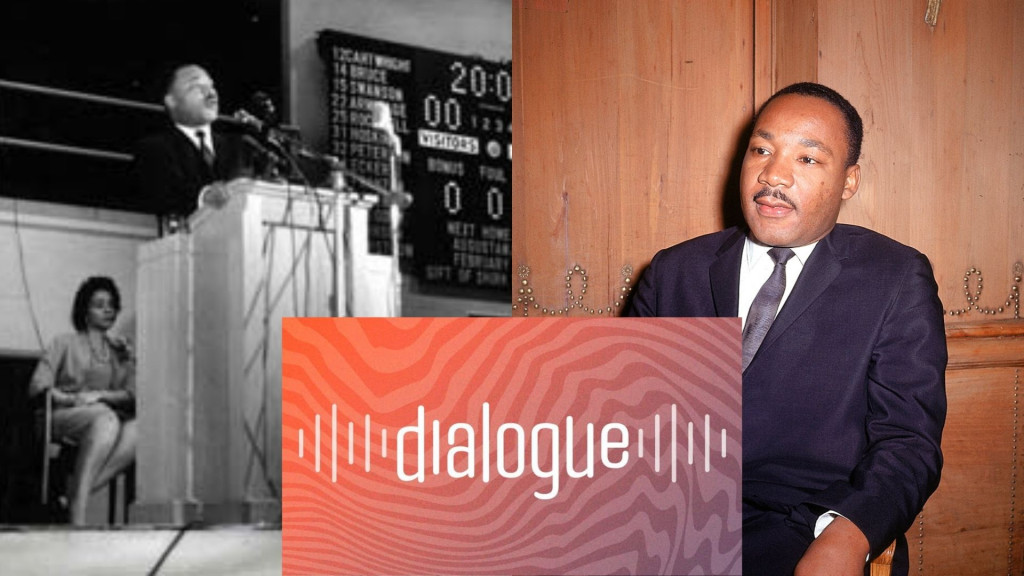
Transcript: Dr. Martin Luther King At Illinois Wesleyan University
Dialogue
Dr. Martin Luther King At Illinois Wesleyan University
Read the full story at https://will.illinois.edu/tags/dr-martin-luther-king-at-illinois-wesleyan-university.
Transcript
Reginald Hardwick
From Illinois Soul. This is Dialogue. I am Reginald Hardwick, news and public affairs director at Illinois public media. Dialog is an exchange about culture straight from the soul. 60 years ago, Dr Martin Luther King, Jr, visited Illinois Wesleyan. It was the second time in five years that he accepted an invitation to speak at the University in Bloomington. Let us listen now to an excerpt of that speech.

Martin Luther King, Jr.
And so, the Negro finds himself perishing on a lonely island of poverty in the midst of a vast ocean of material prosperity, the problem is becoming even more difficult today. For years, we have been victimized with discrimination on many in many areas and on many levels, denied apprenticeship training, deprived of educational opportunities, facing discrimination in so many areas, and this meant that so often we were limited to unskilled and semi-skilled labor, and now, because automation and cyber nation have come into being. These are the jobs that are passing away. And so, while the nation stands in its most prosperous period, while the nation faces its lowest level of unemployment that it has over the last several, seven or eight years, unemployment among Negroes, is at its highest level. And while the average for the nation is still around 4% when we turn to the negro community, the unemployment rate at times goes as high as 14% which means that is a major depression within the negro community, economically, we can see the problems that this will bring about. When people are deprived of economic security, they are deprived of opportunity to educate their children. They are deprived of opportunity of getting proper medical care. They are deprived of the opportunity of being able to live in decent housing situations. They are deprived of the opportunity of having the basic necessities of life. And finally, they are deprived of the opportunity of respecting themselves, and so often out of self-hatred and out of embarrassment and out of humiliation, they lose motivation. And it is not enough to look at the effects of discrimination. It is necessary for a concerned and compassionate nation to look at the causal basis of the whole problem. For instance, there are those who can argue ad infinitum, about the fact that the Negro is culture culturally behind, and so they say we must not integrate certain areas of life, whether it's in housing or schools or what have you, because the Negro is so far behind that he will pull the white race a generation behind. They go on to say, you know, the Negro is a criminal. He has the highest crime rate in any community. And the arguments go on and on and on and on. Well, if they are lagging standards in the negro community, and there certainly are. They lag because of segregation and discrimination; criminal responses are environmental and not racial. Poverty, ignorance, social isolation, economic deprivation breed crime, whatever the racial group may be, and it is a torturous logic to use the tragic results of segregation as an argument for the continuation of it. It is necessary for a great and a concerned nation to go back to the causal basis for the problem, and we have a long, long way to go in order to make economic justice a reality all over this country, it means that there must be massive programs, training programs, and massive public works programs in order to get the jobless on the job, and so that people can work, and so that they are able to walk the earth with dignity and Make an adequate income, and they can stand before their families with that kind of creativity and that kind of creative response that will make the family a real and meaningful unit. And so, in the economic area, we still have a long. Way to go. I mentioned the fact that we've come a long, long way in ending legal segregation, but I must point out the other side, if I can put it in figurative language. It may be true that the system of segregation is on its deathbed, but history has proven that social systems always have last minute strong breathing power, and the guardians of the status quo are always on hand with their oxygen tents to keep the whole order alive. And so, in a sense, segregation is still with us, not in the open sense that it used to be with us with legal sanction, but in the covert, in the subtle, in the de facto sense. And so even in the major cities of our country outside of the South, that is absolute segregation. In so many situations, the Negro finds himself covered up and crowded in ghettos. These ghettos are usually absolutely segregated. The Negro finds himself attending segregated schools, which are almost always inadequately staffed, devoid of quality education. And then, as we look into the whole problem of slum life, the total mental outlook of the individuals who live in the slum, we see deprivation. We see the destruction of personality, and all of these things reveal that before Brotherhood is a reality, that is much that must be done. So, segregation is still with us. But if democracy is to live. Segregation must die for racial segregation is a cancer in the body politic which must be removed before our moral health can be realized. And we don't have long to do this. It is urgent to do it now because the shape of the world today no longer affords us the luxury of an anemic democracy, and we must not only do it because it will help the image of the United States, and it will certainly do that. We must not only solve this problem because it will be diplomatically expedient. We must not only serve seek to solve this problem because it will help us to appeal to Asian and African peoples, and it will certainly do that. We must not only seek to solve this problem to meet the communist challenge, and it will certainly do that. But in the final analysis, racial discrimination must be uprooted from American society because it is morally wrong. It must be uprooted from American society because it is sinful. And somewhere we've seen in all of the major religious faiths, something that tells us that that is something immoral and sinful about segregation and discrimination. The late, great Jewish philosopher Martin Buber used to talk about the I it and the i thy relationship, and I say segregation is wrong because it substitutes an i, it relationship for the I, thou relationship. St, Thomas Aquinas used to talk about natural law and moral law and human law. And I say that segregation is wrong because it is based on human laws that are out of harmony with the natural in the moral and eternal laws of the universe. Somewhere, the late Protestant theologian Paul Tillich said that sin is separation, and what is segregation but an existential affirmation of man's tragic estrangement, his terrible separation his awful sinfulness and the great challenge facing the nation today is to get rid of a system that is evil and that is morally wrong. Now in order to get rid of this system, it will be necessary to develop massive action programs, the problem will not work itself out. In order to develop massive action programs, we've got to get rid of one or two myths that are quite prevalent and that we hear a great deal around various community. It is. One is what I often speak of as the myth of time. I'm sure you've heard this. This is the argument that only time can solve the problem of racial injustice, only time can bring integration into being. And so those who set forth this argument can to say to the Negro and his allies in the white community, just be nice and just be patient and and wait 100 or 200 years and the problem will work itself out.

I think that is an answer to that myth. That is the time is neutral. It can be used either constructively or destructively. And I am absolutely convinced that in so many instances, the forces of ill will in our nation, the extreme righteous of our nation, have used time much more effectively than the forces of goodwill. And it may well be that we will have to repent in this generation, not merely for the vitriolic words and the violent actions of the bad people who will bomb a Church in Birmingham, Alabama, but for the appalling silence and indifference of the good people who sit around and say, wait on time.

Reginald Hardwick
You are listening to Dialogue from Illinois Soul. I am Reginald Hardwick, and we are listening back to a speech by Dr Martin Luther King, Jr, on February 10, 1966, on the campus of Illinois. Wesleyan. We are going to move ahead to the end of the address when King draws parallels between American racism and wars abroad.

Martin Luther King, Jr.
I never intend to adjust myself to economic conditions that will take necessities from the minute to give luxuries to the few and leave men by the 1000s and millions smothering in an airtight cage of poverty in the midst of an affluent society. I must honestly say to you that I never intend to adjust to myself to the madness of militarism and the self-defeating effects of physical violence. But in a day when Sputniks and Geminis are dashing throughout a space and guided ballistic missiles are carving highways of death through the stratosphere, no nation can ultimately win a war. It is no longer the choice between violence and nonviolence. It is either nonviolence or nonexistence and the alternative to disarmament, the alternative to a greater suspension of nuclear tests, the alternative to a negotiated settlement of the crisis in Vietnam, the alternative to strengthening the United Nations, and bringing all of the nations of the world into that United Nations, and thereby disarming the whole world, may well be a civilization plunged into the abyss of annihilation, and our earthly habitat will be transformed into an inferno that even the mind of Dante could not imagine. And so, I say that maybe our world is in dire need of a new organization, the International Association for the Advancement of creative maladjustment men and women who will be maladjusted.

Men and women who will be as maladjusted as the prophet Amos who, in the midst of the injustices of his day could cry out in words that echo across the centuries, let justice roll down like waters and righteousness like a mighty stream. As mal adjusted as Abraham Lincoln, who had the vision to see that this nation could not survive, how slave and how free, as maladjusted as Thomas Jefferson, when the midst of an age amazingly adjusted to slavery, could scratch across the pages of history, words lifted to cosmic proportions. We owe these truths to be self-evident, that all men are created equal, that they are endowed by their creator with certain inalienable rights, and that among these are life, liberty and the pursuit of happiness, as mal adjusted as Jesus Christ, who could look into the eyes of men and women around Galilean hills, and say, He who lives by the sword will perish by the sword, and through such maladjustment, we will be able to emerge from the bleak and desolate midnight of man's inhumanity to man into the bright and glittering Daybreak of freedom and justice. May I say in conclusion that in spite of the difficulties ahead, in spite of the fact that we must work hard, I still have faith in the future, and I still have faith in America, because I love America, and I believe that we will continue to build a coalition of Congress. Intentions that will one day solve this problem. We sing a little song in our movement, and it has been our guiding faith. Sometimes we've been facing hooded perpetrators of violence. Sometimes we face jeering mobs. Sometimes we face dogs and the gushing waters from fire hoses, sometimes in crowded jail cells, we join hands to sing it, and sometimes in just open mass meetings, but we could sing it as a hymn of faith. We shall overcome. We shall overcome. Deep in my heart, I do believe we shall overcome. And somehow, I believe this because the arc of the moral universe is long, but it bends toward justice. We shall overcome because Carlisle is right. No lie can live forever. We shall overcome because William colored, Bryant is right. Truth crushed, Earth will rise again. We shall overcome, because James Russell Lowell is right, truth forever on the scaffold, wrong, forever on the throne. Yet that scaffold sways the future, and behind the dim unknown standeth God within the shadow, keeping watch above his own. And so, with this faith, we will be able to hew out of the mounting of despair a stone of hope. With this faith, we will be able to transform the jangling discords of our nation into a beautiful symphony of brotherhood. With this faith, we will be able to speed up that day when all of God's children, Black men and white men, Jews and Gentiles, Protestants and Catholics will be able to join hands in singing the words of the old Negro spiritual. Free at last. Free at last. Thank God almighty, we are free at last. Thank you.

Reginald Hardwick
That was Dr Martin Luther King, Jr, speaking on the campus of Illinois, Wesleyan on February 10, 1966. That is all for this edition of dialog. Today's reporting is from Anita Johnson and Julian Hayda. Our theme was composed by Lamont Holden. Dialogue and Illinois Seoul are part of Illinois Public Media, a service of the University of Illinois. Urbana Champaign, I am Reginald Hardwick, news and public affairs director at Illinois public media. We will talk with you again next week.

(Transcription by Otter.ai)
Transcript Assistance
Illinois Public Media may use AI assistance for transcript generation and/or formatting. Transcripts that have not yet been reviewed for accuracy will be labeled.
To report a transcription error, or to request transcription of archival material, please contact will-help@illinois.edu.