








Transcript: ‘I was an abomination’: Trans lawyer shares difficult coming out experience in new memoir
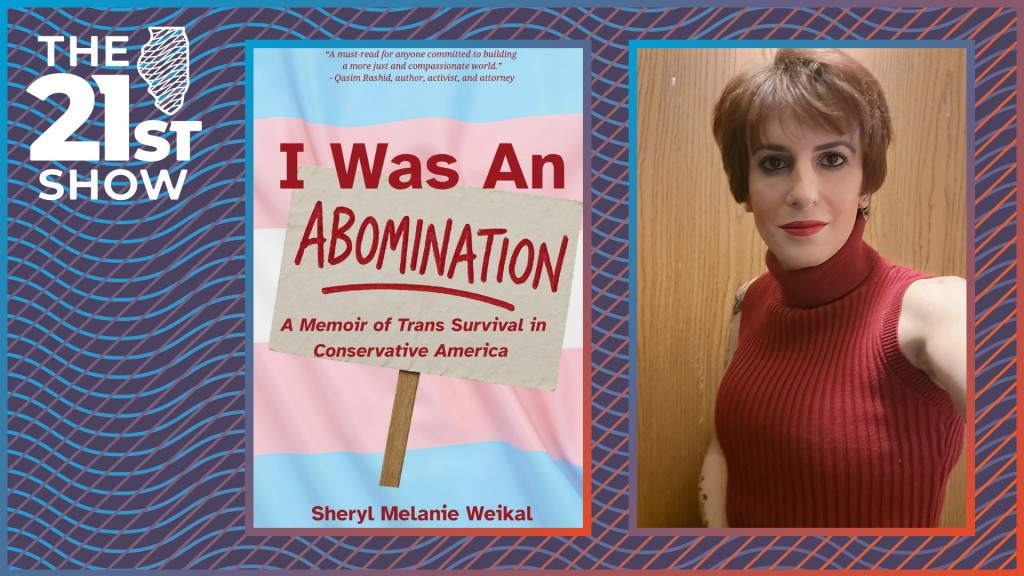
Transcript: ‘I was an abomination’: Trans lawyer shares difficult coming out experience in new memoir
The 21st Show
‘I was an abomination’: Trans lawyer shares difficult coming out experience in new memoir
Read the full story at https://will.illinois.edu/tags/illinois-lawyer-shares-experience-of-coming-out-conversion-therapy-in-memoir.
Transcript
// This is a machine generated transcript. Please report any transcription errors to will-help@illinois.edu.

[00:00:00]
Brian Mackey: Today on the 21st Show, Sheryl Weikal is an Illinois lawyer. Her practice focuses on progressive causes, and she charges clients on a pay-what-you-can basis. Weichel is also trans. She grew up in a conservative family, and her parents spent years trying to cure her. She chronicles that journey in her memoir, "I Was an Abomination." I'm Brian Mackey. That's coming up today on the 21st Show, which is a production of Illinois Public Media, airing on WILL in Urbana, WUIS in Springfield, WNIJ in Rockford-DeKalb, WVIK in the Quad Cities and WSIU in Carbondale. But first, news.

From Illinois Public Media, this is the 21st Show. I'm Brian Mackey, and my guest today is the attorney Sheryl Weikal, based in McHenry and [the] collar counties. Her practice has a progressive bent: civil rights, landlord-tenant disputes and defending against eviction and foreclosure. It's been a long journey. Cheryl was raised in a deeply conservative family, and for many years she and her sisters were homeschooled. At 8 years old, she'd never heard the word transgender, but she understood there was a disconnect between what she saw in the mirror and who she was inside. Weichel tried to come out to her family, but over the years her parents reacted negatively, and at times violently.

All this and more is the subject of Sheryl Weikal's memoir, "I Was an Abomination: A Story of Trans Survival in Conservative America." It's out now. I originally spoke with Weichel back in May 2025, just before it came out. Because our book is on tape today, we cannot take your calls, but you can always share your thoughts with us. Our email address is talk@21stshow.org. So let's start your book with where you start your book, which is rooted in family history. Tell me about your grandfather.

[00:02:19]
Sheryl Weikal: So my grandfather is someone who I always looked to as almost this larger-than-life heroic figure, obviously the family patriarch, and he passed away when I was very young, which in a very real way sort of added to almost the mythos that I had around him. And when I was doing some of the background research for the book, I actually found that some of the family lore that was told about him wasn't entirely true. So for example, we had always been told growing up that his name had been changed from what it was in Europe at Ellis Island, like many other Jewish immigrants. And in reality, he had changed it himself a number of years after he arrived in the United States, likely in response to the anti-Semitism he was experiencing.

And he had an entire life before what we were told about growing up, which sort of began when he met my grandmother. So it was a fascinating sort of digression away from what I expected to find when I was doing that kind of background research. But it also taught me a lot about how family narratives can change over time, which I thought dovetailed very nicely with the narrative of the family that my parents wanted to have, as opposed to the family that they ended up having as a result of me.

[00:03:49]
Brian Mackey: Yeah. Talk more about his politics.

[00:03:52]
Sheryl Weikal: So my grandfather was very progressive. He was a pharmacist. He had wanted to be a doctor, but at the time, you know, being a Jew in medical school just wasn't something that was widely accepted, which sounds weird to say now. But we're talking about a time when even on his naturalization certificate, it listed his race as Hebrew. And so he became a pharmacist, and he was very well-known for being just a very selfless and progressive person. He would treat anyone who came in regardless of their ability to pay. He was very adamant that every single person deserved to be treated equally regardless of who they were or their background. He did not judge people. If you came into his pharmacy needing something, he would make sure you got it.

And that was something that of all of the things that we didn't know, that I didn't know about him when I was doing the background research, that was one thing I was able to confirm. And that was — it was nice to learn that the most important thing about him was in fact true. And so I joke that I sort of inherited four things from my grandfather. I inherited his lefty politics, his very big feet, his Crohn's disease and his love of pastrami.

[00:05:22]
Brian Mackey: Some of those things better than others. Talk about how your parents are different from him, at least politically.

[00:05:31]
Sheryl Weikal: So my parents were very politically conservative. And I say "were" even though they are still alive because I have not spoken to them in about 15 years. But my father was the kind of person who listens to Rush Limbaugh, the entire show every day. Either he would be listening on his way to work or on his days off, he'd be listening, and he'd make sure that everyone in the house listens to his show. My mother was a very big fan of Dr. Laura Schlessinger, who was essentially a family advice columnist on the radio with a very conservative bent, who believed that being gay or queer is a choice and that you can simply choose not to do it. There's actually a very famous scene from the television show "The West Wing," where the president's character, Bartlet, is responding to a character who's based entirely on Dr. Laura Schlessinger.

And my parents both listened to Sean Hannity, watched Fox News every night from the day it went on the air. And that was their entire worldview. So from as long as I can remember, they were extremely conservative, and they only became more so as I got older, to the point that by the time I was in college, my mother was absolutely convinced that former President Obama was a Muslim sleeper agent sent by Kenyan communists.

[00:07:15]
Brian Mackey: Well, yeah. Well, I was going to say before we get to that time, talk about what that conservatism meant for you in terms of your education.

[00:07:26]
Sheryl Weikal: Well, what it meant was that my mother pulled me out of public school after kindergarten because my parents were fervently of the belief that if I stayed in public school, I would be exposed to what they considered to be a liberal mindset that they found extremely problematic because they ascribed to this extremely conservative worldview. And it started when I was in kindergarten, and my best friend was our neighbor, who was Black. And my mother was simply not OK with this. And that led to her moving us to the whitest neighborhood she could find.

And from there it was years of homeschooling with, despite our family being Jewish, an increasingly evangelical conservative curriculum. And my mother was terrified that any of her kids would turn out to be gay because she considered that to be a personal failure on her part.

[00:08:32]
Brian Mackey: And this is something that specifically is about this idea of being gay. It's not something that came up in response to anything from you, at least at first. This is just something that she independently came to on her own as a fear.

[00:08:47]
Sheryl Weikal: Yes, it was. And I think part of the issue was this is a time when influences like Limbaugh, like Schlessinger, are telling parents that being gay is a choice and that homeschooling is a way you can keep that choice from being imparted onto children. It is easy to forget that the idea of trans people influencing trans kids or influencing kids to be trans — it's a myth, but it's not a new myth. It is the same propaganda that was — it's just been repackaged for a new generation. And when I was growing up, it was the same thing, just about being gay. And that was what my parents were hearing.

And so I didn't know what being gay was. I didn't even know — I'd never met a trans person. I just knew from a very early age that I was supposed to be a girl. And I remember the first time I'd ever heard what being gay was, was when my mother was talking to me about how terrible Richard Simmons was. And I didn't understand, and I wrote about this in my book. I didn't understand what she was talking about. And the idea of being trans wasn't something that ever occurred to me. I recall reading every volume of my father's Grolier encyclopedia, all 23 volumes, when I was first learning how to read, because I was just trying to find an entry in there that explained what had happened that [caused] — I was supposed to be a girl. And it seemed to me at the time that all of human knowledge was in this 23-volume encyclopedia.

And so this is not something where, you know, I had ever shown signs of being — they were doing this in response to signs that I had shown, because they pulled me out of school before I did any of these things. And that's one of the reasons why I wrote the book, because this is something where they insulated me as much as they possibly could with the idea that they could completely control how I would turn out. And the reality that I was a trans kid who came out to them at 8, despite all of the insulation, was, I think, something that they were completely unprepared for.

[00:11:13]
Brian Mackey: We're speaking with Sheryl Weikal, who's the author of "I Was an Abomination: A Story of Trans Survival in Conservative America." Talk, you know, the medical term people use is dysphoria, right? Which is the idea that one's self-perception doesn't necessarily match what you — you actually talk about looking in the mirror and how that experience was off for you. Can you expound on that?

[00:11:41]
Sheryl Weikal: Certainly. And I want to be careful because for every trans person, dysphoria is going to take a different form. And so if you talk to 100 different trans people, you will get 100 different descriptions of dysphoria, and there is no one way that is more or less valid than any other. But for me, one of the ways that I experienced it was I did not recognize my own reflection in the mirror. For as long as I could remember when I was growing up, I had to force myself to recognize that the person in the mirror was supposed to be me, because my internal idea of what I looked like was so very different than that. And the older I got, the more — for obvious reasons, the more different the reflection got from my own self-image. And it really, you really do end up in this place where you're wondering if the entire world is crazy or if it's just you, because you have this very well-formed idea of what you're supposed to look like and who you are.

And it was for me one of the hardest parts about this, because it's a little bit like looking in the mirror and something completely foreign is looking back at you. Like, the way I explain it is if you woke up tomorrow morning and you look in the mirror and someone else's body is looking back at you, there would be this feeling of disconnection. And that's very much what it was for me, because for as long as I could remember, I had — I've had this idea of who and what I am. And so the dysphoria for me was largely based around the reality that as I tried explaining to my mother when I came out to her at 8, there's been this mistake. Can you fix this, please? Because this is not what I'm supposed to look like. This is not who I'm supposed to be. And it never occurred to me that this was anything abnormal or that this was something that wasn't supposed to happen from any kind of moral perspective. This was just who I am. This was just the way it had been, and finally I was like, no, this is not OK. There has to be some way to fix this. And that is what prompted me to come out to my mother when I was 8.

[00:14:30]
Brian Mackey: I understand, or you write in the memoir, I should say, that "Star Trek" actually has a role to play in your understanding of yourself, Lieutenant Tasha Yar. I myself feel like I was influenced by "Star Trek" as a young person, but maybe not quite to the same degree you were.

[00:14:47]
Sheryl Weikal: I absolutely adore "Star Trek." I always have. But it's interesting because I remember this vividly to this day. The first episode of "Star Trek" I ever saw was an episode called "The Arsenal of Freedom." It's a first-season episode. It's not even a particularly good one looking back, but I was completely enraptured by it. I was 6 or 7 years old. I'm watching it in my parents' bedroom, and Tasha Yar is on screen, and it's like I have this epiphany. Because up until this point, I've been trying to figure out, OK, I'm not supposed to be what's looking back at me in the mirror. I'm supposed to be something else, but what is the something else? And then I see Tasha Yar played by Denise Crosby on the television, and it really was almost like a lightning strike where it was like, oh, that's what I'm supposed to look like.

And it was like all of the little pieces fell into place at that point where it wasn't so much I decided that I want to look like her, 'cause that isn't what happened. It was more a recognition that she was sort of the track I was on, if that makes sense. And so it was a recognition of, oh, I'm like — I'm not like men, I'm like her. And from that — and that is the first time I remember in my life having an absolute certainty, oh, I'm just a girl. And I've never forgotten that experience, and to this day, it's weird because to this day that episode holds a very special place for me because of that moment. And in a very real sense that was the closest to, I guess you would call it a gender euphoria that I had in my entire childhood.

[00:16:54]
Brian Mackey: Euphoria, the antonym of dysphoria. All right, we are going to pause there. More from my conversation with Illinois lawyer Sheryl Weikal when we return. Her book is "I Was an Abomination: A Story of Trans Survival in Conservative America." This is the 21st Show. Stay with us.

This is the 21st Show. I'm Brian Mackey. We're talking with Sheryl Weikal. She's an Illinois lawyer, and she's also written a book called "I Was an Abomination: A Story of Trans Survival in Conservative America." I should note this conversation is going to get heavier from here. You'll hear Cheryl discuss her parents' attempts at conversion therapy after she came out as trans, and the effects that had on her. Suicide is going to come up. Listener discretion is advised.

That said, we originally spoke with Cheryl back in 2025. We're revisiting this after the recent U.S. Supreme Court ruling that went against state-level bans on conversion therapy. The justices said lower courts should use a more strict evaluation standard when determining whether the bans violate the free expression rights of therapists. Let's pick up where we were earlier.

You are 8 years old. Despite your precociousness, you mentioned having read the entire encyclopedia. You don't know the word transgender, and most 8-year-olds wouldn't. But you know yourself well enough to understand something is up. How do you approach this with your family?

[00:18:45]
Sheryl Weikal: So I did something that I guess you could call quintessentially me. I made a doll of myself as a girl, and I presented it to my mother. And this is at one of those, you know, Build-A-Bear type stores where you can make a stuffed animal or a stuffed doll. And I made a doll of myself as a girl and I presented [it] to my mother and I explained, you know, this is what I'm supposed to look like. Can you please fix this? Because in my 8-year-old mind, if my mother has a handy guide, she can then repair whatever the problem was. And a lot of kids at that age, and I was no exception, have this idea that your parents are omnipotent and can fix just about anything that goes wrong.

And it went over with my parents like a lead balloon. I think it was in a very real sense my parents' worst nightmare. My mother was very proud of having what she thought was an oldest son. My father thought that continuity of the family name was very important in a very old-school patriarchal sense. And I think the idea that the child they thought was their only son, 'cause my two siblings are both my sisters — turning out to be what they consider to be their worst nightmare, because my parents didn't see any real difference between being gay and being trans. I think that was the realization of their worst fears.

And in a very real sense, I suppose you could say the innocence of my childhood ended when I did that, because from then on, it was a constant back and forth of my parents trying to undo that. And me — I mean, it's not something that can be undone, and it wasn't something that I would have wanted to undo even if I could. So that was really the inflection point of my childhood when I gave my mother that doll and my father insisting the entire drive home that there had to have been some mistake, that I didn't really mean it, and my mother freaking out saying over and over again, "Your son made a doll of himself as a girl."

[00:21:26]
Brian Mackey: To the extent you're comfortable sharing, you mentioned that your parents spent your childhood trying to undo that. What form did that take?

[00:21:37]
Sheryl Weikal: So my parents tried a number of different things. There was at first the idea that my transness was the result of a character flaw. Maybe I was lazy, maybe I was just not responsible and not accountable enough. So there was a lot of — we lived on a small farm and so my mother tried various forms of "you're just going to work until you are hardened enough that you've been masculinized." And it turns out that no matter how many horse stalls you muck or chicken coops you clean out or fields you lime and seed and plant, you're still going to be just as trans as you were before.

My parents tried any number of lectures, the explanations that it is an abomination, which is where the name of the book comes from. And then finally, when all else failed, my parents turned to some of the darker methods, anything from — there were multiple attempts to force me to stop being trans by holding a cloth over my face and pouring vinegar on it and making sure the cloth was soaked in vinegar beforehand, basically waterboarding me with vinegar, the idea being that I would stop being trans to avoid having that done to me.

And when that also did not sufficiently work, my mother turned to some more sexually abusive things, thinking — because again, my mother did not understand the difference between being trans and being gay, so she assumed if she could force me to be attracted to the female form, that I would stop being trans. And the reality is that none of it ever worked because you cannot de-trans someone. What we call today conversion therapy, it does not work to make someone less gay or trans, but it does work to break a person, to make a person, especially a child, pliable and broken. And it took me a long time to recover from the effects of that. The only thing it does not do is make you not queer anymore.

And looking back on it, it was all coming from a place where, for my parents, having a trans child was a worse outcome to them than having a dead child. And I think that explains a lot of what we are seeing now across the country with the moral panic surrounding trans kids. Parents like my parents are so scared of having a trans kid that they view it as a worst-case scenario. And one of the reasons I wrote this book was I wanted people to know being a trans kid is a normal thing. It's not a bad outcome. And the only thing you get by torturing a trans kid is a tortured kid. You cannot turn a trans kid cis and more importantly, you shouldn't want to because the only thing you're doing is inflicting pain for no reason.

[00:25:24]
Brian Mackey: I'm really sorry you went through all that. How did you hold up? How did you make it through?

[00:25:31]
Sheryl Weikal: Honestly, it was not easy, and in many ways you could say that, you know, child me really didn't. There became a point where I was actively suicidal because especially going through what we in the trans community often call natal puberty, the wrong puberty, the puberty that your body is forcing you through when it's not the one that your brain says you should be going through. It can be torture. And you add what my parents were doing on top of that, and it was one of the worst experiences of my entire life.

And there was a point where I went to my mother. I was 16 and I was actively suicidal because I was essentially in this place where my parents were telling me that they wished I had never been born. And I went to my mother and I asked her for help because I was in a very dark place, and my mother's response was essentially to tell me that she hoped that I did kill myself because then she would be rid of me.

And it was in a strange way, that was the impetus for me realizing that the only person who was going to save me from that place was myself. And it took fully a decade after that for me to escape from there, get on my own and get to a place where I was able to actually start unpacking the damage from my childhood. But I think it is important to emphasize that, whereas it was very difficult, whereas I'm OK now, thank God, and I'm married to the love of my life and I have a life I would not trade for anything, the damage that it did was permanent. And I say that because I do not want to downplay what effects conversion therapy and similar programs and acts have on kids. This is not something where it is easy to recover from that, and the overall impact of that — I got very, very lucky because what I went through is something that a lot of trans kids don't survive. And it wasn't — it's not because I'm special or I'm stronger than anyone else. A lot of what happened, and it's a recurring theme in the book, is because I had certain people in my life at certain times and because I got really lucky. And I don't want anyone else to have to go through something like that.

[00:28:34]
Brian Mackey: All right, at this point, I'm going to remind listeners that if you or someone you love is ever having thoughts of suicide, you can get help by calling the National Lifeline at 988. The number again, 988. If you're just joining us, this is the 21st Show. We're listening back to my May 2025 conversation with Illinois lawyer Sheryl Weikal. Her book is "I Was an Abomination: A Story of Trans Survival in Conservative America." So when do you finally get to be out as trans?

[00:29:06]
Sheryl Weikal: So it's actually kind of funny because the impetus for that was a car accident. I tried coming out to a therapist. The therapist ended up passing away almost immediately thereafter, which I had taken as a sign from the universe that this is just not something that I am supposed to be. This is not something I'm supposed to be doing.

[00:29:27]
Brian Mackey: So it's like a Woody Allen script before Woody Allen became problematic, but yes, you know where I'm going with that, I guess.

[00:29:34]
Sheryl Weikal: Yeah, it's — so I'm in this car accident, and there's a point during the car accident where it sounds like a cliche, but it really is true, you know, some people say your life flashes before your eyes and what is flashing before my eyes is my funeral. And I think that the worst part of that was this recognition that I was going to die without anyone ever knowing who I really was. And I got lucky again, it was a very bad car accident and I walked away with only minor injuries. But that was when I decided, you know, no matter what the costs, I'm going to be myself because I had — I had sacrificed too much of that. And through all — and I also needed to understand, despite everything I had been through, I was really lucky. You don't get into law school, become a lawyer, you know, go through everything I did and get through it without a lot of blessings and a lot of good fortune. And I did not want to waste all of that living a lie, because that's what it would have been. Living a lie would have been wasting all of that.

And so that was the impetus for me coming out and within a year of that, I had — I socially transitioned meaning coming out to the world. I had started hormones and I was going through the process of legally changing my name and gender marker.

[00:31:20]
Brian Mackey: How easy or difficult was that for you, I guess, in, you know, from a technical sense, from a legal sense, but also just sort of in a philosophical sense, in a human sense.

[00:31:32]
Sheryl Weikal: You know, the transitioning part was — it's difficult because of the gatekeeping involved, but in terms of the actual mechanism, it was the best decision I'd ever made. There's a feeling in a — I compare it to Judy Garland's "Wizard of Oz," when you step out of a black-and-white world into a full-color one. And that is very much what it felt like for me. But what was difficult was not, at least for me, was not the transitioning part, it was the world reacting to my transitioning. And a lot of people and institutions I expected were going to be OK with it, were not. I had a lot of pushback, especially from the legal community, to the point where I ended up having to sue the Illinois agency that regulates attorneys, the Attorney Registration and Disciplinary Commission, after several years, because practicing while trans was not something they were prepared to allow.

[00:32:51]
Brian Mackey: In terms of the name, just in terms of changing your name on the roll of attorneys, right?

[00:32:56]
Sheryl Weikal: It was everything from changing my name on the roll of attorneys to allowing judges to misgender and deadname me even after I'd legally changed my name to allowing attorneys to file motions to disqualify me on the grounds that me being on the opposing side violated their rights. And at one point I even had a judge stop a mediation halfway through to demand to conduct a genital inspection on me. I had a judge rule sua sponte against my client on the grounds that me being in their courtroom constituted a fraud upon the court.

And this is stuff that you don't expect to happen in a state like Illinois. But it did, and it kept happening. And at first when I called the ARDC and I said very naively, I'm transitioning. How do I do this within the rules? The response I got was, "You don't." And what I was told by one of the people at the ARDC was that if they allowed attorneys to transition, attorneys who are facing discipline would simply transition to avoid that discipline, which from a practical perspective doesn't make a whole lot of sense because if your license is in jeopardy, the first call you're going to make is not going to be to an endocrinologist. Nobody goes through the trans experience to avoid having your license suspended.

[00:34:44]
Brian Mackey: All right, we need to take another break. More with Illinois lawyer Sheryl Weikal when we return. This is the 21st Show.

It's the 21st Show. I'm Brian Mackey. For the hour today, we've been listening back to my conversation with Sheryl Weikal. She's an Illinois lawyer and the author of the memoir "I Was an Abomination: A Story of Trans Survival in Conservative America." We originally spoke with Cheryl back in 2025. You'll hear her refer to last year in the conversation, which in that case was 2024. With that in mind, no calls today, but you can always let us know what you thought. Our email address is talk@21stshow.org.

You were talking about the challenge in getting your name changed with the Illinois attorney registration, which is a panel which is run by the Illinois Supreme Court. And I guess that does get at the bigger question of — we do often hear, oh, Illinois is a blue state, Illinois is a haven. A lot of our leading Democratic politicians anyway, say that. I wonder how that is in your own experience and those of people in your network and maybe even clients.

[00:36:03]
Sheryl Weikal: You know, that is a really great question. In my experience, and this does surprise a lot of people, in my experience, respect for trans people is often not a blue versus red thing, and I say that because for both my own experience, I have personally had fairly well-known state Democratic politicians and state Democratic judges openly misgender me, say they had a problem with me transitioning as an attorney, especially in the lead-up to me having to file that lawsuit.

And then on the other hand, I have seen in a very strange way, some of the most understanding and respectful judges have been downstate in what is considered a more conservative area, which is not to say that conservatives are less transphobic than liberals. In my experience, it is simply that oftentimes conservatives tend to be publicly louder about their transphobia. But what I have seen is that there is unfortunately a tendency in institutions, regardless of what political party you are affiliated with, to be more small-c conservative when it comes to accepting diversity. Even if you think you are open to accepting all kinds of people, sometimes that institutional inertia can be a hard thing to fight against.

And oftentimes, the best example of what form that takes is when people are thinking that they know better than a marginalized group what that group needs. And I will give you an example of what I mean by this. It was not until January 1st of last year that the Illinois ARDC finally took deadnames off of the public master roll on their website for trans attorneys. This is something where you would expect a blue state like Illinois would be on the forefront of this, but this was last year.

Another example. Until I filed my lawsuit against the state, Rule 8.4J, which is the Illinois ethics rule that governs — that bans discrimination by attorneys — until I filed my lawsuit that required a finding by a judge that discrimination had taken place and it did not include gender identity as a prohibited ground of discrimination. And what that essentially meant was that across the state, it was not considered misconduct for attorneys to not just deadname and misgender trans people, but to dehumanize us. I have — to this day, I'm still dealing with cases like this, but it made it a routine practice for attorneys to argue that a trans person was an unfit parent on the grounds of their trans identity. It made it a routine practice for attorneys to file motions based on their opponent's gender identity. And I actually had an arbitration panel rule that I was not in their eyes capable of being an attorney because I am trans.

All of that because the rule did not prohibit gender identity discrimination. And what that leads to is an inherent inequality, because it's easy to think, well, there's still the Illinois Human Rights Act, and that was not incorporated into the rules of professional conduct until after I filed my lawsuit. But the problem is lawyers are the people who enforce the laws that we pass, and where those laws essentially have a built-in permission for discrimination, you are always going to have an underclass for whoever is the permitted target of discrimination.

And that was really the problem that I faced most of all, it was a complete misunderstanding of what it meant to be trans and this idea that institutional progress would eventually take care of it, so it wasn't that big of a deal. For a number of years, I introduced a proposed rule change every year to ban anti-trans discrimination in Illinois courts and every year it went nowhere until I ended up filing suit. And I didn't file suit because I was like, oh, I'm going to sue the licensing agency for attorneys in Illinois today. It's not something that anybody does when they value their career very highly for obvious reasons. You do it because you have no other choice.

And in this case, I didn't want the next generation of trans people who want to grow up to be lawyers to have to go through what I went through, because at the end of the day, whether or not you are accepting of trans people is less about whether you are a Republican or a Democrat and more about whether you see all human beings as human beings. And that is something where I have found regardless of party, some people still struggle with the idea of seeing trans people as their equals, unfortunately. I wish it were not that way, but that is one of the reasons why I wrote this book, because I'm hopeful that some people who want to be allies but don't know how, or have questions about whether a trans kid really does exist because there's so much competing information out there, I'm hopeful that this will hopefully sort of shed some light on this so that instead of acting based on feelings and intuitions about, you know, oh, there's no way a kid can be trans without being influenced, let's deal with facts. The fact is I was one, and so I know what that experience is like, and I don't want anybody else to have to go through that.

[00:43:19]
Brian Mackey: One of the things we sometimes hear today is this idea that my identity, my gender is not up for political debate. But people on the Republican side of the aisle in America have very much made it a part of politics and health care in particular is being challenged. You do hear from people on the right that gender dysphoria, it's a mental health problem. I want to ask you what it meant to actually do gender-affirming care as the response to this as opposed to some of the other things that your family tried and why you think that that is the appropriate sort of medical response to this.

[00:44:00]
Sheryl Weikal: I think the reason why so many of us respond by saying that our identity is not up for debate is because of the experience that I went through. My parents tried everything under the sun to make me not trans anymore. And honestly, if I could have turned it off so they would stop waterboarding me with vinegar, I would have, but that's just not a choice that I had. And so I feel like what we are essentially saying when we say gender-affirming care is not the way to go, what you're really saying to people is, hide who you are, no matter how much it harms you, for my comfort. And think about what that is saying. You cannot be in favor of bodily autonomy if you are willing to tell other people to live by the way you see fit.

A lot of this goes back to this so-called pronoun debate. "Well, it's my freedom to call you whatever you want." The problem is that's just a matter of basic respect. Nobody is forcing you to be a respectful human being. But you want to force us to live our lives in a way that harms us, so that you are OK with putting us into boxes that may very well kill us. It very nearly did me. There is this idea that if suicidality is a part of transness, then it's just a mental health problem. And I would argue that is not the case because I would challenge any person, cis or trans, to live in a body that does not match what you see in your own self-image, to live according to a name that is not yours and an image that is not yours and a life that is not yours. And then live like that your entire life without having any problems associated with that. It is like being gaslighted by the entire world. I don't think that any cis person could put up with that.

And so what trans people are asking for is just that same courtesy, that same respect, the ability to take care of ourselves, and it is very much a bodily autonomy issue, no different than reproductive freedom. And so in one sense, even if those of us who are trans, even if this was entirely a choice on our part, I would say that it is still something that should be respected, because it should not be up to the government to decide how we live our lives and how we present ourselves to the world.

So there's so many different levels of this. There's the freedom of expression issue, which is that we want the freedom to be who we are. There's the health care aspect of this, which is, no, we're not crazy when we say this is who we are, because my experience, if nothing else, shows that there is a deep level of innateness to the trans experience for so many of us. And there's a part of bodily autonomy that if we are going to allow for people to make the choices that are best for their own bodies, then that has to include allowing us to live our truths.

And so the simple reality is you have as a society, two options for dealing with trans people. You can accept us, which means letting us exist, recognizing that there have always been people who exist outside the traditional gender binary and always will be. Or you can force us into a box for your own comfort, understanding that many of us will not survive that box because we cannot live within it. That is essentially the question. And for people who say that that is hyperbole, it is not, because I know firsthand what being forced, literally forced into that box does to a person, and it can destroy you. And if there is nothing else that people take away from this book, I want people to understand that the harm that forcing a person into a box to which they don't belong does is real and lasting. And I don't want anyone else to go through what I did.

[00:48:56]
Brian Mackey: Well, Sheryl Weikal, I know you wrote in the introduction that you were ambivalent about even writing this book and telling these stories, but I'm glad you did and I'm glad you shared them with us today. Thank you so much for being here.

[00:49:08]
Sheryl Weikal: Thank you for having me. It really was an honor and thank you for listening.

[00:49:11]
Brian Mackey: Sheryl Weikal is an Illinois attorney. Her memoir is "I Was an Abomination: A Story of Trans Survival in Conservative America." It's available now. I originally spoke with her back in May 2025.

That's it for us today. Before we go, we'd love to hear your thoughts on today's show as well as conversations we're planning for the future. One way to do that is by joining our listener texting group, which you can do by sending the word "talk" to 217-803-0730. Again, text the word "talk," T-A-L-K, to 217-803-0730.

The 21st Show is produced by Christine Hatfield and Jose Zapeda. Our digital producer is Kulsoom Kahn. Technical direction and engineering comes from Steve Morck and Jason Croft. Reginald Hardwick is our news director. The 21st Show is a production of Illinois Public Media. I'm Brian Mackey. Thanks for listening. We'll talk with you again on Monday.
Transcript Assistance
Illinois Public Media may use AI assistance for transcript generation and/or formatting. Transcripts that have not yet been reviewed for accuracy will be labeled.
To report a transcription error, or to request transcription of archival material, please contact will-help@illinois.edu.