Transcript: The Illinois voice announcing World Cup games in Mexico
Transcript: The Illinois voice announcing World Cup games in Mexico
The 21st Show
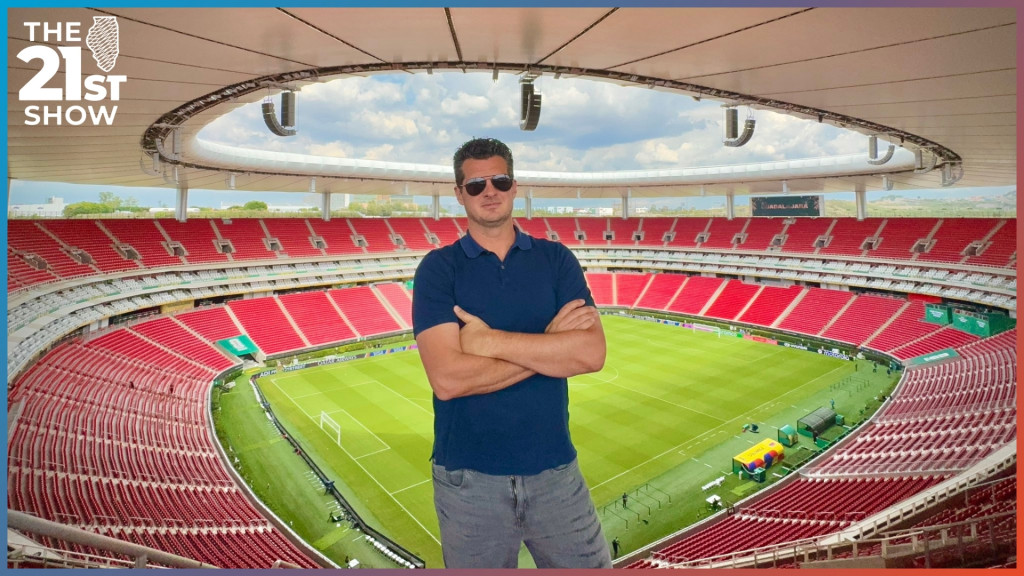
The Illinois voice announcing World Cup games in Mexico
Read the full story at https://will.illinois.edu/tags/the-illinois-voice-announcing-world-cup-games-in-mexico.
Transcript
// This is a machine generated transcript. Please report any transcription errors to will-help@illinois.edu.

[00:00:00]
Brian Mackey: It's the 21st show. I'm Brian Mackey. For most sporting events, the loudest voice in the building does not play for either team. Champaign's Tim Sinclair is a familiar voice to Illinois sports fans, providing in-stadium announcing for home games of the Chicago Bulls, Chicago Bears, Chicago Fire, plus University of Illinois basketball. You can also hear him on NBA All-Star weekends and the video game NBA 2K. This summer, his job has taken him to the World Cup. We wanted to give you a taste of what that sounds like because so many broadcast announcers talk over the in-stadium sound during goals and substitutions. The cleanest tape we could find of Sinclair at work is this run of pregame national anthems. Let's listen.

[00:00:53]
Speaker 1: Please remain standing if you are able for the playing of the national anthem of Mexico. Please [remain] standing. For the playing of the national anthem. [unclear]

[00:01:21]
Brian Mackey: All right. Tim Sinclair was last on the show back in 2020 when he was in the bubble for the NBA's COVID season. Tim, also one of the few people who makes me self-conscious about my radio voice. Tim Sinclair, welcome back to the 21st show. Thanks for making the time.

[00:01:37]
Tim Sinclair: I appreciate you having me back. Thanks so much.

[00:01:39]
Brian Mackey: Excellent mic quality and I would expect no less. So, all right, how does a gig like this — announcing games for the World Cup — how does that come about?

[00:01:49]
Tim Sinclair: It's a long process and one that I didn't have an answer to until I got an email in October, I believe it was, from — there's a sort of a company that handles the hiring of such things for FIFA, and they asked if I was interested. I of course said yes, and thus began a very long process of sending in tapes and filling out resumes and doing auditions until FIFA was comfortable in saying, "Yep, you can do one of our sites." And I think it was early this year, January, I believe, when I got the word that I was not only accepted but would be heading to work the games in Guadalajara, Mexico.

[00:02:36]
Brian Mackey: So this is like a skull and bones thing. So we'll call you — don't, you're not trolling LinkedIn or Indeed for the job, help wanted ads or anything.

[00:02:45]
Tim Sinclair: I'm sure there are some who did that, but I'm not sure how much success they found. You know, you get to a certain point where, with certain events, you have to have either accomplished a certain number of things or know the right people, or both. And I thankfully met at least enough of those requirements to get my foot in the door.

[00:03:07]
Brian Mackey: So everything around the World Cup seems so tightly planned and controlled and choreographed. What has that been like from your perspective, just getting ready for this?

[00:03:17]
Tim Sinclair: You are correct in that assessment. Everything is down to the second, certainly in terms of how the matches happened and my role in them. But even leading up to and during the prep period, the practicing period, and then getting into the games — yeah, it is a well-oiled and tightly run ship, I suppose would be the best way to put it.

But they have to be. It's the largest sporting event in human history. There are 16 sites operating simultaneously, which means 16 public address announcers and producers and match directors and, you know, all of the different things. Our team was large in — I'm sorry — in Guadalajara, but there was [a team] in Monterrey and Mexico City and two in Canada and then a bunch in the states. So they have to be. There's just so many people and so many moving parts that they've locked it down, and I think from the forward-facing perspective, most have been really pleased with how it's gone.

[00:04:24]
Brian Mackey: I had the privilege for a number of years back when I was a reporter at the public radio station in Springfield of reading names at graduation. And I gotta say, it was a challenge, especially until we figured out some system of getting pronunciation advice to me beforehand, even though it was pretty limited. I understand that is unique and extensive for the World Cup. You did a really cool — I think I saw it on TikTok — video about this process. Take us through that. How do you learn, right? So many different nationalities, so many different languages. How do you learn to say all those names exactly right in these players' — you know, the biggest moment of some of their lives?

[00:05:01]
Tim Sinclair: Well, most every event I've worked up to this point, they have phonetic pronunciations written out on a piece of paper. And the problem with that — it's great to have, but the problem with that is some people don't know how to write phonetically. Also, sometimes those are open to interpretation, and so the potential to get them wrong is a little higher than if you just hear the player say them, him or herself. So for FIFA, what they did is had somebody from the team read every single name on their roster — first slowly, syllable by syllable, and then once quickly as they would say it. And then they let us as announcers write phonetically how we interpret that, and hopefully that means we're getting them right more often than not, because the way we write phonetically is the way we read phonetically, and so the likelihood for messing that up is less.

So for every team I did — and it was Mexico, South Korea, Czechia, Colombia, Uruguay, I think there was another one in there I may be forgetting — but I went through every single name, listened to their representative read them out loud, and then I wrote down phonetically how I heard that, and that's what we went with. So it's quite the process, but I think it's probably more apt to be correct than any other option.

[00:06:31]
Brian Mackey: Take me through your game day prep, right? Are you doing yoga, drinking hot tea, "unique in New York, unique New York"? What is it like for you?

[00:06:42]
Tim Sinclair: You know, I think this makes me unique — and I'm not sure it's a good thing — but I have very little that I do ahead of a match. I'm ready to go. I want to be prepared, so obviously I need to make sure there aren't any names that would trip me up if I just looked down and had to read them in a split second, which is typically how that happens. But beyond that, as long as I have a little bit of water and a pen, I feel like I'm good to go. And if I don't, for my process, that means something's wrong. Something's off. I'm not prepared. I'm not in a good headspace. But I can't think of a time, certainly not recently, that that's been the case.

So typically I'm antsy. I just want to get in there and do the job. But leading up to it, I don't have any sort of routine or thing that I go through to make sure I'm ready. I try to make sure that the preparation is done. I know the names. I know how to say them, and once I'm there, the rest kind of has to play out on the field and there's no great way to prep for it. It's just — you're working with what you're given.

[00:07:52]
Brian Mackey: I like that answer a lot. I feel very validated, actually. And we do a lot of prep for the show here and working with the producers and, you know, going over information and thinking through questions, but ultimately you sit down, you turn on the mic, and you talk. That's the job.

So let's talk about what that's actually like in the moment. We heard that national anthem clip. A lot of what you're doing though — you know, you're announcing goals, you're announcing substitutions. One thing I wanted to ask you about: This tournament has seen extensive use of the video assistant referee, VAR. Sometimes goal celebrations are delayed for minutes in the stadium while the play is evaluated for rule violations. I wonder how you know when it's time to announce a goal, when it's time to hold back.

[00:08:35]
Tim Sinclair: That is a great question, and it's different with FIFA than it is with anything else. You're right — for soccer, or football, depending on where you're from — it's goals, cards, substitutions. That's really, during the run of play, the only thing we say. It's very different than basketball or football where you're talking all the time. But soccer is different, and with FIFA and with the World Cup, we have producers on site who are sort of running the show, and they are by and large the ones who are telling me when I should and shouldn't talk, and when we're doing the opening ceremonies, if we're on time, all that kind of stuff.

But when it comes to goals — and you may have seen this online — there is a huge data center in Dallas that's running video for every single match in every single location, and it's the world feed for people who are taking it on television. And in Dallas, they are the official word on things like that. So when it comes to goals, I'm waiting on my producer in Dallas to talk into my ear and say, "Goal, Korea Republic, cue announced in 3, 2, 1, go." And then it's "Goal, Korea Republic!" or whatever we're doing. And then I'm waiting on the official goal scorer, which typically happens 30 seconds or so after we announce the goal.

A couple of reasons for that. One, they're the end-all be-all for — was it a goal or was it not, and who scored it? And we're lining up my voice with graphics that they're sending into the stadium and on the television at the same time from Dallas. So we gotta wait on them. So it is a longer process. Sometimes it is a slightly delayed process, but because of how it works and where the world feed is originating from, that's where I'm having to get my cues from.

[00:10:32]
Brian Mackey: So you have a lot of experience. You've done all these pro teams, you do the Chicago Fire. You know, you're going to Mexico, though, and goal announcements — there's a certain history, particularly in the Spanish language, for elaborate goal announcements, you know, holding the note forever, trilling. I wonder — do you think about that at all when you're going into this? Or how did you approach that?

[00:10:56]
Tim Sinclair: I did, and I'm fortunate enough to work with a Spanish announcer in Chicago with the Fire, and so working alongside a Spanish announcer in Mexico was very comfortable to me. But ultimately, I had to wait till I got there to determine what our producer and what FIFA wanted in that moment. Even though we called a Mexico match in Mexico, it wasn't a Mexico home match. It was, in theory, a neutral match in which I had to provide equal excitement regardless if it was Mexico who scored or Korea Republic. So you gotta ask those questions and figure out what are they looking for.

And in our case, they wanted excited but not over the top, and equal regardless of who scored. And so that's just trying to find a balance of what sounds best, what fits that "excited but not over the top" mantra. And I thankfully didn't have to go Telemundo on anyone. I could in theory, but I think for the moment, what we chose was a good one.

[00:12:05]
Brian Mackey: I've been to a fair number of Fire games over the years. I do get a kick out of your partner there who, you know, goes nuts for the Fire goals and is very, very different when the opposing team scores.

[00:12:17]
Tim Sinclair: Correct, correct. Yep. He does. I mean, Tico's fantastic. I love him. He's a great friend of mine. And so we let him Spanish it up a little bit on Fire goals first, and then I get the details in after the fact. And then obviously when a visitor scores, we don't have to be neutral because it's our home match.

[00:12:37]
Brian Mackey: Yeah. All right, just a couple of minutes left. You talked a little bit about how soccer differs from other sports you announced. Do you have a favorite — a favorite child, in how you approach all these different events?

[00:12:51]
Tim Sinclair: That's the problem — you can't choose, because it is kind of like choosing your favorite child. I like them all for different reasons. Basketball, I love my seat. I'm center court, front row. You get to interact with the players. You sort of experience the game as if you're a player because the crowd surrounds you and it just feels like you're kind of on the court.

[00:13:11]
Brian Mackey: That Larry David, Knicks — you know, Jerry Seinfeld —

[00:13:14]
Tim Sinclair: Yeah, very much like that. Football is hard — American football. You're far away, everybody's wearing helmets, they're running on and off the field without telling you. You know, it's just like, "Oh, hey, new running back or new quarterback or whatever." So it's hard to do. You're talking all the time even when something doesn't happen — you know, "Pass incomplete, intended for [Roma Doonesday], 2nd and 10 for the Bears," whatever. And then soccer is just more of like, "Hey, I get to sit back and watch a sport," and then every once in a while there's stuff to say while it's happening. Usually it comes in like quick waves where it's like, "Oh, triple substitution, a yellow card and a goal all in about 45 seconds." So it gets really exciting real fast, and then you sit back and watch some more soccer. So I like them all for different reasons, and it would be hard to pick my favorite. But basketball is what I played in high school, it's what I do most of, and it's probably the one I'm most associated with.

[00:14:10]
Brian Mackey: Tim Sinclair is the voice of the Chicago Bears, Chicago Bulls, Chicago Fire, University of Illinois basketball, NBA All-Star Weekends. I'm sure you have heard him — I know I have — and he was now the voice of the World Cup 2026 in Mexico. Tim, thanks so much for sharing some of your experience with us today here on the 21st show.

[00:14:31]
Tim Sinclair: My pleasure. Thanks for having me on.

[00:14:48]
Brian Mackey: That is it for us today. Coming up tomorrow: Illinois drivers between the ages of 79 and 86 are no longer required to take a driving test every year. It's part of a new law that just took effect. We'll talk about what's behind the change and what this means for all of us who use our roads.

Plus, Venezuelans are still reeling from powerful back-to-back earthquakes that struck the capital Caracas last week. We'll speak with a Venezuelan man based in Bloomington, Illinois, about the situation and what's being done to try to help.

The 21st show is a production of Illinois Public Media. I'm Brian Mackey. Thanks for listening. We'll talk with you again tomorrow.
Transcript Assistance
Illinois Public Media may use AI assistance for transcript generation and/or formatting. Transcripts that have not yet been reviewed for accuracy will be labeled.
To report a transcription error, or to request transcription of archival material, please contact will-help@illinois.edu.