








Transcript: Illinois General Assembly: Top Democrats talk taxes, education and tech
Transcript: Illinois General Assembly: Top Democrats talk taxes, education and tech
The 21st Show
Illinois General Assembly: Top Democrats talk taxes, education and tech
Read the full story at https://will.illinois.edu/tags/top-dems-in-illinois-legislature-on-budget.
Transcript
// This is a machine generated transcript. Please report any transcription errors to will-help@illinois.edu.

[00:00:00]
Brian Mackey: From Illinois Public Media, this is the 21st show. I'm Brian Mackey. Illinois lawmakers worked late into the night on Sunday, actually into Monday morning, to pass this year's state budget. The $56 billion spending plan includes some new taxes on cryptocurrency, prediction markets, social media companies, and more. It also included a few new pieces of spending, such as one-time payments for Illinoisans who've lost access to food assistance. There are progressives in the legislature who'd hoped for taxes on corporations and the ultra wealthy. Those did not make it in. And Republicans, who are in the super minority in both the House and the Senate, voted against the budget, pointing to high spending and the new taxes.

Meanwhile, the House did leave town without voting on a measure to try and keep the Chicago Bears in Illinois, which has been getting a lot of attention and which the Senate passed earlier in the night. But over the past week, the legislature did pass many other things, including regulations on AI, a ban on cell phones in school classrooms, and new state powers over auto and homeowners insurance rates.

All this and more are going to be the topics for our program today. Later on, we'll talk with the Republican leaders in the state House and Senate to get their perspective on everything that's happened. But we start with the Democrats who preside over those chambers.

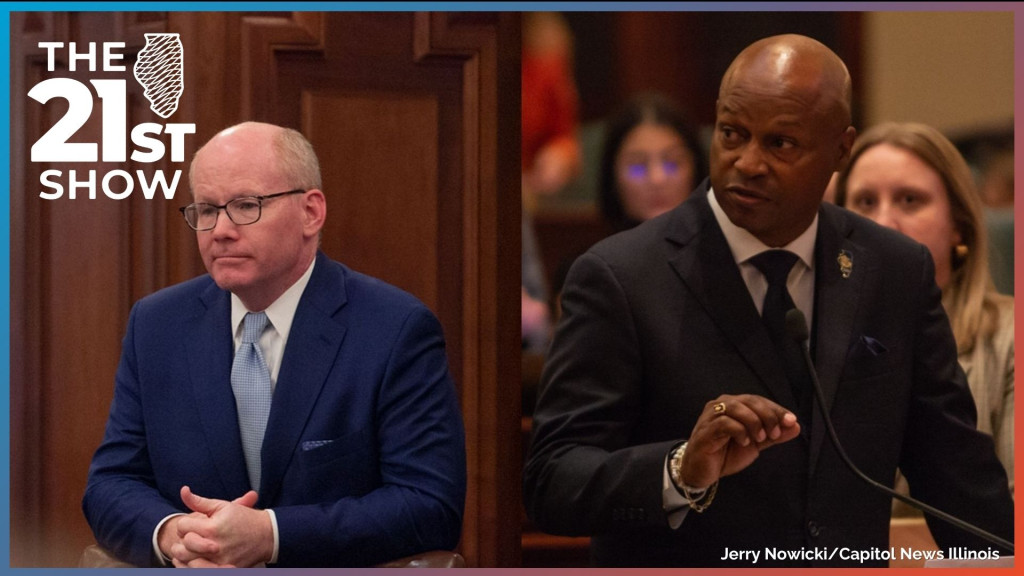
Emanuel Chris Welch is Speaker of the Illinois House of Representatives. He's a Democrat from Hillside. Speaker Welch, welcome back to the 21st show. Hey Brian, thank you for having me. And Don Harmon is president of the Illinois State Senate. He's a Democrat from Oak Park. President Harmon, welcome back to you as well. Great to be with you.

Listeners, we are live throughout the hour today. If you have questions for the leader of the state House and Senate, you can join the conversation by calling 800-222-9455. That's 800-222-9455.

All right, I'll start with each of you and maybe Speaker Welch, I'll begin with you. What do Democrats consider your top win in this year's state budget?

[00:02:09]
Chris Welch: Well, that's a great question, Brian. I think there are several top wins. You know, when my colleagues and I took office in January of 2025, I stood on that stage and I challenged them to meet this moment with bold action, and the work that has followed has kept that promise. I gotta tell you, the conversations families are having around their kitchen tables are at the heart of our agenda for Illinois.

And that's why on Sunday I think we delivered another [fiscally responsible] budget that extends a critical lifeline to people that Donald Trump has kicked off SNAP through his big bad bill. We're investing in expanded school lunch and our first of its kind fresh program that's going to help to meet the needs of SNAP recipients who Washington turned away. As Washington strips away Medicaid coverage and drives the cost of health insurance through the roof, we put more funding into hospitals and health providers to meet the needs for care. I can go on and on and on. There were several big victories that only happened because me, the Senate president, the governor, and all of us were working together to meet this moment, and we met the moment.

[00:03:18]
Brian Mackey: President Harmon, same question to you. What would you point to as a Democratic accomplishment out of this budget process this year?

[00:03:24]
Don Harmon: I would certainly ratify the speaker's list. I would also say the single largest increase in a line item in our budget this year was for elementary and high school education. We are living up to our promise to continue to build the evidence-based funding formula model to make sure all of our schools are fairly funded, and we didn't walk away from that commitment in a tough year. And we did all of that without raising the income tax or the sales tax or the other taxes real people see when they go to the store or go to their mailbox.

[00:03:57]
Brian Mackey: Well, President Harmon, I'm glad you mentioned education funding because, as you said, the state continues its gradual build towards what it considers adequate funding. That's a term of art in state law for school districts, but it is still far short of what even the state board of education says is necessary to meet that 90% goal, which at the current rate could be a decade away — I saw one report said. What do you say to parents of kids in schools, President Harmon, who are having to make tough decisions on class size, counselors, that sort of thing?

[00:04:27]
Don Harmon: I understand the concern. When we enacted the evidence-based funding formula, which was transformational — the first time we acknowledged that the state dollars for education should go to the schools that need those dollars the most — we made a commitment to increase that funding each year by $350 million, and we've lived up to that commitment each and every year with the exception of the first year of the pandemic when we didn't know which end was up. It's like paying a mortgage, and we're making our full mortgage payments. We all wish we could do more and do it faster, but we're sticking with our commitment and we're gonna get there.

[00:05:03]
Brian Mackey: Speaker Welch, what do you have to say about education funding and some of the critiques, especially from progressives — teachers unions, for example — that were really hoping for a more aggressive budget, you might say, right? Targeting Illinois's richest people and biggest corporations.

[00:05:20]
Chris Welch: Well, first of all, let me say that I agree with the Senate president. That is a very big victory in this budget — that being the funding that we're putting into K through 12 education. We fully funded the evidence-based funding formula plus the property tax grants. That's called [PTurge], that's going to help in lower income school districts. That was a big thing for progressives last year because we had paused it for a study, and the study showed that it was working, so it was put back in. That's a huge victory, and I gotta tell you, we all wish we can do more.

We certainly wish that there were other avenues for revenue. I certainly fought for a surcharge tax on millionaires. The Senate president and I are going to continue to sit down and talk about the path toward that over the next couple of years, but this budget does include tax increases on corporations. Social media platforms are taxed, cryptocurrency, fantasy sports — there's a lot of taxes here that are not on regular people, they're on corporations. So the progressives received some big wins in this budget, but no one's gonna get everything they want in a single budget. It's compromises, but do know that there were some big wins here.

[00:06:45]
Brian Mackey: President Harmon, how has the Trump administration's efforts to roll back funding in various programs in blue states in particular — how has that affected the work of passing a budget this year?

[00:06:58]
Don Harmon: Well, in so many of my public statements leading up to the budget, I joked every morning I woke up wondering if a rage tweet from the White House was going to blow a billion dollar hole in our budget. It's a joke, but it's only funny because it's true. The onslaught against Illinois and other states the president doesn't like have been extraordinary.

The SNAP program, the food assistance program, is just the tip of the iceberg. It's the one we're wrestling with right now in the immediate term. The assault on Medicaid, taking people off healthcare, is going to be calamitous. We'll have to wrestle with that even more next year.

What happened — and this was a really frustrating end of the session, but it was frustrating because so many members of the General Assembly thought that we could do more and more and more to fill the gaps created by Washington — and we filled as many of them as we could, and it took some convincing that we were at capacity, that we had done what we could with the resources we had. But I give them credit. They did not want to leave the people that sent them to Springfield in the lurch because Donald Trump and Republicans in Washington are walking away from those families.

[00:08:15]
Brian Mackey: All right, let me take a moment to remind listeners this is the 21st show. We are talking about the end of the Illinois General Assembly's spring legislative session with the two Democrats who preside in the General Assembly: Speaker of the House Chris Welch and Senate President Don Harmon. If you want to join us, 800-222-9455 is the number. 800-222-9455.

Speaker Welch, on the subject of education funding again — this time in higher education, and of course, I guess this is where I should disclose that our station, Illinois Public Media, is a licensee of the University of Illinois at Urbana-Champaign, which is part of the University of Illinois system — which lobbied hard against an effort to sort of make sure any new funding for higher education was more equitably distributed, in the words of the advocates for this program. What has been the holdup in passing that particular piece of legislation?

[00:09:13]
Chris Welch: Well, I think there's been two things that have been the holdup in that legislation. Number one, front and center, is funding. You know, that proposal is going to require about $135 million to go into the formula over the next 10 years. And one of the things that the Senate president and I, along with the governor, have committed to do is make sure we're not passing an unfunded mandate. We have to be responsible when we pass these things, and we need to identify a revenue source, which we have not been able to do so yet, before a proposal like that is funded.

Most of the universities are in support of the current proposal, but the university that supports this show is not. They have been very vocal in their opposition to it. They do believe that they're the only university that is hurt by the current proposal, and as the mother ship that serves the largest number of students, clearly their voices matter on this proposal, and so the members are hearing them in both chambers. But really, we need to find a dedicated revenue stream and figure out a way to address the concerns of the University of Illinois in a plausible way.

[00:10:37]
Brian Mackey: President Harmon, anything you want to add to that?

[00:10:39]
Don Harmon: I want to amplify something the speaker said. It would be $130 million in new money this year, and then another new $130 million next year, and the year after that, and the year after that — it compounds. I don't want to make an empty promise. It's much like what we're wrestling with with the evidence-based funding model for K through 12. We're living up to that commitment, but to create the expectation that we're going to be able to do that with $130 million in new money each year for higher ed, we need the funding source before we adopt the funding formula.

[00:11:16]
Brian Mackey: This is part, as you well know, of a long, long decline in state support for higher education, putting increasing shares of that onto the families that send their students to Illinois universities. Is there ever — I mean, how do you think about the possibility of ever reversing that trend? There was one point a few years back, I remember I crunched the numbers, and Illinois was actually putting less into higher education in the mid-2010s than it was in the year 2000. And that's setting aside the budget impasse, we won't even have to get into that. But how do you think about the long term trend of basically shifting the cost of higher education away from the people and onto individual families in Illinois?

[00:12:00]
Chris Welch: Let me take that, Brian, because I started my leadership in the house as chair of the Higher Education Committee. I have visited every one of our universities and I know the issues of higher ed very well. And I can tell you the work that we have done under my leadership — the Senate president and the governor — we have helped bring our universities back from the brink. During the Rauner years, our universities were literally about to go over a fiscal cliff. They were severely disinvested, and yes, they've been disinvested in for over two decades, but under our leadership we have significantly funded our universities.

And we can't overlook the funding for MAP grants and the [AIM HIGH] scholarship. If you look at enrollment last September, most of our universities saw record enrollment — all but one or two of them. That's because of the work that we have been doing in this budget space. Even with the fiscal challenges that we have, we've been able to make sure our universities are funded, the MAP grant scholarships are funded, the [AIM HIGH] scholarship is funded, programs like Hope Chicago are funded that are driving students to Illinois universities — and all you have to do is look at the enrollment numbers just from last fall. And I believe that trend is going to continue. Can we do better? Certainly we can, and that's why I think we have to continue to find ways to find a dedicated revenue stream for that funding formula.

[00:13:30]
Brian Mackey: We're gonna have to take a break in just a few minutes here, but President Harmon, I want to ask about another aspect of the budget that passed, which is a six-month suspension of an increase in the gas tax. Obviously, all of us in Illinois who drive are dealing with some very high prices at the pump. I should say all of us who drive hybrids or combustion engine vehicles. But ultimately, this increase is a little over 1 cent per gallon. I actually — because I'm a nerd — I track how much gas I buy in a spreadsheet for my hybrid. And I bought 669 gallons in the second half of last year. This would have worked out to $8.70 in savings. It's obviously a lot more significant to the state budget than it is to individual taxpayers. So what makes this good policy, President Harmon?

[00:14:19]
Don Harmon: Well, I'm impressed with your math skills, first of all. This is not the time to let the increase in the gas tax go into effect. Every one of us is angry when we go to the pump and see the price that we're paying because of a war of choice in the Middle East. That said, it's also not the time to neglect the roads and bridges that we all drive on. We've made a concerted effort to make up for years of underfunding our infrastructure. The governor makes a compelling case that our transportation infrastructure is a huge advantage to the state of Illinois in not only families traveling, but in attracting businesses to Illinois. No time for an increase, but I wish it were more — that's more relief for people at the gas pumps. But those are the tools we have at the moment.

[00:15:15]
Brian Mackey: Speaker Welch, briefly — just about 30 seconds — Illinoisans do pay more in taxes on gasoline than most Americans, both per-gallon fees and a percentage sales tax. What are Illinoisans getting for that, beyond what people in Iowa or Idaho or Indiana are getting?

[00:15:34]
Chris Welch: Well, if you look at what CNBC says and Site Selector magazine, they rank Illinois as one of the best states for infrastructure. Our infrastructure is doing very well compared to other states — much better than the red states that are around us and other red states across the country — because the motor fuel tax goes to our roads and bridges. We are investing in our roads and bridges. We all know that there's an additional season in Illinois, and that's construction season. You ride around our roads right now, there's a lot going on.

[00:16:12]
Brian Mackey: Yes, yes, I know that joke. I'm sorry to interrupt you. We do need to take a break. We're on a fixed clock here.

We're going to continue with Speaker of the House Chris Welch and Senate President Don Harmon on the Illinois General Assembly's recently completed spring session. This is the 21st show. Stay with us.

It's the 21st show. I'm Brian Mackey. We are talking about the spring legislative session of the Illinois General Assembly, which wrapped up early Monday morning. We are talking about that first this hour with the Democrats who preside over the House and Senate: Speaker of the Illinois House Chris Welch and Senate President Don Harmon. A little later in the program, we're going to hear from their Republican counterparts, the minority leaders in the House and Senate. If you want to join us, 800-222-9455.

All right, let's talk about some additional policy issues. President Harmon, one of Gov. Pritzker's big pushes this year was for a statewide zoning law. The aim there was to expand opportunities for affordable housing in Illinois. Why didn't that make it through the legislature?

[00:17:27]
Don Harmon: Brian, I don't know about the speaker, but we weren't put back into the room here at the beginning of your question.

[00:17:33]
Brian Mackey: All right, so I'll say it again. Apologies for the technical challenges there. So, President Harmon, one of the governor's biggest pushes this year was for a statewide zoning law in order to expand affordable housing in Illinois. Why didn't that make it through the legislature?

[00:17:48]
Don Harmon: Well, first I want to emphasize that an awful lot of pieces aimed at affordable housing and middle market housing did make it through in the budget, and some pieces advanced through the Senate. The governor's proposal is very ambitious. I think it's one many of us support in concept, but it was a collision of statewide versus local control. I think a lot of our mayors — who we rely on to inform us as to the mood in our communities — were hesitant to cede control over local zoning decisions. The speaker and I have talked about many issues this year in this way. Sometimes they just need a little more time to ferment before they're ready, before people have had a chance to digest the opportunities and the consequences.

[00:18:40]
Brian Mackey: Speaker Welch, do you have anything to add on that in terms of housing? I mean, affordability does seem to be the word that everybody is talking about this year in politics.

[00:18:49]
Chris Welch: Yeah, that pretty much sums it up, Brian. I mean, a lot of these complex issues take time. Many of the governor's proposals that passed this year were proposals that have been around for the last couple of years — particularly cannabis and hemp, we got done this year, and that started two years ago. The Junk Fee Ban Act started two years ago. Some of these things take time, and this is a very complex issue, particularly when you have local governments very much opposed to what's out there. And so we're going to continue working on it. There are some big things that got done through the budget that are going to allow us to do some things for folks, because housing is a big issue. It is an affordability issue, and we addressed it in the budget.

[00:19:32]
Brian Mackey: Speaker Welch, one of the other big issues this spring was a focus on technology, right? There's AI regulation that passed last week, a ban on cell phones in school classrooms that passed over the weekend. And then things that didn't happen that were considered, like allowing robo taxis on Illinois streets or regulating the operations of data centers statewide. How do you think about the role state lawmakers have to play in terms of making sure technology is used responsibly?

[00:20:03]
Chris Welch: Yeah, I think our role is very important, but equally as important is making sure we get it right. And so there were some pieces with regard to AI regulation that passed both chambers and are headed to the governor's desk. There are some responsible things with regard to cell phones and social media use that are headed to the governor's desk, but we're committed to continuing the conversations here over the summer and fall and continuing to work toward other ways of regulating in the AI space. When I mentioned earlier about these being complex issues, they very much are, and a lot of these are very new complex issues, and so you have to change with the times. And we're certainly trying to do that, but do it right.

[00:20:46]
Brian Mackey: All right, let's go to the phones at 800-222-9455. We have Susan calling from Springfield. Susan, thank you for calling in.

[00:20:54]
Susan: Yes, thank you. My question is: could you inform us on the state of health of the state of Illinois pension plan?

[00:21:06]
Brian Mackey: OK, Susan, simple question. Thank you for that. President Harmon, can I come to you and say, what happened with pension funding this year? Obviously, Illinois — just a little context for our listeners, as many will know — has the worst funded government pensions in the country. And I guess full disclosure, I am a member of the State Universities Retirement System by virtue of my employment at the University of Illinois Urbana-Champaign. But I'll let you take it from there, President Harmon.

[00:21:31]
Don Harmon: Thanks, Brian. Thanks, Susan, for the question. We made our full scheduled contribution to the pension funds — the state pension funds — this year. The governor reported at the post-budget press conference that Illinois' funded ratio is at an all-time high, at least in recent memory. So much like the other mortgages we're paying off, we are paying off our pension debt and on track to be 90% funded by 2045.

[00:21:59]
Brian Mackey: One other issue I wanted to ask about is elections. President Harmon, the governor expressed concern last year that ICE agents or National Guard troops might be deployed to Illinois to try to deter people from voting. I know there was a big elections bill that ultimately did not pass the General Assembly. It was being considered. What are your concerns heading into the next election and what are you doing about it?

[00:22:24]
Don Harmon: I have many concerns about the federalization of the next election. It is clear legally and historically that states run elections. We talked about doing something in the last few days. I think heavy on many of our minds was the prospect of a Supreme Court decision on vote by mail, which could land during the summer. It was very difficult to legislate in the abstract, not knowing where the Supreme Court was going to land. So hopefully they'll do the right thing and we won't have to take up any remedial issues before the election, but we're always prepared if we need to do something dramatic in response to something dramatic.

[00:23:06]
Brian Mackey: I want to ask about — so everybody's asking about the Chicago Bears. And honestly, I don't really personally — I enjoy watching the Bears, but I don't really care if they want to go to Indiana. So I'm not gonna ask that question. You can read coverage of that elsewhere. I think it does speak to a sort of broader issue I'm curious about though.

Speaker Welch, I'll come back to you because it seems like quite a bit happened this session where you'd have one chamber pass a bill, maybe even on a bipartisan basis, and then it languishes in the other chamber. You know, the Bears bill is one example, but there are others on ebooks and public libraries, economic development for downtown Springfield, requiring Latin American history to be taught in schools — many, many issues we could look at. How would you describe the working relationship between the House and the Senate, and ultimately between you and President Harmon?

[00:23:54]
Chris Welch: Listen, I think the working relationship with President Harmon and I is great. You know, he's a friend of mine, been a friend of mine since before we were both in these roles. We both come from the same area geographically and spend a lot of time together over the summer and fall. But listen, we both are leaders of different chambers and we have to listen to our caucuses. The day we stop listening to our caucuses, I believe will be the day we're no longer the leader.

But this false narrative that we're not talking and we're not coordinated is completely dismissed when you look at all the big things that did get accomplished: the eighth balanced budget in a row, a fiscally responsible balanced budget — that's only done by working in coordination. The things that we did get done with regard to AI — those did get done by working together. There are so many things that happened this session that we should be proud of: the Junk Fee Ban Act, the cannabis and hemp regulation. I can go on and on, but this narrative that we're not working together is put out just by all these big things that we did get done, and these are things that it's taken us years to get done. It only happens by working together.

[00:25:10]
Brian Mackey: Last thing I want to ask about — and I know our time is short — President Harmon, I'll come to you to start for this. And it's about how the budget was passed. And I'll say upfront, I realize some people dismiss coverage of process as being not relevant to the concerns of everyday Illinoisans. But I'll say I think it also speaks to the work product, right? You don't get the best product from people who are sleep deprived at 3 or 4 in the morning — more than, you know, that college student writing a paper on King Lear at midnight the day it's due. So why does it keep happening that Illinois is passing budgets in the middle of the night on the last day of session? You know, there are states where the budget might pass at 3 p.m. on a Thursday, for example. What is it about the process here, President Harmon?

[00:25:54]
Don Harmon: Well, those states aren't having enough fun, Brian. I'm joking.

Brian, I don't think I need to convince a journalist that the power of a deadline is significant, but I want to put some context around this. First of all, for the first time in my memory, in early May we filed in both the House and the Senate the entirety of the governor's proposed budget in a single bill that was searchable by every member of the General Assembly and every stakeholder. That budget that has been on public display for three or four weeks before passage is somewhere between 95 and 99% of what we passed on the last day of session.

I will go back to my point about members of the General Assembly pushing and pushing and pushing to do more and more and more to fill in the gaps created by Washington. So I've never had so many of my members condition their support of the budget on trying to do more to help the people that sent them to Springfield. That's a point of pride, not a source of embarrassment. The fact that we needed to cajole and convince people that we were doing as much as we could with the resources we had — and that pushed us into the wee hours of the night — again, it's a source of pride for me.

[00:27:16]
Brian Mackey: Speaker Welch, similar question to you. I'll just posit: I think it undermines trust in government. That's obviously something a lot of us are very concerned about these days — the lack of trust in institutions, especially government. And doing things in the middle of the night like that, it's certainly not a good look. What do you say to that?

[00:27:37]
Chris Welch: Well, I think people are going to criticize us no matter what we do or how we do it. What we have to be mindful of is to try to do better. I think we can always do better. And every year that I've been speaker, we've done something a little different every year to try to listen to those concerns. As the Senate president said, filing that budget in the first week of May had never been done before. And if you compare the final product to what was filed a month ago, it's very slightly different.

However, there is a reality in the legislative making process. I have to get 60 votes to pass a budget. The Senate president has to get 30, and the governor has to be willing to sign it or he'll veto it — and then you need 71 and 36. And so those members know their power. We teach them that. And when you get to the end, both of us have to deal with members being able to go home and explain why they voted or decided not to vote for a budget, and a lot of that takes time and you have to listen to it. You have to be responsive to your members as leaders. I'm sure even the Republican leaders will tell you you have to be responsive to your [members], and that's what ends up playing out, particularly in the last couple of days of the budget-making process.

[00:28:59]
Brian Mackey: Speaker of the House Chris Welch, Senate President Don Harmon, thank you for sharing your perspectives with us today on the 21st show.

[00:29:05]
Don Harmon: Thanks for having us.
Transcript Assistance
Illinois Public Media may use AI assistance for transcript generation and/or formatting. Transcripts that have not yet been reviewed for accuracy will be labeled.
To report a transcription error, or to request transcription of archival material, please contact will-help@illinois.edu.