How politics is reshaping scientific research in America
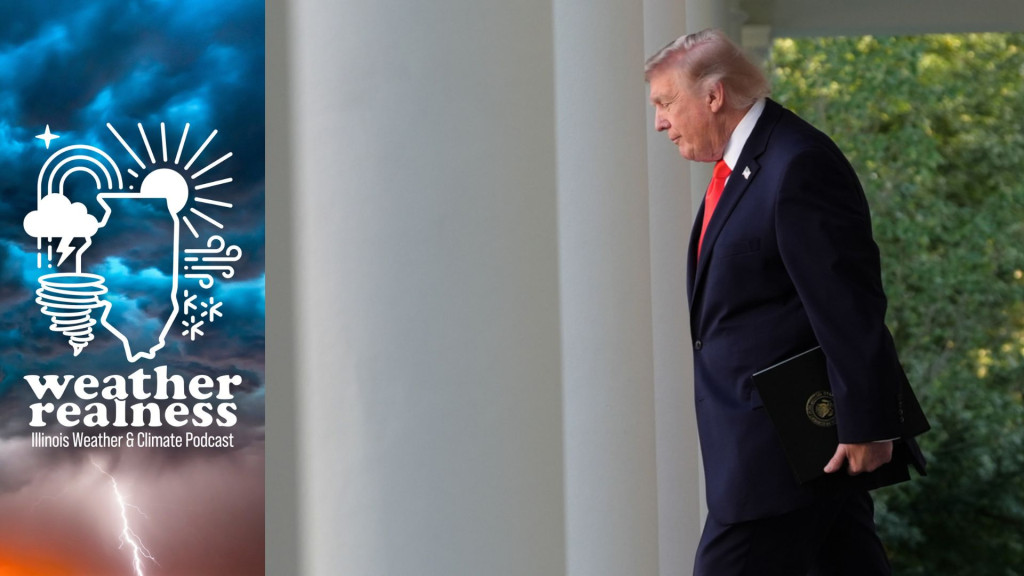
President Donald Trump walks from the Oval Office to speak at a Rose Garden Club dinner with farmers, at the Rose Garden of the White House, Thursday, June 25, 2026, in Washington. AP Photo/Jacquelyn Martin
// This is a machine generated transcript. Please report any transcription errors to will-help@illinois.edu.

[00:00:00]
Speaker 0: The weather and climate often cause concern and curiosity, but understanding the facts behind the phenomena can be a challenge. We're here to help. From the University of Illinois Urbana-Champaign and Illinois Public Media, welcome to Weather Realness, a weekly podcast about the skies above Illinois and the world.

[00:00:29]
Steve Nesbitt: I'm your host Steve Nesbitt, professor in the Department of Climate, Meteorology and Atmospheric Sciences at the University of Illinois.

[00:00:36]
Eddie Wolf: And I'm Eddie Wolf, graduate research assistant in the Department of Climate, Meteorology and Atmospheric Sciences at the University of Illinois.

[00:00:42]
Steve Nesbitt: The Trump administration has put pressure on scientific institutions through funding cuts and termination or suspension of thousands of research grants. Now the administration is proposing a new rule that would change how federal research grants are awarded to universities.

[00:00:57]
Eddie Wolf: The administration has argued that these changes are necessary to ensure taxpayer dollars are spent on research that aligns with the agency's priorities, but some critics say it would give political appointees greater influence over decisions that were traditionally done by scientific peer review. Craig McLean, the former chief scientist of the National Oceanic and Atmospheric Administration, told PBS News he worries the proposal would emphasize political beliefs over scientific facts.

[00:01:20]
Craig McLean: First off, the Trump administration has already demonstrated its ability in the past to displace scientific judgment with their own political pronouncements. One of them is climate change. Believing that it doesn't exist when in fact the evidence is conclusive that climate change is real, humans are causing it. So this is an administration that is quite ready to displace scientific truths for their own convenient interpretation, and that's remarkably damaging to the integrity of the United States, to the safety of our people, and to the value of science itself.

[00:01:54]
Eddie Wolf: Joining us today to talk about how these proposed regulations could affect scientific research is Dr. [Collette Dalawala], the founder and CEO of Stand Up for Science. She launched the organization in 2025 in response to federal funding cuts affecting the science and public health research. Thank you for joining us, Dr. [Collette].

[00:02:10]
Dr. [Collette Dalawala]: Thank you so much for having me. Really excited to be here and I love all of you climate and weather people.

[00:02:16]
Steve Nesbitt: That's great. So before we begin, can you talk about how science in the U.S. has traditionally been funded?

[00:02:22]
Dr. [Collette Dalawala]: Yeah, absolutely. So typically what happens is scientists compete for contracts from the federal government, and they write these really intensive proposals that sort of pitch their idea — if you want to think of it in a more entrepreneurial framework — pitch their idea, and a group of peers who are experts in that niche specific area review all of the proposals that come in and select the top, let's say, 25%, to go on to further review. And then they're even more closely reviewed and, generally speaking, something like the top 10%, depending on your field, are selected for government contracts. And these contracts are usually an established amount of time — five years — which allows the lab, or the group of scientists, to hire folks, to bring on graduate students to work on these projects and gives folks the amount of time and runway that they need to really dive into the science. But the best way to think about these are contracts.

[00:03:28]
Steve Nesbitt: Yeah, so I've been a scientist for almost 30 years and I've both submitted proposals and also been on the other end where I'm reviewing proposals, and in my mind it's a pretty objective process because you have a bunch of people with different opinions that come to consensus. But how could this potentially change in the future?

[00:03:50]
Dr. [Collette Dalawala]: Yeah, so the Office of Management and Budget, which is run by Russell [Vogt], who is one of the sort of masterminds behind Project 2025 and Heritage Foundation work, has made this proposal. It's a proposed rule that would — so while they would maintain these peer review sections — it would place the final say so in the hands of a political appointee, and the political appointee's job would be to make sure that everything that's funded is both in line with the agency's priorities, but more importantly to us in this moment, in line with Trump's priorities and policies.

It would also go further. It would effectively ban international collaboration because of an expansion of something called the Wolf Amendment. It would effectively make it so that individuals are beholden to the government when speaking to press or speaking at conferences — like any sort of public engagement with their work. Individuals could be denied grants based on their individual personal affiliations. It would explicitly ban research on things that are deemed woke or anti-American by the Trump administration, so things like researching health disparities between groups of people or LGBTQ+ matters. Climate and environmental sciences were explicitly named as being effectively illegal for the government to fund. And, you know, it would really create a $1.5 to $1.7 trillion slush fund, because this goes way beyond the sciences. So that's the rule. It is 412 pages of not good things.

[00:05:50]
Eddie Wolf: So I think for us scientists in the room it's very clear obviously how all of this is going to really negatively impact all of our fields going forward if this were to go through, but for the average person who's not directly involved in science, how is this going to end up impacting them in the long run?

[00:06:04]
Dr. [Collette Dalawala]: Yeah, so here's one example. My team reviewed — there are a little bit over 10,000 active clinical trials happening right now that are federally funded. And so we went through and, based on our reading of this OMB rule proposal, as well as — in the past year and a half there's been a number of executive orders from the president outlining what his priorities are with regard to science — by our conservative estimate, 49% of those clinical trials would be illegal on day one of this rule. So, God forbid you or your loved one is facing a terminal illness or is facing a rare disease and you need help. Let's just hope that the rare disease isn't so rare that the scientists are working with folks outside of the U.S., because that's banned.

So, Black maternal health outcomes and measuring those, anything to do with climate and environment — we saw that the Trump administration sort of walked back their original pullout of the ocean monitoring system, which is still in flux, to be clear, that's not 100% fixed — but I guess we wouldn't fund that, like we wouldn't be legally allowed to fund that. Another thing that I don't know that folks tend to think about this broadly: this would be veterans benefits, Medicare, anything to do with HUD or housing, small business grants. FEMA is under this, so any disaster relief that is in more poor areas — because that is considered a disparity — we presume that we wouldn't be funding it. There are just layers and layers to this, and by our estimation, it will impact every single person in this country in at least one way.

[00:08:06]
Steve Nesbitt: Yeah, so one of the significant provisions — you sort of touched on this — is requiring senior political appointees to review which projects receive funding. How would that compare to what's going on now, and what are some potential downsides of that?

[00:08:21]
Dr. [Collette Dalawala]: Sure. So one of the things that we've seen over the last year and a half is Russell [Vogt] at the OMB has, like, pilot tested all of these provisions across different federal agencies, and that has allowed the administration to understand how people respond from a litigation perspective, how people respond publicly, and how people respond at Congress. And so what they're now doing is they're taking all of these pilots, they've tweaked some of them, and they're applying them broadly across 41 federal agencies.

So, the NIH right now technically is under this purview of political appointee, and we've known that. But there are other federal agencies who are not. In fact, FEMA recently — when Mr. Cameron came in as the director — changed this federal, or this political appointee signoff that was in place. That was just a couple of months ago. And so I say that to make the point that what we're going to see is sort of an upping of the ante. So they've pilot tested all of these provisions. Now they're taking all of these provisions and applying them broadly.

[00:09:33]
Steve Nesbitt: If you're just joining us, this is Weather Realness, the podcast about weather and climate from Illinois Public Media and the University of Illinois Urbana-Champaign. I'm Steve Nesbitt, professor in the Department of Climate, Meteorology and Atmospheric Sciences at the [University of Illinois].

[00:09:45]
Eddie Wolf: And I'm Eddie Wolf, graduate research assistant in the Department of Climate, Meteorology and Atmospheric Sciences at the University of Illinois. We're talking about how politics could reshape scientific research with Dr. [Collette Dalawala], the founder of Stand Up for Science.

So the White House has been saying that they're proposing this rule and other rules to essentially try to eliminate fraud and to align research with national priorities. Can you talk about whether there is evidence of fraud within the research sector, and maybe why scientists have been disagreeing with this assessment?

[00:10:13]
Dr. [Collette Dalawala]: I have read in several places that if the NIH — specifically, this is about the NIH — were a charity, they would have an A-plus charity rating, given how well they use their funds, how well it's documented, the fact that there is extraordinarily little fraud in this system. And I think, again, to go back to the original thing — how are these grants funded? It is competitive. Like, you don't just happen upon an R01 grant. People work really, really hard, they put hundreds of hours into securing this funding, and there are so many hoops that an individual has to jump through. This goes in tandem with university systems, which have internal controls and measures to ensure the funds are being used appropriately and as discussed. It's actually pretty hard to defraud the federal government, and interestingly enough, I think that's what a lot of these folks who were in DOGE found. They actually found that the federal government is surprisingly efficient, even though, to the average Joe, it may not seem that way.

And so again, I will also cite — across the last year and a half and even before — we have heard a lot of claims in different areas by the Trump administration about fraud, and I have yet to see a single instance where their claim was substantiated in a court of law. And so I just want to highlight that as a psychologist, the best predictor of future behavior is past behavior. And so if we're taking past behavior, this is well in line with the patterns we've seen from this administration.

[00:12:04]
Eddie Wolf: So I was wondering if you could talk a little bit more — you touched on this already — but how this proposal is going to directly make it harder for scientists to conduct their research on a day-to-day basis.

[00:12:13]
Dr. [Collette Dalawala]: Yeah, so this is twofold, right? First, there is just the sheer — like, congratulations, you're a climate scientist, we don't fund that anymore, right? So if you're studying anything that is outright explicitly banned, if you have international collaborators, etc., this is just going — I don't even know how folks are going to navigate this, to be completely frank with you.

But then there's this other, I think more insidious piece. The rule itself is exceptionally vague, and it is very purposefully vague, and it means that the administration has the ability to really just do whatever they want. They can cancel any grant for any reason at any time. That is what is in this provision. It is the ultimate destabilizer. And so when we think about what has made the scientific ecosystem in the United States flourish over the last better part of a century, it's stability. It's that it's been nurtured and grown across generations. It's that despite the fact that we've had a lot of range in folks in the White House and a lot of range politically with regard to Congress, everybody has sort of agreed that it's really important to maintain and protect this scientific ecosystem that we have, and we're really fortunate to have it.

And imagine what would happen if it just stopped raining tomorrow in the Amazon forest, right? If the seasons flipped or there was just some degree of destabilization that really wrecked the predictable patterns that you might anticipate. Again, it takes years to do good science. So with a grant you've got a five-year runway, it's a contract — you're contracted into five years, and you know that for five years you're going to be OK. If any grant could be canceled at any time for any reason based on the whims of the president and his cabinet, that fully destabilizes everything.

[00:14:24]
Steve Nesbitt: So one of the things that sort of brought this home to me is, you think about our current state of technology — for example, just the iPhone. We all think, yeah, Apple invented the iPhone, but if you actually look at it, it's built on the back of thousands of scientists' inventions over the years that were largely funded by the federal government. That built all the technology so that Apple could leverage that basically for free and turn that into this fantastically profitable thing that obviously benefits the U.S. economy. So, broadening that out to the entire scientific and research portfolio, this could be a big impact on our economy.

[00:15:05]
Dr. [Collette Dalawala]: It will be. STEM, broadly defined, accounts for 39% of GDP. So we are not a small — you may not see scientists out every day — but to delude oneself into thinking that our economy is not directly tied to this federal sandbox that we as a society have agreed upon maintaining is a travesty, and we're going to feel it pretty immediately. I know that folks are thinking, oh, in 50 years this is going to be bad. I beg to differ. I actually think we're going to feel it within a matter of a couple of years.

The other point that I will make with regard to economy is, several days ago, Moody's put out a piece and JPMorgan also put out a piece about this OMB rule, to say — I mean, the finance people are yelling about it. I know everybody thinks that Stand Up for Science is being really extreme and we're saying this is going to be huge, but JPMorgan and Moody's just put out separate statements and reports on how this will impact the U.S. credit rating.

[00:16:30]
Steve Nesbitt: So if you're just joining us, this is Weather Realness, the podcast about weather and climate from Illinois Public Media and the University of Illinois Urbana-Champaign. I'm Steve Nesbitt, professor in the Department of Climate, Meteorology and Atmospheric Sciences at the [University of Illinois].

[00:16:42]
Eddie Wolf: And I'm Eddie Wolf, graduate research assistant in the Department of Climate, Meteorology and Atmospheric Sciences at the University of Illinois. We're talking with Dr. [Collette Dalawala], the founder of Stand Up for Science.

[00:16:51]
Steve Nesbitt: We've been through a lot and I know a lot of federal agencies have been hit by multiple waves of issues — for example, the DOGE cuts — that led to a lot of their senior people effectively being retired, forcibly retired in some cases. We've seen, for example, attacks on the National Center for Atmospheric Research, which we've discussed on this program, where labs are under threat of being basically defunded. We've seen the grants slowed down to a crawl where it's almost impossible for universities to receive funding. Where do you think this is going?

[00:17:27]
Dr. [Collette Dalawala]: I think it's going towards a $1.5 trillion slush fund for the executive every year. That's where this is going. This is going towards privatizing science. And the thing that I think people need to understand — and I get it, OK, I know that when I say that science is political, people bristle. Like, I could feel you tighten. Lower your shoulders, relax your jaw, let's talk through this. Science is inherently political in the United States the way that we do it, because Congress appropriates the funds and directs these funds out. And generally speaking, the executive has the ability to alert Congress to areas that may be important — so, for example, hey, we have an overdose problem in this country, could we get a little bit more focus on maybe addressing this in next year's appropriations? That's typically how this relationship works.

When you pull this money into the executive branch and you sort of cut Congress out of the equation and you cut the experts out of the equation, you're doing multiple things. First of all, you're setting this money up to go to private companies, which we've already seen Trump do across the board, so it shouldn't be a surprise that we're going to see a lot more SpaceX contracts going out from, you know, the NSF. So you've got that piece — there's this financial corruption piece.

And then you've also got the fact that a lot of people tell me every single day — somebody tells me this — they don't believe in science. They do believe in science. If they didn't believe in science, they wouldn't be attacking science. They understand — the Trump administration understands — that science naturally pulls people away from their perspective and ideological and moral understanding of the world. Like, if you believe in science, the idea that men are superior to women, or white people are superior to Black people, or climate change isn't happening — there's evidence against all of those things. And that is the core — those pieces of the puzzle are core foundations to their ideology.

And so by pulling science away from the public and taking away this public good, we are then, as a public, able to be steered towards their ideology more easily, because the third thing that science does is it provides evidence that can drive policy. And that's what we want. We need the evidence to drive the policy, and we need evidence to present to people so they can make informed decisions in our democratic republic of the United States.

[00:20:17]
Eddie Wolf: So, looking forward now, what are some of the possible outcomes here? What are the different paths that we have to look forward to?

[00:20:25]
Dr. [Collette Dalawala]: Yeah, so there are several. One of the first paths is that the Trump administration could pull this rule from consideration. So if there were some emboldened Republicans who wanted to make a call to the White House, they may be able to pull this rule from consideration. There's also the option that appropriators on both sides of Congress could write something into fiscal year 2027 that would effectively ban the rule. We have proceeded forward by trying both of those options. I think realistically those are not super promising, though I am willing to be surprised.

I think where we're really seeing this going is that the public comment period ends on July 13th. We are already seeing OMB communicate with federal agencies — we actually just got something from the NSF today — that basically said go ahead and [implement] this rule to go into effect as written, which is fundamentally not democratic. Because they took the approach of doing a public comment period, which is when the government says, hey, tell us what you think about this, and they're legally required to consider the public's comments. They're legally required to incorporate this into however the rule pans out. And generally speaking, it takes years for rules to come into effect. A two-year start-to-finish period is not at all common.

So there are three things that we're really asking people — and that we're planning to do. Number one, we need everybody to leave a public comment. If you would be impacted by any federal dollars — and the answer is yes — regardless of whether you're a scientist or not, we need you to jump in and say this is unconstitutional, you don't agree with it. We've got resources on how to write those public comments and to better understand the rule. That's the first thing. The second thing is, always, always, always contact your members of Congress. Save their phone numbers in your phone and just call them on your way to work. I know it's scary, but the more uncomfortable it is to you, the more effective it is for them. And the third thing is we will be ready with litigation. The reason why we're asking for public comment and the reason why we're driving this is because every time someone says, my lab, my business, my life, my veterans benefits, my home — pick a thing — is reliant on federal funding and that funding gets cut, that is a litigation hook.

[00:23:13]
Eddie Wolf: So, thank you so much for joining us, Dr. [Dalawala].

[00:23:15]
Dr. [Collette Dalawala]: No problem.

[00:23:20]
Steve Nesbitt: We've been talking with Dr. [Collette Dalawala], the founder of Stand Up for Science. I'm Steve Nesbitt, professor in the Department of Climate, Meteorology and Atmospheric Sciences at the University of Illinois Urbana-Champaign.

[00:23:30]
Eddie Wolf: And I'm Eddie Wolf, graduate research assistant in the Department of Climate, Meteorology and Atmospheric Sciences at the University of Illinois.

[00:23:36]
Steve Nesbitt: Thanks for joining us on Weather Realness. Do you have a weather or climate question you want us to tackle? Leave us a voicemail at 217-333-2141 or email weatherrealness@illinois.edu.

[00:23:54]
Joseph Trujillo Falcon: Weather Realness is produced by Trent Ford, Jeff Frame, Deanna [Hen], Steven Nesbitt, Stephanie Orellana, Eddie Wolf, and me, Joseph Trujillo Falcon. Production is partially funded by the [Backland] Charitable Trust. This podcast is a partnership between the Department of Climate, Meteorology and Atmospheric Sciences and Illinois Public Media, a service of the University of Illinois Urbana-Champaign. Thank you for listening.
The Trump administration has put pressure on scientific institutions, through funding cuts and termination or suspension of thousands of research grants.
Now the administration is proposing a new rule that would change how federal research grants are awarded.
The administration has argued these changes are necessary to ensure taxpayer dollars are spent on research that aligns with the agency’s priorities.
But some critics say it would give political appointees greater influence over decisions that were traditionally done by scientific peer review.
Professor at the Department of Climate, Metrology and Atmospheric Sciences at the University of Illinois Urbana Champaign, Steve Nesbitt and Atmospheric Sciences at the University of Illinois Eddie Wolff and the Founder for Stand Up for Science Dr. Colette Delawalla, discusses how the government is potentially changing how scientific research is funded.
Funding for Weather Realness is partially provided by the Backlund Charitable Trust. If you have a question for a local scientist on this program, please leave a voicemail at 217.333.2141 or email weatherrealness@illinois.edu.