








A look at America’s most iconic sandwich through a Midwestern lens
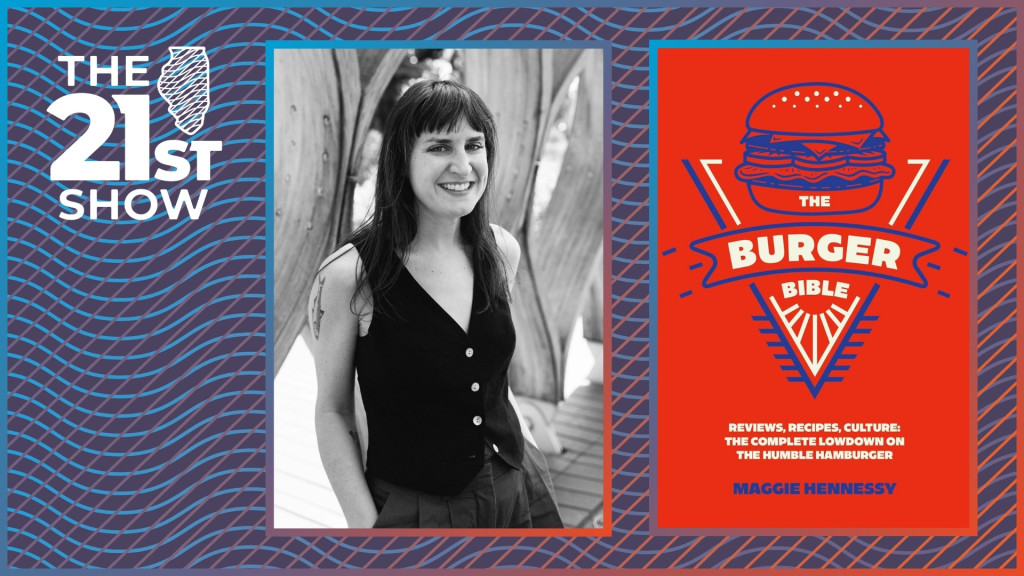
Courtesy of Maggie Hennessy and Welbeck Publishing Group
// This is a machine generated transcript. Please report any transcription errors to will-help@illinois.edu.

[00:00:00]
Brian Mackey: From Illinois Public Media, this is the 21st Show. I'm Brian Mackey. When you think of iconic foods of this 250-year-old country, what comes to mind? Perhaps apples, apple pie, especially if you've been listening to the 21st Show lately. Maybe even hot dogs or the official snack food of Illinois, popcorn, or maybe international foods that have become uniquely American — pizza, orange chicken, tacos.

Well, whatever the food might be, arguably the most iconic of them all has got to be the hamburger. What kind of hamburger is your favorite? Especially when you consider there's virtually an infinite number of ways to make a burger. A new book makes an effort to highlight several dozen and trace the history of America's favorite sandwich.

Maggie Hennessy is a trained cook and food writer. She's a contributor at WBEZ, the NPR station in Chicago. She was the restaurant critic for Time Out Chicago, and her writing has also appeared in Bon Appétit, The New York Times and Condé Nast Traveler, among others. Her new book is "The Burger Bible: The Complete Lowdown on the Humble Hamburger." Maggie, welcome to the 21st Show.

[00:01:14]
Maggie Hennessy: I'm so thrilled to be with you.

[00:01:16]
Brian Mackey: And a quick programming note: We tape this conversation ahead of time, in part because this is an experiment for us. Like many radio shows and podcasts, we're going to start putting some of our segments on camera. You can find us on YouTube by searching "the 21st Show." And Maggie, extra thanks for being our first guest on video.

Let's start with what should be a pretty basic question about burgers. To cheese or not to cheese?

[00:01:41]
Maggie Hennessy: To cheese. I grew up in a household — my dad, actually, it was kind of a badge of honor — he had to not put cheese on the burger. And so it was sort of like a, it almost felt like a faux pas, you know, where it's like gospel in your household, so it felt almost illicit to have cheese on a burger. So now I proudly cheese anytime I can get it.

[00:02:04]
Brian Mackey: I mean, is it even worth eating a hamburger without cheese on it?

[00:02:07]
Maggie Hennessy: I would argue no. And one of the things I love about diving into the burger is you can also complicate every single component and argue over who invented it and when. For example, we don't really know when someone put cheese on a burger first, but I do know that the Humpty Dumpty Drive-In in Denver, Colorado, trademarked the term "cheeseburger." So that every single detail —

[00:02:31]
Brian Mackey: In effect —

[00:02:32]
Maggie Hennessy: I believe — I mean, I don't — how possibly could it be? Yeah, OK, right. But every detail of the burger contains these sort of little tidbits that are just fantastic.

[00:02:44]
Brian Mackey: Yeah. OK, so you mentioned your household burger rules growing up. How long — how long do you have memories? How long have you been eating hamburgers?

[00:02:52]
Maggie Hennessy: Oh, don't you feel like it's the backyard food on the paper plate on your knees? Like, I don't know — how old was I? Four, probably, you know, when you have your earliest memories, right? Like, it's just — it was handheld, and you could put ketchup, as much ketchup as you wanted on it. So for a little kid, you know, this is great.

[00:03:13]
Brian Mackey: Yeah, a ketchup delivery vehicle — as a friend of mine once referred to these sorts of foods. OK, you categorize hamburgers based on their type, right? Tell me about some of the different types of burgers.

[00:03:25]
Maggie Hennessy: This is really fun because once you start doing that, you kind of realize the trend eras of the burger as well. But if you think about it, there's sort of the regional specialties, which we can unpack as much as you like. A couple that come to mind are the Juicy Lucy, which is from the Minneapolis area, where they put cheese inside the patty. They sort of press two patties over it so that when you bite into it, you get this molten cheese center.

There's the steamed cheeseburger from Connecticut, where they steam it in these cabinets, so it gets the texture almost of meatloaf. The onion burger from Oklahoma, which was born in 1922, supposedly, during the railroad strike, where they smash a thin haystack of onions right into the patty and griddle it. The green chili cheeseburger — one of my favorites — from the Southwest, where the long green chilies are grown.

And then if you think about some of the more general categories, there's the pub burger — the big, brawny guy with the thick bacon on top. The fast food burger, we know and love for its commodity everything — kind of thin little patties, yeasted white flour bun, American cheese always, lettuce, tomato, onion. And then a fancy steakhouse burger, where they take the steak trimmings, fancy aiolis on top. So you can really — there's a whole bunch of them.

Burger-adjacent, viral burgers, which could be anything where they build it into the size of an ottoman or douse the entire thing with melted cheese. It's more about shock value than enjoyment of eating, I think.

[00:05:04]
Brian Mackey: [You do a TikTok feed near you.] 100%. All right, we're going to come back to burger-adjacent. So I mean, is there a specific type — like, what is your be-all, end-all burger?

[00:05:15]
Maggie Hennessy: Well, it's interesting. For me, I think I have an affinity toward the green chili cheeseburger because I lived for a year and a half in southern New Mexico, actually 30 miles from Hatch, which is where the famous long green chilies come from. And so that's a moment where you're really eating something that's of the place. Every Labor Day weekend, there's a Hatch Chili Festival where the farmers — I mean, it's just a crush of chilies that arrive and they roast them in these huge rotating drums, and you can hear the crackle and it smells smoky, and they bag them all up and they get sent to local grocery stores.

But there's a place in the town of [Hatch] called Sparky's, and they use local Black Angus beef, sticky American cheese on top, and then they put a heap of these roasted chilies. And so it's tangy, and it goes so well with the beef — it adds some interest to it. So that's one of my favorites.

And then one that I personally have been trying to make a trend, but I'm not a TikTok person, so it's just my word, right? Whenever I can, I'd like to see the onion burger overtake the smash. The smash's reign has been long and fruitful, and I'm ready for the Oklahoma onion burger to take over.

[00:06:36]
Brian Mackey: Is the White Castle a subvariant of the Oklahoma onion burger, or is that different?

[00:06:41]
Maggie Hennessy: It's like — White Castle is kind of more like a slider because they steam the onions with the bun with the burger, so the flavors kind of meld.

[00:06:53]
Brian Mackey: White Castle — yeah, that was a digression. I was just curious when you described it because I'm not sure I've had one of these Oklahoma onion burgers as you've described it.

[00:06:59]
Maggie Hennessy: They're very specific. Wait, are you a White Castle fan?

[00:07:04]
Brian Mackey: It's a complicated relationship, I would say. I don't think I've eaten at one in probably 15 years. They were a part of my childhood. Middle-aged Brian cannot handle it as well, nor does anyone in his family enjoy going there.

[00:07:18]
Maggie Hennessy: Understood. What do you go for then, typically, for a burger? What's like —

[00:07:22]
Brian Mackey: You know, I live in central Illinois, so we don't have maybe quite as many experimental places as you would get in Chicago. I'm open-minded to things. I'm not a big spice eater, but, you know, this is actually a good opportunity to remind listeners they're listening to the 21st Show, and we're talking with Maggie Hennessy, who is a food and drink writer for WBEZ as well as many other outlets, about her new book. It's called "The Burger Bible: The Complete Lowdown on the Humble Hamburger."

We asked people in our texting group about this. Robert in Rockford wrote in and said, "Rockford has a gem of a fast food restaurant where the burgers are top-notch at an affordable price. Beefer [Ro] is Rockford's burger restaurant — head over heels better than any other fast food burger restaurant I've eaten anywhere in the country. Drive by the restaurant on Alpine Road at lunchtime, you'll see the parking lot unusually jammed, because workers know a quality burger at a good price when they see one."

Thanks for that message, Robert. I should say we tape this conversation ahead of time, so we're not taking calls live on the show today, but you can always let us know what you thought by emailing talk@twentyfirstshow.org.

All right, Maggie, Robert mentioned fast food there, and that is obviously one of the dominant forms of the hamburger still. But let's go back further than that. What do we know about the origin story of the hamburger?

[00:08:50]
Maggie Hennessy: Well, it's really interesting. It goes back to the domestication of cattle, right? — technically to Stone Age Mesopotamia. In ancient China, too, there were dumplings made with minced beef inside. So you could almost see that as the precursor to an enwrapped bit of beef, right?

But my favorite bit of trivia is this: In 13th century Mongolia, when the Mongols and Tatars were fighting, they apparently had this real fondness for warm, raw mutton. They would ride with raw mutton under their saddles all day, and they'd get to camp and they would chop it up and put spices and eat it raw, just like that, happily around the fire.

From there, it sort of made its way toward the Baltic Sea, toward Europe, where people started cooking it. The lamb turned to beef by the time it got to Germany. That's when people started cooking the little balls of beef known as [Frikadellen], and German migrants carried that knowledge with them to the U.S. when they migrated.

And so, from there, when agricultural fairs were being set up to educate folks about the economic engines of their areas, that's when we start to get into the battle of when did someone put it between bread — which is another origin that people love to argue over — and then if it counted as a burger if it was bread versus when fast food started putting it on the yeasted bun. But it was really the late 1800s when we start to see the burger as we know it crop up.

[00:10:31]
Brian Mackey: I'm not going to disclose what age I was when I finally made the connection to Hamburg, Germany, and not something having to do with ham as the meat. But, you know, what do we know about the history of the hamburger in America? Whether you mentioned two slices of bread or this yeasted bun or whatever else people have done to it over the years.

[00:10:56]
Maggie Hennessy: It's really cool because fast food plays a really big role in it — in terms of efficiency and how it came to be produced the way we know it. But I think a lot of the origin story was these sort of roadside diners that popped up near places where rail was being constructed and things like this. So the development of America really happened alongside it.

And then around the time of the Depression — like, even the onion burger, it's cool to think about, and the smash burger, which arguably was born around that time — there were these diner owners, little roadside joints. Some of them have been open since the late 1800s, like Louis' Lunch, arguably the inventor of the hamburger sandwich. And they would — because they were stretching precious beef supplies — smash it thin, put it on a bun, and it's a great handheld meal with protein and a little bread for a person working a long shift.

And then when we think about the creative element of how the burger has sort of blown up — one of the things I really loved — I was speaking with a writer from Forbes, and she told me about this study in 2020 done by a couple of sociologists where they called the burger the prime example of a composite culture. So American practices are shaped by every group that enters them. And the burger is an amazing example because if you're an immigrant, a new American, food is still a relatively low-barrier-to-entry business to get into, but you have your flavors of home. You want to share them in a way that's accessible to someone who hasn't had them before. A burger is a great vehicle for that, and so you start to see how all these influences came to impact the burger and kind of make it this very versatile thing that's so broadly adopted.

I mean, I think it's something like 60% of the sandwiches consumed worldwide are hamburgers. It just took off. And then it became famous here — we really incubated it — and then it went back. People who spent time living here then went back to India, to Australia, New Zealand, Europe, and they said, well, I like this about the American fast food burger, but I don't like this. I'm going to change it and make it my own. So it's a really versatile food in that way, which is fascinating.

[00:13:23]
Brian Mackey: Having eaten a Jollibee hamburger in Manila, I can attest that people are definitely making it their own.

[00:13:31]
Maggie Hennessy: That's —

[00:13:33]
Brian Mackey: Different. It's kind of like — it's very similar to McDonald's, but yeah, very different. And it was a long time ago now. I don't remember the exact flavor profile, but different — very different seasoning, no lettuce, no tomato, no ketchup.

But speaking of those things, I mean, arguably McDonald's makes the most famous hamburger in the world. Its roots traced to California, but arguably, McDonald's as we know it started in Illinois. So tell us a little bit about that history.

[00:14:05]
Maggie Hennessy: Well, McDonald's is an interesting one because there was this single stand in San Bernardino, California, in the '50s that was selling hamburgers for — I think it was like 15 cents or something. Dick and Mac McDonald — and they also — at the same time, as these fast food chains are coming, you start to think about the drive-through technology, the two-way speaker system — all this stuff is being developed in concert as we're becoming the convenience country.

And so there was this milkshake machine distributor, Ray Kroc, who visited them, became their franchise agent, and opened the first one we know of east of the Mississippi. And then from there, Kroc had a vision for 1,000 restaurants in the U.S. Now McDonald's is in 120 countries worldwide.

The amount of burgers that they're slinging a day — I actually have the number here, just give me one second. Every 24 hours, the Golden Arches is slinging 75 hamburgers a second worldwide. That is 6.48 million burgers every 24 hours. It's the biggest restaurant on the planet.

There's some really cool trivia that I learned through researching the book about the behemoth that is McDonald's. The Big Mac was coined in 1967 by a 21-year-old secretary named Esther Glickstein Rose. She worked in the advertising department in the Chicago corporate office. They had also considered calling it the Aristocrat, or the Blue Ribbon Burger. I love this, right? Isn't that great?

[00:15:51]
Brian Mackey: I wonder if Esther retired rich. Somehow I doubt it.

[00:15:56]
Maggie Hennessy: The Aristocrat kills me. Can you imagine if that was the name we were calling it to this day? But now — that was the dream of Ray Kroc, 1,000 — now there's well over 36,000. So I think, you know, it was successful.

[00:16:10]
Brian Mackey: Yeah, and I remember they used to have the — however many million or 100 million or billion served — on the signs. They seem to have given up that as a marketing strategy some time ago.

Yeah, all right. Let me reintroduce our conversation if you're just joining us. It's the 21st Show. We're speaking with Maggie Hennessy, food and drink writer at WBEZ and elsewhere, about her new book. It's called "The Burger Bible: The Complete Lowdown on the Humble Hamburger." As the name suggests, it explores the history of the hamburger and how it's made differently across the country and around the world.

We're going to take a break on the program. We tape this conversation ahead of time, mainly so we could test out putting it on video. So if you're listening on the radio or to our podcast feed, head on over to our website, twentyfirstshow.org, or go to YouTube and just search for the 21st Show, and you can see our inaugural effort at doing the 21st Show on camera. More to come. We'll be right back. It's the 21st Show. I'm Brian Mackey.

We are talking today with Maggie Hennessy, who is a food and drink writer at WBEZ, the NPR station in Chicago. Her new book is called "The Burger Bible: The Complete Lowdown on the Humble Hamburger." It explores the history of the handheld sandwich, famous restaurants that have made the burger their own, and how you can up your burger game at home as well.

We asked people in our texting group about this. Kevin in [Faina] was very passionate. He said this is even a topic he had suggested in the past, so thank you for that, Kevin. He writes: "My Illinois favorites are currently Bill's Toasty in Taylorville, a true hole-in-the-wall serving the best burgers. Others include Wally's in [Breeze], Chuck's in Salem and Andrews Eats in Altamont. And who can forget Moonshine, Illinois? The very best is quite likely to be waiting at my next stop at some family-run small-town drive-in restaurant."

He also says: "What makes a great burger? A healthy-sized, properly but not overly seasoned patty, served on a good quality bun, fully dressed, as we used to say in upstate New York. For me, that means cheese, good bacon, lettuce, tomatoes, onions, plenty of good dill pickles, mushrooms in brown gravy, ketchup, mustard and mayo."

I can feel needing extra napkins already, Kevin. Thank you for —

[00:19:02]
Maggie Hennessy: [That's a] dressed burger.

[00:19:06]
Brian Mackey: Well, talk about that. What, in your view, is too much in a burger? How do you strike that balance?

[00:19:13]
Maggie Hennessy: Oh, well, I'm probably not going to be as popular, particularly with the last comment. I like a simple burger, and for me it's all about balancing all the things you want. A swipe of mustard — I like that for tang. I don't like the patty to be too thin. I like when there's some caramelization on it, but I find sometimes with the smash it goes a little too far to the point of being dry. I like when there's still some juicy interior. Good, sticky American cheese will do it for me. Sometimes mayo — I like a swipe, I won't say no. [A] tender bun. Onion — I like it cooked or raw, I will also not say no to both forms. Pickle. Lettuce. Tomatoes sometimes, but it's like, usually if the tomato's in season, I'd rather have it. If not, why bother?

[00:20:03]
Brian Mackey: You don't want those pink tomatoes.

[00:20:05]
Maggie Hennessy: They make me sad. But yeah, I tend to like it pretty simple myself, but I'm that way about pizza toppings too, so people will come at me about all these things — and bring it on. That's fine. I'll take it. Brown gravy — that's incredible. That's like getting into Hot Brown territory. This is fascinating.

[00:20:22]
Brian Mackey: Yeah, you know, there's a million ways to make a burger. I guess that's right. So, talk about the Midwest and Illinois' contribution to the history of the hamburger in particular.

[00:20:33]
Maggie Hennessy: Well, a lot of my research was centered on Chicago, which I think might be unpopular with some listeners, obviously, so we've got to give love to the whole state — but it's where I live. And so for me, a lot of the trends I've watched unfold that contributed to the conversation, I saw them happen in my own hometown. You think about the introduction of the gastropub, really — where it really took over in the early 2000s — and you saw the quality of the burger just jump from fast food the way we knew it to these brawnier pub burgers.

We also have some historic joints that started here. The Billy Goat Tavern is such a famous place, and some would argue that the quality — I mean, it's not the best — I wouldn't say it's the best burger in Chicago. But descending those stairs at that location in the shadow of Tribune Tower, you know, where the famous journalists' names are all over the walls and the photos of the politicians and the lovable crooks — there's some history you can see and feel when you step into that place. And that to me tastes like a backyard burger. They did change the bun — it used to be a kaiser bun, which was much breadier, and they've recently changed to a more tender bun.

But there's the legend, you know, associated with the original owner, [Bill Sianis], and that he and his goat were responsible for the Cubs' [curse] — until they won the World Series.

Another thing that was cool, that I feel very much happened here in real time — not that long after Instagram started and social media was really taking off — we had an early example of a viral burger here with [Avec]. A fancy diner that opened in the West Loop — the owner is Brendan [Sodikoff] — and they made just a really fantastic burger. It was not quite a smash, it was a double burger, and just beautifully made. And they stuck a steak knife in the middle of it. When that place opened, somebody at Bon Appétit went early, and all of a sudden there were 2.5-, 3-hour waits around the block. People [took] turns. And so it was like the early days of the viral burger, which now — we think about how often people chase trends and line up for things, and it's very much part of our culture now. But that was a weird thing that was really unfolding at that time.

Similarly, there's one down the street from that — the Loyalist — whose burger became so famous that it had its own Instagram for a while, the Dirty Burg. It's like an excellent burger.

So that was cool. McDonald's is obviously a big part of Illinois' contribution to the burger. And also another big contribution — if you think about it too — is the publication of "The Jungle" by Upton Sinclair in the early 1900s. I'm jumping around a bit here —

[00:23:39]
Brian Mackey: Well, that almost killed the burger. There was some thought it might kill the burger.

[00:23:43]
Maggie Hennessy: Yeah, correct. And there was this fear that came out of that book — the exposure of the unsanitary conditions of these slaughterhouses and meatpacking lines — that made people sort of shrink away from the idea. And that's what gave birth to White Castle — this gleaming, white tile, chrome temple to cleanliness. "We're going to grind the burgers on site so you can see." And they were even commissioning, I think, universities to do studies to show the healthfulness of the burger. So it was like this kind of brilliant campaign to convince people to come and eat burgers again. Here we are back at White Castle, your old nemesis, Brian.

[00:24:30]
Brian Mackey: Affectionate, affectionate. So, talking about all these different kinds of burgers — and your book introduced me to this idea of regional burgers that I wasn't really familiar with, which is maybe my own gap in literacy — it strikes me that the way we talk about regional pizzas, you can go to almost anyone in the country and the average person in America is going to know New York style versus Chicago deep dish. Maybe they'll take it to the next level and know we have tavern style as well. Quad Cities has a pizza, St. Louis has a pizza. I feel like burgers aren't really as much a part of the zeitgeist in terms of regional flair. How do you think about that? Is that an accurate assessment, or am I just in the dark?

[00:25:17]
Maggie Hennessy: I think that's very accurate — and I hadn't thought about it until you asked it. It's a great observation, because you start to realize as you're researching and trying to find examples, that you can get maybe locally — you know, there is a Juicy Lucy, there are a few spots in Chicago, there's one in particular that serves a Juicy Lucy. But when you're looking for examples of these things, a lot of them live very squarely in a small area. There's the Texas bean burger from San Antonio. And so I think — I don't understand exactly why they haven't, their marketing department for national distribution — you know, who is that? But I mean, you can get —

[00:26:00]
Brian Mackey: New York-style pizza in Chicago, you can get deep dish in New York —

[00:26:04]
Maggie Hennessy: I know. And my quest to bring the Oklahoma onion burger to everybody in this area — there's a place in Uptown in Chicago that serves an Oklahoma onion burger, but it's because the chef lived in Oklahoma City and his parents [did too]. So I think it's a deeply personal thing in a way that pizza isn't, and I don't fully understand it.

Like, if you think about a great example that's a neighboring state — the olive burger. Just a swath of central Michigan pledges loyalty to this thing. I think there's a festival every year, and it's just a pile of green olives on top — loose olives on top — or some places mix them into a mayo-based sauce. But if you talk to the evangelists for this style, they say, well, it's a great way to add this kind of briny salt to the burger.

And so I don't know — maybe it's because a pizza, it's like cheese and bread, and it's such a blank canvas. Maybe the burger isn't quite — I don't know, or maybe we just hold it a little differently. I haven't — oh, it's such a great question. Now I'm going to wake up in the middle of the night thinking about it — why it hasn't traveled.

There was one — it was interesting — when I had already submitted the draft, I was contacted by the tourism board in Corinth, Mississippi. A PR person working with the tourism board, who knows I like regional food, said, "Oh, have you had a slug burger?" And I said, "What?" And I'm like, oh no, it's too late, the draft is in.

It is this Depression-era regional curiosity you can get in a very small regional swath — in and around Corinth, Mississippi, maybe getting closer to Memphis. And it's a patty that's mixed with some kind of filler — soy flakes, bread crumbs, whatever — to stretch the beef. And they fry it, they top it really simply — I think it's pickles, onions, mustard. There are a few places in town that make it. It hasn't traveled very far outside, and also you can buy the mix at the grocery store, so there's nostalgia to it. I think people make it at home in the backyard, on their grills too.

And people have complicated relationships to it, you know. It's like when you talk to people outside of Illinois or Chicago about deep dish pizza and they associate you with it, and you sort of go, "Oh yeah, well, we eat it when people come to town." And the burger — there's a similar relationship to it among some folks. They'd begrudgingly say, "No, it's our regional food we're known for. We take people — they have to eat it when they visit."

[00:28:43]
Brian Mackey: Right, right. The horseshoe in Springfield is that way, I think — some people get very excited about it, some people would have nothing to do with it.

Well, that does raise the question: In the few minutes we have left, how much can we stretch the definition of a hamburger? Is a piece of tuna on a bun a hamburger? Is a ground pork — a burger? I have less of a problem with that one. How about a piece of chicken — or is that a chicken sandwich? So how do you define that?

[00:29:12]
Maggie Hennessy: I would say, with chicken, if you grind it — I don't know why, but in my head, with poultry, if you grind it, that counts. But then there's a place in Tokyo I wrote about where they do a pickled mackerel burger. The thing is, the chef spent some time in the U.S. He loved the idea, but he said, "I don't want to do greasy, mass-produced junk, but I love the idea of this sandwich." And so he's built it sort of like a futomaki sushi roll — there's an omelet, shiso leaf instead of lettuce, and the bun is made locally using natural yeast from a baker in town. And he's getting the [mackerel] from the fish market, which the burger shop is inside of. So I would say, working with what he's got, that's an incredible example of a burger.

But then you could get into this argument — maybe it's like, whatever we're working with. Like, is a burger even a sandwich? Is a hot dog a sandwich? These kinds of things you could debate endlessly, you know what I mean? So I don't know — I think I don't care as much, because one of the things I love about the burger is the way we've popularized it. The thing that's very American is we love to spurn dogma in certain ways, and we kind of take pride in that. We've approached everything that way — like, I feel like we always upset the Italians and the French in the way we approached wine, you know. It's like you learn the rules to break them. So I welcome it — burger, why not?

[00:30:48]
Brian Mackey: All right, probably our last question, just a couple of minutes left. If somebody wants to elevate their burger game at home, what is one tip you would give them? What is the biggest thing you can do to elevate your home chef burger game?

[00:31:01]
Maggie Hennessy: Home chef burger game — let me think about this. It's a very good question.

I think, yeah — sort of across the board — a really good ratio you'll find with ground chuck. It's the shoulder primal from the cow, and there's higher fat, more connective tissue. So it's almost like it's naturally telling us, "Make me into a burger," because it's juicier, it's tastier, it's like a working muscle and you get that extra fat.

If you want to get nerdy, what would be cool is if you go to your gastropub or your steakhouse, find out what their blend is, and you could even ask: "Can the chef tell me?" So then you could go to your butcher and say, "Can I get ground brisket?" — or whatever they're working with — so you can get a more intense beefy flavor.

I would also say, go for the stuff that's in season to put on top. Go for pickles that are made by someone you really love. Go for the good stuff. A lot of chefs swear by Martin's rolls — a really soft, squishy burger bun. I would say there's no shame in asking chefs at your local restaurants, "Where's that bun from?" And then, don't put the out-of-season tomatoes on there. But there are exceptions — I think good old American cheese is always great. Iceberg lettuce, if you love the crunch, is great. But I think simpler is better.

[00:32:36]
Brian Mackey: Maggie Hennessy is the author of "The Burger Bible: The Complete Lowdown on the Humble Hamburger." Thanks so much for being with us today on the 21st Show. Appreciate it.

Maggie Hennessy: Thank you for having me.

Brian Mackey: That is it for us today. The 21st Show is a production of Illinois Public Media. I'm Brian Mackey. Thanks for listening.
As the United States celebrates its 250th birthday, there are few things as American as the hamburger. So how has Illinois and the greater Midwest contributed to America’s favorite hand-held food?
A food expert weighs in. You can watch the full conversation here.
GUEST
Maggie Hennessy
Food and Drink Writer, WBEZ
Author, “The Burger Bible: The Complete Lowdown on the Humble Hamburger”