








Abortion care in Illinois four years after Roe v. Wade decision
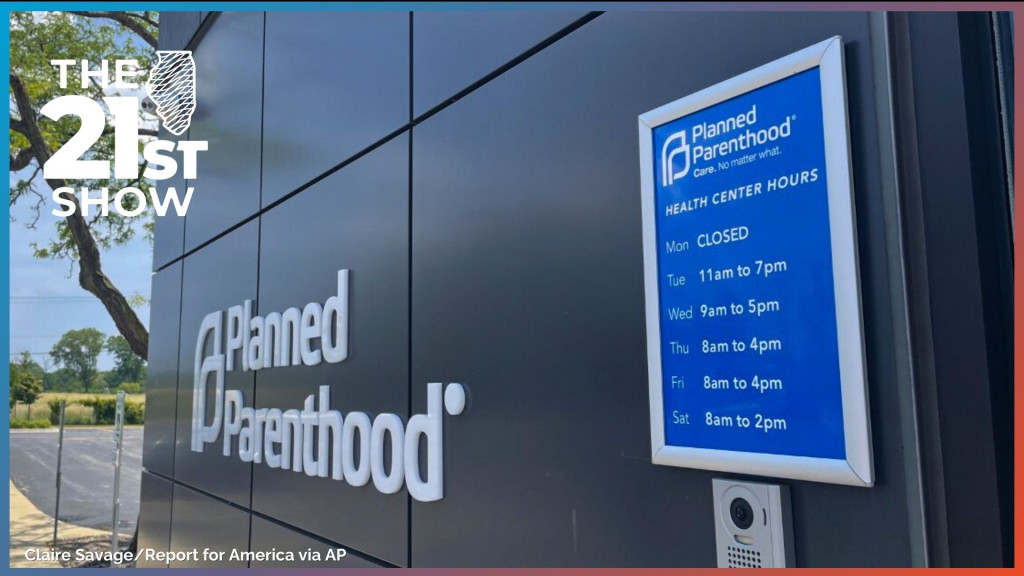
A Planned Parenthood health center is shown in Waukegan, Ill., June 28, 2022. Claire Savage/Report for America via AP
// This is a machine generated transcript. Please report any transcription errors to will-help@illinois.edu.

[00:00:00]
Brian Mackey: From Illinois Public Media, this is The 21st Show. I'm Brian Mackey. Next month will mark four years since the United States Supreme Court issued its ruling in the case of Dobbs v. Jackson Women's Health Organization. That decision overturned Roe v. Wade, the 50-year-old precedent that had guaranteed a constitutional right to an abortion. In the months that followed, abortion became illegal in 14 states either through new laws or existing laws that were triggered once Roe was struck down.

Today, according to the nonpartisan health research organization known as KFF, 23 states completely ban abortion or limit it to the first 18 to 22 weeks of a pregnancy. Most of Illinois's neighboring and nearby states fall into that category, including Wisconsin, Indiana, Kentucky, Iowa, Ohio, Nebraska, Kansas, and Tennessee.

Meanwhile, here in the 21st state, abortion is legal through fetal viability, which usually occurs around the 24 to 26 week mark. Any abortions after that are supposed to only preserve the health and life of the mother. Advocates for abortion rights describe Illinois as a safe haven. It's also a magnet. The Chicago Abortion Fund says the first three months of this year were their busiest in four decades.

So, for the first half of our show today, we're going to talk about the state of abortion care in Illinois in the four years since the Dobbs decision. Joining us now is a representative of the Chicago Abortion Fund. Alicia Hurtado is director of advocacy and communications. Alicia, welcome to The 21st Show.

[00:01:43]
Alicia Hurtado: Thank you so much for having us.

[00:01:45]
Brian Mackey: Listeners, I should also point out, we did reach out to both Illinois Right to Life and the Thomas More Society, the Catholic legal organization, for their perspectives. We did not hear back from Illinois Right to Life, and although the Thomas More Society seemed interested, they ultimately did not come through with a guest. That said, I would like to talk to someone from that perspective. We'll keep trying to do so for a future program. You, however, can join us throughout the hour today. 800-222-9455 is the number. 800-222-9455.

All right, Alicia Hurtado with the Chicago Abortion Fund. I mentioned a little bit about that first quarter, the first three months of 2026. Say more about what that was like day to day for your organization.

[00:02:31]
Alicia Hurtado: Yeah, I can share a little bit more there. First, I'll take a step back just in case folks are unfamiliar with the Chicago Abortion Fund. We are [an] Illinois statewide abortion fund and the largest abortion fund in the country. We support folks who are facing barriers to abortion care, whether they live in Illinois or are coming to Illinois for their abortion care, with travel support, paying for appointment costs, helping with things like lodging or childcare stipends if they need, meal stipends, things of that nature — really just trying to make sure that we're meeting people where they are and ensuring that no matter who they are, their financial situation, their zip code, they are able to access the protections that we've worked so hard to build here in the state of Illinois.

Like you mentioned, we've been around for over 40 years now, and definitely the last four have been — I don't think a radical shift in our mission. We're still here to support people who are facing barriers to abortion care, but absolutely a huge shift in the scale and scope of our work.

[00:03:39]
Brian Mackey: And some numbers on that — like, what does that mean, a shift?

[00:03:43]
Alicia Hurtado: Yeah, absolutely. So I started at the Chicago Abortion Fund in 2020 on staff. I was a volunteer previously, and my first year on staff, we fielded 1,600 calls on our helpline, and last year we fielded 20,000 support requests. So it really just is a completely different ballgame.

At this point, about 85% of the people we support are from out of state and require quite intensive barrier reduction support. We're talking about — previously maybe folks were driving across state lines to access care from Indiana or Missouri, and while we absolutely were supporting that, and we still are supporting, of course, even more people from Indiana, from Missouri, from neighboring states, Wisconsin, what have you, who are accessing abortion care in Illinois — now we're routinely seeing people from Texas, Louisiana, Florida, Alabama, Georgia coming all the way to Illinois to access care. In fact, 1 in 4 people who are forced to cross state lines for an abortion are coming to Illinois for that care.

So we really do have a nationwide scope at this point. Illinois is absolutely a part of the national abortion access landscape, and so many people across the country are relying on the Chicago Abortion Fund to fill gaps in their support, relying on the incredible clinics and providers that we have in our state and relying on our legislators to continue to protect and expand basic healthcare — especially for folks who are traveling across state lines whose representatives are not protecting their bodily autonomy and healthcare.

[00:05:28]
Brian Mackey: What sort of — I mean, to the extent you can generalize, and obviously all people are different, all cases are different cases — but, you know, what is the typical Chicago Abortion Fund, you know, I don't know what the term is, client or caller. What is their situation like?

[00:05:47]
Alicia Hurtado: You know, that's so interesting. I think when you're fielding, you know, 50,000 support requests since the Dobbs decision, it is really hard to generalize. I think I'll first offer that 1 in 4 people who can get pregnant will have at least one abortion in their lifetime. And so, really, when you think about who's getting abortions, it's everyone — it's people of all socioeconomic statuses, all backgrounds, all religions, all walks of life. And so that truly is reflected on our helpline. I've supported people who are younger than me, older than me, parents, grandparents, young people. It really can't be kind of boiled down to a singular kind of profile or type of person.

And I would say even more post-Dobbs this is true — or post the fall of Roe v. Wade — in that people are struggling more. We know that social safety nets are being cut. We know that the cost of living is so high that more and more people are not able to front hundreds of dollars for an unexpected medical need, let alone the travel to get there. And so it's not just who you might think — you know, Medicaid-eligible folks or people who are uninsured. It's also the folks who have private insurance who just can't front an unexpected $500 cost on top of travel. And, you know, we're here to support anybody who needs support accessing abortion care, regardless of their background or who they are.

[00:07:28]
Brian Mackey: And that's what I kind of wondered, because I think after — you know, when this was anticipated, when people were still wondering whether Dobbs would come down the way it did, and then in the immediate aftermath — they said, well, rich people are going to be fine, rich women can be fine. But I kind of wondered how far up and down the, you know, socioeconomic ladder the challenges people experience stretch, if that makes sense.

[00:07:51]
Alicia Hurtado: Yeah, no, that is absolutely true. I think, of course, people who can plan for this type of unexpected cost are able to circumvent some of the barriers that folks are facing, but that doesn't mean they're still not traveling long distances to access care, having to jump through unnecessary hurdles.

And for us, I think one point that is important to think about is that sometimes access to abortion care — even if your household income is one thing, that doesn't mean that you can actually utilize your household income to pay for this procedure. We sometimes will have folks that don't have a supportive partner or support system in general and they can't use their parents' insurance, or they can't use their partner's insurance to cover the cost of their procedure, or to help cover the costs of travel.

And so I think unfortunately we're living in a world where there's so many different factors that can preclude your access to, again, basic common healthcare. And [CAF] is here — we don't have any sort of income requirements or means testing on our helpline. We listen to people when they tell us what they need and we do what we can to make sure that we're meeting the moment and meeting their needs and getting them to the care they want, need and deserve.

[00:09:18]
Brian Mackey: Let me reintroduce our conversation. If you're just joining us, it's The 21st Show. We are talking with Alicia Hurtado, who's director of advocacy and communications at the Chicago Abortion Fund. Next month will mark four years since the Dobbs decision. And [CAF,] the Chicago Abortion Fund, reported that the first quarter of this year was their busiest in their more than 40 years of existence. If you want to join us today, 800-222-9455. That's 800-222-9455.

I'll say again, as I did at the beginning of the program, we did invite Illinois Right to Life and the Thomas More Society to talk with us today on the program. I hope they will do so in the future, so we can hear another perspective on this. Again, if you want to join us, 800-222-9455.

So, a lot of states have passed laws seeking to sort of reach into other states and prevent their own citizens from taking advantage of abortion services in other states. Can you talk about how your organization has sort of thought about what other states are doing? I know that I've heard some providers now are not traveling to certain states. Has that affected you at all? Talk about how you're thinking about that.

[00:10:33]
Alicia Hurtado: Yeah, I mean, it's impossible not to think about the broader abortion access landscape on a national level, and this is certainly top of mind as we're not only thinking about protecting our organization, making sure that we're able to continue to operate — particularly because we are holding such an important role on the national level.

As I mentioned before, 1 in 4 people who are crossing state lines for abortion care are coming to Illinois. The Chicago Abortion Fund, based on our support numbers last year for folks accessing care in Illinois, supported 43% of those people. So we really are helping bridge those gaps and make sure care is accessible, and we recognize that responsibility and want to make sure that we're able to continue to do this work.

Something I always say — and I think something that always shocks people in Illinois — is that changes in the legislative landscape as far away as Texas and Florida have immediate impacts on the access landscape here in Illinois. And I think a perfect example of this is that, concurrently, there was a six-week ban being implemented in Florida at the same time as the ban in Iowa. And so we kind of saw this parallel abortion restrictions happening at the same time, and while of course the restrictions happening in Iowa had an immediate impact on the way we were able to provide abortion care — the strain on the Illinois abortion access system — also thinking about the, yeah, just the numbers of people traveling to our state, the loss of Florida was also a huge impact on the Illinois abortion access landscape, where so many people, not just from Florida itself, but from across the Southeast, now were turning to Illinois as their closest point of access, their point of access with the fewest restrictions, with the most availability, with the most support.

And we're so lucky to have not just the Chicago Abortion Fund filling gaps for folks and other abortion funds across the country supporting people, but clinics in Illinois that really have stepped up and expanded capacity and ensured that we really aren't seeing huge wait times for folks even though we're taking on such a share of the national need. But it's true — whatever happens as far away as the Deep South has immediate implications for the way that we're setting up our care landscape here in Illinois.

[00:13:12]
Brian Mackey: So, the number of people seeking abortions has actually increased a little since the Dobbs decision. It's a modest rise. But I get the sense that that is not what a lot of people were expecting. What do you make of that?

[00:13:28]
Alicia Hurtado: Yeah, I think one, it's a testament to the work that we at the Chicago Abortion Fund do and the work of abortion funds to ensure that these really devastating restrictions that are trying to force people to continue pregnancies are not doing that, or, you know, people are able to access the lifelines that they need to get urgent, time-sensitive medical care.

But I also think what we're seeing now and hearing from a lot of people, particularly in this political moment, is the way that the federal landscape is impacting people's decision-making around starting or growing their families. And it's no coincidence that at the same time that social safety nets are being cut, people are worried or experiencing family separation due to immigration status, we're seeing threats to healthcare coverage, cost of living rising dramatically, that people are sitting down and making decisions about, you know, am I able to continue this pregnancy? Is this something that makes sense for me and my family?

And for me, I think that's something that we really sit with as an abortion fund, and our main goal and our bottom line is: whatever decisions that people want to make for themselves and their families, we are here to help facilitate that and help make sure that if they need an abortion and they don't have the resources to access that care, that we can be there for them. But I do think, you know, people are making hard decisions right now. The federal landscape — it's looking bleak for many families and many people across the country. And at the same time, I think a lot of networks of support like the Chicago Abortion Fund are available for folks to access care, even though we've been seeing such devastating restrictions nationwide.

[00:15:31]
Brian Mackey: All right, let me reintroduce our conversation if you're just tuning in. This is The 21st Show. We're speaking with Alicia Hurtado, director of advocacy and communications at the Chicago Abortion Fund. We're going to continue this conversation after a short break. If you want to join us, 800-222-9455 is the number. 800-222-9455. We'll continue after a short break. This is The 21st Show. Stay with us.

It's The 21st Show. I'm Brian Mackey. We are approaching four years since the Dobbs Supreme Court decision, which overturned Roe v. Wade, which had previously found a constitutional right to access abortions in the United States. In the years since that occurred, multiple states across the country have enacted laws that made abortion effectively illegal there. And that has led to a lot of people turning to states such as Illinois, where abortion is legal up through fetal viability.

The Chicago Abortion Fund is seeing this play out in the work they do. They reported the first quarter of 2026 is among the busiest in their 40-year history. We're talking about this with Alicia Hurtado, who's director of advocacy for the Chicago Abortion Fund.

I should also note we reached out to the Thomas More Society, the Catholic [legal organization], and Illinois Right to Life. Right to Life didn't get back to us. The Thomas More Society ultimately was not able to get someone on our program today. We do hope to speak with them or other people from that perspective in a future program.

We did, however, hear from you on this in our texting group. Christopher in Brimfield says, "I think it should be up to the woman and only the woman when it comes to her body."

But we also heard from Lloyd in Danville, who says, "First, as a man, 71 years old, abortion is a moral issue. If pregnancy affects the life of a mother, well, that's for the medical and scientific community to weigh in on. There are far too many abortions that are not linked to medical issues. There are plenty of options for contraceptives, and where we are failing as a society is not having comprehensive sex education in our education system. To each his own, however, abortion as a way to escape the reality of a pregnancy is just wrong," Lloyd said.

And that sentiment was echoed in a voicemail we got. Let's listen to that.

[00:18:29]
Tana: Good morning. I am Tana from rural Menard County. My comments are directed to elective abortion due to sexual intercourse between consenting adults. Society has become so used to treating sexual intercourse as recreation that we have devalued the way sex can enhance a bond between two people. Elective abortion has become a sad, usual and seemingly casual way to deal with this type of recreation. It is not my place to judge the two people who find themselves in this position, not even the people who run the abortion clinics. I do not feel God calling me to do that. It's just sad that such a wonderful thing as sex has lost its value to such a low point. The [main] — the wonderful gift we can give another person.

[00:19:22]
Brian Mackey: All right. Thank you to everyone who wrote in and left voicemails. We appreciate hearing your perspectives. If you want to join us in real time, 800-222-9455. Alicia, I don't know if you want to respond to anything any of the listeners had to say there.

[00:19:38]
Alicia Hurtado: You know, one thing that stuck in my brain was just talking about abortion as a healthcare issue and this kind of distinction between certain abortions are around healthcare, certain abortions are quote-unquote moral. I think, you know, everybody has their own kind of moral understanding, their compass, what they are and are not comfortable with. I really resonate with the caller who mentioned that, you know, people should be able to make decisions for their own bodies, and I very much feel the same.

But I do think abortion in general is a healthcare issue. One stat I'll pull out is that compared to people in abortion-banned states, pregnant people are two times more likely to die during pregnancy or just after birth. We know that abortions are much safer than continuing a pregnancy or giving birth, and that in states that have comprehensive abortion access and really trust people to make decisions about their own bodies, their own lives, that people have better health outcomes.

And then even beyond that, when people are able to access a wanted abortion, they not only have better economic outcomes for themselves, but their children or future children also have better outcomes — economic outcomes, life outcomes. And so I really think when we talk about abortion as a community responsibility, that's really what we're centered around.

[00:21:12]
Brian Mackey: Let's go to the phones now at 800-222-9455. Paul is calling from Urbana. Hello, Paul.

[00:21:20]
Paul: Hi, well, there are certainly a lot of presumptions in that long voicemail — you presumed, but I won't go into that because I want to stay focused on [mifepristone], or I'll call it RU-486 because it's easier to pronounce. My understanding [is] that it's the main way, and remote consultation is also one of the factors that's allowing it to be used in this way, and that's common in all medicine. But the attack on it through this court in Louisiana — one aspect of that case that I had heard discussed was that they issued this nationwide ruling, and after we'd had this long discussion about whether a district court can make a nationwide ruling, and I heard no one discussing that, it was the [Supreme] Court under Alito [that] had a short statement saying they were suspending it, and they suspended it further. And I guess the decision is coming down. [The Supreme Court] may have, or they're going to say something about it. But a discussion of that, I think, is extremely important, and I knew you were going to get to it. But the aspect of the way the court just summarily banned it nationwide, and it actually went into effect for a number of hours before it was remedied — just struck me as totally, totally strange. And I don't know — I don't think you're a lawyer, but I wonder if it has to do with this Comstock Act.

[00:22:49]
Brian Mackey: All right, Paul, thank you so much. Yeah, thanks for the call, Paul. And Alicia, I don't want to put you on the spot because I don't think you are a lawyer — correct me on that if I'm wrong — but if you can speak, maybe in a more general way if you want, to the idea about [mifepristone] and misoprostol and some of the legal challenges that they're experiencing, you know, it's a very real issue today, as Paul said.

[00:23:11]
Alicia Hurtado: Yes, yes. Thank you so much for bringing that up, Paul. And I'm not a lawyer — unfortunately, we work with lots of great movement lawyers — but I can share from our perspective really how we're making sense of this moment. And I think, Paul, you hit it right on the head. This is absolutely a politically motivated case. This is really down to not just the case itself, but down to the federal government asking the FDA to really take another look at mifepristone's safety and efficacy, even though we know mifepristone is an extremely safe and effective component of a medication abortion that has had just a glowing track record for 20-plus years. And all of this kind of rhetoric around mifepristone is just point-blank political. It is not grounded in science. It is not grounded in the years and years of studies on efficacy and safety.

And really what we're seeing, and what our biggest concerns are, are the confusion and chaos that in the last couple of weeks with these kind of flip-flopping directives from the courts that people are navigating in real time as they're trying to access care. And then, of course, like Paul mentioned, actually, by 5 p.m. Eastern time today, we expect to hear from the Supreme Court whether or not their stay on the ability to dispense mifepristone via telehealth or virtually or at a pharmacy — whether their stay on the block that the Fifth Circuit Court had put on that type of dispensing of mifepristone will continue, or if they will remove their stay and allow the Fifth Circuit Court's decision to stand for now.

And so, in that case, if we do have a bad outcome today and/or ultimately have a negative outcome from the case itself and mifepristone is no longer able to be dispensed either via telehealth or at pharmacies, this is a huge impact on people's ability to [access] abortion care — even pushing aside the continued confusion and chaos that folks will be experiencing.

I mean, I'll just be frank: we still get calls from Illinois residents who think abortion is completely illegal, and that is just because they're hearing these soundbites on the news about abortion, they're hearing things in their communities that are either stigmatizing abortion or talking about abortion criminalization, and a lot of our work is just making sure that we're able to educate people on the resources that are available to them.

But even beyond that — Paul mentioned that telehealth is a huge way that people access abortion care. Medication abortion is the most common way that people are accessing care, and with a change in mifepristone access via telehealth, we might expect that more people will be traveling to Illinois to access care in person. We already know that 1 in 4 people nationwide are coming to Illinois for abortion care. We can absolutely expect that to go up.

We can also expect that in Illinois itself — only 11 counties in Illinois, and folks may know we have over 100 counties in Illinois, so only 11 of those counties have an in-person abortion provider, a freestanding clinic that they can go to to access abortion care.

[00:26:40]
Brian Mackey: Illinois — I want to make sure I heard you right. Did you say 1 in 4 people seeking abortions in the U.S. are doing so in Illinois?

[00:26:48]
Alicia Hurtado: 1 in 4 people who are traveling for an abortion travel [to Illinois].

[00:26:51]
Brian Mackey: Yes, wow, wow.

[00:26:53]
Alicia Hurtado: Yes, yeah — huge, huge percentage of the folks who are traveling for care. And the next [most common destination] after Illinois is actually North Carolina, which has a waiting period to access care and a 15-week abortion ban. So if you think about where the next — we're the best option for folks, and that's the next best option — you can think about just what decisions people are making, the barriers people are facing and overcoming.

But to Paul's point, we're still experiencing both federal attacks on abortion and, of course, on a state level, so many more folks are being impacted every day by abortion restrictions, not just on medication abortion, but just generally being able to access care. And the Chicago Abortion Fund is really here to, one, cut through that confusion, and to connect people to the protected, affirming, comprehensive abortion care that we have here, provided by folks all across the state of Illinois.

[00:27:51]
Brian Mackey: Alicia Hurtado is director of advocacy with the Chicago Abortion Fund. Thank you so much for being with us today on The 21st Show. Appreciate your time.

[00:27:58]
Alicia Hurtado: Thank you.
As the overturning of Roe v. Wade by the Supreme Court approaches four years, what is the status of abortion care in Illinois today? The head of an abortion advocacy group discusses the legal aspects surrounding the issue as well as individuals traveling to Illinois from other states to access abortion care.
*The 21st Show contacted both Illinois Right to Life and the Thomas More Society, the Catholic legal organization, to participate in today's program. Illinois Right to Life did not respond and the Thomas More Society did not offer a guest by showtime. The 21st Show will continue working to produce a conversation with anti-abortion advocates.
GUEST
Alicia Hurtado
Director of Advocacy and Communications, Chicago Abortion Fund