








Abraham Lincoln Presidential Library and Museum’s new exhibit explores ‘Second American Revolution’
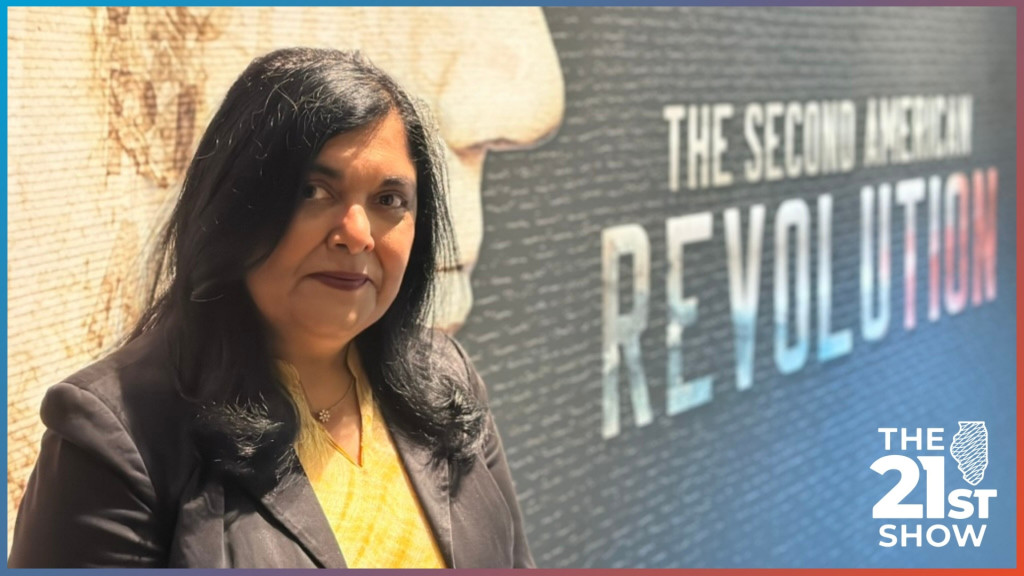
Historian Manisha Sinha is the guest curator for the Abraham Lincoln Presidential Museum's America 250 exhibit. "The Second American Revolution" explores the long Reconstruction era, from the Civil War through the early 1900's. Brian Mackey/Illinois Public Media
// This is a machine generated transcript. Please report any transcription errors to will-help@illinois.edu.

[00:00:00]
Brian Mackey: Today on the 21st show, we'll tour a new exhibit at the Abraham Lincoln Presidential Museum in Springfield. It's meant to commemorate America's founding 250 years ago by exploring our nation's second

[00:00:14]
Manisha Sinha: founding during the Civil War and Reconstruction. The country, as Abraham Lincoln put it, had a new birth of freedom.

[00:00:22]
Brian Mackey: Manisha Sinha curated the exhibit. She's a historian and author who's written extensively about slavery, abolition, and Reconstruction.

[00:00:30]
Manisha Sinha: It's a complicated story, and we should tell it in all its richness because that's what makes history come alive.

[00:00:37]
Brian Mackey: I'm Brian Mackey with Dr. Sinha today on the 21st show, which is a production of Illinois Public Media airing on WILL Urbana, WUIS Springfield, WNIJ Rockford DeKalb, WVIK Quad Cities, and WSIU Carbondale. But first, news.

From Illinois Public Media, this is the 21st show. I'm Brian Mackey. We're less than a month away from America's semi-quincentennial. That is 250 years since our forefathers declared independence from King George and the British Empire. They did so by signing a document that reads in part, "We hold these truths to be self-evident, that all men are created equal, that they are endowed by their Creator with certain unalienable rights. That among these are life, liberty, and the pursuit of happiness."

Of course, for all of Thomas Jefferson's lofty statements about all men being created equal, many people were excluded from actual equality in the nation that would result from that Declaration of Independence. For enslaved people and others of African descent, it would be nearly another century until they were included in the founders' conceptions of liberty. And women would win equal citizenship more than a half century after that.

And it's those changes, what historians call the Second American Revolution, that are the subject of a new exhibit at the Abraham Lincoln Presidential Library and Museum. It was curated by the historian Manisha Sinha, based largely on her 2024 book, "The Rise and Fall of the Second American Republic." It covers the long Reconstruction from the Civil War into the early 20th century.

Sinha grew up in India and came to America at the age of 21. She earned a Ph.D. from Columbia University in New York, and today she's a professor at the University of Connecticut, the Draper Chair in American History. Her other books have covered slavery and the abolition movement.

I spoke with her last Thursday at the Lincoln Museum in the exhibit the day before it opened to the public. Because of that, no calls today, but our email address is talk@21stshow.org. Again, that's talk@21stshow.org.

[00:03:10]
Speaker 2: Manisha Sinha, welcome back to the 21st show.

[00:03:13]
Manisha Sinha: Thank you so much for having me again.

[00:03:15]
Speaker 2: When was America founded?

[00:03:17]
Manisha Sinha: Well, certainly the American Republic was founded 250 years ago. [There is] dispute about this, yes, in 1776, but I would say that it's not been a continuous history, that there have been moments in American history when the American republic has been refounded and reimagined.

Say more about that. Well, this exhibition that we're doing at the Abraham Lincoln Presidential Library and Museum has a story to tell about the second founding of the American Republic, or what I call the second American republic. With the Civil War, the first republic actually died, because the Deep South states that seceded from the republic with the election of Abraham Lincoln — because they could not accept the results of a presidential election that elected a man on an anti-slavery platform — that broke the republic. And people don't realize that the republic was refounded with Lincoln's presidency, through the Civil War, through Reconstruction. As Lincoln himself put it, it gave rise to a new birth of freedom, with emancipation, but also established the foundations of our modern interracial democracy. Lincoln becomes the first American president to publicly endorse black citizenship, and that marks an enormous shift in the history of the American republic.

[00:04:53]
Speaker 2: Maybe we can choose an artifact here that you wanted people to see early on when they come in, and start talking about that.

[00:05:01]
Manisha Sinha: Yes, as you walk into this museum, you will see the campaign that elected Lincoln. He won all the northern states except New Jersey — went half and half.

[00:05:16]
Speaker 2: Nothing good comes out of New Jersey.

[00:05:19]
Manisha Sinha: New Jersey was also the most laggard northern state in terms of abolishing slavery, but at that time Lincoln swept the North, each county in New England, but he was not even on the ballot in the South. So you can see that Lincoln represents an anti-slavery vision of the republic, and as visitors walk in, I want them to look at the campaign that elected him — these young men who formed what are called wide awakes. They were wide awake to the oppressions of the slave power. Maybe today we call them woke. But in those days in the 19th century, these wide awakes were meant to rally people to the candidacy of Lincoln. Remember, he's a dark horse candidate. No one knows him.

And the Republican Party — not the one today, but that of the 19th century — was formed only in 1854, and at that time, the Republican Party was the party of anti-slavery, black rights, and big government. Lincoln was very into how government should solve problems, so it was a very different party in the 19th century.

I want them to look at these wide awakes. I want them to look at these cartoons that show this very crucial 1860 presidential election. As Charles Sumner said, which is quoted right here, "Every four years we choose a new president, but it rarely happens that we choose a new government as was done yesterday." And Sumner, of course, was the abolitionist senator from Massachusetts, and he said this about the election of Lincoln to the presidency.

[00:07:06]
Speaker 2: So the wide awakes, as you said, the woke young men of their day — maybe the Bernie bros of their day, some might

[00:07:11]
Manisha Sinha: say — people, many people were threatened by them. They thought they were too radical because they were running around the streets with their lanterns and torches and banners. They were very ardently pro-Lincoln. Lincoln was their man.

[00:07:28]
Speaker 2: And we're standing here — so there's, as you mentioned, a lantern. There's an eagle, and just for our listeners, it looks — it's metal. It looks like something you might see atop a flagpole, except out of the two wings are coming these sources of fire, I presume. So there are these night marches. What would it have been like to be at one of these wide awake rallies?

[00:07:47]
Manisha Sinha: It would have been very exciting — at least for me. Maybe if you were pro-slavery and a little racist, not so much. But if you were an average northern citizen who had lived through the 1850s and seen the aggressions of, as they called it, the slave power — the Fugitive Slave Law, the Dred Scott decision, the Kansas wars — you would be excited that all that period was coming to an end, that you had the hope to elect a man who would finally loosen the grip of southern slaveholders on the federal government.

[00:08:22]
Speaker 2: Maybe that's worth pausing on, because I think maybe we forget, or don't appreciate, how long America really struggled with this question, felt like it was coming to a head, right? With Kansas, Nebraska, and everything that was happening. Talk about the period leading up to the Civil War.

[00:08:37]
Manisha Sinha: Yes, so most historians — when we call it the antebellum period, which is just a fancy way of saying before the war, it's Latin — we look from the 1830s to 1860s, and you can see the gathering storm. The nation, as Lincoln said, was born half slave, half free. And the controversy over slavery does not die down, mainly because of the abolitionists. They continue to agitate. And Lincoln says this himself when he issues the Emancipation Proclamation. He says, "I came late to this fight. The abolitionists have been at it for a long time," and they were the ones who were fighting not just to end slavery, but to establish equal black citizenship. So they were really despised. They were seen as, quote, [N-word] lovers. They were seen as advocating racial intermarriage, and people didn't like that. Many of them were women's rights men too. They believed in equal rights for women. That was another no-no in the 19th century.

So Lincoln is a moderate anti-slavery politician, but he has a moral condemnation of slavery right from the start. And you can see this in the 1830s, you know, when he condemns the murder of Elijah Lovejoy, the abolitionist editor in Alton, Illinois. He puts forward this resolution in the state legislature in Illinois, and only one other legislator is willing to sign on to him — and he was not going to run for reelection. That was not a popular thing to do — to condemn, in Illinois, even in the North, even in Illinois — because remember, Illinois was a state that did not give black men the right to vote. And many states of the Northwest, or the old Northwest at that time — Midwest today — Indiana, Illinois, and Ohio had black laws preventing the entry of free Black citizens into their states. So being somebody who was even anti-slavery was not that popular.

But it's really the 1850s that are the crisis decade, and we are calling it the crisis decade in American history, because the second party system falls apart. The Democratic Party — again, not the Democratic Party of today, but of the 19th century — at that time was the party of states' rights of the South. It tended to lean pro-slavery. The Whig Party disappears, and you have the rise of this new anti-slavery party.

But the 1850s is really where you can see Lincoln, or what one historian called "the prelude to greatness." Lincoln goes from saying, "Oh well, we have to follow the federal Fugitive Slave Law because it's constitutional, but we should protect the rights of northern free Blacks who were being kidnapped into slavery at that time," to the Dred Scott decision, where he says the Supreme Court has made the wrong decision. "This is unconstitutional. We will not follow it." He tells people to defy the Supreme Court, and he makes one of the most eloquent speeches on the condition of a Black person in the slaveholding republic. He says a Black man is locked behind 10 doors with a different person holding the key to each door. Only Lincoln comes up with these metaphors and analogies, which are just amazing. You can read them today and say, oh my God — this is quite exciting.

I think at that time to have Lincoln elected, that was the revolution of 1860, when the southern states leave. And with the firing on Fort Sumter, they're joined by four [Upper] South states too — Virginia, Tennessee, Arkansas, and North Carolina. That was the counter-revolution. That was the counter-revolution of slavery. Lincoln's election is the real revolution, because it changes the composition of the government.

[00:12:34]
Speaker 2: How much of a stretch was it for people — you know, there are these prints here from [Currier] and [Ives], published in New York — for people, and as you said at the time, this was the Northwest. Men of the West — Lincoln, Grant — they were men of the West. Talk about the significance of that, to their being able to sort of come in and envision this new way and really try to carry it out.

[00:12:55]
Manisha Sinha: Yes, so at that time, no one thought that a man, an obscure lawyer from Illinois, would be the presidential candidate. In fact, there were many waiting in line, and they were considered more radical because they were from the East — especially William Seward, who was the governor of New York and who had defied demands to send back fugitive slaves. He was beloved by abolitionists. They had given money to Harriet Tubman to build her home in upstate New York, so they're closely identified with the abolitionist movement. He was anti-nativist. He didn't like the nativism against Irish and German immigrants, and he defended African Americans and their rights in New York.

So everyone thought it would be Seward — the radical — but they chose a moderate, dark horse candidate from Illinois. And that was the best decision that the Republican convention took, because when the Southern states seceded, Seward suddenly becomes very conservative, and he's willing to give the house away and to compromise with slave owners. But Lincoln is not. He said yes, where slavery exists in the South constitutionally it is protected, we can't do anything about that, but "I will not betray the platform that I was elected on," which is the non-expansion of slavery into the Western territories. And as a Western man, he realized that the future of the republic depended on whether these would be free states or slave states. So you know, maybe all the radicals were on the East Coast, but it is really Lincoln, as that grounded anti-slavery vision, that ultimately realizes their dreams, both in terms of immediate abolition and black rights.

[00:14:52]
Speaker 2: Is it surprising that someone who came up in Illinois politics, in the law in Illinois, in Springfield — which, as you said, was not a shining example of racial harmony in that era, or perhaps today even —

[00:15:07]
Manisha Sinha: You can say that that was a morally courageous thing for Lincoln to do. You read his Lyceum speech from 1837, you see what he's saying earlier. As a one-term legislator in Congress, he proposes the first plans to get rid of slavery in the District of Columbia. It was a shame to have slaves being bought and sold on the steps of the Capitol in a republic dedicated to the proposition that all men were created free and equal.

So yes, Lincoln — you can see Lincoln's also a very good politician. And you can see that in the Lincoln-Douglas debates, where, when he's in Southern Illinois, he tends to go very light on black rights, but when he's in the North, he's more liberal in his attitude. So he loses that election, because in those days senators are elected by the state legislators, and the state legislators actually chose Stephen Douglas.

But Lincoln, you know, he may have lost the battle — he wins the war. Because you see those debates, and you can see the way he's an adept politician, but he's also a statesman. There are certain principles — and he's convincing his audience. In one of his speeches, he says "the right to earn her own bread." He says a Black woman is my equal. He doesn't even say a Black man. He chooses a woman who's doubly disenfranchised in 19th century America as an African American and a woman. He says that Black woman has the same right as me to earn her bread without being enslaved.

So you need to really read Lincoln, and as a historian, you need to put all his quotes and ideas in the broader context. I've written a lot about Lincoln, and I actually have read every word that he wrote — all the multiple volumes — because I feel that's the only way you can understand Lincoln. He was a prolific writer, a deep thinker, and probably the greatest president we've had.

[00:17:08]
Brian Mackey: All right, that's a good note on which to pause. Let me remind listeners, this is the 21st show. We're listening to my interview with Manisha Sinha, a historian who is the guest curator of the America 250 exhibit at the Lincoln Museum in Springfield. It's called The Second American Revolution. We'll continue after a short break. Stay with us.

It's the 21st show. I'm Brian Mackey. Let's get back to my conversation with the historian Manisha Sinha. She's the guest curator of the America 250 exhibit at the Abraham Lincoln Presidential Library and Museum. It just opened last Friday and will remain so through January of next year. It's based largely on her book, "The Rise and Fall of the Second American Republic," which covers the period from Lincoln's election into the Civil War through Reconstruction and its aftermath into the early 20th century. The exhibit is called The Second American Revolution.

Because today's program is on tape, no calls, but let us know what you think. Our voicemail line is open 24/7. The number is 217-300-2121. Leave a message there and we might play your response on a future program. Again, the number for our voicemail line, 217-300-2121.

[00:18:33]
Speaker 2: So we come through the campaign. The next thing we see in this exhibit is a bust of Free Frank McWhorter. This,

[00:18:43]
Brian Mackey: uh, in the last

[00:18:43]
Speaker 2: — just in the last 10, 20 years — has become, I think, more widely known. There's a National Park Service effort to recognize the land. Talk about the significance of Free Frank.

[00:18:53]
Manisha Sinha: So as you said earlier, you know, Illinois was not the haven of racial liberalism, right? Black men did not have the right to vote, but it was still a free state. So for somebody like Frank McWhorter and his wife, Lucy McWhorter — who is also displayed; we have a dress of hers displayed at the back of this exhibition — those enslaved people who bought their own freedom by working overtime on Sundays and extra time, making money to buy their freedom, which was a long and laborious process. Because an enslaved man could cost $1,000 in the 1850s — in today's terms, that would be, you know, I don't know, [$20,000] to $40,000 — who knows how much it is in today's terms. That was a lot of money.

And what's remarkable about Frank and Lucy McWhorter: they buy their freedom, they buy the freedom of their family members, and they form a Black township in Illinois where they can grow their community, family, and business. And so yes, Illinois may not have been racially liberal, but it was a free state, and that legal difference makes a world of difference. Because what Frank and Lucy McWhorter could achieve in terms of Black economic autonomy and rights, they could never have achieved in a slave state, even as a free Black person.

[00:20:14]
Speaker 2: Maybe we can go look at Lucy's — the dress. I think it's a replica of one of her dresses. Yes. So when you look at this, what do you

[00:20:24]
Manisha Sinha: see? What's really important to understand from that period is that even though women were not citizens [and did not] have the right to vote, they were equal partners sometimes in activism. You see this in the abolition movement — William Lloyd Garrison, the great abolitionist, said the women were the best because they were outsiding [outnumbering?] men in abolitionist petitions 2 to 1. So just because they were women, that did not mean that they were not doing anything.

And you can see this particularly with Black women. Many of the famous Black abolitionists — their wives were equal partners in their activism. And Lucy McWhorter was one such person, because she helped Frank McWhorter create that community in New Philadelphia. So we need to acknowledge the efforts of these women and men, and that's a big point that I want to make with this exhibition, where we have an entire section on what I call the women of the Second American Revolution. And Lucy McWhorter was certainly one of them.

[00:21:30]
Speaker 2: For so long — centuries, millennia perhaps — women have been written out of history. How do we know what we know, when there wasn't documentation necessarily? Or maybe there was. Talk about the evidence for what you're talking about and writing women as a more prominent part of modern history.

[00:21:49]
Manisha Sinha: Yeah, so you know, it's not until the 1960s that we get these new histories of the United States — new social histories that include the history of women, immigrants, African Americans, and labor. It's not as if that history wasn't written, but many times it was written outside academia or was simply ignored. But most importantly, it was not integrated into the history of the United States, and that is what I'm trying to do in all my work — to integrate women's history as part of the broader history. Because it's not as if they were absent. They were there, and they have left documentation. They have left letters, newspapers, magazines, their writings.

You know, there's the apocryphal story — and we have it here — of Lincoln meeting Harriet Beecher Stowe, who wrote "Uncle Tom's Cabin," and saying, "You're the little woman who caused the big war." So her book was one of the first American national bestsellers, and it was a history of slavery. It angered southern slaveholders so much that they banned it, and they wrote responses to it, because it had an effect in popular culture in a way that maybe somebody like Lincoln could give a speech — a political speech — but Stowe's novel reached so many people. It was adapted in theater, and it just had — it was a cultural phenomenon, and it was done by a woman. And so that is part of the history of slavery and abolition and anti-slavery in the war that we should be aware of.

But there were so many more, that we created a touch screen here of really 20 important women, including Mary Todd Lin[coln,] who I think has really been misunderstood and mischaracterized — not just by people who wrote nasty things about her when she was alive, but also by historians who are mostly men. And if you look at all the women who've written on her, they have a different picture of her. So I have 20 women there; many of them are abolitionist feminists. They fight for abolition. Women send the largest petitions for emancipation to Congress during the war, and they launched the suffrage movement. And when Reconstruction comes and the 15th Amendment gives the right to vote to Black men, they're like, [we need] an amendment for us to get the right to vote. And eventually it takes a long time — for the 19th Amendment to be passed in 1920 — but I call it the last Reconstruction amendment, because it's modeled after the 15th Amendment that gave Black men the right to vote. So women's rights is a part of the story of the Civil War and Reconstruction, and we should know about that.

[00:24:39]
Speaker 2: You're originally born in India.

[00:24:41]
Brian Mackey: How did you come to

[00:24:42]
Speaker 2: be interested in American history?

[00:24:44]
Manisha Sinha: Yes, I was born in India. I'm a naturalized American citizen. I came to this country when I was 21, and now I have lived here longer than I did in the country of my birth, as most immigrants experience. But I was always interested in history. I was born in a family of historians. We all majored in history. My father wrote history in his spare time. He was an army officer, and then — not a politician really — but a governor of a state and then an ambassador. So he would write history in his spare time, and history was the stuff of conversation.

But I got interested in U.S. history because I was born in the aftermath of the civil rights movement, and Dr. King used Gandhi's notion of nonviolent resistance. So there was this kind of connection with the Black struggle for freedom. And I decided I wanted to do American history, and I came to graduate school here at the age of 21 to do a Ph.D. in U.S. history, and got my Ph.D., and just stayed here and have been teaching and writing American history since.

[00:25:57]
Speaker 2: Was Lincoln a known figure in your youth, someone you would have learned about in school, sort of thing?

[00:26:03]
Manisha Sinha: Absolutely. One of the few Americans who is globally known is Abraham Lincoln. If you go to London, the only American whose statue is in Westminster Abbey is Abraham Lincoln. In India in the 1870s, there was an Indian social reformer, [Jyotirao] Phule, who was fighting against [casteism] in India. And when the Emancipation Proclamation was issued, he saw it as a model for the lower castes in India, and he looked up to Lincoln. So even contemporaries had heard about Lincoln.

It's like the Declaration of Independence — it was like a global phenomenon. Lincoln was a global phenomenon, and a lot of Americans don't realize that he is one American president from the 19th century that most people in the world have heard about. They haven't heard about many of the others. They've heard about Washington, of course, and Jefferson, you know, the founders, and Benjamin Franklin, who was never president. But they know Lincoln.

[00:27:12]
Speaker 2: When you are guest curating — I don't know if you've done this work before — but what is

[00:27:16]
Brian Mackey: that process like?

[00:27:18]
Manisha Sinha: This was a very exciting opportunity for me, and when the Lincoln Library asked me to curate this exhibition, they said, "Please base it on your book, on your new book on the Civil War [and] Reconstruction." Now, how many people will read my book? But how many more people will see the ideas from my book in an exhibition? So it was a huge opportunity.

I had taken part in other exhibitions, but never as the lead curator. So I had contributed to the "Slavery New York" exhibition led by the late historian Ira Berlin — an essay, etc. But to be the person, the point person, was just such an exciting opportunity, and I jumped at it.

And there were certain things that were on my wish list that I told them. The pen, for instance — the emancipation pen from the Massachusetts Historical Society. I've done a lot of work with them, and I knew they had it, and I knew Senator Sumner had gotten it. And the staff was wonderful — especially Lance [Tauzer,] whom I worked with here. He got it. But they also gave me ideas that I would not have imagined as an academic historian who's not in the museum world — just the way to display it. So I would say I want this, and they would tell me the options of how to display it. Or this idea that you give us some quotes, and we will hang them on top for people to read. They just had an idea of how to display artifacts and objects that only museum professionals know.

So it was a really good, happy marriage, where I could give them the content and the suggestions. Like, I wanted the chair that Lincoln was assassinated in — it still has his bloodstain — but that museum in [Dearborn,] Michigan just refused to give us that. So instead they got me a chair from Ford's Theatre. So that was OK. So there was a lot of, you know, I want this object, and then we got the one that we could find.

I wanted objects from the contraband camps — the slave refugee camps during the Civil War — but we couldn't find any. There are not many available, so we showed videos they found from the National Park Service that talked about what was happening, how the meaning of freedom was being defined by enslaved people who had fled into Union Army lines.

So it was a lot of back and forth. It's been a great experience. I loved curating this exhibition. Just seeing my own words — you know — and all the object identifiers, and it's like — and then they did the video, the film. So it was an exciting opportunity, and I'm just so happy at the way it has turned out. All credit to the staff and all the people whom I don't know, who actually built this, you know, who actually put the casings. I said I want this, and they found it in the Lincoln collections and then displayed it just the right way. So all credit to them.

[00:30:13]
Speaker 2: It's fascinating how you mentioned the pen is in Massachusetts, there's a chair in Dearborn, Michigan — how everybody wants a piece of Lincoln and how so much of what was associated with him, almost the way, you know, people would talk about the Shroud of Turin or things like that. Maybe you can

[00:30:31]
Brian Mackey: talk about that

[00:30:32]
Manisha Sinha: aspect. Yeah, you know, Lincoln is like that. I mean, for God's sake, he dies on Good Friday, so he is like martyred in a way. The myth sort of becomes huge the moment —

[00:30:46]
Speaker 2: Washington, the father; Lincoln, the savior,

[00:30:47]
Manisha Sinha: right? Absolutely. The two — you know, I do these rankings of presidents for C-SPAN. They ask historians and political scientists, and Lincoln [and Washington] are always there on top, because they can't get dislodged. They're just so important for the history of the republic. He is the savior, right? But also, as what he called the central act of his administration, which is emancipation — getting rid of slavery. Or what Washington did, which was free the slaves that he had control over on his death. He's the only Southern founding father who does that.

So I think there's a kind of greatness to them, associated to the actions, and I just think that I've always been a big admirer of Lincoln. And to do this at the Lincoln Presidential Library was just an opportunity of a lifetime, and I jumped at it.

I think it's important for people to see, through the lens of Lincoln, many of these broader stories. I mean, Lincoln himself says — when people are sort of praising him for being the great emancipator — he's like, he understands that he came late to this, right? He was elected on a platform not of abolition, but of the non-expansion of slavery to the western territories, which was the lowest common denominator of anti-slavery in the North. And he's like, "All credit is due to the abolitionists who have been raising the question of emancipation and black rights for so long." So he understood that there were many people, that there had been a movement that had put this on the nation's agenda, and that he was going to implement that. And once he moved — he moved slowly, very too slowly for some abolitionists — but once he moves on it, he doesn't go back. And that's important to understand.

[00:32:48]
Speaker 2: Earlier you mentioned a pen that Lincoln used to sign the Emancipation Proclamation. I was speaking with Lance [Tauzer,] who works at the museum here, and he told me a little bit about the sort of finagling and negotiations they had to go through to get this here, and somebody hand-carried it on an airplane, and there was a police escort for part of the journey and that sort of thing. So talk about the significance of this pen.

[00:33:11]
Manisha Sinha: So this is the pen that Lincoln originally signed the Emancipation Proclamation with, and that is an invaluable artifact. I won't tell you how much it's been insured for. This pen — when Lincoln signed it, the Emancipation Proclamation — it was told [to] him that he should give it to Charles Sumner, [the] abolition[ist] senator from Massachusetts, who had been brutally assaulted by Preston Brooks before the Civil [War]. He was almost beaten to death. But he did so much in terms of Black [rights,] laying the vision for Reconstruction. And Thaddeus Stevens, who was the congressman from Pennsylvania in the House, was the leading voice of abolition. He's behind all the Reconstruction laws and many of the amendments. He was the person, the mastermind behind it.

So I knew that Charles Sumner then gave it to the Massachusetts Historical Society to keep. So as you said, there's Lincolnia everywhere.

[00:34:13]
Brian Mackey: Lincolnia everywhere. But perhaps nowhere more so than in Springfield, Illinois, at the Abraham Lincoln Presidential Library and Museum, which is where I recorded this conversation with Dr. Manisha Sinha, professor at the University of Connecticut, author of "The Rise and Fall of the Second American Republic" from 2024, and the guest curator for the America 250 exhibition at the Lincoln Museum. It's called The Second American Revolution. We'll have more from this conversation after a short break. This is the 21st show. Please stay with us.

It's the 21st show. I'm Brian Mackey. Let's get back to my interview with Manisha Sinha, a professor of history at the University of Connecticut, author of the book "The Rise and Fall of the Second American Republic," and guest curator of the new exhibition at the Abraham Lincoln Presidential Library and Museum. It's called The Second American Revolution. And it's the museum's entry into the catalog of events and exhibits commemorating America 250 — the semi-quincentennial of the Declaration of Independence — the idea being that that declaration, while it said all men were created equal, America did not follow through on that promise until the Civil War and Reconstruction, when it actually extended the blessings of liberty to formerly enslaved people. Although, as we'll discuss, that was a long and complicated history that, frankly, we're still fighting over today.

I taped this interview last week at the museum. Because of that, no calls, but you can let us know what you thought by leaving a voicemail at 217-300-2121.

[00:36:13]
Speaker 2: We're here in part because America is turning 250 years old. A lot of people use the Declaration of Independence as the birth date of America. This is about a second founding. I've heard you say we've perhaps been through a third founding. Can you talk about that?

[00:36:30]
Manisha Sinha: Well, the second founding came out of the Civil War with these constitutional amendments and federal laws — the first federal civil rights laws, even the first federal hate crime laws against the Ku Klux Klan and other terrorist groups in the South, racist terrorist groups. But remember, this was all overthrown with Jim Crow by the end of the 19th century — between the sort of violence in the South against Black people and their northern allies and southern unionists. They actually managed to overturn everything, and with the help of a reactionary Supreme Court that interprets [the amendments] away.

But then we do have a third republic that is born. There's no war as such — there is the Second World War — but there's no huge war. But for me, the third American republic is born with the New Deal, with our modern state, which is now under attack actually. And it ends with implementing Black citizenship that had been overthrown, which is also under attack today ironically. The Supreme Court has just eviscerated the Voting Rights Act of 1965, and we have to see what comes next.

[00:37:50]
Speaker 2: Well, that's of course what everybody wants to ask a historian, right? What do you know about the past that can help us understand where we are now? Are people attempting to have a fourth revolution or founding of America, perhaps

[00:38:04]
Brian Mackey: one that winds the clock backwards?

[00:38:07]
Manisha Sinha: So I think that if you look at American history, it's not just a simplistic linear progress of freedom on one hand. On the other hand, I also don't agree with the interpretation now that is very much in vogue, that all American history is a history of racism, reaction, and oppression. I mean, after all, I wrote a history of the abolition movement. I've known that there have always been American citizens — Black and white, men and women — who stood up for the right.

So I see American history as this contest. I call — I end my book, or rather I begin it — with this idea of the great contest between different forces to shape [the nation,] and who controls history is how they would shape the present and future. So there are all these history wars that seem to be happening now. How do we understand our past? Should we study a broad, complex, nuanced history, or should we have very simplistic ideas?

I think what makes history come alive for citizens today — and who understand what is at stake in terms of both our modern democracy and preserving the republic, maybe refounding it, maybe expanding it — those come from this contest, and I think we should be aware of it. I think our present is shaped by this contest.

I mean, I, as a historian of this period, I'm struck by how often people refer to this period, or the period that comes after — which is a period of imperialism. This is William McKinley's government, right? Tariffs, imperialism. This idea that Southern and Eastern Europeans, quote, "lesser whites," were replacing Nordic whites. Or that somehow — you have the resurgence of nativism that Lincoln famously condemned, by using the Declaration of Independence. He's like, "First you say all men are created equal, then you say, 'Oh, no, not Black men.' Then you say all men are created equal — maybe not Catholics. Maybe all men are created equal — maybe not these kinds of immigrants." Right. So I think that contestation continues.

And we have to see if the third American republic, which is under severe attack and criticism — does it fall? Do we have another reimagining of the republic? Are we able to save the gains of the past? And, you know, that contestation that takes place in our times — I always tell my students, "I'm not telling you what to do, but I'm telling you this is the story, and you decide what side you're on and what kind of republic you want to live in."

[00:40:45]
Speaker 2: Perhaps the

[00:40:48]
Brian Mackey: centerpiece of the exhibit here —

[00:40:50]
Speaker 2: we're standing in front of a large piece of black glass, because what's under here is very precious. You press a button, turns on the lights. What are we looking at?

[00:41:01]
Manisha Sinha: We are looking at the 13th Amendment — the original — with the signatures, and the ink is so faded. It's handwritten. It's like looking at the Declaration of Independence in the National Archives — the original, not the many reprinted versions.

[00:41:20]
Speaker 2: Remind us — what is the 13th? Of the 13th, 14th, 15th — the key Reconstruction

[00:41:25]
Manisha Sinha: amendments. The 13th Amendment, of course, abolished slavery in the United States, and it was one that Lincoln, just before his death, really pushed hard for. You could see that in the Lincoln movie. And no one looks at the second or third clauses always of the 13th, 14th, and 15th amendments, that said Congress shall have all the power to implement them. Now, in a [federal] system, this was giving Congress a lot of power — the federal government a lot of power. This is when the Southerners begin this chant against big government, and that's part, again, of our political lexicon today. That somehow the federal government['s] powers are being increased too much. But at that time, it was to protect Black rights in the South, when local law enforcement also did not do that. You know, they would send the army into the South to ensure the rule of law, that people are not being killed in broad daylight. People forget — a congressman from Arkansas was assassinated by these people. It was not just African Americans they were attacking; [it was] all political dissent. We don't think of American history and think we've had [a] coup or violence in our system, but in fact the history of Reconstruction shows that we have.

The 14th Amendment is the most important amendment. It's the one that is a matter of great debate today, which is the first clause — or the first section — that says that all persons born — and says persons, not men, persons — are citizens of the United States by birthright or naturalization. There's a big controversy [about] birthright. But don't forget there's a naturalization part to it too, so there's a national standard for citizenship.

The author of the 14th Amendment, John Bingham, a moderate Republican like Lincoln, is the one who gave the term to the first eight amendments to the U.S. Constitution. He called it the Bill of Rights. Before that, it was never known as the Bill of Rights. He called it the Bill of Rights that should be available to all persons — especially to former slaves in the South, but to all persons. So it's establishing a national standard for citizenship that is unique, and equal protection of the laws for all people. This is also [for] people who are not citizens. If you're in the United States, you should have access to the law. And they had learned from the federal Fugitive Slave Laws that you had to give enslaved people some legal rights in a court — or [to] kidnap free Blacks, you know, the right to trial by jury, etc. So those are really important.

I always think that if we enforce the 14th Amendment, our democracy would be safe. There's a clause there that says Southern states would suffer from a loss of representation if they indulge in voter suppression. When they disenfranchised Black men, it was never implemented, so we've not implemented any of this. Or the idea that says the debt of the United States is sacrosanct — you can't play political football with it. And we have so many government shutdowns, and not paying the debt and all those things happening today, that's also against the 14th Amendment. So I always tell my students, "If we just implement [the amendments] — forget even a new founding, new laws — let's just implement what we have, we would be fine." But unfortunately, that's not happened.

[00:44:58]
Speaker 2: It seems like you — especially, you mentioned the voting rights decision from the Supreme Court — there's this idea of originalism and what did the founding — what can we learn from that? But people overlook this founding, right? And that this is just as much a part of our history.

[00:45:14]
Manisha Sinha: Yes, I think the originalists are originalist until it comes to Reconstruction. They don't want to be originalists when it comes to the 13th, 14th, and 15th amendments.

[00:45:24]
Speaker 2: There's a quote from Grant that stuck with me, where he talks about the founders, you know, and the technology they had — they could set a sail to catch the passing breeze, or maybe have a water wheel. I'm mangling it. But, you know, it's ridiculous to think that their ideas about how we run our country should be the ones that dominate for all time.

[00:45:41]
Manisha Sinha: Yes, but some of the ideas were really good. For instance, the Declaration of Independence has great ideas, and it's what Lincoln went back to constantly. Lincoln was a big believer in the fact that southern slaveholders were actually polluting the republic by going away from the ideals of the Declaration. And he was right, because many of them were running around saying, "Oh, the Declaration is all rubbish — we're not born equal and free." And the vice president of the Confederacy actually says this — Alexander Stephens. He says, "We are founded on the new truth that all men are not created equal." So they were really going back on those ideas.

So I think the problem with the originalists is, it's what they want the founders to say. When the founders are saying something that is inconvenient for them, they don't look at that. And as a historian, I think you have to look at everything. For instance, this whole debate over George Washington — I just did a historic tour of the president's house, where they have taken down the pictures of people enslaved by Washington. But as I've written earlier, when you judge George Washington, you have to keep in mind that here was the president who was willing to pursue his enslaved woman — but in private, in secret; he was too ashamed to do it in public — all the way to New Hampshire, [where] she had escaped. And the postmaster of New Hampshire says, "No, New Hampshire is a free state." He tells the president of the United States, "We are not sending her back to you." And Washington doesn't pursue it. He accepts the decision because he knows he's in the wrong there.

But at the same time, you have to give Washington credit that he did free the slaves that he controlled. He says, "OK, I'll free the enslaved people I control after my death." [But] he used them throughout his life without freeing them. [Still,] at least in his death he freed them. [He's] the only Southern founding father to do so. Jefferson didn't do it. Madison didn't do it. And that's why Washington, I think, is important.

And I was writing my book on abolition, and I read a eulogy of Washington written by a contemporary Black abolitionist. And he says this is the example he has set for the nation — not as a slaveholder, but late in life, in his will, as an emancipator. And so we need to tell the full story. We can't just look at Washington as a person who did not enslave people. On the other hand, we can't just look at him as only an enslaver.

Of course, most Southerners did not follow his example. Jefferson also only freed his own progeny with Sally Hemings. He didn't free all his slaves. [Nor did] Madison. Patrick Henry did [not,] and Patrick Henry is open about it. He's like, "I know it's wrong, but I can't live without them."

And so we need to tell our students those stories and show — not demonize people — [but] be able to understand, and be able to also critique them and say, yes, maybe they should have freed their slaves, as they were being urged to do. It's not as if there were no people out there. There was an abolitionist movement even then, of Black and whites telling them to do this. They were contacting Washington and Jefferson. Lafayette, Thomas Paine — they were all abolitionists. They wanted them to free [the enslaved]. [They said,] "This is a stain on the republic that you guys enslaved people." And they knew it. And those who were mainly from the North — like Benjamin Franklin, Alexander Hamilton — they actually lent the prestige of their names to abolition societies and did free the enslaved people.

So it's a complicated story, and the story of the second founding is also complicated, and we should tell it in all its richness because that's what makes history come alive, and it's so exciting.

[00:49:42]
Speaker 2: Manisha Sinha, thank you so much for talking with us and taking us through your exhibit.

[00:49:46]
Manisha Sinha: Thank you so much.

[00:49:48]
Brian Mackey: Manisha Sinha is the Draper Chair in American History at the University of Connecticut. She's the author of several books, most recently "The Rise and Fall of the Second American Republic," and she is the guest curator for the Abraham Lincoln Presidential Museum's America 250 exhibition. It's called The Second American Revolution. It's open now through January 17th of next year. That's it for us today. The 21st show is a production of Illinois Public Media. I'm Brian Mackey. Thanks for listening. We'll talk with you again tomorrow.

---

**Flags for human review:**

- **[00:00:37]** The host's introduction reads "talk@2firstshow.org" — the email address has been rendered as talk@21stshow.org based on the later, clearer utterance at the same timestamp, but a human editor should verify the correct email address. The station's voicemail number is stated as "217-32121" in one instance and "217-300-2121" in another; the latter has been used throughout, but the correct number should be verified.

- **[00:03:10] / [00:17:08] / [00:34:13] / [00:36:13]** The second interviewer's identity is not clearly established in the transcript. They are labeled Speaker 2 throughout. A human editor should confirm whether this is the same Brian Mackey or a different host/producer, and update the label accordingly. Brian Mackey is heard in the studio framing segments; the in-person interview voice at the museum may be a different speaker.

- **[00:18:43]** The timestamps at [00:18:43] for both Brian Mackey and Speaker 2 are identical. This appears to be a mid-sentence split. A human editor should verify the correct timestamps.

- **[00:20:24]** The phrase "they wereiding men" is unclear in the original — rendered here as "[outnumbering?] men." A human editor should verify the intended word.

- **[00:26:03]** The Indian social reformer's name appears in the original as "yhi Bahule" and the cause as "caism." These have been rendered as "[Jyotirao] Phule" and "[casteism]" based on historical context, but a human editor should verify the correct spelling and transliteration.

- **[00:27:16] / [00:30:31] / [00:40:48]** These timestamps represent brief interjections by Brian Mackey that interrupt Speaker 2's questions. A human editor should review whether these should be consolidated or restructured.

- **[00:33:11]** The staff member's name appears in the original as "Lance Tauser." It has been rendered as "Lance [Tauzer,]" but the correct spelling should be verified.

- **[00:41:25]** The phrase "In a ss federal system" in the original is unclear. It has been rendered as "In a [federal] system," but a human editor should verify the intended phrase (possibly "in a [states' rights-oriented] federal system" or similar).

- **[00:45:41]** Patrick Henry's name appears in a confusing passage: "Jefferson also only freed his own progeny with Sally Hemings. He didn't free all his slaves. Madison did. Patrick Henry did." In context, Sinha appears to mean that neither Madison nor Patrick Henry freed their slaves, which contradicts "Madison did. Patrick Henry did." The transcript has been rendered faithfully with a bracketed note, but a human editor should review the audio for the intended meaning.
America’s semi quincentennial is less than a month away— meaning 250 years since the founding fathers declared independence from King George and the British Empire. They did so by signing a document that reads, in part, “We hold these truths to be self-evident, that all men are created equal, that they are endowed by their Creator with certain unalienable Rights, that among these are Life, Liberty and the pursuit of Happiness.”
For enslaved people and others of African descent, it would be nearly another century until they were included in the founders’ conception of liberty and women would win equal citizenship more than a half-century after that.
It’s those changes — what historians call the Second American Revolution — that is the subject of a new exhibit at the Abraham Lincoln Presidential Library and Museum. It was curated by historian Manisha Sinha and based largely on her 2024 book, “The Rise and Fall of the Second American Republic.” It covers the long Reconstruction from the Civil War into the early 20th century. Brian Mackey spoke to her last week at the museum. The exhibit is open from now through January 17, 2027.
GUEST
Manisha Sinha
Draper Chair in American History, University of Connecticut