An Illinois grand jury said no. Prosecutors came back anyway.
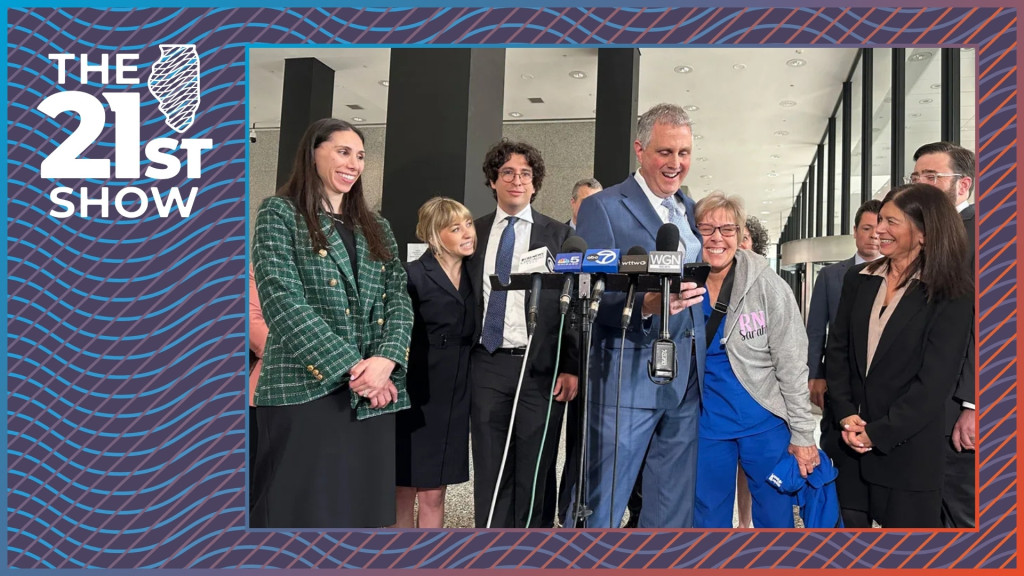
Chicago’s 45th Ward Committeeman Michael Rabbitt and his wife Sarah celebrate the remaining charges being dropped against him and his co-defendants, also pictured, in the “Broadview Six” protest case. Hannah Meisel for Capitol News Illinois
// This is a machine generated transcript. Please report any transcription errors to will-help@illinois.edu.

[00:00:00]
Brian Mackey: From Illinois Public Media, this is The 21st Show. I'm Brian Mackey. For most of American history, when a Justice Department lawyer stands up in court and tells a judge something, the judge takes it as true. There's a name for this. It's called the presumption of regularity. And the idea is that government officials are doing their jobs honestly and in good faith.

But today, that assumption is under strain. A growing number of federal judges appointed by presidents of both parties have indicated they are no longer willing to give the benefit of the doubt to lawyers from the Trump administration. And one of the clearest examples of this is coming out of Illinois.

It's the case called the Broadview Six. Immigration protesters — I should say they were arrested outside a suburban Chicago ICE facility last fall. There was a rare federal felony case against them that collapsed this spring after a judge found what she described as serious misconduct in front of a grand jury. The secret transcripts have since become public, and now the fallout from that case is spreading to others being prosecuted by government lawyers in Northern Illinois.

Here to walk us through what's been happening is Jason Meisner, who covers the federal courts for the Chicago Tribune. He's joining us from the Dirksen Federal Courthouse. Jason, welcome back to the show.

[00:01:26]
Jason Meisner: Hi Brian, thanks for having me on.

[00:01:28]
Brian Mackey: And listeners, we also want to hear from you: 800-222-9455. When you hear that a federal judge says she can no longer trust prosecutors to tell her the truth, what goes through your mind? And maybe if you've even served on a grand jury — did it work the way you expected? Let us know at 800-222-9455. 800-222-9455.

All right, Jason, let's start at the beginning. Can you remind us who are the Broadview Six?

[00:01:57]
Jason Meisner: The Broadview [Six] were six protesters who were arrested outside the Broadview ICE facility in late September during Operation Midway Blitz, and most of them had ties to local Democratic politics. Two of them were actually running for office, including [for] Congress, and so it became one of the highest-profile cases to come out of Midway Blitz, especially federal criminal prosecutions. This one accused them of impeding an ICE agent's vehicle as he was trying to make his way into the facility, and there was some damage done to the car. There were some things scrawled in it, scratched, mirror broken. Nobody got hurt, so it wasn't a serious case in that way, but it was high profile because of who was involved and because the charges alleged a felony conspiracy between the six to do this. It was a charge that carried significant prison time, unlike a lot of the other cases that were charged, so this one got a lot of attention.

[00:02:58]
Brian Mackey: Talk about that felony conspiracy charge, because maybe people who don't spend all their time in the courthouse as you do may not know how rare and unusual that was for this particular circumstance.

[00:03:09]
Jason Meisner: It was very unusual in the sense that these people didn't really know each other — the six. I mean, there were some relationships between them, but there was no grand plan to do what they did. I mean, it was a spontaneous thing, and so the question becomes in a lot of people's minds, how can this be a conspiracy? Well, the government argued it was a, quote unquote, spontaneous conspiracy — that they basically agreed to do it on the fly and that they were all involved in it, and therefore, in kind of a little bit of a contortion legally, it became a conspiracy, which allowed them to charge the felony. Because the underlying crime is just a misdemeanor — impeding a federal agent where no one was injured. It's a misdemeanor. So they elevated it to a felony conspiracy, and that really was a big part of the controversy. If this case had been charged as misdemeanors from the beginning, I don't think we would have gotten to where we are today.

[00:04:04]
Brian Mackey: So tell me, how would a case like this move through the system normally, right? They're arrested in the moment outside this facility. How does it get to a grand jury indictment from there?

[00:04:17]
Jason Meisner: They brought it to the grand jury in October. This happened on Sept. 26. The prosecutor brought it to a grand jury, and that's a secret proceeding where it's anywhere from 16 to 23 laypeople who are sitting for six months. They sit once a week and they hear cases, and they issue indictments. And that's a way for prosecutors to get a finding of probable cause other than having a preliminary hearing. It's done all the time. It's usually a rubber stamp. Everyone knows it.

And so in this case, it wasn't a rubber stamp. We found out later what happened was they went in on Oct. 9 to get the indictment, and this grand jury said no. They issued a no bill, which means they would not return an indictment. Highly unusual.

[00:05:06]
Brian Mackey: Yeah, there's that expression — a grand jury, a federal prosecutor can get a grand jury to indict a ham sandwich.

[00:05:11]
Jason Meisner: Right.

[00:05:12]
Brian Mackey: Exactly.

[00:05:12]
Jason Meisner: Yeah. And you know, now that we have the benefit of the transcripts — which is also very unusual — we have a window into what happened. But basically, they were suspicious of this conspiracy charge from the beginning. You can see in the transcripts they say, how is this a conspiracy? The prosecutor has trouble explaining it. And that day ends, that session ends, with no indictment. And so what we got was two more sessions before the same grand jury that devolved into kind of infighting and arguments, and jurors getting kicked off and calling the case a crock of, you know what. And so in a very unusual way, this grand jury process got to an indictment at the very end, by the third try, and all of that came to light late in the case, right before trial.

[00:06:07]
Brian Mackey: Yeah. So, OK, well, let's come back to the transcripts in a moment, because I think — as you mentioned, these are usually very secret proceedings — I think how they came to light is an important part of this story. So that was last fall. Fast forward to May, right? The case falls apart. How exactly does it unravel?

[00:06:27]
Jason Meisner: Well, the case started unraveling kind of like parts falling off of a car. It was not all at once. It was beginning in, I'd say, January, February — you know, because the defense was doing their usual thing. They were filing motions to dismiss. They were accusing this of being a political prosecution. They were looking for evidence that the White House was involved. But it was headed towards trial.

But in February, I reported that the lead prosecutor who had done this whole grand jury left. The circumstances were a little suspicious — the timing, with the trial looming and everything. She left her position [for] the Senate Judiciary Committee in D.C. right after that. So they appointed a new team. Right after that, the conspiracy charge started to unravel. First, they pared it down, saying, well, we're not going to allege anymore that they were conspiring to damage the car — it was just to impede the car. And then they completely dismissed the charges against two of the defendants who, once more videos came out, it was clear that they didn't do anything. They kind of walked away from the car.

And so that left it kind of at the [Broadview] four, I guess you could say. And then it just continued to unravel. The entire conspiracy was dismissed just weeks before trial, and the U.S. Attorney's Office announced that they were going to proceed on just the misdemeanors. And that's where we were — we were at the Dirksen Federal Building all gearing up for probably the biggest misdemeanor trial this building has ever seen. It was supposed to start the day after Memorial Day. It was going to be kind of like the last gasp of Midway Blitz because this really was one of the last cases. But the trial never happened because the defense kept pushing. They kept pushing for Judge April Perry to read grand jury transcripts, because they kind of smelled a rat. And the prosecutors had handed over redacted transcripts that had redacted out pretty much all of the alleged wrongdoing by the prosecutor — everything we were just talking about.

[00:08:56]
Brian Mackey: Yeah, and she called those redactions shocking — if I remember correctly, that was the word she used. So maybe you can talk about what exactly did the redactions reveal, once they were finally made to unredact those documents and she could see the full thing.

[00:09:12]
Jason Meisner: Right. It started with the defense wanting the judge to look at whether there were any issues with how the jury was instructed on the law, and if there were, they had a chance to get the case dismissed. So what they were ordered to turn over was transcripts of that. It's called a colloquy. It's when the prosecutor goes before the grand jury and says, here's the law, here's how the facts fit in it, and here's the charge we want you to bring.

So what they turned over looked like what she had asked for, but there were some strange redactions — and it was almost like the judge thought it was just technical stuff that she didn't need to see. She trusted — and this goes back to what you were talking about, the presumption of regularity — Judge Perry trusted the prosecutors when they made those redactions, that they had good reason to and it was not anything important that she needed to look at.

It wasn't until the defense made one more request, saying, Judge, I know we're going to trial, but maybe please just look at the unredacted transcripts just to see if there's anything wrong here. And she finally agreed. And then the next day — this was kind of a bombshell — she put on the docket, like, she ordered everybody into court immediately, including any prosecutor who had made a decision or played a role in the decision to redact those things. And it was clear that something was amiss. And so the next day is when everything blew up at the courthouse, and Andrew Boutros, the U.S. attorney himself, ended up coming into the courtroom and dismissing the case completely.

[00:10:51]
Brian Mackey: So let's get into some of the things that are alleged to have been improper. One of them is vouching. What does that mean in plain English?

[00:11:00]
Jason Meisner: Vouching is something that a lawyer would do when they're trying to assure somebody that, you know, the charges are strong — they're making inappropriate comments on the strength of the evidence. It is improper. Remember, grand jury proceedings are not adversarial. In other words, there's no defense lawyer there. There's not even a judge there. It's just the prosecutors and the jury, and what they're supposed to do is just present testimony and then the colloquy about the law and then get an indictment.

But what happened in the Broadview Six grand jury — what the judge said she had never seen before at that level — was the prosecutor literally said, at the very beginning of the first grand jury session: This is an interesting case, and I wanted you guys in particular — this is the Thursday regular grand jury — to hear it, because you know that I trust you and you trust me, and I would never bring a case and ask you to bring charges if the evidence wasn't there. And that is completely improper. That's vouching, and that's what happened here.

[00:12:10]
Brian Mackey: And this is because you imagine that grand jurors — I don't know if they're instructed to not follow the news, or maybe they are following the news and they're seeing about some of the weak cases being brought elsewhere in the country. One imagines. I don't know how much you can speak to that, or if I'm just speculating wildly here.

[00:12:26]
Jason Meisner: Well, it was clear that — all we know is from the transcripts. Obviously we don't know the names of the grand jurors; we never talked to them. But from what we know from the transcripts, there was high skepticism, especially seemingly involving immigration. Remember, at this time when this was being brought to them, it was in the middle of Midway Blitz. Chicago was kind of a powder keg — agents were patrolling the city every day, there were arrests and tear gas. And so to have a grand jury — of course they all know that's going on. They're going in once a week to the Dirksen Building and hearing cases, and so it was clear that they had a problem with this case pretty much from the get-go, although, you know, they did eventually get an indictment.

[00:13:21]
Brian Mackey: But with some of the people removed, though, right — including the one who described the situation, or the case, as a crock of — we'll say excrement.

[00:13:30]
Jason Meisner: Which brings me to the other alleged wrongdoing: when the prosecutor Sherry Mecklenburg asked that person to leave, and then at least one other person. The defense thinks it's three, but from the transcripts it's hard to tell because the grand jurors aren't identified. But in a grand jury, you do not need — unlike in a criminal trial — you don't need the jury to be unanimous. You need 12 votes for an indictment. And so as long as there's 16 jurors and you get that 12, the indictment is returned. So that's why in the transcripts you can see that the prosecutor kept asking for a count. After somebody would leave, she would say, well, do we still have 16? Because without 16, you can't even ask them to vote. So there was some head counting, and yeah, at least two people didn't participate in the vote that second day.

[00:14:31]
Brian Mackey: Yeah. And one imagines that the prosecutors wouldn't want those skeptical voices in the room as the jurors are deliberating on this.

So we need to take a break in about a minute and a half here. But you mentioned Sherry Mecklenburg — she got a job working on the Judiciary Committee, or maybe an assignment, I guess you'd say, under — ironically — Illinois U.S. Sen. Dick Durbin, who's the ranking member on that committee. Where is she now?

[00:14:57]
Jason Meisner: Yeah, she was detailed to the Judiciary Committee in February, and then when this all blew up, she was working that day in Washington, and within a couple of days Durbin's office announced that she was being relieved of her duties. She's still, I understand, on leave from the U.S. Attorney's Office. She hasn't resigned, she hasn't been fired, she hasn't been officially found to have done anything improper — just the judge, Judge Perry, has said it was improper. But there will be a process going forward. I know that she's retained an attorney, as have several other people in the U.S. Attorney's Office, which in and of itself is very unusual — that they would lawyer up. So we know there's going to be a process going forward where more of this will be ferreted out. There'll be a motion for sanctions and hearings, we expect.

[00:15:53]
Brian Mackey: Yeah. And I wondered about Illinois disciplinary cases as well, but I guess that's beyond what we can know. So, all right, we're going to take a break. We'll continue with Jason Meisner, who covers federal courts for the Chicago Tribune. We're talking about the [Broadview] Six, the improper conduct alleged before a grand jury, and how what happened there is now spreading to other cases, and how it fits into a national trend. We're going to continue this conversation after a short break. This is The 21st Show. I'm Brian Mackey.

It's The 21st Show. I'm Brian Mackey, and we're talking with Chicago Tribune federal courts reporter Jason Meisner about the collapse of the federal case against the Broadview Six. The grand jury misconduct a judge found is at the center of that collapse. And now, how what happened there is spreading to other cases in the Northern District, and how this is part of something that's happening nationally — where judges are no longer taking the federal government at its word that it behaved properly and ethically and is being fully honest with courts in all cases, which is a presumption — it's called the presumption of regularity — that had been the standard in our justice system for a long time.

If you want to join us — maybe you've been on a grand jury — we'd love to hear how it worked for you. 800-222-9455 is the number. 800-222-9455.

So let's talk a little about Andrew Boutros. You mentioned him. He's the U.S. attorney up there. He actually came into court himself. Was that expected? Was he summoned, or was it a surprise that he showed up that day?

[00:17:48]
Jason Meisner: It was a total surprise to everyone. The judge had held a closed-door hearing because they were talking about grand jury transcripts that at that point weren't public. And so after that, she gave prosecutors some time to discuss what they were going to do. She said the trial was not going to go forward. But about an hour later, court reconvened — open court — and in walked U.S. Attorney Andrew Boutros, who immediately announced that he was dismissing the case. And then he went on to apologize and say that he was shocked, too — as the judge had said — by what had happened in the grand jury, and he said he wasn't aware of the extent of it until late April, which is when he moved to dismiss the conspiracy count. But he also defended the misdemeanor charges, saying, you know, they were ready to go forward with the trial because they did feel that a crime was committed.

[00:18:50]
Brian Mackey: Which the judge kind of called him out on — like, you're sort of undermining your own apology. Or maybe apology isn't the right word. OK, yeah.

[00:18:58]
Jason Meisner: Yeah, she said you're kind of undermining your own mea culpa here — by going on to defend the case that you just dismissed. So it was quite a moment. I mean, I've been here for over 10 years. I've never seen anything like that, and I don't think anybody else had either. But it really was only the beginning, because there's a lot more — after that is when the transcripts were made public.

[00:19:25]
Brian Mackey: There are questions about his conduct in front of the grand jury, right? What do we know about that?

[00:19:30]
Jason Meisner: Yeah. After the case was dismissed, that's when we learned that Andrew Boutros had gone before the grand jury himself on the third day — the day they actually returned the indictment. Some news of this rancor that was going on had gotten back to the front office, and it was actually Boutros's deputy — one of his deputies — who had told the prosecutor to cut the grand jury short. They're not going to vote that day. That was the second day.

The third day, a week later, started with Boutros going in himself and giving a little pep talk to the grand jury. First of all, I should say — that's very unusual, for the U.S. attorney to go to the grand jury at all. They are like the overseer of it, but to make a personal appearance is rare. And he gave a speech where he talked about fairness, and [said] if anybody there thinks they can't be fair — set aside any personal feelings about cases — and he specifically mentioned immigration cases. He asked them to raise their hand, because, he said, you know, we have another procedure for that. And no one raised their hand. And he left the room. And then the prosecutors came back and did their presentation again, with a new witness, and that was when the indictment was actually returned.

[00:21:01]
Brian Mackey: So that was the Broadview Six case. And this is the part that's kind of changing by the day here. This misconduct finding is now spreading to other cases. Tell me about that COVID fraud case — $800 million.

[00:21:15]
Jason Meisner: Yeah, well, obviously they have issues with this prosecutor, and there was an immediate press release about how they're going to do a full review of all the cases she handled —

[00:21:27]
Brian Mackey: Mecklenburg, that we mentioned before the break.

[00:21:29]
Jason Meisner: Correct, yeah. Sherry — one of her big cases, a much more important case really than the Broadview Six, was a fraud investigation that started with executives at Loretto Hospital on the west side. [Block Club Chicago] had done a bunch of stories about their vaccination program and how people were getting favors in the Trump administration. And that led to an investigation, and she had unraveled a lot of alleged fraud — not just involving COVID or Loretto, but also this massive scheme where they alleged $800 or $900 million in COVID testing fraud, where they were taking government money for tests that weren't being performed.

That case, because it also involved Sherry Mecklenburg, fell under a lot of scrutiny, and sure enough, they got the grand jury transcripts. And according to filings in the case — we haven't seen them — she did the same thing: the vouching and some other alleged misconduct before that grand jury. And so that's what led to that case blowing up just last week.

[00:22:43]
Brian Mackey: Do you know — and again, I don't want you to speculate — but do we know: is this sort of a tip of the iceberg and this kind of thing has just been rampant through the office, or is this one person who is poorly trained? I mean, Mecklenburg was not like fresh out of law school, if I understand it correctly.

[00:23:00]
Jason Meisner: It's surprising to a lot of people who know her. I've known her for a while. She's a 20-year veteran of the office. I think there's a couple of things going on. One — yeah, they have to go back and see, was she doing this a lot? Because these grand jury transcripts don't come out often — almost never — and it's not something that, you know, everybody would be aware of, because they go in and it's a secret proceeding. Even the defense rarely gets to look at the full transcripts. So there's that going on. There's looking into her and whether, and how often, she did this. I would say the Loretto case was her biggest pending investigation.

But there's also the issue with the office itself — what did they know, and when did they know it? The classic, classic thing. And also, with the redactions in the Broadview Six case, that is going to be unraveled probably going forward with hearings.

[00:24:03]
Brian Mackey: So can you link this to that national story — this idea — I've seen reporting from The New York Times, from The Atlantic, that this is happening elsewhere in the country. I mean, do you see this in other cases potentially coming up, and other judges sort of expressing this idea, as Judge Perry said, that trust has been broken?

[00:24:25]
Jason Meisner: Yeah, well, Judge Sharon Johnson Coleman kind of picked up on that theme last week when — she is overseeing the COVID fraud case I just talked about — and she had actually ordered an evidentiary hearing into the matter, which would have covered alleged wrongdoing in the Broadview case and this case and any overlap. That would have been an interesting hearing. It was going to be this week, and it was going to be sworn testimony from possibly Andrew Boutros himself, his front office staff. Basically, the judge had put no limits on what the defense could try to bring out.

That hearing was canceled when they dismissed the two defendants from the case last week. But that is, you know, what's percolating at the federal building right now. Judge Coleman called it a Pandora's box that had been opened, and she told prosecutors in that case: I don't know if just by dismissing this case you're going to be able to put everything back in the box. She talked about other judges — she didn't name them — in other cases, and she didn't say which cases, but [said] they're now being called into question because of all this. So it's still spreading. Nobody knows where it's going to end, but it is certainly — I don't want to say unprecedented, but very unusual for the U.S. Attorney's Office in Chicago to be facing allegations like this that are this serious, that call into question motive and just procedure. I've never seen anything like it.

[00:26:07]
Brian Mackey: This is the office that is known for hunting corruption in Illinois government and local government here, not perpetrating it. I mean, is it too flip to say that people are now missing out on justice for what, at one point, the government says was $800 million in fraud — in order to protect the U.S. attorney from having to testify under oath?

[00:26:28]
Jason Meisner: Yeah, that's why, when a serious case like that — where the defendants, I don't know about the two who were dismissed, they were sort of low level, they weren't allegedly orchestrating this thing — the person who was is sitting in a jail in Serbia right now. [Imad Ahmed], former COO of Loretto, he's fighting extradition and he is still charged, so the case hasn't completely collapsed. But yeah, when you have fraud at that level basically now possibly going unpunished, that's when it really starts to have serious consequences. Unlike in the Broadview case, the figures in the Loretto Hospital case are not very sympathetic. I mean, they were allegedly stealing from a hospital that services a very poor community. So when you're stealing millions of dollars in that situation, I don't think people are going to have a lot of sympathy for you.

[00:27:26]
Brian Mackey: Let's see if we can get a call in here. Paul is calling from Urbana on line one. Paul, thanks for calling in. You want to talk about the national picture here.

[00:27:34]
Paul: Right, there's a defense lawyer unit that's tracking cases of just flagrant violations by the Trump administration at a bunch of different levels, and I think I've heard a statistic that they're like something like 90 cases just in the Minneapolis area where they're just not paying attention to court rulings. It doesn't get emphasized enough, and I appreciate you doing this program, but the broader flagrant violation — it's just, it's hard to fathom and it doesn't get dwelled on that much. So thank you.

[00:28:17]
Brian Mackey: All right, thanks for the call, Paul. Jason, let's wrap it up here. What are you going to be watching for as you continue to do your job in the courthouse there?

[00:28:26]
Jason Meisner: Well, we've had calls for Andrew Boutros to resign — all from Democrats so far — and also a group of over 100 former alumni from the office wrote a letter. They didn't call for him to resign, but they brought up that these are serious issues, and they asked him to kind of depoliticize things, which is how the U.S. Attorney's Office in Chicago has always acted — kind of separate from Main Justice, does its own thing. So there's a lot of worry there. And we're also going to be watching the subplot of the Broadview Six hearings, whatever Judge Perry does going forward, and whether they can get to who made these redactions and why. That's all going to be coming in the months to come.

[00:29:17]
Brian Mackey: Jason Meisner covers federal courts at the Chicago Tribune. Thanks so much for sharing your reporting with us today on The 21st Show.

[00:29:24]
Jason Meisner: Thanks for having me on.
For most of American history, when a Justice Department lawyer stood up in court and told a judge something, the judge took it as true. There's even a name for this — it’s called "presumption of regularity," the idea that government officials are doing their jobs honestly and in good faith.
That assumption is now under strain. A growing number of federal judges — appointed by presidents of both parties — have indicated they are no longer willing to give the benefit of the doubt to lawyers from the Trump administration. And one of the clearest examples of this is coming out of Illinois.
It's the case of the so-called “Broadview Six” — immigration protesters arrested outside a suburban Chicago ICE facility last fall. A rare federal felony case against them collapsed this spring after a judge found what she described as serious misconduct in front of a grand jury.
We spoke with Jason Meisner, who covers federal courts for the Chicago Tribune, to walk us through what's happened.
Discussed
- Judge to review grand jury transcripts as ‘Broadview Six’ trial set to kick off next week
- Judge orders prosecutors to explain redactions in ‘Broadview Six’ grand jury transcripts
- Grand jury improprieties revealed in court as ‘Broadview Six’ case unravels
- Fallout begins in ‘Broadview Six’ case meltdown as prosecutor loses Washington posting
- ‘Broadview Six’ case in rare waters as defense says US attorney may have had ‘personal contact’ with grand jury
- US attorney orders reforms as ‘Broadview Six’ grand jury controversy spreads to new case
- Chicago US attorney handling investigation into nonprofit spending, funding of sex assault lawsuit against Donald Trump by E. Jean Carroll
- Illinois senators Dick Durbin and Tammy Duckworth demand US Attorney Andrew Boutros resign
- US Attorney Andrew Boutros acknowledges contact with ‘Broadview Six’ grand jury
- ‘Broadview Six’ attorneys seek evidence of White House pressure to indict
- Group of former federal prosecutors in Chicago says US Attorney Andrew Boutros has damaged office’s reputation
- ‘I thought it was a crock of (expletive)’: ‘Broadview Six’ grand jury transcripts released showing alleged misconduct by prosecutors
- Judge in fraud case orders evidentiary hearing into grand jury issues as ‘Broadview Six’ fallout intensifies
- Judge grants dismissal of fraud charges, calls out US Attorney Boutros over grand jury wrongdoing
Guest
Jason Meisner
Federal Courts Reporter, Chicago Tribune