As Pride Month ends, Midwest splits on LGBTQ rights
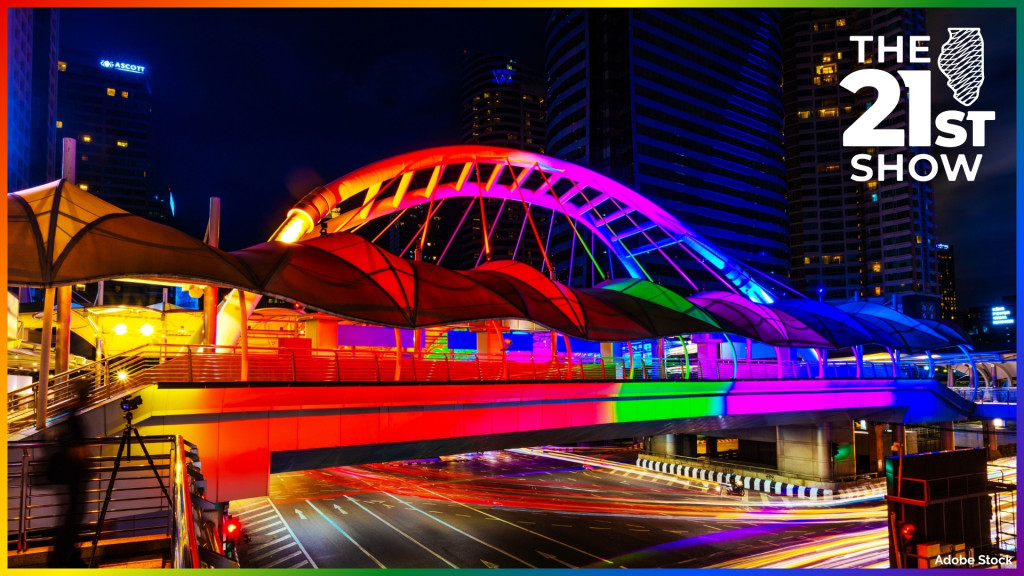
A bridge lit up for Pride Month in Bangkok, Thailand. There is much less to celebrate among LGBTQ people in Illinois' neighboring states. Adobe Stock
// This is a machine generated transcript. Please report any transcription errors to will-help@illinois.edu.

[00:00:00]
Brian Mackey: Today on the 21st show, as Pride Month draws to a close, Illinois has continued to strengthen protections for people who are gay, lesbian, transgender, and the rest of what's known as the LGBTQ community. Meanwhile, some of our neighboring states have banned medical treatment for transgender youth and removed gender identity from civil rights laws. And polling shows support for same-sex marriage and simply being transgender are on the decline. I'm Brian Mackey. We'll talk about what all that means today on the 21st show, which is a production of Illinois Public Media, airing on WILL in Urbana, WUIS in Springfield, WNIJ in Rockford DeKalb, WVIK in the Quad Cities, and WSIU in Carbondale. But first, news.

From Illinois Public Media, this is the 21st show. I'm Brian Mackey. Politics have cast a shadow on Pride Month this year. At the national level, the Trump administration has gone after transgender care and rolled back diversity initiatives across government. And just this morning, the U.S. Supreme Court ruled states can exclude trans women and girls from female sports teams.

At the state level, Illinois still has robust protections for people who are gay, lesbian, bisexual, and especially transgender. But that stands in contrast with some of our neighboring states. In Iowa last year, the state removed gender identity from its Civil Rights Act. And this year, they prohibited local governments from adding those protections back. In Missouri, the state Supreme Court upheld a ban on gender care for minors and restrictions on Medicaid covering that care for anyone. And in Indiana, Gov. Mike Braun joined other Republican politicians looking for alternatives to the very idea of Pride Month. He declared June Nuclear Family Month, in which, quote, one husband, one wife, and any biological adopted or fostered children is God's design for the family structure, end quote.

All this comes as polling shows support for same-sex marriage or simply being transgender is on the decline. Today we're going to talk about what's happening and how Midwesterners who count themselves as LGBTQ are doing.

Clock Inc. serves those communities in the Quad Cities right on the Iowa-Illinois border. Mary Francis is programs and innovation lead there. She joins us now. Mary, thanks for being here. Welcome to the 21st show.

[00:02:49]
Mary Francis: Thank you for having me.

[00:02:51]
Brian Mackey: Noki Ray is executive director for the Metro Trans Umbrella Group, which supports transgender and non-binary communities in St. Louis. Noki, thank you for joining us. Thanks for having me. I'm glad to be here. We're also joined by Randy Rafter, executive director of Black Pride St. Louis. Randy, welcome to you as well. Thanks for having me. And in Indiana, Maya Morrison is co-founder of Trans and Queer Hope in Evansville, the hub of a tri-state area that also includes Illinois and Kentucky. Maya, welcome to you.

And listeners, you can join the conversation today by giving us a call at 800-222-9455. What do you think about what his Pride Month has been like? Not just here in Illinois, but especially in our neighboring states. And maybe you're someone who has been or seen the effects of state or national policies. Maybe you yourself are part of the LGBTQ community. What does pride mean to you at a time like this? 800-222-9455. That's 800-222-9455.

So as we were getting ready to go to air this morning, there was some breaking news. And so I want to ask each of you about if you have a response to this morning's Supreme Court ruling on trans athletes. Noki, I'll start with you. How are you thinking about this?

[00:04:15]
Noki Ray: Absolutely. So, obviously the ruling is disappointing, but what I think is important to remember is that this was a narrow loss. The Supreme Court did not say that every single state has to ban these. They said that the states that already have bans for trans girls and girls' sports can keep doing it. Sports can and should and do have rules around participation, but a blanket ban — a ban that treats a kindergartner the same as a college athlete and a rec league the same as a high-stakes competition — it's not about fairness. It really singles out one group of kids instead of solving any real fairness problem. So, although it is a big blow, we can have hope that the other states don't develop similar policies. Unfortunately, there are 27 states that have policies like this that I'm sure are going to go into effect today, but my hope is that the rest of the states don't.

[00:05:27]
Brian Mackey: Maya, with Trans and Queer Hope in Evansville, Indiana. What's your perspective on the Supreme Court ruling today?

[00:05:35]
Maya Morrison: I think — excuse me — I think that this ruling, as much as it is about sports, it's also about establishing more precedent, building up those legal layers of precedent to determine that trans people are not in fact legally considered to be the gender that they identify as. And of course this is about the cruelty of, you know, excluding people from sports and social activities and opening these doors and avenues for more discrimination against the community. That said, like Noki pointed out, this is a very narrow ruling, so hopefully the damage is kind of mitigated on that.

[00:06:25]
Brian Mackey: Randy, anything you want to add to that this morning?

[00:06:28]
Randy Rafter: Well, I'll just say that it raises the question about inclusion, dignity, and whether young people are being told that there's a place for them specifically in our community. I feel that it's preventing — it's another way for them to other community members versus bringing them in and showing them that they are part of a larger picture. And that's disappointing, but like they said earlier, this is just one milestone that we will continue to push forward against as we move forward in the next direction.

[00:07:07]
Brian Mackey: And Mary, finally to you, anything you want to add on the U.S. Supreme Court decision this morning that just came down about trans athlete participation?

[00:07:16]
Mary Francis: It is heartbreaking, especially for our trans youth. It's already hard enough being 18 and under, then adding this layer to it, but hopefully we will keep fighting and hopefully the states who are against this ruling will keep fighting and pushing against this as well.

[00:07:46]
Brian Mackey: I just want to add to this. I did reach out to the Illinois High School Association, which is the athletic association here in Illinois. My read is Illinois is not actually going to be affected by this ruling, because the state does kind of go the other way from some of the states we've been talking about, in terms of allowing trans youth participation in sports. The person who handles press requests is out of the office today and everyone else apparently is at some conference, so they didn't get back to me. But I do have some of the older numbers. If you think there are like 800 high schools in Illinois — as recently as like the 2023 school year, 21 students received waivers. 16 the year before that, one was denied, four the year before that, nine the year before that. So we're talking about a really, really small number of kids, at least in high school athletics here in Illinois.

All right, that's some context. Let me remind people this is the 21st show. We are talking, as Pride Month is coming to a close, about what the landscape is like and how politics have really cast a shadow on Pride Month this year in particular, as was the case last year as well. And we're talking about that with a panel including Maya Morrison of the group Trans and Queer Hope in Evansville, Indiana; Randy Rafter, executive director of Black Pride St. Louis; Noki Ray, director of the Metro Trans Umbrella Group, also in the St. Louis area; and Mary Francis with Clock Inc. in the Quad Cities.

And Mary, let's take a step back now. So, the Supreme Court ruling today is one thing, but there's other stuff happening at the national level. What has changed for people who are LGBTQ in the past few years — you know, whether it's in the law or just in the way we hear people being talked about by politicians?

[00:09:34]
Mary Francis: So we border Illinois and Iowa. Our community center — for one, we're here for everybody. We have had people travel to us, but we serve Illinois and Iowa the most. And just last year in Iowa, the governor, Kim Reynolds, passed SF 418, which removed civil rights from transgender individuals in Iowa. And that was heartbreaking news for our community and nationally as well, to think of transgender individuals — like, not as humans, to not have civil rights. We have seen a huge influx in our numbers. We're serving more people since 2025, since this administration has taken over and since that ruling in Iowa. I'm watching people leave the state of Iowa. I'm having friends move over here to Illinois just so they can have civil rights. It's been heartbreaking to watch politically, but in our community I'm seeing our LGBTQ+ community be there for each other more than ever. We're serving more, our groups are succeeding and reaching more people that they need to reach, so we're here for one another and we're taking care of one another.

[00:11:23]
Brian Mackey: Noki, I'm going to come back to you now. What is the state of affairs for people who are LGBTQ in Missouri, especially the trans part of that community?

[00:11:32]
Noki Ray: Yeah, I mean, we're right across the river from most of your listeners and it's really a different world over here. In Missouri, if you're a trans kid, you can't get gender-affirming care at all. Our highest court upheld the ban, and right now we're looking forward to the fall for Amendment 3. There's a proposed amendment that would lock into the Constitution for good — sorry, two things. One, it would ban abortions, which Missourians have voted on and, as law of the land in 2024, we want to have the right to an abortion. But they've also snuck in a second thing, which is banning youth trans healthcare in the Constitution — in the Constitution — for a group of people that's like 1% of 1% of the population.

And, you know, we understand the strategy, right? They're trying to pass through an abortion ban on this wedge issue. This year, there was a very large number of anti-LGBTQ bills in the 2026 legislative session. I think there were 58. Luckily we have amazing organizations here in Missouri, like [Promo], who got out into the streets and canvassed and brought people in to speak in Jefferson City, and we were able to defeat, I believe, all but one, which is pretty fantastic. And so to answer your question, yes, there is this top-down push against trans rights, but also on the streets, the people — our neighbors — they support us. And everyone feels this sense of dread, but also this sense of hope and community. So it's not doom and gloom, but it's not a perfect hope either.

[00:13:42]
Brian Mackey: Randy, what about the Black LGBTQ community in St. Louis? How are things going there?

[00:13:49]
Randy Rafter: Well, under this political environment, being Black and LGBT there's another layer on this. We live at an intersection of race and gender, sexuality, and often even economic inequalities. So many of our community members are carrying multiple burdens right now, and the political climate only adds that weight to it. But I will say this: Pride started as a protest. Before it became a celebration, we recognized that people — we had to stand up and fight against what we saw as people being treated wrong and unfairly because of them just being who they are.

[00:14:33]
Brian Mackey: I definitely want to come back to that idea a little later in the conversation. So let's put a pin in that. Maya, let me come to you. From your vantage point over in Indiana, how do things look for the trans community there?

[00:14:45]
Maya Morrison: I would say that things are obviously scary, just like almost anywhere else. I have a lot of close friends of mine who are moving or have moved out of the state. People running into issues finding jobs. And then also, obviously, a large portion of our state-level government is anti-trans. They are pushing a lot of narratives. Fortunately, they seem to be slightly — slightly. They only this past year put out, I want to say, like 10 or 12 anti-trans bills, which is not good at all, but it's better than some of these other states.

[00:15:34]
Brian Mackey: I think at some point you run out of things to try and legislate against, but —

[00:15:38]
Maya Morrison: I suppose, yeah. We've also run into kind of a perceived lack of support from, you know, politicians that claim to be allies.

[00:15:55]
Brian Mackey: All right, let me remind listeners, this is the 21st show. We are talking today about pride across state lines. From our vantage here in Illinois, where state lawmakers and the governor have tried to pass protections for people who are gay, lesbian, trans, and other members of the LGBTQ community. It's quite a contrast from what's happening in states like Iowa, Missouri, and Indiana. And we're talking with people from those states today, or who work on the borders particularly of Illinois and our neighboring states. If you want to join us, we'd love to hear your experience and your thoughts about what's happening. Maybe you know someone who's been affected by these national policies. There's said to be a lot of people coming to Illinois to seek a safer place to live or a more welcoming place. Maybe you've encountered some of them. 800-222-9455 is the number to join us today. 800-222-9455.

I also do want to add — we mentioned the U.S. Supreme Court ruling on trans athletes. The ACLU of Illinois has a news release out and they say today's ruling does not change the policy of the Illinois High School Association, which allows transgender students to seek a waiver to participate on sports teams consistent with their gender identity. Illinois law, which remains in place, continues to recognize the humanity and inherent worth of our trans youth in every aspect of their lives. That again from the ACLU of Illinois. We'll have more after a short break. This is the 21st show. Stay with us.

It's the 21st show. I'm Brian Mackey. We are talking today about LGBTQ communities in some of the states around Illinois and how people in those areas are dealing with an environment where they are often the target of political rhetoric and laws. Our guests are Noki Ray with the Metro Trans Umbrella Group in St. Louis, Randy Rafter with Black Pride St. Louis, Mary Francis with Clock Incorporated in the Quad Cities, and Maya Morrison with Trans and Queer Hope in Evansville, Indiana. You can join us today. 800-222-9455 is the number. 800-222-9455.

Maya, before the break, you were talking about some of the challenges coming out of state government in Indiana. How do you compare that to what's happening at the state level with what you are trying to do locally?

[00:18:35]
Maya Morrison: I would say that the state level is kind of the biggest challenge for us locally. We sort of do more like mutual aid-type activities. We organize, you know, social events, clothing swaps. We help homeless trans and queer individuals find resources and housing. Honestly, we are kind of more of an affinity group rather than an official nonprofit, but we do put in a lot of work to make sure that our community stays surviving and thriving.

[00:19:21]
Brian Mackey: You mentioned that the state Bureau of Motor Vehicles stopped people from changing their gender on their state identification cards. Yeah, there was also legislation. Yeah, there was legislation that passed in the Indiana state Senate that would have defined sex as being set at birth. What effects do policies like that have on trans communities?

[00:19:42]
Maya Morrison: I believe that was SB 182, and that was very scary. Thankfully it did not pass, but it would have defined, obviously, like you said, sex as what you were assigned at birth. I think there were a few other things. It did mention the ID changes. What we've seen lately is a lot of the attorney general trying to effectively enact this policy without any legislation behind it. The BMV did enact a ban on gender marker changes, even though it is still legal in the state of Indiana to get your name and gender marker changed on all your documents with a court order. And then Attorney General Todd R[o]quita [🔍 verify spelling] has called all of these cases where these court orders have been issued falsification of records, which is a fraud charge in Indiana. So there is a lot of concern from a lot of people in the community that they might start going after individuals who have already had their name and gender marker changed —

[00:21:00]
Brian Mackey: — retroactively. Hmm. Yeah.

Noki, you mentioned some of the things that the Missouri state lawmakers are trying to do to change the constitution there. And I can't remember if it was you or somebody else who pointed out — depending on who you ask, trans people make up what, 0.5%, maybe 1.5% of the U.S. population. What do you — why do you think lawmakers put such a heavy focus on laws and rhetoric targeting people who are trans?

[00:21:32]
Noki Ray: Yeah, it blows my mind that people who make up such a small percentage of the population get so much breathing room in both the national and local [discourse]. It's wild to me. The people I work with aren't asking for the spotlight. Most of us would be happy to never be in the news at all, to never have any kind of spotlight on us. And so the real question to me is looking at who benefits from keeping a small, vulnerable group at the center of everything. It's really, in my mind, a reliable way to avoid focusing on the things that actually keep families up at night — and I'm talking about the cost of groceries and the cost of healthcare and housing. When you get everyone riled up about this culture war, then you don't have to focus on actually solving any problems or fixing anything.

Imagine if you're not trans — imagine turning on the news and hearing people argue about whether you should be allowed to see a doctor, or really, and it really boils down to this, of whether or not you should even exist in public life. It's exhausting, right? We are just like other people. We just want to go to work, raise our kids, and be left alone just like everyone else. For me and my community, I think the other piece of this is that it's not just one thing — it's attacks from all angles, and it is relentless. And I think the whole point is to wear us down so that we don't stand up and we don't fight back. But yeah, I agree — it's such a small part of the population, it's curious why we're such a focal point of political discourse.

[00:23:25]
Brian Mackey: Randy, Gallup recently put out the results of an annual survey on values and beliefs. And one of the things they asked about is whether same-sex marriages should be valid. Support for that peaked at 71% a few years ago — when you think about it, it's kind of hard to get 71% of Americans to agree on much. But it has been trending lower since then. And there's also been a question in that survey about whether changing one's gender is — to use their wording — morally acceptable. And that was below 50% when they first asked it in 2021. Now it's below 40%. What do you think is happening there?

[00:24:04]
Randy Rafter: Well, the problem is — and here's where it comes from — it's what we feed our community as far as knowledge and information. So, I think it's interesting that we pointed out that [0.5%] is part of the trans community, and they've been targeted as the enemy or targeted as not belonging. And with that rhetoric that you continue to push and push and push, people are starting to think, well, maybe I'm thinking of this in the wrong way. But in reality, it's bullying. It's schoolyard bullying that's being done, and people aren't stepping up because, to be honest, they're afraid for themselves. And so it's one thing to say one thing about the situation, but it's another thing when you're afraid for your own livelihood. And so that's why you see so many of these politicians — especially ones who are trying to get attention — they're doing this because they see that this is an opportunity for them to show [strength] because this population is not as representative as other populations.

But I'll go back and quote Dr. Martin Luther King: justice anywhere [is] a threat to justice everywhere. And so we have to make sure that we come together, stand up for each other, and make sure that we're doing the right things. And the one thing that I realize is they don't know, or they don't understand. And so with them not understanding, they're like, well, I don't understand, this doesn't affect me, so why should I care? Well, if this doesn't affect you now, something else is going to affect you. I do sit at an intersection of being Black and being part of the LGBTQ community, and I see how the same history is repeating itself over and over again. But I also sit back and recognize that history has shown us that we have to come together to make sure that we are working in solidarity and understanding and love in order for us to continue to move forward in society. Unfortunately, they're using this as an opportunity to divide us, to other us, and to make it a point to where, if I take that out, then I can be focused on it, and I can get away with the other things that I want to really take care of — or not take care of at all.

[00:26:41]
Brian Mackey: Mary, what's your perspective on this? The surveys we've been talking about and the targeting of people in this community?

[00:26:51]
Mary Francis: Well, for the LGBTQ+ community, unfortunately every four years we have a lot of the same conversations because within our community we have to be fearful that when a new administration takes over, what rights are they going to come after. We were not surprised when, just later last year, they came for same-sex marriages again. I was actually surprised that they ruled to keep it. And unfortunately, that's what our community goes through with every new administration.

And I 100% agree with Randy in the sense of, you know, these people have the microphones right now. They're the loudest in the room, so that is the information that is getting pumped so loudly all over our country — anti-LGBTQ+ and especially anti-trans right now. Because in our community — I don't see that — we are very fortunate that the people we surround ourselves with at our community center are either in our community or are allies. They are so supportive. They want us here. But the administration is spreading lies and hate, and that is what so many people are unfortunately hearing, just over and over again.

And right now, I feel like trans humans are under attack so much because they came for queer marriage, same-sex marriage, over and over, and we kept fighting back — so they had to find somebody else in the LGBTQ+ community to go after. And right now it's them. And people losing their civil rights in 2025 is something that is just unacceptable. Even in people's ignorance — if they are not educated — civil rights should just not be something that people should be scared to have taken away from their government.

[00:29:30]
Brian Mackey: Noki, what do you think about that?

[00:29:34]
Noki Ray: About the polling specifically?

[00:29:38]
Brian Mackey: Yeah, I mean, the polling and what Mary was saying there about the idea that maybe people were trying to defeat same-sex marriage for so many years, that didn't work, and so now trans people have proved to be a — frankly, you're a more — what would you say — a better target from their perspective, right, from a political perspective.

[00:29:57]
Noki Ray: Yeah, absolutely. So for the polling — you know, the numbers are real, but if you look underneath them, it's really split by party. And the percentage points go down much more steeply for Republicans than for independents and Democrats. Now I'm not saying it hasn't gone down for both of those, because it has. And so I think, to reframe the question, it's important so that we're honest about that. It's less about broad support going down and more about party sorting, right? The rhetoric that has been coming out over the past 10 or 11 years has been intense. It went from being pretty quiet to being very loud and open. And it says: if you are a part of this party or if you are part of this group, then you must think these ways.

And so I would hate for your listeners to think, oh well, broad support has gone down. I think there are specific factions where that support has gone down.

As far as, you know — I grew up in the '80s and '90s, [which] was very difficult for the gay community, right? We're seeing the exact same rhetoric that we saw back then. And, you know, in another 10 or 20 years, it's going to be some other issue and some other group. It's the same playbook. What's important is that we can't let them win. We pushed this back before. We defeated this before because we came together as a community and we worked hard. We never let our voices be silenced, and we're not going to do that now either.

[00:31:50]
Brian Mackey: Maya, I want to ask you about another aspect of this. Sometimes — we've been hearing recently about — I've read some stories that maybe the LGB and the T in the community are kind of moving apart in some ways, in some areas or some organizations. Maybe it'd be a different way to phrase that. You know, I can't help but note that you put trans first in the name of your organization, Trans and Queer Hope, Evansville. So, talk about that. Do you see that where you live? Any sort of divide there, any separation?

[00:32:21]
Maya Morrison: No, I don't think that we really see like a broader division in the community. We have disagreements with some of our members, but I don't think that it goes any further than, I disagree with you, but we're still very much part of the community. I think that the separatists that we've seen have broadly been kind of astroturfed to some extent. If you don't mind, I'd like to bring up some other semi-recent polling.

[00:32:57]
Brian Mackey: I should say we need to take a break in two minutes, but sure, go ahead.

[00:33:00]
Maya Morrison: OK, yeah. So recently — I believe it was Pew Research — they found that amongst millennials it was about 10 to 14% who were identifying as LGBTQ. Amongst Gen Z it's about 30%, as far as adults go. So we've seen sort of a lot of big money behind a lot of these organizations. Not specifically the LGBT organizations, but I know that Elon Musk and Peter Thiel put a lot of money behind being pro-natalist and trying to put money behind obviously the Republican Party and things like that, while they go on the attack against our communities. So I think that's definitely an important point to keep in mind, that a lot of this is messaging targeting our communities — backed by some of the richest people in the world. In one case, the world's first trillionaire.

[00:34:09]
Brian Mackey: Mm-hmm. Who could you be talking about? All right, we're going to take a break here on the 21st show. We are talking today with people representing LGBTQ communities in the states around Illinois — specifically Indiana, Missouri, and Iowa — and how they are thinking about the moment we are in as we come upon the end of Pride Month. If you want to join us today, 800-222-9455. 800-222-9455. More to come after a short break. This is the 21st show. Stay with us.

It's the 21st show. I'm Brian Mackey. We are talking today with people from LGBTQ communities in the states around Illinois about what's happening where they are and how they are thinking about the moment we're in as we come upon the end of Pride Month.

I want to share a few messages from listeners. By the way, you can join us at 800-222-9455. We got an email from someone named Bradley, [who] says: I'm a member of Iowa's LGBTQ community, now in my late sixties. The discussion of trans athletes has me thinking I was not very athletic in high school. In fact, there were several female students much more capable in performance and endurance than myself. Perhaps we need to change our qualification standards for student athletes regardless of sex. What does your panel think? Bradley says.

And then I also want to share a text message from Karen in Champaign, who says: In regards to the Supreme Court decision to allow states to ban trans women from playing on female sports teams, I have a few questions. One: what countries have bans like this? I think the media should point out that the countries that the U.S. government marks as enemies are also ones that first banned trans rights. And two: how hard is it to move from one of the 27 states that have anti-trans laws? Do we want to track how people move among states and how many folks leave the country entirely?

We're talking about this all with Maya Morrison with Trans and Queer Hope in Evansville, Indiana, which is an organization in a tri-state area — Illinois, Indiana, and Kentucky. Mary Francis with Clock Inc. in the Quad Cities. Noki Ray with the Metro Trans Umbrella Group in St. Louis. And Randy Rafter with Black Pride St. Louis.

Noki, let me come to you about that. Do you know of people who have moved from Missouri to Illinois on account of what we've been talking about?

[00:36:59]
Noki Ray: Absolutely I have.

[00:37:01]
Brian Mackey: How do you quantify that? What has that been like for them?

[00:37:06]
Noki Ray: Look, I get this question a lot — like, why don't you just move? And I'd say this: for most families, leaving just isn't an option, right? Moving costs money that a lot of people don't have, especially in my community. It might mean giving up a job. Jobs are so hard to find these days. It might mean pulling your kids out of school in the middle of a school year, or leaving parents who are getting older and who need you close for care, right? Moving is a privilege, and I think we need to be honest about that.

I think there's something deeper here too, which is that nobody should have to leave a place that they grew up just to have basic human rights or to see a doctor that will treat them with dignity. A lot of the people I work with are from St. Louis and their families are here. And the feeling I get from a lot of people in our community is they're not going to let anyone run them out of their own homes.

I think the other piece to this is: if everyone who can leave does leave, then what happens to the people who can't, right? Somebody has to stay for them. And that's a big part of why [MTUG] exists. We're here to try to make it possible for people to stay. That being said, I have nothing against people who do move — if they can move, that's a personal decision for each person. I've had friends who've moved to Illinois. I've had plenty of people in our community who've moved over to the other side of the river. We have a lot of community in Metro East. I think it's a valid thing to do. I wouldn't be upset at anyone for moving.

What I see, though, is our community — the large number of people, the bulk of our community — is staying right here because we have to stay and fight. We have to stay and support the people who cannot leave, and I think that's incredibly important.

[00:39:00]
Brian Mackey: Randy, how do you see that in the people you're most connected with?

[00:39:05]
Randy Rafter: Well, I come from a community that are fighters and so, like Noki said, a lot of people are staying put because they're up for the fight. We recognize that this is something that can be a challenge for individuals as well, because let's face it — if you actually have a good-paying or stable job and then all of a sudden you have to try to find another one, and how do we know that this next employer, if you're able to get another employer, is going to give you the same dignity, honor, and respect for you being who you are in this type of climate? And so, especially right now, when we're seeing how many corporations have gotten rid of their DEI initiatives across the board, making it more challenging for individuals to simply exist.

[00:40:08]
Brian Mackey: Mary, I want to ask you about the annual Pride parade in the Quad Cities, which was canceled this year. In a statement, QC Pride said essentially that after looking at sponsorship, participation, and costs, the parade just wasn't feasible. I wonder what that says to you.

[00:40:27]
Mary Francis: It was heartbreaking. Our entire community was heartbroken. It was beautiful to see the support they had — like, how many people in our community wanted to see the parade succeed. But this is what's happening. People are losing national funding, state funding. Donors are pulling [out]. It's happening all over, and to see it in your own community — it was tragic. But our community came out and supported in the two Pride fests we had. They had their biggest numbers that they've had. So that was beautiful to see — that we couldn't gather at the parade, but we gathered in all the other spaces we could.

[00:41:21]
Brian Mackey: So, Mary, I know there's been a lot of ambivalence on the, you know — what would you say, progressive side of things — about the sort of, you know, the Raytheon, the defense contractor having a float in the [Pride] parade or that sort of thing, or you know, corporations. And that's not what it's really about. But I wonder — as this pullback continues that you were describing — how are you thinking about that now?

[00:41:48]
Mary Francis: Yeah, exactly — like our community doesn't want to see a corporate pride. But at this time, having that type of funding is very critical since we've lost so much. So we're finding ways on how to receive the funding, but how to still make things grassroots here in our community as well.

[00:42:19]
Brian Mackey: Maya, Evansville had its Pride earlier this month. I wonder what it's been like to celebrate that in this kind of environment.

[00:42:28]
Maya Morrison: It's been a bit bittersweet, obviously. A lot of people are scared for the future. I will say Evansville Pride is always very, very fun. But I think to a lot of us, it kind of misses the original context, which is that pride was a riot. It's about liberation, not assimilation. It's about living and being our true selves without the need for the backing of, you know, a corporation or a government or anything like that — in a lot of cases, in spite of those institutions. I think in my community in particular, we have a lot of very anti-establishment folks. Some of the people that I organized with were members of [BASH BC 🔍 verify name/acronym], and I'd like to think that Trans and Queer Hope tries to adhere to some of their principles in what we do.

[00:43:46]
Brian Mackey: What do you think then when you hear people make the argument that, you know, maybe persuasion is something that has been missing from some of the national discourse right now? And people will point to the slow buildup towards same-sex marriage — you know, it involved Ellen DeGeneres's TV show and Will & Grace and that sort of thing. And maybe that element of wanting to fight more and persuade less has been detrimental to people in the community. I'm not saying I make that argument, but I've certainly heard it out there. What do you make of that?

[00:44:18]
Maya Morrison: I very strongly disagree. What we're seeing right now is an attack, and any fighting that we're doing — I don't think that we should have, you know, everyday people catching strays, right? But I do think that trans rights — we're not starting from a point that we were starting from 20 years ago. We're starting from a point that has very, very recently come about because of politics within the last 10 to 15 years. So I think that there is a difference between, you know, quietly fighting in the background during the fight for gay marriage and the fight for trans rights — especially with cases like Chelsea Manning, who won her Supreme Court case regarding her ability to access gender-affirming care in federal prison. But we're in a situation now where these rights that have already been won are being stripped away bit by bit. And I think that, yes, we need to reach across the aisle. We need to talk to everyday people and help them understand, but we also need to be very clear-eyed about what our strategy is and what we need to do to get the people in power who are doing this to us out of power.

[00:45:49]
Brian Mackey: Maya, what do you think about this? And I should say we're coming to the end of our time together for this hour, but this idea of persuasion versus resistance — or however you'd want to phrase it.

[00:46:00]
Maya Morrison: I think that persuasion is fine on an individual level, but, you know, when somebody demands persuasion in a public setting, it's not for the purposes of being persuaded — it's for the purposes of dismantling an argument in front of a crowd of people, or trying to win a debate, even if they're not technically correct in what they say. It's about showboating, essentially. But when it comes to somebody like a coworker or a family member, giving them grace and space sometimes is very fruitful. So I think these are different tools that we need to use in our tool belt in this fight. Persuasion is good in certain cases, and defending ourselves and fighting back is also good in other situations.

[00:47:10]
Brian Mackey: So we're almost out of time. Noki, quickly — in this environment, big picture — what does Pride Month mean to you as we're coming to the end of it today?

[00:47:22]
Noki Ray: Pride Month means so much. You know, we're out here every single day, every single week, every month, living Pride Month. People are coming in — hundreds of people are coming through our center every single month. And we are showing up and loving each other and being out and proud, right, even in this scary climate.

What's really cool about Pride Month is — I know in Missouri there are dozens of events across the state, even in the most rural places. You've got something downtown, different events in the different neighborhoods, and it's a way for us to show up and be in public and feel safe to be seen. It's incredibly important.

I think I want to speak to the difference between the support for gay marriage and the support for trans [rights]. There came a point where most people knew someone who was gay — a friend or a coworker — and so it's really easy to empathize and be like, hey, I love this person and I support this person. Trans people are a much smaller percentage of the population, and so most people don't know a trans person, or at least they don't know that they know a trans person. And so to be able to go out in public, to be able to be ourselves fully and authentically, is incredibly powerful. It's been a great month, an exhausting month, but a very great month.

[00:48:56]
Brian Mackey: Noki Ray is with the Metro Trans Umbrella Group in St. Louis. Randy Rafter is with Black Pride St. Louis. Mary Francis is with Clock Incorporated in the Quad Cities. And Maya Morrison with Trans and Queer Hope in Evansville, Indiana. Thanks so much for being with us and sharing your perspectives with us today on the 21st show.

That is it for us today. Coming up on tomorrow's show, we'll take a tour through some of the new laws that are taking effect in Illinois on July 1st. Then we'll check in on the World Cup ahead of the U.S. men's team taking on Bosnia and Herzegovina Wednesday evening. And finally, we'll talk with Central Illinois' own Tim Sinclair, the [in-arena 🔍 verify: audio has "in-ana"] voice for sports teams ranging from the Chicago Bulls to the Fighting Illini. He recently traveled to Mexico to provide English-language announcements during the World Cup. We'll hear about his experience tomorrow here on the 21st show, which is produced by Christine Hatfield and Jose Zap[e]la [🔍 verify spelling]. Our digital producer, Colson Kahn. Technical direction and engineering from Jason Croft and Steve Mork. Reginald Hardwick's our news director. The 21st show is a production of Illinois Public Media. I'm Brian Mackey. Thanks for listening. We'll talk with you again tomorrow.
Illinois has strengthened its protections for LGBTQ people in recent years. But just across the border, the picture looks different: Iowa has stripped gender identity from its civil rights law, Missouri's Supreme Court has upheld a ban on gender-affirming care for minors, and Indiana's governor has declared June "Nuclear Family Month." All of it comes as a new U.S. Supreme Court ruling allows states to exclude transgender women and girls from female sports teams — and as national polling shows support for LGBTQ rights slipping from its peak.
We talk with LGBTQ advocates from across the region — in the Quad Cities, St. Louis, and Evansville, Indiana — about what's changed, how their communities are adapting, and what Pride means as the political climate shifts.
Guests
Mary Francis
Clock Inc., Quad Cities
Nokie Rae
Metro Trans Umbrella Group
Randy Rafter
Black Pride St. Louis
Maia Morrison
Trans and Queer HOPE (Evansville, Ind.)