







The latest on the Bears stadium, voting rights in Illinois and Madigan appeal
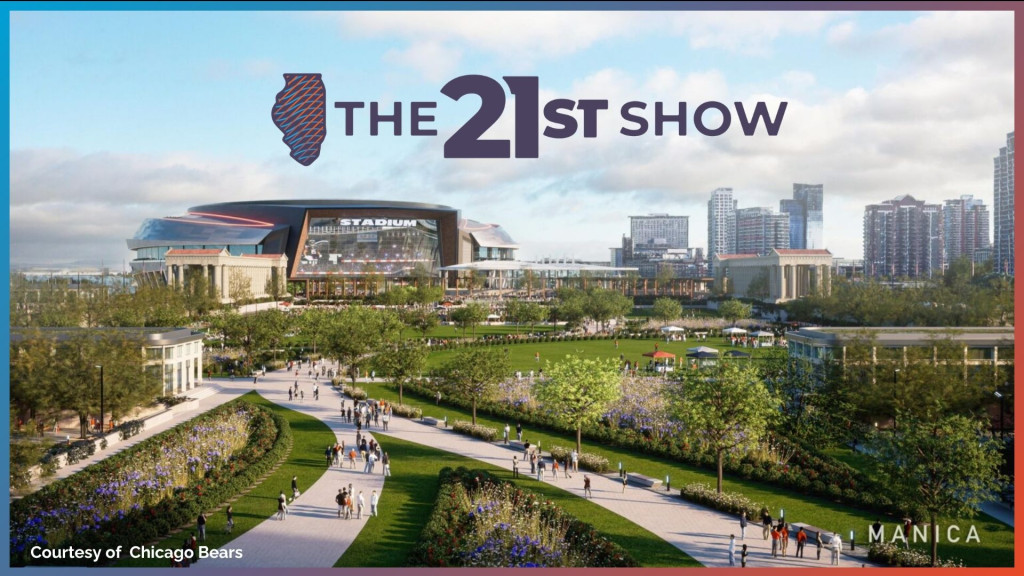
An artist rendering of the Chicago Bears’ stadium proposal Courtesy of Chicago Bears
// This is a machine generated transcript. Please report any transcription errors to will-help@illinois.edu.

[00:00:00]
Brian Mackey: It's The 21st Show. I'm Brian Mackey, and we conclude today with the Chicago Bears. Last week, the Illinois House of Representatives approved legislation aimed at making the owners of the Chicago Bears happy, or at least placating them enough that they don't move the team to Gary, Indiana. Meanwhile, lawmakers also approved language for a potential amendment to the Illinois Constitution around voting rights, but that is, like the Bears' plan, not a done deal yet. There's also been some action on credit card fees, and former House Speaker Michael Madigan got a ruling in the appeal of his corruption conviction.

Joining me to talk through all this is Brenden Moore. He covers the state House for Capitol News Illinois. Brenden, welcome back to The 21st Show. Thanks for being with us.

[00:00:52]
Brenden Moore: Glad to be back, Brian.

[00:00:54]
Brian Mackey: Listeners, you can join us if you have a question about the Bears, but don't wait just to the end of the show, 800-222-9455. I am going to share a couple of questions or comments we got in our texting group. Tom in Downers Grove said, as Jim McMahon said, the Bears will never be any good until they get rid of the cheapskate owners. The Bears still haven't paid off what was done in 2002 to Soldier Field. So why waste money on the Bears?

We also heard from Laura in Peoria Heights who said, "Da Bears, a Chicago institution in tradition loved and adored by so many." But then she says, "In the scheme of things in my life, as much as I like the Bears in Chicago and follow them, it doesn't really have any bearing on my day-to-day struggles. It just proves the point that people with money want everybody else to support them in the form of tax breaks and incentives, etc. And they don't think that the rest of us should have anything like the jobs they're supposedly creating with all of their benefit they get from the government. Let them go. Let Indiana taxpayers support them. My hope is Illinois legislators move on to helping the other 99% of us."

Thanks for those messages. All right, Brenden, we're getting political right off the top today. Let's just talk though about what this so-called mega projects bill would actually do.

[00:02:08]
Brenden Moore: Yeah, so the big thing that it would do is it would create this mega projects designation that would allow for large developers, in this case, the Bears, to negotiate a payment in lieu of taxes for a period of, depending on the size of the project, could be, you know, 20, 25 years, or in the case of the Bears, could be up to 40 years. And this would be your property taxes. The Bears have said that they need this what they call property tax certainty in order to build a new domed stadium on land they own in Arlington Heights, that basically what it would be assessed for, given the property tax rates in Cook County, it would just be too much for them to do without having this tool. And Governor Pritzker has supported having a mega projects bill just generally, not just for the Bears, but for projects across the state. Illinois is one of about, I think about a baker's dozen of states that doesn't have this type of statewide tool. So that's kind of at the core of it.

Although what the House passed last week really, it was more than a mega projects bill. You could call it a kind of an economic development Christmas tree bill. There was some language in there that would allow for the use of so-called STAR bonds in Chicago, that's using sales tax revenue to help fund larger projects, infrastructure for larger projects. There's something in there for Springfield, mechanisms to allow the funding of the expansion of the city's convention center and building a new hotel. So this bill, when it was first heard in committee back in February was about 38 pages, ended up being about 370, so it's about 10 times the size.

Now, Governor Pritzker and Senate leaders and the Bears have all said it's great that it passed out of the House, it's a big hurdle, but there are some changes that are going to be needed. So I would expect over the next few weeks now that it's in the Senate, we're going to see some changes to this.

[00:04:26]
Brian Mackey: Let's imagine ourselves in the future. Let's say this legislation were to pass and be signed into law as it is. If somebody were to run an ad saying so-and-so voted to hand out money to the Chicago Bears, taxpayer handouts to the Bears, would that be an accurate assessment, sort of plain language assessment of what lawmakers are doing here, or is it more nuanced?

[00:04:48]
Brenden Moore: I think it's more nuanced. I mean, if you look at it in the sense that would they be getting a property tax break, undoubtedly they probably would be getting a property tax break. And it would allow for them to have this negotiation that obviously you and I couldn't take advantage of.

[00:05:06]
Brian Mackey: I find it very difficult to do the things I want to do, but given my property taxes, can I get a break from the state of Illinois?

[00:05:14]
Brenden Moore: Exactly, exactly. Although it should be noted that in this House bill, a big reason that it passed is because there was a property tax relief mechanism in there that would require about 50% of this payment in lieu of taxes to go to property tax relief. 60% of that would be in, you know, if you live in a surrounding taxing district of a mega project, another 40% into a statewide fund rebate fund. The problem with that is that who's to say that the local taxing bodies aren't just going to double their ask on the Bears or on other larger developers. So that is something that may need to be worked out. But yeah, I mean, the Bears will probably get a property tax break here, although the governor and other advocates of this proposal would say that, you know, this is a tool that's used in other states, that if Illinois wants to attract larger development, you know, development that's not there, uh, you know, I think people will point out that the land in Arlington Heights is just sitting barren right now. There is no real economic development activity going on right now, so it's not really generating a lot of increment as it is. So that, you know, even if it is maybe less than what it would be just, you know, under the current system, you would still be getting something in addition to, you know, sales tax revenue and other benefits of economic development.

And people will also look at, I mean there's going to be a separate infrastructure conversation. The Bears are probably going to get hundreds of millions of dollars in help with public infrastructure, but that's probably stuff that would have happened, no matter what went there, whether it's the Bears or whether it's a data center, or whether, you know, it's just another mega development. And some of that's already in the capital plan, the 6-year plan that they put out. So yeah, you could say that they would be getting some help, but, you know, I don't know if it would be any more or less than what, you know, the state has kind of a toolbox of economic development incentives, and this would be kind of adding to that. And they would argue that this is not like in Indiana where they would be giving directly about a billion dollars for stadium construction. There would be no actual dollars going into building a stadium in Arlington Heights.

[00:07:44]
Brian Mackey: Well, we have another month of the General Assembly meeting, give or take, which is a lifetime, as you well know, for potential changes to this. So we'll keep following it. Let me remind listeners, this is The 21st Show. We're speaking with Brenden Moore of Capitol News Illinois about, we've been talking about the Chicago Bears and legislative efforts to keep that team in Illinois. They want to move out of Soldier Field to Arlington Heights potentially or maybe Gary, Indiana, but that is a conversation we'll continue another day.

I also, Brenden, want to ask you about a proposed constitutional amendment having to do with redistricting, the way legislative districts are drawn. What did the House do there? What would this potentially do? And I know we can talk about that. It's a long way from necessarily even being something that's going to be presented to voters yet. But what would this do?

[00:08:41]
Brenden Moore: Yeah, so right now, Illinois has three basic requirements when it comes to drawing legislative districts that they be substantially equal in population, they be contiguous, and to the extent practicable, compact. What this amendment would do would add a couple of different additional provisions, one would be to substantially, to ensure that no citizen is denied equal opportunity to participate in the political process, to elect representatives on his or her choice on account of race, and to create more practical racial coalition or influence districts. So, essentially what this language would do, the aim would be to protect minority representation in Springfield in the legislature. This is in anticipation of a possible Supreme Court ruling that would basically gut the provision in the Federal Voting Rights Act that prevents racial gerrymandering. I believe the language in this amendment which passed out of the House last week, includes some of the exact language that's currently in the Federal Voting Rights Act.

So this is kind of viewed as almost a preemptive measure to ensure that the full diversity of Illinois is represented in Springfield. Now, I think some would say that, you know, that's not really in danger at this point. I mean Democrats have supermajorities, they have the governor's office, but it's one of those where, you know, kind of similar to the Workers' Rights Amendment where, you know, yeah, maybe you have a labor-friendly legislature now, but down the line, you might not have that, so it's trying to enshrine it into the state constitution in anticipation of federal protections, voting rights protections being rolled back.

So this passed out of the House, it's in the Senate now. You mentioned how there's another month in the legislative session, but there is actually a clock on this because, to get an amendment on the ballot, it has to be approved at least six months ahead of time. So that's May 3rd, which is Sunday, and the Senate is in until Thursday this week, so they would have to read it into the record today, read it again tomorrow, read it again Thursday, and then they could vote on it. So really, if it's going to pass and be on the ballot this November, we're going to have to see some action later this week in the Senate.

[00:11:16]
Brian Mackey: Time is ticking. All right, just a few minutes left because time is also ticking on our program today. Talk to me briefly about swipe fees. This is credit card fees. Illinois tried to do something to regulate these. There's some state-federal friction here. Can you give us a brief overview of that?

[00:11:33]
Brenden Moore: Yeah, I'm going to try my best not to confuse people or confuse myself for that matter because this is, it's a very confusing topic. But a couple of years ago, the state legislature passed and Governor Pritzker signed, included in the budget implementation bill, basically a provision that said that you can't charge the so-called swipe fees which are added by the banks and the credit card companies on credit card transactions, they can't add that on to the tax and tip provision, you know, on tax and tip, which they say would lead to chaos because the systems aren't set up where you can separate those things.

There was a court challenge, the court ruled in favor of the state, but most recently, a federal agency said that, it basically published a filing that said that the federal law prohibits states from regulating credit card and debit card swipe fees. So this law in Illinois which had been pushed back is supposed to take effect July 1st, but this federal ruling could kind of put that into peril. So basically, we're kind of in limbo now, and I wouldn't necessarily be surprised to see this law get pushed back even further because of some of the uncertainty coming from this federal ruling.

[00:13:03]
Brian Mackey: Well, another story I'm sure we'll have an update on at some point in the future. Last thing I want to ask you about, former House Speaker, goodness, I still have that habit. Former House Speaker Michael Madigan, who of course is serving a 7.5-year prison sentence after his corruption conviction. He had an appeal. What happened with that?

[00:13:23]
Brenden Moore: Yeah, he had an appeal and his conviction was upheld. So he was, if you recall, I believe it was a couple of years ago now, he was found guilty on 10 charges of corruption, and in a 29-page ruling earlier this week, the three-panel, three-judge appellate panel found that there were no issues with his conviction or with any of the instructions given to the jury, any of the way the trial was conducted. There had been some, I guess, maybe some hope for the speaker because a couple of the so-called co-defendants had their convictions basically tossed a few weeks ago and they're going to get new trials, but that's not the case for the former House Speaker. The quote from one of the judges was, "Madigan insists this is run-of-the-mill politics, but a jury of 12 Illinois residents saw the evidence differently, so do we."

[00:14:34]
Brian Mackey: Wow. Well, worth noting Michael Madigan recently turned 84 years old in prison just about nine days ago as we are going to air on Tuesday. Brenden Moore with Capitol News Illinois. Thank you for all the updates. We covered a lot of ground. I appreciate your time.

[00:14:54]
Brenden Moore: Always a pleasure, Brian.

[00:14:55]
Brian Mackey: That is it for us today. The 21st Show is produced by Christine Hatfield and Jose Zepeda. Our digital producer, Kulsoom Khan, technical direction and engineering from Jason Croft and Steve Morck. You can find a podcast of this show wherever you listen, Apple, Spotify, YouTube, and on YouTube, just search for Illinois Public Media. That's also all at our website, 21stshow.org. The 21st Show is a production of Illinois Public Media. I'm Brian Mackey. Thanks for listening.
Last week, the Illinois House of Representatives approved legislation aimed at making the owners of the Chicago Bears happy — or at least placating them enough that they don’t move to Gary, Indiana.
Meanwhile, lawmakers also approved language for a potential amendment to the Illinois constitution around voting rights. Plus, there’s action on credit card fees — and former House Speaker Michael Madigan got a ruling in his appeal of his corruption conviction.
A Statehouse reporter covering all this joins the program today.
GUEST
Brenden Moore
Statehouse reporter, Capitol News Illinois