








Best of: Journalist Lee Hawkins finds freedom in exploring traumatic family history
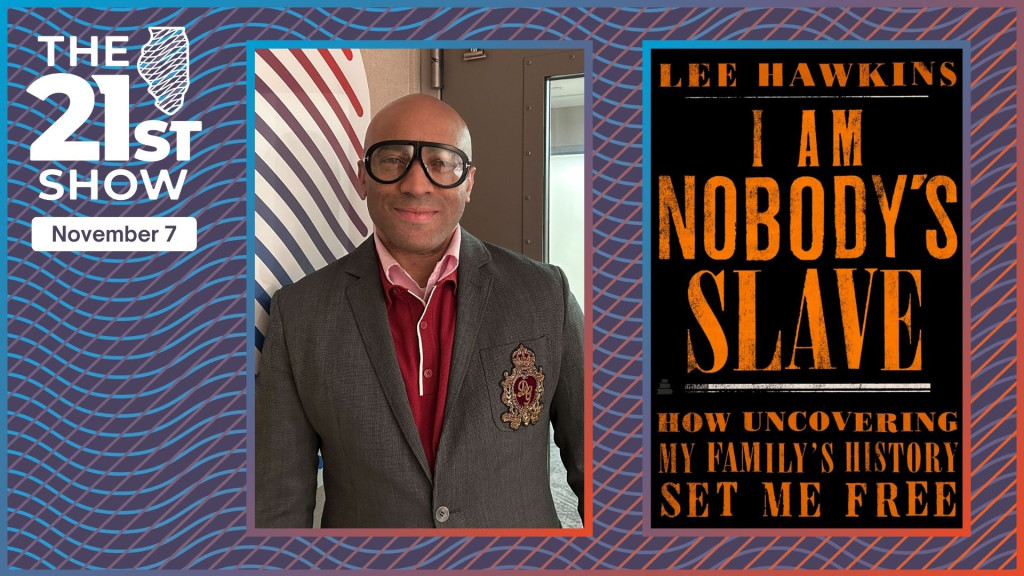
Lee Hawkins at the Urbana studios of Illinois Public Media in May 2025. Portrait: Jose Zepeda/IPM - Book cover: HarperCollins Publishers
// This is a machine generated transcript. Please report any transcription errors to will-help@illinois.edu.

[00:00:00]
Brian Mackey: Today on The 21st Show, Lee Hawkins is a journalist, a podcast producer, a musician, and a Pulitzer Prize finalist. But in his new book, he turns his skills toward telling his own family's story. It's a memoir of his family's journey across 400 years of enslavement, Jim Crow, and beyond, and how the trauma of those experiences is passed from one generation to the next. The book is called "I Am Nobody's Slave: How Uncovering My Family's History Set Me Free."

I'm Brian Mackey with Lee Hawkins for the hour today on The 21st Show, which is a production of Illinois Public Media, airing on WILL in Urbana, WUIS in Springfield, WGLT in Bloomington-Normal, WNIJ in Rockford-DeKalb, WVIK in the Quad Cities, and WSIU in Carbondale. But first, the news from NPR.

From Illinois Public Media, this is The 21st Show. I'm Brian Mackey. And for the entire hour today, we're revisiting our conversation with Lee Hawkins. Originally from Maplewood, Minnesota, Hawkins is a journalist. He's also a singer and songwriter, but that's a story for another day. He spent most of his career at The Wall Street Journal, where he was on a team that was a Pulitzer Prize finalist for a series on the Tulsa race massacre in 1921. More recently, he turned his journalistic expertise on his own family story, resulting in the new book "I Am Nobody's Slave: How Uncovering My Family's History Set Me Free." It's a memoir that explores 400 years of family history through enslavement, the Jim Crow era, and the intergenerational trauma that followed. It argues that some of the core experiences of contemporary Black Americans have been shaped by what their ancestors experienced over the generations.

Lee writes: "Slowly it began to register that being Black rarely meant freedom. Instead it meant there were strict rules to follow, and my parents would belt-whip me every time I broke them. My job was to learn those Black boy rules and be exceedingly careful, and if I stepped left or right instead of exactly on the line, a beating would ensue, and that beating would be all my fault and deserved."

Some of this work also appeared in a podcast series last year called "What Happened in Alabama," which you can find wherever you get your podcasts. Lee joined us in studio back in May when he was in town for an event at the Champaign Barnes & Noble. Because our conversation's on tape today, we're not taking calls, but you can let us know what you thought by sending an email. Our address is [talk@21stshow.org — verify email address].

Alright, I want to begin with a story you tell near the beginning of your book about what happened when you're in kindergarten. You make a snap decision to accept a last-minute birthday party invitation. Maybe you can pick up the story from there, and ultimately I'd like you to read a little from the book.

[00:03:08]
Lee Hawkins: OK, great. Yeah, I mean, first of all, thanks for having me on today. In writing this book, I really tried my best to frame it in the context of history. And so what I was able to do was to answer questions about why I was raised the way I was by going back into history to study my ancestors in a very specific way.

And so when I found all of that out, I thought back to a lot of the experiences that I had as a child to understand why certain things that didn't make sense to me then — such as the belt whipping that you talked about and how prevalent that was — not just with me but with a lot of the children I knew who were raised by Jim Crow survivors, people like my father who was born in 1948 in Alabama.

So I reflected back, once I was able to study my family history, on this incident in kindergarten when I took the invitation to go to the birthday party on the bus from a kid who was on his way to the party, and I hadn't been invited. I hadn't been invited myself. He had a gift that was wrapped and I said, "Hey man, happy birthday. Why don't you open up your present?" And he said, "Oh man, no, I'm actually on the way to a party," and he said, "You should come along." And so instead of going home like I should have — because I was in school half-day and my mom was at home waiting for me — I went to this party.

I came from a family where manners and etiquette [are] most important. There's a big premium on that. And so not only did I go to this party, but I went uninvited, and so that was the first rule that I broke. But I didn't know that, because I was only almost 5 years old. And so what ended up happening is we went into the party and this guy's mother was like, "Oh hi, who is this?" And he said, "Oh, you know, this is Lee, he's on my bus and I told him he could come." And I remember the kids were playing pin the tail on the donkey and there was ice cream, there was cake, and she just said, "OK, well I think before you go — before we get going — we better call your mom and let her know where you are." And so back then they had the big phone book. This was mid-'70s, and they called my mom.

[00:05:46]
Brian Mackey: It all sounds reasonable enough so far, right?

[00:05:50]
Lee Hawkins: And, uh, but what I didn't know was, instead of my mom saying, "OK, just be home at 5 o'clock" like June Cleaver would have said, my mom said, "I'm coming to get him." And at that point, when she said, "Oh, your mom's on the way," this mother was saying, "Oh no, you don't have to come to get him. He's OK. He's having a great time." And when I heard that my mom was coming, that was when I knew that there was trouble — fire on the bayou, pretty much.

And so she showed up, and it was just a — I mean, she walked in, she's a very dignified lady, so she walked in and she said, "Oh, I'm so sorry that Lee invited himself, and Lee, you know better than that. That's not proper for you to do that." And then when we got into the car, it was a totally different thing. It was like, "You know, these white people don't want you at their party, and you came in here just thinking — asking for ice cream and asking for cake — like we don't have food." And it was all of these different things that surprised me, because I didn't at that time have a good sense of the context of race and the very hyper-racialized society that I was living in in America. Because America's society is all about race, and I just didn't know that because I was a child.

So then I tell the story in the book about how my father — who once again was raised in Greenville, Alabama, and grew up under Jim Crow in the 1950s — when he came home, whoa, I mean, he was — he was not as mad. He wasn't mad at all about the fact that I invited myself to the party. He was mad because he thought, "You could have disappeared. They could have killed you."

[00:07:50]
Brian Mackey: I wonder if you'd be willing to read that. It's such a powerful passage in the book where you talk about the actual experience of what that was like that night.

[00:07:59]
Lee Hawkins: Sure, OK.

"But when he got home, he didn't pull out his belt immediately. He grabbed me and shook me hard, then put both hands on my shoulders, pressing down with his thumbs digging into my neck. He launched into a screaming lecture, adding frightening dimensions that Mom hadn't even brought up. Then he unbuckled his belt and brought it down on my back hard. [Whap.] 'Boy, don't you ever disappear like that. [Whap, whap, whap.] Don't you know that you can disappear and never be seen again? They'll kill you. [Whap, whap, whap, whap.] Don't — [whap] — you — [whap, whap] — know that some of these white people — [whap, whap, whap] — will kill you if you go into their homes, and then I won't have a son? You're not a kid. [Whap.] You can't be a kid. [Whap, whap.] Stop acting like a kid. [Whap, whap, whap.] You're not a white kid. You're a Black boy. Don't you know you're Black? You're Black, and don't you ever forget it. [Whap, whap, whap, whap, whap, whap, whap, whap, whap, whap, whap, whap, whap, whap, whap.]'"

"I was 5 years old. He literally beat the child out of me. From that day forward, I knew I would never be anybody's baby — least of all my parents'."

[00:09:26]
Brian Mackey: Yeah, wow. First, I'm so sorry that happened to you.

[00:09:32]
Lee Hawkins: It's not all that uncommon, but thank you. I mean —

[00:09:35]
Brian Mackey: What did you understand as a 5-year-old about what was happening?

[00:09:39]
Lee Hawkins: I understood that there were rules in this society that I needed to observe as a Black boy, that my parents had had something happen in their life that had led them to understand these distinctions — because I was growing up primarily in a 99% Scandinavian suburb in Minnesota and then heavily, heavily involved in the Black community in the city where my church was and a lot of my family members still lived. And so it just taught me that there's a dichotomy here. There is a dual society and you have to learn how to navigate carefully through both.

And so that was — and I didn't know how I was going to do it — and I also had many, many questions about what had happened in Alabama that had led my father to develop these rigid rules. Were those the rules of Alabama?

And at that time, I had a very faint understanding — I always say a very Disneyified version — of what Jim Crow was. I heard it was segregation and —

[00:10:57]
Brian Mackey: Bad water fountains and, you know, back of the —

[00:10:59]
Lee Hawkins: — bus. Yes. At the worst of it was that Black people — oh my God — we have to be separated from white people, you know, and how scary is that. But it was really much more than that, because in the terror in my father's eyes, I could see that he had been affected by something.

What made it difficult and very complex was that my family was and is successful, and my family was and is happy, and that my parents did love me. And what I could not understand was what we had been through, because my father would never talk about Alabama. And when I talked to a lot of my friends whose parents were from the South and moved north and did the Great Migration — which is what it's called, but we often don't understand that slavery was not the only period in which Black families were separated due to trauma — Jim Crow was also about that.

It wasn't, you know — the North is framed as a promised land for us, that we ran to freedom and got jobs in factories and integrated into the society and it was happily ever after. But the truth of the matter was that my father didn't leave Alabama for a better opportunity. He left Alabama because his mother had tragically died as a result of not getting treatment in a Jim Crow-era hospital, because Black people were not even allowed in that hospital. And so he was a 12-year-old boy when that happened, just a few years older than me.

And also we have to understand that his version of Black boyhood was that Black boys need to be adultified, that we have to operate as men in a boy's body. And all of that was running through my head as this little boy in kindergarten.

[00:13:12]
Brian Mackey: How did you come to understand — or did you, as a young man, as you were going into teenagehood — these sorts of episodes continued in your life. Did you come to understand that better, or was it still just, "Well, there's these rules. I don't really know what's behind it"?

[00:13:28]
Lee Hawkins: I think I struggled through elementary school a lot, you know, in terms of making different mistakes and learning different aspects of these rules. And so it was like you had to do one thing wrong to understand, "Oh, that's a rule too," right? But I think as time went on, I started to evolve and I started to get really adept at understanding the psychology of my parents, the psychology of the white people around me — particularly the racist ones — and understanding how to navigate through both of these realms.

You know, the legendary boxing promoter Don King loved to say that he has a master's degree in Negroology and a Ph.D. in Caucasianism. And I would say I got my Ph.D. in both at a very young age and started to understand the success equation and how any small mistake that I could make is something that could affect me for the rest of my life. And that was enforced and reinforced with the belt in my home as a kid.

And so I developed a lot of resilience. To the point that even today, when people read my book — because the first part of my book is about the first 17 years of my life and how I was raised; it's not my life story, it's just the aspects of my life that were more traumatic, that were tied to history — when people who have known me and known my family for years read about that aspect of it, because then we go into the history of my family, they're very surprised because they say, "I would have never known just by the way you carry yourself, and you guys have been so successful, and you've been — you're —"

[00:15:32]
Brian Mackey: Always —

[00:15:32]
Lee Hawkins: — so —

[00:15:33]
Brian Mackey: Big-shot reporter at The Wall Street Journal.

[00:15:35]
Lee Hawkins: You're always gregarious, you're always happy. And I think for me — and I am happy — but again, we have to understand complexity and we have to understand how awesome Black American descendants of slavery and Jim Crow are, because we've walked around this world as if we haven't been through anything. And Jim Crow has never been acknowledged as a system of apartheid, and that's exactly what it was — that we lived through and we don't complain and we keep pushing and we stay positive and love the country unilaterally, moving — you know — leading the civil rights movement and leading the quest for human rights. So that's a big part of this story.

[00:16:19]
Brian Mackey: If you're just joining us, this is The 21st Show. We're listening back to our conversation with Lee Hawkins, who's the author of "I Am Nobody's Slave: How Uncovering My Family's History Set Me Free." It looks at 400 years of Hawkins' intergenerational trauma and its linkage to the enslavement of his ancestors. If you want to find this work elsewhere, you can also check out his podcast series, "What Happened in Alabama." It serves as a sort of audio version of the book. More of our conversation with Lee Hawkins after a short break. This is The 21st Show.

[00:16:59]
Speaker 2: Support for The 21st Show comes from the Des Moines Art Center, located in Iowa's capital city, featuring works by regional, national, and international artists of the 20th and 21st centuries. Details are at [DesMoinesArtCenter.org — verify URL spelling].

[00:17:35]
Brian Mackey: It's The 21st Show. I'm Brian Mackey. For the hour today, we're listening back to my conversation with Lee Hawkins. He's a journalist by trade and was at The Wall Street Journal for many years. He also has a book — a memoir of his family's story through 400 years of enslavement and Jim Crow and beyond. It's called "I Am Nobody's Slave: How Uncovering My Family's History Set Me Free."

Because we're on tape, we're not taking calls live today, but you can always let us know what you thought by leaving us a voicemail at 217-321-[2121 — verify phone number]. That number again: 217-[300]-[2121 — verify phone number].

So talk about why — you write in the book that you didn't really fully grasp — you knew your parents had seen some terrible things. Your father used to have nightmares, and one time he just told you, "Alabama, son. Alabama." That's all you really understood, or what he would say. Why did you decide, as an adult — what was happening in your life that made you think, "I need to try and figure out what is the real story here. What really happened? What's behind this"?

[00:18:40]
Lee Hawkins: Well, I feel the highest form of love is curiosity — not judgment. When people go through things they don't understand about their families, their parents, their grandparents, rather than judgment, I think it's good to ask questions. And I felt that my father deserved an explanation for things that happened in generations previous to him that people kept secrets from him, right? So every generation kept secrets from the next generation in my family. And I feel like that's a parallel to the American story too — that we carry as an American family so many secrets that really don't serve us well. It just has us carry the pain forward.

And so what I wanted to do was, as an American, I really wanted to know what's the truth. No matter where you stand ideologically on the issue of slavery, there are lots of people who wonder: How can something that happened a century and a half ago affect Black Americans and affect our society in modern times? There are many people who feel like we went through these periods and they're over. Get over it and keep moving on. [Raise] yourself up, right? And we have raised ourselves up without the bootstraps and without the GI Bill. And there are a lot of things that Black people have done that — when you don't know history — a lot of times people make these facetious comments, and they wouldn't understand the whole thing if they're not going to understand a lot of the problems that they see in the society unless they understand the history that undergirds it.

And so, you know, I saw the movie "Roots" and I saw how Alex Haley had gone back into his family history, and I wanted to stop talking about it and actually go about and do the work. Because I am an investigative reporter, and there were so many different things that I had successfully investigated in my career, but I couldn't tell you the first thing about who my third great-grandparents were. And the more that I got into genealogy, I started to understand that we don't — we never meet our second great-grandparents, right? But they're probably responsible, no matter where we're from in this world, for 30 to 40% of our socialization, our family values, the way we're raised. And it's important to get to know those people if you can.

And so I saw genealogy as a tool of empowerment and one that could bring some healing for my dad. Because my dad — the scene talks about the belt whipping, but my dad was also a very loving father who was very omnipresent in my life and saw the belt as a form of protection for me, which is really a hard concept for people to process.

[00:21:57]
Brian Mackey: And he's at your games, you sing with him in church. I mean, it's a loving relationship.

[00:22:01]
Lee Hawkins: Oh yeah. And I think that a lot of — I encourage people to lean into the difficult aspects of their relationships with their parents and with their grandparents. I meet a lot of people on the road — I'm on book tour right now — and I see a lot of Baby Boomers who carry a lot of residual pain, people of all races, from being raised by parents who went through the World War II era. Even if you look at that specific period of American history, there was a stoicism. People had gone through hell, and they had lost and they were suffering and they were grieving family members who died. But the national position on grieving was to, you know, toughen up and stiffen up your back, and let's not even reflect on it. Let's not talk about that person. And so it was a tough childhood for a lot of people.

And for me, there was love. But once again, all of this can be wrapped up in this perfect gift that is: "We're going to try our best to protect you from the stories of our family's history and our country's history by not talking about it. And you know, it's going to be brutal. The world's tough. And you need to learn how to adapt. And here are the rules, and if you don't follow them — it's going to be tough." And so, yeah.

[00:23:46]
Brian Mackey: So, among the things — and people can read the book or listen to the podcast series if they want to get into the details — but you uncover so many generations that experienced these terrible things in your background. I don't know if you can talk about that and how that started to unlock your understanding of how, even as an adult, you were still experiencing the sort of aftereffects of this, what you'd gone through as a child.

[00:24:11]
Lee Hawkins: Yeah. So I did take a DNA test, because Ancestry.com and all of the DNA testing just exploded. And so being an investigative reporter, I took the Ancestry.com test. My father took it, my whole family took it, and my father started opening up and doing these incredible interviews where he answered a lot of the questions that touched him in too tender of a place to discuss when I was a kid. But now we have this adult friendship.

When he did that, we were already past a period in my early 30s where I had confronted him about the corporal punishment, the belt beatings of my childhood. And he apologized. We went to therapy — all kinds of things — and for that, for 20 years before I started this process, we had just an incredible adult friendship.

And so when I dug into this history and I took the DNA test, I found out that 18% of my DNA was from Wales — European — and then the rest was from West Africa. And that struck me as surprising. I don't know why, but it did. Because America is such a hyper-racialized society that people think so much about race as a political identity, but they don't actually go back and do the real hard studying that it takes to understand how we got to this place.

And so I ended up identifying white cousins who are also engaged in genealogy work, and I contacted them as part of my research. They opened up their family archives and started to talk about what they knew about their ancestors, and of course we were able to figure out that I was related to them as a result of the sexual assault of my great-great-grandmother Charity Pugh, who was enslaved on a plantation in Troy, Alabama — which is the same town that John Lewis is from.

I started to research the family that enslaved her, who I'm related to by blood. And I started to talk to my elder cousins who had an understanding of their great-grandparents, both through having known their great-grandparents, but also through oral history. And I was able to piece together this American story that gives us an opportunity to actually see how slavery, Jim Crow, the Great Migration, and integration affected one American family — both Black and white.

And so as part of it, I found out that America's origins — for all of the things that we've been able to accomplish in this country — were very violent. Whether you talk about the struggle to steal the land from the Indigenous people and then to enslave Black people to build it up, a lot of — and just even inside the world of the so-called settlers — it was a violent world because many of them were coming from the United Kingdom, coming from a society that was already very violent, where whipping was very prevalent. Flogging and whipping was a hugely colonial tradition, and many of them were herders. They had herds and they had to protect their livestock, and how did they do it? They did it through violence. And so that violent culture was a big part of the way that things were set up in this country, going all the way back to Jamestown.

And I started to see that great-great-grandma Charity — who used to babysit my grandmother, by the way — was the last generation of my family to be enslaved. And I put her childhood together through all of the reporting that I did, through oral history and also through what I knew about the family who enslaved her, what I knew about the culture and the laws that were in the society. And I found out, Brian, that she lived under a set of rules — surprise, surprise — called the Slave Code of Alabama of 1852.

What were those rules? Well, let's break it down. If she was caught reading or writing, that was 39 to 100 lashes. If a Black person who was enslaved was with more than four other Black people without a white person present, they would all be whipped — 39 to 100 lashes. And this applied not just to enslaved Black people, but also to so-called free Black people. There are a lot of people who believe that there were Black people who were free. Well, no — there were no Black people in this society who were free, because they all, in the South, had to live under strict rules. Some of them could not even stay long if they were free, or they would be put into enslavement.

So I found that out, and that was a big breakthrough for me. Because I started to understand — through an interview that I had done with a great-uncle in 1991, before he died — that he was talking all about Grandma Charity. So we went back to that tape from 1991. And he talked about how much he had [resented] Grandma Charity because of how brutal she was in the fields when they were working — how if they weren't working fast enough, she would use the belt or a branch or whatever it was — and that she was a brutal woman from his standpoint. But he never said she was enslaved. I had to go back into the history to find that.

And when I pieced her life together, I started to realize the way that whipping was used in the cotton trade and the fact that after the cotton gin was invented, they needed to extract more labor out of the enslaved people, and they did that through whipping. And so if she was in bondage for the first 30 years of her life and then 60 years living under Jim Crow apartheid where whipping was the way that business was done, then why wouldn't she have used that on her own family?

And so I started to gain insight into how this tradition got passed down and the fact that I grew up thinking that this is what Black people just do — that this was part of our culture — and it wasn't part of our culture. It was actually part of the culture of the colonial tradition that was brought over from the United Kingdom.

So that was one thing. But I also got a very good look into why my father was so afraid that I might disappear. And I found out that my family was one of the biggest offenders in terms of breaking the number one rule that would get a Black person put in danger in this society. And you know what it was? It was entrepreneurship. My family, through the generations, acquired land, built farms, and as a result there were family members — a lot of family members — who were murdered over land. In fact, I've had a murder in my family every generation since 1837.

And when I went back and pieced together some of those murders in the book, we start to gain a very good narrative understanding of American history — the dark parts of American history. And there's also a lot of light in there. But we start to see how prevalent violence is.

And I combined that with my understanding that I gained about childhood trauma and how every generation of these children who lived through these periods would have gone through childhood trauma. In modern science, we're starting to see that adverse childhood experiences, if not confronted, can lead to shortened life expectancy — usually early death, on average about 20 years early — through cancer, diabetes, or a heart attack.

And I started to look at my relatives — my father's siblings and my father from the South — and the nature in which my grandmother died. And I started to see how it would be that they would die so young. My grandmother's father was murdered when she was 9 years old — over land. My grandfather's father was murdered when he was 9 years old. My father's father was also murdered, and he never told me that. My father's father never told him that his father was murdered. Yet they carried so much of these American secrets in their hearts that they couldn't even talk about it to their children. And so when their children would run afoul of these rules in society — even in modern times — that's when they would lose their temper and be so afraid that they needed to put these kids in place so that they would move about society in a perfect way.

[00:34:15]
Brian Mackey: Protecting them in the harshest possible way. Yes. All right, let me take a moment to remind listeners — this is The 21st Show. We're listening back to our conversation with Lee Hawkins about his book, "I Am Nobody's Slave: How Uncovering My Family's History Set Me Free." It argues that some of the core experiences of contemporary Black Americans have been shaped by what their ancestors experienced over the generations, from enslavement to the Jim Crow era. More to come after a short break. This is The 21st Show. Stay with us.

It's The 21st Show. I'm Brian Mackey. Let's get back to the conclusion of our conversation with Lee Hawkins. He's a journalist who spent many years at The Wall Street Journal and more recently turned his journalistic lens to his own life story and that of his family over many generations. The book that came out of that process is called "I Am Nobody's Slave: How Uncovering My Family's History Set Me Free." He also created a podcast about this. It's called "What Happened in Alabama." You can find that wherever you listen.

No calls for the hour today, but we still want to hear from you. Our address is [talk@21stshow.org — verify email address].

And before the break, we were talking about the through line of violence in American history and how, you know, every drop of blood drawn with a lash — to borrow a phrase — can eventually work its way to a 5-year-old boy in Minnesota who made a bad choice about where to go after school that day.

Something I appreciate about your work is the embrace of the complexities of American history. And maybe we can talk about that, because we seem to be in an era where people want history to be one way or the other way, and that complexity gets sanded out a lot of the time.

[00:36:22]
Lee Hawkins: Yeah, and I feel that complexity — and embracing complexity in my work — is the highest expression of love for this country. I consider myself somebody who's very patriotic. And I call myself somebody who calls for a more responsible, complex understanding of patriotism.

I was born on the Minot, North Dakota, Air Force Base at the height of the Vietnam War era, because my father had enlisted in the Air Force — even though he wasn't born equal to a white person under the Constitution of America. He loved the country enough to enlist. And that says a lot to me.

There's one important fact that we have to understand, and that's that I call myself a first-generation American. That's because my family has been here since the 1600s. I'm a descendant of Revolutionary War soldiers. I'm a descendant of soldiers on both sides of the Civil War, Black World War II veterans, and my father was in the Air Force. But still, I'm part of the first generation of my family to be born equal to a white person — even though my family has been here for 400 years. And I think that —

[00:37:49]
Brian Mackey: Because — we can be [proud of that] because of the Civil Rights Act, the Voting Rights Act, the legislation that passed —

[00:37:55]
Lee Hawkins: Exactly right. So that movement that Black America led, to open up rights not only for Black Americans but for marginalized people and for people of all races and gender and everything — that was a big stride forward. And it's important to mention that when that was passed, there wasn't a Black person in the Senate or the House at the time. That was passed by people who understood that our country could only move forward to what the framers envisioned through extending equality — at least on paper. We're still trying to get there, but to people from all backgrounds.

And so that's something that we could be proud of. This book doesn't just focus on the darkness of our American history, but there are some really encouraging parts that really get into the light and the beauty of the American story.

And so I think that right now, one of the reasons we're seeing so much division around how history should be handled is because we have been in denial about the fact that racial equality is a new concept in America. It's only 60 years old, right? And so there are still people who are having a hard time accepting — even if they don't know the history and how deeply ingrained it can be into their subconscious — accepting women as equal, accepting Black people or brown people or so-called illegal immigrants as equal.

And we have to start to look at the part of the Constitution and the part of the American story that the framers envisioned that would bring us to be a more perfect union. Because if you look at the Constitution, it is a beautiful document. It is the most egalitarian document I've ever laid my eyes on. The problem is tribalism. The problem is, when you get primates together in a society, they don't want to observe that kind of democratic equality. They want to do what's best for them.

And so we continue to have these culture wars in our society, and now it tends to be about history. And so what I wanted to do was not write a book that is preachy — because this isn't really about my opinion. It's my objective reporting of the story of an American family, and I do that out of great love for the country and out of great love for children. Because I want us to understand how much the trauma in our society and in our families, and our inability to address the violence in this country, manifests as trauma for our children.

Every mass shooting that we see, every homicide that we see, should not be viewed in isolation. Even every hate crime that we see along the lines of race should not be viewed as, "Oh well, look at those people on the alt-right," or "Let's look at the Proud Boys — all of these people are a problem." When Joe Biden talked about that — with the shooting in Buffalo when those Black people were killed in the grocery store — he was very irresponsible when he came out and said, "This is the problem from the alt-right. White supremacy is a problem." Because he wasn't honest about the extent to which the white supremacy that we see in this country and all over the world goes back not to individual white people — it goes back to our government as an institution. Our government, for all but 60 years of its existence, has set up our society where white supremacy was the law. And that's not a political statement. That is a fact, and it comes from the American government. That's how Nazism — that was how they modeled their system after ours.

And so that's not to say that this country is a terrible place that is irredeemable, but it's to say that if we truly love the country, and if we want the country to move forward — to move to the more perfect union that the framers envisioned — we have to do it through the lens of complexity. It is the ultimate expression of patriotism.

When we walk into the classroom as kindergartners, what's the first thing we learn? We learn that George Washington was the father of this country and that he never told a lie. We hear the story about the [cherry] tree. And I think that is the first — and it's downhill from there in terms of seeing history in a clear-eyed fashion — because that is the first form of indoctrination that our children go through. And what it tells them is: "Don't question the country, because the country is perfect and it's pure." And when you question your country, you're criticizing your country, you don't love the country.

That's not what Thomas Jefferson believed. If we go to that Constitutional Convention, that's all they did — they spent time picking apart the country. If you look at Abraham Lincoln's speeches — yes, he was a white supremacist, but also he talked about the scourge of the Civil War and whether there would be, as I frame it, a cosmic debt to pay for our inability to live up to the ideals of the Constitution.

And so complexity among the best and brightest stars — whether we talk about Thomas Jefferson or we talk about Dr. Martin Luther King Jr. or Fannie Lou Hamer — people who have made contributions to this society — has always been through questioning the country and holding the country to the highest standard possible.

[00:44:24]
Brian Mackey: And, you know, twinned with that embrace of complexity — and you touched on this a little bit earlier — one of the ideas I come away from your work with is this idea that really understanding childhood trauma as something that is passed down from generation to generation. And it's interesting, you link a mass shooting — a racially motivated mass shooting, or one that's not — but with some of the violence we see in Black and brown communities. To be candid about it here in Illinois, that's a big problem in a number of our cities.

[00:44:58]
Lee Hawkins: It is, and it's internalized racism — that's what I call it. I'm passionate, if not self-righteous, about my community, and I love my community. I lost four friends to homicide in high school. And so I guess that takes me out of this whole Black elite label that people like to put on me. But the truth is, I've seen it. I've sat with families as they were grieving, and I'm a murder survivor, right?

And so one of the biggest pains, Brian, that I have is to know that yes, we were killed by white supremacists who were never brought to justice, but I also had family members who were killed by fellow Black people who had internalized self-hatred so much that they hated their own reflection and killed their brother or killed their sister. And I think that our inability to understand intraracial violence — and how intraracial violence ties back to the history of the country and how it's killing so many of our young Black men — we've had over 300,000 killed since 1980, which is like five or six times the casualties in the Vietnam War.

Now, if you're sitting in the ivory tower in an Ivy League school and you're Black, it might behoove you to say, "Well, you know, all crime is intraracial. White people kill white people, Asian people kill Asian people. It's all about proximity." And that's just out of concern about how we're going to be perceived by white people who might be racist and who might want to pathologize us. Well, you know what? I don't care about white people who are racist. I don't live my life for that. I live my life for the people in this country of all races who want to move forward for a better future.

And if that means that Black-on-Black crime is an issue and Black-on-Black homicide is an issue that the Black community must rise up against, then so be it. Because in my era, the term "Black-on-Black crime" was actually coined by us in our community, and there was a time where we marched against it, we acknowledged it, and we were calling for healing in our community.

And I think the other thing is that we have to also recognize the shadows of the past in modern times and start to come to terms with the hypocrisy in our society. That was one example of hypocrisy, which makes my book so hard — because my book involves a lot of truth-telling about issues that even the most progressive, so-called people who claim the left, who claim to be so into social justice, don't even want to address and haven't addressed. And one of them is corporal punishment in schools.

The fact that in society today, in 17 states — mainly, of course, the slavery states that have always held America back, the states who committed treason against our country and tried to hold us back even back then — they're still beating children in schools, right? And Black and brown children and students with special needs are getting hit in school with a paddle. They're allowed to be hit three times. It's not happening everywhere, but it does happen to children. And with all we know about childhood trauma, we have to understand how that affects children over the long term. And they are the most vulnerable in the society with the least protection, and that has gone on throughout American history.

And this is why people should read the book — because it really gives a clear-eyed account of American history through the story of a family, without beating people over the head with preachy stuff, but letting them know an American classic narrative that will help them learn about a family, and in the process learn about truthful American history.

[00:49:23]
Brian Mackey: The book is called "I Am Nobody's Slave: How Uncovering My Family's History Set Me Free." The author is Lee Hawkins. Thank you so much for being with us today on The 21st Show.

[00:49:33]
Lee Hawkins: It is an honor and a privilege to be on your show, Brian. And I love the fact that — we were talking offline and you were telling me that, as a journalist, you embrace complexity — and we need that. We need that so much in our journalism today. And I think it's us and the younger generation that are in a position to help this country go forward.

[00:49:59]
Brian Mackey: The book again is "I Am Nobody's Slave: How Uncovering My Family's History Set Me Free." It's by Lee Hawkins. That's it for us today. The 21st Show is a production of Illinois Public Media. I'm Brian Mackey. Thank you for listening. We'll talk with you again on Monday.
Lee Hawkins is a journalist, a podcast producer, and a Pulitzer Prize finalist. But in his new book, he turns his skills toward telling his own family’s story. It’s a memoir across 400 years of enslavement, Jim Crow, and beyond — and how the trauma of those experiences is passed from one generation to the next. The book is called, “I Am Nobody’s Slave: How Uncovering My Family’s History Set Me Free.”
GUEST
Lee Hawkins
Author, "I Am Nobody’s Slave: How Uncovering My Family’s History Set Me Free"
Podcast creator, "What Happened in Alabama?"
A version of this interview originally aired May 21, 2025.