







Best of: Sci-fi author Ken Liu on his writing, AI, and sentient toasters
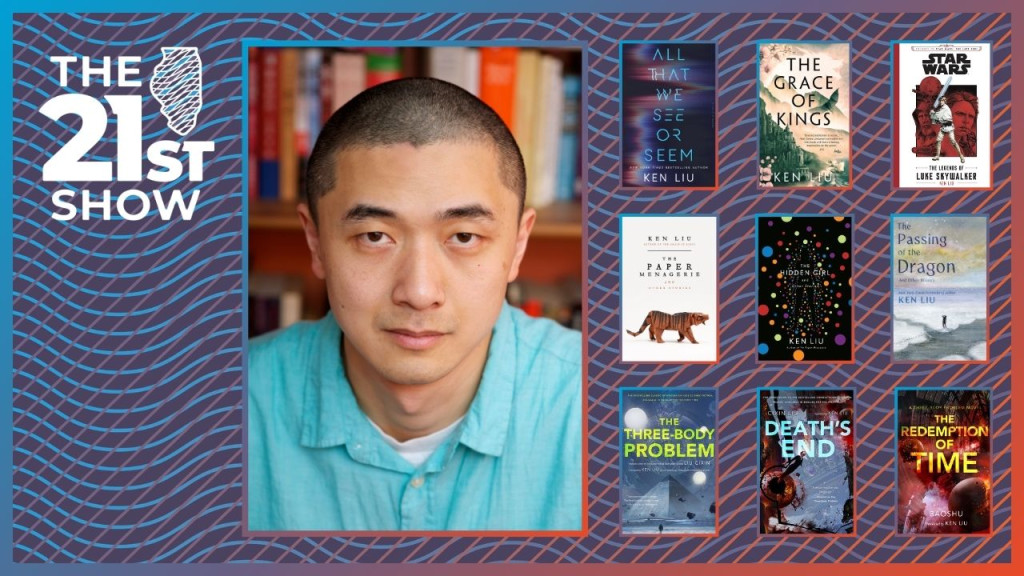
Ken Liu is a prolific writing and translator (from Chinese) of science fiction and fantasy. Portrait by Lisa Tang Liu (courtesy Ken Liu)
// This is a machine generated transcript. Please report any transcription errors to will-help@illinois.edu.

[00:00:00]
Brian Mackey: Today on the 21st show, author Ken Liu — after starting a career as a software engineer and corporate lawyer, he's become an award-winning author of science fiction and fantasy. He's also a translator. His work there includes the series known as the Three Body Problem. But beyond all that, Liu is a futurist, and so we'll also talk about the possibilities for art as we enter the age of artificial intelligence.

[00:00:27]
Ken Liu: What will it be like for AI to get to the point where they actually have consciousness so that you can actually read a novel written by a toaster? That would be incredibly interesting to me. I would love to understand the consciousness of a toaster and how a toaster engages with the universe.

[00:00:44]
Brian Mackey: I'm Brian Mackey with Ken Liu on writing, science, and sentient toasters, all coming up today on the 21st show, which is a production of Illinois Public Media. But first, the news.

From Illinois Public Media, this is the 21st show. I'm Brian Mackey. And we are spending the hour today in the company of one of America's best regarded writers and translators of science fiction and fantasy. Ken Liu was born in China, 1976. His family emigrated to the U.S. when Liu was 11. He went to Harvard and became a software engineer and corporate lawyer. But all through that time, he continued writing to the point where that became his full-time job. Today, Liu has published multiple collections of short stories and an epic series of novels. Several of his works have been made into films, including Good Hunting, which was part of the Netflix animated anthology series Love, Death and Robots.

[00:01:48]
Speaker 2: When I was a child, the whole world was full of magic. My father was a spirit hunter, one of the brave men who protected humanity against spirits that would harm it.

[00:02:02]
Brian Mackey: Beyond his own writing, Liu is in demand as a translator of Chinese science fiction, including the hugely successful series known as the Three Body Problem. Liu is based in the Boston suburbs, but was in central Illinois back in 2024 for a talk at the Champaign Public Library on art and artificial intelligence. That's about when I spoke with him. By the way, he has a new short story collection coming out on those themes. It's called The Passing of the Dragon. That'll be later this year. You can let us know what you thought of today's show by emailing us [talk@21stshow.org]. Ken Liu, welcome to the 21st show. Thank you for being with us.

[00:02:41]
Ken Liu: Brian. It's a pleasure to be

[00:02:42]
Brian Mackey: here. So Freud said that artists are motivated by a desire for honor, power, riches, fame, and the love of women. What motivates your writing?

[00:02:52]
Ken Liu: I love that quote from Freud. It's — I mean, he was like [ChatGPT], always so confident in pronouncing matters of which he knew nothing. I would say that I'm motivated largely by a childish delight of sharing things that I discover about the universe. It's like you're a kid and you're out playing, you know, just outside. And it's getting dark and you come home and you're like, "Oh my God, Betty, you have to — you have to hear what I saw today. I saw — I saw a dragon in the woods." That's what it's like. I see something amazing in the collective unconscious and I want to share it with everybody.

[00:03:32]
Brian Mackey: What got you interested in writing science fiction — or maybe we should call it speculative fiction, and we can talk about that as well.

[00:03:38]
Ken Liu: Yeah, yeah, you can call it whatever you want — speculative fiction, fantasy, magic realism, science fiction. You'll find that I'm not someone who's terribly hung up on genre labels. What happened to me basically was I wanted to tell stories about things I was interested in, and when I was trying to get them published, I didn't know where to send them. And then people told me, "Well, you know, this reads like fantasy, so maybe you should try that," and "This reads like sci-fi, maybe you should try that." So I was like, "Oh, that sounds great." I tried. I got published. And I never set out to write science fiction, fantasy, [realism], whatever. They were just stories that seemed interesting to me, you know, like I said, I saw dragons and I wanted to share them. And readers, if it helps readers define my work by classifying them as one thing or another, that's great. But if readers want to tell me that's not science fiction, that is also wonderful, as long as you enjoy it. I don't care what you call it.

[00:04:38]
Brian Mackey: Did you always want to be a writer? Is that something that you've always had in the back of your mind?

[00:04:43]
Ken Liu: I think that's true, although there's a little bit of historical revisionism here, which is, I think, inevitable. You know what happens is you live a life, right, and a lot of it is very random, and people ask you how did you end up here, and it feels bad to just say, "Well, I just sort of wandered about until I got here," so you have to make up a story about how you got there. So I'm trying to be 100% honest here, and I would say that I think I always did want to be a writer, but it wasn't sort of the plan I was striving towards. I tried my best to make it, but sometimes I wasn't working at it 100%. And I wandered about a little bit here and there, but eventually ended up exactly where I wanted to be, so I'm very happy.

[00:05:34]
Brian Mackey: You started out in — or I don't know if you'd say you started out, but you were a software engineer. You were a lawyer. Talk about that path that you started out on.

[00:05:44]
Ken Liu: Yeah, it's not your typical planned-out career trajectory. This is not how I would advise people to do it, but, you know, it worked out for me, so maybe it is a good example. I was an English major in college, and of course, when it came time to look for a job, I was a little panicked, shall we say, but luckily I had taken a lot of comp sci classes, so I knew quite a bit about what it meant to be a software engineer. So I started out working as a software engineer at Microsoft, and then I joined a startup with some friends, and that was wonderful — some of the greatest time I ever had. A few years later I decided to transition to corporate law, and I did that for a number of years before becoming a litigation consultant, which meant that I was testifying as a computer science expert in technology cases. But throughout that some 20-year period of time when I was doing these jobs, I kept on writing and publishing just because it was something that I really enjoyed doing. Like I said, I would have these ideas, had these visions. I saw the dragon and I wanted to share them with the world. That never stopped, and eventually it got to the point where my publishing side gig was big enough to replace my day job, and so I took the leap at that point and became a full-time writer. So not sort of the, you know, "I just went to New York and started writing" kind of story, but this is my journey and it worked out for me.

[00:07:37]
Brian Mackey: What sort of literature, what sort of writing did you consume when you were younger?

[00:07:43]
Ken Liu: Just about everything, honestly. I've read a lot of poetry, a lot of sci-fi — classic sci-fi, and also some of the more modern stuff. Philip K. Dick, a lot of Philip K. Dick. I read a lot of classical literature. Dickens, Milton. Dickens actually was probably a huge influence in a lot of ways. Jane Austen, just about everything that I could get my hands on.

[00:08:11]
Brian Mackey: It sounds like a mix of both assigned reading, right? We all get assigned Dickens and Jane Austen in our English classes, but you ventured out on your own. How did you chart that course?

[00:08:21]
Ken Liu: Well, actually this is kind of funny. A lot of the books were not assigned books per se. Moby Dick was not assigned. I never took a class that assigned it, but it ended up being a really fun book to read and I really enjoyed it. The thing about Moby Dick was that — well, I guess this is sort of very typical of me.

[00:08:42]
Brian Mackey: I know people who have read that. I haven't — it's what I've never read. Fun is not a word I hear from people describing the experience of Moby Dick.

[00:08:48]
Ken Liu: That's why it's kind of surprising to me, right? I wanted to read it in particular because I had heard a lot about it and I have a little bit of a contrarian in me where if some book is often described as not that great, then I'm particularly tempted to go check it out, because if a book has survived for so long as a member of the canon and yet so many people claim not to like it, there must be something interesting about it that allowed it to stay for so long. And I read it — of course it was amazing. Nobody had ever told me how funny it was. It really was one of the funniest books ever.

That's the thing about encountering these books. It turns out that oftentimes your expectation and your perception and your preconceived notions of what it would be like is nothing like the real thing. You encounter it, you have your own unique experience with it, and it becomes a really wonderful thing. So that's kind of how I discovered a lot of the books I read. I would sort of see what other people say about it, and if I feel like everybody is saying the same thing about something and basically negatively, and yet the book has stayed around for a long time, then I feel like there must be something special about it, and then I want to sort of explore it in that case.

[00:10:10]
Brian Mackey: If you had to make a pitch for me to read Moby Dick — and you mentioned it's humorous — what would that be?

[00:10:17]
Ken Liu: I would say that Moby Dick is in fact not at all a book about allegory. I mean, you can read it allegorically, but that's not interesting at all. It's just a really, really funny book about an absolutely amazing whale and all the digressions you can imagine in the world about whales, in a voice that is utterly [deadpan] and one of the great, great comedians of our time.

[00:10:50]
Brian Mackey: And the digressiveness is part of the modernism of it, I guess, and what makes it feel modern to people now.

[00:10:56]
Ken Liu: Yeah, I think that's right. It's both modern and also sort of pre-modern, I guess, in some ways, because, you know, something like the Iliad or the Odyssey or Paradise Lost are very full of digressions, really, by modern standards. I mean, we now really want our novels to follow a very Hollywood sort of tight plot line. We really want it to do its job well and to do just one thing. Oftentimes my books are criticized for being very digressive and all over the place. They'll say, "Well, you know, some editors should probably trim XYZ number of words from this," and my answer is that would be a much tighter book, but also would not be a me book, and it would not be a better book. Like Moby Dick, I write books that are very digressive because that's just the way I enjoy stories. Life is full of digressions. Life is not one tight plot line, so why should our novels be anything different?

[00:11:58]
Brian Mackey: I want to come back to your novels, but you were known for many years as a short story writer, first and foremost. Talk about that transition and starting in that place. And is it something you felt you were working towards, or you just wanted to change form — or how did you make that leap?

[00:12:15]
Ken Liu: Yeah, that's a fun transition. I wrote short stories largely not by choice, honestly — it was because I was working and I couldn't really find sustained periods of time where I could focus on a very long-form piece of writing. And also I was impatient. The idea that I would have to spend years working on one thing before I could get it out there was very difficult. I'm just not a very patient person, so I wrote short stories, which you could finish in a month or so, and you start submitting, and if you're lucky, within six months or so you can get it out there and get it published. That, to me, was the kind of dopamine hit — that validation of getting a story out there was very important to me. So I wrote a lot of short fiction because that was what you could do when you were commuting and your only time of writing was on the commuter rail.

But later on, as my publishing career became a bigger and bigger piece of my life, I said, "Well, maybe I should try to be patient and see if I could do something a little bit longer," and it was an amazing experience. One of my novelist friends, Kate Elliott, told me that, you know, once you go here you never want to go back, and she's sort of right. I mean, I used to be able to write all of these short stories that are 5,000 words or shorter, and now if I write 20,000 words, I feel like I haven't even gotten started. I mean, how can you even introduce a character in so little space?

And I ended up writing some very long novels. I spent 10 years basically working on an epic fantasy series of four books — more than a million words, a lot more than a million words in [total]. And for 10 years that was basically the only thing I worked on, and so I sort of went the other extreme, shall we say, and it was a totally different experience. I loved it, but it's a very, very different experience from writing short fiction. With short fiction you are done very quickly and you move on to a new world. But here I was in the same world, immersed in it for a decade, knowing every single little detail about it, telling stories involving hundreds of characters. It's a different life. It really is. And I love both, but in some ways I've now been trained to tell the story in a long, very long format. And just recently this happened to me — I was invited to contribute a novella to my publishers, and I basically couldn't do it. I couldn't keep the story under 20,000 words and I ended up having to turn it into a novel because it's just — I'm so used to it now. Telling the story in the long form is

[00:15:11]
Brian Mackey: I want to ask about the process of not just a novel but a series, right? This epic act of world building. How do you even begin to conceive of that?

[00:15:27]
Ken Liu: Wow, I don't know if I'm the best person to answer that, because my process was very haphazard. I had this idea for a story, and I actually had the very last scene of the last book in mind already before I started drafting. I could see the island on the horizon, if you will, but I couldn't figure out quite how to get to it. So I'm not a planner — I don't plan out everything in detail. I'm someone who has to sort of figure out the story by drafting it. My first draft is my outline. Some people outline everything before they start drafting. I can't do that. I have to figure out what the story is while writing it. So maybe that's why it took me so long.

I mean, I started drafting the first book and it was sort of like me exploring this unknown territory. I know ultimately where I wanted to go, but I couldn't figure out exactly how to get there. I just sort of wandered about and let the characters tell me what they wanted to do, and then sort of got to see what happened. And I don't know if that's the best process, but it worked for me. I had a lot of fun along the way. The characters surprised me. The story surprised me. I would finish the first draft and go back and look at it and be like, "Wow, this is not how I thought it would work at all. This is not how I envisioned the story play out. But now that it's done, it's lovely. I'm going to go back and revise it and figure out if I can make the course go a little better, but this was fun. I enjoyed going on this journey with all of you." So that's what it was like. It was really me going into the unknown, just exploring, even though I knew ultimately where I wanted to go. I could see it on the horizon, but I didn't know the exact course, so I just sort of charted it as I figured it out.

[00:17:20]
Brian Mackey: All right, we are going to take a break. More with author Ken Liu when we return. This is the 21st show. Stay with us.

It's the 21st show. I'm Brian Mackey. Let's get back to my conversation with the award-winning science fiction and fantasy writer Ken Liu, which we first aired back in 2024. He came to central Illinois for a talk at the Champaign Public Library on the future of art and artificial intelligence. More on that later. Before the break we were talking about his epic series of novels. It's called the Dandelion Dynasty series, and I asked him to explain what it's about.

[00:18:03]
Ken Liu: Yeah, so the Dandelion Dynasty is epic fantasy. What does that mean? Well, think of a famous fantasy series like Lord of the Rings or Game of Thrones, something like that — very big, big story, a lot of characters, huge worlds, etc. Except in my epic fantasy there are no wizards. Instead of magic, we have engineering. So this is a series about basically a society — a pre-modern society emerging into modernity. It's going through its version of a Renaissance, and so there's inventions, there's engineering, there's discovery, etc. And the world itself is heavily influenced by a kind of classical East Asian Pacific Island aesthetic. So that's why I describe it as silk punk, because it has a technology vocabulary heavily inspired by classical East Asian and Pacific Island engineering practices.

[00:19:08]
Brian Mackey: And silk punk is your coinage, it's your concept — to be compared, I guess, maybe for people who aren't familiar with steampunk or cyberpunk. Spaceships with wooden handles and brass gauges and things like that, that's steampunk. What sets silk punk apart?

[00:19:24]
Ken Liu: So instead of, like you say, this very chrome, brass, steam-based kind of technology, silk punk is very much a technology aesthetic based on silk, paper, bamboo — the materials that are very important in the traditional engineering practices of the areas of the world that I was inspired from. It also draws a lot of influences from historical analogs of modernity — scientific discoveries, electricity, which in the books is called the [silk-]botic force. And the philosophies of the engineers are also very much influenced by a convergence of East Asian traditions with modern developments.

So on the whole, I just think it's a really interesting alternative look at what modernity could have looked like if, instead of the path that we had walked down — which is based on the European Renaissance — what might it be like if we had a world emerging to modernity based on a different set of traditions.

[00:20:41]
Brian Mackey: It's a fascinating concept. So you said you knew where you wanted to go, you don't start from an outline. Do you have the end in mind, or are you finding that from your characters as you go along?

[00:20:52]
Ken Liu: I had the end in mind. I knew exactly which characters would be there and what would happen to them at the very end, but I wasn't sure how to get there. In fact, the scene that is currently the very last scene of the last book was actually in my head before I drafted any of it, and in fact the characters weren't even born in the fictional world at the time that the first book started, so I had to write basically the prequel before even their birth. And it would be thousands and thousands and thousands of pages before I finally got there. I mean, we're talking about several generations of characters being born and dying in the world before I got there. So yeah, it was quite a journey.

[00:21:37]
Brian Mackey: These books are coming out as you are continuing to work on the stories, right? So how do you think — do you find yourself ever wanting to sort of go back, as you're going along, thinking, "I wish I could have done this differently" — you know, a million words ago?

[00:21:55]
Ken Liu: Oh yeah, I mean, I'm sure that happens to a lot of people. There were, I'll be honest, moments when I was like, "Oh, I wish I hadn't done that, because now I'm sort of stuck with that." But the thing is, that's how history works, right? You're stuck with the decisions of those who come before you and you're stuck with the consequences. And so that's how I sort of treated it. I said, "OK, well, that's the thing — the world of Dara, which is the world of my fantasy, the world is real, and these things happened, and now I have to live with the consequences of it." And that actually added weight to the decisions of the characters, because it wasn't like I could just wave my authorial wand and make everything work out the way that they wanted to. They were stuck with the decisions made by their progenitors, and I had to sort of figure out along with them what to do. And I think I came to a good conclusion for the series, but there were definitely a lot of moments of struggle where I was like, "I can't believe I have to do this now." This is terrible because decisions were made, and that's how real life is sometimes.

[00:23:07]
Brian Mackey: I'm intrigued about this notion because you recently wrote — well, it was published recently anyway — the introduction to a new edition of Ursula Le Guin's essay collection, The Language of the Night, in which you talk about her conversing with her old ideas through footnotes, right? Updating her thinking over time. Obviously, you haven't been at this as long as she has, but I wonder if you've ever revisited your old work and thought about it differently as you've aged.

[00:23:33]
Ken Liu: Absolutely, absolutely. I mean, this is actually a really fascinating notion. So Le Guin was famous for revisiting her essays on republication and writing notes and sort of clarifying or repudiating or otherwise engaging with her past self and saying, "You know, I used to think this, I no longer do," and "This is what I believed at the time and now I think differently." I find that to be really, really wonderful. She's setting a great example that we are growing beings. I mean, it would be very strange if after the passage of decades we haven't gained any wisdom or haven't changed our minds in any way. That's not healthy. So I've done something similar. I've published some notes on my old stories in which I highlight bits and sort of say, "This is what I was thinking at the time. Now if I were to do this, I wouldn't do it this way."

But here's the thing where I think it is important. I do not claim — and I know a lot of writers claim this, and I don't — a lot of writers claim that they get better as they get older and that they're a much better writer today than they were before. I think I understand why they say that. I mean, obviously for some of them it's true, and sometimes it just sounds like good marketing to say that I'm getting better, I'm improving [my] skill.

[00:24:55]
Brian Mackey: You don't want to say you're getting worse over time, right? That's not going to —

[00:24:58]
Ken Liu: Yeah, you don't want to say you're getting worse. I don't like saying that either, because I think that suggests that somehow the earlier versions of you were less fulfilled versions of yourself, and I'm not sure I agree with that. It's sort of like the argument that your first love is not real — you know, as a teenager when you fall in love for the first time, somehow that's not as good as when you do it later. And by that argument, if you fall in love when you're 70, that ought to be the best. And I'm just not sure I like that vision of what a life is like.

My preference is to say that Romeo and Juliet — they were young teenagers. Their love was absolutely beautiful and wonderful, and if they got older, it would not invalidate their earlier infatuation, because that was also true. I mean, as a human being you live different selves, and they're all real, equally real. So for me, the stories I wrote earlier in my youth were different. They were written by a different writer. That person no longer exists. I'm a different person now, but I do not say that I am somehow quote-unquote better, whatever that means.

I mean, there are probably ways in which I can say that I'm better, viewed from my own perspective today, but if I were the person I was back then, looking at now, I'm not sure I would necessarily agree with that assessment, because there's a rawness and a kind of youthful energy to our younger selves that is simply absent when we're older. We shouldn't even invalidate that youthfulness either. So I would just say that when I look back on these stories, I think they were written by a different person. I cannot write the stories that I wrote back then, and I celebrate them as the work of a different artist, and that to me is more honest.

[00:26:45]
Brian Mackey: One person who looms large in the universe of science fiction is George Lucas, who has also revisited his past works — sometimes with controversy, tinkering, adding scenes. He says it's telling the stories that he wished he could have told had the technology caught up with his vision at the time. And you now have yourself participated in this Star Wars universe, writing a book about the character of Luke Skywalker. I wonder what you think of George Lucas' revisiting his own footnotes on his earlier work.

[00:27:17]
Ken Liu: Oh yeah, what a fascinating story that is. I actually allude to it a little bit in my Star Wars book. So my Star Wars book is called The Legends of Luke Skywalker, and it's sort of like the Canterbury Tales for the galaxy far, far away. And my approach was to tell a bunch of stories that are legends — basically, as legends, you know, like the cherry tree story about George Washington — their status as factual is questionable, but they get at something very deep about the truth of the characters. So one of the little jokes I put in there was this idea that we're not really sure if Han Solo shot first or not, because, as any nerd would know, this is one of those controversial edits that George made while revisiting the older movies.

So to answer your question, I think it's perfectly valid for George to say, "I was a different filmmaker back then than now, and if I were to do that film now, I would make different decisions. I would do these things differently." His justification largely was that the technology and the budget didn't exist back at the time to realize the vision he had. Now, if that's his belief and he's not really revising the story in any meaningful way, then I can understand his thinking. I mean, you always go back and look at something you did before and you're like, "I just didn't have the money to do this. Now I do. I'm just going to do it the way that I would have done it." That's fine, but I think some of the changes he made don't really fall into that category — like the decision I just described.

I think in those cases, the preferred solution — if somebody can live with this — is to basically add a footnote, if you will, to add the alternative scene so that if you were watching this as a viewer, you could choose the earlier version or the latter version. I think that's the best way to solve it, because you can then say, "I'm a different artist now and this is how I would choose to do it, but I'm not going to invalidate the work of a different George Lucas from before, because that person was also a wonderful filmmaker. He just chose differently than me, and you as the viewer now get to live with both." But I think the idea that we want our older selves to control what we did earlier — that is a little philosophically troubling to me. Like I was saying, I think of the younger version of me as a different writer, and I don't have control over what he did. I would comment on it, but I wouldn't replace it.

[00:29:58]
Brian Mackey: There's almost an arrogance to going back and saying that you now know better than that kid, that punk kid.

[00:30:05]
Ken Liu: Yeah, I think that's right. And I think a lot of artists have this sort of idea that they want to go back and revise their earlier work, and I understand the impulse. I really do. I understand this idea that we always want our present selves to control our past selves and sort of erase anything that looks embarrassing. But I think for me, again, the solution is to simply realize that I was a different person back then, and I'm not going to be embarrassed by what that person did, because that person is a different person. He was motivated by different ideas and he had different passions, and they were as real to him in that moment as what I'm concerned about now is real to me in this moment. And as a science fiction writer, I do believe in the validity of all moments.

[00:30:56]
Brian Mackey: In addition to your own writing, you're very well known as a translator. Talk about how the Chinese approach to writing science fiction differs from that of the English-speaking world.

[00:31:08]
Ken Liu: Yeah, that's a great question. So I'm not sure I can say that there is a difference. The reason for that is, I think when we're trying to make generalizations like that, we're almost always trying to pare away nuances and boil down to some kind of simplistic A versus B, and I've always resisted simplistic divisions. So I'm not even convinced that there is such a thing as Chinese science fiction any more than there is a thing called American science fiction. I mean, if you wanted to say what is a good example of the definitive American science fiction story at this moment, I think it would be very hard to come up with a single one, because we're dealing with Afrofuturism, we're dealing with silk punk, we're dealing with Anglo-American traditions, we're dealing with all kinds of different traditions, all of which are representative of American science fiction in this moment. And it's the totality of their diversity that is representative of what American sci-fi would be. And I think the same kind of argument is true of Chinese sci-fi.

Whatever you want to define that genre or that category to be, it's marked by diversity rather than any kind of simplistic reduction. So I don't think I've noticed a difference in that sense, but I have noticed very, very interesting stylistic choices by individual authors. When I'm working with Hao Jingfang, the way she deals with this interesting [tension] or division in the Chinese tradition — or what she herself is engaged with in dialogue with Chinese philosophical traditions in her sci-fi — I find the choices that she makes to be really, really interesting. I also find it interesting to find echoes and bits and pieces of sort of Russian sci-fi in [Liu Cixin's] work — extremely interesting. But then you go look at someone like [Stanley Chan], who's very cyberpunk, very cosmopolitan — his kind of approach is very unique, I think, in that he integrates truly global influences in his work in a way that I think very few authors do, period. So it's just really fascinating to me to look at individual authors and to appreciate their individual approaches.

[00:33:41]
Brian Mackey: Let me reintroduce my guest. Ken Liu is an author of science fiction and fantasy. There's the epic four-novel Dandelion Dynasty series. He's also published multiple collections of short stories, including The Paper Menagerie and The Hidden Girl. And beyond that, he is known as a translator of Chinese science fiction, including the Remembrance of Earth's Past series, which is often known by the first novel in that series — it's called The Three Body Problem. I spoke with Liu back in 2024 when he was coming to central Illinois for a talk at the Champaign Public Library. The theme of that talk was on the future of art and artificial intelligence. He actually has a short story collection coming out on those themes later this year. It's called The Passing of the Dragon. You can let us know what you thought by emailing us talk@21stshow.org. We'll have more from my conversation with Ken Liu after a break. This is the 21st show.

It's the 21st show. I'm Brian Mackey. Before we get to the conclusion of my conversation with writer Ken Liu, I want to invite you to subscribe to our podcast. You can find us on Apple, YouTube, or wherever you get your podcasts, and we have links to some of those on our website, twentyfirstshow.org. If you like our program, please also consider giving us a rating and leaving a short review. It makes it easier for other people to join our conversation.

OK, Ken Liu. He's a software engineer-slash-lawyer turned writer of novels and short stories. And he's also a futurist — someone who thinks deeply about where humankind and technology are going. In fact, that's the subject of a talk he gave back in 2024 at the Champaign Public Library on the future of art and artificial intelligence. That's also when we first aired this conversation, and we'll get to that in a few minutes. But first, before the break, I was talking with Liu about his work as a translator, which includes The Three Body Problem. I wanted to know if there's something that makes Chinese science fiction uniquely Chinese. But Liu was resisting that generalization.

I appreciate you're fighting against the sort of reductivism, or the generalization. But when I think of Western science fiction — just to pick a few examples — the Second World War, the peace movement of the late 1960s, the anti-war movement of the late 1960s, the anti-war movement of the Iraq and Afghanistan wars in America, you can see those effects in the world of speculative fiction or science fiction. And when I think of China, you think of the Second World War, the famine, the Cultural Revolution. I wonder if you see commonalities of experience that informs things that maybe somebody who is not as carefully studying this broad array of writers and works might not pick up on.

[00:36:59]
Ken Liu: Oh, that's interesting. So I think what you're getting at is, are there shared commonalities of experience that seem to be echoing through in all of their individualistic approaches to imagining the future? I think that's probably true. So I would not venture to make those kinds of judgments myself, but I can quote my friends who have sort of thought about this.

So one of the things that [Stanley Chan] has said is he thinks that one of the things that's really interesting to him — observing other Chinese science fiction writers along [with] himself — is that they seem to be very interested in the rapid pace of change in a way that may be reflective of China's own particular quick emergence into technological modernity. I think I've heard very similar sorts of statements being made about South Korea — not so much about Japan, but South Korea for sure.

So I think there may be something there. I don't know if anyone has actually studied similarities or the kind of parallels between the South Korean cultural experience of emerging into modernity extremely quickly — this rapid pace of development from largely agrarian to one of the most technologically and culturally exporting societies in the world. China has not really had that kind of cultural export role by any means, but it has certainly had a kind of technological and commercial development that in some ways parallels or echoes South Korea's experience. So I would not be surprised if writers from both countries would detect that kind of trend — this hyperawareness of the rapid pace of change in modernity as a core feature.

Now as an American, I sort of feel like we also have those kinds of changes, but I do have to agree that our changes are perhaps not quite as fast as what they've gone through in East Asia, in those parts of East Asia in particular. So I can sort of understand the idea that you look at this rice paddy from 30 years ago and suddenly it's this modern shopping center — that would be a very shocking thing to extend your lifetime through. And culturally, I can see that being very important, and I do think I can pick up on it. But again, like I said earlier, I try to be very careful about drawing conclusions on things as an outsider. The worst thing you can do is make extrapolations that are not warranted by the evidence. I try to let the stories and the common humanity in these stories speak to me, rather than trying to draw conclusions about something bigger based on very scant evidence.

[00:40:14]
Brian Mackey: I want to spend a little time talking about the subject of your talk in Champaign at the library, which is titled "Crafting Time: Art in the Age of AI." One of the promotional materials says, "What can the printing press and the camera teach us about the future of art?" So I obviously don't expect you to give your entire talk now, but talk about what people can expect — how you're thinking about these issues.

[00:40:40]
Ken Liu: Sure. So let me preface this by saying here's how I approach the problem. I spent many years as a technologist and I still am a technologist. I do a lot of work in futurism, talking with leaders and thinkers around the world about how do we build the future we want. And so my view about AI is — I hope — a slightly different one than a lot of the mainstream takes you hear on this.

So I certainly am not a believer in this very dystopian vision that the future of art is for AI to replace humans, and we will live in this world in which everything artistic is going to be done by machines and humans will just sit around as consumers and will be completely displaced by AI. I don't believe that for a second. I don't think that future has any chance of coming to realization.

I also, on the other hand, don't believe in the opposite vision, which is that AI is nonsense and that there will be no change whatsoever, and that this is all hype — just capitalism doing its typical thing, that there is nothing under the mask of AI, nothing under all those advanced statistics, and art will just go on as it always has, and this stuff is just a fad. I don't believe that either.

I think it's something quite different. I think it's important to think about what exactly do we mean when we talk about art, and what do we mean when we talk about craft, and what is it that we're really trying to appreciate when we appreciate human art, and what is it that machines are really doing when they copy us? Because ultimately, that's what AI is really doing — it's copying us. But this is not the first time that a machine has copied humans. We have had other instances where machines have copied things that humans used to do with a great deal of craft and time, that machines sort of displace and do instantaneously. For example, we used to copy manuscripts very laboriously, letter by letter, and the printing press replaced that. We used to have to disseminate great works of art by creating engravings — an artist had to do that work of translation, and then with the camera that became instantaneous.

So what does that mean? What actually happened in that process? What was gained? What was lost? What were the new things being invented, and where did meaning go? My argument is basically that AI is not really different from these other copying machines. It will lead to the creation of new kinds of art and push us humans to do things that humans are good at. My argument — without giving everything away — is largely that in every instance, you realize that the art that was disrupted by a new technology is bifurcated into two pieces. One piece is basically what machines are good at, and machines will do it better than humans ever could, and it actually emerges into a new form of meaning-making — whether it's book printing or photographic reproductions. These are genuinely new forms of meaning-making that have transformed the way we engage with art, with images, with the printed word, period. But it's also pushing humans to move into doing things that humans are good at.

And I don't really think AI is going to be any different in that regard. I think it's going to push us humans to do the human things even better and with more passion than we ever have, and machines now will do the things that machines are good at. And I generally think that you don't have to be cynical about all of this. Yes, it is true that a lot of the push for AI is from capitalism trying to save money. But that's not the only future possible. It is also genuinely possible for AI to lead to new forms of art and to actually promote human craft and human connections, and we just have to make sure we build the future in that direction. Just because the technology exists to displace humans and corrupt all the things that we do doesn't mean that it has to go that way. The printing press could also have gone down a very different path. It didn't. So let us not jump to conclusions that everything's going to be horrible.

[00:45:23]
Brian Mackey: Yes, still figuring out the way of the work of art in the age of mechanical reproduction, I guess. But we're talking about AI now. So many people are experimenting with these large language models through ChatGPT or image generators. Are you thinking beyond that when you're talking about humans working with AI? Where do you see that evolving?

[00:45:42]
Ken Liu: Oh, definitely beyond that. I mean, we're sort of in this very experimental stage where all we're doing is the imitation game. We're very excited by the fact that the machine can imitate us. This, to me, is ultimately not that interesting. This is a very transitional stage in terms of where the future can go and how things will be.

I think it's very hard to know where it's going to be, but we can sort of again use analogies to see where things could go. For example, when the camera was invented, initially people didn't know what to do with it. You can take photographs which are interesting — they're not quite like paintings, but they are sort of like paintings. What exactly are they? I mean, it took a long, long time before people finally figured out that you can use the camera to make some really amazing things.

Again, the essay "Art in the [Age] of Mechanical Reproduction" — what was [Walter Benjamin] absolutely obsessed with? Movies. Movies are enabled by the camera. This was not a thing that anybody in the 19th century during the earliest days of the camera could have envisioned — that one day you can take photographs, put them together, move them real fast, and create something called a motion picture. The motion picture literally broke theories of art apart, right? Prior to the invention of the camera, we believed largely in the Aristotelian unity — that the dramatic arts had to follow these unities of action, of time, of place. But a motion picture does not follow any of those things.

I mean, today, motion pictures, movies, TV series are the main way in which we experience dramatic storytelling. We don't even realize how weird it is that these dramatic stories that we're experiencing are nothing like classical drama. They don't follow any unity. Time just jumps all over the place. Your point of view is changing all the time. You learn to deal with the montages. You learn to deal with all these cuts. We have learned the grammar of cinema, which is nothing like classical dramatic grammar. So none of this would have been possible without the camera.

And my point is that that analogy is what I'm excited about when it comes to AI. It's not that AI will make a movie that's interesting — who cares? I'm interested in things that AI will allow humans to do that are not possible, in the same way that the camera allowed motion pictures, which were not possible. For example, what would a story that's only comprehensible with the help of AI be like? What will a story that features so many plot lines and so many characters that the only way you can experience it is as general large patterns — what would that be like?

What will it be like for AI to get to the point where they actually have consciousness, so that you can actually read a novel written by a toaster? That would be incredibly interesting to me. I would love to understand the consciousness of a toaster and how a toaster engages with the universe. Maybe AI will actually help us finally to be able to communicate with animals and actually understand whale poets. I mean, wouldn't that be an amazing future in which we can read poetry written by humpback whales?

I am excited about all the things that we don't know how to do that can be enabled by having this new way of looking into the world, this new way of processing large amounts of data, this new way of making huge, vast tensor spaces accessible to our little, puny human minds. That is what's exciting to me. I sort of think of AI as the telescope, the microscope, the camera all rolled into one. It's going to enable entirely new ways of looking at this world, this universe. That's where I'm excited.

[00:49:39]
Brian Mackey: I cannot wait to read a work in translation of a toaster. You have left me optimistic.

[00:49:46]
Ken Liu: Me too.

[00:49:47]
Brian Mackey: Ken Liu, thank you so much for taking the time to speak with us on the 21st show.

[00:49:54]
Ken Liu: Thank you, Brian. This was such a fun experience.

[00:49:57]
Brian Mackey: Ken Liu is a multiple award-winning author, translator, and futurist. I spoke with him in 2024. That's it for us today. The 21st show was a production of Illinois Public Media. I'm Brian Mackey. Thanks for listening.
Author Ken Liu was born in China in 1976, and his family emigrated to the U.S. when he was 11.
He has published multiple collections of short stories and an epic series of novels. Several of his works have been made into films , including “Good Hunting,” which was part of the Netflix animated anthology series Love, Death and Robots. He's also known for translating the Chinese sci-fi series known as The Three Body Problem.
Based in the Boston suburbs, Liu visited Central Illinois back in 2024 for a talk at the Champaign Public Library on art and artificial intelligence. That's when we first aired this conversation, in which he talks about trading a traditional job for writing full time, what's unique about Chinese science fiction, and why he's excited for the possibilities of artificial intelligence.
GUEST
Ken Liu
Author, Translator, Futurist
A version of this conversation first aired October 9, 2024.