








Congressman Raja Krishnamoorthi on Iran war, funding ICE, and redistricting
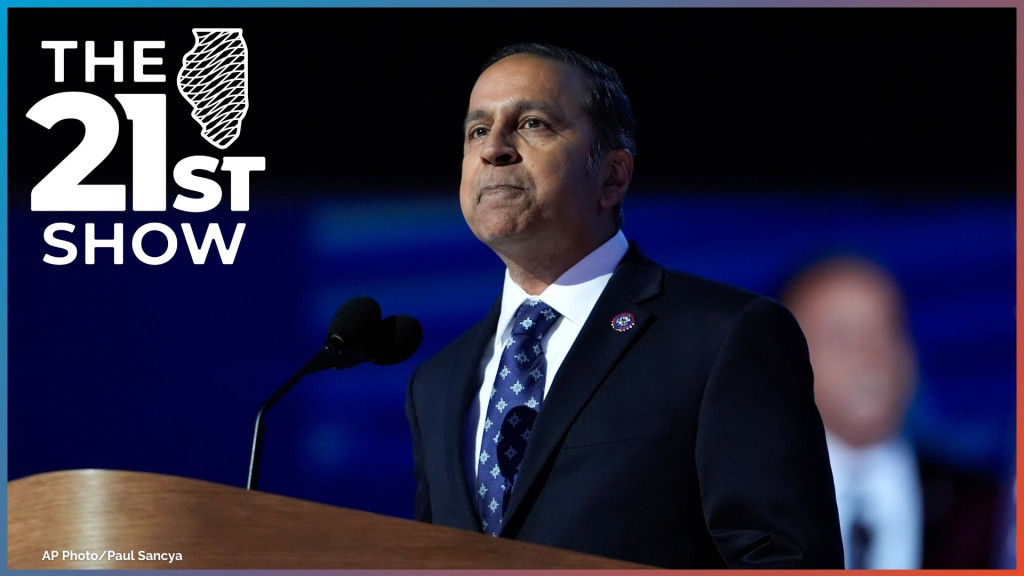
AP Photo/Paul Sancya
// AI-assisted formatting failed. Using simple formatter.


// This is a machine generated transcript. Please report any transcription errors to will-help@illinois.edu.

[00:00:00] Brian Mackey:  It's from Illinois Public Media. This is The 21st Show. I'm Brian Mackey. A brief update to start our program today. We were originally planning to bring you a conversation on the strike among service workers at Illinois State University, but uh, I'm sure owing to our plans, uh, overnight ISU announced they had reached a tentative agreement with AFSM Local 1110. Obviously, I'm kidding there. that agreement is still subject to the approval of the union membership, and part of that agreement is that both sides agreed not to talk about what is in the agreement until That vote happens. So today instead of that we're going to bring you a little later in the hour an update on a number of legal cases affecting Illinois and Illinoisans, including the federal government's attempt to get our voter data. There's also a federal investigation happening into teaching on gender, what they call gender ideology at a wide range of Illinois school districts and also whether Illinois schools are complying with the Trump administration's Uh, orders about, uh, participation in sports and limiting that to, uh, people whose gender identity, I guess matches their gender at birth, their, their biological sex, if you will. Uh, we're also gonna talk a little bit about the ongoing legal fallout from last fall's immigration enforcement in the Chicago area. And then at the end of the program today, we'll be talking about the United States celebrating its semi-quincentennial,250 years since the Declaration of Independence and an oral history project about that here in Illinois. That's all coming up later this hour, but we start today with national politics and Illinois Congressman Raja Krishnamoorthi. He represents the 8th district in Northern Illinois, and he joins us live today. Congressman Krishnamoorthi, welcome back to The 21st Show.

[00:02:01] Raja Krishnamoorthi: Great to be on. Thank you so much.

[00:02:04] Brian Mackey: So we are, uh, and I should say, uh, we're just, uh, together until 22 minutes past the hour today. So listeners, if you have questions, don't wait. You can join the conversation now 800-222-9455. So Congressman, we're several months now into the US and Israel's war with Iran. US law basically requires congressional approval for the president to continue the use of force beyond the first couple of months of a conflict. We reached that 60 day mark last week. Lawmakers have not authorized continued force. The president meanwhile argues that a ceasefire with Iran means authorization isn't necessary, though of course there have been recent attacks that raise the question of whether we're still in a ceasefire. That's a lot of setup, but uh what do you make of where we are today with our war with Iran?

[00:02:51] Raja Krishnamoorthi: It's a colossal disaster. It is illegal. It's unconstitutional, but it's also causing tremendous hardship for Americans. You don't have to look further than your gas pump where you know we're seeing $5 to $6 gas. You're seeing the price of fertilizer go up, cost of goods in grocery stores and across the economy going up, inflation creeping up. And then of course the human costs are mounting as well. We've already had more than a dozen. of our men and women in uniform die and our adversaries are cheering all the way, you know, basically Vladimir Putin is laughing all the way to the bank, making billions of dollars more in oil profits. The Chinese are using this as a potential pretext for their own aggression in the South China Sea and against Taiwan. So this is just a colossal disaster. I think Operation Epic Fury has become Operation Epic Disaster at this point.

[00:03:57] Brian Mackey: What do you understand to be the strategic objectives, the purpose of doing this war?

[00:04:05] Raja Krishnamoorthi: I don't know. I don't know anymore. I don't know anymore. I didn't know at the beginning and I don't know now. If it was to affect regime change, we've now basically made the regime even more hardline than it was before. If it was to slow down their nuclear ambitions, I think if anything they probably accelerated and then on top of it all we've exposed a tremendous vulnerability. On our part, which is they now have de facto control over the Strait of Hormuz and they have a chokehold on our energy supplies. And so not only have we not accomplished any of the various objectives that President Trump has set out and has shifted over the past couple of months, but I think we've worsened our position in numerous ways, especially economically. And um again we're we're we're eroding our national security.

[00:05:11] Brian Mackey: The Congress has for decades ceded its war powers to the executive branch, to the president. Do you see any prospect for a turnaround on that a change to get back to the, you know, sort of constitutional idea that it's the Congress that declares war?

[00:05:28] Raja Krishnamoorthi: Look, the War Powers Act is very clear that you need to come to the American people for their consent to enter into any war, and at this point. I think that the reason why Trump doesn't want to come to Congress and the American people is because he knows that he doesn't have a good reason for being in these hostilities any longer and the American people don't want him to be. In fact, a Washington Post poll just came out a couple of days ago showing that more than 61% of Americans believe that this war was a mistake, and I believe that there are a lot of people on the other side. Uh, who are, um. If not publicly, at least privately expressing grave concerns, and now we're seeing some voices publicly come out, including people like Tucker Carlson and Marjorie Taylor Greene and others. In fact, Marjorie Taylor Greene echoed a sentiment that I have which is I think that, you know, the president is, you know, displaying incredible kind of mental instability during this whole episode. And perhaps the 25th Amendment needs to be invoked as a consequence when he talked about, you know, eliminating the Iranian civilization, I thought that was the height of the responsibility and a sign we need a change.

[00:06:53] Brian Mackey: You mentioned the uh uh China and I know you're on the US select Committee on strategic competition between the United States and the Chinese Communist Party, very long committee name. But talk a little bit more about how you think about whether the, uh, you know, the actions of the administration have, you know, on, on balance helped or hurt the Chinese Communist Party.

[00:07:14] Raja Krishnamoorthi: Oh, it's helped them in at least two ways. One, economically it's only created more of a um. A chokehold on the supply chains that you know basically the Chinese uniquely control around the world on a number of goods and you should know that the Chinese already stockpiled something like 1.4 billion barrels of oil as a contingency for something like this happening in the Gulf. And so they're both insulated in part from what's happening with the oil shock and at the same time you know taking advantage of it for you know further putting a stranglehold on certain supply chains with regard to manufactured goods. The second thing is it gives them, as I said before, a potential pretext for Whether it's, you know, invading or moving on Taiwan or throwing their elbows in the South China Sea because they can just point to us. They can point to our military adventures in Venezuela, in Iran, in so many other parts of the world now, and, and basically say that our, our slogans about stopping endless wars which Trump had repeatedly said on the campaign trail are completely hollow and they seem to be and so I think the CCP is absolutely benefiting from the current needless war in Iran.

[00:08:56] Brian Mackey: Let me remind listeners, this is The 21st Show. we're speaking with Congressman
Raja Krishnamoorthi who represents Illinois's eighth district in the US House of Representatives. You can join us at 800-222-9455. Um, last week, the House finally voted to pass a funding bill for the Department of Homeland Security minus Border Patrol minus Immigration and Customs Enforcement. The department as a whole has been, you know, shut down for the past 2.5 months though Border Patrol and ICE still had funding. Republicans are going to keep trying to fund those agencies for the future. I wonder what does it say to you that it took this long to get this funding package across. The finish line and and where are we now?

[00:09:42] Raja Krishnamoorthi: Well, I think that neither I nor any Democrat that I know are going to fund IC or CBP unless and until numerous grave concerns are addressed with regard to those agencies, and I think that the Republicans finally caved in to public pressure on this particular issue. And uh agreed to fund the remaining elements of DHS including you know TSA as well as Coast Guard and Secret Service um and uh. I think what it says right now is that I believe this is going to become an electoral issue. This is, this is going to be something that the voters have to decide in November, among other things, which is do they like the way that CBP and ICE are operating or do they want to go a very different direction. I think they'll prefer the latter. And I think that's ultimately how this is going to get decided but for now there's no way I'm gonna be a yes vote on business as usual at I and CBP.

[00:10:51] Brian Mackey: Well, speaking of electoral issues, last week the US Supreme Court issued a ruling. Effectively ending the Voting Rights Act. I wonder what your top line reaction to that that decision is.

[00:11:04] Raja Krishnamoorthi: I think it's outrageous. I think that this is going to now give numerous states, especially in the former Confederacy, all the ammunition they need to essentially gut maps throughout the South. You see that they've already started in places like Louisiana where they actually are in the middle of elections and they basically instructed voters not to vote. On congressional races until they have basically gerrymandered a new map that basically destroys the representation of African Americans in that state and and other states like Alabama, Tennessee, we saw Florida already move before the Supreme Court decision are mimicking this strategy and so I think this is going to end up with Um, you know, uh, a, a map which is not representative of, uh, the people of the South mainly and, um, I think it's, it's atrocious.

[00:12:14] Brian Mackey: So democratic states have in some instances, sort of fought back against this. We saw California changing its maps. Virginia has done that now. Illinois is already probably more lopsided than, you know, pure voter preference would suggest in terms of the congressional delegation. But I, I wonder, you know, when you, when you take a step back, right, and you consider what we just talked about in, in conjunction with President Trump's, you know, Uh, uh, comments that that Republicans should take over and nationalize elections. What should Democratic opposition look like in the next few months leading up to the midterms?

[00:12:52] Raja Krishnamoorthi: Look, I think it has to be vigorous. It is vigorous as you can tell. Recently in Virginia they voted on a new map in part in reaction to what Trump is doing in other parts of the country. You saw what happened in California as well after what transpired with Republicans in Texas. I think that Democrats don't want to go down this road, but if they are forced to, then they will. They have they'll have no choice and so um I understand that the voters in New York are now considering changes to their electoral map as well um ideally I think that we should just ban middecade redistricting. And we should kind of go back to a situation where voters choose their representatives and we don't have lines that um for congressional districts or otherwise that look the way they do currently but um at the same time if if the president is going to basically dismantle you know these congressional districts in the middle of an election process or election year. I think that Democrats have to have to respond.

[00:14:11] Brian Mackey: Do you think that the Illinois General Assembly should uh redraw the districts here? Try, I mean, I've seen a, uh, you know, a concept of a map that would have these long fingers connecting, you know, for example, Carbondale and Chicago in a single district somehow.

[00:14:26] Raja Krishnamoorthi: Well I've I've traveled that uh distance uh a few times um look I think that now the primaries have have passed in in Illinois um and so I'm not really sure how the mechanics would work but certainly in other states where the primaries have yet to be uh yet to take place I think that they're going to look at it more closely, um. And I think that should give Republicans pause because you know with the with their ever increasing moves I think they're just inviting countermoves that neutralize everything that they're doing.

[00:15:06] Brian Mackey: With just about a minute left. You, you did mention the primaries and of course, um, I know you were working towards uh uh uh getting the nomination for the Senate. Ultimately, the voters went a different direction. You're not running again for the House because you can only run for one office. So, what, what is next for you?

[00:15:23] Raja Krishnamoorthi: Um, you know, I, I'm, I'm gonna continue to fight for the issues they care about, um, whether it's, um, you know, career technical skills based and vocational education or whether it is, um, making sure that our 2026 elections are free and fair, in part I have jurisdiction in the oversight committee over mail-in balloting which I'm very concerned that the Trump administration is attacking now for purely partisan purposes, um, so I'll be plenty busy. And um I just have to continue to to work on the issues I I care about that's what I intend to do.

[00:15:59] Brian Mackey: Raja Krishnamoorthi, congressman in the 8th district, thank you for being with us again.

[00:16:04] Raja Krishnamoorthi: Thank you sir.

[00:16:07] Brian Mackey: All right. Coming up after the break, we're going to be turning to the courts and talking about some of the things we touched on here, but in greater detail about the Trump administration Trump administration's attempt to get voter data as well as other challenges to Illinois through the law. this is The 21st Show. We'll be right back.
Illinois Congressman Raja Krishnamoorthi represents the 8th District in northern Illinois. He joins the program to share his thoughts on how the war with Iran is going, the U.S. House of Representatives voting to pass a funding bill for the Department of Homeland Security minus Border Patrol and ICE, and what's next for him after he leaves office next year.
GUEST
U.S. Rep. Raja Krishnamoorthi
D-Schaumburg / IL-08
Ranking Democrat, Select Committee on the CCP