








Republican U.S. Senate candidate Don Tracy on Iran war, ‘extreme’ socialist ideas, and immigration policies
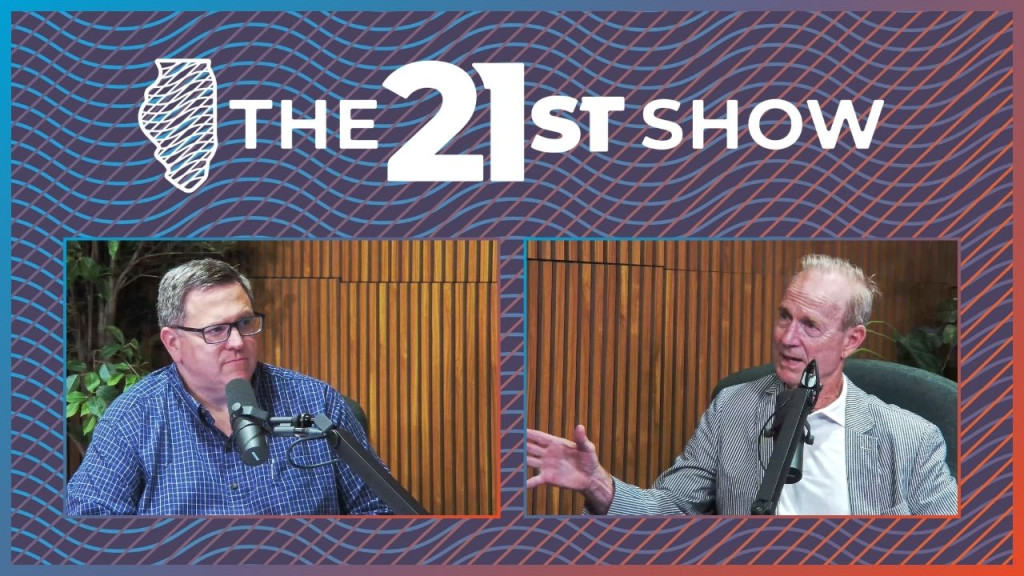
Host Brian Mackey and Republican Senate nominee Don Tracy spoke Wednesday afternoon in the podcast studio at Illinois Public Media in Urbana. Illinois Public Media
// This is a machine generated transcript. Please report any transcription errors to will-help@illinois.edu.

[00:00:00]
Brian Mackey: Today on The 21st Show, the race to become the next U.S. Senator from Illinois. We'll talk with a Republican nominee in this fall's elections. Don Tracy is an attorney and was chairman of the Illinois Republican Party for three years starting in 2021. We'll hear his thoughts on the economy, foreign affairs, and running for statewide office as a Republican in a state that tends to vote for

[00:00:25]
Don Tracy: Democrats. I think the

[00:00:26]
Don Tracy: right Republican can win statewide again. I think it's really a center-right state. And I happen to think I'm the right Republican.

[00:00:33]
Brian Mackey: I'm Brian Mackey with Don Tracy for the hour today on The 21st Show, which is a production of Illinois Public Media, airing on WILL in Urbana, WUIS in Springfield, WNIJ in Rockford DeKalb, WVIK in the Quad Cities, and WSIU in Carbondale. But first, news.

From Illinois Public Media, this is The 21st Show. I'm Brian Mackey, and we're now less than 100 days away from the general election here in Illinois. Over the coming weeks, we're planning to bring you interviews with candidates for some of the state's top elected positions from governor to U.S. House seats. And we start today with a race for U.S. Senate and the once-in-a-generation opportunity of an election without an incumbent. The two major candidates in that race are Democrat Juliana Stratton in her eighth year as Illinois's lieutenant governor, and our guest today, Don Tracy, who formerly chaired the Illinois Republican Party. He was born in Urbana, raised in Mount Sterling, a small town in rural western Illinois, and he's the oldest of 12. He attended Western Illinois University, earned a bachelor's degree in business administration from Arizona State, and he got a law degree from the University of Memphis. He's been an attorney for more than 50 years and is currently senior counsel at Brown, Hay and Stevens. He previously ran for lieutenant governor in 2010. Earlier this year, he defeated five other Republicans in the primary for Senate, and he now joins us in our Urbana studios ahead of the general election in November. Don Tracy, welcome back to The 21st Show.

[00:02:17]
Don Tracy: Good to be back, Brian.

[00:02:19]
Brian Mackey: So, I should say we spoke last November before the primary election, went into some depth on your background, a number of policy areas. We're gonna put a link to that conversation in the description of this video or you can find it at our website, 21stshow.org. I also want to note we've offered an interview to the Democratic candidate, Lieutenant Governor Stratton. We're still trying to get that scheduled. And because events move fast, I'm gonna say this conversation was recorded the afternoon of Wednesday, July 29th. So if you're listening on the radio, we tape this so you can watch it on YouTube. Because of that, we're not taking live calls as we often do on our show, but you can let us know what you think by emailing us, talk@21stshow.org.

All right, let's start with a question from a listener. This is from Helen in Springfield who sent us a text message, says, although I'm a Democrat, I'm interested in hearing the political philosophies and future visions of all the candidates for Senate representing both parties. So, Mr. Tracy, how would you describe your political philosophy?

[00:03:20]
Don Tracy: Well, I'm running to defend the American dream and to reduce the cost of living for all Illinoisans, especially working families, and to bring common sense solutions to Washington, D.C. and to represent all of Illinois, not just Chicago.

[00:03:36]
Brian Mackey: Can you be a little more academic than that, right? What do you think? How do you think of American democracy, right? What is your approach? Who do you look to as examples from history?

[00:03:44]
Don Tracy: Yeah, I think it's the greatest democracy in the history of the world, and we've been very fortunate to have 250 years of mostly honest, good, and competent leaders, and I think we've to some extent been spoiled by that. And so, if we're going to keep going another 250 years, I think more people need to get involved in politics because I think politics is a very honorable profession. As I like to tell people, politics, even though sometimes it seems like more like mud wrestling than a civil society debate, it's the alternative to war and violence. And so I do think that too many of my friends and people around the country have gotten used to other people, you know, governing for them and doing and investing in politics and being involved in politics, and I think, you know, if our founders had taken that approach, we would still be a colony because they sacrifice their reputations, their families, and their fortunes to challenge the king of England, and we don't ask people now to do that kind of investment in politics, but more people need to vote and more people need to be educated about their vote and more people need to be helped if they don't want to run for office — and I think everybody should — they need to help people who do run for office more.

[00:05:19]
Brian Mackey: You don't hear people making a defense of politics and politicians as an honorable vocation, right? "Mostly good and competent men" is the, uh, book of Illinois governors —

[00:05:29]
Don Tracy: As I have read that book, yeah, it's a pretty "mostly good and competent" book.

[00:05:33]
Brian Mackey: How do you reconcile that with someone who's running in an era when people wanna hear politicians are terrible, we need to throw the bums out, right? They want fighters. They want change.

[00:05:45]
Don Tracy: Well, I say what I said to you a lot, not just on NPR. And yeah, you know, if you're going to be elected to a public office, you've got to be ready to take on the other side, but there are ways to do that, I think, that are less polarizing and more productive. And one of the things that attracts me to the U.S. Senate is that there is more bipartisanship in the U.S. Senate than there is in the U.S. House, and that's partly due — in large part maybe — to the filibuster. And I just think, for the really big stuff, you know, healthcare and other things like that, it really needs to be bipartisan — with bipartisanship, you get a better bill because you have checks and balances. I think one of the problems here in Illinois is that it's a one-party state. So in a one-party state, you get extreme legislation that's not checked by the other side, because they're not even let in the room — and the other side in Illinois being Republicans. I suppose in some of the red states it works the opposite, so it's the Democrats that are shut out of the discourse. So, yeah, I just think we need more bipartisanship.

[00:07:08]
Brian Mackey: Do you sense an appetite for that in Washington on your own side of the aisle these days, bipartisanship?

[00:07:13]
Don Tracy: I do in the Senate, very much so. The House,

[00:07:17]
Brian Mackey: the White House.

[00:07:19]
Don Tracy: I don't study the House like I study the Senate. Yeah, I — there's — that's a tough one. That's a very tough question because the president was elected by, I think, a lot of Democrat voters in order to get elected. And a lot of the positions that he has taken are sort of, you know, populistic positions supported by Democrats alike. But I haven't, to your point, I haven't seen a lot of bipartisan legislation passed recently in Washington, D.C. But I think the people are hungry for that, for bipartisanship — you know, the growing voter population are independents, not Republicans and not Democrats.

[00:08:16]
Brian Mackey: Yeah, and among them you can count people like former Governor Jim Edgar — the late Governor Jim Edgar, I should say. I don't know if he counts himself as a former [Republican], but there's a lot of Republicans who were leaders in the party in Illinois 10 years ago who are now doing other things because there's been a change in the party, and that's something else while we're on this, you know, big topic of big-picture political philosophy. Do you see divisions among being conservative, being Republican, and being pro-Trump? Are those different things?

[00:08:47]
Don Tracy: OK, Brian, you know, I was chairman of the Illinois Republican Party and so I saw lots of divisions, and you may recall I resigned because some of the infighting that I was trying to quell left and right throughout the state finally made it to the board level, and it made it very unmanageable. And you know, I put a lot of blood, sweat, and money into building up the party and that infighting really kind of stopped the progress and made continuing the mission impossible, which is why I resigned at that time a little early — you know, my term had a little bit to go, but the average tenure of [an] [Illinois] Republican chair of a state party's only about 1.5 years. I did 3.5 years, doesn't pay, and you always get blamed no matter what happens. If you win, you get zero credit for it, and your main job is raising money. So yes, the answer to your question, there's a lot of infighting in the Republican Party, but the Democrat Party now has, you know, a major divide between the Democrats, socialists, and what they call the establishment Democrats. So that's as serious a divide, I think, and maybe more so than any divide in the Republican Party right now.

[00:10:22]
Brian Mackey: Yeah, well, we'll see how that plays out on both sides this November.

Well, let's talk about some policy areas. You mentioned already in this conversation the cost of living. That's been a big theme in your campaign, as it is in many campaigns. What do you do about that as the U.S. Senator from Illinois?

[00:10:37]
Don Tracy: Well, in Illinois, you know, Illinois is a particularly high-cost state. We are either the highest property tax state or second to New Jersey. We go back and forth on that. And that is what I hear the most complaints about on the trail. I mean, the property taxes are so high they're like taxing people out of their houses, or they're basically creating a second mortgage on a house. And so, you know, that has got to be brought under control. And Pritzker-Stratton just make it worse by, you know, reducing revenue sharing with localities and unfunded mandates — because if you get unfunded mandates from the state, how do you pay for it?

[00:11:19]
Brian Mackey: But you're running for — what does a U.S. senator do about those? Those are general assembly issues pretty much, yeah, and the governor. But can you do

[00:11:27]
Don Tracy: something? Well, fiscal responsibility is a place to start. One of the reasons why cost of living is such an issue now and such a problem for so many people out there that really are struggling to stretch their paychecks, to buy groceries and fuel, is because of Biden inflation. You know, COVID required a lot of extra spending by the federal government, and we did that twice under the Trump administration, and then President Biden was elected. And then he did like a third and fourth round, which I believe are unnecessary, and it's that third round — what was misnamed the Inflation Reduction Act — that caused what I think everybody agrees was the highest inflation in 40 years since the Jimmy Carter years, in excess of 20%, and that 20% is still there, you know, it hasn't — so we're still dealing with that on top of regular inflation. So, you know, being more fiscally responsible about government spending is part of it, because that will help reduce interest rates.

You know, people don't talk about shoplifting — law enforcement can help reduce the cost of living. A lot of the big-city prosecutors stopped prosecuting shoplifting unless it was above a very high level, and that has produced, I think, a national shoplifting epidemic. Even in my hometown of Springfield, go up to any store clerk like at a CVS or Walgreens or a Kohl's or a Target and ask them if people walk out with stuff, and they'll say all the time, and they'll say, what can you do about it? Nothing. We can't do anything. We just let them go. Well, that adds to the cost of everything that can be carried out of a store.

[00:13:23]
Brian Mackey: Is there a federal policy you would recommend to address that issue at the, you know, CVS and Walgreens in Springfield?

[00:13:30]
Don Tracy: Yes, through the power of the purse, which I think would address all of, you know, public safety issues. That's being done in Chicago now, as I understand it — some of the funding for mass transit has been held up, or was paused, until the CTA added real police to patrolling the trains, which have become very dangerous, so that people — a lot of people are afraid to ride the trains up there. Though it's getting better because they had unarmed security forces on the trains patrolling the trains, but now they have real police there, and I think it was because of federal policy that did that. And I've ridden the trains over the years many, many times there. But I don't know that I would do it at night by myself, and it just seems like there's more traffic than ever around Chicago — and I spend a lot of time there now — and I suspect it has something to do with fewer people riding the trains. And I know whenever I've seen some numbers on it, I know their ride revenues are way down and ridership's way down. So on the shoplifting thing, to the extent that the federal government funds local prosecution offices, you could add some strings to that — say, you know, we're only going to fund you if you prosecute, you know, not the real crimes.

[00:14:53]
Brian Mackey: You mentioned this idea of Biden inflation. It's been a year and a half now. I wonder at what point do continued economic problems become Trumpflation or federal Republican inflation?

[00:15:04]
Don Tracy: Depends on which side of the aisle you're talking to. I mean, according to the other side, it's, you know, it happened on day one, right when he was sworn in. But,

[00:15:13]
Brian Mackey: well, I did a little research before this conversation. There's a gas station just a few blocks away from where we're talking in the studio now — $4.40 a gallon as we are taping this on a Wednesday afternoon. I paid $2.50 a gallon in central Illinois back in January. So there's a big price increase, right?

[00:15:33]
Don Tracy: And that's due to the Iranian war. But right after the Biden administration finished its term, I think at that time it was in the $4 range, and it came down quite a bit to $2.50, as you say. And now it's temporarily spiked, and that's hurting the cost of living. There's no doubt about that. But

[00:15:53]
Brian Mackey: does the administration bear responsibility for doing something to address that?

[00:15:58]
Don Tracy: Yes, but it is, you know, it's the price we have to pay for national security, and I know it's a sacrifice for a lot of people, but in World War II we had, you know, rationing. We had ration books, we had victory gardens. You couldn't get a new car because all the plants were building tanks. There were huge sacrifices on the home front at that time. And in this case, in the case of this particular military conflict, the main sacrifice is in what I hope is a temporary spike in gas prices. We've already noticed that when there's a ceasefire that lasts for a while, the prices go down pretty fast, and once there's a permanent resolution, I do expect the gas prices to go down quite a bit.

[00:16:49]
Brian Mackey: All right, we need to take a break on the program. We're talking with Don Tracy, Republican, who's running to represent Illinois in the U.S. Senate. He's the former leader of the state Republican Party. Because we taped with Tracy yesterday, no live calls today, but let us know what you thought. Our email address is talk@21stshow.org. I should also say we've edited this conversation to fit within our hour of airtime. You can listen to the full version at our YouTube page. Just search for The 21st Show. This is The 21st Show. Stay with us.

It's The 21st Show. I'm Brian Mackey, and my guest for the hour today is Republican U.S. Senate nominee Don Tracy. He's seeking to succeed Dick Durbin, the U.S. Senator for Illinois, who's leaving office at the end of his term early next year. We spoke with Tracy yesterday in studio in Urbana. We've had to edit the conversation for time. You can listen to and actually watch the full conversation on our YouTube page. Just search for The 21st Show. That said, no calls today, but you can still let us know what you thought anytime. Our voicemail line is always open at 217-300-2121. That's 217-300-2121. Let us know what you think, and we may share your response on a future program.

While we're on the subject of the Iran war and foreign policy, do you think the U.S. is in a stronger position now than before it launched this latest series of attacks starting in, what, February, March?

[00:18:31]
Don Tracy: I don't know, of course. I'm not in on all the briefings. All I know is what you know and everybody else based on the news reports. It would seem to me that we are in a much stronger position because Iran has been financing terrorism throughout the Mideast through its proxies for, I don't know, decades it seems, and now their navy is at the bottom of the sea. Their air defenses are neutralized. Their air force has been eliminated. Some of their nuclear facilities have been neutralized. I don't — we don't know if all of them have been — and a lot of their leadership has been neutralized. So that means to me that they are less powerful. And certainly

[00:19:26]
Brian Mackey: they do have — that's their effective veto control over the Strait of Hormuz.

[00:19:29]
Don Tracy: Well, you know, given there's battling back and forth, that's what we're fighting over right now. The question is, do they have the means to withstand it? Also, they have fewer dollars. Our blockade and sanctions, you know, have taken their toll on their money and their ability to finance terrorism. So I would have to say that we're in a better position. To what extent have we set back their nuclear program? I don't know. It has to be to some extent. Is it a year? Is it 10 years, 20 years? I don't know. But we have to be in a better position. Is it good enough? I don't know.

[00:20:05]
Brian Mackey: You know, it's interesting because there seems to be a lot of energy on the Republican side, the right side — however you wanna phrase it, I know those are not always the same thing as we talked about earlier — but in America First and MAGA, some people in that movement are pulling us back from America being the sort of policemen of the world, right, as they say. The president himself campaigned on no more forever wars. What do you think of that — not being as much of a participant in NATO as we've been in the past? This is something that senators typically take a great interest in,

[00:20:38]
Don Tracy: right? Yes, as they should. That's a very important aspect of U.S. Senate service. The president campaigned on no endless wars, and so I expect him to keep his word on that, that this is not going to be an endless war. Like, I don't know how long we were in Afghanistan — 12 years or so. Vietnam was 10 to 15 years. So right now there are no signs of this being an endless war, and I know the current administration, I don't believe, wants to be the world's policeman. I don't think that's what this is about. This was a threat to America — a nuclear Iran with ICBM capability, and they seemed like — what I heard was — they were on the verge of that, with the ability to deliver a nuclear bomb to New York City, as a threat to America. So I don't believe that this military conflict is about being the world's policeman, but we do have a significant interest to defend in the United States and throughout the world, and allies are very important. NATO is a very important ally. But what did they say in World War II — the only worst thing than fighting with allies is fighting without them. And NATO has not been doing their share. The president has actually, over the course of I guess two terms, gotten NATO to start participating in their own defense. I mean, World War II ended in 1945 and yet we're still over there defending them and spending a lot of money to defend them. They need — it's about time they defend themselves more — but we need to maintain NATO and we need to maintain Europe as an ally.

[00:22:31]
Brian Mackey: I think we'll have to put a pin in that conversation because there are reasons one might not want a nuclear-armed Germany, having to do with World War II history and some of the World War I history, but I want to —

[00:22:42]
Don Tracy: I haven't advocated for that.

[00:22:44]
Brian Mackey: Yeah, well, there are those who say that's the natural consequence of — if America stops protecting Europe with its nuclear umbrella, maybe more and more countries feel the need to arm themselves.

[00:22:55]
Don Tracy: Yeah, well, that's a separate issue, the nuclear umbrella versus the overall defense forces that we have in Europe, and we have a lot of troops over there. It's not just a nuclear umbrella.

[00:23:08]
Brian Mackey: One of the few areas of agreement — and we can close the book on foreign policy here because there are domestic issues to talk about, too — but one of the few areas of agreement in this strange realignment we're going through now in American politics, between young progressives and young conservatives, or people on the right however they want to describe themselves, is a skepticism toward America's relationship with Israel. A long-standing, some would say uncritical, relationship with Israel. We think about that and the direction that there seems to be this energy for reevaluating the steadfast support America has shown Israel for decades.

[00:23:45]
Don Tracy: Well, a lot of it, I think, is pretty ugly — the antisemitic aspect of it. There are two things that I thought we had basically conquered in my lifetime, and one was socialism. I thought that with the falling of the Berlin Wall, once and for all, the world was going to start getting rid of socialism and antisemitism, but they're both coming back through the Democrat Socialists, and I don't quite understand that. Israel is an important ally, our most important ally in the Mideast. They're a true democracy. They're a successful democracy and they've been an ally for a long time. And the conflict in Gaza and Lebanon [is] horrible. War is horrible. It's absolutely horrible. But Israel didn't start it. Hamas started it on October 7th, and so I do believe in supporting Israel and its defense. And a lot of the people on the Palestinian side — they like to recite "from the river to the sea," basically they want to destroy Israel. It's like Iran's "death to America" — their position is death to Israel. And so we have to support Israel.

[00:25:12]
Brian Mackey: I think people on the right though are — younger people as well — there are some

[00:25:16]
Brian Mackey: [dipping into this area],

[00:25:17]
Don Tracy: right? Yeah, and I can't — you know — they're — the Republican Party, the Conservative Party, whatever you want to call it, it's a big-tent party. We have a lot of different views on a lot of different subjects, but I think the majority of Republicans support Israel.

[00:25:35]
Brian Mackey: All right, let's turn to domestic policy. Would you support a national law prohibiting abortion?

[00:25:42]
Don Tracy: All right. Well, according to the Supreme Court, abortion is now a state issue. So I — this is a states' rights issue, and I think that's where it should have been all along. And states will end up with different abortion laws. Illinois's abortion laws are different than Alabama's abortion laws, and I think that's the way it should be. From a federal standpoint, the only abortion issue I can think of is the Hyde Amendment, which prohibits taxpayer funding of abortions except for rape, incest, or to save the life of the mother. And I fully support the Hyde Amendment, but I do not support nationalizing abortion law.

[00:26:29]
Brian Mackey: So if somebody were to — because anyone can propose legislation on anything — if there were to be a, you know, "Save the Babies Act" or something like that, how would you vote on something?

[00:26:38]
Don Tracy: It's gonna be whether it's a bill that I think my opponent and some other Democrats would like, which would be for unlimited abortion, basically, which is kind of what we have in Illinois now, or whether it's a national bill to end all abortions without exceptions — I would oppose. I would not support those kinds of nationalizing abortion bills.

[00:27:05]
Brian Mackey: This is from a listener, Terry in Batavia, who wants to know, is the U.S. a Christian country or one founded on freedom of belief?

[00:27:14]
Don Tracy: You know, I think one of the great things about this country is religious freedom. That's why a lot of people came here, was for religious freedom. And so I'm a big supporter of religious liberty. I think it's what's made — I think with religious freedom, you end up with a lot of other freedoms. And that's one of the reasons why I don't like socialism, because socialism tends to elevate the state or the government over religion.

[00:27:53]
Brian Mackey: What about the idea, though — I mean, this is an increasingly popular idea — that we're a Christian country, we need to get back to Christian values, that sort of thing?

[00:28:01]
Don Tracy: Religious liberty, freedom of religion, applies to all religions, whether they're Muslim or Jewish or Christian or other religions. I mean, that's the great thing about this country. And no matter what religion you are, you can practice it freely, so long as it's a real democracy and a free country, and not a socialistic country.

[00:28:30]
Brian Mackey: Another domestic policy area, and this is one of those local-federal things where maybe people want the federal government to take a more active role. Flock cameras — if you're familiar with these automated license plate reading cameras, they're in a bunch of cities now, putting hundreds of these things in Bloomington-Normal. I know Springfield has them. Other cities in Illinois. Sam in Urbana wants to know if you would support legislation to regulate Flock automatic license plate readers. And for people who don't know, these are cameras that — maybe in your town, as you're driving around — you know, the government can't put a GPS device on your car without a court order, but these cameras track where cars go all over cities, and it's a private company, and the government can then access the data of where people have been, where they've been going. So would you support, as Sam wants to know in Urbana, legislation to regulate that?

[00:29:21]
Don Tracy: I would certainly consider reasonable regulation of that to protect important privacy rights. However, I'm also open to the idea that Flock cameras are very helpful in controlling crime and saving lives. And so I think this kind of regulation or this kind of legislation requires a careful balancing of trying to save lives on the one hand and preserve privacy on the other hand. And so that would be my approach — to try to arrive at the right balancing of those two competing interests in this particular situation.

[00:30:01]
Brian Mackey: Speaking with — or sticking with the theme of law enforcement — as you know, the Trump administration has been actively working to deport millions of people from America. There have been at least nine deaths linked to these campaigns. I wonder, to what do you attribute that?

[00:30:20]
Don Tracy: OK, you're talking about the deaths from deportation, from immigration —

[00:30:28]
Brian Mackey: more like

[00:30:28]
Brian Mackey: people being shot by immigration enforcement.

[00:30:31]
Don Tracy: OK, that sort of thing. Well, I think in most of those cases, the people that were injured or shot were either actively obstructing federal law enforcement, or they were allegedly directing their vehicle towards a law enforcement officer, or they were disobeying a lawful officer command. And then in those — just like in any kind of police shooting — it's the same issue: was the shooting justified? And in each of those cases, I'm sure that is the issue.

[00:31:17]
Brian Mackey: I think the federal government has done a good job of sort of investigating whether those shootings were justified, working with local law enforcement as they have in the past to investigate these sorts of things.

[00:31:29]
Don Tracy: You know, I don't know because I haven't followed the investigations. But like I said, the question is, was reasonable force used in the situation? And here, you have organized groups that are out there doxing law enforcement officers and stalking them and following them and getting in their way and trying to obstruct law enforcement because they disagree with the law — because they are, I think, open-borders people. And there are a lot of people — my opponent is for open borders as well. And that's fine, it's a free country. You can have that belief. But I believe that laws should be enforced, including immigration laws. They should be reasonably enforced — I want to add that. That's important. Because all law enforcement should be reasonable. I think that's the ultimate judgment.

[00:32:40]
Brian Mackey: To be fair, I think when your opponent is sitting in the studio, she will not say she's for open borders. She will say she's for reasonable immigration, and yes, you have to have some border security. Probably — this is what I hear from a lot of Democrats — yes, we need border security, but what we're concerned about are masked government agents, you know, in the streets carrying heavy weapons, wearing camouflage like they're soldiers and not police officers.

[00:33:03]
Don Tracy: Well, I hope you cross-examine her on that, Brian, because she is for abolishing immigration law enforcement. And she isn't for reforming immigration law enforcement. That's what you just said — you said you thought she would say she's for reforming it, but she says abolish. She says abolish immigration. Well, it's immigration — ICE stands for Immigration and Customs Enforcement, so she wants to abolish immigration

[00:33:32]
Brian Mackey: enforcement. I do hear Democrats say that, and then they say, and we'll need to rebuild something new in its place. I think their argument is the agency is so broken and has so lost the trust of so many Americans that it needs to be rebuilt.

[00:33:44]
Brian Mackey: And I wonder, well, that's

[00:33:45]
Don Tracy: what they want the public to think because, you know, they want — these are open-borders people and they do not want immigration law enforced. And so their approach to that is to demonize the people enforcing it, you know, kind of like police have been demonized over the last few years — by, I don't know, people that have some political endgame in mind. But anyway, yeah, that's what abolish Immigration and Customs Enforcement means. It really means open borders. You might ask my opponent what kinds of deportations she would support.

[00:34:27]
Brian Mackey: With that, we need to take another break. We're talking with Don Tracy, Republican candidate in this fall's U.S. Senate race in Illinois. We've edited this conversation. You can watch the full version on our YouTube page. Just search for The 21st Show. In order to make that possible, we taped this Wednesday afternoon. It's The 21st Show. We'll be right back.

This is The 21st Show. I'm Brian Mackey. We're talking today with Illinois Republican Don Tracy, who's running for U.S. Senate in this fall's election against Democratic Lieutenant Governor Juliana Stratton. I spoke with Tracy yesterday afternoon, so we're not taking calls live today, but you can let us know what you thought by emailing talk@21stshow.org.

Before the break, we were talking about immigration. And we'll pick up where we left off. Last thing on this area: the president has expressed his repeated opposition to the idea of birthright citizenship in the U.S. Constitution. The U.S. Supreme Court issued a ruling last month maintaining that, although it was closer than some people thought it would be — 6-3 on some aspects, 5-4 on others, legally. We don't have to get into the details of that, but this is maintaining birthright citizenship for children of parents who are not citizens or don't even live in the U.S. Was that the right call?

[00:36:03]
Don Tracy: Well, as I said before, I'm a fan of legal immigration. We're a nation of immigrants, and we need probably more legal immigration, not less. And we do now, as I understand it, naturalize more citizens through immigration policy than I think any other country in the world already. But birthright citizenship is just such a weird concept, you know, and as a result, there are companies — I understand in China and elsewhere — that are in the business of what's called birthright tourism, where people will pay them to go to the United States just to have a baby and have a baby that's a U.S. citizen, and then they return to their place, so they have a child that can be, I guess, a dual citizen and qualify for certain benefits even though they're away. There are very few, if any, major countries in the world besides the U.S. that have that. There are countries in Europe that had it, and then they got rid of it because it was such a strange thing. I don't think Mexico allows birthright citizenship. The Supreme Court — I respect the Supreme Court, and I thought it was kind of a close issue, but

[00:37:26]
Brian Mackey: would you remove it? Would you support an amendment to change the 14th

[00:37:30]
Don Tracy: constitutional amendment? Yes, I would. I think it's — what public policy does that serve? We need good immigration policy. We need a good process, a due-process procedure for citizenship. It shouldn't be that somebody pays a Chinese businessman $50,000 to have a child who's an American citizen just by making a trip to the United States. I think that's wrong policy. So yes, I would support a change in the law, a lawful change in the law.

[00:38:01]
Brian Mackey: I wanna come back to this idea of bipartisanship in the Senate you talked about earlier. Lloyd in Danville sent us a text message, says, "I'd like to know if he" — you, Mr. Tracy — "are willing to reach across the aisle to cause substantive change in the Illinois economy. More of the same is unacceptable. If he's not willing to work with the other party, he shouldn't run. Voters are tired of lip service and division." What would you say to Lloyd?

[00:38:25]
Don Tracy: I'd say he's right on. I agree with everything that Lloyd said there. I think we do need more bipartisanship. I plan to reach across the aisle, and the U.S. Senate has a storied tradition of reaching across the aisle — and, you know, partly because they have to, because of the filibuster. That is the U.S. Senate. And I look forward to reaching across the aisle because, to get really big stuff done — and we need some big stuff done like immigration reform — it has to be bipartisan. I mean, if you look at, for example, the Affordable Care Act, which has really become, I think, the Unaffordable Care Act — that was done on a strictly partisan basis and we're still fighting, there are still problems with it. It has become unaffordable. Almost 20 years later, 18 years later, had that been a bipartisan bill that had come out of the Senate with some Republican votes, I expect it wouldn't have had to have been amended so many times, including right out of the chute through reconciliation because of a big glitch, and I think it would have been a better bill. I think healthcare would be better and more affordable today, and we wouldn't still be fighting over it 18 years later.

[00:39:52]
Brian Mackey: Is it really possible though? Because if it's gonna be a win for one party, why would the other party get on board — both ways?

[00:39:58]
Don Tracy: No, that's not my idea of legislating. My idea of legislating is not about wins. It's not about winning. It's about serving the people. It's about addressing problems that we agree are problems, and then coming up with a reasonable solution to those problems. That's what government is for.

[00:40:20]
Brian Mackey: But we've seen time and again — if the president is strong, depending on the issue, and gets on the phone and says, I need you to not vote for this — especially President Trump. He seems to have a special persuasive ability that, you know, Republicans will not get on board if it's something like that. We had a question about this. Jane in Pawnee wants to know, on what issues have you differed from President Trump and why?

[00:40:44]
Don Tracy: I'm not going to be a rubber stamp for anybody, whether it's a Democrat president or a Republican president. I agree with the president on some things and disagree on other things. And when I'm asked this question, I usually say ask me an issue — I'm not going to try to guess what you wanna ask about. But I will say this: the filibuster, since I've talked about it so much — that is one issue where my opponent, Lieutenant Governor Stratton, and President Trump are in lockstep. They both want to abolish the filibuster, and I disagree completely with that. I think the filibuster is what encourages — requires — bipartisanship on really big stuff. And I think it also provides stability to our government; otherwise we'll be more like a banana republic, where every time we have a slight majority of maybe one vote in one house and one vote in the Senate, there are complete 180-degree turns in policy. So I think the filibuster is a very important part of the success of this American democracy. And so I do disagree. I understand the president's view on this, that he thinks, well, the Democrats are going to abolish it as soon as they get back in the White House, so we better do it first. I understand that argument, and that is the best argument for abolishing the filibuster. But I have confidence that there are enough reasonable Democrats in the U.S. Senate that even when they get back in control — which is probably inevitable at some point — there will be some new Manchins or Sinemas or Fettermans who will not go along with abolishing such an important, good-governance aspect of American governance.

[00:42:37]
Brian Mackey: The reason the president wants to abolish the filibuster is to pass this legislation called the SAVE Act. Among its many provisions, it would require both ID to vote and proof of citizenship to register to vote for federal elections, as well as things involving transgender people and many other things that have been thrown in there. Do you support that legislation, the SAVE Act?

[00:42:59]
Don Tracy: First of all, every citizen should have the right to vote. Non-citizens should not be voting. I believe that voting should — with voting policy, voting rules, voting laws should make it easy to vote but hard to cheat. Voter ID — it is easy, relatively easy. You know, people died for the right to vote. And are you gonna tell me that somebody can't go to the trouble of getting an official voter ID to vote for a right that people died for? I don't understand that.

[00:43:42]
Brian Mackey: Well, to give voice to the opposition, I think they would say — yes, that's one thing for, you know, a lawyer, journalist, people with cars, we can go get — I can, if I need to get my birth certificate, it's up in the Chicago area — to prove that I'm a U.S. citizen to vote. Or I happen to have a passport because I'm fortunate enough to be able to travel outside the borders of our country from time to time. But like for somebody who's living paycheck to paycheck, or no paycheck, maybe it is harder to go to the state they were born in and get their birth certificate, and they don't have a passport — just to give voice

[00:44:13]
Brian Mackey: to the opposition.

[00:44:14]
Don Tracy: Well, Brian, you're doing what some of my Democrat friends on the other side of the aisle are doing. You're conflating the two issues: voter ID and proof of citizenship. Well, it's both in the same — well, I'm addressing it one at a time. OK, forgive me. So, voter photo ID is like an 80-20 issue.

[00:44:33]
Brian Mackey: 71% of Democrats support it —

[00:44:34]
Don Tracy: and we should have voter ID in Illinois, and the Illinois voters support it, but the Illinois Democrat leaders do not. There's no justification for opposing a voter ID.

Right, stipulated. OK. Then, proof of citizenship — because of the conflation, and I've heard some Democrats say this on national TV, kind of what you just said — that you have to prove citizenship every time you vote. That's not what's being proposed. All that's being proposed is that when you first register to vote, you have to prove your citizenship — or when you change your registration, like if you change address or something like that. Now that's a little bit more inconvenient than pulling out your driver's license, because you might have to get a birth certificate, which I've had to do from time to time for various reasons. It's not that hard to do. And when you have people who have died for the right to give you the right to vote, I don't think it's asking that much to get a birth certificate, or pull your passport out of your lockbox or wherever you keep it, or some other proof of citizenship.

[00:45:55]
Brian Mackey: We're coming to the end of our time. As you probably well know, Illinois voters statewide have not elected a Republican since 2014. What makes you different? Why are you different? What's your pitch?

[00:46:08]
Don Tracy: Well, the last time there was an open U.S. Senate seat — and you began this by noting that was in 2010 — I was running for lieutenant governor. Then Mark Kirk was running for that open Senate seat. He's a Republican and he won it. So the last time there was an open Senate seat in Illinois, a Republican won it. And then Rauner and Topinka won in 2014. That's the last time we won statewide. So it's been 12 years. But remember we had 26 years of Republican governors. The pendulum swings both ways. I sense it's swinging this way. Maybe not this election cycle — I certainly hope it does — because I think as Democrats get more extreme on their issues, you know, open borders, what I call the career criminals being let loose on electronic monitoring that doesn't work, and boys and girls' sports — I think that moves a lot of those independent voters our way. And so I think because of those changes, I think the right Republican can win statewide again. I think it's really a center-right state, and I happen to think I'm the right Republican.

[00:47:24]
Brian Mackey: An alternative hypothesis I want to get your take on — which is that as long as President Trump has been the dominant force in American politics, either running himself or taking up a lot of the oxygen, people have just turned out for Democrats in Illinois, and that's the coalition here. And that as long as Trump is the force, Republicans are going to struggle here. What do you think of that?

[00:47:46]
Don Tracy: Well, let me just add to my prior answer a little bit, because the Chicago Tribune did an editorial, I think just yesterday on this — and something I've been saying a long time — is that a one-party state is not a healthy state. You know, there's no checks and balances, and a one-party state is a more corrupt state, or put it a better way, a two-party state is a less corrupt state. Over 2,000 Chicago Democrats have been convicted of political corruption over the last 40 years, about one per week. So the Tribune was arguing that really there ought to be more — this ought to be more of a two-party state. They weren't making all the points I just made, but they were arguing for a two-party state. And so I think that's something that appeals to independent voters and will more and more as they realize just how extreme some of these Democrat Socialist ideas are — like government-run healthcare, which according to our calculation will cost $30 trillion; no school choice; a $25-per-hour national minimum wage everywhere — just a lot of really extreme, crazy ideas, I think, will open up the middle for the right Republican to win in Illinois, and I think that's me.

You mentioned the president. The president secured 2,450,000 votes in Illinois without campaigning here, without spending any money here, without even trying. So that's a lot of votes. I think if I were to get 2,450,000 votes, I think I would win this election. And particularly if some of the independents vote for me — or a lot of them, I don't know. So I am the underdog, there's no doubt about it, Brian, but I do think, based on all the things I've just said, that I have a shot. I wouldn't be doing this if I didn't think I had a shot at winning this election.

[00:49:53]
Brian Mackey: Don Tracy is the former chairman of the Illinois Republican Party. He's an attorney. He's running to become the next U.S. Senator from the 21st state. Thank you for speaking with us today on The 21st Show.

[00:50:04]
Don Tracy: Thank you, Brian. It's always a pleasure.

[00:50:06]
Brian Mackey: Again, we had to edit today's conversation for time. You can find the full version on video on YouTube. Just search for The 21st Show. That's it for us today. The 21st Show is a production of Illinois Public Media. I'm Brian Mackey. Thanks for listening. We'll talk with you again next week.
Election day is less than one hundred days away. Over the coming weeks, we’re planning to bring you interviews with candidates for some of the state’s top elected positions from Governor to U.S. House seats.
We start today with the race for U.S. Senate and the once-in-a-generation opportunity of an election without an incumbent. The two major candidates in that race are Democrat Juliana Stratton, in her eighth year as Illinois’ lieutenant governor; and Don Tracy, who formerly chaired the Illinois Republican Party. (The 21st Show is working to schedule an interview with Lt. Gov. Stratton.)
He’s been an attorney for more than 50 years and is currently senior counsel at Brown, Hay & Stephens. Previously, he ran for lieutenant governor in 2010. In November 2025, Tracy appeared on The 21st Show ahead of this year's primary. He defeated five other Republicans in the primary for Senate and now he joins the program ahead of the general election in November.
You can watch an extended version of this conversation on YouTube.
Guest
Don Tracy
2026 Republican nominee, U.S. Senator from Illinois