








Illinois General Assembly: Top Republicans talk taxes, effects of federal policies on state government
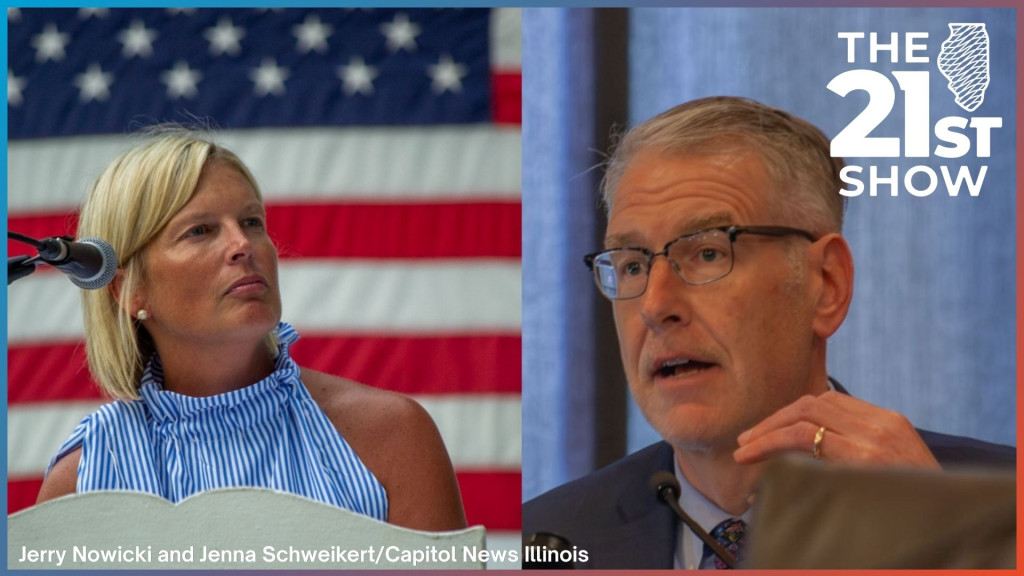
Jerry Nowicki and Jenna Schweikert/Capitol News Illinois
// This is a machine generated transcript. Please report any transcription errors to will-help@illinois.edu.

[00:00:00]
Brian Mackey: And again, this is the 21st show. I'm Brian Mackey. We are talking today about what happened and did not happen in the final stretch of this year's spring legislative session in Springfield. We've heard about the — or I should say we've heard from the leaders of the Democratic caucuses, the House and Senate. And now for the rest of the hour, the other side of the aisle. Toni Mc[C]ombe is the House minority leader, the top Republican in the Illinois House of Representatives. She's from Savannah in the northwest part of Illinois. Leader Mc[C]ombe, welcome back to the 21st show.

[00:00:31]
Toni McCombe: Good morning and thanks for having us. We appreciate

[00:00:34]
Brian Mackey: it. And John Curran is the Senate Republican leader. He is from Downers Grove. Leader Curran, welcome back to you as well.

[00:00:40]
John Curran: Nice to be with you, Brian.

[00:00:41]
Brian Mackey: And again, you can join us at 800-222-9455. 800-222-9455. All right, Leader Mc[C]ombe, I'll start with you — your sort of top-level reaction to the budget that passed the Illinois legislature early Monday morning.

[00:00:59]
Toni McCombe: Well, I think you just touched on it a little bit ago with your — with the previous speakers, and, you know, it's about trust in government, and this process certainly undermines that trust, as well as the additional spending that is not the priority of the state. And there's so many things that were still left unsaid. You keep talking about needing 60 and 30. Well, you don't need 60 Democrats and 30 Democrats in the Senate. You need to have a bipartisan bill that has a mix that references the priorities of the entire state. Every county has priorities, and certainly they weren't addressed in this budget.

[00:01:38]
Brian Mackey: Leader Curran, same question to you. Sort of top-level reaction to the budget that passed this weekend.

[00:01:45]
John Curran: Brian, Illinois is stuck in a cycle of low growth. Our economy, year in and year out since Governor Pritzker took office, is the lowest growth in the Midwest and is a bottom 5 in the country. Our unemployment is bottom 5 — or actually the lowest in the Midwest under Governor Pritzker, bottom 5 in the country. Nothing in this budget was done to address the fundamental challenges that is keeping Illinois growing at a slower pace, and that's why you see the year in and year out scrape in desperation of more, more taxes to kind of bandage together the budget. This year it was $800 million. Last year it was closer to a billion dollars. That's just become a yearly norm, unfortunately, because the Democrats are too concerned with their power — maintaining their power — and not putting some fundamental changes in place that are going to shift Illinois to a more pro-growth economy that ultimately would be the budget solution for the state of Illinois. You mentioned missed opportunities — that's how I see this.

[00:02:57]
Brian Mackey: Yeah, you mentioned the $800 [million] in higher taxes. Those — many of the new taxes in this budget are on things like cryptocurrency and prediction markets. I would wager — but, right — I guess your everyday Illinoisan is not necessarily a heavy user of those. Leader Mc[C]ombe, and many of the other new taxes were on companies, such as the social media tax. Does that have broad effects in Illinois? Does that sort of thing roll down to the everyday Illinoisan?

[00:03:25]
Toni McCombe: Oh, of course, and eventually it will — regardless of what tax or fee increase, it always is passed on to the consumer and the taxpayer. And several of the items, like when you were just talking about the social media tax, that wasn't even really considered part of the budget because they're looking at it for the next fiscal year because it's, you know, an idea from Mayor Johnson — a bad idea that they can't even get implemented. So I think you're going to find the same with the state. And rather than looking at nickel-and-diming everything that you can find, or diverting things away from one thing to another, why not pass really good policy that is going to grow the state? You know, just the governor himself this morning — or yesterday morning, I'm a little lost on my time — was talking about his priority is the taxpayer and building and growing and attracting business. Well, his policies over the last 8 years have not done that. They've actually done the opposite.

[00:04:23]
Brian Mackey: All right, we need to take another break on the program. We're gonna continue talking about the end of the Illinois General Assembly's spring legislative session. My guests for the last part of the program today are Toni Mc[C]ombe, the House Republican leader, and John Curran, the Senate Republican leader. If you want to join us, 800-222-9455. This is The 21st Show.

It's The 21st Show. I'm Brian Mackey, and we are talking today about the Illinois General Assembly and the end of the spring legislative session, which came to a close early, early Monday morning. We talked at the beginning of the program with the House speaker and Senate president, and now we're hearing from their Republican counterparts — the Republican leaders in the General Assembly: Senate Minority Leader John Curran and House Minority Leader Toni Mc[C]ombe. If you want to join us, 800-222-9455. 800-222-9455.

Leader Curran, how would you describe the Republican caucus's role in the budget process this year?

[00:05:41]
John Curran: From the outside, Brian. So I think our budgeteers do a very diligent job in committee questioning, in vetting the governor's agencies and those agencies' proposed budgets, but the big policy items — taxes, additional borrowing, the state going further into debt — those types of items, completely on the outside.

[00:06:13]
Brian Mackey: Leader Mc[C]ombe, what about you? Were you invited to any budget meetings this time around?

[00:06:18]
Toni McCombe: You know, a few weeks ago the speaker and I had a very high-level, probably a 20-minute conversation, which I certainly appreciated, just talking about some of, you know, the Republican priorities and whether or not we could even engage in conversations — to ask to be put on for votes. But the budgeteers, as usual, rank and file do it better than we do. And they did meet a couple of times, and quite honestly, the morning of — I'm trying to think what day that was — the morning of the last day, the supposed last day, our budgeteers did get a breakdown with our staff of some of the things that were going to be in the budget, which is extremely helpful to our staff, as you know, that are there all hours of the night. Our team, you know, roughly got 6 hours of sleep in 2 days. So that was very helpful, and we certainly appreciated that.

When it comes to real conversations or negotiations, certainly we did not have those, but we cannot say that, you know, they were certainly keeping us behind closed doors — at least until the last day, which, like I said, we appreciate, and hope next year we have more conversations. You know, I heard the speaker say today that he's not the speaker of the House, he's the listener of the House. Well, I have 40 members that represent parts of 102 counties, so I hope that he takes that to heart.

[00:07:42]
Brian Mackey: Let's talk about some of the policy specifics that came out this year. And, Leader C[urr]an, I'll start with you. What do you think of suspending the gas tax increase? And as I said, if anyone's just joining us and they didn't hear the math on that — it works out to about [$0.0]1.3 a gallon. [I] crunched the numbers on my own gas consumption last year, for the last 6 months of last year, and hey, we drove to Cincinnati and Colorado in that time. It would have saved me about $8. So what do you think of suspending the gas tax increase from a policy standpoint?

[00:08:14]
John Curran: $8, assuming, Brian, that you were able to fill up in Illinois and not fill up after that in Colorado and your other trips.

[00:08:23]
Brian Mackey: Fair point. I did fudge the math on that. Thank you for calling

[00:08:26]
John Curran: — but I mean, yeah, Brian, our math is — it sounds like you do a lot of driving. Our math came up to about, you know, somewhere in the neighborhood of $5, you know, for a motorist. A real — another missed opportunity. The state of Illinois last year has taken in $150 [million] in surplus tax revenue from the gas sales tax, not the —

[00:08:53]
Brian Mackey: Million dollars.

[00:08:54]
John Curran: $150 million, and that was a real opportunity to pass that surplus revenue back to motorists to help with the high gas prices. And those are the dollars that go into the GRF — the general revenue fund — not into maintaining our infrastructure. And, you know, that's what we were seeking was suspending that sales tax, not the motor fuel tax, to bring down gas prices, really give drivers relief at the pump. It would have been — you know, we could have done 20 cents. Even if you just did it for a period of time until prices return back to where they were last year, those opportunities, those tools are there. But again, the preference was to spend the dollars rather than return savings.

[00:09:56]
Brian Mackey: Leader Mc[C]ombe, what would you have done differently with regards to the gas tax?

[00:10:01]
Toni McCombe: Yeah, I would have done both. I would have suspended the gas tax for a year rather than 6 months — just on, you know, showing good responsibility. But the $150 million, as Leader C[urr]an just said, that certainly should have been suspended — that sales tax. As everybody knows, it's a tax on a tax, and it shouldn't be going, quite honestly, paying for, in the scheme of things, the healthcare for [undocumented immigrants] as well as welcome centers. Oddly enough, that's about the same amount of dollars that was in the budget for them. So that's not fair, and we have a surplus unfortunately due to the high gas prices, but when there's a surplus like that, they shouldn't look to divert it and put it somewhere else. They should give it back to the taxpayer.

[00:10:47]
John Curran: And I thought, Brian, it is amazing that the governor gets out there and — look, gas prices are way too high — but to hear the governor complain about it as he is taking the excess revenue on the sales tax that, because of gas prices being too high, and spending it on their pet projects is a bit rich.

[00:11:10]
Brian Mackey: Well, I think we heard the phrase from Democrats earlier — it's that the gas prices are really a result of the "war of choice," as they phrased it, that President Trump has waged in Iran. On that note, how do each of you — and Leader C[urr]an, I'll start with you — think about what the federal government has done in terms of targeting states like Illinois, blue states, in terms of federal funding and the consequences that has had here. What do you think of as your role as a Republican leader in this state? Do you see your role as trying to counter that in any way?

[00:11:47]
John Curran: Brian, my role is here in Illinois. I represent Illinois. I'm all about Illinois. So what's good for Illinois is what I support. This governor has chosen, on day one when this new administration came into office, to not work with the administration — to take an adversarial role in belief. I would assume that he thinks it positions himself better to run for president, but that was day one. There was no attempt to work with this administration, and we are seeing the result now that he chose to fight rather than to work and collaborate. So that's unfortunate. The governor is the leader of the state. There's no voice in the legislature that is going to circumvent, you know, the elected governor of the state. So I mean, I think that's an unrealistic expectation.

[00:12:45]
Brian Mackey: Leader Mc[C]ombe, what about you? What do you think about President Trump's — and the Trump administration, I should say — you know, targeting states with Democratic leaders to hold up funding in a variety of areas? How do you see that as federal policy and how it affects Illinois?

[00:13:01]
Toni McCombe: Well, I think first we've been given some opportunities from the federal government to provide tax relief. But as you saw in this budget, and you saw in last year's budget as well as throughout the year, the Democrats continued to decouple away from federal policy that's actually going to make cuts better — whether that is, you know, for the tax on tips, the scholarship tax credits that we still haven't weighed in on. Certainly, you know, our caucus continues to talk to the Republican delegation, as I know the Senate does as well, to make sure that we are fighting for Illinois families' access to — you know, medical, certainly the Medicaid — there are concerns there — strong schools, whether or not, if the Department of Education goes away, we want to continue to make sure those dollars are put directly into those funds. And obviously infrastructure — but we have a $7 billion balance in infrastructure. So when you talk about Illinois having the best infrastructure in the nation, as the governor, I think, said yesterday morning — well, we're not spending that. So that's another good reason that we could have paused the sales tax and the gas tax, because we're not spending those dollars right now. We can't get the money out.

[00:14:08]
John Curran: And Brian, that education scholarship — we still have not heard from the governor that he's going to opt Illinois into that. We have blue-state governors, New York, Colorado, that have had no problem signaling their state's gonna opt in, work with the administration, work with Congress to get more educational dollars back to Illinois. But again, it's because we're running for president instead of doing what's best for the state of Illinois. There's been no attempt by our governor to opt us in and get additional educational dollars back to Illinois.

[00:14:44]
Brian Mackey: Let me remind listeners, this is The 21st Show. We're speaking with Senate Republican Leader John Curran and House Republican Leader Toni Mc[C]ombe. Just about 5 minutes left in the program. Let's go to the phones again. We have Jim calling from Springfield. Jim, you have a point about some of the people in southern Illinois. Thanks for calling in.

[00:15:02]
Jim: Well, Illinois has a disparity between northern and southern Illinois. Many of the southern counties are heavily Republican, and many of those counties are extremely poor and getting worse. I'd like to know what proposals Republicans have made to help their constituents in those southern counties.

[00:15:22]
Brian Mackey: All right, Jim, thank you for the question. Leader C[urr]an, go ahead.

[00:15:25]
John Curran: Jim, great question. You know, this gets into what did we see in the last day of session. I heard that, you know, the speaker and the president talk about the governor's proposed budget was out there. Well, the Democrats in the legislature increased the borrowing in that budget by $600 [million] for projects in Democratic districts, when Republican districts in southern Illinois are the 10 poorest counties in the state of Illinois. But because they choose to be represented by a Republican, they are frozen out of that $600 million in borrowing done in the last day of this session for projects in Democratic districts. So it is absurd when they get on and talk about that they're looking out for the little guy. Here we have in southern Illinois the 10 poorest counties in the state, and they're frozen out, Brian — in complete inequity.

[00:16:31]
Brian Mackey: Well, we just have a couple of minutes left in our time together. So Leader Mc[C]ombe, from your perspective, what were the House Republicans' top priorities that actually were enacted this spring?

[00:16:41]
Toni McCombe: That were enacted.

[00:16:43]
Brian Mackey: Yeah, maybe we can leave on a slightly upbeat note.

[00:16:47]
Toni McCombe: Yeah, for sure. And just real quick, too, to respond to Jim — I would just say, once again, a gerrymandered map certainly cannot go unstated. But, you know, there were some good things in the budget that we certainly will celebrate, whether you feel it's minimal or not — the sales tax on school supplies, the additional dollars for the school lunch program, the property tax relief that goes along with the evidence-based funding model, the pension payment. Those are things that are certainly important. And another thing for our caucus that's been important — which is kind of in the weeds for your listeners — is the additional time for the interchange lawsuit that's out there that concerns our banking industry.

[00:17:29]
Brian Mackey: And just in case people missed it — you, when you mentioned the sales tax on school supplies, it's going away for a time during back-to-school shopping season.

[00:17:36]
Toni McCombe: And that's helpful. And that's helpful.

[00:17:38]
Brian Mackey: Leader C[urr]an, similar question to you. What would you say were the sort of Senate Republicans' top priorities that did actually make it into the end zone, so to speak?

[00:17:48]
John Curran: Well, I mean, Brian, we wanted to ensure that we had voices in the process on artificial intelligence. This is a growing — an important technology. I think we took, on a bipartisan basis, a couple of very important steps in the regulation around safety on that technology. So that was something that I think we got significant input into, and at the end of the day, a much better product because of that. So those types of areas around public safety were areas where I think we were given the opportunity to have a big role in participating, and we got good results.

[00:18:33]
Brian Mackey: John Curran is the Republican leader in the Illinois Senate. Toni Mc[C]ombe is the Republican leader in the Illinois House. Thank you both so much for being with us and sharing your perspectives today on The 21st Show.

[00:18:43]
Toni McCombe: Thank you.

[00:18:44]
Brian Mackey: That is it for us today. Coming up on tomorrow's show, more than 100,000 Illinois residents are at risk of losing federal food support because of new work requirements. We'll talk about what that means and what is being done to address it. Plus, we're gonna have a preview of the World Cup. A record number of players from Illinois's top professional soccer team, the Chicago Fire, are called up for international duty. We'll talk about that with somebody who covers the Chicago Fire, as well as a Division 1 soccer coach in central Illinois about soccer culture here and what to look for in this year's World Cup. Again, that's all coming up tomorrow here on The 21st Show.

I want to mention our website, twentyfirstshow.org. You can find all the ways to contact us there — our email address, voicemail line, social media. Please get in touch. Let us know what you thought about our program and suggestions for future topics. We love hearing from you at talk@twentyfirstshow.org.

The 21st Show is produced by Christine Hatfield and Jose Za[e]da. Our digital producer is Colson Kahn. Technical direction and engineering comes from Steve Mork and Jason Croft, and Reginald Hardwick is our news director. The 21st Show is a production of Illinois Public Media. I'm Brian Mackey. Thanks for listening. We'll talk with you again tomorrow.
Illinois lawmakers worked late into the night Sunday going into Monday morning to pass this year’s state budget. The $56 billion budget includes some new taxes on cryptocurrency, prediction markets, social media companies and more.
Top leaders representing the Republican side of the Illinois House and Senate share their thoughts on this year's budget including the Republicans caucus' top priorities and what happened with them as well as some criticisms.
GUESTS
John Curran
R-Downers Grove, Senate Minority Leader
Tony McCombie
R-Savanna, House Minority Leader