How did the denial of climate change become popular in America?
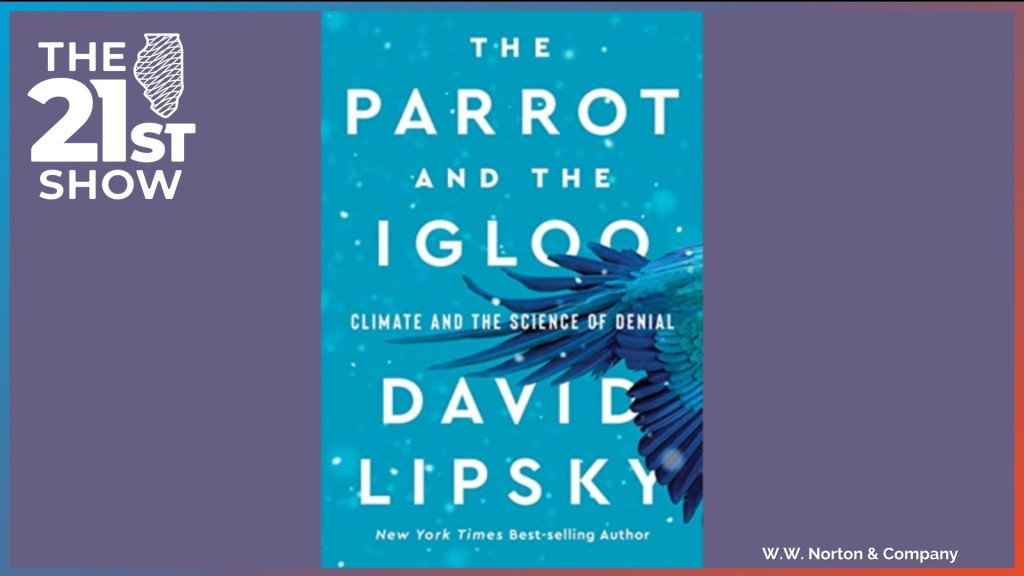
Courtesy of W.W. Norton & Company
// This is a machine generated transcript. Please report any transcription errors to will-help@illinois.edu.

[00:00:00]
Brian Mackey: Today on the 21st Show, evidence of global warming has been everywhere, from heat waves and wildfires to dust storms and a shifting tornado alley. We were warned about this many years ago, but then came the lies.

[00:00:17]
David Lipsky: It was a deliberate move. The idea was there had been the slow normal march of science. Without the deniers, we would have begun actions in the late '80s, early '90s, but they determined to reposition, reframe it, and they went out and they found scientists who had done some work with tobacco and were willing to go on stage and say this isn't going to happen.

[00:00:37]
Brian Mackey: David Lipsky recounts all this history in his book called "The Parrot and the Igloo: Climate and the Science of Denial." I'm Brian Mackey with David Lipsky for the hour today on the 21st Show, which is a production of Illinois Public Media. But first, news.

From Illinois Public Media, this is the 21st Show. I'm Brian Mackey. I don't know about you, but in the past few years, climate change has felt like a very present phenomenon. Maybe it's the heat, the dust storm that led to the apocalyptic series of car crashes on Interstate 55, or that derecho that left many of us without power for the better part of a week a few summers ago. Or how our skies are occasionally choked with the ashes of trees burning half a continent away.

[00:01:35]
Speaker 2: The heat dome that has caused record temperatures in the Southwest is now shifting toward the Midwest. Record keepers say the last three weeks have been the hottest ever recorded on Earth.

[00:01:46]
Speaker 3: Two separate wildfires now raging near Athens in Greece. Authorities say strong winds are fanning the flames.

[00:01:52]
Speaker 4: People in New York City masking up again, not because of COVID, but due to harmful [smoke] wafting into the

[00:01:58]
Speaker 5: city. We're now seeing flows in the Colorado River that we've never seen before since records were kept.

[00:02:03]
Speaker 6: In Italy, authorities issued extreme health warnings for 16 cities, saying that even hotter temperatures are yet to come.

[00:02:12]
Speaker 7: This is not normal. I don't remember such intense heat, especially at this time of year.

[00:02:17]
Brian Mackey: This is not normal, but how much longer can we say that? And when did things start to go off track?

If global warming was made manifest this decade, when was it real for you? Was it in 2006 when Al Gore's documentary "An Inconvenient Truth" was released? How about 1988, when NASA scientist James Hansen gave testimony before Congress about the unmistakable signature of global warming? What if I told you people were wondering and arguing about whether our climate was getting warmer back in the 1950s or the 1930s, or that warming was a known phenomenon in the late 1800s?

This history is the subject of the book "The Parrot and the Igloo: Climate and the Science of Denial." It's by David Lipsky, a journalist, and it traces the history of the modern world from our first attempts to tame electricity through the people who warned us about the dangers of burning coal and oil to the liars and cheats who spent all of their energy confusing people about the inconvenient truths that have become all too apparent.

A review in The New York Times says Lipsky's book is "a project of maximum ambition. He retells the entire climate story from the dawn of electricity to the dire straits of our present day. It's well trod ground, but Lipsky, a newcomer to the climate field, makes it page turning and appropriately infuriating."

I originally spoke with Lipsky back in 2023 and you'll hear that reflected in some of the things we talk about. With that in mind, no calls today, but let us know what you think. talk@twentyfirstshow.org is our email address.

So I don't need to go too deep down this rabbit hole just yet to start, but as we begin this conversation, should we be saying climate change or global warming or something else?

[00:04:12]
David Lipsky: Uh, it depends. If you want to make deniers happy, you would say climate change, and if you want to make scientists happy and our — our future neighbors happy, you would say global warming.

[00:04:24]
Brian Mackey: So your view, global warming acknowledges the reality better.

[00:04:27]
David Lipsky: One of the fun things about doing the research for this book and getting to tell this great, funny, surprising, devastating story is so many things that I thought were accidental turned out to have been organized in a way that I normally wouldn't expect.

Around 2002, the Republican Party understood that global warming was a losing issue for them at the local and federal level. And the man who Time said was like Merlin to the party — a sort of wizard named Frank Luntz, a pollster — he wrote an extremely influential planning document, and one of the things he said is, "It is time for us to stop using the phrase global warming and start using the phrase climate change because global warming has catastrophic connotations, whereas climate change sounds like a vacation from Ohio to Fort Lauderdale."

[00:05:23]
Brian Mackey: Turning up the thermostat, changing the climate. Let's — let's leave that as a teaser, and we will come back to Frank Luntz and that entire industrial complex that arose to challenge global warming. But we'll go with global warming for our conversation.

So, with this year's drought and heat and fire and storms, you've got a heck of a news peg for publication. It feels to me like this year is different. There's a significant chance it is going to be the hottest year on record. What does it feel like for you as your book is coming out in this climate?

[00:05:57]
David Lipsky: It feels like I imagined the way it would feel to the scientists. I spent a long time on this book because when I began reading about global warming — so funny, you do want to make Frank Luntz happy and say climate change. Some part of us thinks that's the way we're supposed to say it now.

But people didn't know about it, and the reason why I spent so much time trying to make this book into a funny and exciting story — one of my models was "The Godfather" because the book is sort of a saga — people didn't know enough about the topic, and it felt a little bit like being the scientist whose stories I was trying to tell. They kept saying to people in government — and they were blocked by extremely able people — "You're gonna start feeling this in about 40 years," and they were saying that in 1980, 1981, 1982. And so, the fact that it's right on schedule has been interesting for me just because that's part of what the story is about.

So it's a great question. It's been odd. It would be like if you had a good friend who was Noah. And he kept saying, you know, you guys might want umbrellas, you might want to look at the weather reports, you may notice it's very cloudy up there. It's like, you know, Noah is pretty good at this.

[00:07:15]
Brian Mackey: Yeah, and he's got a book coming out called "The Unicorns in the Ark" — just as it's starting to rain. So —

[00:07:24]
David Lipsky: The unicorns — I guess they saw some really, really sweet looking grass and they just didn't clatter up the [gangplank].

[00:07:29]
Brian Mackey: Just didn't make it. Maybe they were listening to Frank Luntz. So, there's no shortage of books on climate. What made you — what did you hope to bring to the shelf?

[00:07:39]
David Lipsky: It's one of the things that's come up when I've been talking to people about the book — it's been difficult for people to read because the subject matter seems [daunting]. And I read for pleasure mostly. I teach creative writing at NYU to graduates and undergraduates. And my own taste in reading is people like Lorrie Moore, Curtis Sittenfeld. I read to have my brain thrilled. I read with the pleasure that my stomach and my taste buds take in french fries. It's just thrilling to me to be reading something good.

And there are a lot of great books on climate change, but they didn't seem to appeal to the people I would think of as people like us — people who just pick up a book hoping it will supercharge their brain, right? And so in my poor way, I wanted to try to give people a book that would do for them what other books do while it would tell them material they had to learn, which is: here's what climate change is, and here's why there hasn't been any action, here's who to blame.

[00:08:44]
Brian Mackey: So you structure this book in sort of three phases, right? The makers, the [warriors], and the deniers, broadly speaking — my phrases. Talk about that decision and how you came to that.

[00:08:55]
David Lipsky: I wanted it — you know, when I'm not feeding my brain prose french fries, I am feeding it televisual french fries. I'm feeding it streaming french fries. I love shows on Netflix and on Apple TV. I love streaming shows, and I wanted to do a book that would work like a streaming show. So, essentially the book is like three different seasons.

The first season is The Inventors. The book starts as our story — all of us on the planet who've watched the world get hotter and noticed it in the back of our minds — and then I think one way you could describe what happened this year is it moved from the back of our minds to the fronts of our minds, basically. We've all kind of watched that happen, and it's the result of this great thing that began in the 1850s and really accelerated in the 1880s, which is we electrified the planet. So the story is the people who made our world — the inventors — that's the first season.

Second season is the scientists who thought, you know, this is great, it's totally great. I have electric lights in my lecture hall. I can have an overhead projector, but there might be this little problem. And then they were brilliant. They were like all these Watsons working together, or all these Holmeses arguing with each other and working together, and then by about 1992, we were on a great schedule. We had — this had been predicted in 1896. Well, I'm sure we'll go into this. And then by the '80s, it had made it to the government level. [By] 1992, we had people announcing they'd seen the signature, like global warming had signed the check saying we're the ones paying for this. And then from 1992 on, the deniers took over and they delayed us for really until about the present day.

And so it seemed like that would be a great way to tell the story because it's the way that we love to get stories now, and it's a story that we're all living. And so it seemed the most natural way for us to learn about this big story that was taking place in front of us and involving all of us.

[00:10:58]
Brian Mackey: Let me take a moment to remind listeners, this is the 21st Show. We're speaking with David Lipsky, who's the author of the new book called "The Parrot and the Igloo: Climate and the Science of Denial." Our program is on tape today, but you can always let us know what you thought by emailing talk@twentyfirstshow.org.

[00:11:17]
David Lipsky: And Brian and I aren't live, but we'll know if you guys email — somehow during this conversation we'll know.

[00:11:25]
Brian Mackey: So there really is a lot here. It's dense with stories and asides, many of them funny, some poignant. I thought we could give listeners just a taste of what they'll experience by pulling a few threads from each section. And maybe we could start with Samuel Morse. I kind of thought I vaguely knew the story of Morse code and the telegraph. I've read a fair amount — my fun reading is Civil War history and American history — but there was a lot I did not know. I mean, this is a man who could not catch a break until basically he made the modern world. So where did Samuel Morse come from?

[00:12:04]
David Lipsky: I don't know, but I love that the biography that now is the most reliable biography, the regnant biography — it's "Lightning Man," and the subtitle is "The Accursed Life of Samuel Morse." You just don't want that to be your subtitle.

He just had one great idea, but he just kept having terrible luck. It was a really fun story to begin our story with, because when he does find the first use for electricity — there's a — do you remember Steve Jobs, the phrase he used when he was trying to popularize new technologies? He said every new technology has to have a killer application, right? And so for the old Macintosh — for people who have read the great Walter Isaacson biography — the killer app for the computers that we all now use, the Apples, was laser printing. You never had control of your fonts, so it turned out that everything that led up to the iPhone, the killer app is something you wouldn't think of, which is just the ability to print italics and to pick Times New Roman over Cambria, right, or over Palatino.

Samuel Morse — the telegraph was the killer app for electricity, a huge thing, and one of the first great uses for the telegraph was that a man had gone to Slough, which is where the British version of "The Office" is set, and he had killed his mistress, and he had done what he considered a good job. He was so pleased with his ability that he treated himself to a first-class ticket on the way back from Slough to London, and some people had seen him. He was wearing a very distinctive long black jacket, and they used the telegraph. And they said, "Hey, there's a man in a black jacket. He just committed a murder in our town," and the message — first time in history — outran the technology that was available for travel. It was the first time that a message could go faster than the listener, than the reader.

And so what a great way to popularize electricity. The murderer's name was John Tawell [John Tawell], and all across England people would point at the lightning lines, and they would say, "Them's the cords that hung John Tawell [John Tawell]."

[00:14:16]
Brian Mackey: How do people react to this? Because — I mean, you mentioned this case out of England — Morse finally gets a little bit of good luck and he's able to present his technology in Washington and it, after a few fits and starts, he finally gets some money from the government to actually install —

[00:14:33]
David Lipsky: This is such a terrible story.

[00:14:35]
Brian Mackey: Yeah, but people are —

[00:14:37]
David Lipsky: Oh, so when he first shows it — sorry, so when he first — it's great, and it's such a pleasure to begin the book with it.

When he first demonstrates the apparatus, he keeps just having a terrible time. So, you know, Morse's story is basically positive because he knew it was a great idea, but he keeps being kicked around. He was a painter, and one of his painting students came to him — he was teaching at NYU, which actually, oddly enough, just comically for me, is where I teach — and there, professors would collect the fees themselves. One of his students came and said, "Would it be OK if I paid my fees a week or two late?" And he said, "Yeah, the only problem is I'd be dead by then." By starvation. And then the kid took him for a meal at whatever the diner equivalent was in the 1840s, and he said, "Don't be an artist. A house dog lives better."

So that was the position he was in while he was working. He knew that he had this amazing technology, which was this tremendous use — electricity moves, oddly enough, at about the speed of light, and so if you could use turning electricity on and off to convey messages, you had lightning-fast communications. But he couldn't get it across, and finally, this man who sometimes couldn't afford to eat — he hadn't eaten for a day before his student came through for him — he went down to demonstrate his apparatus for the Commerce Committee, firelit room, I think this is probably about 1841, 1838, and the shock of them was great to write about. They said, "You know, this is the end of the world," was what one of the congresspeople said. And then another one said, "What would Washington and Jefferson say if they could arise and see what we just saw?" And they said, "When will wonders cease?" And then being Washington, they just forgot. It's sort of like a precursor to dealing with global warming — they literally forgot to bring it to a vote, so he had to struggle around for a while longer.

And then three years later, they did bring it to a vote. It was stunning. It was immediately clear how it would be valuable for people. One of my favorite things in this first chapter of the book is Morse immediately had the first post-dinner intercity communication in human history. A friend of his said, "Have you had dinner yet?" And he said, "Yeah, have you? What was it?" And Morse said, "You know, mutton chop and strawberries." Just that first — that first you've been — you've got your delivery from Seamless and your buddy is asking what it was. Samuel Morse pioneered that too.

And the first message that he sent — he was a minister's son — was just four words: "What hath God wrought?"

[00:17:16]
Brian Mackey: We need to take a break. David Lipsky's book is "The Parrot and the Igloo: Climate and the Science of Denial." More on that when we come back. This is the 21st Show. Stay with us.

It's the 21st Show. I'm Brian Mackey. We're listening back to my 2023 conversation with author David Lipsky, who wrote "The Parrot and the Igloo: Climate and the Science of Denial." We're not taking calls live today, but we do appreciate hearing from you. You can leave a voicemail anytime: 217-300-2121. [FLAG FOR REVIEW: Earlier in the transcript the number is read as "217-32121," which appears to be a misread of 217-300-2121.]

So, we were talking a bit about Morse. We should move on soon, but I do want to — Samuel Morse — before the break, I do want to just pause one more moment on this because I was thinking back about all these breakthroughs in technology that you and I have seen in our lifetime, right? The smartphone, the rise of text messaging. But is there anything that represents a bigger break from the past than did the telegraph machine?

[00:18:29]
David Lipsky: No, and that's how it was seen. That was why those — it's a great question. That man Marshall McLuhan, who in the movie "Annie Hall" settles a bet for Woody Allen —

[00:18:41]
Brian Mackey: "You don't know anything about my work —"

[00:18:43]
David Lipsky: "Yes, you mean my whole fallacy is wrong." Boy, if life were only like this.

What McLuhan said is that by eliminating distance, by eliminating space basically, he had ushered in the age of pervasive dread, the age of anxiety and the age of pervasive dread, because all of a sudden what's happening in Chicago is also happening in New York. The conversation that you and I are having right now — even though it is in the past for the listener — impossible without this technology.

It is a giant moment, one of the biggest moments in history, and I think you can put those four words with "one small step for a man, one giant leap for mankind." "What hath God wrought" should be up there too, absolutely. And it was seen that way in the 19th century — they would, you know, 1890, the magazine that would have been like The New Yorker would actually show what the keys were that were used to express that message, because they understood how world-shaking it had been.

[00:19:42]
Brian Mackey: What did the first cave person say when they invented fire? Put it up in that pantheon.

So, let's jump forward a little bit. You mentioned ushering in this age of anxiety — and one of the things of pervasive dread, yes — and one of the things that we are now dreading and anxious about is the climate. But I was really struck by how much earlier there was anxiety about this than I had realized, right? I've read about the Dust Bowl, of course, in history and things like that, but I had never really linked it to people actually understanding that our climate was changing in ways that were something to be concerned about and maybe a bigger picture than just one-off storms here and there. So, maybe you can just talk about some of the earliest points at which we noticed that things were not right.

[00:20:37]
David Lipsky: So Brian, now we're in Season 2: the scientists.

Interesting thing — because when we first became aware of climate change, I think that we had a sense that it came from — it was like from vegans and people who like to sloganize. It seemed like it was something maybe that was left over from a very heavy use of granola period, but it's always been an establishment idea.

Like, 1859 is when John Tyndall — who was about to become director of the laboratories at the Royal Institution, which just means director of the Royal Institution of Science in Britain — he was just wondering what kept Earth warm. Sun comes down, bounces off the planet, and what keeps it around? And he thought that it would be good to figure out what it was, and he found, after spending about six or nine months on the experiments, that it was water vapor and carbon dioxide. So that was when we first knew that carbon dioxide is one of the ways that we keep heat on the planet. Without it, by the way, we'd be cold the way Mars is cold.

In 1896, Svante Arrhenius, who would become director of the laboratories at the Nobel Institute and would be the first Swedish recipient of the Nobel Prize, thought: OK, carbon dioxide is keeping heat here — and what would happen if we raised and lowered it? He was the first person to ask that question, and if we doubled it, temperatures would go up by 4 degrees Celsius. If we lowered it, we would slip down to near the ice ages. And so you can date our understanding of how we could use carbon dioxide — either on purpose or accidentally — to regulate climate. You can date it from, I think it was published in February of 1896 in the London Philosophical Magazine. It's still hard for me to believe how old that is.

And he thought it was good news. He's from Sweden, and so buddies of his — other scientists, scientists have buddies who are scientists, people he drank beer with in Oslo — they said, "You know what, it's so cold here, we should take old coal mines and we should light them on fire, ones where the coal has mostly been mined, because we could pump carbon dioxide into the atmosphere that way and trigger climate change." Frank Luntz [and the deniers] — we could trigger climate change earlier than it will happen.

So, scientists are cautious. That's one of the other things that Republicans were able to make it seem like — scientists were scary Doc Emmett Brown-type people from "Back to the Future" — but they're really cautious. And even though on a graph, you would see that we had unprecedented heating beginning in the early, let's say, part of the 1800s, they were cautious about attributing it to carbon dioxide until the last five to 15 years.

But the people who were alive then were noticing that the climate was getting warmer. So what you're alluding to was such a thrill to write about. By 1933, on the front page of The New York Times, it says, scientists are scratching their heads — America in longest heat spell since 1776, temperature line records, I think, 36-year rise. And for me what was really fun and surprising and sort of pull-out-your-hair — it was next to stories on the same front page of the Times. One was about closing down Al Capone's speakeasies and the other was about the Nazis promising there'd be no more violence toward the Jews. So that's how old the issue of our climate warming is.

[00:24:09]
Brian Mackey: And even in the '50s, I remember in there you had some New York Times headlines that were competing — in the same span of months, they can't figure out if it's real, is it not real, it's going up, the climate is not changing.

[00:24:24]
David Lipsky: It was — I'll read them because they always make me laugh. This is over about a three-year period. They kept writing the same stories, and it was — it's as if the newspaper — you can watch the greatest newspaper in the world having an argument with itself, sort of murmuring ideas, restating, retracting, and then deciding: "Is climate changing?" then "Is the climate changing? Answered definitively by" — "No, the weather isn't changing" — then "Our changing climate" — then "Old-timers may be right when they tell us the climate is getting warmer" — then "How industry may change climate" — and at last, "The weather is really changing." And that's 1953.

[00:25:05]
Brian Mackey: How does consensus begin to emerge before the deniers swoop in?

[00:25:09]
David Lipsky: It's funny — part of what emerges — and this is again, this was all just a funny story and a thrilling story. What Arrhenius believed was that we would keep generating carbon dioxide because he thought it was great. He thought that burning coal and fossil fuels was great because humankind needs warmth, basically.

[00:25:28]
Brian Mackey: Spoken like a man from the northern latitudes.

[00:25:31]
David Lipsky: Yeah, no, exactly. But even beyond that, you would think: OK, what happens if it builds up?

There's this term "sinks," and part of what I wanted the book to do is just to help us know the terms that you would hear on the news, right? So everyone get ready, there's going to be a sort of a small science term. Sinks are things that will remove carbon dioxide from the air. On land, trees do it. Trees do this great service — they take carbon dioxide and they turn it into air. But the sink that Arrhenius was counting on was the ocean. He thought that it would absorb about nine-tenths of the carbon dioxide that our cars were generating and our power plants were generating.

So, the first truly influential American climate scientist — a man named Roger Revelle, [who] looked like Tony Bennett and William Holden [combined], right? If you combine their features, you get Roger Revelle. And a man with a great story, by the way — he thought, you know what, I'll test this, because I've been doing work for the Navy. Again, always an establishment idea — we're in this Cold War with Russia, the Navy is asking me to check on our nuclear tests, and I'll use some of their money just to verify that Arrhenius was right. And he checked it, and it turned out that Arrhenius was wrong — that yes, the oceans would take in nine-tenths of all the new carbon dioxide, and then they would evaporate it right back out again and it would go right back into the atmosphere and it would continue heating things up.

And so in 1957, he published this paper in the [leading] atmospheric journal. It was called Tellus — funny because it just sounds like "tell us," but I think it's the Roman name for the [goddess] of the [Earth]. But he said mankind is part of a vast, tremendous geophysical experiment of a kind that could not be repeated in the future, nor have taken place in the past. We are returning to the atmosphere all of the carbon dioxide that's been stored for millennia. And he told Time magazine in 1956, while he was doing the research, that in 50 years this might have a violent effect on the climate. And just add 50 to 1956, and everyone began to really notice the weather changes around just when Roger Revelle said.

[00:27:44]
Brian Mackey: Amazing. It's the 21st Show. I'm Brian Mackey. We're speaking with the author David Lipsky, whose book is "The Parrot and the Igloo: Climate and the Science of Denial." Let's get into the denial. This is the third season of your Netflix show. Before we talk about climate though, we have to talk about cigarettes and cancer, and how that sets the template for modern anti-science flimflam in some ways.

[00:28:10]
David Lipsky: The tobacconists — they had unlimited budgets, and they're extremely intelligent people. They are like the Hannibal Lecters of corporate planners and corporate criminals in a way. Infinite resources and infinite imagination, and they faced a problem.

One of the comic things — just because there are concordances in places when you begin telling any long story, any saga — their problem arose around the same time that Roger Revelle said, "Hey, the carbon dioxide's gonna collect and it's gonna get warm." In the mid-'50s, scientists said, this stuff that you're selling that we're all smoking and enjoying causes cancer. The cigarette companies had known for a while, and the question is: what do you do?

Now, what we hope from responsible members of our community is that they'll say, "OK, we will try to figure out some way to fix the cigarettes," and that, by the way, is what the scientists who had begun to establish just how dangerous tobacco was assumed — that Philip Morris and Reynolds, who did Camel and all, would just change the way cigarettes were. They'd never expected the other solution, which is: we're gonna fight the science.

And what they came up with is the idea that — let's say, for example, you are the pet of a household, or you're in a sustaining love relationship, and your partner or your kids want to go away for the summer, they want to rent a summer house, and you don't want to say no, but you don't want to do it — you can just keep studying it. You can say, "You know what, I don't want to come to an answer yet."

And so that is the solution they came up with during this tremendous emergency at the end of 1954, which is: the best way to establish a controversy is to say that we need more research. And they also realized that if you could find scientists who loved money slightly more than truth and even their eventual reputations, you could get them to say what you needed to have said. And so they pioneered the idea of taking Ph.D.s and putting them at a podium and having them say what everyone else says is true isn't true. And Americans — and all of our neighbors on this globe — we're pretty fair-minded. If someone says something isn't true, we don't tend to suspect their motives, or we don't suspect them enough.

[00:30:29]
Brian Mackey: So how does that template that tobacco establishes translate to the attempt to suppress concern for global warming?

[00:30:40]
David Lipsky: Well, there are a number of ways. First, they trained — Brian, did you see "Rambo" when you were a kid?

[00:30:45]
Brian Mackey: Of course. Yeah.

[00:30:47]
David Lipsky: Do you remember what Colonel Trautman says about Rambo? It's: "What you call hell, he calls home," because he's been trained in the unpleasant situations and so now we've loosed him.

A good number of the deniers — many of the most high-profile deniers — they were trained by the Colonel Trautman of the tobacco industry. They were scientists who were available. They somehow let it be known, inside the community, that if you gave them enough money, what they could say is there's no certainty on this issue. So they were trained by tobacco in all the methods that they would then use to delay action on climate.

Second thing is: "more research" is what tobacco arrived at as the best way to delay action on a thing which has led to deaths in the hundreds of millions — there's a scientist named Robert Proctor at Stanford, he's put the death toll in the hundreds of millions — of just the people. So he compares it to the bad things that the Germans did, despite their promise on the front page of The New York Times along with the same story about global warming in 1933.

They were in a sort of a bad situation, and the solution was to say "more research." If you want to know how effective that was: "The Simpsons," when their movie came out in 2007 — Nelson Muntz, a bully, and Milhouse is a smaller person and obviously believes, as we all now have every reason to believe, in the science. He's talking about global warming, and Muntz comes out and grabs him by the arm and says, "Say global warming is a myth," and [Milhouse] says, "It's a myth, more research is needed." So that is how effective that decision that tobacco reached in December of 1954 determined the exact way in which global warming would be fought in all the nations of the globe.

[00:32:46]
Brian Mackey: And this brings us back to Frank Luntz, and we need to take a break in another minute here. But we talked at the beginning of the program about how in 2002, he was this guru, this messaging guru, right? If you know the phrase "death tax" instead of "estate tax," you can thank Frank Luntz for that. He encourages candidates to use the phrase "climate change" instead of "global warming." Now, he came to regret his decision, I understand.

[00:33:13]
David Lipsky: He regrets it because he lives in the same weather that we do. So he started saying, "This isn't my fault." But yes, I love that you know that he regretted it.

[00:33:22]
Brian Mackey: I mean, this is the problem, right? And we still live in the world that they made. We're still dealing with that.

[00:33:29]
David Lipsky: Yeah, there's a great story leading up to Luntz, which I'll save for the other side of the break. But yeah, of course, Luntz — it's one of those sad things. You can be an amazing liar. It's the problem that we all face in our private lives. You can be an amazing liar, but then if you succeed, you have to live in a world that is now based on things that aren't true. And so it's one of those great things that — it's a great question for us as people, and it's the real question that global warming poses in a way too: short-term good, long-term bad. And what a great, almost fairy-tale conclusion that Frank Luntz regrets having delayed and thus changed the world.

[00:34:06]
Brian Mackey: All right, let me take a moment to reintroduce my guest. I'm speaking with David Lipsky, author of "The Parrot and the Igloo: Climate and the Science of Denial." We need to take a break on the program. I should say we tape this conversation ahead of time for our convenience. So we are not taking calls during this show, but we do love hearing what you thought. So, send an email: talk@twentyfirstshow.org is our address. You can also leave us a voicemail. The number to do that is 217-300-2121. [FLAG FOR REVIEW: Number read as "217-32121" in original transcript.] And we will occasionally share your responses on air. Again, the number: 217-300-2121. More with David Lipsky after a short break. This is the 21st Show. Stay with us.

You're listening to the 21st Show. I'm Brian Mackey, and we're speaking with the author David Lipsky, who wrote "The Parrot and the Igloo: Climate and the Science of Denial." It tells the story of how we came to be in our modern world — the invention of electricity and its taming and use, the scientists who raised the alarm about what this amazing modern technology was doing to our planet, and then the people who set out to say, nothing to see here, let's keep the party going, nothing to worry about.

Before the break, we were talking about Frank Luntz, who is the Republican messaging strategist. I guess he's probably more of a persona non grata these days — I don't know if I can still call him a Republican — but you said there was an interesting story leading up to him in terms of this gap between when people really started pushing back on climate science in the, what, late '80s, early '90s, and as we are feeling the planet warming, people are pushing back harder and harder.

[00:36:06]
David Lipsky: Yeah, it's — you know, every episode of this Netflix show that the book is, they're all thrilling and cool.

Scientists are cautious, so if they're saying something is gonna happen, we can tend to trust it. So, even though the scientists who understood what was coming in the '50s said we'd know by the '80s, and by the time it got to the '80s and even in '79, President Carter — a farsighted man in terms of seeing the future, not in terms of [near]sightedness — he had the National Academy of Sciences. He said, "I keep getting reports. Is this gonna happen?" And in the summer of July of 1979, 44 years ago, they met on Cape Cod for five days to review all the evidence, and they said: "The conclusions of this review will be reassuring to scientists but disturbing to policymakers. If the carbon dioxide increase continues, we find no reason to think climate changes won't occur and no reason to believe those changes will be negligible." Nature magazine, 40 years later on the anniversary of that, said that is the first absolutely serious warning. "It was the handwriting on the wall" is the phrase they used.

Now, why did we not act then? And reading about that, reading the stories about that, is the origin story of this book. I couldn't believe that we had a 40-year head start and didn't take it. Here's one of the reasons why. Some of the scientists who were involved in the reports that had made the White House ask the National Academy of Sciences to meet and give them a yes-no answer, they went to brief lawmakers in D.C., and the lawmakers reasonably said, "When can we expect these changes?" This is in the first half of 1979, and the scientists said, "Well, you know, 40 years — so around 2019." And the officials, the politicians said, "Well, get back to us in [2019]."

[00:37:58]
Brian Mackey: Right, they're on two-year time horizons in Congress, most definitely. Yeah.

[00:38:03]
David Lipsky: So all the head start — there's a great scientist who won the Nobel Prize named Sherwood Rowland. His work was in a different kind of atmospheric disturbance. It was in the ozone layer, which we sort of almost chewed away for non-roll-on deodorants and for shaving cream. And he asked this amazing question in the late '80s, which was: "What's the point of having developed a science well enough to make predictions if in the end all we're willing to do is sit around and wait for those predictions to come true?"

But in 1989, one scientist — who is the second truly great American climate scientist, a man named Jim Hansen, who is the head of a study group at NASA — he requested time on the Senate floor, and he announced during the drought summer of 1988, June 23rd, he announced that the signature of global warming has been determined, and the greenhouse effect is changing our climate now.

Now, let's say — and the third section of the book is narrated from the side of the villains, it's the Darth Vader story — let's say you're a coal company and science has been working on this problem for 100 years. They have come to a determination about it. One of the heads of a giant coal company said this is a game-ending kind of issue for the American coal-fired electricity industry. And so in the spring of 1992, they came up with an approach to this, which is to reposition global warming from fact to theory. It was just a deliberate move. The idea was there had been the slow normal march of science. Without the deniers, we would have begun actions in the late '80s, early '90s, but they determined to reposition, reframe it — from a scientific, pretty much proven or provable theory, from a provable fact into a theory — and they went out and they found scientists who had done some work with tobacco and were willing to go on stage and say this isn't gonna happen.

[00:40:13]
Brian Mackey: You know, the language of science doesn't help, right? Because "theory" — as you know, as I'm sure a lot of our listeners know at universities — that's as good as you get in science, right? I mean, relativity is a theory, gravity is a theory, but that's established. It's not a hypothesis. But people use that.

[00:40:31]
David Lipsky: Brian, that's so great. In fact, generally the accepted number for scientists who believe and don't in global warming is 97 to 3 — 97% to 3%. What do you think the belief is in evolution, in Darwinian natural selection?

[00:40:48]
Brian Mackey: I'm gonna guess lower, but I don't know.

[00:40:50]
David Lipsky: No, it's the exact same. It's just like there are always people — generally it's sort of like noise in an experiment. There are some people who, for a variety of reasons — maybe they want it refined, right? But you tend to have 1 to 3% of people who in any consensus will be, "Well, we could make it even tighter."

Very early on in the history of climate, people were saying there is greater consensus on this issue than over anything that I know except the second law of thermodynamics, which is that a glass of tea left on the counter will go from being warm to being cold and easier to drink in this season.

[00:41:25]
Brian Mackey: You know, it strikes me — Galileo was imprisoned. Is the fight among scientists and truth tellers and the powers that be — be it the Catholic Church or big tobacco or big oil — is it ever thus?

[00:41:39]
David Lipsky: Yeah, if you look at it — it's a great question. You remember "Jaws" pretty well? Just imagine that Roy Scheider is a climate scientist. It's not gonna help the small town of Amity during its summer months if they say, "Hey, there's a shark here that's biting people." So yeah, it may be ever thus.

But tobacco tilted the scales in a way that's wild. During the '90s — now, again, these scientists, we ought never to have trusted them. The same scientists who tobacco recruited to say cigarette smoke is fine — the make-or-break issue for them came not just when we began to understand that it would cause your lungs to develop cancers, it would cause your wife's lungs or your husband's lungs if they had the misfortune of sitting next to you at the dining table, or if your husband or wife were on the Amtrak and they were smoking and you were next to them, you might develop a cancer.

The scientists who they found to deny that secondhand smoking — they had also worked with Reverend Moon. Do you guys remember the Moonies? They had worked for him, they had taken money from him to deny that his cult was a cult, and they would get up and they would say at official meetings, "We need this religious persecution against Reverend Moon to end." Or they would say, "He is really helping us make giant strides in science." So these people with flexible morals but impressive degrees, they were dragooned into a wildly intelligent strategy that tobacco had, which is: the EPA is saying that secondhand smoke is the No. 1 airborne threat to Americans' health. Now, what we have to do — we can't fight that, their data is solid — so what we have to do is make people not trust the EPA. So if we can say that the EPA is wrong about global warming, then the people who we need to keep buying tobacco and the people we need to keep allowing them to smoke in restaurants and on airplanes, they'll say, "Well, if they're wrong about global warming, maybe they're wrong about this." And so they started investing widely, massively, in people who were denying the global warming that had been basically established between '88 and '92.

[00:43:55]
Brian Mackey: I wonder if we can leave people with a little hope, because on these points — the smoking ban that Illinois enacted, I think it was in 2008, is one of the most effective and personally, for me, enjoyable things that I've seen a government do in my lifetime. We have addressed the ozone problem, right? We came together as a country, as a species, and made big changes to address that. Is there a template for actually doing what we need to do here?

[00:44:27]
David Lipsky: Brian, that's a great point.

Dr. Rowland and also Dr. Hansen — Jim Hansen, the fellow who was willing to say, "Hey, this has started" — they always thought that ozone would be the template because no one thought it was gonna happen. We've been using spray-on deodorant and spray shaving cream for decades, and then we looked up and the ozone, which stops us all from getting skin cancer — there was a hole in it that was larger than Antarctica. It was a hole that you could see from Mars. And so right when they saw the emergency, all the nations — they couldn't, for the five years before, they couldn't quite get it together — when they saw that there was a hole that is literally the size of Antarctica, they met and they ironed out a freeze within about seven months.

Dr. Hansen always thought that would be the model, and so he was hoping that we wouldn't need a disaster, but he always thought if there was a disaster, what happened with ozone would happen with fossil fuels and carbon dioxide. And I think, A, the fact that we could do it — also for me, the fact that we so quickly arrived at, ahead of the politicians, laws that allowed our gay neighbors to marry, right, that was way ahead of where the politicians were — those two things have always given me hope on this issue. And the response of people to this summer has been a thing that has filled me and a lot of other people I know who care about this issue with hope.

[00:45:51]
Brian Mackey: Yes, although we are living through some trying times there. What can everyday people do? What do you think about that? Because I think this is one of those issues people maybe don't want to read another book about, right? I'm sure you're encountering that, where people say, "Oh gosh, another book on climate. I can't do anything. I just hope that we get our act together," and they leave it as that royal "we." But how do people engage?

[00:46:15]
David Lipsky: So I'm so excited to talk about this issue, just because also when you write a book you are having a conversation with yourself, and to be having a conversation with you — when you are really, really great on this topic — is just too much of a kick for me in a way, so forgive my enthusiasm.

I think reading — one of the reasons I wrote the book. Do you remember the Keep America Beautiful ads? I think this may be when I was a kid and not when you were a kid, but there was a Native American and he was [watching trash being thrown at] —

[00:46:43]
Brian Mackey: — rolls at his feet, and a single —

[00:46:46]
David Lipsky: — and a single tear rolls out. And so the slogan was — and it really moved me as a child — "People start pollution, people can stop it." And so I thought, OK, I've got to get my parents to not litter, I've got to stop my grandparents from throwing their trash out the window. I have to, you know, volunteer to clean up along the highway.

It turned out that that was a denial operation that was being run by the beverage and packaging industry because they didn't want there to be recycling laws. So if you are Pepsi or if you are Coors and you don't want to have to make easily recyclable cans, the best way to solve the problem of people throwing stuff out the window is to make people clean it up. So what the slogan really means — "People start pollution, people can stop it" — is: we're not going to do it, you better do it.

And there have been a million dodges like that that have tried to shift the responsibility for cleaning up the climate to us — like we shouldn't drive, we shouldn't travel. These were decisions that were reached by governments and by corporations, and they are the only ones who can fix it. Al Gore, who is most closely associated with this issue more closely than any other politician — around the time that people started saying "change your light bulbs, that's the way that we can get through this" — he was speaking a few months after getting the Nobel Prize, and what he says is: no, it's about changing our laws, not our light bulbs.

So learn about the issue and try to bring in candidates and make it clear by the way you communicate on Facebook, by the way you talk about it with friends. But the same way that you could show great knowledge of how terrible the last two seasons of "Game of Thrones" are — and then they understood that they couldn't make "Game of Thrones" for a while — understanding the issue is the best way to solve it. We know that because the people who didn't want to have action, they thought that the best way to delay it was by spreading misunderstanding.

[00:48:40]
Brian Mackey: David Lipsky, thank you so much for taking the time to speak with me. I've really enjoyed this conversation.

[00:48:44]
David Lipsky: I did too. It was great. Thanks so much for having me, and thanks for making this hour pass so blazingly fast.

[00:48:50]
Brian Mackey: David Lipsky is the author of "The Parrot and the Igloo: Climate and the Science of Denial."

And that's all the time we have for our show today. We'd love to hear what you think about what we've been talking about today or on any topic in the recent past, whether you liked it or didn't like it. If you think we got something factually wrong or for whatever reason, leave a voicemail at 217-300-2121. [FLAG FOR REVIEW: Number read as "217-32121" in original transcript.] You can call that number anytime, day or night: 217-300-2121. We'll be sharing some of your responses on air from time to time. You can find that number as well as our email address, our texting group, and every other way to contact us — it's all on our website, twentyfirstshow.org. You can also find our past segments there. And you can find links to our podcasts, or just look us up on Apple Podcasts or Spotify by searching for the 21st Show.

The 21st Show is a production of Illinois Public Media. I'm Brian Mackey. Thanks for listening.
Today's show included a rebroadcast of the following "best of" segment first aired August 07, 2023: How did the denial of climate change become popular in America?