








How Sherman’s March to the Sea became ‘America’s largest emancipation’
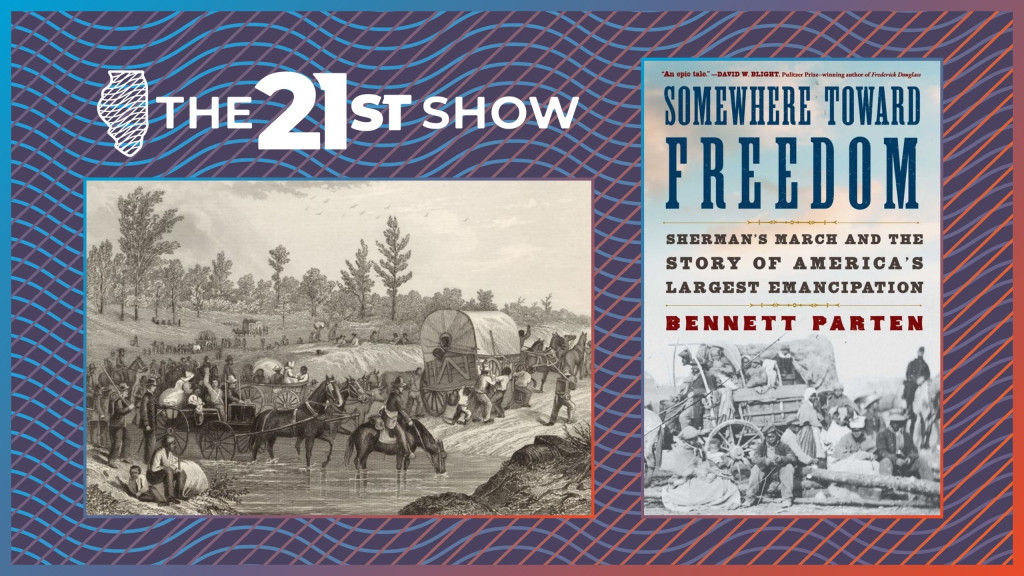
This 1864 drawing, "Sherman's march through Georgia, the 'Rear Guard,'" shows some of the thousands of emancipated people who accompanied the U.S. Army on it's march from Atlanta to Savannah. Thomas Nast via New York Public Library (drawing) / Simon & Schuster (book cover)
// This is a machine generated transcript. Please report any transcription errors to will-help@illinois.edu.

[00:00:00]
Brian Mackey: Today on the 21st show, among the most famous episodes in the Civil War is General William Sherman's March to the Sea. It split the Confederacy in half and helped bring about the end of the war. Less well known is that the march led to the emancipation of as many as 20,000 people who'd been enslaved and who joined the march following behind Uncle Billy's army. Their perspective is at the center of the book Somewhere Toward Freedom by the historian Bennett Parton, who joins us for the hour today on the 21st show, which is a production of Illinois Public Media airing on WILL in Urbana, WUIS in Springfield, WNIJ in Rockford DeKalb, WVIK in the Quad Cities, WSIU in Carbondale, and Tri-States Public Radio in Maccomb, Galesburg, and Keokuk, Iowa. But first, news.

From Illinois Public Media, this is the 21st show. I'm Brian Mackey. To the extent anyone thinks about the Civil War in the episode known as the March to the Sea, we think of General William Tecumseh Sherman. Sherman has gone down in history as one of the great American leaders of the war, but his generalship is just part of the story. Another part of the story involves thousands upon thousands of Black men, women, and children who were emancipated from slavery or emancipated themselves and joined the march. They would follow Sherman's army to the sea and in many cases aided the war effort. This makes the march arguably America's biggest emancipation event.

So argues my guest today, Bennett Parton, in his book, Somewhere Toward Freedom, Sherman's March in the Story of America's Largest Emancipation. Parton is originally from Royston, Georgia. He studied history at the University of Georgia and went on to earn a PhD in the subject at Yale. In fact, this book grew out of his dissertation. Today Parton is an assistant professor of history at Georgia Southern University in Savannah, where the march ended, or at least pivoted. He also holds an appointment in the Center for Africana Studies. Most relevant for us here in Illinois is that Parton will be participating in a talk about his book this Wednesday evening in Springfield. It's at 6:30 at the Abraham Lincoln Presidential Library and Museum. The event's free, registration is required. We'll have a link, or I should say we already have a link on our website right now, twentyfirstshow.org if you're interested.

Bennett Parton, welcome to the 21st show. Thank you for being with us. Yeah, thanks for having me. And listeners, you can join Ben and I throughout the hour today. 800-222-9455 is the number. If you have a question or comment about any of this, 800-222-9455. Whether it's the place of William Sherman in history, the role of emancipation on the march, or the way we frame and talk about history, which is also part of this story. 800-222-9455. 800-222-9455.

All right, well, let's start with Sherman and then we can move him to the side as we go along here. But who was William Tecumseh Sherman before the Civil War?

[00:03:29]
Bennett Parton: Hey, yeah, that's a good place to start, uh, great question. Uh, Sherman is actually someone who um is a bit of a professional failure before the Civil War. Um, he's born in Ohio, um, and the key part of his backstory, uh, is that his father actually passes away when he's 9 years old, and his mother is unable to take care of all of the Sherman children, and so she faces the impossible task of, or at least the impossible decision of what to do. And she ultimately begins uh fostering out her uh oldest children to family and friends who can take care of them. And Sherman has the um good fortune, ultimately, of landing in the home of a uh a prominent attorney there in town in Lancaster, Ohio. It is this attorney that later paved Sherman's way to West Point. Uh, interestingly enough, uh, this attorney goes on to become his father-in-law, uh, because Sherman will marry his foster sister, uh, which means that his foster father becomes his his father-in-law, which is a relationship that will be incredibly important to him for the rest of his life, but also one that he sometimes tries to to get away from.

Uh, but going back to his professional career, he is someone who has spent time in the army. Uh, but, uh, as an adult, he ultimately leaves the army and goes into banking. Uh, but Sherman has the misfortune of going into banking in California, uh, right as the, uh, wave of the gold rush is beginning to crest. Um, his banking venture in California fails, he moves to New York, uh, uh, and tries to, um, go back into banking there, uh, but he does so right as the financial crisis or the financial panic of 1857 happens. Uh, and so by the time the Civil War begins, uh, Sherman is someone who is really struggling. He's struggling to support his family, he's struggling to, uh, get out of the shadow of his foster father or his father-in-law turned foster father. Um, and at the time, he's actually serving as the superintendent of a new military college in Alexandria, Louisiana, uh, which is the predecessor of today's LSU. Uh, and this job was really a lifeline for him. Um, it wasn't [exactly] what he wanted necessarily, but it's what he got, uh, and for him, this was saving him from what seemed to be a surefire life of continued struggle and continued financial hardship. Uh, he's in this position in Louisiana as, uh, the Civil War begins, which means that he had been in the South, uh, teaching Southern soldiers, uh, right on the eve of the Civil War and as the secession crisis, uh, gets underway.

[00:06:17]
Brian Mackey: It's a bit of an — oh, sorry, sorry, it's a bit of an aside to, to your story and the, the book you, you wrote here, but you know, what does it say that both Grant and Sherman, right, two of the great leaders of the American government's efforts in the Civil War were sort of personal failures and sort of revived themselves through, through this, through this great, great conflict.

[00:06:41]
Bennett Parton: Well, I think it says something about how the Civil War for an entire generation of Americans was the defining event of their lifetimes. And some people like Sherman and Grant, uh, would have been lost to obscurity, right, if it hadn't been for this this conflict. And we see how warfare and and conflict like this, um, tries people's characters, um, it tests people, uh, and certainly both Grant and Sherman were tested, uh, in this conflict, but they rose to the fore. Um, and it definitely is — I mean, they both become really good friends. They both have this kind of Midwestern rugged sensibility about them that allow them to succeed. Um, but if it had not been for the war, um, you know, we would never have known about them. Uh, and Sherman, uh, even resists during the war. When the war begins, um, as I said, he was down in Louisiana, he eventually moved back to — moved to St. Louis for a bit, um, but it wasn't a guarantee that he was gonna re-enlist, and he actually had to kind of fight and claw his way to get back into the army. Uh, and so that is who Sherman is, uh, as the Civil War begins.

[00:07:41]
Brian Mackey: How does he fight and claw, you know, from, from this man who's maybe ambivalent about some of the war's aims, uh, as it's going along, not, not the reunification or the, the continued union or however you want to phrase that, but, uh, I mean, Sherman is pretty racist, even by the standards of his day, at least for a northern man. Uh, maybe you can talk about that and how he nevertheless, you know, rises in the, in the army.

[00:08:06]
Bennett Parton: Yeah, absolutely. I mean, Sherman is someone who does not see this war as being a war being fought over slavery. At one point he says, um, this is me paraphrasing him, that, um, uh, slavery is really just a pretext for secession, and for him, what is driving this conflict is really this conflict over secession, over the nation's integrity, and it's ultimately gonna come down to a question of whether or not the US can preserve itself. I mean, he's very clear that secession is a form of treason. Uh, that it's a rebellion, it's an insurgency, uh, and that is how he views this conflict, and he does not see slavery as really having, uh, a place in it. He doesn't see enslaved people as having a place in it.

Um, and some of this comes from, uh, his own, um, you know, uh, prejudice. I mean, he was not unlike many other, uh, uh, Ohioans. Um, many northerners held these the same views, uh, but Sherman also spent a significant amount of time in the South. I mean, I just mentioned, uh, before the Civil War begins, he was in, uh, Louisiana, in Alexandria, Louisiana, uh, but before that, he had lived in New Orleans, uh, he had lived in St. Louis, he had lived in Charleston, he had been stationed in the South, um, or all across the South, uh, as a young military officer. And as many biographers have pointed out, he shared many of the South's own views towards slavery, to race. And even as the Civil War begins to evolve into one that will embrace emancipation, uh, Sherman is someone who resisted at every turn. And the best example of this is when he serves in 1862 as the military governor of the city of Memphis. Uh, Memphis becomes a magnet for enslaved people who flee to the city in search of freedom. And there he uh enforces the emancipation policies that are on the books. He later enforces the Emancipation Proclamation, but he's not happy about it, and he only enforces it in the most narrow sense possible.

And even as he's marching through Georgia towards Atlanta in early 1864, he still resists some of the signature features of the Emancipation Proclamation, that being uh the provision that allows for the enlistment of Black troops. He does not like the idea of having Black troops in his army, and he is still resisting some of the government's policies on emancipation. But by the [time the] army arrives on the outskirts of Savannah at the end of the March to the Sea, he has slowly begun to change his tune, just even if ever so slightly. What I mean by that is he now has begun to recognize that targeting slavery is a way of targeting the Confederacy, in a way of ending the war, and he's also begun to recognize that styling himself as an emancipator is good for him politically. Uh, and so Sherman is someone who resists embracing emancipation, but by the late 1864, he has begun to evolve, even if ever so slightly.

[00:11:05]
Brian Mackey: Yeah, ever so slightly, and that's after, you know, humiliation in a northern newspaper when what he thought was private correspondence was made public, uh, showing his sort of resistance to some of these things, especially the adoption of of Black soldiers into his units, which is a contrast with Grant, right, who, who did have Black soldiers fighting under him, uh, throughout or or at least during much of his campaign along the east coast.

[00:11:29]
Bennett Parton: Yeah, and that's one of the big differences between Sherman and Grant, um, and we can see it especially in their, uh, post-war careers, which is, of course, Grant goes into politics, uh, and he becomes a fairly adept politician in the sense that he is, um, you know, he rides to the office of presidency, uh, he, um, becomes a Republican, he takes on many of these, uh, Republican positions, uh, when it comes to protecting, uh, Black rights, uh, he is very strong, especially in his early presidency. Uh, but Sherman is someone who never really sort of thought about politics. He didn't really think about great moral questions, political questions. Uh, he had a much more sort of black and white view of the world, uh, and he was very stubborn on some of these issues. And where someone like Grant was able to evolve — he, uh, you know, got involved in politics, he thought about political issues — uh, this was not Sherman. Um, Sherman did not think like that, uh, at all. And when it comes to this question of slavery, we can see this, uh, highlighted, uh, even more so, right? It becomes very clear just how different the two men, uh, in terms of how they think about slavery and emancipation.

[00:12:41]
Brian Mackey: All right, so before we, we talk about uh the emancipation that was happening in Georgia during the march, maybe you can just give us a thumbnail, you know, for — it's been 20 years since E.L. Doctorow's book came out. It's been longer than that for many of us since our college history classes. Remind us what was Sherman's march to the sea? What were the aims? What were they trying to do?

[00:13:00]
Bennett Parton: Yeah, so the March to the Sea is the Savannah [campaign] — that's how it's referred to in official military documents. And it's a march that begins in mid-November of 1864, uh, and will end just before Christmas of 1864. Uh, that is about a 250-mile march from Atlanta to Savannah. Um, this is the campaign that comes after Sherman's army takes Atlanta, which was a major strategic victory because Atlanta was one of the last sort of, uh, industrial centers left standing in the South. Uh, and so the march from Atlanta to Savannah is the sort of final movement through, uh, the state of Georgia that disembowels the state of Georgia, uh, so to speak, uh, except this is not your average ordinary military campaign. Uh, it is a movement of soldiers, to be sure. Uh, but Sherman was very clear that part of his goals here was to strike at the emotional, material, and psychological wherewithal of white Southerners to keep up the fight. Uh, and how he did this was by targeting, uh, Southerners in their livelihood. Um, and pulling out of Atlanta, uh, he had to relinquish his supply lines as well as his lines of communication. And so the way his army would sustain themselves was by feeding, uh, or foraging off the farms and fields of middle and central and south Georgia.

[00:14:25]
Brian Mackey: Foraging is the official name. Bumming, bumming is one of the unofficial —

[00:14:28]
Bennett Parton: Bumming is one of the terms, right? Uh, and, um, this was official military policy. Now this has given rise to a longstanding understanding of the march as being, uh, one in which, uh, Sherman's army just ravaged the state of Georgia. Uh, inflicted just enormous damage on the state, uh, became a kind of a Genghis Khan-like figure, right, marching through Georgia. Uh, this has been the perception at least, but it's worth saying that Sherman always wanted the foraging done by the book. He uses that phrase. Uh, there were real clear parameters about how his army was supposed to do the foraging. For example, they're only supposed to take about 10 days' worth of food, um. Soldiers could not commit trespass, uh, only officers could approach, uh, white families, uh, only officers could, uh, appropriate livestock like mules, cattle, that sort of thing. Sherman even, uh, ordered his men to, uh, show real restraint when it came to foraging from the poor, because he believed that the poor had already given up the fight and could ill afford to lose these things, but he urged less restraint in the case of the rich, who he believed were the ones keeping up the fight and who he believes could very much afford to lose, right? A cow, a horse, or a pig, or two. And so this movement and Sherman's intentions here has been sort of part of our popular memory. Uh, it's been seen as one as what Sherman did to Georgia, right? What Sherman's soldiers did to Southerners, uh, but it was never quite as devastating as, uh, our popular memory has allowed it to be, or how we remember it sometimes in our own popular memory.

[00:16:08]
Brian Mackey: Yeah. And I, I'm curious what your, you know, instruction was — that as somebody who grew up in Georgia and was educated in Georgia, we can talk about that. We need to take a break here. Uh, one thing I will — one episode I enjoyed from the book is, you know, one of Sherman's orders, yes, as you said, only officers can do the more destructive — decisions. High officers were supposed to be the ones making decisions about actually like burning cotton gins and that sort of thing, although obviously some of the men took matters into their own hands, but there's this episode. The order apparently also included an instruction to forage liberally. Sherman comes upon a man with his face in a jar of molasses, and he supposedly looks up to Sherman and says, forage liberally.

Uh, so, all right, we're gonna continue our conversation with Bennett — Ben, Ben Parton, who is the author of Somewhere Toward Freedom, Sherman's March and the Story of America's Largest Emancipation. He's gonna be talking about the book this week in Illinois. That's Wednesday evening. More information on that at our website, twentyfirstshow.org. We'll have more with Bennett Parton after a short break. You can join us, 800-222-9455. This is the 21st show here in the 21st state. We'll be back in a moment.

It's the 21st show. I'm Brian Mackey. We are talking today with Ben Parton, who's an assistant professor of history at Georgia Southern University and author of the book Somewhere Toward Freedom, Sherman's March in the Story of America's Largest Emancipation. His book is gonna be the subject of a talk he's giving at 6:30 this Wednesday at the Abraham Lincoln Presidential Library and Museum in Springfield. We'll have information on that on our website, twentyfirstshow.org. It's free, uh, although they do uh require registration in advance. If you want to join us today, the number is 800-222-9455. That's 800-222-9455.

All right, before the break we were talking about this foraging or bumming that, that the uh Sherman's army had to do, basically sustaining itself off the land, right? Gathering foodstuffs, uh, animals as, as they went to, to, to feed this, this huge army. Um, you quote a, a, a man from the 102nd Illinois Infantry Volunteers, uh, [S. Flaherty], who says it's becoming apparent that unprincipled men are taking advantage of the license given them to forage and are pillaging. But another part of this story that you document is that, you know, sometimes the Southerners were hiding their food and their valuables, and it was enslaved people who were helping the northern army, the, the U.S. Army, I should say, to find some of this stuff, to, to take, to uh to take it as contraband.

[00:19:15]
Bennett Parton: Yeah, absolutely. That's one of the great stories that I'm able to document in the book. Um, and it's pretty common uh throughout the Civil War for white families, whenever, or white southern families I should say, uh, whenever the U.S. Army uh marches close by to take all their goods and valuables and to bury them, um, whether it's out into the woods somewhere or in the family cemetery, or they take their horses and their, their cows, and they put up a a temporary corral out in the woods somewhere. Uh, but of course, they themselves didn't actually do any of this hiding. They always forced their enslaved people to do it for them, which meant that when in this case, Sherman's army arrives on the scene, uh, enslaved people there are armed with real knowledge of where these things are. And are more than willing to share this information with uh Sherman's soldiers, and sometimes they even use this information as a bartering chip to say, I will take you to where you can find all these things if you let me and my family join along with you, um, on the march.

And it's this experience of interacting with enslaved people in this way that goes on to have a really important impact on Sherman's men, many of whom were from uh somewhere in the Midwest who had many of them had never seen slavery, never met enslaved people. Uh, many of them were fighting this war not for enslaved people or not to end slavery by any means. They were fighting a war for the union still. But this becomes just an incredibly important experience where they realized that enslaved people in Georgia were their best allies. They were their friends. Uh, they were people that they could rely on to help them make this march, uh, successful. And so it's this sort of interaction that takes place in a very intimate setting that is the plantation or the the the the farm, right? Uh, that is hugely important for many of Sherman's men, and that helped make this moment, uh, a moment that will be defined by freedom and emancipation as much as anything else.

[00:21:14]
Brian Mackey: And you also have stories of of enslaved people or I guess emancipated people leading uh Union government soldiers out — away from — if they've escaped from captivity, leading them through, you know, around southern patrols and outposts and that sort of thing to reunify with their fellow — yeah, go ahead.

[00:21:35]
Bennett Parton: Absolutely. I mean, they took part in this campaign and, you know, just as soldiers did. I mean, they served as intelligence scouts, they uh led uh escapees from local southern prisons back to Union lines. Uh, Sherman always asked for enslaved people to, um, get a sense of the landscape, to know which plantations still had white families, uh, in residence on. Uh, the closer the army gets to the coast, particularly the cavalry, which moves further down the Georgia coastline, uh, enslaved people regularly, uh, pilot canoes, uh, leading, uh, cavalry troops, uh, you know, across the sort of rivers and bayous down here on the, the Georgia coast. And so enslaved people played a remarkably important role in this, this campaign.

Um, a couple of really good examples of that, um, aside from what they do, uh, in terms of, you know, giving over forage to the men, uh, enslaved people also, uh, taught Sherman's army how to eat rice. And this becomes especially important, uh, the closer the army gets to Savannah because there is one wing of the army that marches right through the kind of rice districts or the rice plantation districts north of Savannah. And here, uh, the march had, uh, slowed down to a crawl. The farms were not nearly as abundant, they had all been picked over, uh, the roads had been destroyed, and there were, uh, there was a moment here where many of the men would go out to forage and come back empty-handed, and they believed that maybe this campaign may not be that successful. Successful, maybe they would stall out right on the gates of Savannah, maybe they would go hungry, uh, but they didn't go hungry because Georgian enslaved people taught them how to subsist on rice, taught them how to use a mortar and pestle, taught them how to cook it, they provided them with rice. And so in these very sort of nervous days, uh, right before the campaign comes to its completion, when it was still uncertain whether or not it'd be successful, uh, Georgia's enslaved people rose to the occasion and helped sustain Sherman's army.

Another great example that speaks to just how crucial they were to the army's success, uh, has to do with a group of people known as the pioneers. Now, a military pioneer in a different campaign, uh, might just refer to some uh, generic manual laborer, uh, maybe a, a, a ditch digger or, you know, a teamster or something like that. But on the march to be a pioneer was to be a road builder. These were the people that went out ahead of the army and prepared the road so the army could march more easily. And on Sherman's march through Georgia, uh, these individuals were made up almost exclusively of formerly enslaved people, which means that our mental image of what's happening in this moment has to include the fact that wherever the army went, there were always scores of enslaved people who were literally paving the army's way to Savannah. And so, especially out here on the uh Sherman's march to the Sea, the Savannah campaign, we can really understand just how important enslaved people were to the operations of the Union Army, and that's especially true for this one example here in Georgia, but that is true writ large for the Civil War as well. Uh.

When we begin to sort of rethink about the — rethink the Civil War and see it less as a battle between two opposing armies meeting on battlefields and think about the experiences of enslaved people, we can begin to see all the many ways that enslaved people consistently showed up in the Civil War and consistently did things to try to help the U.S. cause.

[00:25:01]
Brian Mackey: You know, the, the Civil War, uh, I don't know, maybe the most contested thing in American history over the many decades and a century and a half since it happened, right? And, and there was obviously the, the, the South's efforts to sort of rewrite that history for, for many, many years. And now we see, uh, you know, a new round of contesting that. And, and maybe you can talk a little bit about um you know how you came to decide to write this story in this way, right? Putting enslaved people or formerly enslaved people at the center of this narrative that, you know, by accounts, all accounts that I could find and blurbs on the back of the book, this is, this is a unique lens on the march.

[00:25:44]
Bennett Parton: Yeah, well, uh, let me first just say, well, I am a native Georgian. I grew up, um, not far from, uh, really a part of the state that Sherman marched directly through, uh, here, uh, in this, this story. Uh, I'm someone that spent a decent amount of time here on the coast around Savannah and on the Sea Islands of South Carolina.

[00:26:04]
Brian Mackey: Can I pause there and ask you, like, I mean, did you visit Stone Mountain as a, as a school group? Were you, did you — were, you know, sort of taught in the sort of southern revisionist way, as, as, you know, me, a man of Illinois might, might call it.

[00:26:17]
Bennett Parton: Well, I would say that I wasn't necessarily taught in the southern revisionist way, uh, you know, by the time that I was going through school, that, um, you know, uh, much of this, I think, had been put in its proper place. Uh, but, uh, you bring up Stone Mountain, that's a great example, where so much of this older revisionist, uh, uh, narrative was still embedded in, you know, different cultural forms. Uh, it was still kind of embedded on the landscape, literally, right? In the case of Stone Mountain. And of course I went to Stone Mountain as a kid. I mean, that's uh something that most, um, you know, uh, Georgians, uh, I think do as they're growing up, I suppose, at least if you grew up in the Atlanta area somewhat like I do.

[00:26:57]
Brian Mackey: And I guess maybe if any of our listeners aren't familiar, this is like a Confederate Mount Rushmore, right? You might say.

[00:27:02]
Bennett Parton: That's right, yeah, it's a giant, um, it's a giant granite mountain just south of Atlanta. Um, it is the largest Confederate, uh, monument, uh, in the U.S. There are uh depictions of, uh, of Jefferson Davis, Robert E. Lee and Stonewall Jackson on the monument. Uh, though now it's, uh, well, I'm not sure what it is like now, but when I was growing up, it was this really confused theme park, uh, where they have a laser show featuring all sorts of Coca-Cola ads, uh, Elvis songs, and it was all being displayed against the mountain. It's a bizarre place, bizarre place. But the point that I'm trying to suggest is that, you know, some of this old revisionist narrative, despite, uh, I think, as a society, us moving on from it, still lingers. It's still a part of the kind of cultural landscape, uh, and certainly in terms of how we remember the Civil War. And so it's, um, harder to escape from than we might think.

[00:27:56]
Brian Mackey: So, and I'm sorry, I derailed you. You were beginning to say how you came to think about, uh, you know, or how, how you came to tell this story, putting emancipated people at the center of the march.

[00:28:07]
Bennett Parton: Yeah, so as I said, I grew up in Georgia, very close to this history, um, and when I was uh doing a PhD, I, I realized that this was maybe a story that that that I needed to, to tell. And part of how I came to this was, uh, through a book that you mentioned earlier in the broadcast. I mean, you mentioned E.L. Doctorow's fictional account of the march. Uh, which if readers don't know E.L. Doctorow, E.L. Doctorow is one of our great novelists. Um, he's primarily known for his historical fiction, but I think he is a great novelist, uh, you know, spanning any genre. Uh, he's probably best known for a book called Ragtime, which is a book about, uh, America at the turn of the 20th century. It's set primarily in New York City and its northern suburbs. Uh, but he also wrote a book on Sherman's march called simply The March. And as was his characteristic style, Doctorow wrote with a huge cast of characters. I mean, this is one of the things that makes Doctorow, uh, [Doctorow]. Uh, Sherman's a character. There is a German-born U.S. Army surgeon, there's a white southern debutante, but he also included as one of the characters in his story, uh, a freed woman by the name of Wilma Jones, who, uh, as Sherman's army is moving through Georgia, drops everything, she escapes her plantation, she runs to the army, and then joins the army as it marches through to Savannah. And you later learn — I won't spoil this for any listeners out there or for any people who might go pick up uh Ragtime — but you later learned that Wilma Jones uh is likely the mother, if not the grandmother of a character that appears uh in Ragtime as well.

Um, but nonetheless, it occurred to me that Wilma Jones would not have been a singular character, that she would have been a composite character. There were likely hundreds if not thousands of Wilma Joneses that experienced this march and experienced it the exact same way she did. And so part of the inspiration for trying to write this book is an attempt to uh tell, uh, the story of Wilma Jones and those like her, not as a matter of fiction as Doctorow did, but as a matter of real history, right? Can we tell this, this story? And in some ways, I always saw my book, uh, operating as the kind of nonfiction companion piece to Doctorow's fictional work in The March.

[00:30:20]
Brian Mackey: And then for people who may not know, Doctorow — I mean, it's, it's a substantial enough work that I know like David Blight at Yale, your advisor, puts it on his curriculum for what he's teaching about the Civil War. So,

[00:30:30]
Bennett Parton: all right, let's — it is a fictional work, but, uh, Doctorow uh drew a lot from Sherman's memoirs, from, from soldiers' letters. I mean, he, he did, he did real research in in writing this book.

[00:30:41]
Brian Mackey: All right, let's go, uh, go to the phones at 800-222-9455. We've got Molly calling from uh Kansas City, Missouri. Molly, thanks for calling in.

[00:30:52]
Speaker 2: Uh, hi, yeah, I had a question. Uh, so one of my ancestors marched with Sherman from Georgia. And the story that was passed down in my family was that when they reached the coast, they lived for four days on nothing but parched corn and raw oysters. I was wondering if you have ever heard anything like that before.

[00:31:14]
Brian Mackey: All right, Molly, thanks, thanks for the call. So in case the, the sound wasn't that clear to everyone, Molly said one of her ancestors was part of Sherman's march and says when they reach the coast, they lived for four days on nothing but uh raw oysters and, and I couldn't hear what quite the other thing she said. If it was hardtack or what else she said.

[00:31:30]
Bennett Parton: I think I heard parched corn.

[00:31:32]
Brian Mackey: Oh, parched corn, yes, yes, yes, that makes more sense. Yeah,

[00:31:34]
Bennett Parton: and, uh, thanks, Molly. Um, yes, that actually is pretty, pretty common. I mean, uh, Sherman's men, they had had been foraging off the farms and fields of middle and central Georgia for a month and a half. They arrived in Savannah, where there is more food, but because Savannah had been blockaded, right, there is, uh, it was still a lack of food there in the city, and it took time for fresh rations to get into the city. Uh, and so I wouldn't be surprised, right, if they, if they, they did in fact, uh, you know, eat, uh, parched corn and and oysters. Uh, and one of the reasons I wouldn't be surprised either is because, uh, you see, uh, a number of different sources from Savannah at the time of local Savannahians making money by selling oysters to the soldiers. This is a way for poor Savannahians who were really struggling, uh, to try to make, uh, make a buck or two, right, by selling oysters to the soldiers. Um, and, uh, some of the soldiers will go on to write about, uh, feasting on oysters, um, while they're here in the lowry.

And there is, I should just say, as a sort of sidebar here, this great kind of theme that runs through, uh, the sources on the — on the March to the Sea, whereby these, um, northern soldiers, many of whom, uh, you know, come from places like Wisconsin or Minnesota, you know, Ohio, Illinois, Indiana. Some of them are first- or second-generation German immigrants, uh, and they come to the South, and for the first time ever, they discover things like, uh, sweet potatoes, Georgia-grown sweet potatoes. Uh, they begin eating, uh, pork, like they've never eaten pork before, right? And they write about this, this experience, uh, for them, and they, they actually discovered Georgia to be quite a breadbasket, uh, with a lot of new foods, uh, you know, like rice, you know, oysters, uh, these cold cooked sweet potatoes and things like that. So, uh, part of what's going on here is really a kind of cultural experience for many, uh, Midwesterners — or what we now think of as the Midwest, right — coming south and, um, really encountering a new, new world almost.

[00:33:36]
Brian Mackey: Yeah, westerners of the time, and I don't know, maybe if I had a Civil War march level hunger, I would actually enjoy oysters as well. That's, that's a personal aside. Uh, all right. We're gonna take another break on the program. We've got, uh, if you're on the line, please hold. We'll, we'll come to you after the break. We are talking with Ben Parton, who is a professor — assistant professor of history at Georgia Southern University based in Savannah, Georgia, which was the destination of Sherman's great march to the sea from Atlanta. That march is the subject of his book. It's called Somewhere Toward Freedom, Sherman's March and the Story of America's Largest Emancipation. He's going to be talking about the book if you're in the Springfield area this week, Wednesday evening 6:30 at the Abraham Lincoln Presidential Library and Museum. It's a free event. Registration is required. We've got a link on our website. We're going to talk more with Ben Parton after a short break. You're listening to the 21st show. Please stay with us.

It's the 21st show. I'm Brian Mackey. We are talking for the hour today with Bennett Parton, professor of history at Georgia Southern University and the author of the book Somewhere Toward Freedom, Sherman's March in the Story of America's Largest Emancipation. If you want to join us, 800-222-9455 is the number and let's go to the phones again. We have Paul calling from Urbana on line two. Paul, thanks for calling in.

[00:35:35]
Speaker 3: Yeah, thank you. I don't want to get hung up on the diet thing, but I heard parched rice, and that's more likely because the slaves actually brought the knowledge that was necessary for rice cultivation with them from Africa. But I think more people [get their] formation of this period then from Gone with the Wind and Doctorow than they would from uh — uh, than they [get] from [Doctorow] is what I was trying to say, but um. Uh, the, uh, the point that I think should be emphasized for, well, for one is that this was a horrific, horrific, horrific time. I mean, I, I, I can't — I kind of objected to the idea of seeing this as like a career advancement opportunity for for either, you know, Grant or — yeah, for Sherman or Grant, so, uh, that, that just that just bothered me a bit but, uh, but putting that aside, um, the, uh. Uh, he was [begrudged] more for uh doing the 40 acres [and] a mule than he was for uh the uh you know, burning, torching of, of the area as it's characterized. So, uh, yeah, I just, if you could react to that, I'm, I'm sorry, I'm a little unfocused today.

[00:37:12]
Brian Mackey: That's all right, Paul. Appreciate the call. And yeah, I mean, to be fair, I think, yeah, it would be fair to say Grant and Sherman were both reluctant participants in the war, at least at first. Um, so, not, no, no offense intended, certainly for me toward toward Grant or Sherman, but, but Ben, I'll let you take that.

[00:37:29]
Bennett Parton: Yeah, no, uh, I totally agree. I mean, they, they took no, no joy in, in this experience. I mean, Sherman hated the war. He hated that it was happening, um, and that is evident from his earliest letters from the war begins, all the way right through it, um, and they just happen to be in positions to where, uh, it elevates them, and they, uh, ride it to successful post-war careers. I mean, they become national heroes at the end of the war, but it's absolutely true, neither one of them took any, any joy in this experience, and Sherman was always very clear, uh, to counsel people to not get too high or too low about this experience. He was always very clear that it was going to be a very brutal, bloody war, uh, and that everyone would get their fill of it at some point or another, and so this was something that neither one of them, uh, really, really, uh, enjoyed.

And uh the caller, uh, I think is right in the sense that uh Gone with the Wind uh has had a huge impact on how we remember this story, um, as has so many other uh, um, uh, sort of cultural productions like Birth of a Nation, which was, uh, you know, the famous film of the early 20th century. And then before these, uh, cultural productions, uh, Sherman didn't really have the kind of place in our popular memory, the way that, at least in the popular memory of the South, uh, in the way that he has for much of the 20th century. And in fact, immediately after the Civil War, uh, Sherman returns to Atlanta twice. He's welcomed to the city on, uh, uh, both of those, uh, occasions. Uh, and Southerners did not look at him as the kind of villainous figure that they will later. Uh, that really happens in large part because of this larger lost cause effort to re-remember, or deliberately misremember, uh, what the Civil War was and what it's, uh, about. Um, and so Sherman's, uh, reputation here really sort of, at least among Southerners, uh, rises and falls with the ongoing story of the lost cause. But immediately after the Civil War, he is, um, you know, typically welcomed in the South, and most people understood that, uh, his campaign, uh, it was a brutal one, a difficult one, but it was part of the war, uh, itself. Uh, and so when we think sometimes about, uh, memory and how elastic and nebulous memory can be, sometimes it's cultural productions, right? Movies, films, uh, books that go on to play, uh, maybe a larger role than we might think they would in how we remember some of these things.

[00:39:58]
Brian Mackey: Yeah, as God is my witness, I'll never be hungry again, she says, right? Um so, so. As a historian, you're approaching telling this story. You have far more accounts of U.S. government soldiers, you know, we used to call northern soldiers, than there are of enslaved or formerly enslaved people. How do you approach that as a problem in your work?

[00:40:22]
Bennett Parton: Well, uh, in this book, it was uh a huge problem, right? Because you are essentially making, uh, enslaved people here, the central actors, the central characters of the story, uh, and I think for good reason, right? Uh, but it is hard to actually find any documents that, uh, explain this experience from their, you know, own perspective, their own points of view. There are some, there are a few. Uh, and so this is a real problem, um, but fortunately there are plenty of, uh, stories, uh, about enslaved people and how they experienced this campaign, uh, that can be found through, as you mentioned, the, um, writings of the soldiers themselves, who, uh, recognized they were taking part in one of the biggest campaigns of the war. Uh, and for them, one of the most unique things about it was their interactions with enslaved people. And so they wrote copious amounts of — or, you know, they, they, they wrote quite a bit about their experiences that I was able to use. Uh, enslaved people also uh appear in official military records and reports and letters from Sherman to his subordinates and vice versa. Uh, they don't often appear in any sort of great qualitative sense, and we don't get a, you know, a full narrative about what's going on in their lives, but we do see them.

And so my approach to this problem was to read with a very discerning eye, to understand that some of the authors of these reports and of these letter collections will have the same kind of biases and prejudices that, you know, any white uh 19th century American would have would have would have come to it. Um, and then also just to use the kind of totality of evidence to tell a much larger story. And so it presented a real problem, and it's one that um you always had to be on guard against, you had to be aware of, uh, but there are ways by being judicious and by using the historical evidence, I think very carefully, that you can in fact get around it, and that's what I hope that I've done in, um, in the book.

[00:42:16]
Brian Mackey: Yeah, you're, you're no doubt reading with an eagle eye as you're going through all these accounts for any little little sort of hints of the way — when I do, I'm always looking for connections to Illinois, and so I stumble — you know, my eyes catch on your quote from an adjutant named [Fenwick Headley], who's from Illinois and writes that in countless instances enslaved people had possessed news of the war in advance of the troops as well as the local whites. Their knowledge so amazed the soldiers that common folklore held it enslaved people had some underground circuit of information, relaying information across the South. And I guess that's an example, right? You can intuit a lot about what's happening from that, you know, short passage in uh an Illinois soldier's accounting of what was happening.

[00:43:01]
Bennett Parton: Absolutely, and if I could just say, um, Illinois soldiers play a huge role in this story. Um, there are a number of Illinois soldiers who I quote from, uh, and, uh, again, just to get back to the point about the totality of evidence, I mean, one of the reasons that I had so much to pull from is that because in the decades after the Civil War, uh, soldiers were typically more than willing to share their stories, uh, and they were especially willing to share their stories as they realized that the American reading public and American publishers really wanted these stories. Uh, and so in many cases, single regiments would write their own regimental histories. Someone would write the kind of regimental history of the, you know, whatever Illinois or whatever Indiana. Uh, and oftentimes these would be, uh, compendiums of different letter collections of different soldiers. Uh, and so the American publishing industry, right, in the 1870s, 1880s, the late 1860s, uh, really does a lot to preserve a number of these, these stories. And again, as I said, for many of Sherman's men who were Midwesterners who had never experienced slavery, had never met enslaved people, uh, this was one of the unique things about Sherman's march, and they wrote about it repeatedly, and then uh here I am, right, uh, many, many, many years later, uh, using these stories to try to tell a much larger story about the role of enslaved people in Sherman's March to the Sea.

[00:44:24]
Brian Mackey: All right, back to the phones. Kathleen calling from Champaign, Illinois. Kathleen, thank you for calling in.

[00:44:30]
Speaker 4: You're welcome. I would like to say thank you to the author. I was a Yankee who grew up in South Carolina in the 1960s, which was a completely different era of conflict. But when I was growing up in the 1960s, we did refer to it as the war — they did refer to it as the war of northern aggression. Mainly based on what Sherman did. I was in Hampton, South Carolina, and he passed straight through Hampton. So I am so happy to get information about him that I never knew and I will plan, I plan to buy and read the book. So thank you.

[00:45:06]
Brian Mackey: All right. Thank you for the call, Kathleen. Ben, I'll let you respond to that.

[00:45:10]
Bennett Parton: Yeah, thanks, Kathleen. It's very, very nice of you, and I'm actually going over to Hampton uh here in a couple weeks to talk to some folks uh over there. Uh, but yeah, no, I'm not surprised. I mean, I think it's a common experience for a lot of folks that grew up in this part of, uh, the country. Um, and, uh, I'm really grateful to be, you know, one of, you know, a handful of our many historians who are, uh, sort of rethinking maybe how uh Sherman has sometimes been portrayed. And I should just say, just as maybe a uh, a preface here that, or maybe just a, you know, just, just to mention that I actually am working on a new biography of Sherman, uh, with Simon [&] Schuster that I'm hoping to have out here in, um, the next few years. So, um, more of that to come.

[00:45:52]
Brian Mackey: Nice. Congratulations. I'm, I'm looking forward to that. Well, let me ask you about, so, OK, I'm a, I'm a little starstruck, I have to admit. I'm a big fan of David Blight. I see he was your advisor on your dissertation that became this book. I've listened to his Yale Open Course podcast. I don't know how many years ago that was made, but I've listened to it at least, uh, once, some of it twice. Um, it's pretty rare for someone's, you know, sort of academic dissertation to become a major book by Simon and Schuster, right? Hardback — doesn't know — well enough there that there's a paperback now. Talk about that process, right? We're, we're on air in a lot of college towns. I'm sure there are other, uh, faculty members who might be interested in, in how you — how you approach that and how you made this something that, you know, didn't just collect dust in, in a university library somewhere.

[00:46:38]
Bennett Parton: Yeah, sure, no, I'm happy to talk about it, and I'm maybe not to get too far into the weeds here, um, but it basically just started with the fact that, um, you know, I wanted as many people to read and access the story as possible. And so from the very beginning, I went into, you know, working on this dissertation project with the idea that it would be, you know, as public and as popular as it could be, while still maintaining a, you know, a certain sense of of rigor, and here I've got to give, uh, you know, um, David, Professor Blight, lots of credit 'cause I, I, I told him this, and he said, go for it, right? I mean, this is, this is something that you want to do, you should, you should do it, and don't hold back. And so, a lot of credit has to go to him for really encouraging me to do this, and then uh doing a whole bunch of other things to kind of help, uh, me get to where I am and get the book to where, uh, it is.

Uh, but it really just started with, as I said, just this intention of I felt like I had a really big story, uh, and I had a big story that I wanted to tell to as many people as possible, and so that's the way, uh, that, uh, that I wrote, and that's, um, you know, really, like I said, it was just my intention and um uh something I felt very deeply about — that history uh should be read by as many people as possible. It should be accessible, and people should be able to to to to get a hold of it. Um, and so yeah, I wish, you know, there's maybe more to say other than uh that was just something that was very, very, very, very important to me as a uh sort of novice writer who was just figuring out how to do this.

[00:48:05]
Brian Mackey: Well, last question, just about a minute left. What has been the reception to your book in places, you know, where you live, right? In Savannah, in places in Georgia where you can still buy uh the Confederate battle flag at, you know, many, many gas stations along the highway.

[00:48:21]
Bennett Parton: Well, uh, it's been great. I mean, I have had a wonderful, uh, you know, I've had a wonderful reception. I mean, I've been able to go, uh, you know, different places in Georgia, across the South, across different parts of the country, and, you know, everywhere I've gone, I think people just have a real thirst for new stories, for stories that make them think, uh, for what I, I would like to think, right, is good, uh, well-researched history, history that has the receipts, the sources. And so for the most part, the, the reception has been just uh really positive, and I've been really encouraged. I mean, we hear a lot about how the humanities are dying, you know, all this sort of thing, but my experience is that people are — you know, that people aren't reading as much anymore, uh, and, but my experience is that people have a real thirst and a real desire for, you know, narrative nonfiction and for, you know, uh, history. And so the reception's been, um, really, uh, incredibly positive, and I've been really, really um, uh, fortunate for that to be the case, uh, but it's been great.

[00:49:21]
Brian Mackey: Ben Parton is an assistant professor in history, also has an appointment in Africana Studies at Georgia Southern University. The book is Somewhere Toward Freedom, Sherman's March and the Story of America's Largest Emancipation. If you're in the Springfield area, 6:30 Wednesday evening at the Abraham Lincoln Presidential Library and Museum, he'll be giving a free talk on the book. They do ask people to register in advance. You can find a link to that right now at twentyfirstshow.org. Ben Parton, thanks so much for sharing your work with us and safe travels to the 21st state.

[00:49:55]
Bennett Parton: Yeah, thanks for having me. It's been a blast.

[00:49:58]
Brian Mackey: That is it for us today. Coming up tomorrow on the program, James McBride is a musician, screenwriter, and an award-winning author. He's often considered essential reading in American schools. He'll be joining us tomorrow on the 21st show ahead of a talk he's giving in Champaign this Thursday. That's coming up on the 21st show, which is a production of Illinois Public Media. I'm Brian Mackey. Thank you for listening. We'll talk with you again tomorrow.
Among the most famous episodes in the Civil War is General William Sherman’s “March to the Sea.” It split the Confederacy in half and helped bring about the end of the war.
Less well known is that the march led to the emancipation of as many as 20,000 people who’d been enslaved. Although Sherman himself was quite racist, these men, women and children joined the march — effectively making up the rear guard of “Uncle Billy’s army.”
Their perspective is at the center of the book Somewhere Toward Freedom: Sherman’s March and the Story of America’s Largest Emancipation, by the historian Bennett Parten. Parten will be giving a talk on his book this Wednesday in Springfield.
Want to go?
When: 6:30 p.m. Wednesday, Oct. 7, 2026
Where: Abraham Lincoln Presidential Library and Museum, Springfield, Illinois
Admission: Free (registration required)
Guest
Bennett Parten
Assistant professor of history, Georgia Southern University
Author, Somewhere Toward Freedom: Sherman’s March and the Story of America’s Largest Emancipation
Correction (Oct. 5, 2026): An earlier version of this post misidentified the artist and source of the drawing. The work is by Thomas Nast, and it was accessed through the digital collections of The New York Public Library.