








Oral history project to explore ‘life, liberty and the pursuit of happiness’ through lens of Illinoisans
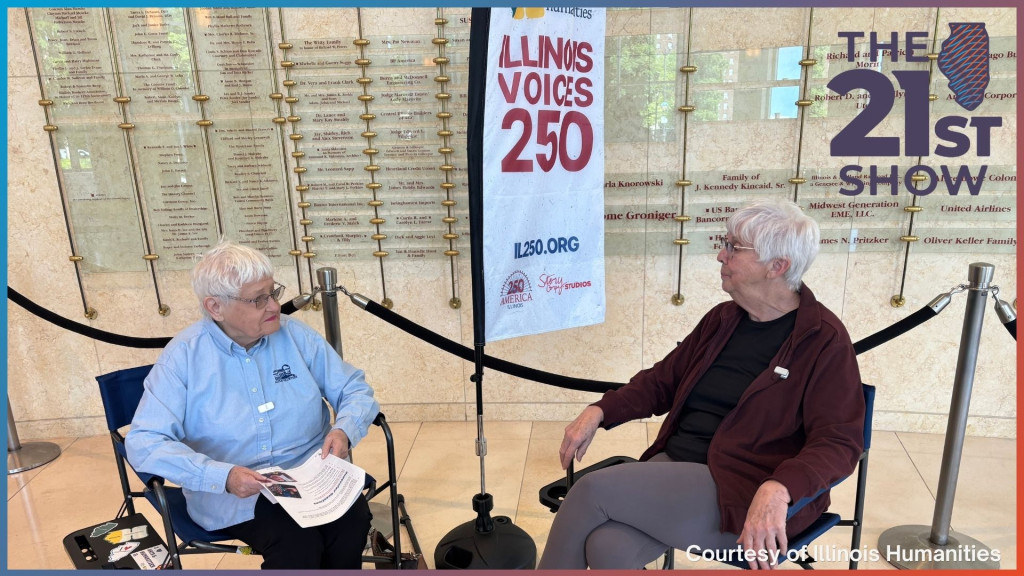
Francie Staggs and Rhonda Trower of the Captain William Penny Chapter of the Daughters of the Republic record their Illinois Voices 250 interview during a Community Recording Day at the State Capitol in Springfield. Courtesy of Illinois Humanities
// This is a machine generated transcript. Please report any transcription errors to will-help@illinois.edu.

[00:00:00]
Brian Mackey: It's The 21st Show. I'm Brian Mackey. In about 2 months, the United States will be marking a major historic milestone. 250 years, 3 months I should say. In about 3 months, the United States will be marking a major historic milestone. 250 years since the Declaration of Independence. It's an occasion for celebration and also one for reflection. What can future Americans take away from the lives and experiences of people in 2026? What are modern Americans learning from our history and what does it mean to have unalienable rights to life, liberty, and the pursuit of happiness as the founding fathers laid out all those years ago?

All of these are questions guiding a new Illinois oral history project, Illinois Voices 250. Its goal is to document perspectives and stories of residents in all 102 counties of the 21st state for future generations. It's a collaboration from Illinois Humanities with StoryCorps Studios and the Illinois America 250 Commission. Joining me now to talk about this is Gabrielle Lyon, the executive director of Illinois Humanities. It's a nonprofit that, as the name implies, focuses on connecting people across Illinois to the humanities, things like art and history. Gabrielle, welcome to The 21st Show. Thanks for being with us.

[00:01:31]
Gabrielle Lyon: Thank you so much for having me. And

[00:01:33]
Brian Mackey: yes, humanities is my thing, not math. 2 months until July. I've lost my mind and thought we were back in April. Uh, it's been a long year. It's been a long decade. All right, uh, Gabrielle, say more than I did in the introduction there about what you are hoping to draw out of people in these oral histories.

[00:01:50]
Gabrielle Lyon: Well, well, thank, thank you so much for having me on. And the, and the good news is it's 59 days until July 4th, but we've got a lot more time to, uh, to think about this 250th anniversary all the way till the end of 2026. So more time if we want it.

Um. Illinois Humanities is really focused on centering people's lives, experiences, and stories. It's what we do day in and day out. We're a statewide nonprofit organization. We do free public programs because the truth is civic fabric is what we weave when we come together and have conversations. So this is a really important moment for the work of the humanities and frankly, you don't get to reflect and make meaning. Without it, we're, we really think, and I, and I think what we are seeing across Illinois in every county is people want this moment to be more than just a birthday party. So, Illinois Voices 250 is what we decided we wanted to do to commemorate this moment.

[00:02:57]
Brian Mackey: So talk about how this kind of project can benefit the historical record as it's, you know, as it's sort of pretentiously known.

[00:03:05]
Gabrielle Lyon: Yeah, I mean, I think, I think it both benefits the historic record and it protects this fleeting moment of space for people now. I think that's one of the things I'm finding is so extraordinary about this. So, for example, um, I was able to help facilitate some conversations last week in Springfield. We opened our doors, uh, to this project at the Abraham Lincoln Presidential Library and Museum. It feels very fitting. It really means something when somebody who is perhaps the first Black mayor of Alton can talk about what this moment means to him. Because Alton is also the burial site of Elijah P. Lovejoy, who was a free speech advocate. Some think of him as the [first] martyr to the Civil War, but this was a person who was an abolitionist. He ran a paper. He was killed for, uh, his reporting and testimony. And flash forward to right now, Illinois Voices 250 makes the opportunity for Mayor [Goys] to talk about what it's like for him to have grown up in Illinois and now represent the people there. So it's very much of the moment as well as creating the historic record in 50 years, 250 years, we want to make sure that here in Illinois, we really mean we the people means everybody.

[00:04:41]
Brian Mackey: Yeah, well, on that note, let me share, we, we reached out to our uh texting group and asked members what they might tell their ancestors if they could, people 100 years ago or people living a century from now. We heard from Lloyd in Danville who said 100 years ago, I'd asked why Black people were being left out of the growth and prosperity of America. 100 years from now, I'd ask why with all the resources of the country, why do they let so many people suffer? The pursuit to me, pursuit of happiness means equity in jobs, housing, healthcare, and equal protection under the law. Humanity in many aspects is on the wrong course. We are polluting our planet. People are sick, hungry, and wars are senseless.

We also heard from Randy, a farmer in rural Peoria County, uh, who told us the question he would ask his ancestors is, was the work you did for property the most important, or the work you did for people around? What one of those two have lasted? I can see my family always has done both, and hands down the property evaporates. Randy goes on, says from his descendants, he'd want to know, did I do good by them, or would the land have been better?

Lloyd, Randy, thanks so much for both of you. You can join our texting group, by the way, by sending the word talk to 217-803-0730.

We're talking with uh Gabrielle Lyon, executive director of Illinois Humanities that's spearheading a project, an oral history project marking 250 years of the US. It's called Illinois Voices 250. And as we've been talking about, its aim is to document voices and stories from throughout all of Illinois's 102 counties. You know, I'm wondering, I don't know if you look back on, on sort of similar projects from the the bicentennial in 1976. There was a lot going on in America at the time that people would have been unhappy with, right? We're still pretty shortly out of Watergate at that time. Uh, there was a, you know, oil crisis in the 1970s. I wonder how much of, you know, and when we reached out to our texting group, a lot of people were like, are we gonna have America in the future, right? People are very concerned with the current political moment. How do you sort of sort through that and think about, you know, talking about the very particular concerns of what people read on their phones this morning or saw on cable news last night, versus, you know, bigger picture thoughts.

[00:07:01]
Gabrielle Lyon: I mean, I think this is a really, I think this is a really hard question you're, you're asking. There's not one answer. But because you brought up history and I, and I'm a historian at heart, I think it is important to remember that in 1976, right, there was also protests for the Vietnam War, real fights for equality, and all of that upheaval gave way to, I think, what the ideals of the Declaration of Independence really call for, you know, this anniversary in Illinois, we've chosen to focus on the Declaration of Independence. So that's a real point of difference for how we're commemorating versus say, what they're doing in Boston or Massachusetts. And that text gives us a chance to do something that is, is critical. It's not just to wash our hands or be afraid. It's inviting us to say, what does it mean to be patriotic, but to be, you know, reflectively patriotic. Abraham Lincoln talked about this all the time right here in Illinois, in some of the places that your, your callers and, and text members have talked about, you know, he really said, look, the most important way to understand our country is that we share a set of beliefs, not language, not our economic status, not our, not our heritage. It's that we have a shared set of beliefs.

So I think what I've seen with people that I've been talking to all across the state, those beliefs include wanting the places where they live matter, wanting the stories of their families and their ancestors and their children to, to, to matter and to be included. And uh when you have that starting point, not who did you vote for, why didn't you vote, there's a world of commonality that people are really excited about and feel empowered about and, you know, one of the things I I hope for through Illinois Voices 250 is not only are we creating a living archive, we're letting people have a moment to sit back and think about their lives and their communities from a different angle and an angle that's often neglected and, and frankly, is being eroded.

[00:09:24]
Brian Mackey: So I, I want to get a little meta here because this is a radio show where I ask people questions about their lives every day. We often think about how do we, you know, how do we do this job? How do we ask questions to draw thoughtful responses out of guests, right? We don't, we try not to ask yes or no questions. I wonder how you deal with something like that where presumably most of the people taking part in this project are not professional interviewers. So yeah, maybe the question is what, what makes a good oral history as opposed to a, you know, professional interview.

[00:09:54]
Gabrielle Lyon: I mean, I think the best thing is to not worry too much about it being an oral history or worry too much that your conversation will be recorded in the Library of Congress, the Folklife Center, but to really just be in conversation with the person across from you. And one of the things Illinois Humanities, you know, we're very partner-centered. We have programs happening all across the state, a lot of small towns and rural communities, and of course, bigger cities like Chicago. But we curated a set of questions to get that on ramp to happen. So I think the questions matter. I think listening matters. And I also think, you know, the idea behind Illinois Voices 250 is, frankly, you can do it at your kitchen table. A, a grandson and grandmother can do it together. This can happen in a church basement during, uh, you know, Bible study. It's set up to be DIY.

The other thing is that the questions are ones that have to do with just you and your life. Like what's a story from your family you wanna be remembered. What have you, when have you felt most proud or conflicted about the country, you know, and like your, your folks have already shared, you know. Giving people a chance to kind of imagine like what future do you want to see in the country's 300th anniversary. But the, but the main thing is to be in conversation and to make and protect that space that like, if you don't make it, it doesn't happen. You're just in your normal way of talking with each other. But this is a conversation ideally with someone that maybe you know well or that you want to get to know better and it's about, it's about the heart of the matter, which is the conversation.

[00:11:38]
Brian Mackey: So you, you mentioned the American Folklife Center. Say more about what happens to these, I almost said tapes, but nobody uses tapes to these files after I still think

[00:11:47]
Gabrielle Lyon: of, I think of them as tapes. Um, you know, it's a, it's a pretty, we're very lucky to have a very special partnership with StoryCorps Studios. So if people listen to public radio or our, uh, radio or archive nerds, they'll be familiar with StoryCorps Studios. But basically, you, you pick a partner, you get ready to record, you record your conversation, you can use the questions that we're providing or go down a rabbit hole for a question that you're interested in. Um, you save it, you give permission, and then all of the conversations that are recorded will be part of a collection at the Folklife Center and at that point, they are not just being saved and protected, but they're available to researchers in the future.

Let's say you want to do research on, um, on, on Peoria or West Frankfurt, you know, that's where one of our our recording days is going to be in West Frankfurt, a small town. We know that those conversations are going to be focused on the history of coal mining and intergenerational conversations about what that place has, has been like in the past, what people want it to be in the future. Those stories will be available well beyond us. And, um, and I've personally have been very inspired by the kinds of things that happened in the '30s with the Works Progress Administration, the WPA right here in Illinois. And so, there's a little bit of that spirit too, that it's not just what do you think about the 250th, but what is happening in this moment with the people that live here and what do they most want to hold on to think most matters. It also feels fitting that this is a very grassroots effort at a time when things feel fragmented. Small can be good. Hometown can be powerful, and I think that's where we are right now.

[00:13:41]
Brian Mackey: Well, if people are interested in learning more and participating themselves, we will have a link where they can find out about that at our website 21stshow.org. Gabrielle Lyon is executive director of Illinois Humanities. We've been talking about their program, Illinois Voices 250. Thanks so much for being with us today here on The 21st Show.

[00:14:01]
Gabrielle Lyon: Thank you so much.

[00:14:16]
Brian Mackey: That is it for us today. Coming up on tomorrow's program, Illinois's own Pope Leo XIV was recently critical of the war in [Ukraine]. He's also had negative things to say about overly harsh immigration enforcement tactics. And for that and more, he's become the target of attacks by President Donald Trump, by Vice President Vance. All this has sparked a conversation and questions about the intersection between American politics and Catholicism, Catholic teaching, what's known as Catholic social thought. We're gonna take a deep dive into those questions tomorrow on The 21st Show. We're planning to speak with [a] Cardinal, Archbishop, uh, uh, out of Chicago and uh also some other people who are well versed in these areas. You can, uh, if you have questions for us, you can submit them ahead of time. Talk at 21stshow.org is the address. Talk at 21stshow.org. The 21st Show is a production of Illinois Public Media. I'm Brian Mackey. Thank you for listening. We'll talk to you again tomorrow.
In about two months, the United States will be marking a major historic milestone: 250 years since the ratification of the Declaration of Independence.
What can future Americans take away from the lives and experiences of people in 2026? What are modern Americans learning from our history? And what does it mean to have unalienable rights of life, liberty and the pursuit of happiness – as the founding fathers laid out all those years ago?
All of these are questions guiding a new Illinois oral history project, “Illinois Voices 250.” The goal of the project is to document perspectives and stories of residents of all 102 counties of the 21st state for future generations. It’s also a collaboration of Illinois Humanities with StoryCorps Studios and the Illinois America 250 Commission. The head of one of the organizations involved in this endeavor joins the program.
The list of community recording days can be found here, and you can listen to one of the project's oral history interviews here.
GUEST
Gabrielle Lyon
Executive Director, Illinois Humanities