







Illinois skipped the Great American State Fair; Peoria stepped in
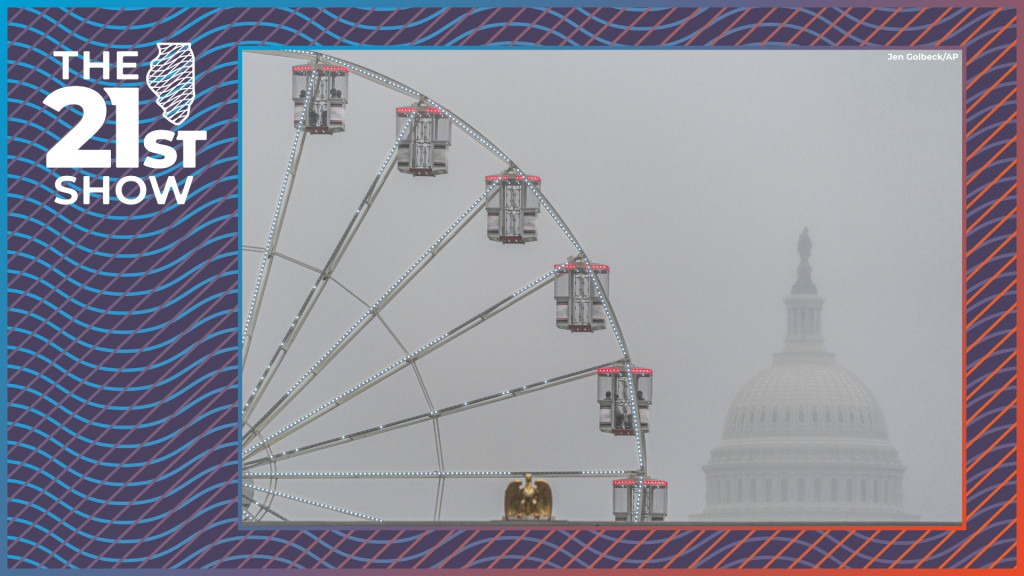
The U.S. Capitol is seen through fog behind the ferris wheel at the Great American State Fair on the National Mall, June 28, 2026, in Washington. Jen Golbeck/AP
// This is a machine generated transcript. Please report any transcription errors to will-help@illinois.edu.

[00:00:00]
Brian Mackey: It's the 21st Show. I'm Brian Mackey. This weekend, July 4th, the United States will be celebrating its semiquincentennial, our 250th birthday. The Congress and other top government officials have been anticipating this for years, but as the date has approached, an event meant to unite Americans has been impeded by the friction in our politics. And now there are two organizations planning commemorations. America 250 is the official effort of the United States Semiquincentennial Commission, enacted by Congress in 2016. Now there's also Freedom 250, created by an executive order from President Trump last year. Essentially, this is the White House version of the semiquincentennial. America 250, Freedom 250 — you can understand how there might be some confusion.

In fact, that's what prompted many musicians to back out of the Great American State Fair. They say they were not told Freedom 250 was the Trump-driven celebration. The president's involvement has also prompted several states to pass on participation in the state fair, including Illinois. That said, the 21st state is being represented in D.C. this week by the Peoria Riverfront Museum. Joining us now to talk more about this is John Morris, president and CEO of the Peoria Riverfront Museum. John, welcome to the 21st Show.

[00:01:24]
John Morris: Brian, thanks for having me on.

[00:01:26]
Brian Mackey: And I should say, for scheduling reasons, we tape this conversation ahead of time, so no calls in this part of the show, but you can still let us know what you thought. Our voicemail line's always open — 217-300-2121. That's 217-300-2121. All right, John, let's start with some background. For people who've never been there, what's the Peoria Riverfront Museum all about?

[00:01:47]
John Morris: It's a remarkable place. We're a nonprofit, privately funded organization. We'll turn 14 in the building where we are now, but we [are] the only multidisciplinary museum of our kind in the nation — art, science, history, achievement. We do a lot with the American Museum of Natural History, the Museum of Modern Art, the Whitney. We're working with the 9/11 Museum coming up on the 25th anniversary of 9/11. And we really swing for the fences in bringing some of the most important museum exhibitions, films, planetarium shows anywhere — under one roof, the sort of assortment. And it's an amazing place. We had a 1,000% increase in philanthropic giving in the last nine years during my tenure as CEO, and it's a place of inspiration. Our mission is to unleash the full talent and genius of every individual.

[00:02:41]
Brian Mackey: So it sounds like it's not just about Peoria history or Peoria this or Peoria that. You really have broader ambitions.

[00:02:47]
John Morris: Oh, we're the No. 1 partner of Alice Walton's Art Bridges — the greatest American art philanthropist. We received the inaugural Bridgemaker Prize along with two other museums last year. We are a constant collaborator, as I mentioned earlier, with great science museums. We've brought in T. rex, we brought in bioluminescent creatures from New York, and so it's just a place of inspiration and the greatest film society screen in the United States. So if you haven't been here and you're a listener, check it out. It's a pretty cool place.

[00:03:25]
Brian Mackey: So how did the Peoria Riverfront Museum become part of the Great American State Fair?

[00:03:30]
John Morris: Well, about four years ago, we decided to be the biggest celebration of America 250 there was. So we aligned with — what you mentioned earlier — there was a bipartisan commission established by Congress. They put out a logo. We put that logo on the side of our building. It's the size of a house. It's the biggest sticker of America 250. We co-branded ourselves with that logo.

As it turns out, Brian, they're not just two different celebrations and logos. Those may be the two big ones at the federal level, but all 50 states have logos. Illinois would later add its own logo with the Ferris wheel. We work closely with the Illinois America 250 Commission. So I was up in Chicago earlier this year. Governor Pritzker announced a series of activities. Gabriel Lyons, who is a terrific leader — [head of the] Illinois Humanities Council — is sort of leading the charge. In fact, we're doing a program with her here at the Peoria Riverfront Museum on July 8th to really look at all the contributions of Illinois to America.

So it happened, Brian, that about eight weeks ago, Gabe Lyons contacted me and said Illinois is not going to be able to put anything in the 750-square-foot pavilion that is being offered for free in Washington, D.C. — all 50 states have been invited. And so I knew that it was being organized by the Department of the Interior, the Department of Agriculture, the National Park Service — all of these are executive branch departments that report up through the White House. And so, in the past two weeks, there's been an increasing narrative about [one] celebration for one part and another celebration.

We wanted to celebrate Illinois. We think we're the greatest state. We're the richest farm ground on earth. Where you are sitting, Brian, is the birthplace of the World Wide Web. We invented the skyscraper. We, here in Peoria, produced mass production of penicillin. I mean, the list goes on and on. As [a] multidisciplinary museum, we have a track record — we celebrated the bicentennial of Illinois back in 2018. We have a four-year lead-up to the celebration of our semiquincentennial.

So I went to my board of directors. They unanimously approved the idea that we could, in a hurry, use all of the tools that we had and try to represent the state as well as we possibly could. And so that's what we did, in the swirling context of the partisan nature of America — it is who we are. Not everybody's happy about going to one party or another. We —

[00:06:11]
Brian Mackey: I think a lot of people didn't even realize what was happening until these concerts started getting canceled and the artists are like, wait a minute — we don't. So how did that come on your radar? What was that like for you? I mean, did you get calls from your board? Hey, wait, are we aligning with Trump here? How have you thought about that?

[00:06:29]
John Morris: Look, I think the board leaned into it, and so did I, with good intent. And what we set up is a Lincoln proto[type] hologram device where we recorded [Fritz] Klein, the greatest reenactor of Lincoln in the country. We worked with convention and visitors bureaus all over the state. They went and found folks in their communities to record. I think we have close to 50 diverse representations. We invited all 17 congressional districts to send interns or, you know, come down to it. So I mean, we approached this as if it could be, Brian — maybe it's something that all of us could just take a minute and celebrate. But, you know, it's the United States of America.

And that said, I'm very proud that we love Illinois and we're doing our best. Many Democratic governors actually ended up sending pavilions as well. So it was not — [it] was [not] a strictly partisan thing in the end. We opened yesterday. We're up for 15 days. I'm in Peoria. I'm going to try to get out there to visit with some museum donors in Washington and conduct some business and see it. But we're very grateful for volunteers [and] private donors [who] stepped up above and beyond our budget here at the museum. And, you know, there are a number of people that are grateful that Illinois is represented. There are others who feel like we shouldn't be at America's 250th party on — I say that's our National Mall. That is our property. That is Illinois property.

And so we've been — the board redeliberated after some of the noise of the politics and leaned into it and said, just do the best. We always approach things with the highest ethical way and with a good heart. We're a nonpartisan organization. Our intent has been good, is good, and will continue to be the greatest multidisciplinary museum in the country. So let me —

[00:08:37]
Brian Mackey: Yeah, let me remind listeners that we're talking with John Morris, who is the president and CEO of the Peoria Riverfront Museum, which has taken up the charge of representing all of Illinois at the Great American State Fair — the big event in Washington, D.C. that has proven to be somewhat controversial because the event organizers, Freedom 250, are tied in with the Trump administration and sort of competing with the bipartisan America 250. But OK, we've talked about that, acknowledged. Let's talk about what people can actually see. You mentioned this Fritz Klein hologram — we've talked to him on the show, I know he was working on something about that. What else? How else is the 21st state being represented at this event?

[00:09:18]
John Morris: [There's a] really fantastic mural that shows the prairie grasses to the cornfields to Cahokia Mounds — UNESCO World Heritage site across from St. Louis — to Peoria. Of course, we're proud of the oldest continuously [French-]settled city, dating back 10,000 years of human history, with indigenous folks along the Illinois River. And upstate Illinois is represented with the skyline. So we've got a beautiful mural on that. People are taking selfies.

And we've got a table with corn kernels on it that people can use little Caterpillar tractors to push things around. We still have 10,000 Caterpillar jobs in the Peoria area, and [we're] proud of that. And there's a little homage to the Chicago Cubs sign. And we're giving away pumpkin seeds — we're the largest pumpkin-producing state in the union. There's Lincoln Logs people can build their own things with, and, you know, there's a cornhole [game] where you can compete. So I mean, this is just good family fun, but also communicating facts about Illinois that are throughout the pavilion. There are facts about first, best or only things that Illinois represents.

[00:10:30]
Brian Mackey: You know, we were joking before we started taping this about that idea — does it play in Peoria, right? That was a common turn of phrase. You don't quite hear it as much anymore. But I wonder what it means that it's a downstate museum representing Illinois, as opposed to some of the many — probably much larger and richer — museums in the Chicago area.

[00:10:52]
John Morris: I'm so proud of our staff here, Brian, because we've organized eight exhibitions around America 250. And I'll just touch on a few of those.

The first exhibition we did, we launched in the fall, called Joyful Resistance — the beautiful story of the Black American art experience, [the] American civic experience through artwork. So we have [Rasheed Johnson,] and we've got a Phillis Wheatley signed book of poetry, one of only 11 known to exist. We've got a [Michele Thomas] painting on loan from Art Bridges. And so that's a beautiful exhibition. There are probably 40 different works in that exhibition.

The second exhibition we opened is the anchor of the whole year, called The Promise of Liberty. It's a spectacular exhibition with 250 authentic documents — from the broadside 1776 printing of the Declaration, to the first printing of the Constitution, to the Emancipation Proclamation signed by Lincoln, all the way up through. The name of the exhibition takes its name from a speech in 1963 by the Rev. Dr. Martin Luther King Jr., who referred to the Declaration of Independence as a promissory note to which all men and women are entitled. And what a beautiful sort of full circle, to look at how those words in the Declaration — "We hold these truths to be self-evident, that all men are created equal. They are endowed by their Creator with certain unalienable rights, that among these are life, liberty, and pursuit of happiness." That phrase, which would become the mission statement of the new nation, I think has guided us [and] continues to guide us to a more perfect union — however broken and zigzag and skinned knees and ups and downs — that's still the greatest aspirational statement imaginable.

[00:12:41]
Brian Mackey: "It is obvious today that America has defaulted on this promissory note insofar as her citizens of color are concerned," King would say.

[00:12:48]
John Morris: We had a speaker last night, Brian, on American slavery who was — if you saw Ken Burns' [The] American Revolution, a 12-hour series — he was a featured scholar in that: Christopher Brown from Columbia University. And I had dinner with him last night, and he's an absolutely terrific scholar. So interesting to contemplate liberty and the flip side — the ultimate flip side of liberty — which is the enslavement of people. And so we're very proud, last night, to have brought him to town. We had a great audience, great discussion. The Peoria Riverfront Museum continues, I think, to lead the way in a multidisciplinary examination of who we are.

I'll mention one other thing, Brian. I had the great privilege of an advanced tour, before it opened to the public, of the newest museum in America — the Obama Presidential Center. So I was up there about 2½ weeks ago now. And I was really intrigued and heartened and inspired to see that the first object that President Obama chose to put in the exhibition of his new presidential center was, in fact, the Declaration of Independence. However flawed and filled with hypocrisy those times were — where we had enslaved people, women didn't have rights, a lot of white men had no rights — it still was a great aspirational statement. And for him to place that, his own personal broadside — a 1776 broadside, very valuable, incidentally — as the first object you see in the new Obama [Presidential] Center.

There's hope, Brian, that all of us can kind of refocus — I pray — on the idea that there is a promise of liberty to which every American is entitled. And our mission here is to unleash the full talent and genius of every individual within that promise of liberty. And we invite people to come experience the Peoria Riverfront Museum on our Illinois River for themselves.

[00:14:50]
Brian Mackey: As well as in Washington, D.C., during the Freedom 250 celebration. John Morris, president and CEO of the Peoria Riverfront Museum — thanks for being with us on the 21st Show. Thank you, Brian. The Illinois exhibit at the Great American State Fair is open now through July 10th in Washington, D.C. Peoria Riverfront Museum is open every day on the river in Peoria. That's it for us today. The 21st Show is a production of Illinois Public Media. I'm Brian Mackey. Thanks for listening. We'll talk with you again tomorrow.
As the United States marks its 250th birthday, the celebration has split into two: America250, the bipartisan effort Congress created in 2016, and Freedom 250, established by executive order from President Trump. The overlap has caused confusion — and some musicians backed out of the Great American State Fair in Washington, D.C., saying they weren't told about its ties to the Trump administration.
Several states, including Illinois, declined to participate. But the 21st state will be represented after all — by the Peoria Riverfront Museum.
Brian Mackey talks with museum president and CEO John Morris about how a downstate institution ended up filling in for Illinois, what visitors to its exhibit will see, and what it's like navigating a politically charged event. The Illinois exhibit is open through July 10 in Washington, D.C.
Guest
John Morris
President and CEO, Peoria Riverfront Museum