








Memoir recounts multi-faceted life of Walter Braud
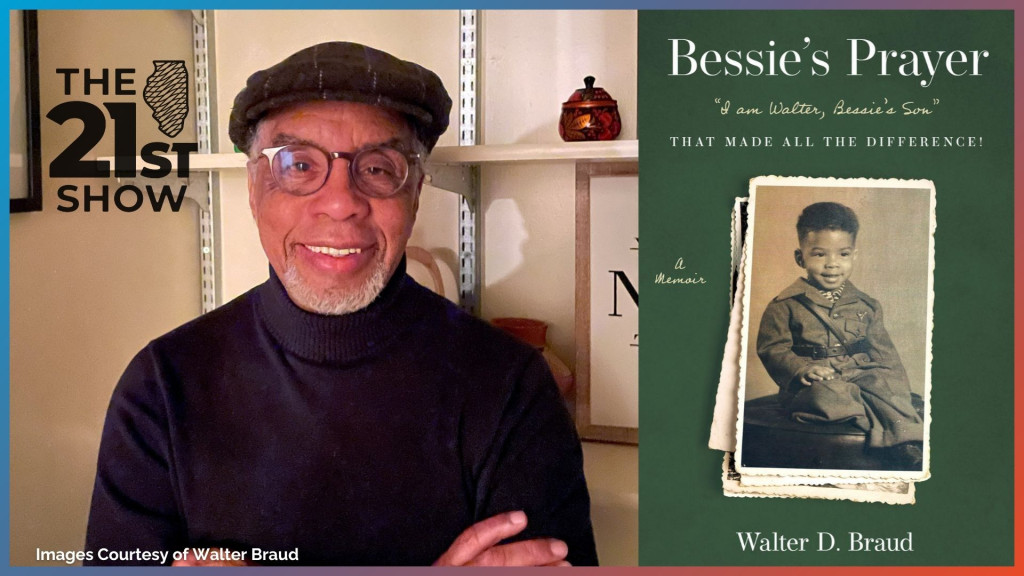
Images Courtesy of Walter Braud
// This is a machine generated transcript. Please report any transcription errors to will-help@illinois.edu.

[00:00:00]
Brian Mackey: Today on the 21st Show, Walter Braud spent part of his youth as a doo-wop singer and growing up in Chicago, saw a little bit of trouble, but he went on to become a teacher, a lawyer, and then the first black prosecutor and judge in Rock Island.

[00:00:13]
Walter Braud: So I kept asking myself, how do all these things happen, you know, am I so deserving and that when I look at myself, I say absolutely not. I'm not so deserving and certainly not more than other people. So what is it? And the one recurring answer kept being my mother, Bessie Mayfield.

[00:00:33]
Brian Mackey: Braud has written a memoir named for his mother. It's called Bessie's Prayer. I'm Brian Mackey, and that's all coming up today on the 21st Show, which is a production of Illinois Public Media, airing on WILL in Urbana, WUIS in Springfield, WNIJ in Rockford [DeKalb], WVIK in the Quad Cities, and WSIU in Carbondale. But first, news.

From Illinois Public Media, this is the 21st Show. I'm Brian Mackey. For the entire hour today, we're listening back to our conversation with Walter Braud. His name may be familiar to listeners in the Quad Cities. He had a long career there in the law spanning 50 years. But beyond his legal work, Walter's life also included teaching, a business proposition in Ghana, a cab ride with members of the Chicago mafia, and singing in a doo-wop group.

[00:01:43]
Singer: [singing lyrics - unclear]

[00:02:06]
Brian Mackey: All that and more is recounted in his memoir, Bessie's Prayer. This conversation first aired in December 2024, so we're not taking calls live today, but you can let us know what you thought. Our email address is talk@21stshow.org. All right, I want to begin with the title of the book. It's called Bessie's Prayer After Your Mother. Who was Bessie in life?

[00:02:30]
Walter Braud: Well, at the end of my legal career, which spanned 50 years from approximately 1970 until 2020, the last five years of that was a kind of a mudslinging battle to build a badly needed courthouse that had been needed since 1955, but the bottom line was that it was a 24/7 battle that pretty much exhausted all of my emotional, physical, uh professional resources and at the end of which I was just left empty happy because we built the courthouse. But I knew that it was a time for a change of life and so I took a few days off, actually a couple of weeks off, just sort of recuperating myself and trying to see what the next steps were. And it came to me that um my, my legal career and all of that was done, but that it was time for me to write a book.

So then of course as that probably happens to everyone who arrives at the conclusion that they ought to tell their stories, you know, so what the heck is the book gonna be about, you know, I mean, who wants to read about a bunch of old law cases or a bunch or some old guy that uh maybe had a few more successes than somebody else, but, uh, certainly not, I'm not Obama or anything that that spectacular, but as I thought about it, it occurred to me that all of these miraculous situations that came up in my life from my birth to uh trying to be an opera singer to being on the television, uh, the doo-wop singing, dropping out of high school, uh, getting a miraculous opportunity for a scholarship to become a school teacher, becoming a school teacher, and then getting the job in Rock Island, which was a, a miracle and a whole story of itself which is in the book all the way through to being called out of the blue to become a judge, uh, when I didn't, I was already 60 years old and thinking that, you know, that ship has sailed a long time ago.

So I kept asking myself, how do all these things happen, you know, am I so deserving and that when I look at myself, I say absolutely not. I'm not so deserving and certainly not more than other people. So what is it? And the one recurring answer kept being my mother, Bessie Mayfield. So Bessie Mayfield was 26 years old in 1937. And she had not seen her high school boyfriend for 4 years. They were hot and heavy, uh, but you didn't plan to marry him because he was a boy who was a lot of fun, liked to sneak out and play the piano at night. And she was very straight laced so when she went away to college that was pretty much it for her, but when she got to her senior year where she was studying to become a school teacher and you can see where the thread goes because her mother was studying to be a school teacher and her mother was a school teacher, so Bessie's heading down the well worn track, but the Great Depression came, blew everything up.

She was sent back to Chicago with her tail between her legs, didn't get to see her, uh, fiance, a medical student ever again and so she went to work. And in 19, so that's 1931, but by 1937, the Second World War was starting and prosperity came back, everybody had money, and she prayed to Jesus for a husband, home, and family, she didn't bother to do it before because under the circumstances her job was to help her mother survive the Great Depression. So she, you know, dearest Lord Jesus, please help me find a husband, home, and family and as many children as you can spare. I will raise them to love God and family above all things, to be kind in all endeavors and to show excellence in all endeavors and to help others before they helped themselves, so out of that came 5 children. I was the second born.

And out of that came her further promise to Jesus about how she would raise us to live worthwhile lives, starting me out to be an opera singer, which she worked on just uh relentlessly from the time I was 7 years old, taking music lessons and vocal lessons and on and on it went until I reached puberty and decided to become a doo-wop singer. And then the next magical event is when I was 17, almost ineligible for public high school because I, I was a dropout for a year and a half to be a doo-wop musical entertainer. She beat me over the head with the kitchen broomstick and shouting, be somebody or I'd rather see you dead, wham, be somebody or I'd rather see you dead, wham! And concluding with go back to high school and quit that singing group.

Well, I had resisted all of her efforts to get me corralled until that moment. And I, I didn't go directly there, but within a few days, I was back applying for high school, magically found a high school that would take me, and the rest goes on. So there are more magical moments that are tied to my mother's faith in God, faith in hard work, uh, and her, her loving grizzly bear approach to raising me as rambunctious as I was. So I knew that my, my bountiful life, a life that even I can't imagine how every day has been just sunshine, could have existed without Bessie Mayfield. so it's Bessie's prayer, and that's the genesis.

[00:09:02]
Brian Mackey: I, I like that her idea as a, as a young person of, of, uh, sort of maybe degenerate is overseeing it is sneaking out at night to play the piano, and you end up running off to join a doo-wop group. You were, uh, you were difficult for her, right?

[00:09:18]
Walter Braud: Yes, except that her other tenant is that you're to work hard always and, and, and, and do it without complaining. So one of the other benefits is that I inherited her incredible body that I've never been in the hospital overnight except for a tonsillectomy. She was never in the hospital overnight except for 5 childbirths, and our bodies have allowed us to rise early in the morning and, and pursue compulsively whatever we wanted to do. Her thing was to raise these 5 children, uh, to be spectacular in whatever they were going to do. And, and mine was just to do whatever I was doing until I exhausted it, whether it was shooting marbles or helping the milkman or singing in a doo-wop group or uh working somewhere, playing on the basketball team, whatever, wherever it was, learning how to speak Spanish, all of these little side trips all became connected together and it's the work ethic that she showed me and told me over and over and over again.

There's a little snippet in the book called Homeschool, where all of the so-called lessons in life we're not just a a background that you might get in a normal family situation. They were almost like the Bible. I mean, they, they were just coming out of her mouth, coming out of my grandmother's mouth, coming out of my father and Uncle Dave's mouth constantly, uh, do it now. Do it now. You can rest when God takes your breath away. Uh, don't look back, just keep moving on and on and on. So, she taught me and showed me how to live, how to love and how to live a selfless life, in other words, you can pursue whatever other people might call ambitions, but if you're doing it well for the most part, for other people, it's not for your own aggrandizement. Uh, there are rewards on the other side of it. So, uh, living in my house was, uh, like living in a school for learning how to live a bountiful life.

[00:11:44]
Brian Mackey: If you're just joining us, this is the 21st Show. We're speaking with Walter Braud. He's the author of the memoir Bessie's Prayer. He's also retired Chief Judge of Illinois's 14th Judicial Circuit, a lawyer, a teacher, a singer. You mentioned, well, we've mentioned the title of the book is Bessie's Prayer, and you, you recited part of it. And throughout the book, you, you talk a lot about your Catholic faith, maybe even, even call it a profession of faith. What does being Catholic mean for you?

[00:12:17]
Walter Braud: My mother was sent to a private Catholic school for colored girls in the South. My grandmother went to that same private colored school for Catholic girls in in the South in Mississippi. And so my grandmother brought my mother to Chicago in 1920. And my mother was already converted to Catholicism. I mean, she was in it knee-deep. And it formed all of these principles to live by, and so they were all when I, when I was born, there were always crucifixes and rosaries and pictures of the Sacred Heart and Jesus and around the around the house and of course we always went to mass.

So when it was time for me to go to school when I was 5 years old, there was no public there was no Catholic school available to me because on the south side of Chicago, it was segregated and the the nearest possible school for me to attend was one block over the racial divided line. So there was just no chance for me to go to a Catholic school. My older sister, who was 2.5 years older, was already experiencing some difficulties with the public school kids just because they were rowdy, and my mother really believed in her heart that, you know, we had to have a Catholic education, but no way to get it, so she prayed. And, and her prayers were a habit that had been established as far back as Mississippi. And so she prayed, um, how would I say it? She prayed with confidence that the prayers would be answered because they had always been answered for my great grandmother, for my grandmother, and for her.

And so 2 weeks after that prayer, she's sitting on the front porch of our little shack of a house which she worked monstrously hard on to make it into a proper home. She's sitting on the front porch enjoying her 15 minute break in the afternoon, and an Irish priest pulls up in a car. Handsome guy, dilapidated wreck of a car pulls up, gets out, and she looks up at the heavens because she knows why he's there. He's coming to give us a Catholic school, and which of course he does. He walks up and introduces himself, Father Paul Ryan from Holy Name of Mary, uh, I'm the founder along with the Order of Black nuns to uh provide Catholic schooling for Negro children. It's 13 miles away from here in a, in a farther part of the city, but we have resources and we will pick up your children and take them back and forth for the first year. We'll give them free tuition, etc. etc.

Uh, so that's how I became a Catholic, but that's also how my mother began to teach me all the way through how God works His wonders through religion which to her was not confined to Catholicism because my grandmother was a Protestant, but they prayed together, they wrote the they wrote, read the Bible together and they believed in hard work and prayer, opening all doors and so, uh, from, and so as a little boy, of course, I'm hearing these stories over the dinner table. I was in the room when she had a conversation with Father Ryan.

And then there's one incident after another where they're praying and I'm sort of being my own willful self finding my own adventures, some of which are a little risky, but always there's this intervention and so always in the back of my, my mind, I believed that hard work and prayer and Jesus Christ is a convenient person because I, I was raised Catholic, so, you know, I have the Lord's Prayer and the Hail Mary just sort of as a, a resource reflection in my head, but the bottom line is that I always believed that I was in good hands, that my grandmother and my mother through their faith had my, had my back. And so I could, I could forge ahead into quandaries that others would stay back from. I would, I would jump into a fight where I was overmatched without thinking about how it was going to come out because that, that was my training because of religion. So,

[00:17:09]
Brian Mackey: uh, let's, let's take a break. We're going to continue our conversation with Walter Braud when we return. His book is Bessie's Prayer. This is the 21st Show. Stay with us.

[music]

It's the 21st Show. I'm Brian Mackey. We're listening back to our conversation with Walter Braud. He's the author of the memoir Bessie's Prayer. He's also a retired chief judge of the 14th Judicial Circuit. He had a long career in the law, mostly in Rock Island in the Quad Cities, and he worked as a teacher, and he was a doo-wop singer earlier in life. This is a conversation we first aired back in 2024 in December, so we're not taking calls today, but you can always let us know what you thought. Our voicemail line is 217-300-[2121].

Before the break, we were talking about your faith. The faith is really throughout the book, the phrase Lord have mercy, which is part of the call and response of the Catholic uh mass, um, is throughout the book. I, I do want to ask though, because you, you do recount a lot has been written and said about what's come to be called the Catholic Church's child abuse crisis. And you write about your own experience with this. If it's not too difficult, will you tell the story now?

[00:18:41]
Walter Braud: It it's strange how um I reacted so to to try to get to the story. So when I went to Holy Cross, I was 11 years old, and the racial barriers uh the, the segregated the segregation line on Cottage Grove Avenue was finally eroded and I could go to a Catholic school close. So I went to Holy Cross. Well, when I got to Holy Cross, there were probably 3 or 4 other black students in our class of maybe 45. See, I would have been a 6th grader and so I, I, I became an altar boy and all the things that happened as a Catholic, but the unique thing that happened to me was that I was called out by Father [Dear], who was the music director of amongst his other uh parochial duties for the for the school.

Father [Dear] was a man probably in his early 50s as I can best remember it, uh, nothing indistinguishable other than that, um, kind of scruffy as priests can tend to be since they don't have to. For whatever reason he was, but he was a, a pretty gifted photographer, a, a very poor musician, but he was the music director. So he called me out on the loudspeaker. I'm sitting in the class and he says, Sister, would you have uh Walter come down to the music room? And nothing else, so I go down to the music room and he informs me that he is aware that I have a musical talent. So by, by this time I'm singing in churches, singing in Catholic and Protestant churches, singing in recitals. I think I was on the [unclear - opera, no] I wasn't on the radio yet. But I was performing and I'd been to the Irish bars with my father performing as well, so.

Anyway, he found out about it and he sort of made me the school singer, so he was always taking me out of class and we would have singing practice which was really a waste of time because I knew the songs in Latin and in English and he was a poor piano player so he could have just winged it and we would have been done just as well but he had another motive which I was unaware of. So in, in, in short shrift, he got me a job working bingo where I made $3 we're working about 2 hours on Thursday nights. And then he got me a a gig where I got to sing on the radio for the Catholic Hour for I think 4 Saturdays that spring. And then what else did he do? You get so I got to sing for all the high masses when the cardinal and the bishops and everybody would parade up and down and my voice would spill out into the neighborhood from the belfry over the loudspeakers.

So there, there was a lot of prestige and he was always announcing me over the loudspeaker, so showing me off. My mother was just so appreciative because she thought, boy, this is an extension of Father Paul Ryan. He's my, my son is, you know, he's he's definitely, she, she had ideas that maybe, uh, she has shortchanged her goals and that maybe I was going to become a priest, which would have been her highest goal even above being a school teacher. And of course at that time I was still on track to be an opera singer. Well, Father [Dear] then decides that he's gonna take me out to dinner. So he gets permission from my mother and my mother's overjoyed because, uh, of course, if I'm gonna be an opera singer, I have to have a good table manners and social graces, so he takes me to a Greek restaurant, tablecloth restaurant in the white neighborhood. And I, I love the restaurant and I loved the, the ambience, uh, but Father [Dear] and I had a rough, had a rough go.

We were there maybe an hour and just, well, Walter, how do you like your steak? Walter, isn't this a nice restaurant? And on and on it went with these aimless questions that I so I didn't have social grace skills and I never have had them, and I realized it at the time, but the bottom line was, um, he was showing me a good time and I had on a little uh, jacket and tie and he was dressed in his priestly attire and I was the only brown-skinned person in the place of any age. So when that was over, 3 days later, he called me down to the music room. And I go down to the music room. And before I go to the music room, uh, the, the teacher says, uh, tell Father you'll have to practice another day, uh, because we have a a final math test today, so.

So I said fine and, and I really didn't want to practice. I wanted to stay there because there was a a girl that I wanted to get the better of on the test scores. But anyway, I, I ran downstairs. I used to call in doing the Jackie Robinson, so I did the Jackie Robinson down to, to the music room. And it was darker than normal. There was no music on the piano, the priest was facing me, not facing the piano, uh, and he was sitting there with a, a strange grin, and he says, come over here, Walter. and so I dutifully walked the 15 or so feet over to where he was sitting on the piano, wide leg with his feet planted, his fingers on his thighs. When I got close enough for him to put his hands on me, he pulled me to him and he kissed me, just flat on the lips, our our lips smashed together like pancakes.

And so that had never really happened. I, I, I already knew instinctively that I didn't like to be kissed on the lips even by the choir member friends of my grandmother at her Protestant church, even by my own family and certainly by no men. My father never kissed me on the lips, but we, we were locked at the lips probably for 5 seconds, seemed like 5 minutes, and I had my eyes open because I had been thinking of how I was gonna work my way up to kiss a a girl and I watched television and the movies, so I was really having a an experience of oh OK, so this is kissing, but I looked at Father [Dear] and uh he was pretty emotional. His eyes were closed. He was kind of in heaven. So he pushed me back and says, how did you like that, Walter?

And I went, my God, what on earth could I say to that? I said, well, father and sister said I need, I need to get back upstairs for a music test, so I wiggled myself out of his arms, ran back up to my schoolroom, and, and, and, uh, went back to class. Well, when school was over, I'd forgotten all about it. It really didn't have much of an impact on me one way or the other. I didn't think about whether I'll ever go back to that class or I, I, I really hadn't reached puberty yet. So there was no arousal or anything revolting wise or appreciation wise or anything. I didn't, I felt nothing. And so when I was out of school, I really forgot all about it until we got home.

And so when I got home, my mother gave her usual comments, which was, anything unusual happened at school today, children? And I blurted out, Father [Dear] kiss me on the lips like a girl. Oh, my mother. So she turned red, but she otherwise didn't react. Told my sisters to go up to the room to get out of their school uniforms and go out and play. Told me, took me in the dining room and made me regurgitate the whole story, which I did, uh, with no embellishments or or deletions. OK, you go outside and play too and don't go too far away.

Well, when I went back to school on Monday, Father [Dear] had been transferred to a school in Green Bay, Catholic grade school in Green Bay, I didn't make much of it, just reported it to my mother and found out when I was, oh, maybe 5 years later when I was a teenager that my mother had gone up to that school the very day that it happened and um had a heart to heart talk with the Father McMahon who was the, the head guy at the school and so that was the end of Father [Dear].

My mother never gave me any indication whether I handled it well or poorly or anything else to do about it. Her way of keeping us pure from sin was to not let us know any cotton picking thing about sex, whether it was uh the preferred one on one sex or [marital] sex or or pedophilia, so. That's the story.

[00:28:15]
Brian Mackey: Did that affect your view or how did that affect your view of the church and people in authority?

[00:28:21]
Walter Braud: Didn't. Didn't I I just thought that he was a man who had a flaw, and I'd had so many priests and nuns who were dear to me. I mean, they cared about me, they treated me like they cared about me, they were concerned about and I could see how the church itself did such a magnificent job with its hospitals and its schools primarily that uh it, it just never really affected me and, and, and only later when it, when I realized that it was a gigantic scandal when, you know, across the nation and maybe across the world that I thought, well, it's OK, so that's why these guys go and become priests, uh, as choosing a monastic sort of life because, you know, they're, they're going to the, to the to the apple tree, but even, even then I, and even now as I'm discussing it, I've always found a way to look at it the way my mother looks at it, which is they are not the church. They are individuals who have fallen and they deserve our prayers.

[00:29:38]
Brian Mackey: I wonder how that attitude came to influence your work many years later when you would become a lawyer and a prosecutor and a judge.

[00:29:49]
Walter Braud: In every instance, starting when I became a schoolteacher, every minute of the time that I was thinking about how I would teach my students, how I would help my clients, how I would help the people in front of me when I was a judge, the overriding concern for me was, help somebody, show mercy to somebody, show kindness to somebody, use your creativity to make somebody's life better. How can you help Johnny learn? How can you find a way to help this poor client that got himself in the mess no matter what the mess was, even if it was his own fault, even if it was the thirty-second time he's a child of God, your mission is to do all you can within the law to, to help and when I was when I was a judge, every time someone was in front of me, I made it a point to try to see it as my father would say, from their point of view, not only from the point of view of the police officer but or the victim, but to also see it from the point of view of the defendant, and from that perspective, mercy and justice combined to do the right thing.

[00:31:29]
Brian Mackey: We need to take a break in a few minutes. So I do want to spend a little time talking about, um, you at one point were a client, a legal client of Harold Washington prior to his mayoral career. Can you tell us that story?

[00:31:44]
Walter Braud: Well, so I'm 19 years old and going to Chicago Teachers College and working part-time at the main post office in Chicago on the near West Side close to downtown, and it's the time of year where the weather is rather changeable and so I don't have a car. And I went to school that morning, it was in the low 60s, high 50s. So I had on my college basketball logo jacket, basketball shoes, khaki pants, and a collared shirt. And I went to school and had my day at school. Did my classes, did my basketball practice, and now I caught the bus to go to the post office. So I get to the post office and all is fine. But by the time I got to the post office, which is about a 45 minute journey on elevated trains and buses, by the time I get to the post office, the weather has changed dramatically. It's cold. And inside the post office it's cold, but I work for 8 hours, 11 o'clock I'm off and I leave the post office with 7[, 8], 9, 10 other postal clerks who are full-timers, older men, probably 30 to 50 in age, so we all leave the post office, it's raining sheets.

And it's cold. So by the time I get on the first bus at Harrison to get off of that bus and go down into the subway, I'm drenched and I'm cold and I'm shivering. So I get on the elevated train and I sit next to the heaters and I pretty much warm up a little bit, but now when we get to 63rd Street, which is about a 25 minute ride, now we all have to go down the steps to get on the bus on the, on the connecting bus that takes us to our neighborhood, which is about 1 mile south. So always when we come home on that shift, the bus is waiting with the front and back doors open so that people coming down the steps can just get on the bus because they don't have to give money, they have a transfer. People waiting in line get on the front and give a transfer or give money. The bus driver closes the doors, he walks back, collects the transfers, usually says something pleasant, and off we go in your home. The bus driver comes back. He's madder than hell about something. I want you postal workers to get off my bus. I'm sick and tired of y'all coming on here disrespecting me, getting on the back door.

[00:34:33]
Brian Mackey: All right, we need to take one more break. My guest throughout the hour has been Walter Braud. He's the author of the memoir Bessie's Prayer about his life as a doo-wop singer, then a teacher, and then a lawyer, a public defender, a prosecutor, and ultimately a judge and chief judge in Illinois's 14th Judicial Circuit in the Quad Cities. We'll finish this conversation after a short break. This is the 21st Show. Stay with us.

[music]

It's the 21st Show. I'm Brian Mackey. Let's get back to my conversation with Walter Braud, a lawyer, retired chief judge of Illinois's 14th Judicial Circuit. He's written a memoir about his life. It's called Bessie's Prayer.

[00:35:23]
Walter Braud: So I pretended I was sleep, and I let those guys they, so they went out and got on the front door and gave the guy his [seat - transfer?] and they came back and sat down, but I didn't get off. I just said, well, he doesn't know I'm with them. I'd never seen him before, but he did know and he came back and said, you too, young blood, you get off the bus too, and you get on around the front of the bus, you know better. So I, my first thought was just to get up and punch him in the mouth, but there was a police car, and and there's always a police car there with the lights flashing so that things go smoothly, so I knew that that was a bad idea. So I ran off the bus, Jackie Robinson around the bus went in and I leaned over to the bus driver and I said, if this was any other situation, I said it quietly so other people would think I was saying something pleasant if this was any other situation in life, I would kick your mother [effing ass], or something along those lines and I was pretty sure being a smart aleck that and, and by the way, as a in the black neighborhood was sure to get a fight every single time, but I thought he wouldn't do it because the police were there and he didn't want to lose his job, but I was wrong.

So he just, before I could react, he had hit me so hard I was windmilling off the bus, stumbling out in the rain, fell on my butt in a pile of in in a puddle of water, and I, and I was sitting there surprised and I looked up at the passengers who were looking out the windows with wide eyes, and I'm reading their eyes saying, I don't know what college that boy goes to, but he show enough don't know how to keep himself out of trouble. But by the time I put all that together and I saw the police officers getting out of the police car, now here comes the bus driver off the bus with his fists balled up, so I jump up and we have a fight. So we probably throw 5 or 6 punches back and forth at each other, which I was really enjoying. I think I was maybe born to fight. It's my mother got in a fight, beating up a guy on the bus who was being mistreating the bus driver. My grandmother punched out some guy and my grandma great great grandmother punched out a guy, so I guess that was just in my blood.

But anyway, I enjoyed the fight, but I didn't enjoy the end of the fight because I was under arrest for aggravated battery, which was a serious felony. And the bus driver, they treated him like he did no wrong. So the bus left and I went to jail and uh to the disgrace of my father and my uncle who really didn't think well of anybody under arrest, but I only stayed there 3 hours, but I had to go to court, and when I got to court, my lawyer, who I didn't, I'd never met before I got there, but my father hired him, was Harold Washington, the first black mayor of Chicago. Uh, some say he was elected in 1983 and the fight was in 1959. So, um, Harold Washington got me out of it and uh, when I met him some years later when I was a lawyer and he was the first mayor and he was in Rock Island on some kind of goodwill tour, uh, he didn't recognize me, but I recognized him.

[00:38:43]
Brian Mackey: No doubt, no doubt. You were born and raised and spent a lot of your young life in Woodlawn, Bronzeville, it's what's known as the black metropolis in that era. You moved to the Quad Cities, which is quite different in its composition. What was that like?

[00:39:01]
Walter Braud: Bottom line is, uh, and, and, and I say that in the book, living in the Quad Cities, so living in Chicago, you, you're in a metropolis of about 3 million people at that, at that time, 3 million people, roughly 6 to 700,000 of them are black or Negroes or African-Americans, whatever description you're using and in our minds, the, the whole world consists of Chicago, New York, Detroit, Los Angeles, and maybe to a lesser degree, Kansas City or something like that. And now all of a sudden I'm coming to the Quad Cities, which is 300,000 people on a, on a good day. It's a manufacturing, agricultural manufacturing capital of the world where most of the world's tractors and and agricultural implement machinery is made, but it's on the Mississippi River where the river turns east, turns west for 3 miles and the only place where it does that, and then returns on its route, but what's happened because of that anomaly is the 300,000 people, there wouldn't be 300,000 people if not for the river turning that way and creating this, this industry.

So it's a combination of farmers spreading out as far as the eye can see for maybe hundreds of miles, but circled around this Quad City area of factories, so factories and farm workers, but 97% white of all categories, they came from all over Europe, all over everywhere, a lot of Hispanics, a lot of black people all coming to work in the factories, but predominantly the white people, the people in the farms are white. But the one defining thing that I learned on my first interview, and have never found a reason to alter my opinion, is that Rock Island County, which is one of the three counties that surround the river, but all of the Quad Cities is the land of milk and honey where people are so nice they smile and offer help even if they don't like you.

So whereas in Chicago, if you meet a stranger on the street, whether they, if they, if they don't know you, they're likely not to respond to you, they, they won't be mean to you, but they're just indifferent. It's as if you don't exist. Whereas in in Rock Island, strangers talk, they smile, they may not even like you, they may not like you racially, they may not like you status-wise, they may think you're a dumb, a dumb bunny, whatever their, their actual opinion may be, their outward motivations are warm and friendly, and it's just a wonderful, wonderful place to live. So it's not crowded, of course, good schools. When I moved here, if you wanted a job, you could have two. There was no such thing as unemployment unless you chose to be unemployed and there were some people that chose to be unemployed, but for the most part it was a union shop area so either you worked on the farm, which meant you had some family connection or you worked in the factories and you probably had a union job, so you had good wages, good schools it was just everything and the legal community was robust.

But still small enough that you weren't a stranger no matter what courtroom you went into, and the community was small enough that no matter who was on the jury, you had a relationship with them. You, you, because you'd find out, you know, are you Catholic? No, I'm not Catholic. Uh, do you go to church? Yeah, I like to go to church. Um, are you from [Moline]? Yeah, well what do you think about that high school basketball game? There, there's so many familiarities that in Rock Island, you're not a stranger, and you become a fabric of the community which was uh just an absolute blessing. I mean my my family just blossomed just you know, my sister became a school teacher my other sister became a lawyer, a paralegal in my office all the children did well in their chosen areas and made friends and that some of which they still have to this day it's a it's a wonderful way to live if you're not caught up with the show in the push of a big city. It's, it's, it's small town.

[00:43:38]
Brian Mackey: So, you're a lawyer for many years, you become a prosecutor. I, I wanna ask you if you've given much thought to this idea of the progressive prosecutor movement. And, and there are some people who've argued that African American prosecutors and police and judges have perhaps been a bigger part of the problem of mass incarceration than some have reckoned with. There was a book a few years ago called Locking Up Our Own. I wonder how you thought about that and how you have thought about that.

[00:44:09]
Walter Braud: When I was a prosecutor, it was right in the middle of the crack cocaine epidemic, and the crack cocaine epidemic was created because they found a chemical way to adulterate powder cocaine. Powder cocaine was too expensive for black people, so it was not a problem, and that was a California, Los Angeles, New York problem. But once they found a way to adulterate it so that you could buy daily supply of crack cocaine for say $20 it's sold like a miracle and it's instantly addicting. So one or two tries of crack cocaine, which too many people took, so it devastated the black community. It's so addictive that you have to have it and it's so devastating to you personally that you lose your job, you lose your morals, you lose all the things that keep you, uh, able to make a living, and now you have to prey on other people.

So, the establishment, the House of Representatives, the congresses, the governors, and the police establishment, including the prosecutors and the local police departments, [somebody] came up with this idea that we can stop this crime wave by locking everybody up, which really translated into locking up all the black men, primarily because they were committing a large part of the crimes because they were the ones that were addicted and, and affected. So that's the situation that I was brought into and as a defense attorney, some of those people were my clients, uh, and, and nothing like Chicago, uh, you know, the, the, it, it, it's just apples and oranges, but even in Rock Island where people are so nice that they smile and they offer help, even there as a prosecutor, I could see the heavy hand. I had already seen it as a defense attorney, but I could see it. I, I saw it as a prosecutor, the heavy hand to the blacks that were in that situation, and made up my mind that when I became a defense attorney that these people, black people were gonna get a fair shake. They were gonna get a fair shake.

And when I became a judge, I absolutely made sure that they got a fair shake, and by a fair shake, I meant if there was any way I could get him out of it, I would, but only if they were willing to go into the treatment programs and everything else that was available as they become, became constantly available. So to get back to the original question, it was an epidemic that existed in Rock Island. It's everybody's fault. A lot of prosecutors, their ambition is to get more skulls, you know, they, they wanna get more scalps. It's, it's just part of it. A lot of police officers, they wanna get more arrests and so racial prejudice plays into it sometimes, unbeknownst, sometimes they, they don't know, they just feel I'm just really being a good cop because there's a black guy. I know he's got, he's done something wrong, so there's a lot of that mistreatment.

And uh I never let it get to me. I, I I never felt animosity towards the police. I never felt, I may have felt animosity towards a particular police officer in a particular case. I was in a case once and, and it, so I'm representing a real drug dealer, which I didn't, I didn't ever want to do because I didn't want to be known as a drug lawyer, but this particular drug dealer was a, a friend of, of a friend who owned a business that I did legal work for and we had connections. In fact, that friend and I went to Africa together about 5 years after this. But anyway, this drug dealer was a notorious drug dealer for our little small town. He was the kind of guy you would see in a bad movie, a black exploitation movie with a derby hat and prancing around with a big Cadillac car.

So we're we're in trial, having a hearing, and the police are lying. I mean, they're just lying through their teeth, and I can see it, and I go to my and I'm, I'm a young lawyer still, and I'm kind of afraid of my client because I'm, I'm also hearing these rumors about how violent drug dealers are. And so even though this guy was selling $25 cocaine and and $25 marijuana, which is no really big drug dealer, he was big for our little area. So I'm thinking, so the cops are lying up and down and I'm going, God, I'm gonna, if I lose this case, I wonder if this guy is gonna do me some harm, my client, I mean. So I said, hey, you know, these cops are lying. He said, hey, little bro, they just doing their job. Their job is to catch me. My job is to get away. Now go and do your work, and that was the most clarifying situation for me.

Because he was not a victim. He didn't present himself as a victim, and it gave me another, another way to look without being entangled myself emotionally about representing drug dealers, so I represented a few more after that because I was just doing my job they were doing their job, and they didn't care if the police lied because they were lying too. It's just winner take all, so to speak.

[00:49:51]
Brian Mackey: Walter Braud, the hour has flown by. Thank you so much for sharing your some of your life with us.

[00:49:58]
Walter Braud: Thank you, thank you for calling and it's uh a, a warm feeling that someone wants to hear my old stories.

[00:50:05]
Brian Mackey: Well, I will say there's so much more that we didn't get time to. You mentioned the trip to Ghana, your encounter with the mafia. People will just have to buy the book which is called Bessie's Prayer. Walter Braud, thank you again.

And that is all the time we have for our program today. the 21st Show is a production of Illinois Public Media. I'm Brian Mackey. Thanks for listening. We'll talk with you again tomorrow.
Today's show included a rebroadcast of the following "best of" segment first aired December 5, 2024: Memoir recounts multi-faceted life of Walter Braud.