








New book explores apples in Midwestern history and culture
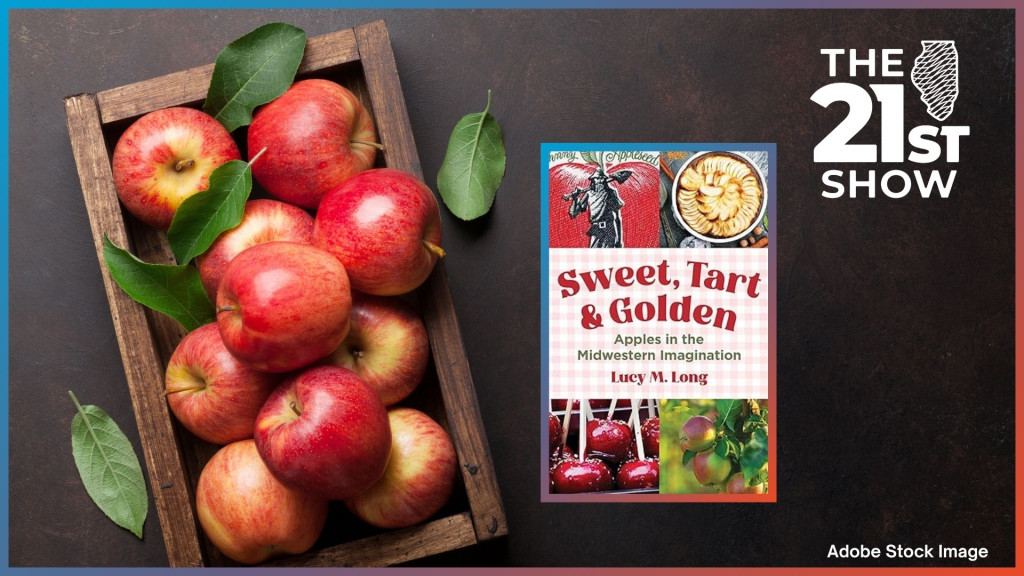
Adobe Stock Image and Courtesy of University of Illinois Press
// This is a machine generated transcript. Please report any transcription errors to will-help@illinois.edu.

[00:00:00]
Brian Mackey: From Illinois Public Media, this is The 21st Show. I'm Brian Mackey. We were hoping to begin today's program with a — I should say we were planning on it, not just hoping for it — with an update on what the Illinois General Assembly is doing with regard to the Chicago Bears, a proposed constitutional amendment on voting rights, as well as some other things that are working through the legislature. We're having some issues connecting with the guest we had planned to bring you for that. So instead, we're gonna pivot to what we were gonna talk about in the second part of our show today, which is apples.

You've all heard the phrase "as American as apple pie." It stems partly from the history that the apple is heavily associated with historic Americana. But beyond pie, there's apple cider, apple orchards, apple folklore. And my guest today argues that apples share a lot of history and values with our culture, Midwestern culture — that being seen as historically and culturally significant, but also, you know, forgettable among many Americans.

Lucy Long has described herself as a folklorist, musician, mother, cook and consumer of all things edible. She's also the founder and director of the Center for Food and Culture and the author of the new book "Sweet, Tart and Golden: Apples in the Midwestern Imagination." In it, she writes, "Apples are not unusual, too expensive or too fancy. They're practical and pragmatic. They're sturdy and long-lasting. They're an uncomplicated fruit to eat. They can be dressed up or made gourmet, but most often they're everyday, plain and straightforward. They're found everywhere regardless of class, ethnicity or religion, but require human intervention and the taming of nature to grow into useful edible fruits. These qualities fit with the image of celebrating apples. This region celebrates the ideals of itself as self-sufficient and pragmatic, with hands-on skills grounded in traditional values, but also embracing modern technologies."

Lucy Long joins me for the rest of the hour. Welcome to The 21st Show. Thanks for being with us.

[00:02:11]
Lucy Long: Thank you for inviting me.

[00:02:14]
Brian Mackey: So listeners, you can join us today at 800-222-9455. That's 800-222-9455. We wanna know: what is your favorite apple? I was high on Jazz apples for a long time, but more recently I've switched over to Cosmic Crisp. In fact, I had one this morning. How do you like to eat or use apples in your cooking? And what do you think of apples as a metaphor for the Midwest and its culture? 800-222-9455. That's 800-222-9455.

All right, Lucy Long, tell me about the origin story of your own history with apples.

[00:02:51]
Lucy Long: OK, so I think my origin story with apples — it does go outside the Midwest. I was born in North Carolina, grew up in the mountains and also in the flatlands, but also moved to Northern Virginia, Washington, D.C., and then moved overseas to Asia because of my father's job as an economist. So I'm used to apples from those areas. And when I moved to the Midwest — which was a long time ago, about 40 years ago now — I moved out here to teach and partly because I'm a folklorist, I was just really interested in: what do people here think of as being something distinctive for themselves?

I have to admit, typical of most people who live on the coast, I didn't know the difference between Ohio, Iowa, you know, Illinois — it was all the flyover region, no, flyover country, yeah. So, and I was very aware of the stereotypes of the Midwest because I would say to, you know, friends, family, colleagues, you know, "I'm moving to Ohio to teach out there," and they'd all say, "Iowa," you know. So it wasn't just me, you know, being superior or stereotypical. I discovered that those stereotypes really were alive and well — that the Midwest is just the flyover region, it doesn't have anything distinctive to offer. It's kind of bland and boring. That's the perception.

You know, whenever someone needs to evoke, it's kind of mainstream America, they'll pick out a city in the Midwest — Cleveland or Toledo. So, you know, I came out here very aware of those perceptions because I've lived in different places and I was aware of how people would stereotype different places. And there was always a little bit of truth, but never completely, to those stereotypes.

So when I came out here, I would ask people: "What do you have that is distinctive? What would you miss if you left here?" And a lot of people would say apples. You know, so I thought, "Well, that's strange, because I grew up with apples, going apple picking and that type of thing." So OK, so that's a nice commonality to have with people.

And then when I started tasting the apples out here — and this was 40 years ago — the local apples didn't strike me as all that wonderful. You know, so, OK, that's kind of interesting.

And then I started going to an apple butter festival that is located in a little town about 15 miles west of here in Grand Rapids, Ohio. And I wanted to go partly because I was desperately trying to find public events to go to that would be kind of fun, you know, take my children to them. But also, I was very familiar with apple butter from the Appalachian Mountains in North Carolina, and all my relatives would make apple butter.

So I went out to this apple butter festival and it was very, very — it tasted very different. It was made very differently from what I was used to. And when I was asking people, you know, "What was it celebrating exactly?" "Oh yeah, you know, we're just all-American and, you know, this is just this all-American food." Well, apple butter actually comes originally from German and from German-American settlers. And at the festival itself, they had a lot of things, you know, that struck me as very different, you know, not what I would consider all-American — bratwurst and a lot of German things. And people were completely unaware of that, which is the nature of folklore, you know — we're just living our lives. We're not intentionally trying to express identity or heritage usually.

[00:07:28]
Brian Mackey: Yeah, that's interesting. And I wanna come back to that idea of folklore a little later. We actually, well, as we're talking about, you know, the origins of some of these — of apples and some of these apple products — we have a caller on this very point. And you can join us today throughout this conversation: 800-222-9455. That's 800-222-9455. Let's go now to Gordon calling from northern Illinois. Gordon, thank you for calling in.

[00:07:53]
Gordon: Thank you. My understanding is that the apple originally originated on the foothills of the Himalayas. Does she have any information about that?

[00:08:06]
Lucy Long: Yes, yes. You know, and that's one of the things that's so fascinating about apples because we tend to think of them as all-American, you know, "as American as apple pie," that type of thing. And then when I started doing this research, people here in the U.S. did not know the origins of the apple.

There was a Soviet scientist who had studied it and discovered, from his perspective, you know, that all apples — all the type that we eat today — that they all go back genetically to this one mountain forest region in Central Asia, in Kazakhstan. The irony of that — the people in Kazakhstan had actually named that area the, in the mountain, the "father of apples," and that's the name of their capital city. They knew full well, you know, they said, "Yeah, this is the origin of apples right here." But the Western scientists and the Western world didn't know that, actually, until fairly recently they started publicizing it — the scientists and historians did. I thought that was fascinating.

So, and then there are native crab apples throughout North America and throughout Western Europe. It's a different species though, and it turns out some people in Western Europe were using the native crab apples, similar to how apples are used today to make cider and things like that. But native crab apples tend to be very small, very hard and not nearly as useful and tasty, you know, as our modern apples. So yeah.

[00:10:09]
Brian Mackey: And what is it — so let's get into that. Because, so, these apples originate, as you say, in Kazakhstan. It's probably Silk Road sort of trade routes and animals carrying them around and distributing the seeds, as animals will do. But each apple — this is something interesting — each apple, you know, the type of apple that goes, goes in, so to speak, is not necessarily the one that comes out. Or I should say, that's put in the ground. You know, if you take an apple out of a — or a seed from a certain type of apple, you're not necessarily gonna get that same one coming back. Talk about how that is.

[00:10:47]
Lucy Long: Exactly. And I do not have a background in botany, so I hesitate to —

[00:10:54]
Brian Mackey: Well, neither do I, but in a general way, maybe.

[00:10:56]
Lucy Long: OK, so, so what I understand is that each apple seed has the ability to become any variety of apple with any flavor, any texture, any shape, any color. So if you plant an apple tree from the seed, you have no idea what kinds of apples you're going to get. And you can get different tasting apples on that same tree. So, you know, this was something that made the fruit not as useful to humans originally.

So it wasn't until grafting was invented — and that was probably, probably by the Egyptians; they're not quite sure about that. In grafting, you find a tree that seems to be — that is producing apples that do have a flavor, texture, color that you like. And, you know, so they cut off a branch that is producing exactly that apple, and then they tie it onto — they graft it onto what they call a rootstock. And frequently crab apple trunks — that can be used for rootstock. And then that way, the apple tree grows, but it's producing the type of apple that was on that original branch.

[00:12:27]
Brian Mackey: Fascinating. So yeah, I ran into this when I was curious, you know — I mentioned my affinity for the Cosmic Crisp apple — and I just wondered, you know, could I take one of these seeds out of here and put it in a pot and grow myself a Cosmic Crisp tree? But that is definitely not likely to happen. When those — when that seed would come out, it'd be something else entirely.

There's also commercial restrictions on Cosmic Crisp — you're not supposed to sell those, the trees anyway, outside of Washington. So I don't even know that I could pull off a graft here in Illinois.

In a few minutes we need to take a break, but maybe we can talk a little more about some of the uses for apples, right? I think people are familiar with cider, applesauce, baked goods. What else are people doing with apples that maybe would be a little less familiar to people?

[00:13:16]
Lucy Long: Well, something that we do not think of all that much today — apple cider vinegar was something that was very, very necessary for a lot of European and early, like, colonial pioneer American foodways. Because the vinegar was used as a preservative and it was something that was needed, you know, prior to refrigeration. People had to have some way to preserve.

So, but also the hard cider — and everywhere else in the world when people say "cider," they mean the alcoholic beverage. So in the U.S., because of Prohibition, cider became just sweet cider, you know. But in colonial America, in pioneer America, the alcoholic cider was considered healthier. Alcohol kills germs, and so a lot of people felt that the water couldn't be trusted, you know. But they also felt that it had a lot of nutritional components and it was a healthy thing to drink. So it was given to children, you know — and we're talking about hard ciders. Everybody drank this.

[00:14:37]
Brian Mackey: That's — maybe it would make parenting a little easier in some ways, perhaps.

[00:14:41]
Lucy Long: Definitely, definitely. Well, you know, and — you know, Benjamin Franklin and Thomas Jefferson, George Washington — you know, they all promoted drinking hard cider. And I think it was Benjamin Franklin, you know, said, you know, he would never trust a man who did not drink hard cider.

[00:15:00]
Brian Mackey: And you mentioned vinegar — that's something that's actually kind of come back as a health craze now, right? This apple vinegar thing. People are — I don't know if you can speak to the truth or falsity of those health claims.

[00:15:12]
Lucy Long: Right. Well, and, you know, I wouldn't know about the actual effectiveness, but I do know that vinegar was being used for health and medicinal purposes in ancient China, ancient Egypt, ancient India. You know, and that's the kind of thing, you know, we can't just dismiss that. You know, people were using it. The Greeks and Romans wrote about how vinegar was something good to take for digestion too.

You know, so in the U.S., there was a lot of use of vinegar, you know, for health reasons. You know, and then when the medical field started becoming more science-based, you know, they wanted everything to be objectively —

[00:16:08]
Brian Mackey: Yeah, you moved away from some of the home remedies and snake oil and apple cider to something a little more FDA approved.

All right, we're gonna take a break. We'll continue with Lucy Long, who is a folklorist and an author. The book is "Sweet, Tart and Golden." This is The 21st Show. Stay with us.

It's The 21st Show. I'm Brian Mackey, and we're talking for the first part of our program today with Lucy Long, who is a folklorist, also founder and director of the Center for Food and Culture, and the author of a new book. It's called "Sweet, Tart and Golden: Apples in the Midwestern Imagination." It's published by Three Fields Books, which is part of the University of Illinois Press. You can find it now wherever you find your books.

If you wanna join us, 800-222-9455 is the number. Are you a fan of apples — apple a day, that sort of thing? What's your favorite type? Let us know: 800-222-9455.

So let's get into the folklore side of apples. And, you know, perhaps looming large, literally and figuratively, over that is Johnny Appleseed. I thought maybe we could do a quick round of fact and myth on Mr. Appleseed.

So let's just start with the idea: Johnny Appleseed is simply an American folk tale. True or false?

[00:17:39]
Lucy Long: False. So, well — and there actually is a little bit of truth in it also. But Johnny Appleseed was a real person. His real name was John Chapman. He was born in Massachusetts and ended up as a teenager moving out and going over to the frontier — Western Pennsylvania and then the Northwest Territory, which was Ohio.

That opened up and one of the occupations during that time was being a fruit tree salesman. You know, and part of what was going on was that for the Northwest Territory — and I should check my dates — so when that opened up, it ended up was like 1787, I believe. There were rules that people, pioneers, had to prove that they were living on a homestead. And they had to prove that by within three years having some kind of fruit orchard, preferably apples — having that fruit orchard set up.

So, you know, there was this real need for fruit trees. And Johnny Appleseed — they're kind of different theories. Some people thought he was kicked in the head by a horse at one point, so he was maybe a little bit odd. You know, but it wasn't odd at all to be a fruit tree salesman. He was very entrepreneurial. He would go to cider mills in Pennsylvania and pay a very, very small amount for the leftover apple pulp that included seeds, and he would put all of that in burlap bags, and then he'd take those burlap bags and then take a boat down the various rivers that go into the Ohio River. And then he would get off in Ohio and he would either lease some land or just find, you know, spots of land that he thought nobody would pay any attention to, and he would plant these seeds. And then he would come back several years later and harvest the apple seedlings, the — you know, so he would have an instant crop that he could then take around and sell.

[00:20:16]
Brian Mackey: Did he wear a pot on his head? Is that fact or myth? See, that's how he's often depicted, right?

[00:20:22]
Lucy Long: Right, right. And there's actually a lot that has been written about that — how he was turned into a myth. And a lot of that was — he belonged to a religion, you know, that was considered non-mainstream, Swedenborgianism or Swedenborgian religion, which was a utopian religion that — "We could all live together peacefully" — you know, and it was actually very common to have utopian religions of the 1800s. So that wasn't really all that odd either, you know. But he was not considered mainstream.

And he was very entrepreneurial. He bought a lot of land. He bought houses and farms for his younger siblings who all moved to Ohio. He was registered to vote, you know, so he was kind of a regular citizen. However, he was an interesting-looking character, apparently. And people found it odd — he never married, and that was part of his religion. And he was not concerned about wealth for himself, so he tended to dress, you know, like a vagabond, you know.

And then in the mid-1800s — and part of this was because of the Civil War — people were trying to find things that could then bring the country together. And so they were finding characters that, "Oh yeah, here's an American character, you know." And so Johnny Appleseed — he represented the individualism, kind of the innovation for a lot of people, you know. He was this incredible entrepreneur. And he was very adventurous. He would go everywhere. He was known in some areas as a peacemaker because he would — he actually helped mediate some treaties with Native Americans, you know. So a lot of people found him to be a very romantic character.

And then there were a couple of people in the latter 1800s who started writing about him as an American figure, and that is what started turning him into this caricature. And then there was a very popular poem written about him in the 1920s, and that had some lines that then turned into a little song that people would sing — a blessing. And then Walt Disney picked up on this and put out a cartoon about him in which he was wearing a tin pot on his head. So apparently one time he was trying to cross a river and he put everything on his head to carry it, and people liked that image, so that became part of his story.

[00:23:38]
Brian Mackey: Yeah, how much has Walt Disney done to shape our view of what is Americana, especially that early American time period? No doubt that was a significant part of this story.

All right, let me remind listeners, we are talking today with Lucy Long, who is a Ph.D. folklorist and consumer of foods — all different kinds of foods — and cook, and is the founder and director of the Center for Food and Culture, and is the author most recently of "Sweet, Tart and Golden: Apples in the Midwestern Imagination."

I wanna share an email we got from a listener, Catherine, who says: "I'm a Jew by choice. We always eat apples dipped in honey on Rosh Hashanah, the Jewish New Year. It represents the hope for a sweet new year, and the honey represents the sweetness of studying the Torah. But I don't know why apples rather than another fruit. Pomegranates are probably more common in Israel. Perhaps it's an Ashkenazi tradition, but not a Sephardic tradition." She also offers a tip: "When I serve apple slices for the new year, I toss them in pineapple juice to prevent oxidation. I feel that lemon juice changes the flavor too much."

Lucy, I don't know if you wanna speak to any or all of those points.

[00:24:54]
Lucy Long: Yes, yes. One of the things that historians point out is that the word "apple" started being used in a lot of European languages to refer to any fruit at all that could be consumed, any round fruit with seeds in it. And so there are words actually taken from the Hebrew that were used for alcoholic drinks that then became translated into "cider."

So, you know, but apples definitely did exist in the Middle East, in the areas that the early Hebrew writings would, you know, would be coming from. And so a lot of the Jewish traditions do go back to historical uses of apples.

Also, a lot of those apples would not have been as sweet as what we're used to eating today. So dipping them in or, you know, covering them in honey would probably have been kind of necessary. A lot of them were very tart and bitter. And, you know, so that might have been practical as well as a metaphor.

[00:26:12]
Brian Mackey: I feel like the apples I grew up eating are not as sweet and, you know, genetically perfect as they are today. There's probably some truth to that. Maybe that's a good segue to talking about the sort of, what do you say, the agricultural-industrial complex and how apples have changed over time. Can you talk us through that?

[00:26:33]
Lucy Long: Right. Well, part of what happens with the industrial food system, the contemporary industrial food system — there are certain benefits. We can eat foods that come from many other places and come from other seasons, you know. So we have a much wider variety of foods because of the industrial food system now.

You know, but part of what happens then is that everything becomes just a commodity, and commodities are defined by how well you can sell them and how much money you can make. So consistency is extremely important. You know, if people are gonna buy apples, they wanna know exactly what they're getting. They wanna know that they're gonna be the sweet and crisp ones that they think they're paying for, you know.

So a lot of that is the nature of the system and the nature of something becoming a commodity. You know, so a lot of the varieties that are being sold commercially were being engineered and cultivated specifically for appearance and for size and the redness of the outside. So, you know, and that's the nature, unfortunately, of business being involved.

And unfortunately today too, people are starting to discover that we're missing out on things if we forget the older varieties and if we always go for uniformity and always go for something that's homogeneous, you know. So people are trying to bring back a lot of the older varieties and, you know, try to educate consumers about that — that sometimes the best apples, the best-tasting apples, are not the prettiest.

[00:28:32]
Brian Mackey: That's such an interesting point because I have totally fallen prey to that idea that the best-looking apples are the ones I tend to go for. Whereas we have been taught that, like, tomatoes — in some ways, like, the uglier the better, right? When you're looking for heirloom tomatoes, you want the lumpiest ones that don't have that perfect, you know, sort of grocery store appearance.

In the few minutes we have remaining, I want to come back to something you said earlier. And I'm just gonna paraphrase here, but it's the idea that, you know, studying folklore is — people are just living their lives. They're not thinking of what they're doing as something significant. And as I've looked through the book, you know, some of the recipes you talk about — you were collected from this, this [turkey] Waldorf wrap — you say you were teaching a class at Bowling Green State University. A student collected it from an aunt in Laurelville, Ohio. Talk about the idea of, you know, finding significance and meaning and depth in the everyday things that we don't even think about as being significant.

[00:29:34]
Lucy Long: Right. That is basically, for me at least, the essence of what folkloristics — the study of folklore — is all about. And it's not so much identifying what something can mean, you know, something could be a metaphor for something else. We're looking at what things mean to the individuals who are using them.

And frequently we don't recognize what's meaningful in our own lives. There are times, holiday celebrations — those are times when we obviously say, "Oh yeah, we have to have turkey because we're American or whatever," you know. But most of the time we're thinking, "Oh, we just want what tastes good," or "This is what's in the refrigerator," and we're not thinking about how these things can actually carry our identities and they carry memories for us.

So a lot of what folklorists do is go out searching and trying to identify what things mean to people. So it's not — it's usually not something where, you know, we say, "Oh, this means something. Now let's go find people to whom this means something." It's, you know, talking to people and saying, "What foods do you miss when you leave here? What foods make you think of your grandmother?"

And, you know, sometimes it might be — my own children kept saying they always thought of their grandparents [and] McDonald's french fries because my parents, when they would visit, would take them to McDonald's just for the french fries, you know. And so they are things that are — they don't have to be traditional or, you know, thought of as traditional — that they actually do become traditions and they can become very meaningful to people. And that's a lot of what folklore does.

[00:31:25]
Brian Mackey: Just a couple of minutes left. Do you have advice for how we — how can I, how can people listening now sort of wake themselves up to some of these things in our lives that we haven't thought that deeply about? Maybe we've taken them for granted, but maybe we should wake up to their meaning a little bit more frequently.

[00:31:46]
Lucy Long: Well, I think, unfortunately, we frequently do not recognize that something is meaningful to us until it's either not there anymore or it has been changed by someone else. So change is part of this. But it's change that we do organically, you know, because, you know, maybe we discover a new variety of apples, so we start using that type. You know, that's very different from the supermarket saying, "We are only stocking this kind because this is what's most profitable for us, so this is what you have to eat." And then people start saying, "Oh, but I missed that other kind."

And so a lot of it is to think about: If you moved away, if you could not have your family dinner or whatever, what would you miss? And then, even if you don't miss it — like, you know, what do these things actually — what memories do they carry? And everything does carry memories. Sometimes they're not positive memories, but they are memories that give clues to who you are, what your identity is, what your social group is, your values, you know.

So recognizing that through the everyday common foods we eat, I think, really helps us to then recognize how important things like food traditions and other cultural traditions — how important they really are, you know, to making us feel like we are grounded, you know, we are connected to our past, but also connected to other people. Yeah. And then we can move on into the future with that sense of connection.

[00:33:33]
Brian Mackey: Lucy Long is the author of "Sweet, Tart and Golden: Apples in the Midwestern Imagination." Thank you for sharing your work with us today on The 21st Show.

[00:33:43]
Lucy Long: Thank you for inviting me.

[00:33:46]
Brian Mackey: More to come after a short break. This is The 21st Show. Stay with us.
The phrase “as American as apple pie" partly stems from the fact that the humble apple is heavily associated with historic Americana. Beyond apple pie, there’s apple cider, apple orchards and apple folklore.
Lucy Long argues apples share a lot of history and values with Midwestern culture. She has described herself as a folklorist, musician, mother, cook and consumer of all things edible. Long is also the founder and Director of The Center for Food and Culture and the author of the new book “Sweet, Tart and Golden: Apples in the Midwestern Imagination.”
She joins the program today.
GUEST
Lucy Long
Author, “Sweet, Tart and Golden: Apples in the Midwestern Imagination”
Founder and Director, The Center for Food and Culture